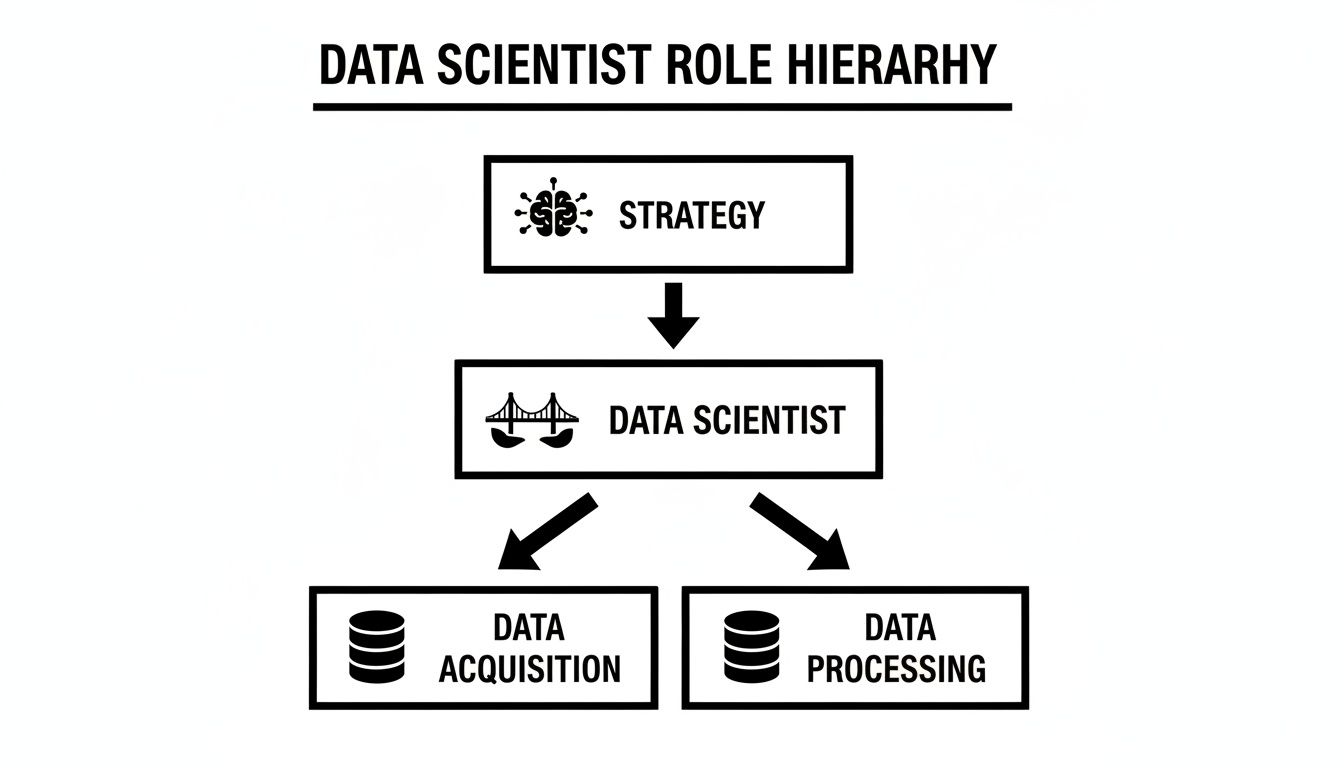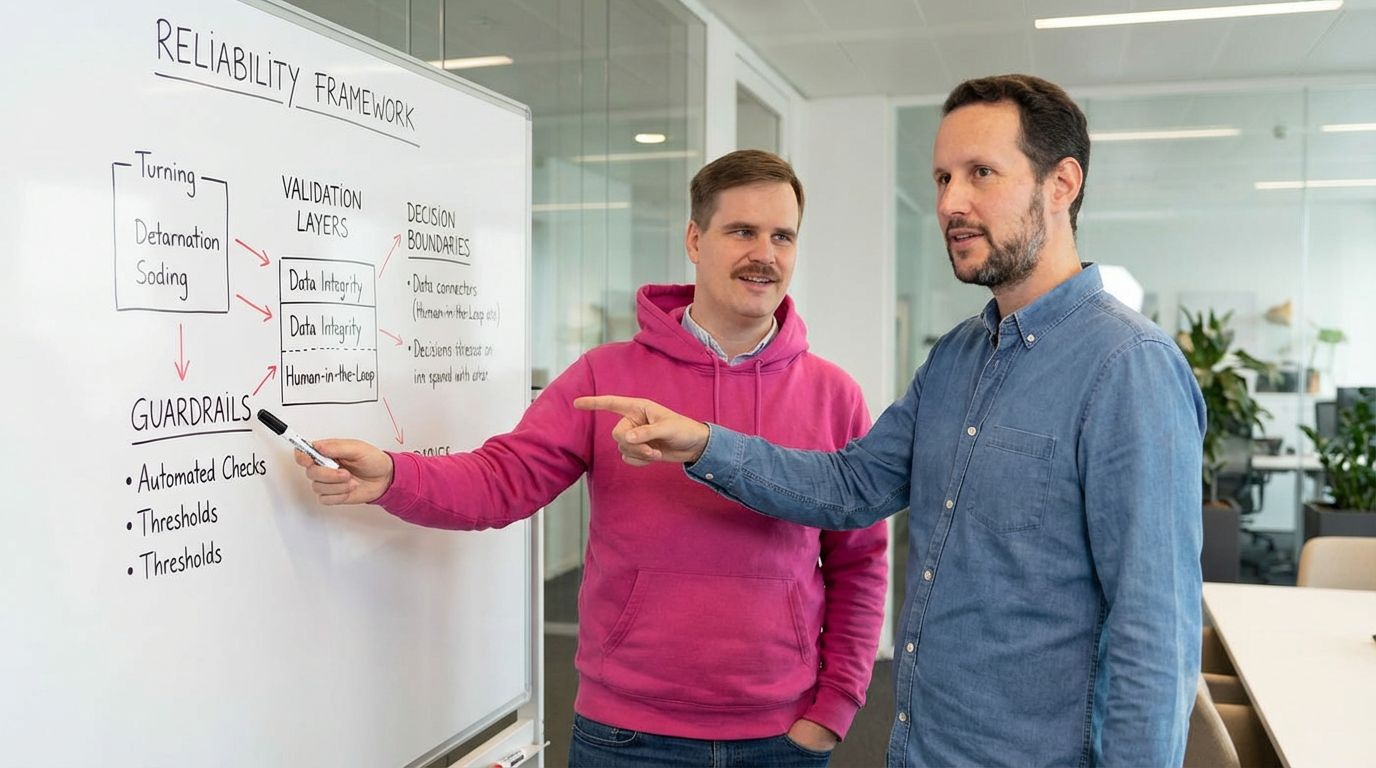
The traditional conception of a business analyst in IT is obsolete. The role has evolved far beyond requirements gathering into a strategic partnership function, responsible for ensuring that significant technology investments—particularly in Artificial Intelligence—deliver quantifiable business value rather than becoming costly technological diversions. In essence, the contemporary business analyst is an architect of innovation, bridging the gap between complex technology and strategic business objectives.
The Modern Business Analyst as an Architect of Value
In the high-stakes environment of corporate technology investment, the demarcation between transformative success and costly failure is frequently established during the planning phase.
Consider the construction of a skyscraper. One does not begin by laying bricks and hoping for a favourable outcome. An architect first develops a detailed blueprint to ensure the foundation is sound, the structure is viable, and the final edifice serves its intended purpose for its occupants.

This is precisely the function a premier business analyst in IT performs for your digital and AI initiatives. They do not merely compile a list of feature requests. They map the business problem (the foundation), define the technological solution (the structure), and ensure it delivers measurable value to users and stakeholders (the purpose).
Bridging Strategy and Execution
This architect's mindset is indispensable for any enterprise seeking to drive innovation internally. The business analyst serves as the critical link between a high-level strategic vision and a market-ready product.
Their primary mandate is to answer the most critical question before significant capital is allocated: "What is the strategic rationale for this initiative, and what specific, measurable outcome are we targeting?"
This is not a matter of conjecture. It is a rigorous, structured process encompassing:
- Opportunity Identification: Sifting through operational noise to identify high-impact areas where technology, particularly AI, can resolve a genuine business challenge or unlock new revenue streams.
- Feasibility Analysis: Moving beyond the question of "can we build it?" to "should we build it?". This involves assessing organisational readiness, financial viability, and strategic alignment with corporate objectives.
- Risk Mitigation: Systematically invalidating non-viable ideas early in the lifecycle. They de-risk projects by testing core assumptions with rapid prototypes before significant budget is committed.
The core function of a modern IT Business Analyst is to provide leadership with the clarity and confidence required to invest in the right technology, for the right reasons, at the right time. They transform ambiguous concepts into a clear, actionable plan for value creation.
An Indispensable Strategic Partner
By integrating business requirements, technological capabilities, and user value, the analyst ensures that every project is built upon a solid strategic foundation. This practice avoids the common pitfall of developing a technically sophisticated solution that yields no discernible impact on the bottom line. To maintain this edge, leading analysts continuously absorb essential business analysis best practices.
Ready to Build Your AI Project?
Let's discuss how we can help you ship your AI project in weeks instead of months.
When the business analyst is viewed as a strategic architect, their role transitions from a support function to a core driver of innovation. They ensure that each digital product is not merely a line item on a budget, but a calculated investment designed to deliver a significant return. To explore this concept further, consult our article on analytics and insights. For any organisation aiming to secure its future through intelligent technology deployment, this perspective is not merely beneficial—it is essential.
Strategic Functions in the Age of AI
In an economic landscape increasingly defined by Artificial Intelligence, the role of a business analyst in IT has fundamentally transformed. The traditional perception of a BA as a simple documenter of requirements is outdated. Today, they are a strategic necessity for any organisation serious about converting technological potential into tangible business value. Their contemporary responsibilities are direct levers for success, translating high-level AI ambitions into profitable commercial outcomes.

This modern analyst operates at the intersection of business vision and technical feasibility. They are tasked with constructing a robust business case for any new AI initiative, ensuring that every project is grounded in a clear return on investment from its inception.
Comparing the Traditional BA with the Modern AI-Era BA
The shift from a tactical support role to a strategic leadership position is significant. The table below delineates this evolution, contrasting the traditional BA—often viewed as a "translator"—with the modern AI-era BA, who functions as an "innovator."
Want to Accelerate Your Innovation?
Our team of experts can help you turn ideas into production-ready solutions.
| Strategic Function | Traditional BA Focus (The Translator) | Modern AI-Era BA Focus (The Innovator) |
|---|---|---|
| Problem Definition | Gathers and documents pre-defined business requirements. | Proactively discovers and defines high-value business problems that AI can solve. |
| Solution Design | Translates business needs into functional specifications for IT. | Co-creates solutions, validating hypotheses with prototypes and real-world data. |
| Risk Management | Focuses on project delivery risks (timeline, budget). | Systematically de-risks innovation by testing commercial and technical viability early. |
| Stakeholder Engagement | Acts as a liaison between business units and the development team. | Orchestrates collaboration across the entire organisation—from C-suite to the factory floor. |
| Value Creation | Ensures the delivered solution meets the initial requirements. | Ensures the solution delivers measurable business impact and a clear ROI. |
As illustrated, the contemporary role is markedly more entrepreneurial. It demands a forward-thinking mindset focused on creating new opportunities, not merely fulfilling existing requests.
Leading High-Value Discovery
One of the most critical functions of a modern business analyst is facilitating use-case discovery workshops. This is not an unstructured brainstorming session. It is a meticulously structured process designed to uncover high-impact problems uniquely suited for an AI solution. The objective is to move beyond superficial ideas and pinpoint opportunities where intelligence or automation can generate a genuine competitive advantage.
In these workshops, the BA facilitates dialogue among all stakeholders—from front-line engineers to executive leadership. They work to build a shared understanding of the core challenge and achieve alignment on the definition of success. This foundational step prevents teams from operating in silos, a primary contributor to the fact that up to 50% of IT projects fail to meet their objectives.
Methodical De-risking and Validation
The most significant financial liability in AI development is not the cost of building the technology, but the cost of building the wrong technology. A substantial component of the business analyst’s role is to systematically de-risk innovation before the organisation commits significant capital.
This is achieved through a disciplined cycle of assumption testing and rapid, low-fidelity prototyping. The analyst focuses on securing answers to critical questions with minimal investment:
Looking for AI Expertise?
Get in touch to explore how AI can transform your business.
- Problem-Solution Fit: Are we addressing a problem that our stakeholders consider a high-priority issue?
- Technical Feasibility: Can this be built with our current data, tools, and talent?
- Commercial Viability: Is there a clear path to monetisation and a sustainable business model?
The analyst’s mandate is to ensure the organisation invests in validated opportunities, not speculative technology. They champion a culture of evidence-based decision-making, converting "we think" into "we know."
The Central Link in the AI Value Chain
Ultimately, the business analyst is the integrating force that connects strategy, engineering, security, and end-users. They are the orchestrators ensuring an AI solution is not only technically impressive but also secure, compliant, profitable, and adopted by its intended users. This holistic perspective is indispensable for translating complex technology into measurable business growth.
As AI becomes central to business operations, a foundational understanding of how these systems are architected is no longer optional. For leaders overseeing these initiatives, grasping the technical underpinnings is crucial. This knowledge empowers executives to ask pertinent questions and ensure their business and technology strategies remain in lockstep.
The Financial Case for Investing in Top-Tier Analysts
Within any large enterprise, executive decisions are subject to intense scrutiny, particularly those impacting the profit and loss statement. Hiring is no exception. A common strategic error is to view the salary of a senior business analyst in IT as a simple cost item.
This is a fundamental miscalculation. It is not a cost; it is a strategic investment. Furthermore, it serves as a powerful insurance policy against the colossal expense of a failed technology project.
Ready to Build Your AI Project?
Let's discuss how we can help you ship your AI project in weeks instead of months.
The true cost is not the remuneration of a top-tier analyst. It is the multi-million-euro fallout from an AI or IT project that was inadequately defined from its inception. When a project fails to align with genuine business needs, expends capital on superfluous features, or solves a non-existent problem, the financial damage vastly outweighs any salary consideration.
A high-calibre business analyst is the primary defence against this risk. They operate at the intersection of high-level strategy and operational execution, ensuring every unit of capital is deployed against a validated business opportunity.
Shifting from Cost Centre to Value Driver
To fully appreciate the financial logic, one must connect the analyst's activities directly to business outcomes. A top-tier analyst prevents the most common and costly mistakes that plague corporate innovation.
Their expertise delivers a clear return on investment in several critical ways:
- Rigorous Business Case Validation: Before any code is written, a skilled analyst stress-tests the business case. They quantify the expected value, define key performance indicators (KPIs), and challenge every assumption to ensure the project has a clear, defensible path to profitability.
- Scope Creep Containment: They introduce discipline to the often-chaotic process of managing requirements and stakeholder demands. This prevents the uncontrolled expansion of features—a classic project-killer that inflates budgets and delays market entry.
- Accelerated Time-to-Value: By maintaining a laser focus on the most critical user needs and business goals, they shorten development cycles. This means the solution begins delivering value sooner, generating revenue or cost savings that directly impact the bottom line.
A senior Business Analyst does not cost the company money; they protect and multiply the company’s investment in technology. Their primary function is to ensure that every euro spent on development is a euro spent wisely.
Want to Accelerate Your Innovation?
Our team of experts can help you turn ideas into production-ready solutions.
Justifying the Premium for Top German Talent
The German market recognises this value. The high premium placed on these skills is reflected in compensation. Business analysts in Germany's IT sector command significant salaries, averaging approximately €55,000 annually for standard roles and rising to €77,008 for senior positions. It is one of the most lucrative markets in the EU for this profession for a reason. You can learn more about salary benchmarks for business analysts in Germany.
This premium is not an extraneous expense; it is the market rate for a professional capable of steering multi-million euro projects away from failure. The alternative—placing a less experienced individual in this pivotal role—represents a far greater financial risk. To understand how this role integrates into the broader data landscape, consult our guide on the role of a business intelligence consultant.
Ultimately, the decision is straightforward. Investing in a top-tier business analyst is an act of fiscal prudence. It is a strategic choice to prioritise clarity, alignment, and methodical de-risking over conjecture and hope. For any C-level executive monitoring the P&L, this investment provides the assurance that technology initiatives are not just being completed—they are being architected from day one to create tangible, measurable value.
The Core Competencies for Driving Digital Transformation
When hiring an IT business analyst, you are not merely filling a position. You are onboarding a critical asset who will navigate your company through complex technological transformations. The focus should be on identifying what we term a 'T-shaped' professional—an individual with deep analytical expertise complemented by a broad, strategic understanding of the entire business ecosystem.
This combination of depth and breadth differentiates a good analyst from a great one. It enables them to transcend note-taking and become a genuine force for discovery, analysis, and persuasion. Their function is to convert raw data into intelligent strategy, and that strategy into concrete action. This is especially true for AI-first initiatives, where the path forward is often ambiguous and the risks are substantial.
The Bedrock and The Vanguard: Foundational and Future-Critical Skills
A top-tier IT Business Analyst operates from a foundation of proven skills while continuously acquiring emerging competencies. This balance is critical—it allows them to manage current operational realities while building the capabilities required for the future.
Foundational Skills (The Bedrock):
- Process Modelling: Mastery of standards like Business Process Model and Notation (BPMN) is non-negotiable. It is the mechanism by which an analyst maps current-state operations, identifies bottlenecks, and designs optimised future-state workflows enabled by technology.
- Requirements Engineering: This remains a cornerstone of the BA skillset. They must be experts at eliciting, analysing, and validating requirements from all business functions. This is the only way to ensure the final product solves a real, verified problem.
- Stakeholder Management: Corporate structures can be complex. A great analyst knows how to navigate this landscape, employing sharp communication and negotiation skills to build consensus among diverse stakeholders. They bridge the gap between technical teams, business leaders, and end-users.
Future-Critical Skills (The Vanguard):
- Data Literacy: This extends beyond interpreting a dashboard. True data literacy involves a deeper engagement with data—understanding data structures, questioning data provenance, and formulating sharp, testable hypotheses. For further perspective on adjacent roles, understanding the Data Analyst role offers valuable insights into skill overlaps.
- Machine Learning & AI Concepts: An analyst does not need to be a data scientist, but they must possess a firm grasp of machine learning fundamentals. They need to understand what AI can realistically achieve—and, critically, its limitations. This is essential for identifying viable opportunities and setting realistic expectations.
- AI Governance and Ethics: As AI becomes more pervasive, the analyst's role expands to include navigating complex issues of bias, transparency, and regulation. They become a key voice in ensuring that developed solutions are not only powerful but also responsible and equitable.
The modern Business Analyst is fluent in two languages simultaneously. They must be as comfortable debating the strategic implications of an AI model with the C-suite as they are mapping a complex workflow with an engineer.
The Analyst's Toolkit: From Discovery to Persuasion
The tools an IT Business Analyst employs are more than just software; they are extensions of their ability to think, analyse, and influence. They are instruments for uncovering insights and building consensus. A candidate's proficiency with these tools is a strong indicator of their ability to advance a project from concept to reality.
Looking for AI Expertise?
Get in touch to explore how AI can transform your business.
Key tool categories include:
- Business Intelligence (BI) Platforms: Tools such as SAP, Tableau, or Power BI serve as the analyst's command centre. By 2025, Germany's Business Intelligence Software market is projected to reach US$1.27 billion in revenue, which is expected to drive a 5.9% increase in business analyst jobs over the next decade. This is not a coincidence. With major players like SAP holding 40% of the enterprise market share in Germany, the analyst's role in leveraging BI for actionable strategy is more critical than ever.
- Collaboration and Project Management Tools: Modern project execution is impossible without platforms like Jira and Confluence. An analyst must be fluent in their use to manage backlogs, maintain agile team alignment, and provide a single source of truth for all stakeholders.
- Modelling and Diagramming Software: Visualisation is a powerful tool for clarity. Applications like Visio or Miro are essential for translating complex processes, systems, and strategies into clear visuals that are immediately comprehensible to non-technical stakeholders.
Ultimately, a manager's objective is to assemble a team possessing this potent blend of skills. This is the mechanism by which an organisation prepares for future challenges and opportunities. To learn more about initiating this process, review our guide on the digitalisation of companies.
Embedding the Business Analyst in High-Velocity AI Teams
In legacy IT project management, the business analyst was often a transient figure. They would appear at the outset to gather requirements, disappear for months during development, and reappear at the project's conclusion to validate the final product against an initial document. This waterfall methodology is completely unviable in the context of AI, where speed, agility, and continuous learning are paramount.
For any AI initiative to succeed, the business analyst in IT must be a fully embedded member of the product team. Not an external consultant, but a true partner, working day-in and day-out alongside product managers, data scientists, and ML engineers. This integrated structure ensures the project remains firmly anchored to business value, from initial ideation through to a scaled production system.
The Analyst's Role Across the AI Project Lifecycle
An AI project is not a linear progression. It is an iterative cycle of discovery, experimentation, and refinement. A skilled business analyst is the constant that weaves the business objectives through every stage of this dynamic process. Without their presence, it is far too easy for the team to become preoccupied with technically interesting problems that lack a clear commercial purpose.
Ready to Build Your AI Project?
Let's discuss how we can help you ship your AI project in weeks instead of months.
To illustrate, consider the development of a predictive maintenance solution for a German manufacturing client. The objective is to use AI to predict machine failures on the factory floor, thereby reducing downtime and associated costs.
Here is how an embedded BA delivers significant value at each stage:
Phase 1: Hypothesis and Data Exploration: The analyst convenes with stakeholders to define the precise business problem. They challenge a vague goal like "predict failures." Instead, they help frame a testable hypothesis: "Can we predict motor burnouts in our CNC machines at least 72 hours in advance with 90% accuracy to reduce unplanned downtime by 15%?" Subsequently, they collaborate with engineers to assess the existence and quality of the necessary sensor data.
Phase 2: Prototype Validation: With a viable dataset, the team builds an initial model. The analyst's role here is critical: they define the metrics for success. They ensure the prototype is validated against the complexities of real-world factory conditions, not just sterile statistical measures. They conduct feedback sessions with maintenance crews to determine if the model's predictions are operationally useful.
Phase 3: Scaling to Production: Once the model demonstrates value, the analyst's focus shifts to business integration. This involves mapping the new workflow for maintenance teams, designing an optimal user interface for alerts, and finalising the ROI calculation to secure budget for a full-scale deployment. They ensure the solution is adopted, not just deployed.
Want to Accelerate Your Innovation?
Our team of experts can help you turn ideas into production-ready solutions.
This iterative flow highlights the core sequence of skills an IT BA brings to the table: modelling the problem, analysing the data and potential solution, and persuading stakeholders with empirical evidence.
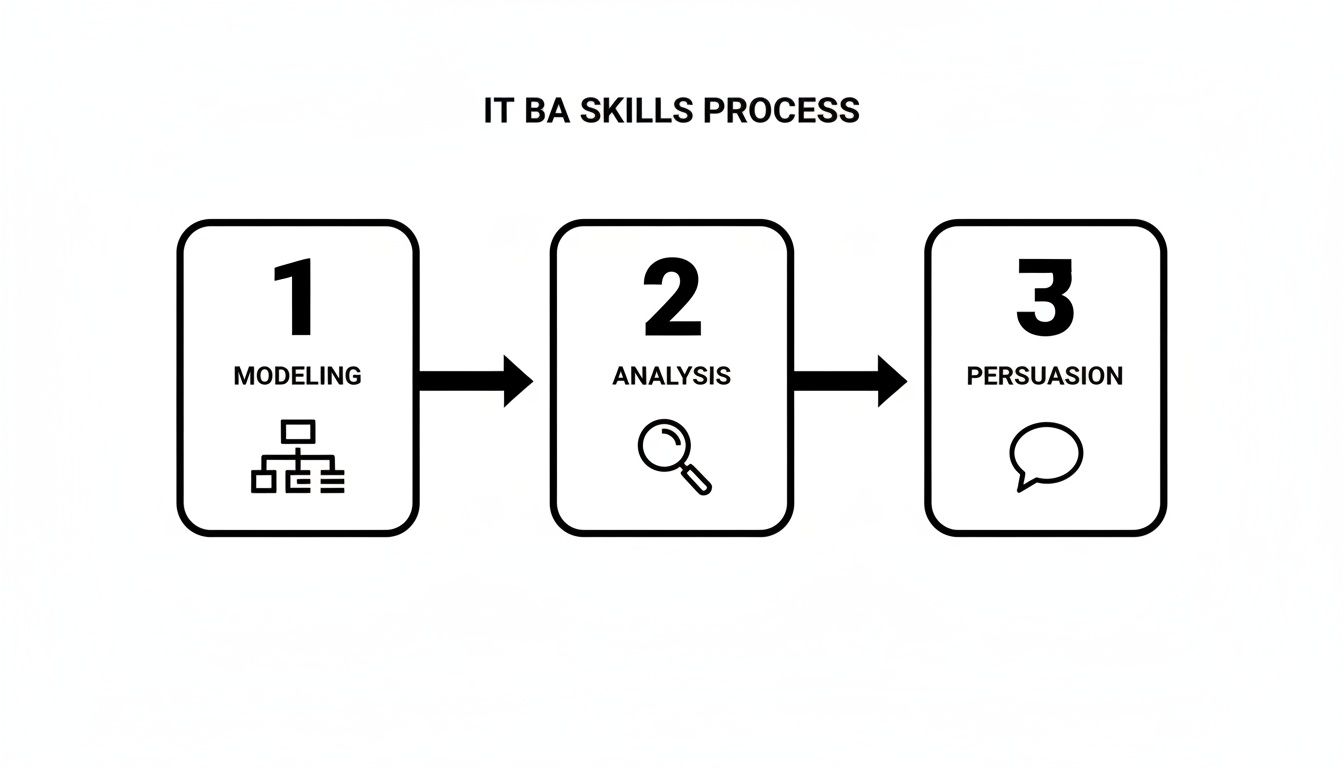
As is evident, the analyst's role is far from purely technical. It is a potent combination of structured thinking, deep analysis, and the communication skills required to drive organisational change.
From Siloed Translator to Integrated Partner
The legacy model positioned the business analyst as a simple translator between business and IT. In a high-velocity AI team, they are a co-creator of value. Their constant presence ensures the team never loses sight of the why behind the what. They become the voice of the business in daily stand-ups and the voice of technology in high-level strategy meetings.
By embedding the business analyst directly within the AI team, you transform the development process from a linear handoff to a dynamic, collaborative partnership. This is the single most effective way to ensure that complex AI solutions deliver tangible, measurable business outcomes.
Looking for AI Expertise?
Get in touch to explore how AI can transform your business.
This integrated model is the foundation of rapid, effective AI delivery. For organisations seeking to implement this approach, Reruption’s proprietary methodology offers a clear framework. You can explore its application in our 21-Day AI Delivery Framework, which is engineered to ship productive AI systems with speed and precision. It is a system designed to keep the BA, and the entire team, focused on delivering value, not just code.
The Analyst as a Catalyst for Corporate Growth
The role of the business analyst in IT has undergone a profound transformation. It is no longer a support function confined to a project team; it is a strategic leadership role, essential for any company seeking not just to survive, but to thrive amidst continuous technological disruption. The analyst functions as an internal catalyst—an agent who ensures that investments in technology, especially AI, are not merely novelties but are genuine drivers of commercial success.
For Germany's economic powerhouses—the Mittelstand and large corporations—mastering AI is no longer optional. The business analyst is the strategic navigator on this journey, directly linking the power of data analytics to a sustainable competitive advantage. Their work is to convert vast quantities of operational data into strategic assets, a capability that is rapidly separating market leaders from the laggards.
Securing Germany's Competitive Edge
The stakes are exceedingly high. Germany's data analytics market is valued at USD 4.80 billion in 2024 and is projected to expand to USD 51.20 billion by 2033. The business analyst is positioned at the epicentre of this transformation. This is not a mere trend; it is a fundamental economic shift that underscores the criticality of the IT business analyst role in bridging the gap between raw data and intelligent decision-making. To examine the underlying data, you can explore the full research on Germany's data analytics market.
This new reality places the analyst in a position of significant influence. They are responsible for ensuring that AI adoption is not a reactive measure but a deliberate strategy to:
Ready to Build Your AI Project?
Let's discuss how we can help you ship your AI project in weeks instead of months.
- Strengthen market position by uncovering new operational efficiencies and revenue models.
- Drive operational excellence through intelligent automation and predictive insights.
- De-risk innovation by rigorously vetting AI use cases before significant capital is committed.
Empowering your business analyst is a direct investment in your company's capacity for internal innovation. They are the architects of a culture where decisions are driven by evidence, not intuition, ensuring every technology initiative is aimed squarely at long-term growth.
A Mandate for Leadership
For any C-level executive, the directive is clear. To secure a prosperous future, the business analyst in IT must be recognised as an indispensable strategic partner. Investing in this role—and granting it genuine authority—is the foundation for building a culture of internal innovation, navigating technological change with confidence, and achieving the sustainable growth required to lead in the years ahead. They are not just analysing the business; they are actively architecting its future.
A Few Common Questions
It is easy to become disoriented by the jargon of modern technology roles. Let's clarify a few common questions that managers and executives often have regarding the integration of a business analyst into their IT organisation.
Business Analyst vs. Project Manager – What's the Difference?
Consider this distinction: The Project Manager is concerned with the 'how' and 'when'. They are masters of logistics, managing timelines, resources, and scope to deliver a project on schedule and within budget. Their function is to execute a plan flawlessly.
The IT Business Analyst, conversely, operates in the realm of 'why' and 'what'. Their role is to challenge the project's premise, define the core business problem, and ensure that the proposed solution will generate meaningful business impact. They are the critical link between a high-level strategic objective and the technical feasibility of its implementation.
We're Starting an AI Project. When Do We Bring in the BA?
From the absolute beginning—when the initiative is merely an idea or a hypothesis. Do not wait until the technology has been selected or the project has been scoped.
Engage them to lead the initial discovery workshops with your stakeholders. Allow them to conduct a thorough problem definition and map the potential for value creation. This foundational step ensures that all subsequent AI development is anchored to a robust business case, preventing costly misdirection later in the project lifecycle.
Can't We Just Outsource the Business Analyst Role?
Outsourcing is a viable option for short-term projects or for acquiring highly specialised skills. However, the most significant, game-changing value is derived from an internal BA who possesses a deep, nuanced understanding of your company—its culture, its internal dynamics, and its long-term strategic vision.
For your most critical initiatives, a hybrid model is often optimal. This approach involves creating an embedded partnership, pairing sharp external expertise with your team's deep institutional knowledge. This is how you develop solutions that are not only technically excellent but also culturally resonant and sustainable within your business.
At Reruption GmbH, we do not just consult; we become Co-Preneurs. We embed our experts into your teams to translate your strategic vision into market-ready AI innovations—rapidly. Find out how we can help you build your future, from the inside out, at https://www.reruption.com.
Want to Accelerate Your Innovation?
Our team of experts can help you turn ideas into production-ready solutions.