
For German corporate leadership, digitalization is far more than an IT upgrade. It is a fundamental strategic repositioning of the entire enterprise—reimagining operational workflows, value creation, and customer engagement from the ground up to remain competitive on the global stage.
The Mandate for Digital Transformation in Germany
In many German boardrooms, “digitalization” is still equated with modernizing IT infrastructure. That view is too narrow. True transformation extends well beyond incremental process improvements; it demands the creation of entirely new, data-driven business models.
Imagine you’re not merely renovating a factory hall. You’re designing a fully intelligent, interconnected production ecosystem from scratch.
For executives at companies with more than 500 employees, that distinction is critical. The strategic imperative is to treat technology not just as a tool, but as a core component of value creation. Achieving this requires a deep shift in culture, processes, and mindset.
From Optimization to Architectural Shift
The first step is a clear shift in focus: move beyond pure efficiency gains toward a strategic reorientation. Process optimization remains important, but the real value lies in unlocking new revenue streams and reinventing the customer experience. The challenge is to keep the core business running while simultaneously investing boldly in digital innovation.
Ready to Build Your AI Project?
Let's discuss how we can help you ship your AI project in weeks instead of months.
Digitalization is an organization’s ability to replace or augment traditional business models with technology-enabled, data-driven alternatives, thereby creating sustainable competitive advantages.
The urgency of this shift is underlined by compelling market data. The digital transformation market in Germany is projected to reach USD 53.90 billion by 2025 and grow to USD 90.41 billion by 2030—an annual growth rate of 10 percent. The manufacturing sector, accounting for 30.20 percent of the market, is a major driver through Industry 4.0 initiatives. Learn more about Germany’s market dynamics with this report from Mordor Intelligence.
The Urgency for German Leadership
It bears repeating: this evolution is urgent. Organizations that hesitate risk not just market share, but their very right to exist. Leaders must act now to prepare their companies for the journey ahead.
A critical first step is to understand the typical digital transformation challenges. Only then can you move beyond empty buzzwords to genuine execution.
Strategic engagement with digitalization is no longer optional—it is imperative for the German Mittelstand and large enterprises alike. In our knowledge hub, you will find additional articles on Digitalisierung to help sharpen your strategy.
Architecting Your Strategic Digitalisation Roadmap
Moving from a high-level digital mandate to a practical, actionable plan is precisely where most initiatives falter. A successful roadmap for the digitalisierung der unternehmen is not a static document—it is a dynamic strategic framework. It translates corporate vision into tangible, value-driven steps that create momentum and maintain stakeholder alignment.
The journey does not begin with technology selection; it starts with a rigorous assessment of your current state. Think of it as a diagnostic for your company’s digital health. Where are the operational bottlenecks? Which legacy systems impede progress? Answering these questions highlights the critical areas for improvement and reveals competitive gaps you must close—quickly.
Establishing Your Digital North Star
Once you have a clear view of your starting point, define the destination. Your digital vision must be more than a vague ambition—it must be a powerful narrative aligned directly with your core business objectives.
For example, “becoming more data-driven” is too generic. A stronger vision would be: “We will leverage predictive analytics to reduce supply chain disruptions by 30 percent within three years.” That is a clear, measurable goal around which you can rally.
This vision becomes your North Star, guiding every decision and every euro you invest. It must be communicated and embraced at all leadership levels, ensuring departments from the shop floor to marketing pull in the same direction. Without this alignment, even the most promising digital initiatives risk fizzling out as siloed, low-impact experiments.
Want to Accelerate Your Innovation?
Our team of experts can help you turn ideas into production-ready solutions.
This flow diagram illustrates the shift from incremental process tweaks to the architecture of a new digital future.
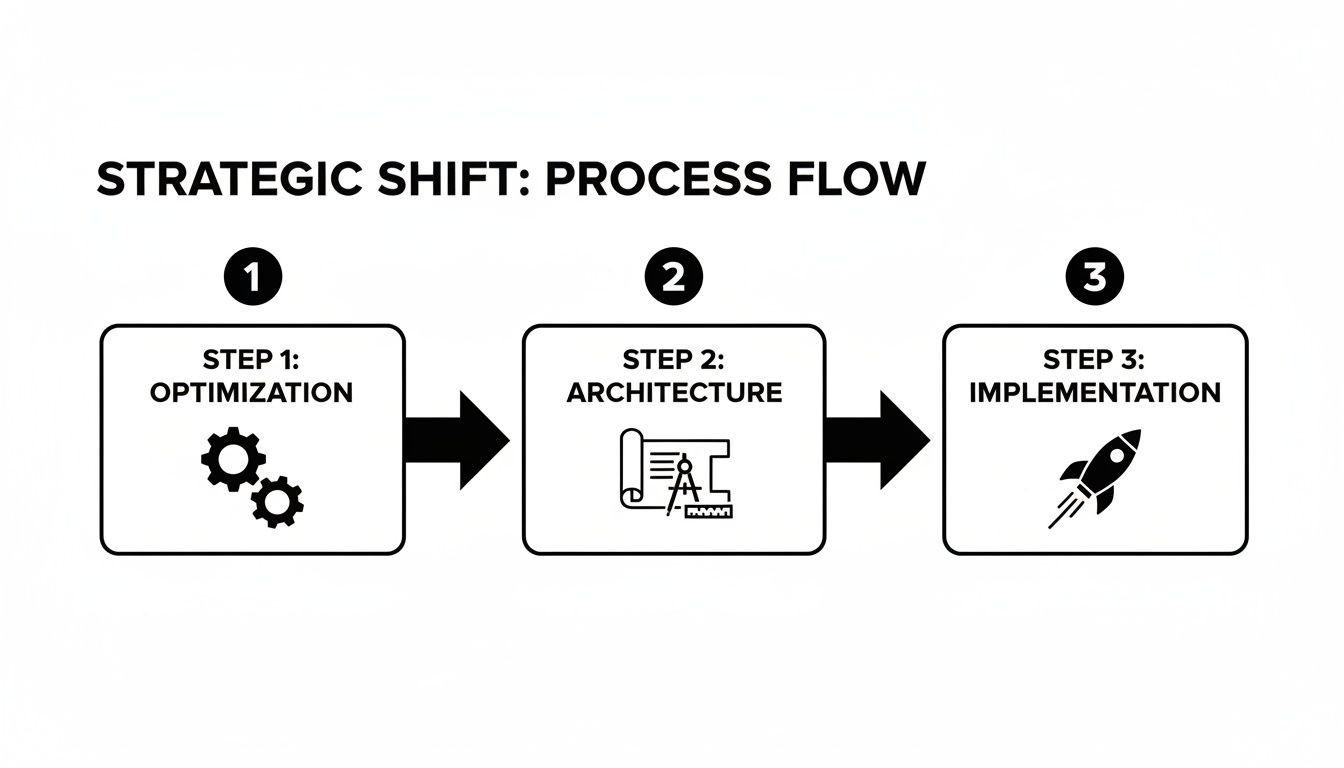
The lesson is clear: genuine transformation means moving beyond minor enhancements and fundamentally rethinking how your organization creates value.
Prioritising Initiatives for Maximum Impact
With a crystal-clear vision in place, map out specific projects. Here’s the catch: not all initiatives deliver equal value. Attempting everything at once dilutes focus and exhausts resources.
Intelligent prioritisation is critical. A straightforward matrix plotting business impact against implementation complexity can help you distinguish high-value quick wins from long-term strategic bets and avoid low-return detours.
Digitalisation Initiative Prioritisation Matrix
| Initiative Quadrant | Description | Example Initiatives | Strategic Action |
|---|---|---|---|
| Quick Wins | High business impact, low complexity. Build momentum and demonstrate early value. | Deploy an AI chatbot for customer service; automate invoice processing. | Execute Immediately. Secure these wins to build confidence and fund larger programs. |
| Major Projects | High business impact, high complexity. Foundation for long-term advantage. | Overhaul ERP; develop a proprietary data platform. | Plan & Resource. These strategic cornerstones require dedicated funding and oversight. |
| Fill-Ins | Low business impact, low complexity. Small optimizations with spare capacity. | Minor software updates; streamline reporting. | Delegate or Schedule. Fit these around major projects but keep focus on high-impact work. |
| Reconsider | Low business impact, high complexity. Significant investment with marginal return. | Build a custom niche tool instead of using a COTS solution. | Avoid. Divert resources to initiatives with stronger strategic alignment. |
This framework is not merely a project selector; it structures a balanced portfolio. Combine short-term victories that prove the concept with ambitious strategic plays that drive lasting advantage. This phased approach reduces risk and ensures continuous value delivery.
Structuring the roadmap demands a firm grasp of both business priorities and technological feasibility. Executives who intend to integrate AI from day one will find that partnering with an AI strategy service delivers structured thinking and deep expertise, ensuring your AI initiatives are aligned with your broader digital vision.
Choosing Your Technology Engine: AI and Core Platforms
Technology selection is not a procurement checklist—it’s the design of an integrated engine that drives your business forward. For any leader overseeing the digitalisierung der unternehmen, each choice must serve a clear strategic purpose, not simply satisfy feature requirements.
Your tech stack is the nervous system of your digital enterprise—dictating data flow, cross-functional collaboration, and agility. Getting this architecture right from the outset is essential.
Cloud: The Foundation for Agility and Scale
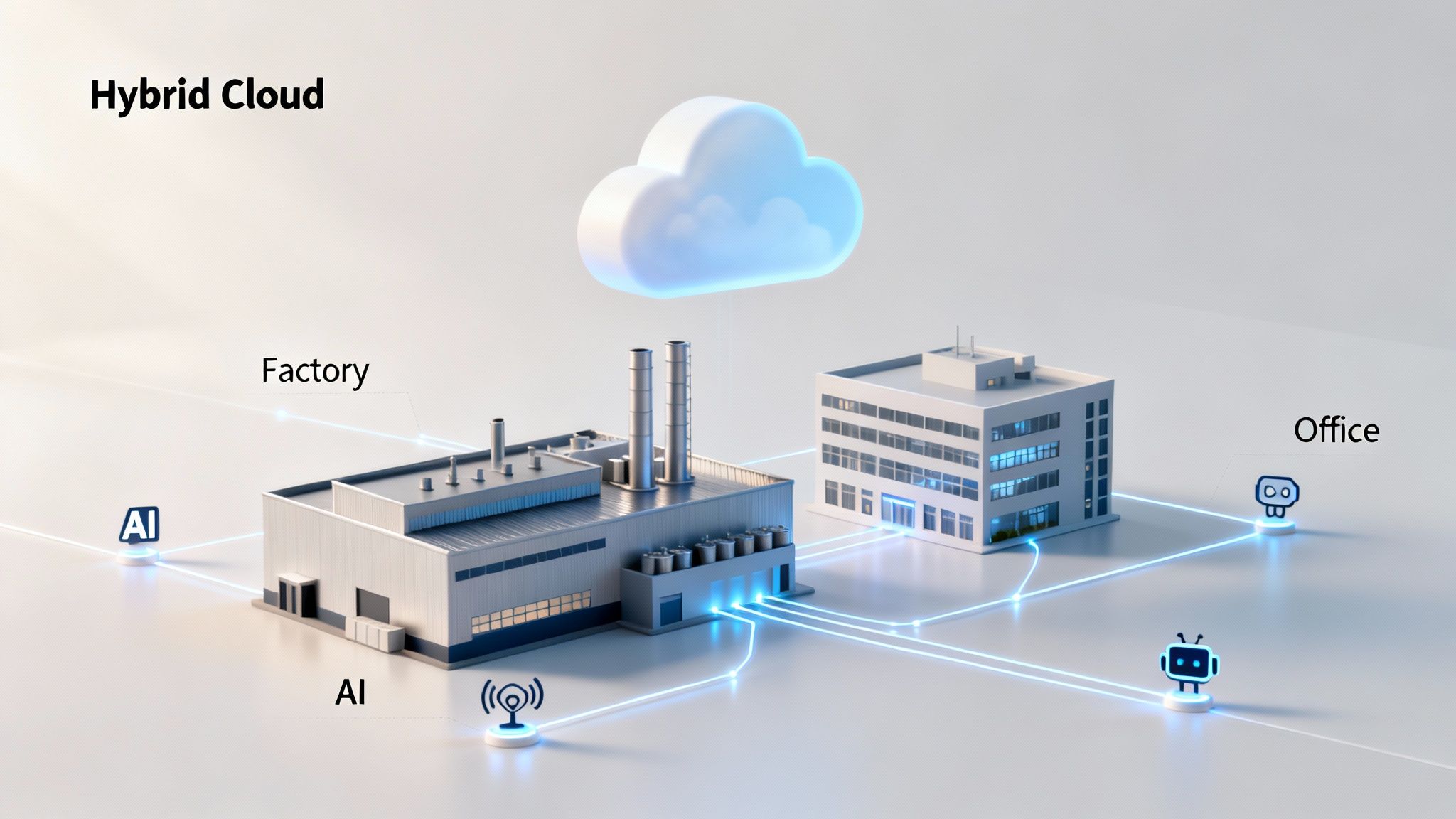
The cloud is no longer optional; it is the default platform. German enterprises face a strategic choice between public and hybrid models, balancing scalability with data sovereignty requirements under EU regulations.
- Public Cloud: Offers elastic scalability and immediate access to advanced services—ideal for customer-facing applications and big data analytics.
- Hybrid Cloud: Combines private infrastructure with public cloud services. You retain control over sensitive data while leveraging the cloud’s flexibility for other workloads. This is a common choice in regulated industries like manufacturing.
Cloud adoption in Germany stands at 90 percent, driving a market projected to reach USD 21.5 billion by 2025. Rapid growth also highlights infrastructure challenges, such as the national focus on improving fiber-optic coverage. For a comprehensive overview, see Germany’s digital progress report.
Artificial Intelligence: Moving Beyond the Hype
AI is the intelligence layer atop your data and cloud foundation. It transforms raw information into actionable insights and automated decisions. For executives, the emphasis should be on the business problems AI can solve, not the underlying algorithms.
AI is not just a technology to implement; it is a business capability to cultivate. Its true value lies in solving problems and unlocking new opportunities—from the factory floor to customer service.
Avoid an all-encompassing “AI strategy.” Instead, identify high-value use cases with clear ROI:
Looking for AI Expertise?
Get in touch to explore how AI can transform your business.
- Predictive Maintenance: Use machine learning on sensor data to forecast equipment failures before they occur, converting unscheduled downtime into planned maintenance.
- Supply Chain Optimisation: Analyze complex datasets—from weather to shipping data—to predict demand and anticipate disruptions, enhancing resilience.
- Hyper-Personalised Customer Journeys: Leverage real-time behavior analytics to deliver tailored marketing, product recommendations, and support at scale.
For a practical, step-by-step guide, see how to implement AI.
Selecting the Right Technology Partners
No organization can build its entire digital engine in isolation. Choosing the right cloud and AI partners is a crucial leadership decision. Evaluate candidates not just on features and cost, but on:
- Integration Capability: Their solutions must seamlessly integrate with your existing ERP, CRM, and other systems—avoiding new data silos.
- Proven Scalability: Verify scalability through case studies from companies of similar size and complexity.
- Security & Compliance: Must meet German and EU data protection standards with appropriate certifications and a track record of robust security.
Your technology partners effectively become an extension of your leadership team. A prudent choice ensures your digital foundation is both powerful today and resilient for tomorrow.
Leading the Human Element of Digital Change
Acquiring technology is the easy part. The real challenge—and the ultimate determinant of success—is guiding your people through the operational and cultural shifts that follow. For any executive spearheading the digitalisierung der unternehmen, remember: technology is the enabler; people are the engine.
This transition demands a deliberate strategy for the human side of change—a core leadership responsibility, not an HR footnote. It hinges on clear communication, purposeful culture-building, and systematic skill development.
Ready to Build Your AI Project?
Let's discuss how we can help you ship your AI project in weeks instead of months.

Communicating the Strategic Why
Resistance rarely stems from the technology itself; it arises from uncertainty and a sense of change being imposed. Your first task is to craft a clear narrative explaining why this transformation is mission-critical.
Connect digital initiatives to real business outcomes—strengthening market leadership, enhancing customer satisfaction, or securing long-term jobs. Communicate this story consistently, transparently, and directly from the C-suite to build trust and alignment.
Cultivating a Digital-Ready Culture
True digital transformation requires a new mindset—one that embraces experimentation over risk aversion. Think of shifting from a rehearsed orchestra to a skilled jazz ensemble: you need structure and discipline, but also autonomy and improvisation.
Aim to build a learning organization where psychological safety allows teams to experiment, fail fast, and share insights to accelerate collective growth.
Want to Accelerate Your Innovation?
Our team of experts can help you turn ideas into production-ready solutions.
Cultural change must be intentional, driven by:
- Visible Leadership Commitment: Leaders must model the behaviors they expect—actively participating in digital initiatives.
- Cross-Functional Teams: Break down silos by forming agile, multidisciplinary teams focused on business challenges.
- Empowerment with Tools and Autonomy: Provide modern digital tools and grant teams the authority to make decisions in their areas of expertise.
Upskilling as a Core Business Strategy
The skills that delivered yesterday’s success will not power tomorrow’s growth. Make upskilling and reskilling a strategic priority, not an HR checkbox. Structured programs for AI in human resources identify gaps and deploy targeted training. Equally important is employee awareness and training in information security to nurture a secure digital culture.
Leading the human element is the hardest and most rewarding aspect of digitalisierung der unternehmen. Centering your people creates a sustainable competitive advantage beyond mere technology adoption.
Governing Transformation and Measuring What Matters
Launching a company-wide digitalisation initiative without governance is like building a state-of-the-art factory with no quality control. You need a mechanism to track real value creation. Without measurement, transformation is just motion, not progress.
Leading organizations establish a central Digital Transformation Office (DTO) or a cross-functional steering committee. Their mandate is to align initiatives with strategy, manage resources, mitigate risks, and ensure the program delivers tangible business results—not isolated tech projects.
Designing a Meaningful KPI Framework
The governance team’s key responsibility is to measure what matters. Avoid “vanity metrics” that look good but offer no insight into business impact. A mature KPI framework provides a balanced, multi-dimensional performance view:
- Operational Metrics: Are core processes more efficient after automation?
- Customer Metrics: Is customer value and satisfaction improving?
- Financial Metrics: Is the investment yielding a return?
This structure shifts the dialogue from technical progress to business outcomes—the language boards understand.
Effective KPIs translate digital efforts into business performance, making the ROI of your strategy undeniable.
Selecting Your Core Transformation KPIs
Be deliberate in categorizing your metrics. Below is a sample dashboard to capture a comprehensive view:
Sample KPI Dashboard for Digital Transformation:
Looking for AI Expertise?
Get in touch to explore how AI can transform your business.
| KPI Category | Key Performance Indicator (KPI) | Business Question Addressed |
|---|---|---|
| Operational | Process Cycle Time Reduction | How much faster are our core processes after automation? |
| Employee Productivity Rate | Is technology helping teams accomplish more? | |
| System Downtime | How has the new infrastructure improved reliability? | |
| Customer | Net Promoter Score (NPS) | Are our digital services boosting customer satisfaction? |
| Customer Lifetime Value (CLV) | Are digital enhancements driving more valuable relationships? | |
| Digital Channel Adoption Rate | Are customers using our new digital platforms? | |
| Financial | Revenue from Digital Products/Services | Are we generating new, digitally-native income streams? |
| Cost Savings from Automation | What is the direct financial benefit of process improvements? | |
| Return on Digital Investment (RODI) | Is the overall financial return justifying our expenditure? |
This dashboard is more than a reporting tool; it is a strategic compass guiding resource allocation and stakeholder communication.
As digital ecosystems evolve, robust security becomes paramount. Learn more about this crucial aspect in our guide on strategic cybersecurity consulting for German companies.
Tuning Your Strategy to Germany’s Digital Pulse
Your internal roadmap for digitalisierung der unternehmen cannot be developed in isolation. It must align with Germany’s national ambitions and regulatory environment—factors that can either accelerate or impede your progress.
The German government is actively laying the groundwork for the country’s digital future. Aligning with these initiatives is like leveraging a current rather than fighting it. It can provide a significant competitive advantage.
Riding the Wave of National Infrastructure Investment
A major element of Germany’s digital strategy is expanding core infrastructure. The federal government’s Special Fund for Infrastructure and Climate Neutrality (SVIK) has earmarked over €4 billion for digital projects in 2025: €2.93 billion for broadband expansion and €366.8 million for mobile network upgrades. Deutsche Telekom targets 99 percent 5G coverage by then. You can discover more insights about Germany's accelerated digital expansion and its implications for your business.
Plugging into Collaborative Data Ecosystems
Infrastructure is only part of the picture. Germany is also fostering collaborative data ecosystems to unlock new industry capabilities. These initiatives break down data silos, creating secure, shared data spaces that redefine value chains. The prime example is Catena-X, the automotive data network.
Catena-X transcends a typical platform; it establishes a standardized, secure data exchange across the entire automotive value chain—from raw material sourcing to recycling.
Participation in such initiatives is not optional for major manufacturers—it is a strategic necessity. It enhances supply chain transparency, operational resilience, and opens doors to data-driven services and circular business models.
Engaging with national initiatives ensures your strategy works harder and smarter, turning potential regulatory challenges into competitive advantages.
Tough Questions from the Boardroom
Here are the critical questions leaders always ask—and direct answers to guide your decisions on digitalisierung der unternehmen.
We’re Ready to Go. What’s the Very First Step?
Pause the technology demos. Your first step is strategic alignment, not product evaluation.
Convene your executive team in a focused workshop to define what “digitalization” means for your organization, customers, and market position. Identify the top three business problems or opportunities before discussing vendors. This ensures the initiative is business-led, not IT-driven, and secures unified direction from day one.
How on Earth Do We Fund This Thing?
Avoid requesting a single, large budget allocation. That approach often triggers a hard “no.”
Treat digitalization as a portfolio investment, allocating funds incrementally and demonstrating value continuously:
- Secure Seed Funding: Obtain foundational funding for critical enablers like data infrastructure and cybersecurity.
- Mandate Business Cases: Every subsequent project requires a robust ROI case to qualify for funding.
- Pilot First, Scale Fast: Prioritize small-scale pilots that deliver quick wins, using those successes to unlock further investment.
This staged approach builds confidence and directs resources to initiatives that deliver real impact.
Can We Do AI Without Hiring an Army of Data Scientists?
Absolutely. The misconception that you need a large in-house data science team from the outset can stall progress.
Begin by exploiting AI capabilities in platforms you already use—your CRM, ERP, and marketing systems often embed machine learning features. These offer immediate value in areas like sales forecasting and task automation, with minimal technical overhead.
The most effective AI entry is through existing tools and targeted external expertise for high-impact pilots. This approach builds internal proficiency and validates AI’s business value before expanding your team.
Simultaneously, partner with an external specialist to develop a pilot for one high-priority use case. This dual strategy delivers quick benefits, enables hands-on learning, and establishes a persuasive proof point for broader AI investment.
At Reruption GmbH, we are more than consultants; we are your co-entrepreneurs in the age of AI. We partner alongside you to transform bold ideas into market-ready products. We go beyond slide decks by assuming P&L accountability, de-risking your AI initiatives and delivering results in days, not months. If you’re ready to build an AI strategy that truly drives the bottom line, let's build the future together at Reruption.
Ready to Build Your AI Project?
Let's discuss how we can help you ship your AI project in weeks instead of months.