In the contemporary corporate landscape, the data scientist job is not merely a technical function—it is a strategic investment in an enterprise's future. This role serves as the cornerstone of any substantive AI initiative, tasked with transforming vast, unstructured datasets into measurable financial outcomes and a distinct competitive advantage. These professionals are the architects who bridge the gap between raw information and profitable, data-driven strategic decisions.
Why the Data Scientist Is Your Most Critical AI Hire
For corporate leaders in Germany, navigating the implementation of artificial intelligence presents a formidable challenge. The primary obstacle is rarely a deficit of data; rather, it is the scarcity of specialised talent capable of converting that data into a strategic asset. A common misstep is to relegate this role to a function within the IT department. In contrast, a high-impact data scientist operates as a strategic partner to the business.
An effective framework for viewing a data scientist is as an in-house entrepreneur who de-risks innovation. They apply rigorous scientific methodologies to test business hypotheses, validate new product concepts, and forecast market trends with a level of precision previously unattainable. Their work furnishes the empirical evidence required to execute bold decisions with confidence, thereby transforming AI investments from speculative ventures into calculated manoeuvres for market leadership.
The Strategic Value Beyond Technical Proficiency
The true value proposition of a data scientist extends far beyond coding or algorithm development. Their primary mandate is to connect data-derived insights directly to the company's Key Performance Indicators (KPIs) and executive objectives. This requires a unique synthesis of deep technical expertise and acute business acumen.
A proficient data scientist enables an organisation to:
Ready to Build Your AI Project?
Let's discuss how we can help you ship your AI project in weeks instead of months.
- Identify Untapped Revenue Streams by analysing customer behaviour and market data to uncover new product or service opportunities.
- Enhance Operational Efficiency by developing predictive models that optimise supply chains, reduce waste, or anticipate maintenance requirements, all of which directly impact the bottom line.
- Refine Strategic Decision-Making by providing leadership with clear, data-supported narratives that substitute conjecture with evidence-based insights.
The crucial distinction is this: a data scientist does not merely present data; they architect systems that learn from it. This capability is the engine of sustainable competitive advantage, enabling an enterprise to adapt and innovate at a pace that outmatches competitors.
Building an Internal Engine for Innovation
Ultimately, hiring a data scientist represents the foundational step toward building a robust internal innovation capability. This individual is instrumental in cultivating a data-first culture where decisions are underpinned by analytical rigour. They are not simply analysts; they are the strategic architects who ensure AI initiatives deliver a tangible return on investment.
While their responsibilities may intersect with other innovation-focused roles, further insights into structuring these teams can be found in our guide on the modern innovation manager job. By integrating this talent, an organisation is not merely filling a position; it is appointing the architect of its data-driven future.
Understanding the Data Scientist Career Path
To effectively integrate AI, leadership must recognise that "data scientist" is not a monolithic role. The distinction is analogous to that between a junior architect and a managing partner at a design firm—the strategic value delivered evolves significantly with experience. One of the most common and costly errors is the misalignment of seniority with business requirements, leading to stalled projects or, more critically, unfulfilled strategic potential.
A structured view of this career path facilitates precise hiring. It enables the organisation to construct a balanced team capable of addressing both immediate execution and long-term innovation, ensuring AI investments yield their intended returns. The progression is best understood across three distinct stages of impact.
Want to Accelerate Your Innovation?
Our team of experts can help you turn ideas into production-ready solutions.
This diagram illustrates the centrality of the data scientist, who functions as the critical link between high-level business strategy and the raw data that fuels it.
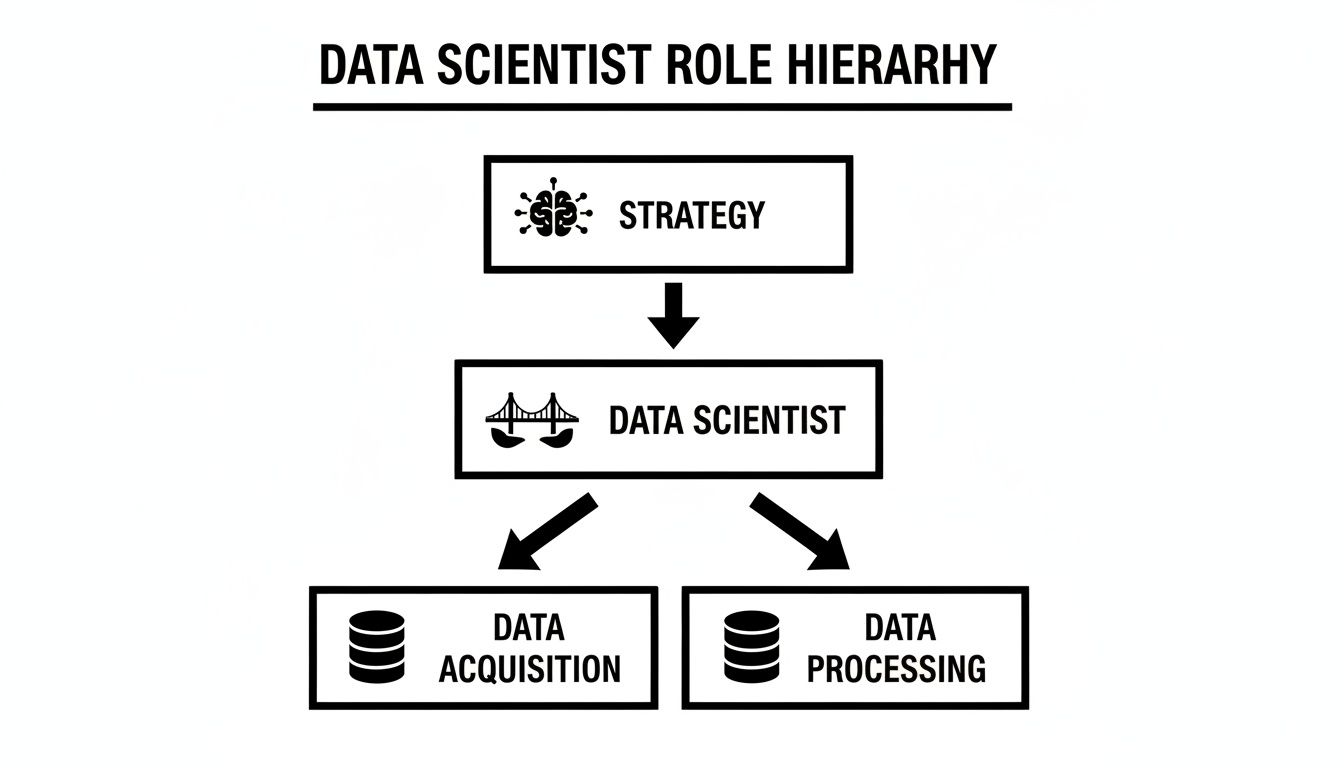
This highlights that the role is not purely technical. It is fundamentally about translating executive objectives into data-driven initiatives that produce tangible business results.
The Junior Data Scientist: The Executor
A Junior Data Scientist is, first and foremost, an executor. Their responsibilities centre on the tactical, hands-on application of data science techniques to solve well-defined problems. Their daily activities involve data cleansing, conducting statistical analyses, and building initial models under the guidance of more senior team members.
Their contribution is measured by technical output and efficiency. They can be viewed as skilled artisans refining raw materials—essential for project momentum but requiring clear direction to ensure alignment with broader strategic goals.
The Senior Data Scientist: The Project Owner
At the senior level, the role evolves from pure execution to ownership. A Senior Data Scientist manages complex projects from conception through to deployment. They are responsible for framing ambiguous business questions as tractable data problems, selecting appropriate methodologies, and mentoring junior colleagues.
Their strategic value stems from their ability to lead projects that deliver measurable business impact, such as optimising a supply chain or developing a customer churn prediction model. This necessitates a robust combination of deep technical skill and strong project management capabilities. While similarities exist with other analytical roles, understanding the key differences between a data scientist and a business analyst in IT is beneficial.
The Lead Data Scientist: The Strategic Visionary
At the lead or principal level, the data scientist transitions into a strategic visionary and a key partner to the executive team. A Lead Data Scientist's focus shifts from individual projects to shaping the organisation’s overarching data strategy. They identify novel opportunities for AI, align data initiatives with C-level objectives, and champion a data-first culture across the enterprise.
A Lead Data Scientist's primary function is to answer the question, "How can data and AI create a durable competitive advantage for our business?" They are the architects of your data-driven future, ensuring analytical capabilities are developed not just for today's challenges but for tomorrow's opportunities.
This individual influences technology roadmaps, promotes best practices in AI ethics and governance, and ensures the data science function operates as a centre of innovation rather than a mere support service. For any organisation committed to leveraging AI for sustained growth, hiring at this level is a critical strategic decision. With modern flexible work arrangements, for those seeking remote talent, a comprehensive guide to landing data science jobs from home can provide valuable insights.
Data Scientist Role Progression from Junior to Lead
This table provides a concise, at-a-glance comparison of how the responsibilities and focus of a data scientist evolve throughout their career, illustrating the shift from tactical execution to strategic leadership.
| Attribute | Junior Data Scientist | Senior Data Scientist | Lead Data Scientist |
|---|---|---|---|
| Primary Focus | Task execution, model building, data cleaning. | Project ownership, end-to-end model deployment. | Data strategy, team leadership, business alignment. |
| Scope of Work | Well-defined tasks within a single project. | Manages complex projects from inception to completion. | Oversees multiple projects, defines the data roadmap. |
| Key Responsibility | Writing code, running analyses, reporting results. | Translating business problems into data solutions, mentoring juniors. | Driving data innovation, influencing C-level decisions. |
| Level of Autonomy | Works under direct supervision and guidance. | Works independently, makes key project decisions. | Sets direction for the entire data science function. |
| Business Impact | Contributes to project milestones and deliverables. | Delivers measurable business value through project outcomes. | Shapes long-term competitive advantage and growth. |
Understanding these distinctions is paramount. It ensures the right talent is hired for the right purpose, creating a team where each member’s skills are precisely matched to the organisation’s strategic needs at every level.
The Three Pillars of a High-Impact Data Scientist
When seeking to fill a data scientist job, it is easy to become overwhelmed by résumés replete with technical jargon. However, a truly effective data scientist is defined by more than a list of certifications. Their impact is built upon three foundational pillars. For any leader aiming to build an AI-ready team, understanding these pillars is the key to differentiating a technician from a true strategic partner.
It is this synthesis of skills that enables an individual not only to construct sophisticated models but also to connect that work directly to tangible business results. This is the quality that separates competent practitioners from exceptional ones.

Here is a breakdown of the essential competencies to seek.
The Essential Skillset for Corporate Data Scientists
A high-performing data scientist requires a balanced blend of technical proficiency, business acumen, and communication skills to drive significant value. The table below outlines these core competencies and clarifies why each is critical for your organisation's success.
| Skill Category | Core Competencies | Why It Matters for Your Business |
|---|---|---|
| Technical Proficiency | Programming (Python/R), Statistics, Machine Learning, Data Munging, SQL, Cloud Platforms (AWS, Azure, GCP) | This is the engine. Without these skills, data remains inert. It is the ability to build, test, and deploy reliable models that solve concrete business problems. |
| Business Acumen | Industry Knowledge, KPI Understanding, Operational Awareness, Product Sense, Financial Literacy | This translates technical work into business impact. It ensures that models address the right problems and that solutions are both practical and profitable. |
| Strategic Communication | Storytelling with Data, Visualisation (e.g., Tableau), Stakeholder Management, Presenting to Non-Technical Audiences | This is the steering wheel. If insights cannot be understood or acted upon by leadership, even the most advanced model is ineffective. It drives adoption and organisational change. |
Let us examine each of these pillars in greater detail.
Pillar 1: Technical Proficiency
Technical proficiency is the non-negotiable foundation. It encompasses the ability to manipulate complex data, apply statistical methods, and build predictive models using languages such as Python or R.
From a management perspective, the critical element is not merely possessing knowledge of these tools, but applying them with purpose. A superior data scientist does not just build a model; they understand precisely which model is the appropriate tool for a given business problem. Their focus is on solutions that are robust and scalable, not just academically interesting.
Pillar 2: Business Acumen
This is the pillar that distinguishes a data analyst from a strategic problem-solver. Business acumen is the comprehension of the broader context—your company's objectives, its challenges, and its market position. A data scientist with this skill can translate a high-level goal, such as "reduce customer churn," into a specific, measurable data science project.
They begin by asking the right questions, long before writing a single line of code:
- How is success defined and measured? What are the relevant KPIs?
- What are the operational constraints? How will this solution integrate into existing workflows?
- Who are the stakeholders for these insights, and what information do they require to make a decision?
Without this commercial context, even the most sophisticated algorithm remains a theoretical exercise. Seek candidates who demonstrate genuine curiosity about your industry and competitors. This curiosity is a strong indicator of their potential to deliver results that matter. This is central to generating true business value, a topic further explored in our guide on analytics and insights.
An effective data scientist functions as an internal consultant. They do not wait for perfectly defined tasks; they proactively collaborate with business units to identify and frame high-impact opportunities where data can provide a decisive advantage.
Pillar 3: Strategic Communication
The final pillar may be the most critical. A brilliant insight is worthless if it cannot be understood. Strategic communication is the ability to translate complex findings into a clear, compelling narrative for a non-technical audience.
Looking for AI Expertise?
Get in touch to explore how AI can transform your business.
It involves presenting results not as a collection of statistics, but as a story with a clear "so what?" for the business. This means creating simple, intuitive visualisations and confidently explaining to an executive why the findings are significant and what actions should be taken.
A data scientist who masters this skill can influence strategy, secure buy-in for new initiatives, and ensure their work translates into concrete action. This is the competency that bridges the gap between data and decision-making, and it is the ultimate measure of their value in a corporate environment.
Navigating the German Data Scientist Job Market
To successfully attract premier data science talent, a grounded understanding of the current market is essential. For leaders in Germany, this involves comprehending the signals that define competition, compensation, and talent availability. This is not a static landscape; it is continually reshaped by economic trends, technological advancements, and evolving corporate priorities.
Recent market data reveals significant fluctuations. The demand for data scientists in Germany reflects broader trends within the AI industry. As of October 2025, there were only 153 active data scientist roles advertised—a sharp decline of 460 positions from the preceding three months, representing a 75% contraction in open roles. Such a reduction typically indicates a saturated market and heightened competition for available positions.
However, this is not the complete picture. A deeper analysis reveals 493 data scientist jobs still listed across major job boards. This suggests that despite the recent cooling, robust demand persists. Established companies continue to hire, particularly for senior talent. It appears that while entry-level opportunities may be constricting, experienced professionals remain highly sought after. These opportunities are distributed across 67 different locations in Germany. A more detailed view is available in this in-depth analysis of the data scientist job market.
Decoding Compensation Strategy
To secure a senior professional capable of leading high-stakes AI projects, a competitive salary is non-negotiable. In Germany, compensation is primarily influenced by three factors: track record, specialisation, and location.
- Experience Level: While a junior data scientist may start with a respectable salary, the compensation scale steepens rapidly. Senior and lead data scientists—those with a proven portfolio of projects that delivered tangible business value—command salaries that are multiples higher.
- Specialisation: Generalists are valuable, but premium compensation is reserved for specialists in areas like Natural Language Processing (NLP), Computer Vision, or the increasingly critical field of AI ethics. For specific, complex problems, an expert in a niche domain is an invaluable asset.
- Geographical Hubs: Major tech centres such as Berlin, Munich, and Frankfurt naturally offer higher compensation, driven by cost of living and intense competition for talent. However, the rise of remote and hybrid work models is beginning to moderate these geographical disparities.
To attract top-tier talent, your compensation offer must communicate a clear understanding of the role's strategic value. A suboptimal offer is not merely uncompetitive; a senior candidate will interpret it as a signal that the organisation does not fully appreciate the potential of data science.
What This Means for Hiring Managers
Correctly interpreting these market signals is what distinguishes employers of choice. It is imperative to move beyond generic salary bands and construct an offer that is not only competitive but also directly reflects the unique value a candidate brings to the organisation.
Consider this: a candidate with extensive experience in the automotive sector, skilled in applying machine learning to resolve supply chain complexities, is a game-changer for a manufacturer in Baden-Württemberg. Their compensation should reflect this unique, high-impact capability.
By mastering these dynamics, hiring managers can avoid common pitfalls, such as underestimating the competition for senior talent or failing to differentiate their offer. A well-researched, strategic compensation plan is one of the most powerful tools for attracting the individuals who will architect your company's future with AI.
How to Write a Job Description That Attracts Top Talent
Your job description is the initial point of contact with a potential hire. It functions as your introduction, your value proposition, and your first marketing communication. For a role as competitive as a data scientist, a generic list of technical requirements is insufficient. To attract a true professional, the role must be framed as an opportunity—a chance to make a measurable impact on the business.
Consider their perspective. The best data scientists are not merely seeking employment; they are driven by the challenge of solving complex, high-stakes problems. They need to know their work matters. Therefore, the most effective job descriptions lead with the "why." Articulate the core business challenge you need them to solve, right from the outset.

Core Components of a High-Impact Job Description
A compelling job description tells a story. It is not a checklist but a narrative that appeals to the ambition of a senior professional. To craft a message that stands out, focus on these key components.
Powerful Role Summary: Begin with a concise paragraph that links the role directly to a major business objective. Instead of "seeking a data scientist," try, "We are seeking a strategic data scientist to spearhead the development of our predictive maintenance models, with the objective of directly reducing operational downtime in our manufacturing division."
Ready to Build Your AI Project?
Let's discuss how we can help you ship your AI project in weeks instead of months.
Focus on Impact, Not Just Tasks: Describe the expected outcomes, not just the daily activities. Instead of "build machine learning models," frame it as a mission: "Develop and deploy machine learning solutions to optimise our supply chain, targeting a 15% reduction in logistics costs."
Clearly Define Success: What constitutes success in the first six to twelve months? Outline specific, measurable goals. This demonstrates that you have a clear vision for the role and value tangible results.
An effective job description is a clear statement of intent. It communicates not only what the candidate will do, but why their work is important. For a senior data scientist, this alignment with purpose is often more compelling than any list of technical perks.
A Practical Template for German Enterprises
Precision is key to attracting qualified applicants. Vague, buzzword-laden descriptions tend to attract unqualified candidates, a common consequence of poor job description quality that can derail the hiring process.
Here is a structured template designed to attract serious candidates by focusing on what matters:
Want to Accelerate Your Innovation?
Our team of experts can help you turn ideas into production-ready solutions.
- Job Title: Be specific. For example, "Senior Data Scientist, Supply Chain Optimisation," not merely "Data Scientist."
- The Mission: One paragraph summarising how this role advances a strategic corporate objective.
- Key Responsibilities & Impact Metrics: Use a bulleted list for 3-5 core responsibilities, each tied to a clear business outcome.
- Core Qualifications: The non-negotiable requirements. List essential technical skills (e.g., Python, SQL, TensorFlow) and any critical domain experience.
- Preferred Qualifications: The "nice-to-have" attributes that would distinguish a candidate, such as experience with specific cloud platforms or industry verticals.
- What We Offer: Briefly highlight opportunities for strategic influence, project ownership, and meaningful professional growth.
By structuring your job description in this manner, you shift the dialogue from a list of demands to a compelling proposition of mutual value. This approach ensures you attract individuals seeking not just another job, but their next significant impact.
Of course, once you have their attention, effective evaluation is crucial. For guidance, refer to these Top Data Scientist Interview Questions to help refine your assessment process.
Integrating Data Science into Your Business Strategy
Securing a top-tier data scientist is a significant achievement, but it is only the first step. The true realisation of value occurs when their expertise is deliberately integrated into the organisational fabric. It is not enough to have them on the payroll; an environment must be created where their insights actively drive measurable business outcomes, rather than remaining confined to reports.
This requires moving data science out of its technical silo and making it an integral part of product development cycles and operational workflows. The most successful enterprises treat their data scientists as strategic partners, including them in discussions with product managers, engineers, and department heads from the outset.
Choosing the Right Organisational Model
There is no universal structure for a data science team. The optimal model depends on your company's size, culture, and strategic objectives. Each approach has distinct advantages and disadvantages, and understanding them is crucial for designing a structure that facilitates, rather than hinders, your AI ambitions.
Looking for AI Expertise?
Get in touch to explore how AI can transform your business.
Most companies adopt one of three primary models:
- Centralised Centre of Excellence (CoE): This model consolidates all data science talent into a single unit that serves the entire organisation. It is highly effective for establishing standards, developing deep expertise, and tackling large-scale, cross-departmental projects.
- Decentralised or Embedded Model: In this structure, data scientists are placed directly within business units or product teams. This fosters deep domain knowledge and ensures their work is tightly aligned with immediate business needs, promoting agility and speed.
- Hybrid or Federated Model: This approach combines elements of both. A central CoE sets standards, provides governance, and focuses on broad strategy, while embedded data scientists execute daily initiatives within their respective teams.
Regardless of the model chosen, the most critical factor is a clear mandate supported by executive leadership. The team's purpose must be well-defined and its initiatives tied to tangible business KPIs. Without this alignment, the value of their work is diminished.
Fostering a Culture of Data-Driven Innovation
Beyond organisational charts, the right culture and processes must be in place. This includes robust project governance to ensure efforts are focused on high-impact initiatives and a managed data science lifecycle from ideation to deployment. It also involves cultivating a culture where experimentation is encouraged and data-backed hypotheses are valued over intuition. This cultural shift is further explored in our guide to the digitalisation of companies.
Salaries for data scientists in Germany reflect this strategic importance. The average annual salary is approximately €73,497, but this is merely a baseline. For senior roles with specialised skills, compensation can range from €160,000 to €210,000. This premium is not just for technical proficiency; it is for the ability to drive innovation and create a sustainable competitive advantage.
Ultimately, successful integration is about creating a partnership. When data experts understand the business strategy and business leaders understand the capabilities of data, the conditions for truly transformative results are met.
Questions We Often Hear from Business Leaders
Onboarding a data scientist is a significant strategic move, and it is natural for leadership to have questions. This is an investment in a new organisational capability. Here are concise answers to the questions most frequently raised by corporate leaders.
How Fast Will I See a Return on Investment?
Hiring a data scientist is a strategic investment, not an immediate fix. Progress occurs in phases. The initial three to six months are typically dedicated to orientation, as the new hire familiarises themselves with the business, identifies and cleans relevant data sources, and pinpoints high-potential opportunities.
The first tangible results—such as an optimised process or a small-scale predictive model—are likely to emerge within six to twelve months. The substantial, transformative ROI materialises later, as their work scales and begins to inform major strategic decisions, thereby building a lasting competitive advantage.
What’s the Single Biggest Mistake Companies Make When Hiring?
The most common error is prioritising technical skills to the exclusion of business acumen. An individual may be capable of building highly complex algorithms, but if they cannot articulate the business implications of their work, they will not deliver meaningful value.
A data scientist’s primary role is not to build models; it is to generate profitable business outcomes. You are seeking a strategic partner who understands your challenges and can demonstrate how data can be leveraged to solve them.
Ready to Build Your AI Project?
Let's discuss how we can help you ship your AI project in weeks instead of months.
Pay close attention to the questions a candidate asks during the interview process. A strong focus on your business problems over your technology stack is a positive indicator.
Do I Really Need to Hire a PhD for a Senior Role?
This is a common misconception. While a PhD demonstrates rigorous research capabilities, it is not a prerequisite for a senior data scientist job in a corporate setting. Far more valuable is a proven track record of solving complex, real-world problems and successfully deploying projects into production.
Focus on their portfolio. Can they provide evidence of projects that delivered measurable results? Proven commercial experience will almost always outweigh purely academic credentials when the objective is to drive profit and innovation.
What Kind of Support Do They Need to Actually Get Things Done?
A data scientist cannot operate in isolation. Enabling their success is as crucial as making the right hire. They require several key resources:
- High-Quality, Accessible Data: This is the foundational requirement. They need ready access to well-maintained datasets relevant to the problems they are tasked with solving.
- Collaboration with Business Units: They must be integrated with other departments. Direct communication with experts in marketing, operations, or finance is essential for understanding the business context.
- The Right Tools: They require sufficient computational resources, whether through cloud platforms like AWS or Azure or powerful on-premise infrastructure.
- Executive Sponsorship: Clear support from leadership ensures that their projects are prioritised and their insights are translated into action.
At Reruption GmbH, we act as your co-preneurs in the AI era, helping you build and integrate high-performing data science capabilities that deliver measurable results. We take P&L responsibility for outcomes, ensuring your AI initiatives move from concept to profitable innovation. Discover how we can de-risk your AI strategy by visiting us at https://www.reruption.com.
Want to Accelerate Your Innovation?
Our team of experts can help you turn ideas into production-ready solutions.