
For German enterprises, the contemporary market is inundated with data. The pivotal challenge for leadership, however, is not the accumulation of more data, but the strategic conversion of existing data into a tangible corporate asset. Mastering analytics and insights is the definitive factor that separates market leaders from their competitors.
From Data Overload to Strategic Action

Many organisations find themselves data-rich yet insight-poor. They possess vast reserves of operational and market data but struggle to forge this raw material into the high-grade intelligence required for confident, forward-looking decisions. The objective must be to transition from rudimentary data aggregation to strategic value creation.
This transition necessitates a fundamental shift in perspective. Consider the master watchmaker. They do not perceive a mere collection of components—the raw data—but rather the precise, intricate interplay between each gear and spring. Their expertise lies in understanding how these individual elements function in unison to create a perfectly synchronised mechanism. This holistic understanding is the essence of insight.
The Strategic Value of True Insight
Adopting this mindset elevates an organisation’s approach from basic reporting to high-value intelligence. When leadership can perceive the complete picture, the organisation gains a significant competitive advantage. This strategic vantage point enables:
Ready to Build Your AI Project?
Let's discuss how we can help you ship your AI project in weeks instead of months.
- Proactive Decision-Making: Shifting from reacting to historical events to anticipating future trends and opportunities.
- Operational Excellence: Identifying and rectifying subtle inefficiencies that remain obscured within siloed data structures.
- Sustained Market Leadership: Formulating strategies based on a deep, nuanced understanding of market dynamics and customer imperatives.
By focusing on the interconnections within the data, an organisation begins to uncover the why behind the what. This is where the true power of analytics and insights is unleashed.
An organisation’s ability to learn, and translate that learning into action rapidly, is the ultimate competitive advantage. This process commences when data is transformed into coherent insight that informs strategic choices and clarifies the path forward.
A New Leadership Mandate
For managers and C-level executives in Germany, driving this transformation is now a core responsibility. The mission is to cultivate an environment where data is not merely reported, but is actively interrogated, interpreted, and explored to reveal actionable intelligence. This guide provides the strategic framework for that journey.
We will delineate a clear path for shifting your organisation from reactive analysis to a predictive, even prescriptive, strategy. The goal is to make data work for you, transforming it from a latent liability into your most potent asset for growth and resilience. The ultimate evolution of this capability is the creation of systems where insights trigger automated responses, a concept explored in our analysis of autonomous workflows over traditional dashboards.
Distinguishing Analytics From True Insight
To construct a genuinely data-driven organisation, it is imperative to move beyond data accumulation. The critical advancement comes from understanding the fundamental distinction between analytics and insight. These terms are often used interchangeably, yet they represent distinct stages in the value creation process. Conflating them leads to the misallocation of significant resources toward sophisticated dashboards that describe what has occurred but offer no guidance on subsequent actions.
Want to Accelerate Your Innovation?
Our team of experts can help you turn ideas into production-ready solutions.
Analytics constitutes the foundational work. It is the process of examining data to identify patterns, correlations, and trends. Consider it the detailed diagnostic output from a high-performance engine: it provides precise readings on temperature, pressure, and RPMs. This information is accurate and necessary, but in isolation, it remains a collection of metrics.
Insight, conversely, is the strategic breakthrough derived from that analysis. It is the clarity of understanding why an event occurred and, more critically, what the optimal next move should be. To continue the engine analogy, insight is the master mechanic’s expert recommendation based on the diagnostic report. They interpret the data, explain that a marginal pressure drop is the root cause of performance degradation, and specify the precise adjustment required to win the race.
The Core Difference in Strategic Value
The substantive distinction lies not in the data itself, but in its application to solve business problems. Analytics is retrospective, providing a clear view of past performance. Insight is prospective, illuminating the path to future success. For any leadership team seeking a competitive advantage, mastering this distinction is non-negotiable. Investigating resources on leveraging AI for insights in modern data analytics can provide a more profound understanding of this journey.
True insight doesn't just present facts; it provides a narrative. It connects disparate data points to reveal the underlying story of your business, your customers, and your market, giving you the context needed for confident decision-making.
This is precisely where many data initiatives falter. Companies invest heavily in business intelligence tools that excel at showing the what but are silent on the why. A sales report indicating a 15% decline in a key region is analytics. The insight is the discovery that this decline commenced the same week a competitor partnered with a new logistics firm offering next-day delivery—a service your customers have demanded. The action? Engage your own logistics partners immediately. For guidance on maximising the utility of these information systems, our guide on the role of a business intelligence consultant offers valuable perspectives.
Analytics vs Insight: A Strategic Comparison
To ensure investments are directed appropriately, it is useful to compare these two concepts directly. The ultimate goal is to empower your teams to move beyond data processing and begin generating genuine strategic foresight.
This table delineates the fundamental differences, aiding leaders in focusing on activities that create tangible value.
| Attribute | Analytics | Insight |
|---|---|---|
| Primary Question | What happened? | Why did it happen and what should we do? |
| Focus | Data processing and pattern detection. | Contextual understanding and action planning. |
| Output | Reports, dashboards, and visualisations. | Actionable recommendations and strategies. |
| Time Orientation | Retrospective (looking at the past). | Prospective (guiding the future). |
| Business Value | Informs operational awareness. | Drives strategic change and competitive edge. |
Once this distinction is fully understood, it is possible to fundamentally shift the organisation’s mindset. The objective evolves from constructing more charts to cultivating a culture of inquiry that consistently unearths high-value analytics and insights. This pivot ensures that investments in data and AI do not merely generate more information, but deliver a clear, measurable return through smarter, faster, and more impactful business decisions.
The Analytics Maturity Model for Your Organisation
Every enterprise possesses a wealth of data. However, the transformation of this raw material into a strategic asset is not a matter of chance; it requires a structured pathway. An analytics maturity model provides this roadmap, defining your current position and the necessary steps for advancement.
This model serves as a diagnostic tool for leadership, enabling a benchmark of current capabilities, an identification of gaps, and the formulation of a deliberate growth strategy.
Looking for AI Expertise?
Get in touch to explore how AI can transform your business.
The journey represents a conscious progression, moving from simple data points to transformative insights that propel the business forward.
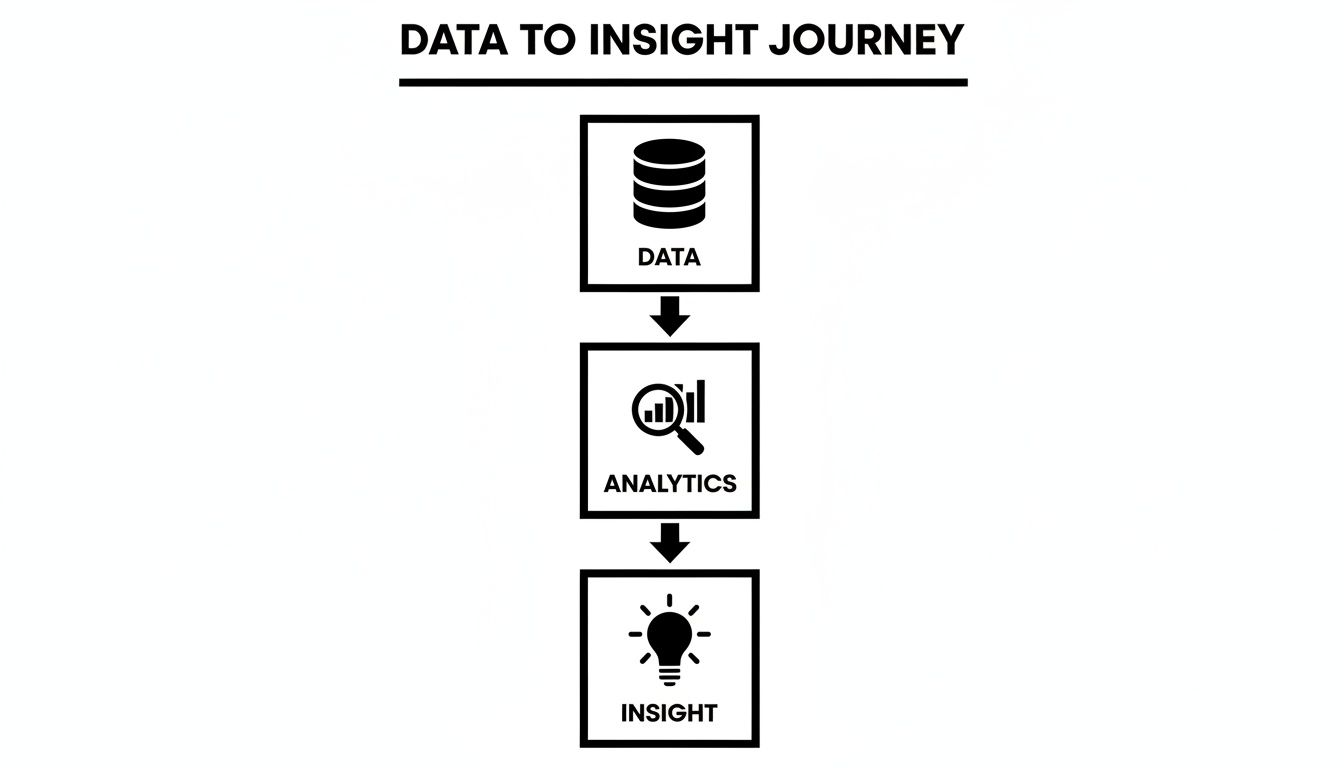
This is not merely a technical exercise; it is about re-engineering how your organisation thinks and operates. Most companies advance through four distinct stages, each answering a progressively more complex—and valuable—business question.
Stage 1: Descriptive Analytics — What Happened?
This is the foundational stage for nearly every company. Descriptive analytics involves summarising historical data to provide a clear picture of past events. It is the bedrock of traditional business intelligence.
Activities here include creating standard reports, building dashboards, and tracking KPIs, such as last quarter's sales figures or website traffic summaries. The primary goal is to establish a single source of truth for past performance, creating essential visibility across the organisation.
Ready to Build Your AI Project?
Let's discuss how we can help you ship your AI project in weeks instead of months.
While an indispensable first step, it is entirely retrospective, describing what occurred without explaining why or predicting future events.
Stage 2: Diagnostic Analytics — Why Did It Happen?
The next level of maturity involves asking the critical question: why? This stage moves beyond simple reporting to investigate the root causes behind the data. Diagnostic analytics is the investigative phase where teams drill down to identify dependencies and establish causal relationships.
This stage is characterised by ad-hoc queries, data discovery, and correlation analysis. For instance, if a sales report (descriptive) shows a sudden decline, a diagnostic approach would explore whether it correlates with a competitor's marketing campaign, a recent price adjustment, or seasonal trends.
The transition from descriptive to diagnostic analytics marks a significant shift in mindset—from passively consuming data to actively interrogating the business. It is the point where teams begin to challenge assumptions with empirical evidence.
Achieving this requires more than just sophisticated tools; it demands a culture of curiosity and the analytical skills to formulate and test hypotheses.
Stage 3: Predictive Analytics — What Will Happen?
Here, the focus shifts from the past to the future. Predictive analytics utilises statistical models and machine learning to forecast likely future outcomes based on historical data. This is where a sustainable competitive advantage is built by anticipating market shifts, customer behaviour, and operational risks.
At this stage, models are developed and deployed to answer questions such as: which customers are most likely to churn? Which sales leads have the highest probability of conversion? When will a critical piece of machinery require maintenance? A clearly defined AI strategy with a prioritisation framework is vital here to focus these powerful capabilities on the highest-value opportunities.
These capabilities enable proactive decision-making, moving the organisation from a reactive to a preemptive posture.
Stage 4: Prescriptive Analytics — What Should We Do?
This is the apex of analytics maturity. Prescriptive analytics not only forecasts future events but also recommends specific actions to achieve the optimal outcome, often quantifying the likely impact of each alternative. It represents the closest approach to automated, data-driven decision-making.
Prescriptive models integrate predictive forecasts with business rules and constraints to suggest the optimal path forward. Examples include dynamic pricing engines that adjust prices in real-time to maximise revenue, or supply chain systems that automatically reroute shipments to avoid predicted delays. The objective is to confidently guide the organisation toward the best possible result.
Want to Accelerate Your Innovation?
Our team of experts can help you turn ideas into production-ready solutions.
Within the German market, the trend is clear: significant value is being captured in these advanced stages. In 2024, predictive analytics alone accounted for 39.13% of analytics revenues in Germany, with prescriptive analytics identified as the fastest-growing segment.
The market signal is unequivocal. German companies are aggressively moving beyond historical reporting to embrace algorithmic forecasting and decision automation, thereby securing their competitive advantage.
A Pragmatic Roadmap for AI Implementation
Translating an analytics strategy into tangible results requires a structured, disciplined implementation plan. For enterprise leaders, this is not about executing a series of pilot projects; it is about building a scalable, organisational capability. A successful AI implementation is not a technology project—it is a business transformation, supported by four critical pillars: People, Process, Technology, and Governance.
This roadmap eschews technical jargon to focus on the strategic decisions and organisational shifts required. It serves as a practical blueprint to guide your transformation, ensuring resources are allocated effectively and the necessary cultural change is championed.
Cultivating the People Pillar
Technology is merely the enabler; your people are the engine of transformation. The primary investment must be in developing widespread data literacy. This entails ensuring all employees—from the factory floor to the boardroom—are comfortable understanding, interpreting, and communicating with data.
Looking for AI Expertise?
Get in touch to explore how AI can transform your business.
Beyond general literacy, it is crucial to empower specialists. This involves creating clear career pathways for data scientists, machine learning engineers, and data analysts. Critically, these roles must be embedded within business units, not isolated in a central IT department, to ensure their work addresses real-world operational challenges and advances strategic objectives.
Re-engineering the Process Pillar
For analytics and insights to have a meaningful impact, they must be integrated into daily decision-making workflows. Generating an insightful report is insufficient; that insight must trigger a specific action. This requires redesigning core processes to include explicit, data-driven checkpoints.
A pragmatic starting point is to select one or two high-impact processes, such as demand forecasting or supply chain optimisation. By mapping the existing workflow, you can identify precise points where AI-driven insights can replace conjecture with evidence. The objective is to make data-informed decision-making the most logical and efficient path. A practical guide on how to implement smarter data analysis with AI in Excel can illustrate this application.
Effective implementation is less about deploying a single monolithic system and more about weaving a thread of intelligence through the fabric of daily operations. The goal is to augment human judgment, not replace it, creating a powerful partnership between your teams and your technology.
This organisational change demands a disciplined methodology. To accelerate the journey from concept to a productive system, our 21-Day AI Delivery Framework provides a structured model for achieving tangible results rapidly.
Selecting the Right Technology Pillar
The technology landscape can be complex, but the guiding principles should be scalability and flexibility. Your technology stack must be capable of evolving with your strategic ambitions. This typically involves investing in a modern, cloud-based data platform that can manage large volumes of diverse data and support sophisticated machine learning workloads.
A robust technology pillar generally includes:
- A Centralised Data Platform: A cloud data lakehouse or warehouse serving as the single source of truth.
- AI and Machine Learning Tooling: Platforms that enable technical teams to build, train, and deploy models with minimal friction.
- Business Intelligence (BI) Tools: User-friendly visualisation tools that deliver insights to non-technical stakeholders.
The priority is to select an architecture that avoids vendor lock-in and supports an agile, iterative methodology. This ensures organisational nimbleness, allowing adaptation as business needs and technologies evolve.
Mastering the Governance Pillar
Finally, strong governance provides the essential guardrails for your entire analytics programme. Without it, the organisation is exposed to risks of poor data quality, security breaches, and significant compliance violations. For any German enterprise, rigorous adherence to data quality standards, security protocols, and GDPR is non-negotiable.
This requires establishing clear data ownership, defining quality standards, and implementing stringent access controls. A formal governance framework ensures that data is not only accurate and reliable but is also handled ethically and legally. This foundation of trust is indispensable for scaling the use of analytics and insights across the enterprise. The opportunity is substantial; Germany’s data analytics market is projected to reach approximately USD 5 billion in 2024, with aggressive growth forecast.
Real-World Applications in German Industries

The strategic value of analytics and insights is best understood through its practical application. For German industrial leaders, abstract concepts are secondary to measurable gains in efficiency, resilience, and profitability.
Let us examine how leading organisations are realising a clear return on investment across core sectors of the German economy. These are not speculative scenarios but proven applications delivering a competitive advantage today.
Manufacturing: Predictive Maintenance
Manufacturing is the backbone of the German economy, a sector where uptime and efficiency are paramount. Unplanned downtime is not merely an inconvenience; it directly impacts the bottom line and can cause disruptions throughout the supply chain.
- The Problem: A leading automotive supplier was experiencing significant financial losses from production line failures. Their reactive maintenance strategy was inadequate, resulting in excessive repair costs and missed delivery deadlines.
- The Solution: The company transitioned to a predictive maintenance model. By installing sensors on critical machinery, they could feed real-time data—vibration, temperature, pressure—into a machine learning algorithm capable of forecasting component failures with high accuracy.
- The Result: This shift from a reactive to a predictive posture resulted in a 25% reduction in unplanned downtime within the first year. The analytics and insights empowered the maintenance team to schedule repairs proactively, reducing overtime costs and increasing overall equipment effectiveness (OEE).
Logistics: Dynamic Route Optimisation
In a tightly integrated global economy, a resilient supply chain is a strategic necessity. German logistics firms must navigate complex networks, volatile fuel prices, and frequent disruptions. Static, pre-planned routes are no longer viable.
Ready to Build Your AI Project?
Let's discuss how we can help you ship your AI project in weeks instead of months.
- The Problem: A major logistics provider needed to reduce delivery times and fuel consumption. Their traditional routing software could not account for real-time variables such as traffic congestion, adverse weather, or last-minute changes in delivery priority.
- The Solution: They implemented a dynamic route optimisation system powered by prescriptive analytics. The platform processes live GPS data, traffic feeds, weather forecasts, and fuel prices to continuously recalculate the most efficient route for each vehicle in the fleet.
- The Result: The initiative yielded a 15% decrease in fuel costs and a 10% improvement in on-time delivery rates. This reflects a broader trend; location and real-time analytics are expanding rapidly in Germany, which held an estimated 14.4% share of the European market in 2024. As you can discover in more detail from this industry analysis, national infrastructure investments and the 5G rollout are accelerating this adoption.
True operational excellence is achieved when data does not merely report on the state of the business but actively guides its next move. These real-world examples show analytics in action, transforming passive data streams into dynamic, value-creating decisions.
Finance: Personalised Risk Management
The financial services sector must balance rigorous risk management with the delivery of highly personalised client services. For German financial institutions, the ability to achieve both is a key differentiator. Understanding how AI will transform the German Mittelstand is crucial in this context.
- The Problem: A mid-sized investment bank aimed to offer more customised wealth management portfolios but was constrained by its non-scalable risk assessment process. Standard models were too general, failing to capture the nuances of their high-value clients' objectives and risk tolerance.
- The Solution: The bank developed a prescriptive analytics model that integrated a client's financial history and stated goals with real-time market data. The system simulated thousands of market scenarios to recommend a truly personalised, risk-adjusted portfolio for each client.
- The Result: This initiative increased client satisfaction scores by 20% and grew assets under management by 12% within the targeted client segment. The bank could now deliver bespoke strategic advice at scale, strengthening client relationships and creating new revenue streams.
Cultivating Insightful Leadership
Becoming a data-driven organisation is fundamentally a leadership challenge, not a technological one. Mastering analytics and insights requires more than the acquisition of a new platform; it demands a strategic, unwavering commitment from senior leadership.
This journey extends beyond sophisticated dashboards. It is about fostering a new organisational culture—one where inquiry is standard practice and data serves as the final arbiter in any debate. As a leader, your primary responsibility is to create an environment where curiosity is encouraged and data is recognised as the most valuable strategic asset. It involves compelling your teams to look beyond surface-level reports and to challenge long-held assumptions with empirical evidence.
Forging a True Partnership
Embarking on this journey alone is a formidable task. The path is fraught with potential pitfalls, and traditional consulting models often fall short, delivering theoretical roadmaps without accountability for implementation. This leaves leadership with the full burden of execution.
Want to Accelerate Your Innovation?
Our team of experts can help you turn ideas into production-ready solutions.
We propose a superior model: a genuine partnership founded on shared objectives and, critically, shared risk. This is the essence of our 'Co-Preneur' approach.
True leadership in the data era isn't about buying tools; it's about building capabilities. It's about giving your people the power to consistently turn information into a competitive edge, creating an organisation that's not just resilient, but ready for anything.
We do not merely advise; we embed ourselves as an extension of your team, bringing entrepreneurial drive and a methodical approach to de-risking your AI initiatives. Our singular focus is to accelerate your progression up the analytics maturity model, providing the hands-on expertise required to extract maximum value from your data.
This co-entrepreneurial model is designed for leaders who are ready to move from discussion to execution. By working collaboratively, we build the systems, processes, and culture that secure a lasting competitive advantage. The ultimate objective is to ensure every euro invested in analytics and insights delivers a tangible, measurable return, transforming ambitious ideas into the concrete innovations that will define your future.
Frequently Asked Questions
As an organisation begins its journey toward becoming driven by analytics and insights, several key questions invariably arise. These are common inquiries from executives in Germany, and we have provided direct answers to guide your initial strategic thinking.
What is the appropriate level of investment in analytics?
There is no universal formula. Investment should be directly proportional to the expected business value. Rather than allocating an arbitrary percentage of the IT budget, begin with a business case.
Identify one or two high-impact problems, such as production downtime or supply chain inefficiencies. Quantify the current cost of these problems. This figure should serve as the baseline for your investment. A focused pilot project with a budget tied to its expected return is a more prudent strategy than making a large, untargeted investment.
How can the ROI of analytics initiatives be effectively measured?
To measure the return on analytics, focus on business metrics, not technological milestones. Vague objectives like "improved data access" are insufficient. Every project must be linked to a key performance indicator (KPI) that is relevant to the C-suite.
The only question that matters when measuring ROI is this: "Did this insight lead to an action that created real, tangible value?" Answering that question keeps every analytics investment focused on what really moves the needle.
Your measurement framework should include:
Looking for AI Expertise?
Get in touch to explore how AI can transform your business.
- Operational Efficiency: Track reductions in cost, time, or resource consumption. For example, a 15% decrease in fuel consumption for a logistics fleet.
- Revenue Growth: Measure the increase in sales, customer lifetime value, or market share. For instance, a 12% growth in assets under management.
- Risk Mitigation: Quantify the costs avoided, such as regulatory fines, fraud losses, or operational disruptions.
Is it necessary to undertake a massive overhaul, or can we start small?
Starting small is not only possible but highly recommended. The "big bang" approach, attempting to transform the entire organisation at once, is fraught with risk and has a low probability of success. The most successful programmes begin with focused pilot projects that demonstrate value quickly.
Select a single, well-defined business problem where improved analytics and insights can make a tangible difference. This allows your team to develop skills, refine processes, and build a compelling business case in a controlled environment. A successful initial project creates the momentum and internal support necessary for larger-scale initiatives. The strategy is to build confidence and scale intelligently.
At Reruption GmbH, we are your Co-Preneurs for the AI era. We help de-risk and accelerate the journey from raw data to decisive action. We work alongside you to build the systems and culture that transform insights into a durable competitive advantage. Learn more about our approach at https://www.reruption.com.