
In an economy increasingly defined by data, information has ceased to be a mere operational by-product; it is now a core strategic asset. A business intelligence consultant serves as a strategic partner, uniquely positioned to transform disconnected data points into a coherent narrative—one that informs high-stakes decisions and secures a sustainable competitive advantage.
The Strategic Imperative for Business Intelligence Consulting
Many organisations, despite significant investment in technology, find themselves constrained by data silos and locked in a cycle of reactive decision-making. They possess a wealth of information but struggle to translate it into clear, actionable intelligence.
Too often, business intelligence (BI) is relegated to a technical function within the IT department, tasked with generating historical reports. This perspective fundamentally misunderstands its strategic potential. Viewed through an executive lens, BI becomes a powerful engine for organisational performance, shifting the focus from standard reporting to predictive insights and operational excellence. The objective evolves from answering "what happened?" to "why did it happen?" and, most critically, "what is our optimal next move?" This is the transition from data as a passive record to data as a dynamic strategic asset.
From Data Overload to Decisive Action
The primary challenge for senior leadership is not a scarcity of data, but an overabundance of it without context. A BI consultant addresses this by architecting a unified, enterprise-wide view of the business. This involves dismantling the departmental silos where data is often trapped, inconsistent, and tells conflicting stories.
The core objective is to establish a ‘single source of truth’ that brings analytical clarity to every business function. When sales, marketing, operations, and finance all operate from the same validated data set, strategic alignment becomes a natural outcome, not a forced objective. This foundational work is indispensable for accurate forecasting, effective risk management, and identifying emergent market opportunities ahead of competitors.
Ready to Build Your AI Project?
Let's discuss how we can help you ship your AI project in weeks instead of months.
"The greatest challenge for modern enterprises is not the collection of data, but its intelligent interpretation. Business intelligence consulting provides the framework and expertise to convert raw data into a decisive competitive advantage."
The Economic Context in Germany
This demand for strategic data interpretation is reflected in Germany's robust consulting market. The broader management consulting industry is projected to reach a market size of approximately €47.7 billion in 2025, with sustained growth driven by digital transformation and the imperative for operational optimisation. This trend underscores the increasing reliance of German enterprises on external expertise to navigate complexity.
Ultimately, a BI engagement is designed to equip leadership with the confidence to make faster, better-informed decisions. It facilitates a critical shift away from intuition-based choices towards strategies grounded in empirical evidence. To fully grasp this imperative, exploring comprehensive resources such as a guide to business intelligence and reporting is a valuable exercise.
What a BI Consultant Delivers: From Data Chaos to Boardroom Clarity
A business intelligence engagement is not an IT project; it is a strategic initiative. For an executive, the sole relevant question is how technical execution translates into tangible business outcomes. The journey progresses from establishing a robust data foundation to delivering the insights that confer a distinct competitive edge.
The process begins with foundational architecture. An experienced BI consultant first establishes a clear data strategy and governance framework. This is not an exercise in bureaucracy but a necessary step to construct a data ecosystem that is reliable, secure, and fit for purpose. It is analogous to creating architectural blueprints for a skyscraper before pouring the foundation, ensuring the integrity of all subsequent development.
From Raw Data to a Strategic Asset
With the strategy codified, the work of organising enterprise data commences. This typically involves establishing a centralised data warehouse—a single repository for all critical business information. This process integrates data from disparate systems (e.g., ERP, CRM, logistics platforms) using ETL (Extract, Transform, Load) processes that cleanse, standardise, and structure the information.
The result is the establishment of a 'single source of truth'. This alone resolves a significant source of friction in senior management: conflicting reports from different departments. With this foundation, the entire organisation begins making decisions based on the same verified data.
This diagram illustrates how a consultant transforms scattered data points into a coherent strategic framework.
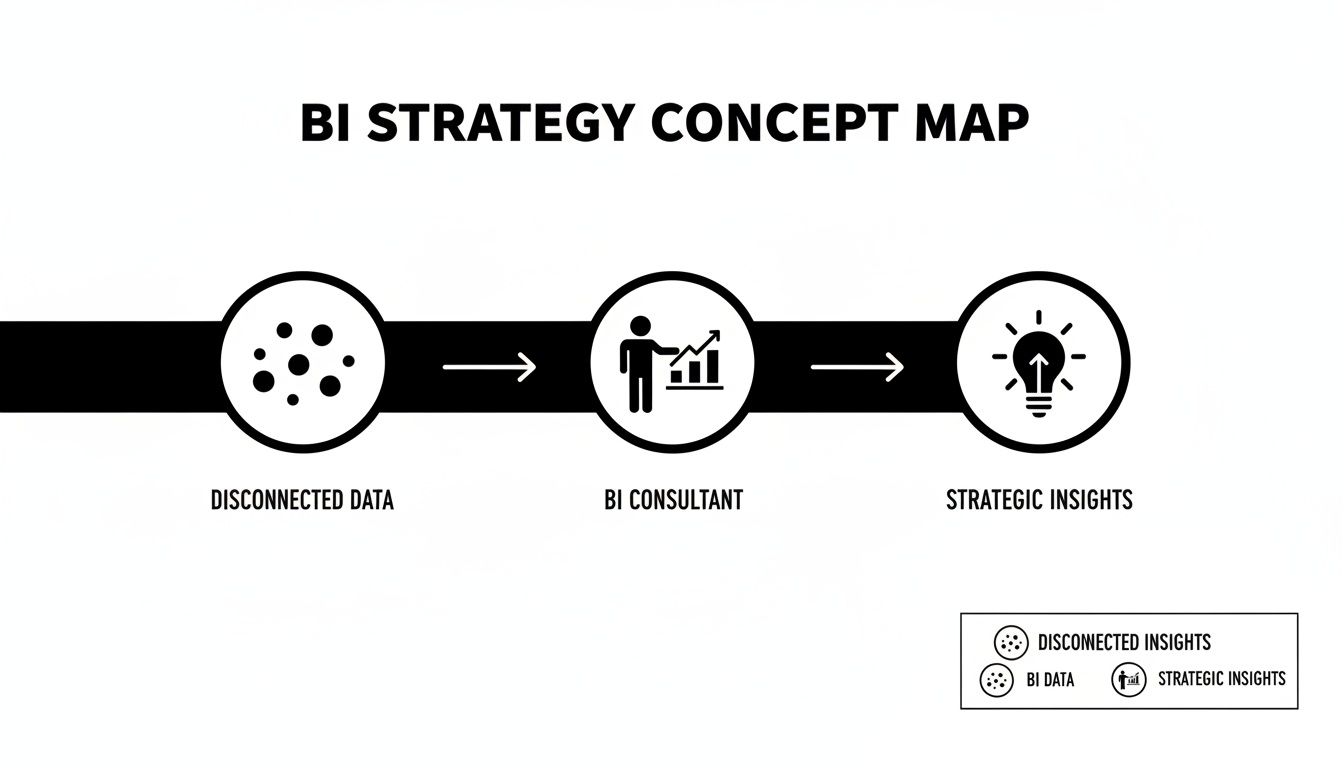
It provides a clear visual representation of how a consultant structures raw information into a framework that enables strategic thinking.
Making Performance Visible and Uncovering Latent Insights
Once a clean, centralised data source is established, the focus shifts to delivering its value to decision-makers. This is the domain of dashboard development and advanced analytics. A skilled consultant designs and builds interactive dashboards that present highly complex data in an intuitive, visual format.
These are not static reports but dynamic analytical tools that allow executives to explore data, drill down into specific metrics, and identify trends in real time. Key services typically include:
- Executive Dashboards: A consolidated, at-a-glance view of enterprise performance, from financial health to operational efficiency.
- Departmental Analytics: Custom-built visualisations for functional teams such as sales, marketing, or supply chain, empowering them to optimise their operations.
- Predictive Analytics: Leveraging historical data to forecast future outcomes—predicting customer churn, forecasting demand, or identifying potential supply chain disruptions before they materialise.
This transformation of raw data into actionable intelligence is a primary driver of investment in Germany. The German business intelligence market is projected to grow from USD 3.74 billion in 2025 to USD 6.07 billion by 2034, propelled by the intense demand for data-driven tools in core sectors like manufacturing and automotive. This growth underscores the significant value generated by converting data into a genuine strategic asset. You can explore these trends in greater detail within the full business intelligence market research.
A world-class BI programme empowers leaders to shift from reactive problem-solving to proactive strategy. The objective is to anticipate future trends, not merely to understand past performance.
Business Intelligence Service Offerings and Executive Outcomes
Ultimately, every BI service is directly mapped to a specific executive-level challenge. The table below connects common BI services to the high-level business outcomes they produce, illustrating how a technical engagement delivers measurable value.
Want to Accelerate Your Innovation?
Our team of experts can help you turn ideas into production-ready solutions.
| BI Service Offering | Description for Management | Primary Business Outcome | Example KPI Improved |
|---|---|---|---|
| Data Strategy & Governance | Establishing the architecture and protocols for reliable, secure, and accessible enterprise-wide data. | Establishes a "single source of truth," reducing data-related errors and mitigating compliance risks. | -20% reduction in time spent on data reconciliation; improved compliance scores. |
| Data Warehousing & ETL | Consolidating data from disparate systems (CRM, ERP) into a central, optimised repository. | Enables unified, cross-functional reporting and analysis for a holistic business view. | +30% faster report generation; -15% in operational reporting costs. |
| Executive Dashboard Design | Creating intuitive, visual dashboards with key performance indicators (KPIs) for C-level monitoring. | Provides real-time visibility into business health, enabling faster, more informed strategic decisions. | -25% shorter decision-making cycles; +10% improvement in meeting strategic targets. |
| Predictive Analytics | Using historical data and statistical models to forecast future trends, behaviours, and outcomes. | Shifts focus from reactive to proactive management, identifying opportunities and mitigating risks. | -15% customer churn rate; +20% forecast accuracy for demand planning. |
| Self-Service BI Implementation | Equipping business users with tools (like Power BI or Tableau) to explore data and create their own reports. | Empowers departmental leaders to answer their own questions, reducing reliance on IT and data teams. | -40% reduction in ad-hoc report requests to the data team; increased user adoption. |
A supply chain dashboard is not merely about tracking shipments; it is about reducing logistics costs and improving on-time delivery metrics. A customer segmentation analysis is not just a marketing report; it is a tool for increasing customer lifetime value and market share. This outcome-first methodology ensures every component of the BI engagement delivers measurable value to the bottom line.
Building the Bridge from Business Intelligence to AI
For any forward-looking executive, the journey from raw data to intelligent action no longer concludes with historical analysis; it extends directly into the realm of artificial intelligence. However, launching an AI initiative without a robust data foundation is analogous to attempting to race a Formula 1 car on an unprepared dirt track—a futile exercise.
This is where the critical linkage between Business Intelligence and AI becomes clear. Successful AI is not possible without first establishing a solid BI framework.

Consider your BI framework as the Autobahn: a meticulously engineered system of clean data pipelines, trusted sources, and clear governance. Your AI models are the high-performance vehicles designed to operate on this infrastructure. Without the Autobahn, the vehicles are merely expensive, stationary assets. AI requires a clean, well-structured environment to function effectively.
Differentiating Roles, Unifying Strategy
To construct a cohesive strategy, it is essential to understand that BI and AI specialists perform distinct yet complementary roles. They are not interchangeable. A common error is to conflate these functions, which leads to confusion and stalled projects.
A consultant business intelligence expert focuses on structuring and interpreting historical and current data. Their primary goal is to build a ‘single source of truth’ that enables human leaders to understand precisely what is happening within the business. They address the "what happened" and "why it happened" questions.
An AI specialist, in contrast, utilises this clean, structured data to build models that predict future outcomes. They concentrate on answering "what will happen next" and "what is the optimal response." They engineer the systems that can automate decisions and provide foresight.
The synergy is self-evident:
- BI provides the high-quality fuel. A strong BI programme delivers the organised, governed data that AI algorithms require to learn and generate accurate predictions.
- AI provides the forward-looking navigation. AI takes the historical insights from BI and uses them to chart a course for the future, enabling a shift from a reactive to a proactive strategic posture.
AI without a strong BI foundation is merely a sophisticated guessing machine. High-quality, governed data is the bedrock of reliable artificial intelligence, turning speculative models into dependable strategic assets.
Looking for AI Expertise?
Get in touch to explore how AI can transform your business.
How a BI Foundation De-Risks AI Investments
Allocating significant capital to AI before mastering BI is a substantial financial risk. The principle of "garbage in, garbage out" is absolute; training AI models on inconsistent, incomplete, or inaccurate data yields flawed and untrustworthy results. This not only wastes capital but can irrevocably damage leadership's confidence in data-driven initiatives.
A BI consultant mitigates this risk by establishing the necessary groundwork first. This ensures that when the organisation is ready to invest in AI, the foundation is already in place, dramatically increasing the probability of success and a measurable return on investment.
A Phased Approach to AI Readiness
A logical, sequential progression ensures the development of a stable and scalable data ecosystem. For leaders in German enterprises, this methodical approach aligns with a culture of precision engineering and long-term value creation.
- Data Governance and Centralisation: This is the foundational priority. A BI consultant will lead the initiative to create a unified data warehouse and establish clear governance protocols. This is the most critical step.
- Descriptive and Diagnostic Analytics: Subsequently, dashboards and BI tools are developed to provide management with clear, reliable insights into historical and current performance.
- Predictive and Prescriptive AI: Only with this trusted data foundation can AI specialists confidently build models for forecasting, automation, and optimisation.
This structured journey ensures that investments are sound and that each phase delivers tangible value. To formalise this process, our guide on creating an AI strategy with a prioritisation framework offers a valuable starting point. A consultant business intelligence expert can guide you through this progression, ensuring your organisation is prepared to bridge the gap from insight to intelligence.
Identifying the Right Time to Engage a BI Consultant
The decision to engage external expertise is a moment of strategic clarity, not an admission of internal deficiency. It is a recognition that an external perspective can cut through organisational inertia, accelerate progress, and de-risk a major transformation.
Ready to Build Your AI Project?
Let's discuss how we can help you ship your AI project in weeks instead of months.
For most organisations, the tipping point is not a single event but a series of persistent operational challenges that signal a deeper, systemic issue with data management and utilisation. The need for a BI consultant becomes acute when the gap between the data an organisation possesses and the answers it requires becomes a tangible business problem. This often manifests as a collection of symptoms that, while seemingly manageable in isolation, collectively indicate a significant missed opportunity.
Common Triggers Signalling the Need for a BI Consultant
Certain business scenarios are clear indicators that an organisation's existing data infrastructure is no longer adequate. These are not merely technical issues; they are fundamental business impediments that require specialist intervention in data strategy and execution.
Key red flags include:
- Post-Merger Integration Challenges: Following an acquisition, the organisation is inundated with disparate systems, processes, and data sets. A BI consultant is essential to harmonise these systems, standardise performance metrics, and create a single, unified view of the newly combined entity.
- Extended Reporting Cycles: If leadership teams must wait days or weeks for critical reports, the organisation's ability to react to market changes is severely hampered. This is a classic symptom of manual processes, siloed data, and a lack of automation—inefficiencies a BI consultant is equipped to resolve.
- Unexplained Performance Decline: A decline in market share, an increase in customer churn, or shrinking profit margins without a clear cause indicates significant analytical blind spots. A BI expert can conduct a cross-functional data analysis to identify the root causes that are often invisible from within departmental silos.
The definitive trigger is the realisation that the company is data-rich but insight-poor. The objective is to convert this dormant data into a primary tool for strategic decision-making and performance improvement.
From Problem Identification to Strategic Partnership
Consider a major German manufacturer experiencing persistent supply chain disruptions. Despite possessing vast amounts of production and logistics data, the company could not proactively identify bottlenecks. A BI engagement to build a real-time supply chain dashboard resulted in a 15% reduction in delays within six months.
Want to Accelerate Your Innovation?
Our team of experts can help you turn ideas into production-ready solutions.
Alternatively, consider a large retail chain with a fragmented view of its customer base. A consultant was engaged to integrate e-commerce, in-store, and loyalty program data. The outcome was a unified customer profile that enabled targeted marketing campaigns, increasing customer lifetime value by 20%. In both cases, the core problem was not a lack of data, but an inability to synthesise it effectively.
The German market for this expertise is substantial and growing. In 2025, management consulting in Germany is projected to generate approximately USD 23.62 billion, with technology-related consulting as a primary driver. While large corporations have traditionally been the main clients, Germany’s Mittelstand is increasingly engaging consultants as digitalisation transitions from a strategic option to an operational necessity. More details can be found on the German management consulting market on mordorintelligence.com.
When these triggers emerge, it is time to seek a strategic partner. A premier business intelligence consultant does more than build dashboards; they provide a comprehensive plan to transform an organisation's data culture and capabilities. For accelerated results, frameworks like our 21-Day AI Delivery Framework are designed to deliver productive systems in weeks, not months, converting a strategic need into a rapid competitive advantage.
A Framework for Selecting Your Ideal BI Partner
Selecting the right business intelligence consultant is a strategic decision, not a procurement exercise. You are not merely purchasing a service; you are engaging a partner who will fundamentally shape your organisation's ability to compete on data. A rigorous selection process must extend beyond presentations and technical terminology to vet real-world capabilities, cultural alignment, and a demonstrable commitment to measurable results.

A methodical approach is required, focusing on three core pillars: technical proficiency, proven industry experience, and strategic alignment. An ideal partner understands not only technology but also your specific business context, including the commercial and regulatory pressures of the German market.
Verifying Technical and Strategic Proficiency
The initial step is to penetrate marketing claims and assess genuine expertise. A top-tier BI consultancy must demonstrate mastery across the entire data value chain, from foundational data architecture to advanced analytics.
Your evaluation must be specific. Inquire directly about their approach to:
- Data Architecture: How do they design and implement scalable data warehouses and pipelines capable of handling significant future growth in data volume?
- Tool Agnosticism: Can they provide unbiased, objective advice on the optimal technology stack for your specific needs (e.g., Power BI, Tableau, or Qlik), or are they aligned with a single platform?
- Data Governance: What is their methodology for establishing a robust framework for data quality, security, and compliance?
However, technical capability is only one component. You must also assess their strategic acumen. The best partners operate at the intersection of business and technology. They should be as comfortable discussing supply chain optimisation or customer lifetime value as they are debating ETL processes. Their primary focus must be on resolving your most pressing commercial challenges, not simply implementing new software.
Assessing Industry Acumen and Regulatory Compliance
For German companies, particularly within demanding sectors like automotive and manufacturing, a generic BI solution is inadequate. The selected partner must possess deep, demonstrable experience in your specific industry. They must understand your operational nuances, competitive landscape, and domain-specific language.
Looking for AI Expertise?
Get in touch to explore how AI can transform your business.
This industry-specific knowledge is not a discretionary benefit; it is a prerequisite for success. A consultant with prior experience in manufacturing will already be familiar with concepts like Overall Equipment Effectiveness (OEE) and the complexities of production scheduling. This pre-existing knowledge dramatically shortens the learning curve and accelerates the time to value.
Equally critical is a comprehensive understanding of data privacy regulations. Any BI consultant operating in Germany must be fluent in the General Data Protection Regulation (GDPR). Their entire methodology for data handling, storage, and processing must be compliant by design. This is not a secondary consideration; it is a fundamental requirement. Our guide to creating audit-proof AI systems covers many of the core principles for security and compliance that are equally applicable here.
A consultant who does not proactively address GDPR compliance in the initial meeting is not a serious contender for a German enterprise. Data security and privacy must be integral to the solution architecture from day one.
Essential Interview Questions for Your BI Consultant
To rigorously evaluate potential partners, a structured set of questions is needed to move beyond prepared responses. These questions are designed to reveal a consultancy's thought process, problem-solving capabilities, and commitment to an outcome-driven methodology.
| Evaluation Area | Key Question to Ask | What to Look for in the Answer |
|---|---|---|
| Problem-Solving Approach | "Describe a past project where the initial business problem was poorly defined. How did you clarify the objectives and align stakeholders?" | A structured discovery process, evidence of strong facilitation skills, and a clear focus on defining measurable outcomes before technical development begins. |
| Stakeholder Management | "How do you manage resistance to change from departmental leaders who are protective of their data silos or existing reporting methods?" | A clear change management strategy, experience with executive-level communication, and an emphasis on demonstrating value to secure buy-in, rather than forcing compliance. |
| Outcome-Driven Methodology | "Walk us through your process for ensuring a project delivers tangible ROI. How do you define and track success metrics beyond project completion?" | An immediate focus on business KPIs, a model for quantifying financial impact (e.g., cost savings, revenue growth), and a plan for long-term value tracking and optimisation. |
| Industry & GDPR Expertise | "Provide an example of how you have addressed a GDPR-specific data challenge for a client in the manufacturing (or your specific) sector." | Specific, concrete examples demonstrating a working knowledge of both your industry’s data landscape and the practical application of data protection laws. |
By employing this rigorous, multi-faceted framework, you can proceed with confidence, selecting a business intelligence partner who possesses not only the requisite technical skills but also a deep understanding of your strategy and market, ready to act as a true co-preneur in your data-driven transformation.
Key Questions Regarding BI Consulting
Engaging a business intelligence consultant is a significant strategic decision, and it is natural for leadership to have critical questions. Below are direct, executive-level answers to the most common inquiries.
How is the ROI of a BI Engagement Measured?
The return on a BI investment is measured not by technical milestones, but by tangible business results. A competent consultant will collaborate with you from the outset to define success in clear financial and operational terms.
The process begins by establishing a baseline for key performance indicators (KPIs). What is your current customer churn rate? What is the cost per unit for logistics? How many man-hours are required to compile the monthly financial report? The project's success is then measured by the quantifiable improvement in these metrics.
This translates to clear, measurable wins, such as:
- Cost Reduction: Decreasing operational expenditures through process optimisation, such as a 10% reduction in supply chain costs or optimised inventory levels resulting from improved demand forecasting.
- Revenue Growth: Increasing top-line revenue through data-informed decisions, such as a 5% uplift in customer lifetime value from enhanced segmentation or the identification of a new market opportunity.
- Efficiency Gains: Reclaiming productive time through automation, for example, reducing the hours spent by the finance team on manual report generation by 40%.
The core principle is to link every technical activity directly to a metric that is meaningful to the business. For a deeper analysis of this concept, our guide on ROI measurement in marketing analytics provides frameworks applicable to any BI initiative.
What is a Realistic Timeline and Budget?
Any consultant providing a generic answer to this question lacks credibility. The timeline and cost are always contingent on the project's scope, the complexity of the existing data landscape, and the organisation's readiness for change. However, a reputable consultant will structure the engagement into distinct, predictable phases.
A typical engagement follows this structure:
- Discovery & Strategy (2-4 weeks): Intensive workshops with key stakeholders to define the precise business problem, assess the current data maturity, and develop a detailed roadmap with clear milestones.
- Implementation & Development (3-6 months): The core technical execution, including the construction of the data warehouse, development of data pipelines, and creation of the initial set of analytical dashboards. The duration is primarily dependent on the number and complexity of data sources.
- Deployment & Enablement (4-8 weeks): The rollout of the solution to end-users, including comprehensive training and the establishment of governance protocols to ensure long-term adoption and value realisation.
A credible BI consultant will refuse to provide a fixed price without first conducting a thorough discovery phase. They should propose a phased approach that protects your investment, delivers value at each stage, and allows for adjustments based on findings.
For a medium-sized enterprise, a focused departmental project may start around €50,000, while a comprehensive, enterprise-wide transformation could exceed €250,000. The final cost depends on the level of expertise required, the duration of the engagement, and the selected technology stack.
How Will a Consultant Integrate with Our Internal Team?
The traditional consulting model of fostering client dependency is obsolete. A modern BI engagement is a collaborative partnership designed to enhance the capabilities of your internal team. The consultant acts as a catalyst and mentor, embedding themselves within your organisation from day one.
Ready to Build Your AI Project?
Let's discuss how we can help you ship your AI project in weeks instead of months.
A "co-preneurial" model, where consultants work shoulder-to-shoulder with your IT staff, data analysts, and business leaders, is most effective. This approach is not about siloed work; it is about comprehensive knowledge transfer.
By the project's conclusion, your team will not only know how to use the new tools but will also understand the strategic rationale behind them. The consultant's objective is to build the engine, provide the training to operate it, and then hand over the keys. For an overview of market offerings, this summary of Business Intelligence Consulting Services is a useful resource.
What Occurs After the Project Is Complete?
A successful BI project is not an endpoint but the beginning of an organisation's transformation into a data-driven enterprise. The final deliverable is not merely a set of dashboards but a sustainable data operating model and a clear roadmap for future evolution.
Long-term success depends on robust data governance, including clear data ownership, quality standards, and a process for managing the BI platform. The consultant should assist in establishing a "Centre of Excellence" or a steering committee to guide the data strategy long after their engagement concludes.
The consultant’s role should evolve from that of an implementer to a trusted advisor, available for quarterly strategic reviews or to assist in planning the next phase, such as the integration of advanced AI capabilities. The ultimate goal is to leave you with a living, adaptive data ecosystem that grows in sophistication alongside your business.
Want to Accelerate Your Innovation?
Our team of experts can help you turn ideas into production-ready solutions.
At Reruption, we do not merely consult. We operate as co-preneurs, assuming P&L accountability and driving projects with an owner's mindset. If you are ready to transform your data from a cost centre into your most valuable strategic asset, let's build it together.
