Why Dashboards Won't Be Enough in 2025
Dashboard metrics have long been the centerpiece of reporting and control. But the reality in enterprises is more complex: data is fragmented, decisions must be made faster, and repetitive work ties up specialists. A dashboard shows what is happening; an autonomous workflow tells you what to do, prepares actions and executes routine tasks without manual effort. We believe: for the next wave of efficiency, organizations need decision and action systems, not more visualization tools.
Dashboards remain important for transparency, but they are passive. In a world where LLMs (Large Language Models) master routine interpretation, contextualization and action creation, it is unproductive to keep forcing people and systems to shuttle between numbers and action. Instead, we build systems that interpret data, generate recommendations and trigger actions — with clear control points.
What Are Autonomous Workflows?
By autonomous workflows we mean chains of modular components that ingest data, understand it, prioritize and become operational. These chains combine LLM capabilities for natural language processing, rule-based logic, external integrations (e.g. CRM, ATS, ticket systems) and an execution engine that automates tasks or prepares human decisions.
In practice this means: a workflow reads applicant data, compares it to job requirements, proposes a shortlist, drafts standardized response emails and schedules interviews — all controlled by an LLM-based orchestration layer. That reduces manual steps, speeds up time-to-hire and increases consistency.
Architecture of an LLM-based Workflow Pipeline
A robust architecture is crucial for autonomous workflows to run reliably and securely. We break the pipeline into six core layers:
1) Data Ingestion & Normalization
Here we collect data from internal systems (ERP, CRM, ATS, CMS), external sources (APIs, webhooks) and manual inputs. Clean data is the foundation for everything else: standardization, enrichment and security (e.g. PII redaction) happen in this layer.
2) Contextualization & Retrieval
The pipeline builds a situational context. Retrieval-Augmented Generation (RAG) or vector-based search fetch relevant documents and historical context. Without this step, LLM responses are often too generic. Context is the oil that keeps the LLM engine running smoothly.
3) Orchestrator / Workflow Engine
The orchestrator controls which models and tools are invoked and in what sequence. It implements conditions, retries and escalation paths and ensures transactional safety. Here we decide whether a result is implemented automatically, presented for review or discarded.
4) Specialized LLM Modules
Instead of a single general model we use specialized modules: one for classification, one for proposal generation, one for dialog handling. This specialization improves quality and controllability. Modular LLMs are easier to evaluate, test and monitor.
5) Execution & Integration Layer
The execution layer performs actions: creating CRM entries, sending emails, opening tickets or generating documents. API integrations, authentication and idempotency are critical here to avoid duplicate actions or inconsistencies.
6) Observability & Audit
Every decision needs traceability. Our pipeline logs inputs, model responses, triggered actions and human interventions in a tamper-proof audit log. Observability is not a nice-to-have feature — it is the core of trust and compliance.
Observability: Visibility, Quality and Explainability
Observability in autonomous workflows goes far beyond classic logging mechanisms. We measure three dimensions: system health (latency, error rate), performance (quality metrics of outputs) and business impact (time-to-resolution, conversion rate).
Concrete measures:
- Request and response metrics: measuring latency of each model call and the success rate of actions.
- Output quality metrics: human ratings, A/B tests and automatic heuristics (e.g. plausibility checks).
- Lineage & auditing: full traceability of which data and model versions influenced a decision.
Additionally we implement explainability modules that document the decision rationale in clear language. This is especially important for HR, legal and finance workflows, where transparency satisfies regulatory and ethical requirements.
Ready to Build Your AI Project?
Let's discuss how we can help you ship your AI project in weeks instead of months.
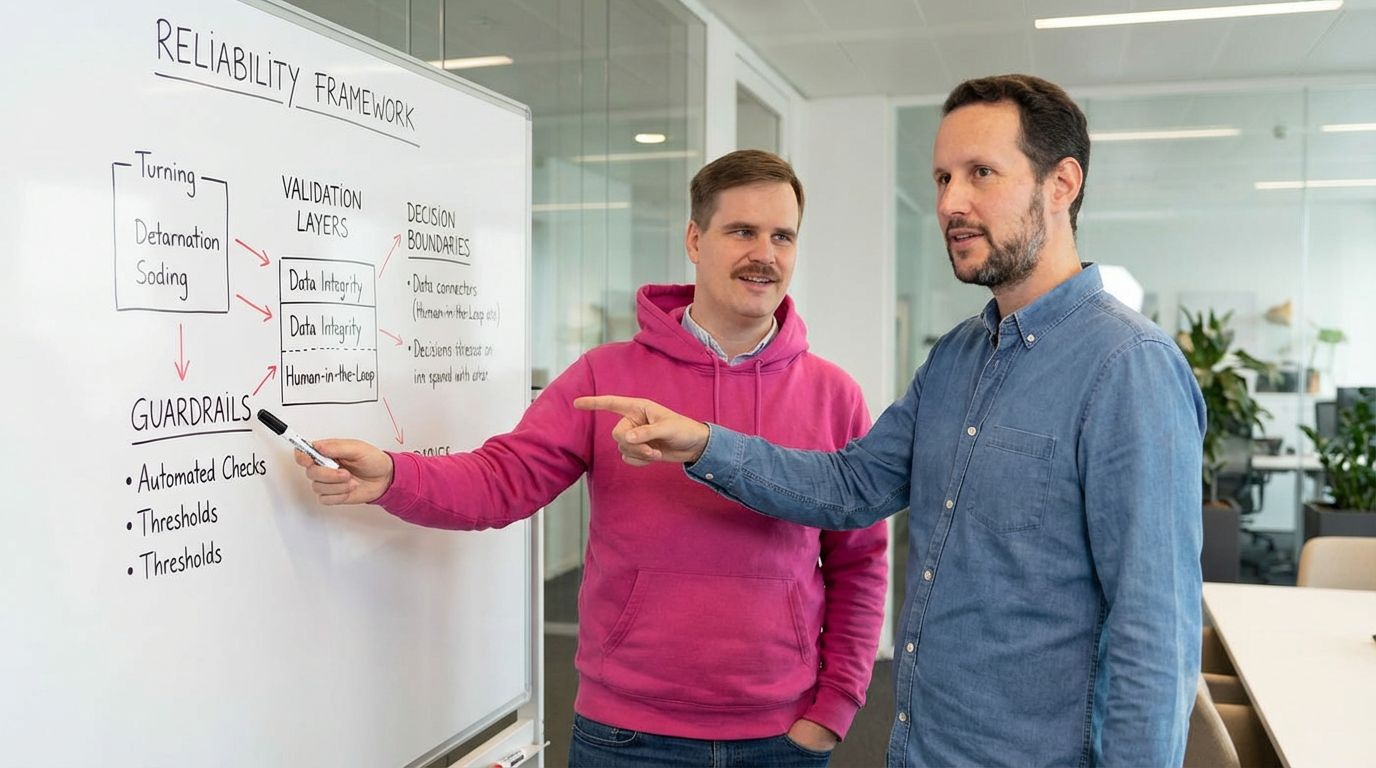
Risk Management: Guardrails, Human-in-the-Loop and Compliance
Autonomy does not mean “no control.” We rely on multiple, interlocking layers of protection:
- Guardrails: rule-based filters that prevent short-term risky actions (e.g. payment approvals above a threshold).
- Human-in-the-Loop: for critical decisions we configure review gates where a human simply needs to confirm the system’s proposed decision.
- Model Governance: version control, regular re-evaluation and drift detection for deployed LLMs.
- Data Privacy & Compliance: PII handling, access controls and data lineage to meet GDPR and industry-specific requirements.
An example: in recruiting workflows we let the system screen candidates and prepare communications, but CV screening results for candidates meeting certain criteria (e.g. leadership roles) are automatically forwarded to a recruiter for final approval. This way we combine speed with accountability.
Practical Use Cases
Recruiting – faster, more consistent, more human
At Mercedes Benz we have already implemented NLP-based candidate communication. This shows: automated pre-screening and 24/7 communication reduce time-to-hire and improve the candidate experience. An autonomous workflow goes further: it reads applications, identifies top profiles, creates interview guides and proposes slots — the recruiter makes the final decision. The result is a dramatically faster process with less administrative overhead.
Lead Qualification – priority instead of data overload
Far too many leads remain unqualified because sales teams misallocate resources. An LLM-driven workflow analyzes incoming leads, extracts intent and budget signals, qualifies them by internal rules and tags leads for immediate follow-up or long-term nurturing. For e-commerce or B2B sales organizations this means higher conversion rates with less effort.
Proposal Drafting – faster to the right offer
Proposal creation is repetitive but also technically demanding. Autonomous workflows can combine standard building blocks, pricing rules and customer history to generate initial proposal drafts. Salespeople then edit purposefully instead of starting from scratch — this speeds up processes and increases consistency.
Content Operations – scalable content production
Content teams spend a lot of time on briefs, revisions and formatting. We build workflows that automatically generate content briefs from product data and keyword strategies, create drafts, check versions and trigger publishing schedules. Content operations become a scalable engine instead of a bottleneck.
Customer Service – from chatbot to problem solver
Flamro is an example where intelligent chatbots already augment customer dialogs. The next step are workflows that not only provide answers but solve problems: they open tickets, trigger replacement shipments, schedule service appointments and follow up based on escalation. The customer experiences a seamless resolution, not just a conversation.
Implementation Roadmap: From PoC to Production
Our experience shows five pragmatic steps to anchor autonomous workflows in an organization:
- Use-case scoping: clear definition of input, output, success criteria and risks. Prioritize cases with high automation potential and clear data sources.
- PoC & validation: rapid prototyping to measure technical feasibility and business impact. Our AI PoC offering (€9,900) delivers a working prototype, performance metrics and a production plan within days.
- Iterative expansion: extend modular components, build observability and governance. We favor small, measurable releases over big-bang projects.
- Scaling & interfaces: integration into core systems, automatic monitoring and SLA definitions.
- Operations & further development: continuous model governance, drift monitoring and feature cycles for new automations.
We operate under our Co-Preneur approach: we take responsibility as co-founders, not just as consultants. That means we build, deploy and operate together with your team — until real results are live.
Want to Accelerate Your Innovation?
Our team of experts can help you turn ideas into production-ready solutions.
Measurable KPIs and ROI
Which metrics show that autonomous workflows work? Concrete KPIs are:
- Time-to-Action: reduction of time from event to action.
- Automation Rate: share of tasks completed without manual intervention.
- Error Rate: reduction of manual errors through standardization.
- Throughput: number of cases processed per unit of time.
- Business Impact Metrics: e.g. conversion rate, hiring duration, customer satisfaction.
In our projects we regularly see double-digit improvements in time-to-action and significant efficiency gains from automating repetitive work.
Conclusion: From Reporting to Action — What Leaders Should Do Now
Dashboards inform — autonomous workflows act. For 2025 we recommend a clear prioritization: identify processes where decisions are recurring, data-driven and rule-based. Start with a PoC, validate technical feasibility and business impact, and then gradually build robust, monitored pipelines.
At Reruption we help companies master this transition: with technical depth, operational accountability and a pragmatic roadmap. Relevant experiences from projects like the AI-based recruiting chatbot for Mercedes Benz or the intelligent customer communication for Flamro show how much faster and more consistent decisions become when systems not only inform but act.
If you're interested: start with a manageable PoC (e.g. our AI PoC for €9,900) and quickly measure whether your processes are suitable for autonomous workflows. We are happy to advise, design the pipeline and support implementation — from the idea to the live-operated system.
Takeaway / Call to Action
Dashboards remain part of transparency, but they are not the future of operational efficiency. In 2025, bet on autonomous workflows that generate decisions and trigger actions. Contact us if you want to know which workflow in your company should be automated first — we deliver the technical implementation and take responsibility until it really runs.