Software Asset Management (SAM) is the strategic discipline for governing and optimising the procurement, deployment, maintenance, utilisation, and disposal of an organisation's software assets. It encompasses the strategies, processes, and technologies for managing the complete software lifecycle. For a large German enterprise, this is not a tactical IT function; it is a fundamental pillar of operational excellence and risk mitigation.
A Strategic Imperative for C-Level Leadership
In Germany's highly competitive automotive, manufacturing, and technology sectors, software asset management transcends its traditional IT-support role. It has become a C-suite imperative that directly influences profitability and risk exposure. Executives are perpetually challenged by escalating cloud expenditure, labyrinthine SAP and Microsoft licensing structures, and the stringent compliance mandates of GDPR and TISAX. A proactive, accountable software management asset strategy transforms this complex cost centre into a distinct strategic advantage.
This paradigm shift is critical in an expanding digital landscape. The German software development market, for instance, is projected to reach €94.6 billion in revenue by 2025. This growth signifies a more complex and dynamic ecosystem for enterprises to navigate, increasingly populated by AI-driven software assets.
The Modern Mandate for SAM
Effective software asset management delivers a material impact on an organisation's P&L. It provides the framework to:
- Optimise Expenditure: The foundational step in cost optimisation is complete visibility. This requires a consolidated view of all software spend, from major enterprise agreements to decentralised SaaS subscriptions.
- Mitigate Enterprise Risk: Ensuring compliance with intricate vendor licensing agreements and data protection legislation like GDPR is non-negotiable. Correct implementation averts significant financial penalties from audits.
- Enable Strategic Innovation: The secure and efficient integration of new technologies, particularly artificial intelligence, is impossible without a precise understanding of the existing software portfolio.
A disciplined approach to software asset management is not merely a cost-saving exercise; it is about constructing a resilient and agile enterprise. It establishes the requisite governance to de-risk technological innovation and secure long-term operational stability.
Ready to Build Your AI Project?
Let's discuss how we can help you ship your AI project in weeks instead of months.
By elevating SAM to a core business function, organisations achieve superior financial control and operational clarity. For further insights, explore our comprehensive articles on software and asset management. This guide provides a strategic blueprint for transforming a necessary function into a powerful competitive differentiator.
Understanding the Four Pillars of Modern SAM
An effective software asset management strategy is constructed upon four core, interconnected pillars. For executives accustomed to the precision of German engineering, these components can be viewed through a similar operational lens. Each pillar represents a critical function, and their synergistic operation elevates SAM from a simple IT task to a strategic driver of operational excellence and risk mitigation.
This diagram illustrates how a well-architected SAM programme supports these two crucial business objectives.
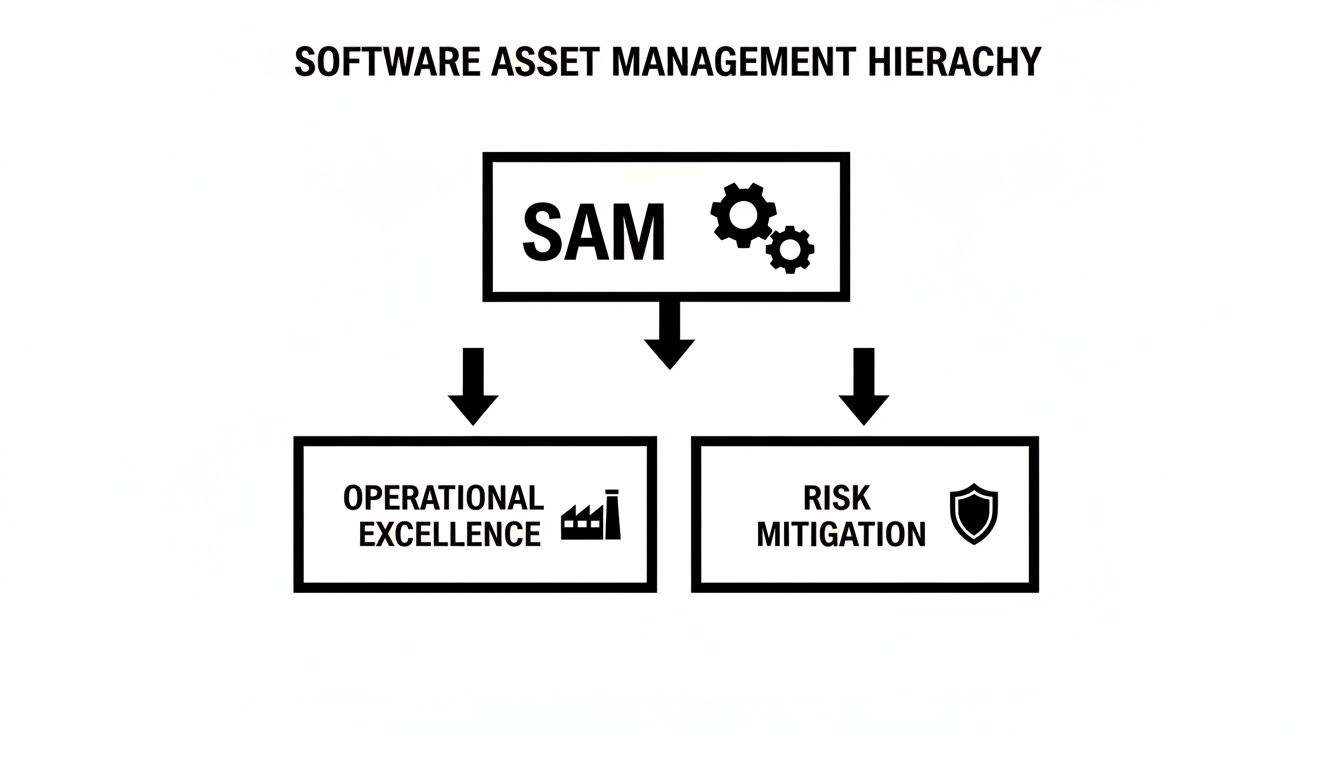
As depicted, a structured programme directly enhances business operations while concurrently safeguarding the enterprise against significant compliance vulnerabilities and financial penalties. These four pillars provide the blueprint for achieving this strategic equilibrium.
Want to Accelerate Your Innovation?
Our team of experts can help you turn ideas into production-ready solutions.
To fully grasp the mechanics of a successful SAM programme, we will dissect its core components. The following table outlines the four pillars, employing a straightforward analogy to clarify each function and its corresponding value proposition.
The Four Pillars of Strategic SAM
| Pillar | Analogy | Primary Business Value | Key Challenge Addressed |
|---|---|---|---|
| Asset Inventory | Digital Factory Blueprint | Complete visibility into all software assets across servers, cloud, and endpoints. | "Shadow IT" and undocumented software risks. |
| Licence Management | Supply Chain Logistics | Ensures every licence is tracked, correctly allocated, and optimised for cost. | Over-expenditure on unused software and audit failure. |
| Governance & Policy | TÜV Certification | Establishes formal rules for software usage, ensuring security and compliance. | Inconsistent security protocols and non-compliance. |
| Process & Automation | Industrie 4.0 | Automates workflows for software requests, deployment, and reclamation. | Manual errors, process inefficiencies, and slow service delivery. |
Each of these pillars builds upon the last, creating a comprehensive system that is far more robust than the sum of its individual parts. Let us now examine their functions in greater detail.
A Closer Look at the Pillars
The initial pillar is Asset Inventory. This can be conceptualised as the detailed digital blueprint of your entire operational infrastructure. It provides a complete, real-time inventory of every software instance—whether on-premise, in cloud environments, or on end-user devices. Without this comprehensive map, strategic decision-making operates in a vacuum.
Building upon this blueprint is Licence Management. This function serves as the supply chain logistics for all software entitlements. It ensures that each licence is allocated precisely, analogous to a logistics manager directing materials to the correct production line at the optimal time. This discipline prevents both wasteful over-provisioning and the significant risk of operational disruption due to non-compliance. These foundational elements require a firm grasp of complex IT environments, a topic further explored in our guide on modern system engineering practices.
The third pillar, Governance and Policy, functions as the TÜV certification for your software estate. It establishes the clear, non-negotiable standards and rules that guarantee quality, security, and compliance across the organisation.
Looking for AI Expertise?
Get in touch to explore how AI can transform your business.
Effective governance does not stifle innovation. It creates a secure, predictable environment in which new ideas can be developed and scaled without introducing unacceptable business risk.
Finally, we have Process and Automation. This is the Industrie 4.0 layer of your SAM strategy, focused on optimising and automating day-to-day workflows: software requests, approvals, deployment, and the reclamation of unused licences. By eliminating manual tasks and implementing efficient, repeatable processes, you reduce operational overhead, minimise human error, and accelerate the delivery of technology to your teams.
Quantifying the Financial and Compliance Risks
Neglecting software asset management is not a passive choice—it is an active acceptance of significant, quantifiable risk. For leadership, understanding these financial and compliance vulnerabilities is the first step toward transforming SAM from a cost centre into a strategic defense for the enterprise. The cost of inaction is frequently measured in millions of Euros and severe operational disruption.
Vendor audits represent the most immediate and acute financial threat. Major software publishers like SAP, Oracle, and Microsoft have refined the identification of non-compliance into a science. They are adept at scrutinising complex enterprise agreements. An audit that uncovers unlicensed software, incorrect user-type assignments, or deployments in non-licensed virtual environments can easily result in a seven-figure financial penalty.
How Modern IT Amplifies Risk
These risks are not static; they are amplified by the complexities of modern hybrid and multi-cloud environments. The ease of provisioning a new cloud server or subscribing to a SaaS tool has created two major issues that impact both the bottom line and security posture.
Ready to Build Your AI Project?
Let's discuss how we can help you ship your AI project in weeks instead of months.
- Shadow IT: This occurs when business units procure software without central IT or procurement oversight. The result is a lack of visibility into what software is active within the organisation. This leads to redundant spending and, more critically, the introduction of applications that have not been vetted for security vulnerabilities or GDPR compliance.
- SaaS Sprawl: This uncontrolled proliferation of subscription-based software results in significant wasted expenditure on underutilised tools. It also dramatically expands the company's attack surface, creating new vectors for potential data breaches.
A deficient software asset management programme constitutes a direct threat to corporate resilience. It exposes the organisation to substantial financial penalties from audits and increases the likelihood of a data breach under stringent regulations like GDPR.
The German Market Context
This issue is particularly acute in Germany. The nation's Enterprise Software market is projected to reach US$13.57 billion by 2025, yet organisational visibility remains a persistent challenge. A startling 43% of organisations report having an incomplete view of their IT assets. Given this complexity, a robust SAM strategy is not optional—it is a core component of any credible enterprise risk and compliance strategy.
Furthermore, attempting to manage cloud costs and risks without a structured framework is an exercise in futility. Understanding what FinOps entails for cloud financial management is becoming indispensable. This methodology provides the framework to control unpredictable cloud expenditure and ensure it directly supports business objectives. Without it, financial planning remains speculative.
Integrating AI into Your Asset Management Strategy
A robust software management asset programme is more than a defensive measure against audits and escalating costs. It serves as the essential foundation for strategic innovation.
Artificial intelligence represents the next stage of this evolution. It transforms SAM from a reactive, historical accounting function into a proactive, predictive discipline. The focus shifts from merely tracking past usage to anticipating future business needs and identifying efficiencies preemptively.
Want to Accelerate Your Innovation?
Our team of experts can help you turn ideas into production-ready solutions.
For executive leadership, the value of AI lies not in the algorithms themselves, but in the superior business outcomes they enable. By applying machine learning models to the rich dataset gathered through disciplined SAM, an organisation can transition from simple usage tracking to true predictive optimisation.

From Reactive Reporting to Predictive Optimisation
Traditional software asset management answers the question, "What did we utilise last quarter?" AI-powered SAM, in contrast, answers, "What will we require next quarter, and where can we realise savings before the expenditure occurs?" This represents a fundamental strategic shift.
Machine learning models excel at analysing vast quantities of historical usage data to identify subtle patterns that a human analyst would likely miss. This capability unlocks several high-value applications:
- Forecasting Future Demand: AI can predict future software requirements with remarkable accuracy by analysing project pipelines, departmental growth trends, and seasonal business cycles. This ensures licences are procured on a just-in-time basis, optimising cash flow.
- Automated Licence Reclamation: The system can intelligently identify underutilised software licences. It flags assets with low engagement and can automate the process of reclaiming and reallocating them, maximising the value of existing investments.
- Proactive Cost Optimisation: Instead of relying on estimation, AI algorithms can simulate various licensing and cloud consumption models. This enables the identification of the most cost-effective contract structures before entering into vendor negotiations.
Integrating artificial intelligence into an asset management strategy is analogous to transitioning from driving by looking in the rearview mirror to using a sophisticated navigation system that anticipates the road ahead.
Looking for AI Expertise?
Get in touch to explore how AI can transform your business.
Managing AI as a Software Asset
The relationship between AI and SAM is bidirectional. As AI enhances the intelligence of software management, SAM principles must be applied to the growing portfolio of AI technologies themselves. This creates a virtuous cycle of control and innovation.
Managing AI assets involves maintaining a rigorous inventory of machine learning models, data pipelines, and the underlying platforms. Ensuring 100% compliance for the software licences of sophisticated AI development environments is non-negotiable. Without this discipline, a promising AI initiative can rapidly escalate into a significant compliance liability. For a detailed implementation methodology, this step-by-step guide on implementing AI in business provides a valuable framework.
Ultimately, scaling AI ambitions responsibly is predicated on a mature SAM framework. It is the prerequisite for success. To learn more about this critical intersection, explore our insights on the role of AI in asset management. This disciplined approach ensures that every investment in intelligent technology is built upon a solid foundation of governance and financial control.
Executing a Pragmatic Implementation Roadmap
A successful software management programme is not implemented overnight. The "big bang" approach is a known recipe for failure. The optimal strategy is a phased, methodical journey that delivers tangible, measurable value at each stage.
This structured approach ensures stakeholder alignment—from IT to finance and procurement—and systematically de-risks the initiative. The process is analogous to building a high-performance engine: one begins with the core block and progressively adds components, testing and refining throughout the process.
Ready to Build Your AI Project?
Let's discuss how we can help you ship your AI project in weeks instead of months.

This type of disciplined execution is critical in the German market. Germany is at the forefront of Europe's SAM evolution, demonstrating a high level of maturity driven by digitalisation policies and strict GDPR enforcement, particularly within its dominant manufacturing sector.
While the global SAM market is expanding, European firms are acutely focused on optimising existing assets and contending with resource constraints. This context makes a structured, phased roadmap not merely advisable, but essential for success.
Phase 1: Discovery and Baseline (Vermessung)
The first principle is achieving complete visibility. An organisation cannot control what it cannot see.
This initial phase, the Vermessung (surveying), is dedicated to a comprehensive inventory of every software asset across all environments—on-premise data centres, public and private clouds, and every endpoint device.
Want to Accelerate Your Innovation?
Our team of experts can help you turn ideas into production-ready solutions.
The objective is singular and non-negotiable: to establish a single source of truth that will inform all subsequent decisions. This baseline is the bedrock of the entire strategy.
Phase 2: Quick Wins and Pilot Projects (Prototyping)
With a clear baseline established, the next priority is to demonstrate immediate value and build momentum.
The Prototyping phase concentrates on high-risk, high-expenditure vendors such as Oracle or Microsoft. By executing a focused pilot project—for instance, identifying and reclaiming unused licences or optimising a single major contract—an organisation can generate significant cost savings that validate the programme's ROI from the outset.
These early victories are crucial for building executive confidence and securing the necessary support for a broader implementation.
A successful pilot project does more than save money. It transforms an abstract business case into tangible financial results, making the value of disciplined SAM undeniable to all stakeholders.
Looking for AI Expertise?
Get in touch to explore how AI can transform your business.
Phase 3: Scaled Rollout and Automation (Skalierung)
Building on the success of the pilot, the Skalierung (scaling) phase extends the programme across the entire enterprise.
This involves implementing standardised processes and integrating specialised SAM tooling to automate discovery, licence reconciliation, and reporting. Automation is the only viable method for managing this complexity at scale, reducing manual effort, and ensuring consistent data accuracy.
For initiatives of this complexity, structure is paramount. Our guide on a 21-day AI delivery framework offers valuable insights into executing complex technology rollouts with speed and precision.
Phase 4: Continuous Optimisation (Kontinuierliche Verbesserung)
Finally, the programme must transition from a finite "project" into a mature, ongoing business function. This is the Kontinuierliche Verbesserung (continuous improvement) phase.
Here, permanent governance processes are established. The focus shifts to proactive optimisation, perpetual compliance monitoring, and strategic vendor management. The objective is to ensure the software portfolio remains perpetually aligned with the company's strategic goals.
Ready to Build Your AI Project?
Let's discuss how we can help you ship your AI project in weeks instead of months.
This represents the end state: transforming SAM from a reactive, corrective exercise into a forward-looking, strategic capability.
Choosing Your Strategic Tools and Partners
With the commitment to formalise software asset management, the pivotal question becomes one of execution. This decision extends beyond technology selection to a fundamental choice of operating model: building an in-house team, procuring a powerful tool, or engaging a dedicated partner.
There is no universally correct answer. The optimal path is contingent upon your organisation's scale, existing in-house expertise, and ultimate strategic objectives.
For many large German enterprises, the initial impulse is to procure a top-tier SAM platform. These tools are impressive, promising a single source of truth and a comprehensive feature set for discovery, inventory, and licence management. Their sophisticated dashboards can create the impression of total control over the software estate.
However, this is a common point of failure. A tool, irrespective of its power, is merely an instrument. It provides data, but it does not provide strategy. It can identify what assets you possess, but it cannot construct the commercial case for renegotiating an unfavourable vendor contract. It will not drive the complex, cross-departmental collaboration required to reclaim unused licences, and it will not assume ownership of the P&L impact.
From Data Provision to P&L Accountability
This is the critical distinction between a tool and a partner. A partner delivers accountability. They provide the requisite technical expertise, but they also bring an entrepreneurial mindset focused on translating raw data into measurable financial outcomes.
A tool flags an issue; a partner is remunerated for solving it. They employ a proven methodology for executing complex projects, de-risking them, and ensuring their successful completion.
A tool provides a dashboard; a partner provides a strategy. This distinction represents the difference between merely monitoring costs and actively driving profitability through optimised software investments.
Consider a major AI initiative. A SAM tool can dutifully catalogue all software components and their associated licences. A strategic partner, conversely, ensures the entire initiative is built on a solid commercial and legal foundation. They align the technical execution with financial prudence and long-term business objectives.
A Framework for Your Decision
As you evaluate your options, consider the following framework:
Want to Accelerate Your Innovation?
Our team of experts can help you turn ideas into production-ready solutions.
- Complexity vs. Expertise: Does your organisation possess the deep, specialised skills required not only to operate a complex SAM tool but also to interpret its output and translate it into strategic action?
- Accountability for Outcomes: Are you seeking a solution that simply provides data, or do you require a partner who assumes co-ownership of the financial results?
- Strategic Alignment: Is the primary objective to satisfy a compliance requirement and generate reports, or is it to transform your software portfolio into a source of competitive advantage and financial strength?
Ultimately, the choice is yours. The key is to select the path that aligns with your true strategic goals, ensuring your investment delivers not just data, but tangible, enduring business value.
Burning Questions About SAM
When senior leadership begins to investigate software asset management, a consistent set of critical questions emerges. The following provides direct answers to the most common inquiries from executives in German enterprises.
How quickly can we expect a return on a SAM programme investment?
The return on investment for a well-executed SAM programme is typically realised faster than anticipated due to the ability to target high-impact opportunities first.
For example, the cost savings generated from simply identifying and eliminating unused software or renegotiating a single major enterprise agreement with data-driven insights can often cover the entire first-year cost of the programme. Many organisations observe these initial returns within six to nine months. Engaging a strategic partner can accelerate this timeline, as they possess the expertise to identify the areas of greatest financial impact first, effectively transforming the initiative into a self-funding engine for the business.
Is Software Asset Management still relevant in the cloud era?
It is not only relevant; it is more critical than ever. The core principles of SAM do not diminish in the cloud; they evolve. The modern application of these principles is often termed FinOps—essentially, SAM for the cloud.
Looking for AI Expertise?
Get in touch to explore how AI can transform your business.
The focus shifts from counting on-premise licences to managing complex pay-per-use models, ensuring compliance in bring-your-own-licence (BYOL) scenarios, and controlling the proliferation of SaaS subscriptions procured decentrally.
In the cloud, SAM is the primary mechanism for controlling unpredictable operational expenditure (OpEx). It is the discipline that ensures an organisation pays only for the resources it actively consumes across providers like AWS, Azure, and Google Cloud.
What is the absolute first step we should take to improve our SAM capabilities?
Establish complete and total visibility across the entire IT estate. It is a fundamental business axiom: you cannot manage, optimise, or secure what you cannot see.
All effective SAM initiatives begin with a comprehensive discovery and inventory process. It is imperative to establish a single, authoritative baseline of every software asset—on-premise, on every endpoint, and within every cloud account. This data constitutes the foundational single source of truth. Without it, all subsequent efforts are based on speculation.
At Reruption GmbH, we operate as your co-preneurs, assuming P&L accountability to transform your AI and software strategies into tangible business value. We do not just consult; we build and deliver. Discover how we can de-risk your innovation and drive real results at https://www.reruption.com.
Ready to Build Your AI Project?
Let's discuss how we can help you ship your AI project in weeks instead of months.