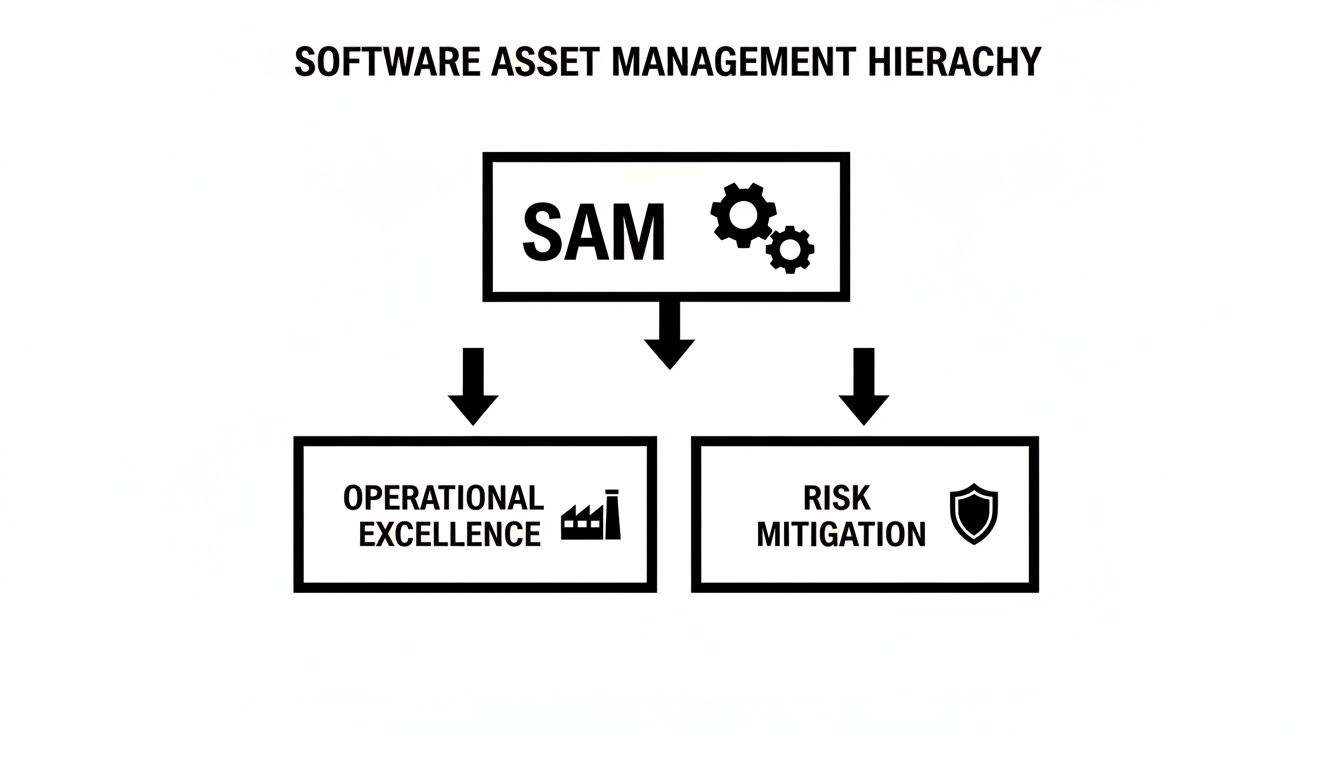
For German enterprises, software and asset management has transitioned from a back-office IT function to a strategic boardroom imperative. It is no longer a technical exercise but a core component of corporate strategy. A disciplined approach to managing digital assets directly impacts financial performance, transforming technology from a cost centre into a source of durable competitive advantage.
The Strategic Value Of Software And Asset Management
In today's dynamic business environment, rigorous oversight of software and IT assets is fundamental to both operational resilience and financial foresight. Many organisations, however, continue to grapple with significant challenges that erode value and introduce unacceptable levels of risk. These are not merely IT issues; they are strategic business problems that demand executive attention.
The core challenges facing German enterprises are consistent:
- Navigating Licence Complexity: Vendor agreements are notoriously intricate and difficult to track. This complexity frequently leads to unintentional non-compliance or, equally damaging, significant over-expenditure on underutilised software licences.
- Controlling "Shadow IT": Decentralised software procurement by individual departments, while seemingly agile, creates a fragmented ecosystem of redundant tools, significant security vulnerabilities, and a distorted view of enterprise technology expenditure.
- Mitigating Severe Financial Risks: Non-compliance with stringent German and EU regulations can result in substantial financial penalties and severe reputational damage. Robust governance is not optional.

A Framework For Competitive Advantage
Viewing Software Asset Management (SAM) as a central governance framework enables a shift from reactive problem-solving to proactive strategic planning. A mature SAM programme provides the structure necessary to master these challenges, creating a single, reliable source of truth for every technology asset within the enterprise. To better conceptualise this, it is useful to explore what Freshservice Asset Management is and how it can optimize IT.
Ready to Build Your AI Project?
Let's discuss how we can help you ship your AI project in weeks instead of months.
This strategic oversight directly underpins critical business functions. It facilitates precise financial planning by providing an accurate understanding of software costs and usage patterns. Furthermore, it enhances operational efficiency by ensuring teams are equipped with necessary tools without wasteful duplication. This level of control is a cornerstone of modern corporate strategy, particularly for enterprises navigating digital transformation. This journey is further detailed in our guide on the digitisation of companies.
A mature Software Asset Management programme is the foundation for strategic agility. It allows an organisation to respond to market changes with speed and confidence, knowing its technology portfolio is optimised, compliant, and secure.
Ultimately, by institutionalising robust software and asset management, an organisation is not merely managing IT. It is building a more resilient, efficient, and competitive enterprise. This guide will delineate the essential components for architecting such a programme to unlock its full strategic potential.
Diving into the Modern Asset Management Ecosystem
To fully leverage asset management, it is crucial to understand the relationship between Software Asset Management (SAM) and the broader discipline of IT Asset Management (ITAM). Moving beyond standard definitions, we will construct a clear model of how these two disciplines integrate to deliver comprehensive strategic control.
Conceptualise your organisation's entire technology stack as a complex, interconnected system. ITAM is the discipline of managing this entire system—every server, laptop, cloud instance, data centre, and peripheral. It represents the complete view.
Want to Accelerate Your Innovation?
Our team of experts can help you turn ideas into production-ready solutions.
In contrast, SAM is a specialised practice. It focuses on the most dynamic and complex component of that system: the software that enables its functionality.

Why Scope And Focus Matter
Although interconnected, ITAM and SAM serve distinct functions. ITAM provides the foundational inventory of all physical and digital assets, tracking them from procurement to disposal. Its primary objective is simple yet critical: to maintain a complete and accurate record of every technology asset the company owns.
SAM, conversely, delves into the intangible and intricate world of software. It is concerned with optimising licence utilisation, ensuring contractual compliance, and mitigating the substantial financial and legal risks associated with software audits. This intense focus is essential for controlling software expenditures and rationalising complex vendor agreements.
To clarify the distinction, a direct comparison is useful.
ITAM vs SAM A Strategic Comparison
This table highlights the key differences in scope, objectives, and ultimate business impact between the two disciplines. Understanding these nuances is the first step toward building an integrated and effective asset management strategy.
| Dimension | IT Asset Management (ITAM) | Software Asset Management (SAM) |
|---|---|---|
| Primary Scope | All technology assets: hardware, network devices, cloud infrastructure, peripherals, and software. | Focused exclusively on software licences, subscriptions, and usage rights. |
| Core Objective | Maintain a complete inventory, track the asset lifecycle, and optimise physical resource allocation. | Ensure licence compliance, control software costs, and mitigate audit risks. |
| Business Impact | Improves financial accountability for physical assets, aids in hardware refresh planning, and enhances security posture. | Directly reduces software spend, prevents costly legal penalties, and optimises vendor contracts. |
Ultimately, while ITAM provides the "what" and "where" of your technology, SAM provides the "how" and "if"—how is the software being used, and are we operating in a legally and financially optimised manner?
The Real Power Is In The Synergy
The true strategic value emerges when these two disciplines are integrated. A robust ITAM programme identifies what hardware the enterprise owns. A mature SAM programme determines what software is running on that hardware, and whether it is over-licensed or poses a compliance risk.
This creates a powerful feedback loop that drives tangible business value:
- Smarter Hardware Refreshes: ITAM data on ageing equipment can trigger the SAM team to manage software updates or licence transfers, preventing compliance issues during technology upgrades.
- Smoother Cloud Migrations: The SAM process identifies which software licences are eligible for cloud migration, while ITAM manages the underlying cloud infrastructure assets.
- Tighter Security: An integrated view allows security teams to instantly identify unauthorised software on corporate hardware, closing a significant and often overlooked security gap.
A core concept unifying these efforts is Asset Lifecycle Management (ALM). This framework provides a structured approach to maximising an asset's value at every stage, underpinning both ITAM and SAM.
Looking for AI Expertise?
Get in touch to explore how AI can transform your business.
Without this unified perspective, an organisation operates with critical blind spots. Decisions are made with incomplete data, leading to capital waste, increased security risks, and missed opportunities. By harmonising software and hardware asset management, your business can build a technology foundation that is not just efficient, but truly resilient.
Building a Watertight Governance and Compliance Framework
Effective software and asset management is not a technical task; it is a business discipline founded on robust governance. For German enterprises, this framework is the architecture that shields the organisation from significant financial and legal liabilities. Without it, even the most advanced tools are ineffective, leaving the business exposed to audit failures, data breaches, and uncontrolled costs.
A proper governance structure transitions an organisation from a reactive, crisis-management mode to a proactive, risk-aware posture. It establishes clear rules of engagement—the roles and responsibilities required to manage the entire software lifecycle, from procurement to retirement. This deliberate structure transforms a simple inventory into a cornerstone of corporate resilience.
The Essential Pillars of Governance
An effective framework is supported by three critical pillars. They work in concert to create a system of checks and balances that ensures compliance, contains spending, and aligns technology with business objectives. A weakness in one pillar jeopardises the entire structure.
The required components are:
Ready to Build Your AI Project?
Let's discuss how we can help you ship your AI project in weeks instead of months.
- Clear and Enforceable Policies: Explicit rules must govern how software is procured, deployed, utilised, and decommissioned. These policies must be integrated into daily operations to eliminate ambiguity.
- Defined Roles and Responsibilities: Ambiguity is the enemy of governance. It is vital to assign clear ownership for every asset management task. This includes appointing a dedicated SAM Manager or establishing a central Centre of Excellence (CoE) to direct the programme.
- Standardised Processes: Consistent, repeatable workflows must be created for all key activities. This encompasses software requests, licence assignments, and employee onboarding and offboarding procedures. The objective is to achieve uniformity and control.
Proactive Risk Management and Audit Readiness
For any German business leader, the threat of a software vendor audit is a persistent concern. These are not minor inconveniences; they can result in crippling financial penalties and disrupt operations for months. A governance framework changes this dynamic, enabling the organisation to control the narrative and operate from a state of constant readiness. The objective is not merely to pass an audit, but to render it a formality.
A mature governance framework means that by the time a vendor requests an audit, it’s just a formality. You already have a complete, accurate, and verifiable record of every license you own and how it’s being used.
This state of readiness is achieved by embedding compliance checks into daily operations. Consider a German manufacturing firm that integrates its SAM tool with its HR system. When an employee departs, an automated process immediately reclaims their software licences. This simple, automated workflow closes a potential compliance gap and eliminates unnecessary expenditure. For more complex environments, engaging specialised cyber security consultants can ensure these processes are both secure and fully compliant with regulations like GDPR.
Navigating German Compliance Complexities
Operating in Germany introduces unique layers of complexity, particularly concerning data protection. Germany is Europe's largest software market, accounting for approximately one-quarter of the continent's total value. With the market projected to reach US$32.30 billion in revenue by 2025, the imperative for impeccable compliance has never been greater. A more detailed analysis of Germany's software market dynamics is available.
Your governance framework must directly address German data protection laws (DSGVO/GDPR). This requires ensuring that all software—especially cloud solutions—adheres to strict data residency and processing regulations. By standardising the procurement process, vendors can be vetted for compliance before their software is introduced to your network, preventing costly future remediation and protecting sensitive corporate data. A structured approach to governance is the only viable method for managing the complexities of software and assets in such a demanding regulatory landscape.
Leveraging AI For Predictive Asset Optimisation
Historically, software and asset management has been a retrospective discipline, focused on inventorying existing assets and ensuring compliance. While essential, this is akin to driving a vehicle while looking only in the rearview mirror.
Artificial Intelligence (AI) fundamentally alters this paradigm. It transforms asset management from a historical record-keeping function into a forward-looking, strategic capability that can predict future requirements and risks.
For business leaders, AI should be viewed not as an abstract concept, but as a practical tool for delivering tangible outcomes. It functions as a tireless analyst, working 24/7 to process vast quantities of data. This analyst examines software usage logs, procurement records, and user activity to identify patterns and forecast future events with remarkable accuracy.
This capability allows your organisation to move beyond simple reporting and into the realm of genuine optimisation.
From Reactive Reporting To Predictive Insights
At its core, AI in asset management automates the discovery of insights that would be impossible for a human team to uncover manually. It begins to answer critical questions before they escalate into critical problems.
Want to Accelerate Your Innovation?
Our team of experts can help you turn ideas into production-ready solutions.
AI-driven systems can automate several high-value tasks:
- Pinpoint Underutilised Software: AI algorithms analyse login frequency and feature usage to identify expensive licences that are underutilised. This enables proactive reclamation and reallocation of licences, resulting in direct cost savings.
- Forecast Future Needs: By analysing historical usage trends and mapping them against future project pipelines, machine learning models can predict future software requirements. This helps avoid last-minute, premium-priced purchases and ensures teams are properly equipped.
- Flag Compliance and Security Risks: AI excels at anomaly detection. A user accessing software from an unusual location or a sudden, unexplained spike in data usage can be an early indicator of a security breach or a non-compliant installation.
By applying predictive models to asset management, an organisation can shift its focus from merely counting licences to strategically managing its entire digital portfolio. It becomes a system that anticipates needs, prevents waste, and actively mitigates risk.
Making Data-Driven Decisions A Reality
The German software development industry exemplifies modern digital complexity. With a market size projected to reach €94.6 billion in 2025, driven by a significant shift to dynamic cloud products, manual tracking is becoming untenable. Further details on Germany's dynamic software industry trends from this IBISWorld report are available.
This is precisely the type of complexity AI is designed to manage. Instead of relying on a spreadsheet to inform a major software renewal decision, your system presents a clear recommendation based on real-world usage data, projected demand, and specific contract terms. This empowers you to negotiate with vendors from a position of undeniable strength, supported by empirical data.
This transition to intelligent systems also liberates your team from manual data collection, allowing them to focus on more strategic initiatives. The true value is unlocked when the central question shifts from, "What did we spend last year?" to "What is our optimal spend for the next quarter?".
Looking for AI Expertise?
Get in touch to explore how AI can transform your business.
To explore this concept further, review our article on how analytics deliver powerful business insights. This transition is the essence of leveraging AI for predictive asset optimisation.
Your Phased Roadmap For Implementing Enterprise SAM
Deploying a comprehensive Software Asset Management (SAM) programme can appear to be a monumental undertaking. The key to success is to approach it not as a single project, but as a phased journey. By deconstructing the implementation into distinct, manageable stages, you can progress from a state of software chaos to one of complete control, demonstrating tangible business value at each step.
This is not merely a technology rollout; it is a fundamental operational shift. It requires meticulous planning, the right personnel, and a clear vision of the end state: an optimised, compliant, and cost-effective software portfolio.
Phase 1: Discovery And Planning
Before considering tools or processes, you must establish a clear baseline. This initial phase is dedicated to understanding your current environment and defining what success will look like. Without this foundational work, the programme lacks direction.
The primary objective here is to map the software landscape, identify key stakeholders, and secure executive sponsorship. This forms the strategic foundation for all subsequent activities.
Ready to Build Your AI Project?
Let's discuss how we can help you ship your AI project in weeks instead of months.
Key activities include:
- A preliminary inventory: Conduct a high-level assessment of your most critical software assets and largest vendor relationships.
- Identifying key stakeholders: Assemble a cross-functional steering committee comprising representatives from IT, Finance, Procurement, and key business units.
- Defining the programme's scope and objectives: Establish specific, measurable goals for cost reduction, risk mitigation, and operational efficiency.
- Building the business case: Secure the necessary budget and executive buy-in to ensure the programme's success.
Phase 2: Tool Selection And Implementation
With a robust plan in place, the focus shifts to technology. The right tools are required to automate and support your new SAM processes. It is crucial to remember that a tool is an enabler, not a solution in itself, but selecting the right platform is critical for long-term success.
The technology must address the specific challenges identified in Phase 1. For instance, if "shadow IT" is a significant problem, a tool with powerful, automated discovery capabilities is essential. If the organisation is encumbered by complex enterprise agreements, a platform with sophisticated licence management features is required.
This phase involves:
- Developing detailed requirements: Document the precise technical and business requirements for a SAM tool.
- Evaluating vendors: Assess potential partners based on their ability to meet your requirements, their market reputation, and their capacity to support German data protection regulations.
- Implementing the chosen platform: Begin with a controlled pilot project, focusing on a single high-value vendor or business unit to demonstrate value quickly.
- Integrating the SAM tool: Connect the new platform with other mission-critical systems, such as HR, financial, and IT service management (ITSM) platforms.
Phase 3: Process Integration
Technology alone does not create good governance. This phase focuses on embedding SAM principles into the daily operational rhythm of the organisation. Here, new, standardised processes are formalised, and personnel are trained to adhere to them. This marks the beginning of a cultural shift from reactive fire-fighting to proactive asset intelligence.
Want to Accelerate Your Innovation?
Our team of experts can help you turn ideas into production-ready solutions.
The process flow below illustrates how AI can enhance asset optimisation, transforming raw data into actionable insights.
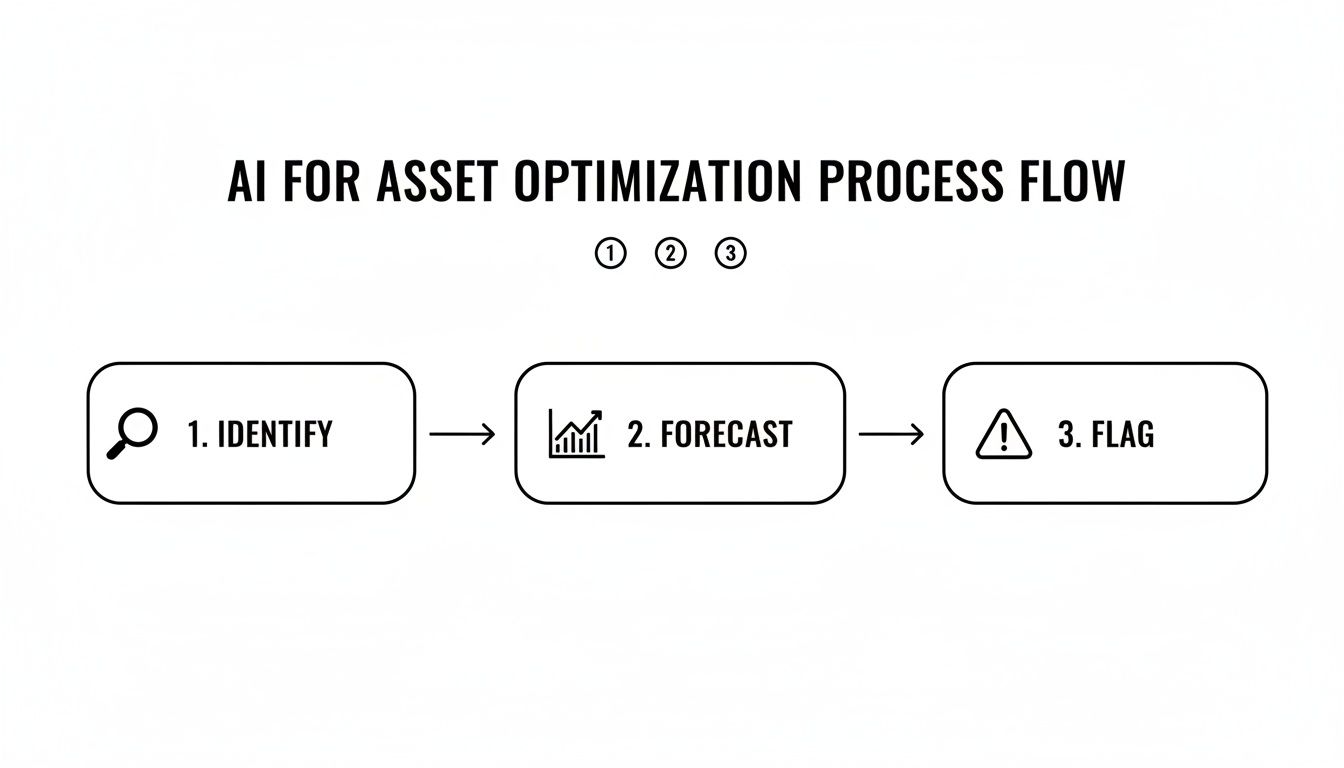
This cycle of identifying assets, forecasting needs, and flagging issues becomes a core component of daily operations.
The real goal here is to make smart asset management an automatic, unavoidable part of how your business works—from the moment an employee is onboarded to every single software request.
During this phase, you will define clear workflows for software requests, approvals, deployment, and reclamation. You will also need to develop comprehensive training materials and conduct awareness campaigns to ensure enterprise-wide adoption of the new governance framework.
Phase 4: Continuous Optimisation
A successful SAM programme is never static; it is an ongoing business function. This final phase is a perpetual cycle of monitoring, measurement, and refinement. With established tools and processes, you can now leverage the data they generate to drive continuous improvement and identify new opportunities for value creation.
This is where the strategic power of software and asset management is fully realised. The organisation moves beyond simple compliance checks to making strategic decisions informed by empirical data. The insights gathered can inform vendor negotiations, guide technology strategy, and highlight areas for process improvement. To further this, many forward-thinking organisations develop a formal AI strategy to scale these optimisations across the enterprise.
To maintain momentum, it is imperative to track progress against the Key Performance Indicators (KPIs) established in the planning phase. These metrics provide the evidence that your programme is delivering tangible value and warrants continued investment.
Key Performance Indicators (KPIs) By Implementation Phase
Tracking relevant metrics at each stage is essential to demonstrate the value of your SAM programme. This table outlines some of the most relevant KPIs to focus on as you progress through the implementation.
| Implementation Phase | Primary KPI | Secondary KPI | Business Outcome |
|---|---|---|---|
| Phase 1: Discovery | Accuracy of initial inventory (>90% of critical assets identified) | Percentage of stakeholders engaged | Establishes a reliable baseline and ensures executive buy-in. |
| Phase 2: Tooling | Time to implement pilot (<90 days) | Number of successful integrations (e.g., ITSM, HR) | Validates tool effectiveness and integration capability quickly. |
| Phase 3: Integration | Process adoption rate (>85% of requests through new workflow) | Reduction in software request fulfillment time (-20%) | Embeds new governance and improves operational efficiency. |
| Phase 4: Optimisation | Cost avoidance/savings from licence optimisation (>15% annually) | Audit readiness score (>95%) | Delivers measurable ROI and significantly reduces compliance risk. |
These KPIs are not merely numbers on a dashboard; they narrate the story of your SAM programme's success. They provide the tangible evidence required to justify continued investment and to communicate achievements to your team and stakeholders.
Transforming Asset Management Into A Competitive Advantage
Throughout this guide, we have established that disciplined software and asset management is no longer an ancillary IT function. For German enterprises, it is a central pillar of corporate strategy, essential for navigating a complex economic climate.
The dialogue must evolve. We must move beyond viewing asset management as a purely defensive measure—a means to mitigate fines—and begin to recognise it as a powerful enabler of competitive advantage.
From Cost Control To Value Creation
Mature asset management provides leadership with the empirical data required to make superior strategic decisions. A real-time, accurate understanding of your technology landscape allows you to allocate capital effectively, identify automation opportunities, and invest in new digital initiatives without being encumbered by legacy waste.
This extends far beyond budget reduction. It cultivates a culture of asset intelligence, where every technology investment is directly linked to a clear business outcome. This is how a reactive IT function is transformed into a proactive business partner that enables every department to achieve its objectives.
The real goal of a modern SAM programme isn't just to manage software licences. It's to turn your entire software portfolio from a list of costs into a collection of strategic assets that actively drive your business forward.
Looking for AI Expertise?
Get in touch to explore how AI can transform your business.
A Call To Action For German Leaders
Effecting this transformation requires decisive leadership. C-level executives must champion this change, providing their teams with the processes and technology necessary to unlock the latent value in their software assets. This necessitates collaboration between IT, Finance, and Procurement, breaking down the organisational silos that foster waste and risk.
This is not a theoretical exercise. The same principle is observed when industry leaders begin using AI and digital twins to slash jet engine downtime. They are converting asset data into insights that enhance operational resilience and efficiency.
By treating software and asset management as a core strategic function, German enterprises can build a significant competitive advantage. This creates a business that is not only lean and compliant, but also agile, innovative, and positioned for market leadership. The time for action is now.
Frequently Asked Questions
In discussions with leadership teams regarding software and asset management, a consistent set of critical questions emerges. The following provides direct answers tailored for executives and managers in Germany, focusing on implementation, compliance, and financial returns.
What’s the Realistic ROI of a SAM Programme?
A return on investment for a Software Asset Management (SAM) programme can realistically be expected within the first 12 to 18 months. The initial returns are generated from immediate cost avoidance. Identifying and eliminating unused licences or consolidating redundant applications typically reduces software expenditure by 15% to 30% in the first year.
Ready to Build Your AI Project?
Let's discuss how we can help you ship your AI project in weeks instead of months.
Longer-term value is derived from risk mitigation. A state of continuous audit readiness allows the organisation to avoid non-compliance penalties, which can amount to millions of euros. Furthermore, possessing accurate usage data provides significant leverage in vendor negotiations, yielding sustained savings year after year.
How Does SAM Support GDPR Compliance in Germany?
A robust SAM framework is foundational to GDPR (DSGVO) compliance. It provides a complete, authoritative inventory of all software within the organisation, which is particularly critical for cloud applications where personal data may reside. This visibility is essential for mapping data flows and fulfilling data subject access requests accurately.
Crucially, SAM helps control "shadow IT"—unsanctioned applications used by employees without approval. A well-executed programme identifies and helps eliminate tools that do not meet Germany's stringent data protection standards. This is a proactive measure to ensure that only approved, compliant software interacts with sensitive customer or employee data, thereby directly reducing the company's risk profile.
A mature software and asset management programme isn't just about counting licences. It creates a verifiable system of record that proves you’re doing your due diligence to protect personal data—a cornerstone of GDPR accountability.
What’s the First Practical Step to Get Started?
Avoid attempting a comprehensive, enterprise-wide inventory from the outset. The most effective first step is to select your top three to five highest-spend software vendors and focus your initial efforts there. This targeted approach prevents the paralysis often associated with large-scale projects and delivers rapid, demonstrable wins.
Want to Accelerate Your Innovation?
Our team of experts can help you turn ideas into production-ready solutions.
This initial review should address three fundamental questions:
- What licences do our contracts entitle us to?
- What software is actually deployed and in use?
- Where are the discrepancies between entitlement and usage?
This focused exercise will immediately highlight areas of over-expenditure or compliance risk. The findings provide a powerful, data-driven business case to secure the executive support and resources required for a full-scale SAM implementation, grounding the initiative in tangible financial outcomes from its inception.
At Reruption GmbH, we act as your co-preneurs to implement intelligent asset management strategies that deliver measurable results. We turn complex data into a competitive advantage, ensuring your technology portfolio is optimised for growth and compliance. Discover how we can transform your approach to software and asset management.