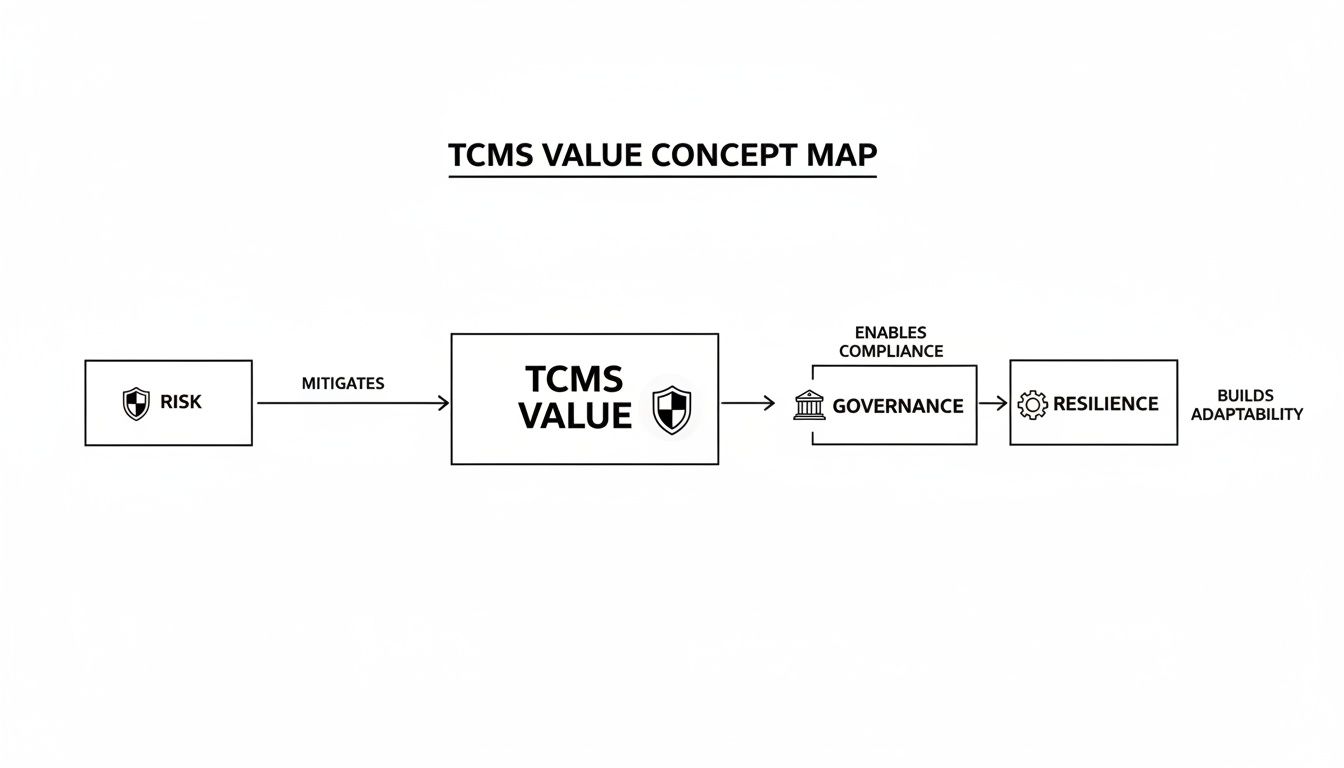
For German enterprises, the deployment of Artificial Intelligence presents a significant strategic dichotomy. On one hand, AI serves as a powerful engine for innovation and efficiency; on the other, it introduces novel and complex challenges to corporate oversight. A robust risk compliance and governance framework is not a bureaucratic constraint but a strategic enabler. It provides the essential structure required to pursue AI-driven growth with confidence while systematically mitigating its inherent risks.
The Strategic Imperative For AI Governance

For C-level executives, the discourse surrounding AI has evolved from its potential to its direct impact on profit and loss accountability. The operative question is no longer if AI will be integrated, but how to implement it in a secure, scalable, and profitable manner. This is precisely where an integrated approach to Governance, Risk, and Compliance (GRC) becomes mission-critical.
An effective GRC framework should be viewed as the strategic chassis upon which all AI initiatives are built. It ensures that ambitious concepts transition beyond isolated proofs of concept into powerful, dependable, enterprise-wide solutions. Without this foundational structure, organizations expose themselves to significant operational, financial, and reputational liabilities.
De-Risking Innovation for Competitive Agility
In the German market, where precision, quality, and reliability are paramount, the Silicon Valley maxim of "move fast and break things" is untenable. Instead, leadership must focus on methodical de-risking to build a sustainable competitive advantage. A proactive AI governance model establishes the necessary guardrails for rapid yet responsible innovation.
Ready to Build Your AI Project?
Let's discuss how we can help you ship your AI project in weeks instead of months.
A proactive, embedded approach to AI governance is crucial for transforming ambitious AI concepts into secure, scalable, and profitable enterprise-wide solutions. This moves the focus from mere compliance to creating durable business value and strategic advantage.
This approach mandates building oversight directly into the AI development lifecycle, rather than applying it as a post-facto compliance check. This deep integration is the core of effective risk compliance and governance. It ensures every AI system aligns with strategic objectives and adheres to stringent regulatory and ethical standards from its inception. The principles of system engineering in IT offer further insight into how modern infrastructure can support these advanced, integrated systems.
Key Pillars of a Modern AI Governance Strategy
To translate strategy into execution, leadership must establish the core components that form the bedrock of any successful AI governance program:
- Clear Accountability: Define explicit ownership for AI models, their underlying data, and their operational outcomes. This fosters transparent and rigorous decision-making.
- Systematic Risk Assessment: Proactively identify and quantify potential risks—from algorithmic bias to data privacy breaches—before they manifest as incidents.
- Regulatory Adherence: Ensure every AI application complies with existing and emerging regulations, such as the EU AI Act and GDPR, as well as sector-specific mandates.
- Transparent Operations: Maintain auditable records of AI model behaviour and decision-making processes. This is essential for building trust with both internal stakeholders and external regulators.
By prioritising these elements, German enterprises can unlock the full potential of AI, converting regulatory complexity into a tangible competitive advantage.
Deconstructing The GRC Framework For AI
To execute AI initiatives successfully, senior leadership must cease to view Governance, Risk, and Compliance (GRC) as siloed functions or procedural checklists. The only viable path forward is to treat them as a single, integrated system. This unified approach to risk compliance and governance is what transforms a promising AI experiment into a reliable, enterprise-ready asset.
Want to Accelerate Your Innovation?
Our team of experts can help you turn ideas into production-ready solutions.
Consider the construction of a high-performance engine. It is insufficient to merely possess powerful components; they must function in perfect concert. Each element of the GRC framework plays a critical, non-negotiable role in ensuring the final system is not only high-performing but also safe and compliant.
Governance: The Strategic Playbook
Governance is the strategic framework for all AI-related activities. It establishes the organisational structure, defining roles, responsibilities, and decision-making authority for how AI is developed, deployed, and managed across the enterprise.
It addresses critical questions: Who owns the risk if a model underperforms or fails? Who holds ultimate accountability for its daily operational efficacy? What is our defined process for approving new AI projects to ensure they align with core business objectives? Without clear answers, AI development can devolve into organisational chaos, resulting in wasted resources and unmanaged risks.
Risk Management: The Early Warning System
If governance is the playbook, then Risk Management is the system's predictive early warning mechanism. Its function is to systematically identify, analyse, and mitigate potential threats arising from the use of AI. This extends beyond technical glitches to encompass a broad spectrum of significant business threats.
Key focus areas for AI risk management include:
Looking for AI Expertise?
Get in touch to explore how AI can transform your business.
- Algorithmic Bias: Ensuring models do not produce discriminatory outcomes based on protected characteristics like gender or ethnicity.
- Data Privacy Breaches: Safeguarding the large datasets used for AI training against the exposure of sensitive customer or proprietary information.
- Operational Disruption: Managing the material risk of an AI system failure that could halt core business processes.
- Reputational Damage: Preventing scenarios where an AI's output could inflict serious harm on the corporate brand and public trust.
An effective risk management process is not about risk avoidance, which is impossible. It is about understanding potential threats with precision, making informed decisions on acceptable risk tolerance, and maintaining robust mitigation plans. The approach must be proactive, not reactive.
Compliance: The Rulebook
Finally, Compliance represents the non-negotiable set of rules. This function ensures that every AI activity adheres strictly to external laws, regulations, and internal corporate policies. For German enterprises, this involves navigating a complex landscape that includes GDPR, the forthcoming EU AI Act, and any applicable industry-specific standards.
Compliance provides the auditable evidence that AI systems are operating within legal and ethical boundaries. It translates abstract legal requirements into concrete operational actions, such as maintaining meticulous records of data lineage or ensuring a model’s decisions are explainable to a regulator.
For any organization serious about the responsible deployment of AI, a robust GRC framework must include detailed strategies for managing these legal and ethical obligations. A valuable starting point for addressing these challenges can be found in resources on mastering regulatory compliance risk management. When these three pillars—Governance, Risk, and Compliance—are engineered to work in unison, they create a powerful system that enables rapid innovation without compromising stability or integrity.
The GRC framework is not merely theoretical; it translates directly into practical actions and critical questions for your AI teams.
Ready to Build Your AI Project?
Let's discuss how we can help you ship your AI project in weeks instead of months.
The GRC Framework Applied To AI Initiatives
| GRC Pillar | Core Function | Key Questions For AI Projects | Example Application |
|---|---|---|---|
| Governance | Sets the strategy, roles, and decision-making structure. | Who owns this AI model? Who is accountable for its performance and ethical implications? How do we approve new AI use cases? | Establishing an AI Steering Committee with members from Legal, IT, and Business units to review and approve all AI projects before development begins. |
| Risk Management | Identifies, assesses, and mitigates potential harm. | What could go wrong with this model (bias, privacy, security)? What is the business impact of a failure? What are our mitigation plans? | Conducting a formal "AI Impact Assessment" before deploying a customer-facing chatbot to identify potential biases in its training data and implementing a human-in-the-loop review process. |
| Compliance | Ensures adherence to laws, regulations, and internal policies. | Does this AI system comply with GDPR and the EU AI Act? Can we prove it to an auditor? How do we document data lineage and model decisions? | Implementing a model registry that automatically logs every version of a model, the data it was trained on, and its performance metrics to meet auditability requirements. |
By systematically addressing these questions for each pillar, the abstract concept of GRC becomes a tangible instrument for building safer, more effective AI systems.
Navigating The German Regulatory Landscape
For any German enterprise seeking to implement AI, the path is governed by some of the most rigorous regulatory standards in the world. This should not be perceived as a roadblock but rather as a strategic advantage for organisations that navigate it correctly. A methodical approach, grounded in Germany's specific legal and corporate governance principles, ensures that AI initiatives are not just powerful, but also defensible and sustainable.
Between 2020 and 2024, Germany established itself as one of Europe’s most ambitious—and tightly regulated—digital environments. The revised German auditing standard IDW PS 340 n.F., effective since January 2021, mandates that any company subject to a statutory audit must operate an "early risk detection system." This requires more than just documenting risks; it necessitates a system capable of identifying and aggregating existential threats in a manner verifiable by an auditor. This has compelled large Mittelstand firms and listed corporations to formalise their risk inventories and escalation protocols.
For the C-suite, the implication is clear: any significant new technology, particularly one as potent as AI, must be deployed within a framework that can withstand intense regulatory scrutiny.
The Mandate For Auditable AI Risk Systems
The IDW PS 340 standard has profound implications for artificial intelligence. AI introduces a new class of risks—from algorithmic bias and data privacy breaches to model drift—that traditional risk registers were not designed to manage. A generic risk management checklist is no longer sufficient.
Your organisation requires a system that can:
- Proactively Identify AI-Specific Risks: This entails active monitoring for factors such as degrading model performance, anomalous outputs, and the unique security vulnerabilities inherent in machine learning systems.
- Quantify and Aggregate Risks: The system must be able to translate complex technical risks into clear business impacts that can be aggregated into an enterprise-wide risk profile.
- Provide an Auditable Trail: Every decision, from model selection to in-production monitoring protocols, must be documented and fully traceable for auditors.
This is where the interconnected functions of Governance, Risk, and Compliance become critically important.
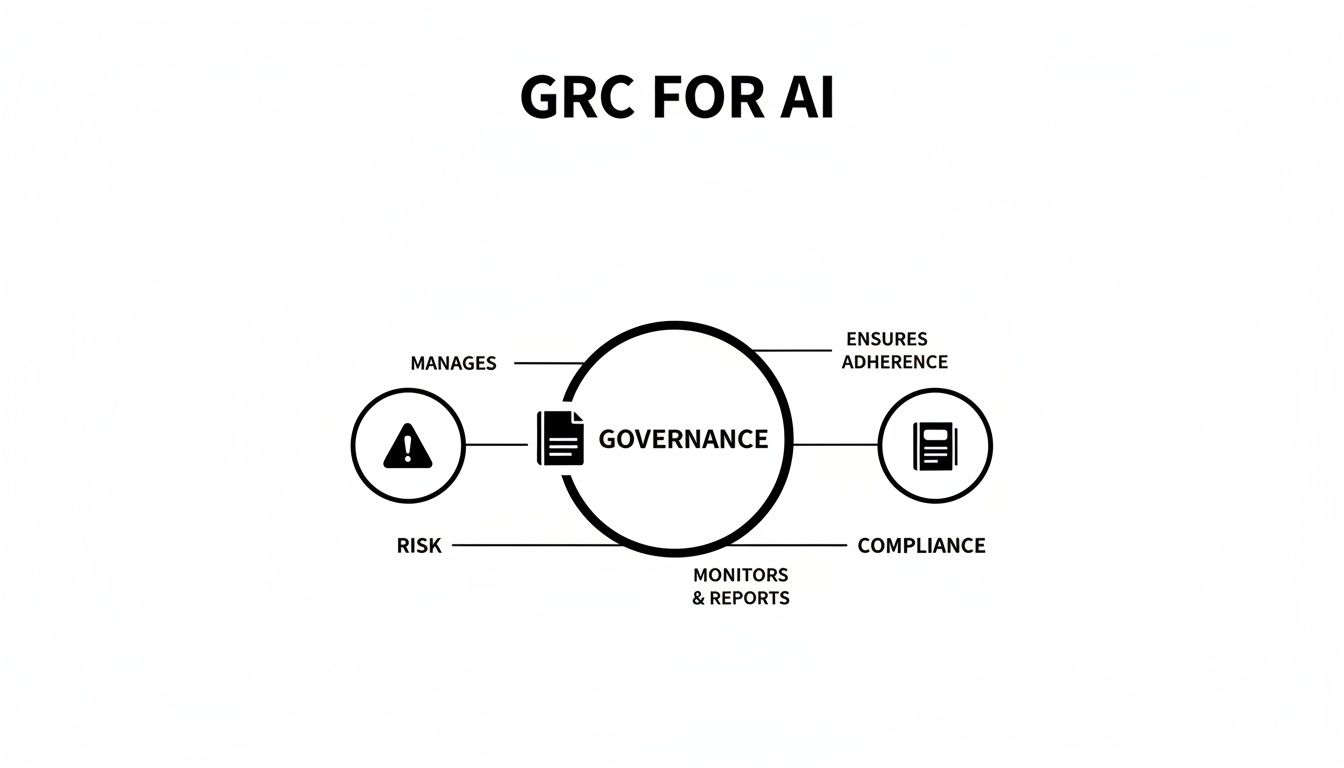
The diagram above illustrates this dynamic effectively. Successful AI implementation depends not only on the technology itself but on the continuous interplay between the strategic direction set by Governance, the protective oversight from Risk Management, and the rules-based guardrails of Compliance.
Board-Level Accountability Under The GCGC
To further underscore this point, the German Corporate Governance Codex (GCGC) was updated in 2022, introducing an additional layer of executive responsibility. It now explicitly requires a formal Compliance Management System (CMS) to be a core component of a company's internal control and risk framework.
For the management board, this means AI is no longer just an IT project; it is a governance topic. The board is now directly expected to ensure that a compliant structure is in place to manage the risks associated with such powerful technologies.
This change elevates risk, compliance, and governance from an operational function to a board-level imperative. It demands that AI projects are designed from their inception with verifiable controls, transparent reporting mechanisms, and unambiguous lines of accountability. A failure to do so is not merely a project management oversight but a potential breach of corporate governance duties. We explore these specifics in greater detail in our guide on AI in risk management and compliance for German companies.
Ultimately, these German regulations are not intended to stifle innovation. They provide a blueprint for building trustworthy, resilient, and truly enterprise-grade AI. By embracing these standards, leaders can de-risk their AI investments and establish a durable competitive advantage grounded in both operational excellence and unwavering regulatory integrity.
Building The Right AI Governance Structure
Effective AI governance is not fundamentally a technological challenge; it is an organisational one, built on people and processes. For German enterprises, the distinction between isolated AI experiments and a truly valuable, scalable asset lies in establishing a coherent structure for risk, compliance and governance.
Want to Accelerate Your Innovation?
Our team of experts can help you turn ideas into production-ready solutions.
The objective is not to create bureaucracy, but to establish clear lines of accountability and logical processes that accelerate innovation by eliminating ambiguity. This is how governance becomes an enabler, providing teams with the necessary guardrails to operate with speed and confidence.
Defining Essential Roles And Responsibilities
A primary cause of AI project failure is ambiguous ownership. When accountability is diffuse, critical details are overlooked and oversight becomes a perfunctory exercise. A high-performing governance structure places the right individuals in clearly defined roles, bridging the gap between technical expertise and strategic business objectives.
Several key roles are indispensable:
- AI Product Owner: This individual serves as the business champion for an AI initiative. They are responsible for its return on investment (ROI), ensuring alignment with corporate goals, and are ultimately accountable for its operation within the organisation's defined risk appetite.
- MLOps Lead: The technical counterpart to the Product Owner, this role oversees the entire machine learning lifecycle—from development and deployment to ongoing maintenance—ensuring system reliability, security, and performance.
- AI Ethics Board (or Council): This is the strategic steering committee. It should be a cross-functional body of senior leaders from legal, HR, data science, and key business units. They establish high-level policies for responsible AI and serve as the final arbiters on complex ethical questions.
The most effective governance structures are built upon a foundation of shared responsibility. While specific roles carry distinct accountabilities, the integrity of an AI system is a collective endeavour—from the data scientist developing the model to the executive leading the business unit it serves.
Choosing The Right Governance Model
A one-size-fits-all governance model does not exist. The optimal structure is contingent upon a company's size, corporate culture, and AI maturity level. Our observations indicate that German organisations typically adopt one of two primary models, each with distinct advantages and disadvantages for managing risk and compliance.
Looking for AI Expertise?
Get in touch to explore how AI can transform your business.
Designing the right structure is more than an organisational chart exercise. For a deeper analysis of practical implementation, consider these 10 AI Governance Best Practices.
Centralised vs Federated Governance
A centralised model consolidates all AI governance authority within a single body, typically a Centre of Excellence (CoE). This approach ensures maximum consistency and control, making it ideal for companies in highly regulated industries or those in the early stages of AI adoption, as it simplifies auditing and guarantees uniform adherence to standards.
Conversely, a federated model distributes governance responsibility. A central team establishes overarching policies and standards, but individual business units or product teams are empowered to manage their own AI projects within those guidelines. This fosters greater agility and accelerates innovation, making it a better fit for larger, more decentralised organisations with established AI capabilities. The organisational design principles behind this model share dynamics explored in the McKinsey 7-S model.
The choice represents a strategic trade-off.
Comparing AI Governance Models
Ready to Build Your AI Project?
Let's discuss how we can help you ship your AI project in weeks instead of months.
| Feature | Centralised Model | Federated Model |
|---|---|---|
| Decision Authority | Held by a single, central committee or CoE. | Distributed to business units within central guidelines. |
| Best For | Organisations starting with AI; high-risk environments. | Mature, decentralised organisations with multiple AI teams. |
| Primary Advantage | High consistency, strong control, simplified compliance. | Greater agility, faster innovation, business unit autonomy. |
| Potential Challenge | Can become a bottleneck and slow down innovation. | Risk of inconsistent application of standards if not managed well. |
The optimal structure is one that aligns with your corporate culture and strategic objectives. It must provide robust oversight without stifling the very innovation it is designed to protect. Achieving this balance transforms AI governance from an administrative burden into a significant competitive advantage.
An Actionable Roadmap For AI GRC Implementation
Execution is where strategy becomes reality. For German enterprises, the most effective method for implementing AI risk compliance and governance is not a large-scale, multi-year initiative, but a phased, iterative approach.
This methodology delivers tangible results quickly, avoids protracted delays, and allows the framework to mature in tandem with the organisation's AI capabilities. The focus is on achieving demonstrable progress and establishing robust oversight without impeding the pace of innovation.
Phase 1: Foundation and Assessment
The initial step is to establish a clear baseline. Before governing AI, it is essential to understand its current and planned presence across the organisation. This phase is an exercise in strategic visibility.
Begin by creating an inventory of all AI use cases, both active and in development. This should be treated as a strategic mapping exercise, not an exhaustive technical audit. For each use case, document its business objective, the data it consumes, and its designated owner.
Want to Accelerate Your Innovation?
Our team of experts can help you turn ideas into production-ready solutions.
With this map, conduct a high-level risk assessment. Triage each project based on its potential impact: the sensitivity of its data, its operational criticality, and its potential regulatory exposure. This prioritisation allows you to direct governance resources to the areas of highest risk first.
Phase 2: Framework Design
The next phase involves constructing the governance architecture. Here, high-level principles are translated into concrete, operational policies and processes. The objective is not a generic rulebook, but a framework tailored to your company's culture and specific regulatory environment.
Key deliverables for this phase include:
- Define AI-Specific Policies: Develop clear, concise guidelines for AI development, data handling, model validation, and ethical use. These should augment, not replace, existing corporate policies.
- Establish the Governance Body: Formally constitute the cross-functional AI Ethics Board or Steering Committee. Provide it with a clear mandate, genuine decision-making authority, and a regular cadence for meetings.
- Select Key Controls: Identify a core set of non-negotiable controls, such as mandatory bias testing for AI systems used in recruitment or stringent access controls for sensitive training datasets.
This is the critical step where the concept of "responsible AI" transitions from a corporate slogan to an operational reality.
Phase 3: Pilot and Integration
With the framework designed, it is time for practical validation. The most effective way to test the viability of your governance plan is to apply it to a live project. A pilot provides an opportunity to identify gaps, demonstrate value, and build organisational support for a full-scale rollout.
Looking for AI Expertise?
Get in touch to explore how AI can transform your business.
Select a single, high-impact AI project—ideally one identified as moderate-to-high risk in Phase 1—to serve as the pilot. Apply the new policies, controls, and governance oversight throughout its lifecycle. The direct feedback gained is invaluable.
This is also the moment for technical integration. The German market for GRC technology is expanding rapidly, driven by intense regulatory pressure. As Europe’s largest GRC platform market, valued at approximately USD 14.8 billion in 2024 and projected to grow at 12.4% annually, it is clear that any successful AI program must integrate with the primary corporate GRC stack to ensure auditable trails and controls. Further insights can be found by reviewing the European GRC platform market on imarcgroup.com.
The pilot is not just a test; it is a proof point. A successful outcome builds the business case and internal credibility required for enterprise-wide deployment. It demonstrates that governance is not a roadblock, but a guardrail for safe innovation.
Phase 4: Scale and Continuous Improvement
Following a successful pilot, you are prepared to scale the framework across the entire organisation. The lessons learned will streamline the enterprise-wide rollout, embedding risk compliance and governance into the company's operational DNA.
The task is now to systematically apply the GRC framework to all AI initiatives, both existing and new. Automate monitoring and reporting functions wherever possible. Utilise dashboards to provide leadership with a real-time view of the AI risk landscape. For a more detailed examination of this process, refer to our guide on structuring risk management and compliance.
Ready to Build Your AI Project?
Let's discuss how we can help you ship your AI project in weeks instead of months.
Crucially, the framework must not be static. The domains of AI and its regulation are in constant flux. A static governance model will quickly become obsolete. Establish a regular review cycle to ensure your framework remains sharp, relevant, and prepared for future developments.
Turning Compliance Into A Competitive Advantage

It is a common but significant strategic error to view risk, compliance, and governance solely as a cost centre. For German enterprises, a sophisticated GRC strategy is not merely a defensive measure; it is a catalyst for sustainable growth and a distinct advantage in a competitive global market.
The narrative must shift from regulatory burden to business value. When AI systems are engineered with compliance embedded from their inception, they do more than satisfy auditors. They enhance operational efficiency, build unwavering trust with customers and partners, and create opportunities in new markets.
From Regulatory Overhead To Strategic Asset
Consider the substantial administrative burden of new regulations like the Corporate Sustainability Reporting Directive (CSRD). The manual effort required for data collection, verification, and reporting is immense. It is in this context that a compliance-first AI strategy demonstrates immediate value.
Want to Accelerate Your Innovation?
Our team of experts can help you turn ideas into production-ready solutions.
This presents a significant opportunity for AI-driven innovation in Germany. AI systems can automate data aggregation, manage evidentiary records, and conduct scenario analyses for CSRD, CSDDD, and other risk audits. Such tools do not just "support compliance"—they actively reduce the recurring regulatory overhead that, by the government's own admission, costs millions of euros per regulation. For further context, refer to the OECD Regulatory Policy Outlook for Germany.
Building Trust Through Transparent AI
In a market founded on quality and reliability, trust is the ultimate currency. A robust AI GRC framework provides the auditable proof that your systems are fair, secure, and unbiased. This level of transparency is no longer a discretionary feature; it is a fundamental expectation of customers, partners, and regulators.
By demonstrating responsible stewardship of data and algorithms, German companies can command a market premium, attract top-tier talent, and forge stronger relationships with enterprise clients who prioritise integrity. This is how regulatory requirements are transformed into a strategic advantage.
This proactive governance posture also strengthens cybersecurity. A structured methodology for managing AI risk is intrinsically linked to cyber resilience. Our insights on building a robust defence, as detailed in our work on cyber security consultancy, can provide valuable guidance in this area.
Ultimately, the enterprises that master risk, compliance, and governance for their AI initiatives will lead the market. They will innovate faster and more securely, converting perceived obstacles into the very foundation of their competitive advantage. It is a methodical, de-risked approach that secures not just current projects, but long-term enterprise value.
Frequently Asked Questions About AI GRC
Implementing a formal AI risk, compliance, and governance program will inevitably raise challenging questions. Addressing these issues directly is the only way to align technical teams and business leadership toward the common goal of responsible innovation.
Here are some of the most common questions we encounter from German enterprises, along with our direct responses.
We Have AI Projects in Operation but No Formal GRC. Where Should We Begin?
First, conduct a rapid inventory of all AI projects to identify the areas of highest risk. This does not need to be an exhaustive audit. Assemble a small, cross-functional team from legal, IT, and relevant business units to create a clear overview of AI activities.
Prioritise projects based on their risk profile, considering the data they use, their business criticality, and applicable regulations. Select the single highest-risk project to serve as a pilot. Use this project to establish a "minimum viable" GRC process: document its purpose, data sources, and decision-making logic. This approach builds momentum and demonstrates immediate value without halting operations.
How Do We Govern AI Without Hindering the Agility of Our Teams?
The objective is to implement guardrails, not roadblocks. The framework should enable, not restrict, your teams. A federated governance model is particularly effective here: a central body sets the standards and provides expertise, while innovation teams operate with autonomy within these defined boundaries.
Looking for AI Expertise?
Get in touch to explore how AI can transform your business.
The purpose of AI governance is to enable innovation safely and at speed. When controls are integrated directly into the development workflow, compliance ceases to be a bureaucratic hurdle and becomes a shared responsibility. This approach actually accelerates delivery by identifying issues early, not at the final stage.
Do not treat GRC as a final inspection. Integrate checkpoints into your agile sprints. Provide teams with automated tools for security scanning or bias detection. When compliance is an intrinsic part of the process, you achieve both speed and rigour.
What are the Most Critical KPIs for Our AI GRC Programme?
Effective KPIs should provide a holistic view. A balanced set of metrics covering risk, operations, and business value is essential. Avoid vanity metrics that lack substantive meaning.
Consider a balanced scorecard approach for your program:
- Risk Management: Track the number of AI-related risks identified and mitigated prior to deployment. This metric demonstrates a proactive posture.
- Compliance: Measure the percentage of high-risk AI models with complete, audit-ready documentation. This proves readiness for regulatory scrutiny.
- Operational Health: Monitor the rate of model performance drift over time. This indicates the ongoing reliability of your AI systems.
Crucially, you must link GRC activities to business outcomes. Track metrics such as "Cost savings from automated compliance tasks" or "Revenue generated by AI systems operating within the defined risk appetite." This makes it unequivocally clear that your risk, compliance, and governance program is not merely a cost centre, but a core contributor to a resilient and growing enterprise.
Ready to Build Your AI Project?
Let's discuss how we can help you ship your AI project in weeks instead of months.
At Reruption GmbH, we act as Co-Preneurs, partnering with you to implement AI strategies that are not only innovative but also secure and compliant from day one. We help turn your ambitious ideas into production-ready innovations with P&L accountability. https://www.reruption.com