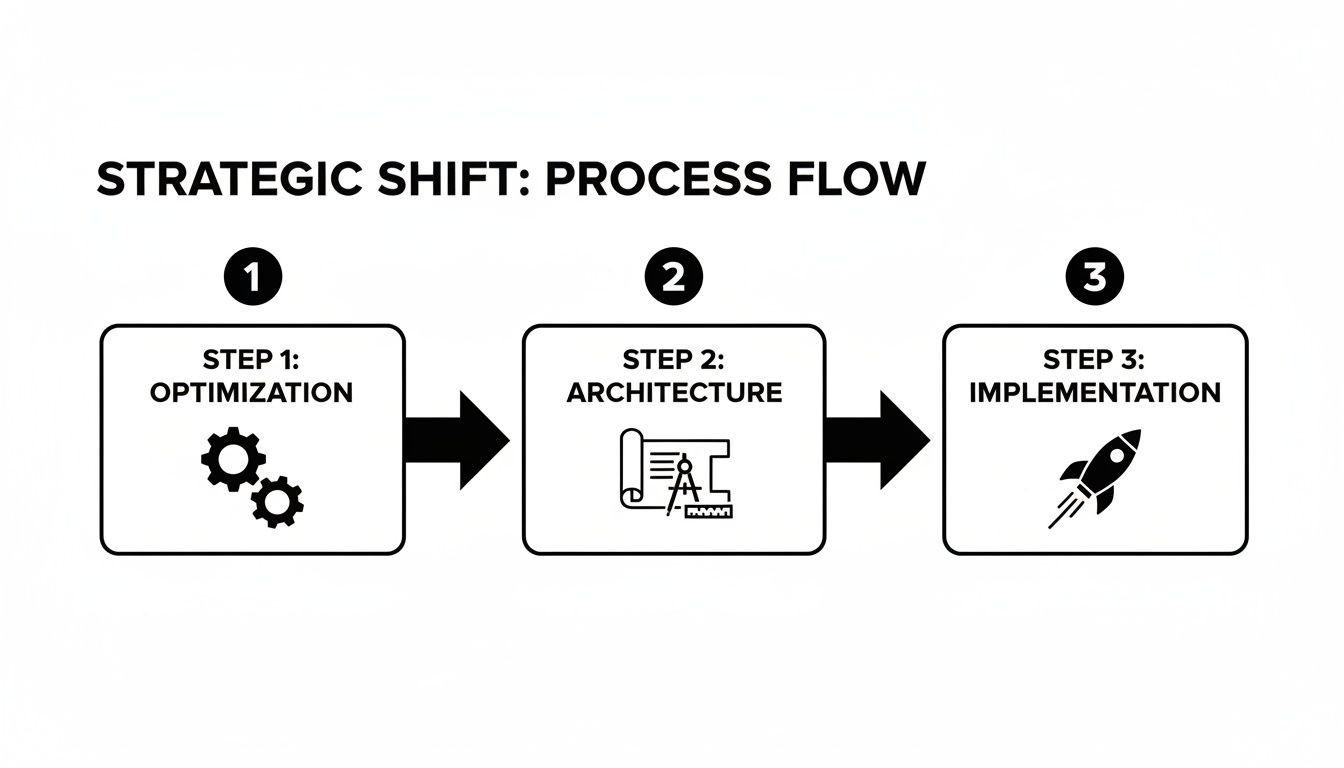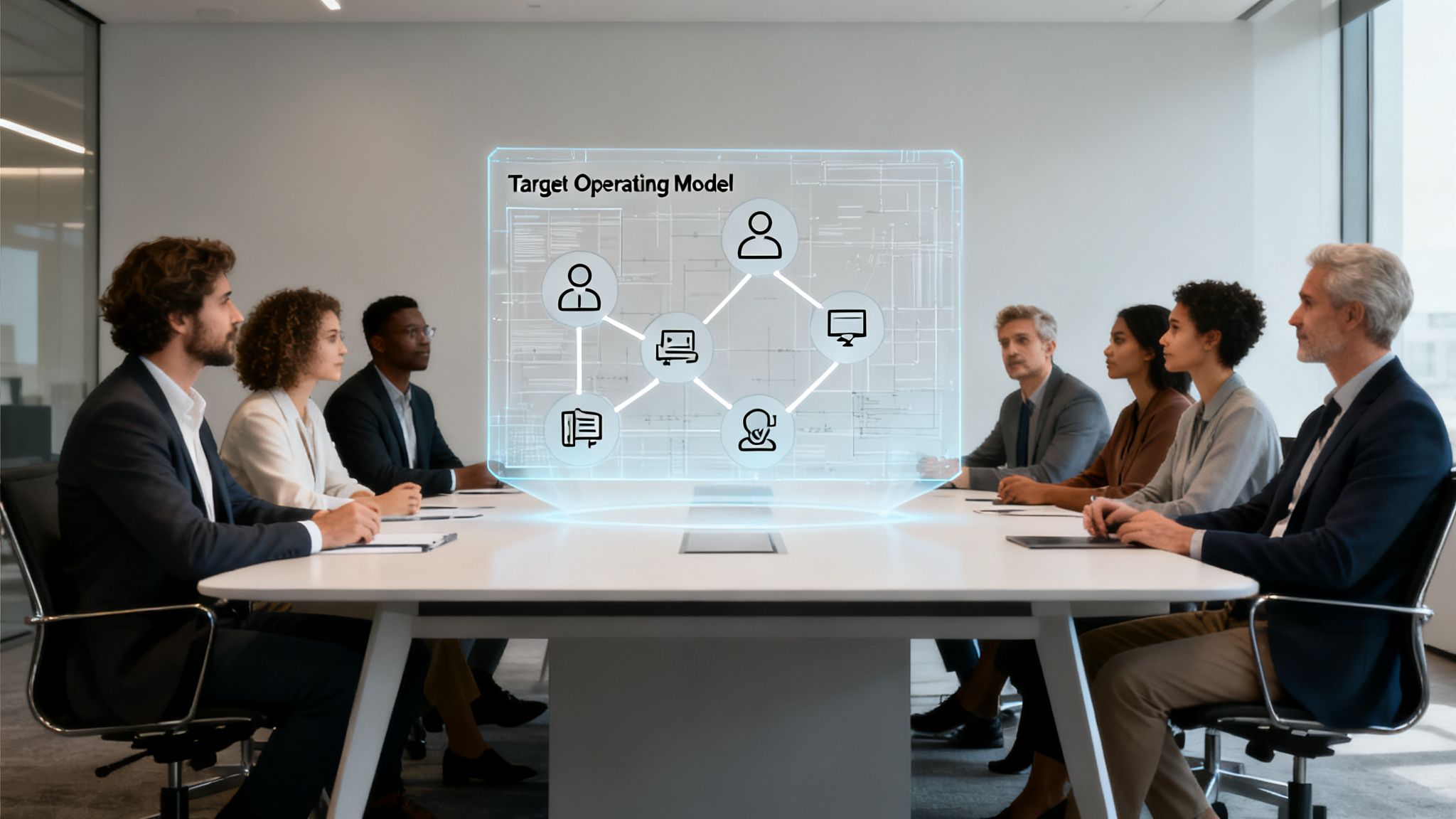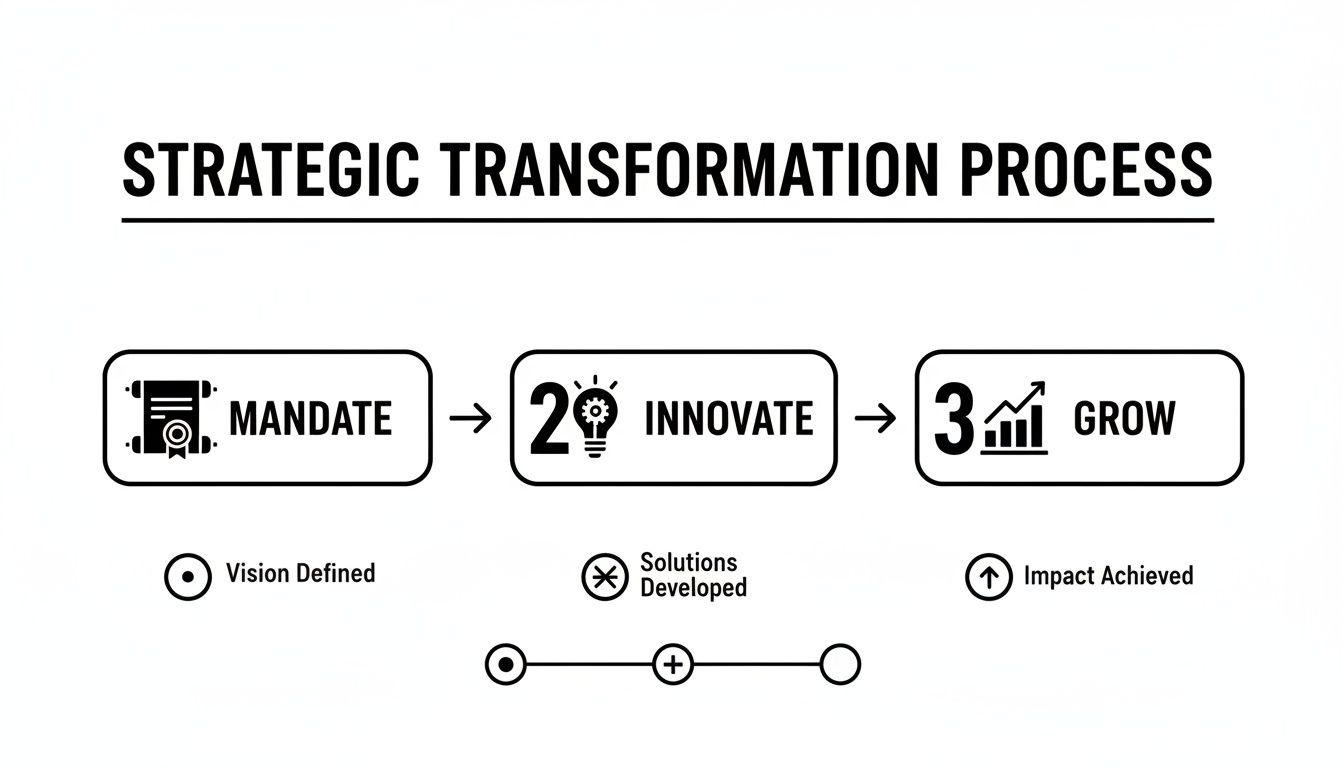
In a market defined by perpetual change, agility is not merely an advantage—it is a prerequisite for survival. For senior leaders in Germany, navigating digital transformation, integrating artificial intelligence, and countering global competition are daily imperatives. The McKinsey 7S Framework is not an academic relic; it is a pragmatic diagnostic instrument for guiding an enterprise through such turbulence.
Why Organisational Alignment Is Your Strategic Imperative
Consider the framework as a methodology for achieving a comprehensive, 360-degree view of your organisation, ensuring every component operates in unison with your strategic intent. It is an indispensable leadership tool for synchronising everything from human capital to operational processes. When executed effectively, this alignment becomes a formidable competitive advantage.
It is, in essence, the architectural blueprint for your enterprise. A building requires a solid foundation, aligned structural supports, and functional systems to remain sound. Your company is no different. A brilliant strategy will fail if the organisational structure fosters silos, if personnel lack requisite skills, or if internal systems create operational friction.
The Quantifiable Impact of Alignment
Misalignment is not an abstract concept; it incurs tangible costs through employee attrition, diminished efficiency, and direct impact on profitability. Conversely, achieving alignment delivers measurable returns, particularly during significant transformations such as mergers or major technology deployments.
Research on German mid-cap and large-cap companies from 2018–2021 substantiates this. Mergers that integrated a 7S alignment analysis within the initial 90 days improved their EBITDA margin by an average of 3.4 percentage points within one year.
Ready to Build Your AI Project?
Let's discuss how we can help you ship your AI project in weeks instead of months.
This represents a significant gain compared to the 1.1 percentage points observed in mergers focused solely on structural reorganisation. Furthermore, this holistic approach reduced voluntary staff turnover in the acquired entity to just 11%, versus 19% where alignment was neglected.
This data underscores a critical lesson for any executive: attending to the interplay between strategy, structure, systems, and people is not a "soft" initiative. It is a core driver of commercial success and talent retention. The same logic applies directly to enterprise modernisation, a theme explored in our guide to digital transformation in banking.
Understanding The Seven Core Elements of Your Organisation
The McKinsey 7S Framework delineates an organisation across seven distinct yet deeply interconnected domains. It functions less as a checklist and more as an organisational MRI—a detailed scan of your company's internal health and the synergy between its components.
These elements are not independent silos. They form a web of dependencies where a change in one inevitably creates reverberations throughout the others.
For leaders in Germany navigating today's complex market demands, mastering this interplay is essential. A decision to enter a new market or integrate AI is never solely a strategic one. It immediately impacts your existing structure, the systems supporting it, and the skills of the personnel tasked with its execution.
Want to Accelerate Your Innovation?
Our team of experts can help you turn ideas into production-ready solutions.
To facilitate comprehension, the framework is logically partitioned into two categories.
The Hard Elements: Your Organisational Architecture
The 'Hard S's' are the tangible, logical components of your company. These are the elements that management can most directly control and define through strategic decisions, formal processes, and official documentation. They represent the skeleton and central nervous system of your operations.
- Strategy: Your plan for achieving competitive advantage. It defines where you will compete, how you will secure an edge, and the specific actions required to achieve your objectives. Your strategy is the North Star that must guide every other element.
- Structure: This describes the organisational architecture—reporting lines, departmental divisions, and the overall chain of command. It dictates how work is allocated, how teams coordinate, and where decision-making authority resides.
- Systems: These are the formal processes and procedures that govern daily operations. Systems encompass everything from your financial and HR processes to your core IT infrastructure and operational workflows. They are the mechanisms that enable the business to function.
Neglecting the Hard Elements results in immediate and conspicuous operational failures. A brilliant strategy remains a theoretical document without the requisite structure and systems to operationalise it.
The Soft Elements: Your Organisational Character
The 'Soft S's' are less tangible and more deeply rooted in your company's culture. These elements are often more difficult to define and influence, yet they frequently determine the success or failure of change initiatives. They represent the culture, capabilities, and collective mindset of your people.
- Shared Values: Also known as 'Superordinate Goals', these are the core beliefs central to your company's identity. They are the principles that influence behaviour and shape the organisational culture, acting as the corporate conscience.
- Skills: This refers to the distinctive capabilities and core competencies of the organisation as a whole. It is not merely about individual employee talents, but about what your company does exceptionally well—be it world-class engineering, superior customer service, or rapid innovation.
- Style: This is the leadership approach of senior management and the organisation's overall operational ethos. It dictates how leaders interact with their teams, their areas of focus, and their decision-making processes, thereby setting the tone for the entire enterprise.
- Staff: This element pertains to your human capital—how you manage talent, recruit, train, and develop your employees. It addresses the critical question: do we have the right people, in the right roles, with the right motivation?
The following table provides a concise summary of all seven elements.
The McKinsey 7S Framework at a Glance
| Category | Element | Description | Strategic Focus |
|---|---|---|---|
| Hard S's | Strategy | The plan to build and maintain a competitive advantage over the competition. | Resource allocation, market positioning, goal setting. |
| Hard S's | Structure | The way the organisation's units relate to each other: centralised, decentralised, matrix, etc. | Coordination, communication channels, decision-making authority. |
| Hard S's | Systems | The procedures, processes, and routines that characterise how work should be done. | Workflow efficiency, control mechanisms, information flow. |
| Soft S's | Shared Values | The core values of the company that are evidenced in the corporate culture and the general work ethic. | Guiding principles, organisational identity, employee behaviour. |
| Soft S's | Skills | The actual skills and competencies of the company's employees. | Talent development, capability gaps, competitive differentiation. |
| Soft S's | Style | The style of leadership adopted. | Management behaviour, employee engagement, cultural tone. |
| Soft S's | Staff | The organisation's people and their general capabilities. | Recruitment, development, motivation, talent management. |
A systematic evaluation of each provides a complete picture of your organisation's current state.
The following chart illustrates how aligning these elements during major transformations, such as post-merger integrations, can lead to measurable improvements in key business metrics.
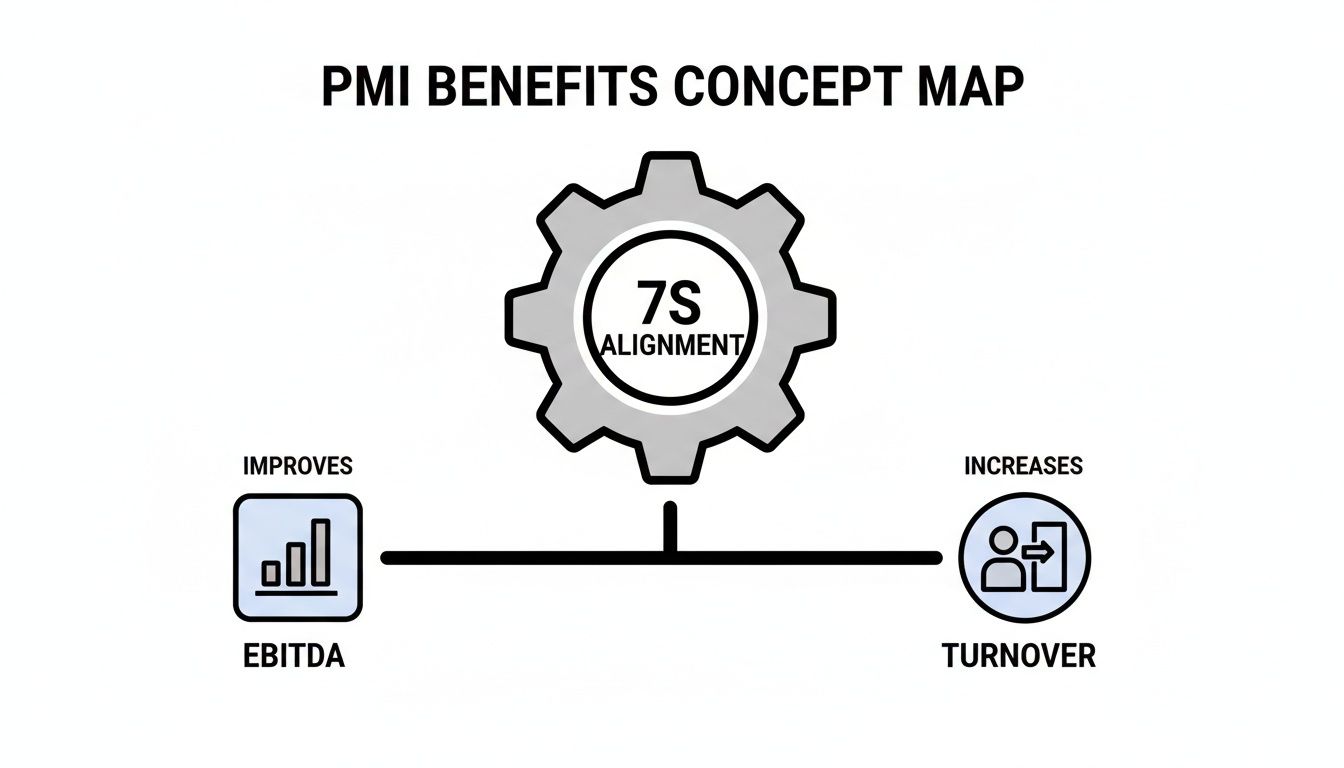
This is not merely theoretical. The visual demonstrates a direct correlation between 7S alignment and enhanced performance, translating abstract concepts into tangible gains in financial health and talent retention.
The core insight of the McKinsey 7S framework is that organisational effectiveness isn’t about perfecting one element in isolation. It’s the product of achieving a dynamic harmony among all seven.
Looking for AI Expertise?
Get in touch to explore how AI can transform your business.
A misalignment between these 'Hard' and 'Soft' elements is where most strategic initiatives falter. For instance, launching a new AI-driven strategy (Strategy) will fail if your teams lack data literacy (Skills), your leadership punishes experimentation (Style), and your legacy IT (Systems) cannot support the data requirements.
Each 'S' must be considered and recalibrated in concert with the others. For a deeper analysis, our perspectives on modern business management and consulting may prove valuable. Preparing leaders to utilise this model as a diagnostic tool is the first step toward building a truly aligned and agile organisation.
A Practical Guide to Diagnosing Your Organisation
Understanding the seven elements of the McKinsey framework is foundational. However, its true value is realised not in theory but in application. The diagnostic phase is where leadership must conduct a rigorous, methodical examination of the organisation to identify the misalignments impeding performance.
This is not a top-down executive exercise; it is a collaborative investigation. It necessitates assembling a cross-functional team, incorporating perspectives from various departments and hierarchical levels. This approach is critical for obtaining a holistic view—one informed by those who operate within the company’s systems and culture daily, not just the perspective from the boardroom.
The diagnostic itself is a structured, four-step process.
1. Analyse Your Current State (As-Is)
The initial step is to establish an objective, evidence-based assessment of the organisation's current operational reality. This is your "As-Is" analysis. For each of the seven elements, your team must gather data and address critical questions to define a baseline.
This requires collecting both quantitative and qualitative data. Financial reports and process cycle times provide objective metrics for 'Systems', while employee surveys and structured interviews offer invaluable insights into 'Style' and 'Shared Values'. The objective is to move beyond assumptions and document reality.
An honest "As-Is" assessment is the most critical component of the process. Without a clear and accurate understanding of your starting point, any plan for change is built on a foundation of guesswork.
It is at this stage that points of friction become apparent. For example, your official Strategy may prioritise customer-centric innovation, yet your Systems (e.g., incentive structures) may exclusively reward cost reduction. This represents a fundamental conflict.
2. Define Your Desired Future State (To-Be)
With a clear understanding of the present, the next step is to define the future. This is the "To-Be" analysis. To execute your strategy and achieve market leadership, what must the organisation look like? This is not about crafting a vague vision statement; it is about a concrete description of how each of the seven elements must operate.
Ready to Build Your AI Project?
Let's discuss how we can help you ship your AI project in weeks instead of months.
For example, if the strategic objective is to integrate AI into core operations, your "To-Be" state might be defined as:
- Structure: A new, empowered data science unit that collaborates seamlessly with traditional business functions.
- Skills: A workforce where a significant percentage of employees possess strong data literacy competencies.
- Systems: Agile development methodologies and robust data governance are standard operating procedures.
This "To-Be" model becomes your blueprint for transformation. It provides a clear destination for all stakeholders, aligning leadership and guiding subsequent decisions. For another perspective on this challenge, consider this article on fixing internal alignment through a VUCA lens.
3. Identify Gaps and Misalignments
The next phase is the Gap Analysis—comparing your "As-Is" reality with your "To-Be" ambition. Here, the 7s of McKinsey model demonstrates its power as a diagnostic tool. By systematically contrasting the present with the future for each 'S', you can pinpoint the exact points of friction and inconsistency.
This is where you identify precisely where the organisation is misaligned. You might discover a chasm between your stated 'Shared Values' of collaboration and a 'Structure' that fosters inter-departmental competition. These gaps become the primary targets for your change initiatives.
4. Develop a Concrete Action Plan
Finally, these insights must be translated into an actionable plan. For every identified gap, a specific, measurable initiative is required to close it. The plan must define what needs to change, who has ownership, the timeline for completion, and the metrics for success.
Want to Accelerate Your Innovation?
Our team of experts can help you turn ideas into production-ready solutions.
This structured approach is proven to be effective, even in highly complex organisations. For example, a 2019–2023 federal study of digitalisation projects in German municipalities revealed compelling statistics. Projects that employed structured frameworks like the 7s of McKinsey achieved operational adoption rates of 68% after 18 months. In contrast, those without such a framework reached only 42%.
The report also found that 54% of failing projects exhibited weak links between 'Strategy' and 'Structure', demonstrating the criticality of a holistic view. This data is a powerful reminder that progressing from a sharp diagnosis to a structured action plan is what transforms the concept of alignment into measurable results.
Navigating AI Transformation with the 7S Framework
Integrating artificial intelligence is a profound organisational transformation, not a simple technology upgrade. It fundamentally alters how your business operates, makes decisions, and creates value. For any leader, viewing this change through the lens of the McKinsey 7S framework is the most effective way to avoid the common pitfall of prioritising technology over strategy.

Let us examine a practical scenario. Consider an established German automotive supplier, "AutoFertigung GmbH," facing intense pressure to enhance efficiency and reduce costly downtime. The board resolves to implement an AI-powered predictive maintenance model for its production lines.
Looking for AI Expertise?
Get in touch to explore how AI can transform your business.
This is a fundamental change, and the leadership team approaches it systematically. They use the 7S model to map the entire transformation, ensuring all seven elements are aligned toward the new objective.
Realigning the Hard Elements for an AI Future
The initial focus is typically on the tangible components of the organisation. The leaders at AutoFertigung understand that a new strategy requires a new supporting architecture.
Strategy: The objective shifts from reactive maintenance to proactive, data-driven prediction. The new goal is to achieve near-zero unplanned downtime within three years by leveraging AI to anticipate machine failures.
Structure: The traditional, hierarchical engineering department is inadequate for this new paradigm. Consequently, a new, agile "Data & Analytics" division is established, reporting directly to the COO. This team is designed to operate horizontally, collaborating with production and IT to break down silos and accelerate data flow and model deployment.
Systems: This involves building the new technological and procedural backbone. The company invests in a modern MLOps (Machine Learning Operations) platform to manage the entire lifecycle of its predictive models. Concurrently, it implements new data governance protocols to ensure the integrity and security of data from the factory floor to the cloud. Managing these complex IT environments is a specialised discipline; a firm grasp of system engineering for IT is non-negotiable for building a sustainable system.
Ready to Build Your AI Project?
Let's discuss how we can help you ship your AI project in weeks instead of months.
Cultivating the Soft Elements for AI Adoption
While changes to the hard elements are visible on an organisational chart, the leadership team knows the true challenge lies in transforming the company's culture and skills. Without aligning the "soft S's," even the most advanced systems and brilliant strategies are destined to fail.
An AI transformation is ultimately a human transformation. The success of the initiative hinges less on the sophistication of the algorithms and more on the organisation's ability to adapt its culture, skills, and values to a data-centric mindset.
This principle shapes their approach to the people-focused elements of the framework.
Skills: A significant skills gap is immediately identified. The company launches a mandatory data literacy program for all production managers and engineers. Simultaneously, it partners with technical universities to develop specialised training for the new data science team, ensuring their capabilities remain at the cutting edge.
Staff: Recruiting top-tier data scientists and ML engineers becomes a strategic priority. To attract and retain this talent, they establish new career paths distinct from the traditional engineering ladder, offering specialised growth opportunities. As you consider upgrading skills for technological shifts, understanding the transformative impact of AI on corporate training is crucial for building a future-ready team.
Want to Accelerate Your Innovation?
Our team of experts can help you turn ideas into production-ready solutions.
Style: The leadership team makes a conscious decision to evolve its management approach. The purely top-down, command-and-control model is replaced by a style that encourages experimentation, accepts that some model tests will fail, and celebrates data-backed decision-making at all levels.
Shared Values: This is the most critical and long-term component: shifting the company's core DNA. A new guiding principle is introduced: "Data is our most valuable asset." This is more than a slogan; it is reinforced through internal communications that celebrate predictive "saves" and recognise teams that leverage data to solve tangible problems. This is how a data-first culture is built, from the shop floor to the C-suite.
By systematically addressing each of the 7s of McKinsey, AutoFertigung GmbH executes a comprehensive transformation. They do not merely purchase new software. Instead, they realign their entire organisation to become a genuinely AI-driven company. This example demonstrates that the framework is not merely theoretical—it is an essential roadmap for navigating the complex realities of modern industrial change.
Common Implementation Pitfalls And How To Avoid Them
Even the most robust frameworks can fail if improperly applied. When navigating a major organisational transformation using the 7S of McKinsey, it is crucial to anticipate the common obstacles that derail even well-intentioned leadership teams. Success depends not only on a sharp analysis but on the rigour and quality of the subsequent implementation.

Many leadership teams fall into predictable traps. Identifying these pitfalls early is the first step toward architecting a change initiative that delivers results, rather than a report that gathers dust.
Neglecting the 'Soft' Elements
A classic error is to focus almost exclusively on the 'Hard' elements—Strategy, Structure, and Systems. This is understandable, as these are tangible, quantifiable, and feel more directly controllable. However, true, sustainable alignment is achieved only when the 'Soft' elements receive equal attention.
A new corporate structure is rendered ineffective if the leadership Style remains unchanged, or if the Staff lack the requisite Skills to operate within the new paradigm. Ignoring the cultural fabric of your organisation is a recipe for failure.
Corrective Action: Assign a dedicated executive champion for each of the seven elements. Ensure the champions for 'Shared Values' and 'Skills' have equivalent influence in planning sessions as the champion for 'Structure'.
The Ivory Tower Analysis
Another frequent misstep is conducting the 7S analysis as a closed-door, top-down exercise. When the entire assessment is confined to the C-suite, it invariably misses the operational realities on the ground. This approach not only yields a distorted picture but also fosters resentment among employees.
Looking for AI Expertise?
Get in touch to explore how AI can transform your business.
Genuine insight is not generated in a boardroom. It emerges from incorporating a cross-section of your organisation into the diagnostic process. The perspectives of middle managers and frontline staff are not 'nice to have'; they are essential for an accurate 'As-Is' assessment.
Corrective Action: Institute formal feedback loops and workshops that include participants from different functions and hierarchical levels. This not only improves data quality but also begins to build the buy-in necessary for the impending changes.
The 'One and Done' Mentality
Treating the 7S framework as a one-off project with a defined endpoint is a significant error. Business environments are dynamic; therefore, organisational alignment cannot be a static achievement. It requires continuous attention and adjustment.
Corrective Action: Integrate a streamlined 7S review into your annual strategic planning cycle. This transforms the framework from a reactive crisis-management tool into a proactive instrument for maintaining organisational health and agility.
Analysis Without Action
This is the most detrimental pitfall: a brilliantly executed analysis that culminates in a detailed report... and nothing more. Without allocated budget, resources, and a clear action plan, the identified gaps remain unaddressed. Insights without implementation are worthless.
Ready to Build Your AI Project?
Let's discuss how we can help you ship your AI project in weeks instead of months.
Corrective Action: Every identified misalignment must be translated into a concrete initiative with an assigned owner, a budget, and clear KPIs. This is the mechanism that connects diagnostic work to real-world execution and is a core tenet of effective risk management and compliance.
Some Final Questions About the 7S Framework
As you consider leveraging the 7S of McKinsey model, several practical questions invariably arise. Addressing these will provide clarity on how and when to best apply this powerful tool.
How Often Should We Run a 7S Analysis?
The optimal frequency depends on your organisation's operational tempo. However, this is not a tool to be reserved for emergencies.
A full-scale analysis is imperative at major strategic inflection points. These include mergers, new market entries, or foundational shifts like the integration of AI into core business processes. Such events disrupt the entire system, and a 7S analysis is essential to ensure all components are aligned for the new trajectory.
Beyond these critical junctures, conducting a lighter, annual review as part of your standard strategic planning process is a prudent practice. It shifts the framework from a reactive tool to a proactive health check, enabling you to identify and correct minor misalignments before they escalate into significant performance impediments.
Can We Use the 7S Framework for Just One Department?
Certainly. The model is highly scalable. While renowned for enterprise-wide analysis, it is equally effective for diagnosing issues within a single team, business unit, or department.
Applying the 7S of McKinsey to a specific function, such as marketing or IT, can illuminate localised dysfunctions. It allows a departmental head to clearly assess how their team's internal configuration—its skills, systems, and structure—either supports or conflicts with broader corporate objectives.
The real work in a 7S-driven change isn't redrawing the org chart or buying new software. The toughest part is always shifting the 'Soft' stuff—the deeply ingrained habits, cultural norms, and leadership styles that define how people actually behave day-to-day.
What's the Biggest Hurdle When Making 7S-Driven Changes?
The most significant challenge almost always lies within the 'Soft' elements. It is relatively straightforward to redesign an organisational chart ('Structure') or implement new software ('Systems'). It is profoundly more difficult to alter a company's deep-seated culture ('Shared Values') or the ingrained behaviours of its leaders ('Style').
Overcoming this inertia requires concerted and sustained effort. It demands that leaders act as visible champions of the new operational model, that small wins validating the new culture are celebrated, and that reward systems are reconfigured to incentivise new behaviours over old ones.
How Does the 7S Model Fit in with Frameworks Like OKRs?
This is an excellent question. The 7S model and Objectives and Key Results (OKRs) are complementary, not competing, frameworks. They serve two distinct but synergistic purposes.
- McKinsey 7S Framework: This is your internal diagnostic tool. It is used to assess the health of your organisation, ensuring all its parts work in concert and are capable of executing the strategy.
- OKRs: This is a goal-setting and execution framework. Its function is to focus, align, and motivate the entire organisation toward specific, measurable targets.
Consider them sequentially. You use the 7S analysis first to ensure your organisational 'engine' is correctly built and running smoothly. Once you have confirmed the integrity of the system, you can employ a framework like OKRs to set a destination and monitor progress. Attempting to implement an ambitious OKR plan within a misaligned organisation is a formula for failure—the underlying structure cannot support the stated goals.
Turning Alignment into a Competitive Advantage
Ultimately, the McKinsey 7S Framework is not a static diagram for occasional reference. It should be viewed as a dynamic leadership tool—a compass for navigating organisational complexity. True alignment is not a final destination; it is a continuous process of calibration and optimisation.
In a market characterised by relentless change, the ability to continually adjust and harmonise the moving parts of your enterprise is what distinguishes enduring companies from those that are left behind.
The 7S model provides a common lexicon and a structured methodology for discussing this complexity. It elevates critical conversations from departmental silos to the strategic, enterprise-wide level. Mastering this internal orchestration is the source of genuine, sustainable competitive advantage.
From Diagnosis to Dominance
Whether navigating a post-merger integration, launching a large-scale digital transformation, or committing to AI adoption, the 7S lens is indispensable. It enables you to see beyond the allure of new technology or ambitious financial targets.
Viewing your initiatives through this framework transforms a high-stakes gamble into a calculated strategic manoeuvre. It compels you to confront the human and cultural factors that, more often than not, determine the success or failure of major projects.
The primary function of any executive team is to build an organisation that not only survives disruption but thrives on it. The 7S framework is a critical instrument in the leadership toolkit for building that calibre of resilience and performance.
By deliberately aligning your Strategy, Structure, Systems, Shared Values, Skills, Style, and Staff, you create a business that is far more than the sum of its parts. You build an organisation that is coherent, agile, and capable of precise execution. This deep internal harmony is the foundation upon which market leadership is built and secured.
For more on transforming data into strategic decisions, explore our expert perspectives on analytics and insights.
Want to Accelerate Your Innovation?
Our team of experts can help you turn ideas into production-ready solutions.
At Reruption GmbH, we act as your co-preneurs, helping you turn strategic ideas into market-leading innovations. We don't just consult; we take accountability for outcomes, ensuring your AI initiatives are not only planned but expertly executed. Discover how we can help you build your competitive advantage from within.