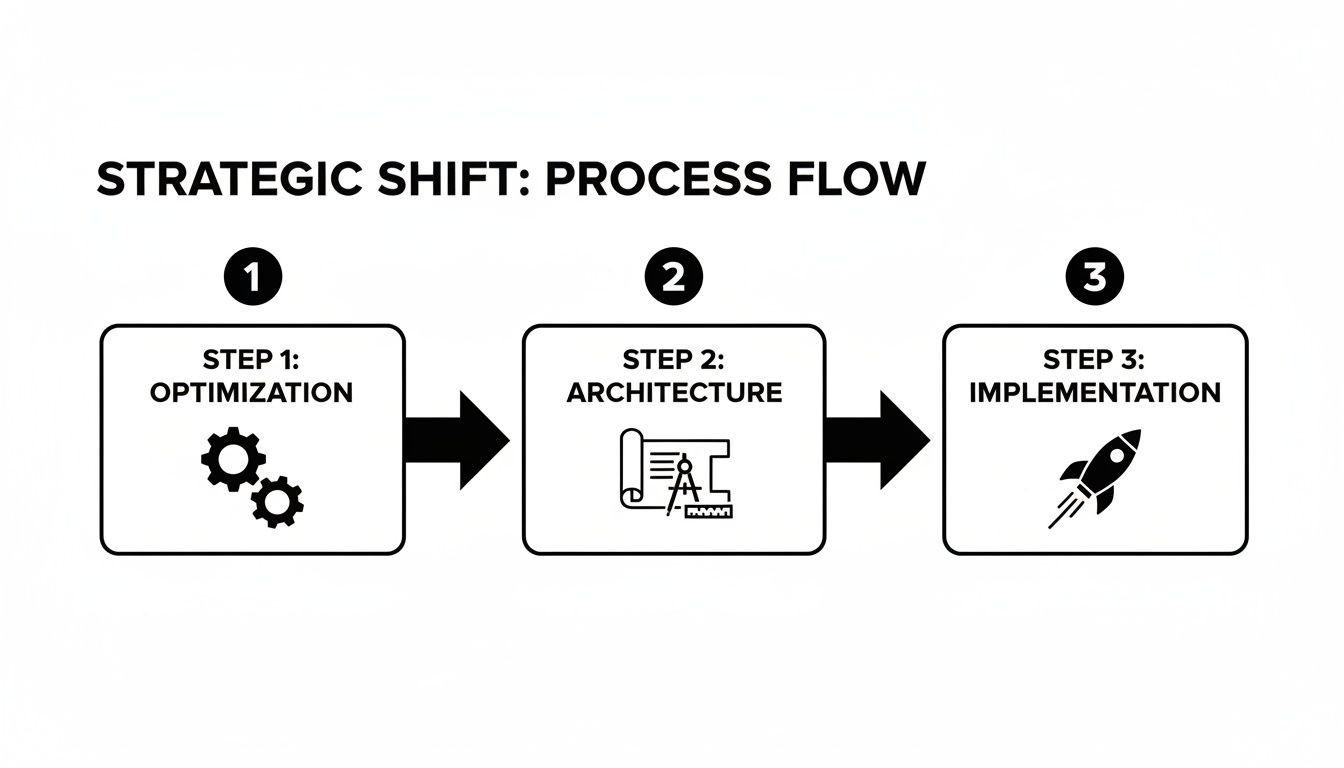
Modelling business processes provides a visual representation of how work is executed within your organization. It is the foundational prerequisite for any enterprise serious about leveraging artificial intelligence. The rationale is simple: one cannot automate what one does not fundamentally understand. This clarity is the strategic asset that enables the identification of high-impact automation opportunities, de-risks innovation, and aligns the entire organization for enterprise-wide transformation.
Why Process Modelling Is a Strategic Imperative
In today's competitive landscape, process excellence is not merely an operational goal; it is the bedrock of competitive advantage and AI readiness. For leaders in Germany’s established enterprises, the pressures to enhance agility, build resilience against market volatility, and unlock new value through artificial intelligence are immense. In this context, business process modelling transcends its role as a technical exercise to become a core leadership instrument.
Legacy process maps, often static and outdated, are inadequate. They fail to capture the dynamic, data-rich reality of modern operations and are entirely unsuitable for identifying the sophisticated AI opportunities required for a competitive edge. Modern process modelling, in contrast, establishes a clear, shared language that is understood from the operational floor to the executive suite.
This clarity is fundamental for several critical reasons:
- Identify High-Impact Opportunities: It illuminates operational bottlenecks, redundant activities, and manual, repetitive tasks that are prime candidates for AI-driven automation.
- De-Risk Innovation: It allows for the simulation of process changes before capital is deployed, enabling the validation of new concepts without disrupting live operations.
- Align the Organisation: It creates a single source of truth, uniting finance, operations, and IT around a shared vision for the future operating model.
Connecting Process to Performance
Ultimately, the objective is to draw a direct line from process improvements to financial performance. Germany's world-class manufacturing sector, particularly the Mittelstand, exemplifies this. For these firms, business process modelling has become a cornerstone of Industry 4.0 integration, driving significant efficiency gains.
Ready to Build Your AI Project?
Let's discuss how we can help you ship your AI project in weeks instead of months.
Market data validates this trend. The German business process management market, heavily driven by process modelling, reached USD 724.50 million in 2024. Projections indicate a substantial increase to USD 1,825.21 million by 2033.
This represents a clear, standardized methodology for mapping complex operational workflows.

This visual language enables teams to discuss complex processes without ambiguity—a critical precursor to committing significant resources to an AI initiative. Executing this effectively requires a solid foundation in systems thinking. Our guide on system engineering for IT offers deeper insights into structuring complex technology initiatives.
"A tool makes a conversation better. Business process modelling isn't just about diagrams; it's about facilitating strategic conversations that drive tangible business outcomes. It shifts the focus from incremental tweaks to inventing the future business."
Want to Accelerate Your Innovation?
Our team of experts can help you turn ideas into production-ready solutions.
To elevate this to a strategic level, a clear understanding of available AI methodologies is essential. For instance, exploring how retrieval-augmented generation (RAG) technology can be integrated into redesigned workflows opens up entirely new operational paradigms. By adopting this strategic perspective, leaders can ensure their companies are not merely adapting but are actively pioneering an AI-powered future.
Defining Scope and Aligning Stakeholders for Transformation
Any process modelling initiative launched without a precisely defined scope and unified stakeholder support is destined for failure. Before any diagramming begins, the foundational work is non-negotiable: establishing firm boundaries and securing consensus among all key leaders. This is where high-level strategy translates into an executable plan.
Most initiatives originate from a broad business problem, such as "reduce procurement cycle times" or "improve customer onboarding." While a valid starting point, these goals are too ambiguous for effective modelling. The critical task is to deconstruct these broad objectives into a specific, interconnected set of processes that can be rigorously analyzed.
Forging a Unified Vision Through Collaboration
Defining scope is not a siloed task for an analyst. It must be a collaborative, structured endeavor. The most effective approach is a series of workshops with key stakeholders. This must include the heads of every department the process impacts—typically finance, operations, IT, and customer service.
The primary objective of these initial sessions is to build a shared understanding of the problem domain. This involves a few key activities:
Looking for AI Expertise?
Get in touch to explore how AI can transform your business.
- Map Pain Points: Each stakeholder articulates the specific challenges their team faces. Finance may struggle with protracted invoice approvals, while operations contends with supply chain bottlenecks.
- Define Success Metrics: The group must agree on quantifiable success criteria. Is it a 20% reduction in cycle time? A 15% decrease in manual errors? These metrics are non-negotiable requirements, not aspirational goals.
- Identify Dependencies: No process operates in isolation. The workshop must map the flow of data, decisions, and approvals between teams and identify the software systems involved at each stage.
This collaborative approach is the primary defense against the siloed thinking that undermines many transformation projects. It compels all stakeholders to view the true, end-to-end process reality, not just their individual segment. Achieving this alignment is the bedrock for all subsequent work.
Codifying the Mission in a Project Charter
Once consensus is achieved, it must be formalized in a project charter. This document serves as the project's constitution, providing clarity for all participants and, critically, a mechanism to control scope creep. It is not an administrative formality but a vital governance tool that ensures accountability.
A well-crafted project charter is what turns a big idea into a project you can actually execute. It becomes the single source of truth that aligns sponsors, project teams, and operational staff on the 'why,' 'what,' and 'how' of the work ahead.
A robust charter must explicitly document several key elements. It outlines the project's strategic objectives and links them to broader business goals. It defines the specific Key Performance Indicators (KPIs)—such as cost per transaction or customer satisfaction scores—that will be used to measure success. Finally, it establishes the governance structure, naming the project sponsor, key stakeholders, and decision-making authorities. By formalizing these elements, you ensure the modelling effort remains focused, relevant, and directly tied to measurable business value.
Mapping the Current State with the Right Tools and Fidelity
With the scope defined and stakeholders aligned, the next phase involves mapping the current operational reality. This is not a simple documentation exercise; it is a discovery mission to establish the factual foundation for all subsequent AI and automation decisions.
Ready to Build Your AI Project?
Let's discuss how we can help you ship your AI project in weeks instead of months.
Without a clear and brutally honest “As-Is” model, any discussion of a future “To-Be” state is purely speculative.
The objective is to move beyond official organizational charts and process manuals to uncover how work is actually performed—including unofficial workarounds, hidden dependencies, and persistent bottlenecks. It is within this undocumented reality that high-value opportunities for intelligent automation are typically found.
Choosing Your Modelling Language
As a leader driving this initiative, the choice of modelling notation is a strategic decision. The selected standard must be precise enough for technical implementation yet clear enough for business stakeholders to comprehend without specialized training. The industry standard, for valid reasons, is Business Process Model and Notation (BPMN 2.0).
BPMN functions as a universal flowchart language that minimizes ambiguity. Its core elements—events, activities, gateways, and flows—enable teams to map even the most complex workflows with a high degree of precision. This level of detail is non-negotiable when planning AI integration, as it forces the explicit definition of data handoffs, system interactions, and human decision points that are prime candidates for automation.
However, the level of rigor must match the task at hand.
A Comparison of Process Modelling Notations for Leaders
This overview provides a strategic guide for selecting the appropriate notation based on your objective and team capabilities.
| Notation | Primary Use Case | Level of Detail | Best For |
|---|---|---|---|
| BPMN 2.0 | Detailed, unambiguous process modelling | High | Complex, cross-functional processes where precision for automation is critical. The standard for engineering handoffs. |
| Simple Flowcharts | High-level communication | Low | Quick, straightforward process overviews for broad audiences who do not require technical specifics. Ideal for presentations. |
| UML Activity Diagrams | Modelling system and software behaviour | Medium to High | Technical teams mapping system logic or the flow of control within a software application. Less intuitive for business users. |
| Value Stream Maps | Lean manufacturing and operations | High-Level (Focus on flow & waste) | Identifying waste, delays, and non-value-added steps in a production or operational process from start to finish. |
| SIPOC Diagrams | Scoping a process at a high level | Very Low | Defining the boundaries of a complex process in initial workshops by identifying Suppliers, Inputs, Process, Outputs, and Customers. |
Ultimately, the chosen notation should facilitate, not hinder, strategic conversation. If the team is debating syntax, the wrong tool has been selected.
Finding the Right Level of Detail
A common pitfall in process mapping is achieving an inappropriate level of granularity—either too detailed or too superficial. The required level of detail is dictated by the project's objective.
If the goal is to implement an AI tool for invoice data extraction, every manual keystroke and validation check must be mapped. Conversely, for a strategic discussion on supply chain optimization, a higher-level model depicting major stages and handoffs is sufficient.
The initial scope and problem definition should serve as the guide.
Want to Accelerate Your Innovation?
Our team of experts can help you turn ideas into production-ready solutions.
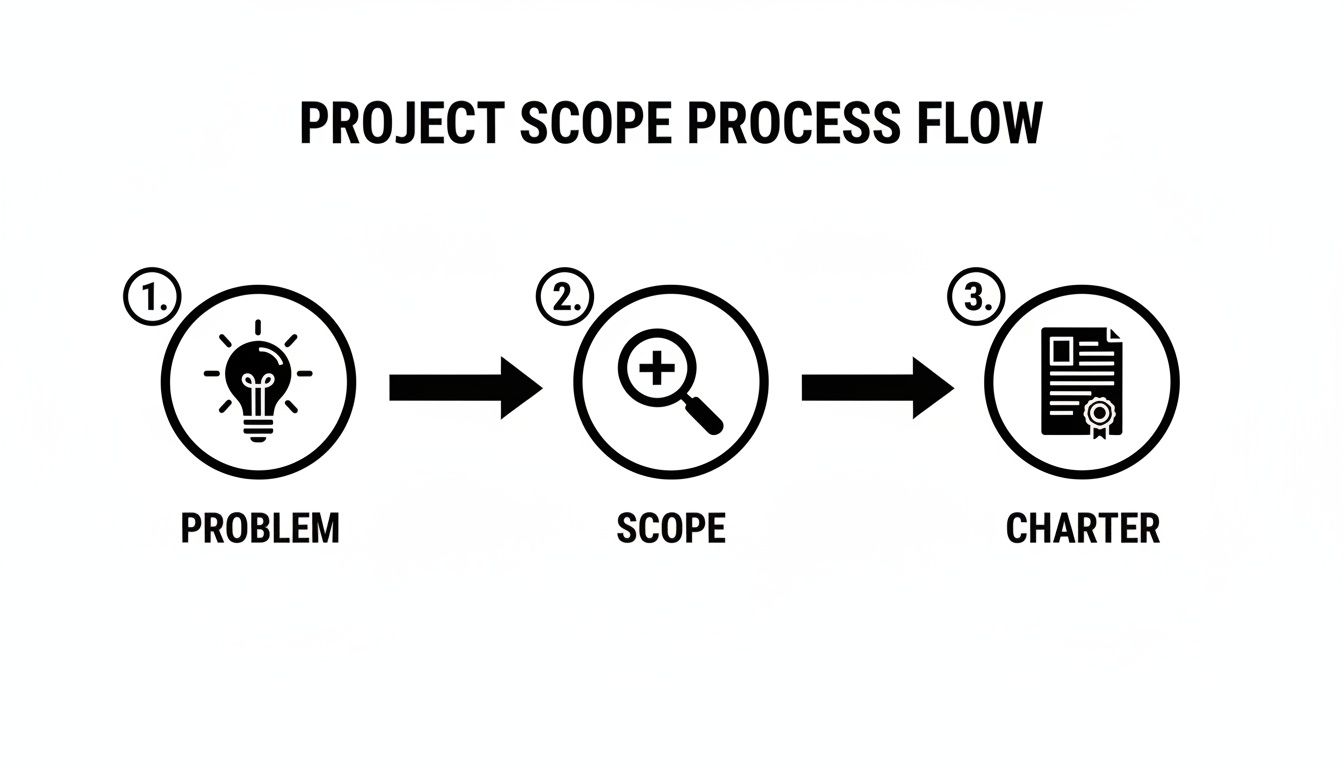
This simple flow serves as a constant reminder: the agreed-upon scope and charter dictate the necessary granularity of the process maps.
A process model's value isn't measured by its complexity, but by its ability to help you make a specific decision. Always ask: "What question is this map helping us answer?" If a detail doesn't get you closer to the answer, it's just noise.
For instance, mapping a customer onboarding process requires capturing decision points for eligibility checks, data handoffs between CRM and finance systems, and API calls for identity verification. These are the specific junctures where AI can significantly reduce cycle times and error rates.
A robust method for grounding this work is a gap analysis. A modern guide to the gap assessment process demonstrates how this analysis pinpoints the largest discrepancies—and therefore opportunities—between the current state and future goals.
Looking for AI Expertise?
Get in touch to explore how AI can transform your business.
To obtain an even more data-driven, objective view, many German enterprises now utilize specialized software. Understanding how process mining with tools like Celonis can automatically construct As-Is maps from system logs is a transformative capability. It validates manual maps with empirical data, often revealing previously unknown inefficiencies.
Identifying and Scoring High-Value AI Automation Opportunities
With a validated ‘As-Is’ process model, the focus shifts from documentation to strategic action. The map is not the destination; it is the tool that reveals where high-value transformation opportunities reside.The objective is now to systematically analyze these process maps to identify bottlenecks, redundancies, and manual, low-value tasks that are prime candidates for AI-driven automation.
This is not an exercise in intuition. It requires a structured, analytical approach to evaluating each potential opportunity. By scoring every candidate against a consistent set of criteria, you can make data-backed investment decisions. This builds a compelling business case and ensures that limited resources are allocated to projects with the highest strategic return.
A Framework for Quantitative Prioritisation
Transitioning from a long list of potential improvements to a focused, actionable roadmap requires a scoring framework. An effective framework balances potential impact against practical feasibility.
Our experience indicates that the most effective frameworks evaluate opportunities across four key dimensions:
Ready to Build Your AI Project?
Let's discuss how we can help you ship your AI project in weeks instead of months.
- Potential Value: What is the quantifiable impact? This includes direct cost savings, potential revenue growth from an improved customer experience, or mitigation of significant compliance risks.
- Feasibility: Is this technically achievable? This assesses data quality, the complexity of the required AI, and the integration challenges with the existing technology stack.
- Strategic Alignment: Does this initiative support a core corporate objective? It should clearly advance a C-level priority, such as enhancing a competitive advantage.
- Customer and Employee Impact: Who benefits from this change? Will it materially improve the customer experience? Will it free employees from mundane tasks to focus on higher-value work?
Assigning a score (a simple 1-5 scale is effective) to each dimension allows for the calculation of a total priority score for every opportunity. This yields a clear, defensible ranking to guide the implementation roadmap. We explore this in greater detail in our guide on creating an AI prioritisation framework for MVPs.
Scoring in Action: A Finance Department Scenario
Consider a typical finance department in a large German company. After mapping its procure-to-pay process, three distinct automation projects are identified.
Here is a sample scoring:
| Opportunity | Potential Value (1-5) | Feasibility (1-5) | Strategic Alignment (1-5) | Stakeholder Impact (1-5) | Total Score |
|---|---|---|---|---|---|
| 1. AI-Powered Invoice Processing | 5 | 4 | 4 | 4 | 17 |
| 2. Automated Compliance Checks | 4 | 3 | 5 | 3 | 15 |
| 3. Predictive Cash Flow Forecasting | 5 | 2 | 5 | 2 | 14 |
In this scenario, AI-Powered Invoice Processing is the clear priority. While all three projects are strategically aligned, its combination of high feasibility and significant impact on the team's daily workload makes it the optimal starting point. The predictive forecasting project, despite its high potential, has a lower feasibility score due to technical complexity, making it better suited for a later phase after initial successes are secured.
This kind of quantitative scoring takes the emotion and politics out of decision-making. It replaces subjective debates with objective, data-driven conversations. It gives leadership a crystal-clear rationale for why Project A is getting the green light over Project B.
Want to Accelerate Your Innovation?
Our team of experts can help you turn ideas into production-ready solutions.
Market trends reflect this urgency. Automation is the single largest driver in Germany's BPM sector, commanding a 32.22% revenue share in 2024. The overall German BPM market is projected to grow from USD 1,134.7 million in 2024 to USD 3,247.0 million by 2030, a surge overwhelmingly driven by automation.
By meticulously identifying and scoring opportunities, you ensure that AI is not implemented for its own sake, but is strategically deployed to solve critical business problems and deliver measurable results.
Designing The Future State: From Model to Prototype
Once high-value opportunities have been identified and prioritized, the focus shifts from analysis to design. This phase bridges the gap between a theoretical process map and tangible, value-creating work. The objective is to construct a ‘To-Be’ process model—a detailed blueprint for a future state that intelligently integrates AI and automation.
This is not about applying technology to existing inefficiencies. A common error is to automate a cumbersome manual process, merely making it faster. The true strategic victory lies in fundamentally redesigning the workflow to leverage the unique strengths of AI, eliminating redundant steps, and enabling new ways of creating value. This requires a mindset shift from incremental improvement to bold reinvention.
From 'To-Be' Model To Actionable Blueprint
The ‘To-Be’ model serves as the definitive guide for technology and operations teams—the architectural plan preceding implementation. It must visually articulate precisely how the new, AI-powered process will function, detailing where AI agents intervene, what data they require, and how human oversight is maintained.
Looking for AI Expertise?
Get in touch to explore how AI can transform your business.
Key principles for designing this future state include:
- Human-in-the-Loop Design: Be deliberate about where AI operates autonomously versus where it functions as a 'co-pilot' for human staff. For example, an AI might pre-process and categorize customer support tickets, while a human agent handles the final, empathetic response.
- Data Flow Optimisation: Map how data will be sourced, cleansed, and supplied to AI models. The ‘To-Be’ diagram must account for the new data dependencies introduced by AI; the principle of "garbage in, garbage out" remains paramount.
- Exception Handling: Define a clear protocol for when the AI encounters novel situations or fails. The model must specify who receives an alert and what the manual fallback procedure is. A robust ‘To-Be’ model plans for failure as rigorously as it does for success.
A well-defined blueprint is critical for aligning business requirements with technical capabilities, preventing costly misunderstandings during implementation.
The Power Of Rapid Prototyping
While a detailed model is essential, it remains a document. To effectively test assumptions and secure executive buy-in, the ‘To-Be’ model must be translated into a working prototype. The era of multi-month proof-of-concept projects is over; stakeholders now expect to see tangible evidence of viability within days. This is the role of rapid prototyping.
The goal is to build a minimal, functional version of the AI solution to test its core functionality with real users and data. This is the most effective method for de-risking a new concept, gathering authentic feedback, and building momentum before committing to a full-scale development effort.
A prototype turns an abstract process model into a tangible experience. It allows stakeholders to see, touch, and interact with the future state, transforming a theoretical discussion into a practical evaluation of business value.
Ready to Build Your AI Project?
Let's discuss how we can help you ship your AI project in weeks instead of months.
Consider a ‘To-Be’ model intended to accelerate legal contract reviews. Instead of building a full enterprise solution, the team could develop a simple web application. Lawyers upload a document, and an AI model instantly highlights key clauses and potential risks. Such a prototype, built in a matter of weeks, provides immediate feedback on the AI's accuracy and its practical utility in the lawyers' daily work.
This approach dramatically accelerates the innovation cycle. By focusing on rapid validation, you can pivot quickly or proceed with confidence. To see how such projects can be executed at speed, review our guide on the 21-day AI delivery framework. This is the point where strategic process modelling delivers a real, tangible competitive advantage.
Keeping Your Processes Alive: Governance and Measuring What Matters
Modelling your business processes is not a one-time project; it is the starting point of a continuous discipline. The true value is realized when these process models become living documents that evolve in tandem with the business.
Sustaining this requires two components: a robust governance framework and a rigorous system for measuring success. This is what transforms a successful initiative into a sustained competitive advantage.
The Case for a Centre of Excellence
Without proper oversight, even the most meticulously detailed process maps rapidly become obsolete. The most effective way to prevent this is to establish a central team, often designated as a Centre of Excellence (CoE), to assume ownership of this function.
Want to Accelerate Your Innovation?
Our team of experts can help you turn ideas into production-ready solutions.
The CoE acts as the custodian of the organization's process architecture. Its purpose is not to introduce bureaucracy but to function as a strategic unit responsible for maintaining alignment and performance.
Key responsibilities include:
- Curating the Process Library: Ensuring all models are current, adhere to a standard format, and are easily accessible to all relevant personnel.
- Monitoring Performance: Continuously tracking key metrics against established baselines.
- Identifying New Opportunities: Proactively analyzing process data to identify the next cohort of high-value candidates for AI and automation.
Defining and Tracking the Right KPIs
Improvement cannot be managed without measurement. To demonstrate the value of this work, you must define and track the right Key Performance Indicators (KPIs). These metrics provide empirical evidence, translating abstract concepts like "efficiency" into concrete results that command executive attention.
An effective performance dashboard should focus on metrics that directly reflect business health. We recommend starting with the following:
- Process Cycle Time: The total time from process initiation to completion. A 15% reduction can significantly enhance the customer experience.
- Error Rate: The percentage of outcomes requiring rework or correction. For many transactional processes, AI can reduce this figure to near zero.
- Operational Cost: The total cost to execute the process, including personnel and system licensing. This directly links process improvement to the P&L statement.
- Throughput: The number of transactions completed within a given period.
A well-designed KPI dashboard transforms process modelling from a theoretical exercise into a data-driven performance management system. It provides the empirical evidence needed to justify past investments and secure funding for future innovation.
Looking for AI Expertise?
Get in touch to explore how AI can transform your business.
This focus on measurement is a critical area for German companies. A 2024 study by BearingPoint and BPM&O revealed that while 42% of German firms now consider process management 'very important', only 53% are quantifying its benefits.
This represents a significant gap, particularly when compared to France and Switzerland, where over 70% of companies are measuring impact. Closing this gap is imperative. You can explore the full BPM study findings for further regional analysis.
By embedding strong governance and rigorous measurement, you cultivate a culture of continuous improvement. The cycle of modelling, analyzing, improving, and measuring is what maintains organizational agility. This discipline is also a critical component of corporate governance; our article on risk management and compliance illustrates how fundamental structured processes are in today's regulatory environment.
Got Questions? Let's Talk Specifics
When senior leaders begin modelling business processes for AI integration, several key questions consistently arise. Clarifying these points early is essential for establishing alignment and a shared understanding of the objectives.
Aren't "Process Modelling" and "Process Mapping" the Same Thing?
This is a common point of confusion. While the terms are often used interchangeably, they represent distinct levels of analysis.
Ready to Build Your AI Project?
Let's discuss how we can help you ship your AI project in weeks instead of months.
Process mapping is the initial sketch. It involves creating a simple visual representation of the steps in a workflow. It answers the basic question, "What happens next?"
Business process modelling, conversely, is the detailed blueprint. It employs a formal notation, such as BPMN, to facilitate a much deeper analysis. It goes beyond documenting steps to enable simulation, analysis, and complete process re-engineering for maximum impact. Here, we address the critical questions: "Why is it done this way, and how can AI fundamentally change the game?"
We Have Nothing Mapped Out. Where on Earth Do We Start?
The most common mistake is attempting to model the entire organization at once. This approach is a formula for failure.
Instead, select one high-impact, high-pain area and conduct a deep analysis. This could be a process universally recognized as problematic, such as customer returns, supplier onboarding, or month-end financial closing. Assemble the individuals who perform the work and map the ‘As-Is’ reality.
The goal of your first project isn’t perfection; it’s proof. A small, tangible win is infinitely more powerful than a grand, enterprise-wide plan that never leaves the slide deck.
Want to Accelerate Your Innovation?
Our team of experts can help you turn ideas into production-ready solutions.
A successful pilot project generates momentum. It provides the empirical data and the success story needed to secure executive support for a broader initiative.
What Tools Should We Be Using?
The appropriate tool depends on the specific task at hand.
For initial discovery workshops and collaborative brainstorming, digital whiteboards such as Miro or Mural are highly effective. They facilitate visual alignment and idea generation.
However, for rigorous, standardized modelling intended for technical implementation, a dedicated BPMN tool is required. Platforms like Camunda, Signavio (now part of SAP), or Bizagi are designed for this purpose. They provide the necessary precision for deep analysis and ensure a clean handoff to development teams. Many of these platforms also include low-code automation features, enabling business analysts to automate simpler workflows directly.
At Reruption GmbH, we are not merely consultants; we are "Co-Preneurs." We partner with you to transform process models into production-ready AI systems that deliver measurable business results. By taking P&L accountability, we help you translate strategic concepts into tangible value. Discover how we can help you re-rupt from within at https://www.reruption.com.
Looking for AI Expertise?
Get in touch to explore how AI can transform your business.