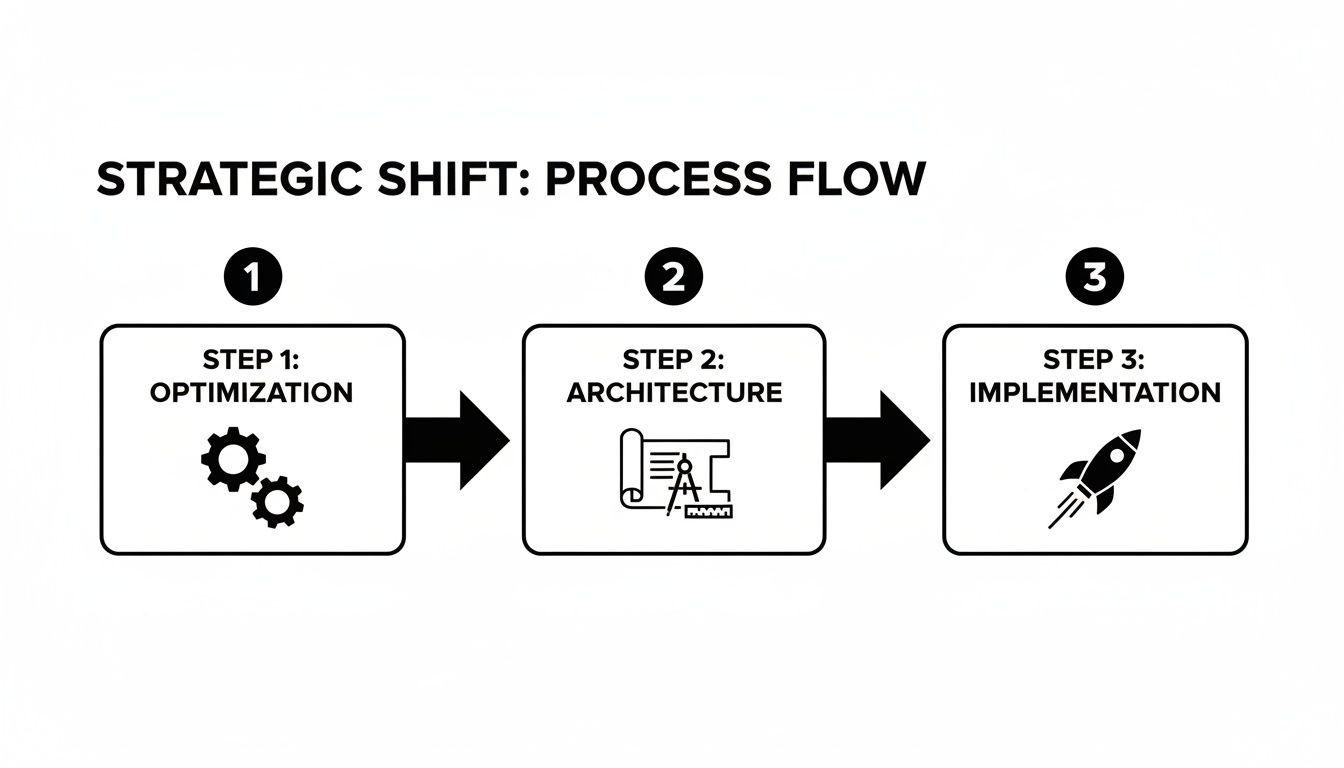
For executive leaders contemplating a transition to the cloud, the lift-and-shift methodology represents the most direct pathway. This approach, also known as rehosting, involves migrating your organisation's digital operations from on-premise infrastructure to a cloud environment with minimal initial modifications. It is unequivocally the most rapid method for exiting costly data centre contracts and establishing the foundational infrastructure for future digital and AI-driven innovation.
The Strategic Imperative of a Lift-and-Shift Migration

A pertinent analogy for a lift-and-shift migration is the relocation of an entire corporate headquarters to a new, state-of-the-art facility. All existing furniture, equipment, and established workflows are transported exactly as they are, with the primary objective of resuming operations at maximum velocity. Substantive renovations and process optimisations are deferred until after the organisation has stabilised in the new environment and restored full productivity.
This strategy prioritises speed and business continuity. For German enterprises facing time-sensitive imperatives, such as an expiring data centre lease or the urgent need to decommission legacy systems, this velocity provides a significant competitive advantage. It minimises immediate operational disruption, a critical consideration for any large-scale organisation.
Why This Approach Is Strategically Relevant Today
The rationale for executing a lift-and-shift is compelling and aligns with key senior leadership objectives. By migrating applications and data to the cloud on an as-is basis, an organisation can begin to realise the fundamental benefits of cloud infrastructure almost immediately.
Ready to Build Your AI Project?
Let's discuss how we can help you ship your AI project in weeks instead of months.
The primary business drivers include:
- Accelerated Data Centre Exit: This strategy enables a swift departure from expensive contract renewals and circumvents significant capital expenditure on new hardware by transitioning to a more flexible and scalable environment.
- Cost Structure Optimisation: It facilitates an immediate transition from a capital expenditure (CapEx) model, characterised by large upfront investments in physical servers, to an operational expenditure (OpEx) model, where costs are directly tied to actual resource consumption.
- Foundation for Enterprise AI: Critically, this migration establishes the powerful, scalable infrastructure required to support large-scale data analytics and future artificial intelligence initiatives that are often infeasible within the constraints of on-premise data centres.
A lift-and-shift is not the culmination of a cloud journey; it is the strategic ingress. It provides the solid foundation required for subsequent optimisation and architectural transformation, enabling a controlled, phased evolution toward a cloud-native state.
This methodology delivers an early, demonstrable success within an organisation's digital transformation roadmap. It builds institutional momentum and provides rapid proof of value, which facilitates executive buy-in for more ambitious, future-state projects. The focus is on achieving immediate strategic goals while positioning the business for enhanced agility and innovation.
It is a pragmatic initial manoeuvre that de-risks the broader transformation initiative by segmenting it into manageable phases. To explore the critical steps of this process in greater detail, our guide on the digitalisation of companies offers further strategic insights.
Positioning Lift-and-Shift Within the Migration Strategy Spectrum

Effective executive decision-making requires a comprehensive understanding of the strategic landscape. A lift-and-shift migration is not an isolated tactic but one of several established pathways within the broader spectrum of cloud strategies. This framework, often referred to as the "6 Rs of Migration," delineates the available routes, each with distinct trade-offs regarding velocity, cost, and long-term strategic value. It is advisable to first understand what a cloud migration strategy entails before committing to a specific approach.
Consider your organisation's application portfolio as a diverse fleet of vehicles. Some are essential workhorses, others are high-performance assets, and a few may be legacy models. The decision to relocate, upgrade, or replace any specific asset depends entirely on its role in achieving overarching business objectives. Framing the challenge in this manner transforms a complex technical problem into a series of clear business choices.
Rehost: The Direct Relocation
Rehosting, more commonly known as lift-and-shift, is the most direct migration path. It is analogous to transporting an entire vehicle fleet on a carrier to a new location. The assets arrive quickly, unchanged, and ready for immediate operation.
This strategy is defined by its emphasis on speed and minimal disruption. It is the preferred choice for rapid data centre exits or for migrating legacy systems where source code modification is not feasible. The core architecture remains unchanged, significantly reducing the immediate technical burden on internal teams.
Replatform: The Tactical Enhancement
Replatforming, sometimes termed "lift, tinker, and shift," is a slightly more involved methodology. In our fleet analogy, this is akin to moving the vehicles and immediately fitting them with specialised tyres optimised for the local conditions—a minor adjustment yielding a noticeable performance gain.
Want to Accelerate Your Innovation?
Our team of experts can help you turn ideas into production-ready solutions.
A typical example involves migrating an on-premise database to a managed cloud database service. This requires minor configuration changes but unlocks immediate benefits, such as enhanced performance and reduced administrative overhead, without a complete application overhaul.
Refactor: The Architectural Transformation
Refactoring, or re-architecting, represents the most intensive migration strategy. This is not merely a relocation but a complete transformation, comparable to rebuilding a classic combustion-engine vehicle into a high-performance electric one. The process is resource-intensive but results in an asset perfectly optimised for its new environment.
This path entails redesigning applications to be cloud-native, often leveraging microservices or serverless architectures. While it demands significant upfront investment, it is the mechanism for unlocking the full potential of cloud scalability, resilience, and cost efficiency. This is a crucial consideration when designing an AI architecture for longevity.
The selection of a migration strategy is not a monolithic decision. A successful cloud transformation involves a hybrid approach, applying a mix of these strategies across the application portfolio, with each choice aligned to the specific business value and technical constraints of the workload.
The remaining strategies complete the framework:
Looking for AI Expertise?
Get in touch to explore how AI can transform your business.
- Repurchase: Decommissioning a legacy application and transitioning to a Software-as-a-Service (SaaS) platform. This is equivalent to replacing a company-owned fleet with a corporate mobility service.
- Retire: Systematically identifying and decommissioning applications that no longer deliver business value, thereby freeing up resources that would otherwise be wasted on migrating non-essential assets.
- Retain: In some cases, the most prudent action is no action. Certain legacy systems may be best left in their current environment due to compliance constraints or prohibitive technical debt.
Understanding this spectrum enables the construction of a pragmatic and effective migration roadmap. A lift-and-shift provides a powerful entry point, securing early strategic wins while creating the space to plan for deeper, more transformative modernisations.
Identifying the Optimal Scenarios for a Lift-and-Shift Strategy
Translating high-level strategy into executive action requires clear criteria for when a lift-and-shift is the most prudent course. This methodology is not a universal solution; its strategic value is most pronounced in specific, often time-sensitive, business contexts. For decision-makers, recognising these triggers is the first step toward building a compelling business case that secures stakeholder approval.
The impetus to rehost is typically driven by significant external pressures—non-negotiable deadlines and operational challenges with direct bottom-line impact. Identifying these triggers allows the migration project to be framed around tangible, measurable business outcomes from its inception.
Key Business Triggers Mandating a Rehosting Strategy
Certain situations make a lift-and-shift migration the most logical and strategically sound choice. When faced with these catalysts, the speed and minimal disruption offered by rehosting outweigh the long-term, and often resource-intensive, benefits of a comprehensive refactoring initiative.
Organisations should be alert to these classic drivers:
Ready to Build Your AI Project?
Let's discuss how we can help you ship your AI project in weeks instead of months.
- Imminent Data Centre Contract Expiration: This is a primary catalyst. An expiring lease presents a choice between a costly renewal or significant capital outlay for new hardware. A rapid cloud migration provides the most efficient exit strategy from this capital-intensive cycle.
- Urgent Requirement for Disaster Recovery (DR): Establishing a geographically disparate DR site with physical hardware is a prohibitively expensive and time-consuming undertaking. Cloud infrastructure is purpose-built for this use case, and a lift-and-shift can replicate critical systems for protection in a fraction of the time and cost.
- Reliance on Commercial Off-the-Shelf (COTS) Software: Many enterprises depend on third-party software for which the source code is inaccessible. Attempting to re-architect such applications for a cloud-native environment is infeasible. Rehosting allows these mission-critical systems to be moved to the cloud as-is, without code modification.
The strategic value of a lift-and-shift is maximised when the primary objectives are speed and operational continuity. It is a tactical manoeuvre to resolve an immediate business problem while simultaneously positioning the organisation for subsequent strategic transformation.
This is a pragmatic approach that prioritises resolving the most urgent issue first, deferring more complex modernisation efforts until operational stability is secured. It is a decision that places immediate cost avoidance and operational resilience at the forefront.
Establishing the Foundation for Enterprise AI
Beyond immediate operational benefits, a lift-and-shift migration is a critical prerequisite for advancing an organisation's artificial intelligence capabilities. Modern AI and machine learning models are computationally demanding, requiring vast data volumes and immense processing power—resources that are impractical and cost-prohibitive to maintain on-premise.
By migrating large datasets and their associated applications to the cloud, an organisation creates the scalable, elastic environment necessary to execute powerful analytics and machine learning workloads. This initial migration unlocks the ability to experiment with and deploy AI solutions without a prohibitive upfront investment in specialised hardware.
For enterprises seeking to self-host large language models to maintain control over security and cost, a flexible cloud or private cloud architecture is non-negotiable. A practical example of what is required to build a secure and cost-efficient self-hosted LLM cluster demonstrates a capability only achievable upon a solid cloud foundation.
A Decision Framework for Your Application Portfolio
To construct a business case that withstands executive scrutiny, a systematic, data-driven assessment of the application portfolio is required. This checklist helps identify prime candidates for a lift-and-shift and provides a rational basis for the migration plan.
- Business Criticality: Is this application essential for daily business operations? High-priority systems with low tolerance for downtime are excellent candidates.
- Architectural Constraints: Is the application a monolithic legacy system or a COTS product that cannot be modified? Applications that are difficult or impossible to alter are prime targets for rehosting.
- Infrastructure Lifecycle: Is the underlying hardware aging, out of warranty, or due for a costly refresh? Migrating these workloads can yield immediate and significant TCO reductions.
- Strategic Roadmap Alignment: Does this application have a short- to medium-term operational lifespan, or is it a core component of the future technology landscape? A lift-and-shift is ideal for systems not slated for a major rewrite.
- Potential for Quick Wins: Are there applications with minimal dependencies that can be migrated rapidly? Securing early successes builds momentum and demonstrates the value of the cloud program to the entire organisation.
By methodically addressing these questions, leadership can develop a prioritised migration plan that focuses on delivering maximum business impact with minimal initial disruption. This ensures the organisation's first steps into the cloud are confident, successful, and strategically sound.
Navigating Inherent Risks and Mitigation Strategies
While the lift-and-shift approach offers an accelerated path to the cloud, it is not without potential hazards. A common misconception is to view it as a simple "copy-paste" operation. To realise the intended strategic benefits, leadership must proactively address the inherent risks of transplanting legacy systems into a modern, dynamic environment.
A rigorous analysis of such projects reveals three primary areas of risk. These are not insurmountable obstacles but predictable challenges that require a robust mitigation plan. Proactive management can transform these potential liabilities into manageable components of the migration strategy.
The Specter of Unforeseen Costs
The most frequent and impactful negative surprise in a lift-and-shift project is "bill shock." An application that appeared economical to run in a data centre—where hardware costs are sunk—can become unexpectedly expensive in the cloud's consumption-based pricing model. Legacy applications, not architected for efficiency, can consume cloud resources at an alarming rate, jeopardising the project's budget and undermining its business case.
Want to Accelerate Your Innovation?
Our team of experts can help you turn ideas into production-ready solutions.
This occurs because on-premise systems are typically provisioned for peak demand, a model that is highly inefficient in the cloud. Consequently, the organisation pays for maximum performance capacity 24/7, even if the application only requires it for brief periods.
To establish financial control from the outset, implement these measures:
- Conduct Comprehensive Pre-Migration Assessments: Profile the actual resource utilisation of applications, not just their server specifications. This empirical data provides an accurate baseline for right-sizing cloud instances.
- Establish Rigorous Cost Governance: Utilise the cloud provider's native tools to set budgets, configure alerts, and automate shutdown policies for non-production environments, fostering a culture of cost-consciousness.
- Implement Mandatory Tagging Policies: Enforce a policy that every cloud resource is tagged by project, department, and owner. This provides the granular visibility required to identify and eliminate financial waste.
Confronting Performance Deficits
The assumption that migrating an application to the cloud will automatically enhance its performance is a common fallacy. In many cases, it will not. Legacy applications, designed for the stable and predictable latency of an on-premise network, are often unable to leverage the dynamic, distributed nature of cloud infrastructure.
The result can be a degradation in performance, with applications running slower post-migration. This stems from a fundamental mismatch between the application's architecture and the cloud's operational model. For example, a latency-sensitive application may suffer if its components are distributed across different availability zones without architectural consideration.
A lift-and-shift migration transfers an application's code but does not inherently modernise its behaviour. Proactive performance engineering is critical to ensure the user experience is not compromised post-migration.
Looking for AI Expertise?
Get in touch to explore how AI can transform your business.
The only effective mitigation is a disciplined approach to testing and tuning, both pre- and post-migration. This entails detailed performance testing in a cloud environment that mirrors the production setup, identifying bottlenecks before going live, and planning for tactical "tinkering" or minor replatforming of specific components—such as transitioning to a managed database service to improve response times.
Addressing Security and Compliance Gaps
An on-premise security model, architected like a fortress with a strong network perimeter, does not translate directly to the cloud. Executing a lift-and-shift without a corresponding shift in security paradigm creates significant vulnerabilities. The cloud operates on a shared responsibility model; assuming the provider manages all aspects of security is a frequent and costly error.
This risk is particularly acute for German enterprises subject to stringent regulations like GDPR. Data residency, access controls, and encryption must be entirely re-architected for the cloud. Our in-depth guide on achieving audit-proof enterprise AI security provides further detail. By designing a cloud-native security architecture from the project's inception, organisations can not only maintain compliance but often achieve a security posture superior to their on-premise environment.
A Strategic Framework for a Successful Enterprise Migration
Executing a successful lift-and-shift migration requires more than technical execution; it demands a disciplined, strategic framework. A methodical approach ensures stakeholder alignment, mitigates key risks, and connects the entire initiative to clear business objectives. We recommend structuring the journey across four distinct phases, guiding the process from initial concept through to long-term value realisation.
Consider this your strategic roadmap, designed to navigate the common pitfalls that derail these business-critical projects.
Phase 1: Discovery and Assessment
This foundational phase begins with a comprehensive inventory of all applications, servers, and their intricate dependencies. An organisation cannot effectively migrate what it does not fully understand. The objective is to map the entire digital estate, identifying inter-system communication paths to prevent the inadvertent disruption of critical business processes post-migration.
During this stage, the initial candidates for lift-and-shift are identified. These are typically applications with minimal dependencies or those operating on aging hardware—ideal for securing a quick win and gathering valuable lessons for the broader migration program.
Phase 2: Planning and Design
With a clear inventory established, the next step is meticulous planning. This involves selecting a cloud provider whose services, security posture, and data residency options align with the organisation's specific requirements—a critical consideration for adherence to regulations like GDPR in Germany. For complex enterprise migrations, engaging one of the top cloud migration service providers may be a prudent investment.
The target cloud environment is then architected. This includes defining network configurations, establishing security groups, and implementing identity and access management protocols. The outcome of this phase is a detailed migration roadmap, complete with timelines, resource allocation, and a robust communication plan to keep all stakeholders informed.
Phase 3: Migration and Validation
This is the execution phase—the "lift and shift" itself. Following the roadmap from Phase 2, teams migrate applications and data in carefully orchestrated waves to minimise business disruption. Automation is a critical enabler here, ensuring consistency and reducing the potential for human error.
Ready to Build Your AI Project?
Let's discuss how we can help you ship your AI project in weeks instead of months.
Following each workload migration, a rigorous validation process is mandatory. This is a non-negotiable step that includes extensive performance testing to confirm the application performs at or above its on-premise baseline. It also involves security scanning to identify and remediate any new vulnerabilities and User Acceptance Testing (UAT) to secure final business approval.
A migration's success is contingent upon its validation. Bypassing or expediting the testing phase is a false economy that invariably leads to performance issues, security gaps, or a diminished user experience that erodes confidence in the entire initiative.
The following graphic illustrates the primary risk categories that this validation process is designed to address.
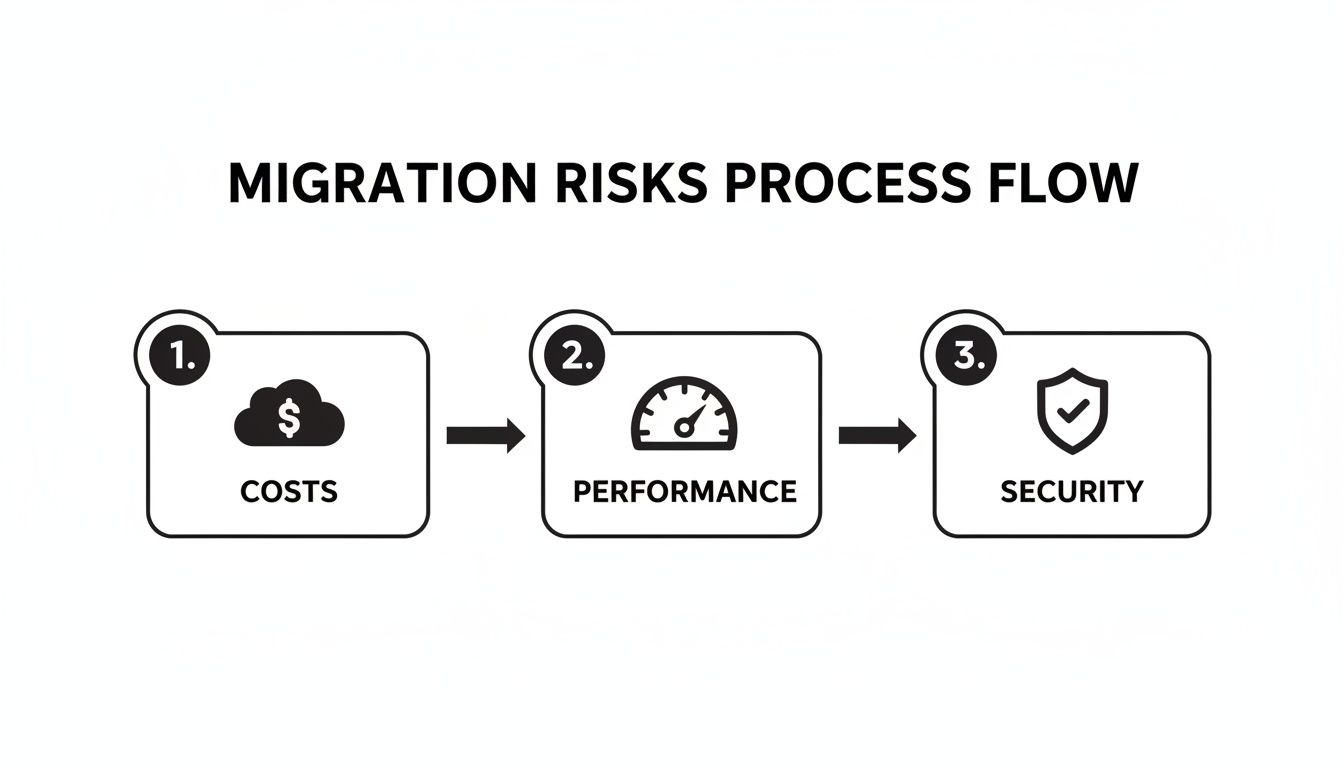
As depicted, a successful project requires the careful management of the trade-offs between cost, performance, and security throughout its lifecycle.
Phase 4: Governance and Optimisation
The project does not conclude upon completion of the migration. This final, ongoing phase is essential for maximising the return on the cloud investment. It involves continuous monitoring of cloud expenditure to prevent bill shock and the "right-sizing" of resources to ensure payment is only for what is consumed.
This phase is also where security protocols are continuously hardened and the strategic focus shifts to modernisation. The lift-and-shift has established a stable foundation. Now, the more value-additive work of refactoring or replatforming key applications to achieve a true cloud-native architecture can begin. This methodical, phased approach is a core principle of frameworks like our proprietary 21-Day AI Delivery Framework, which is engineered for the rapid deployment of production-ready AI systems.
Executive Briefing: Your Key Questions Answered
When evaluating a cloud migration, a consistent set of strategic questions arises at the executive level. The following provides direct answers to these critical inquiries.
How Do We Determine the True Return on Investment?
Calculating the ROI for a lift-and-shift extends far beyond a simple comparison of server invoices to cloud subscription fees. A comprehensive financial model must account for multiple value streams.
The initial component is the reduction in Total Cost of Ownership (TCO). This includes the elimination of hardware procurement, software licensing renewals, and data centre operational costs such as power and cooling. The second component is the operational efficiency gained by reallocating high-value IT personnel from infrastructure maintenance to strategic, revenue-generating projects.
Want to Accelerate Your Innovation?
Our team of experts can help you turn ideas into production-ready solutions.
However, the most significant value lies in quantifying the enhanced business agility and reduced operational risk afforded by the cloud. Accurately modeling these strategic benefits is where the true value proposition is revealed, and an experienced partner can assist in building a business case that resonates with the CFO.
What Is the Single Most Critical Error to Avoid?
The most critical error is treating lift-and-shift as a one-time project. It is not. The migration is the starting point for a continuous cycle of optimisation, not the finish line.
Too many organisations celebrate the successful migration of their applications, only to be confronted with a substantial, unforeseen invoice the following month. This occurs because unoptimised legacy workloads consume cloud resources inefficiently.
The correct strategic approach is to plan for this "Day Two" optimisation from the project's inception. This includes having cost management tools and processes in place, a plan for right-sizing virtual machines based on actual usage data, and a clear roadmap for modernising high-value applications over time.
Viewing lift-and-shift as the first step, not the final destination, is the fundamental mindset shift required for long-term cloud success. Neglecting the optimisation phase undermines the entire economic premise of moving to the cloud.
Looking for AI Expertise?
Get in touch to explore how AI can transform your business.
Failing to budget for this crucial second act effectively negates the financial and operational advantages the migration was intended to achieve.
Can We Migrate Sensitive Data Under GDPR?
Yes, provided it is executed with a security strategy architected specifically for the cloud. Simply replicating an on-premise security posture is insufficient and will lead to compliance failures. Migrating data governed by the General Data Protection Regulation (GDPR) is entirely feasible but requires a fundamentally different approach.
Success hinges on two core principles: a deep understanding of the cloud's "shared responsibility model" and meticulous implementation of GDPR's technical requirements. This means you must:
- Enforce Data Residency: Obtain contractual guarantees from your cloud provider that personal data will be processed and stored exclusively within GDPR-compliant jurisdictions.
- Implement Universal Encryption: Mandate strong encryption for all data, both when stored (at-rest) and during transmission (in-transit).
- Apply Principle of Least Privilege: Utilise cloud-native Identity and Access Management (IAM) to grant users and services the minimum level of access required to perform their functions.
Engaging legal and compliance teams early in the process to conduct a Data Protection Impact Assessment (DPIA) is non-negotiable. For German enterprises in particular, partnering with experts who specialise in regulated workloads is the only way to ensure a secure and compliant migration.
At Reruption GmbH, we serve as your "Co-Preneurs for the AI Era." We do not merely deliver projects; we assume P&L responsibility for business outcomes. We de-risk your cloud migration and AI initiatives by blending entrepreneurial drive with disciplined execution. Let's turn your ideas into innovations together.
Ready to Build Your AI Project?
Let's discuss how we can help you ship your AI project in weeks instead of months.