In today's volatile global landscape, managing supply chain risk has evolved from a reactive operational task to a core strategic imperative. For Germany's leading enterprises, legacy linear risk models are no longer sufficient. The imperative now is to architect deep, multi-tier visibility and proactive resilience, leveraging artificial intelligence as a decisive competitive advantage.
Why Supply Chain Resilience is a Board-Level Imperative
For decades, German industry perfected the art of lean, just-in-time global supply chains, with a laser focus on cost and efficiency. In a stable world, this model delivered exceptional results. That world, however, no longer exists.
Today's executives navigate a persistent storm of interconnected threats. Geopolitical instability can sever critical trade routes overnight. Climate events inflict increasingly severe and frequent disruptions on logistics networks. Concurrently, the regulatory environment is intensifying, transforming compliance from a routine task into a complex strategic challenge. The established playbook is obsolete.
The New Regulatory Mandate: From Best Practice to Legal Obligation
In Germany, the Lieferkettensorgfaltspflichtengesetz (LkSG)—the Supply Chain Due Diligence Act—has fundamentally reset the parameters of corporate responsibility. What was once considered best practice is now a legal mandate. The legislation compels companies to proactively identify, prevent, and remediate human rights and environmental risks across their entire global supply network.
This is not a mere reporting exercise. It demands a granular, multi-tier understanding that extends far beyond direct Tier-1 suppliers. This new reality has exposed critical vulnerabilities in legacy systems:
Ready to Build Your AI Project?
Let's discuss how we can help you ship your AI project in weeks instead of months.
- Pervasive Opacity: Most organisations lack visibility beyond their immediate suppliers. This creates significant blind spots where unidentified risks can escalate undetected.
- Reactive Posture: Traditional risk management is overwhelmingly reactive. Disruptions occur, and organisations scramble to respond, incurring costly delays, reputational damage, and lost revenue.
- Fragmented Data: Critical risk intelligence is often trapped in functional silos—procurement, logistics, finance. Synthesising a single, coherent view of the enterprise's risk profile is a significant analytical challenge.
The core challenge has shifted from optimising a predictable system to building resilience into a fundamentally unpredictable one. The objective is no longer pure efficiency, but the strategic capability to anticipate disruptions, absorb their impact, and adapt without compromising operational integrity.
This paradigm shift necessitates a move from passive problem-solving to proactive resilience, embedding agility into the core architecture of the supply chain. For a deeper analysis of this strategic pivot, explore our guide on modernising supply chain consulting.
The enterprises that will lead in this new environment are those that transform their supply chain from a source of vulnerability into a strategic asset. By deploying advanced analytics and AI-driven platforms, they can forge a durable competitive advantage. The focus is no longer just on mitigating threats; it is on identifying opportunities and ensuring operational continuity in any market condition.
Mapping Multi-Tier Supply Chain Risks
Effective risk management begins with a comprehensive understanding of the entire supply network, extending well beyond direct, Tier-1 suppliers. The most significant threats often originate in deeper, less visible tiers of the supply chain.
Consider the data: 76% of European shippers were impacted by major supply chain disruptions in 2024. This is not a statistical anomaly; it is a direct consequence of limited network visibility. Catastrophic failures frequently originate from suppliers' suppliers—the hidden dependencies in Tiers 2, 3, and beyond.
Want to Accelerate Your Innovation?
Our team of experts can help you turn ideas into production-ready solutions.
Without a comprehensive network map, an organisation is operating with incomplete intelligence. A single component from an unmonitored sub-supplier can halt an entire production line. In this context, a lack of visibility is not a defence—it is a significant liability. The strategic objective is to transition from a linear, opaque view of suppliers to a transparent, interconnected network model.
This evolution is a strategic necessity.
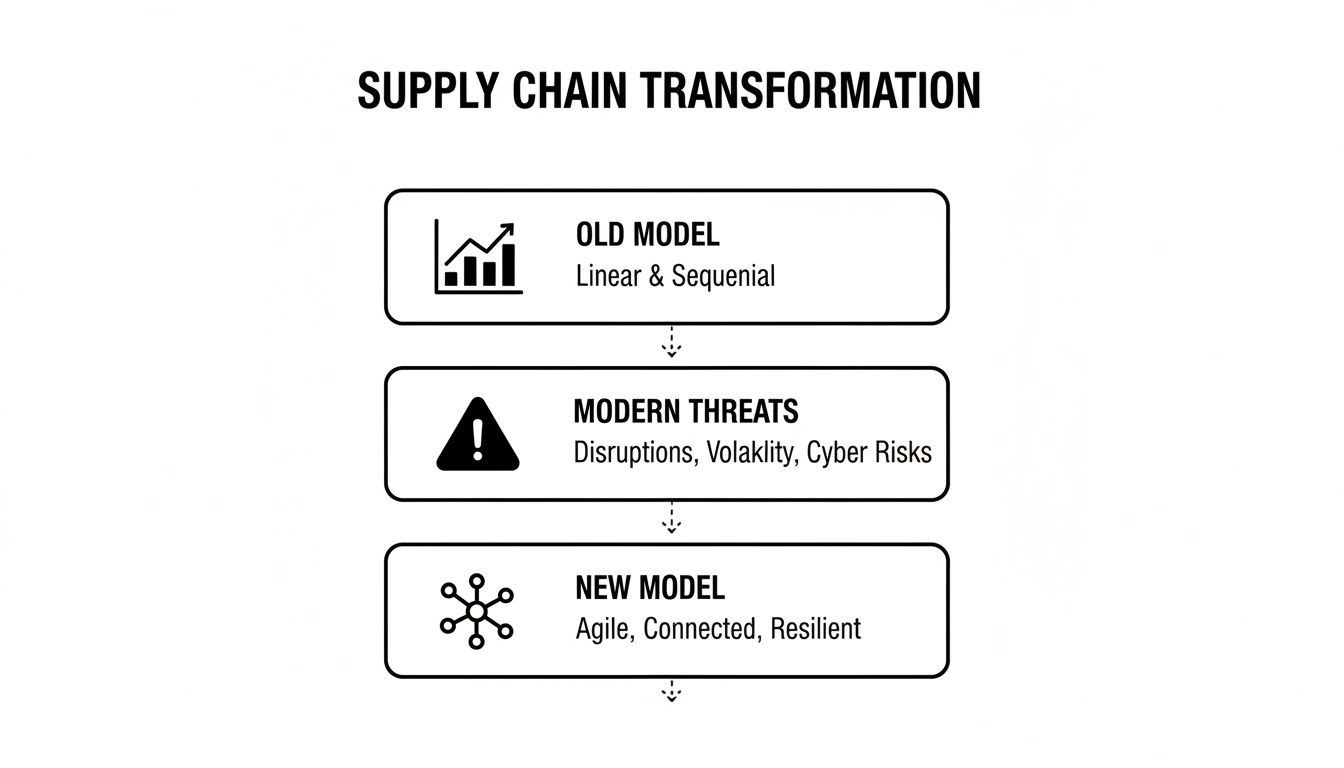
As the diagram illustrates, today’s complex threat landscape demands a move beyond the legacy linear chain to a truly resilient, multi-dimensional network architecture.
Conducting a Comprehensive Risk Audit
A rigorous risk audit is not a superficial check; it is a structured, deep analysis that categorises vulnerabilities into distinct yet interconnected domains. This provides a holistic view of an enterprise's exposure, overcoming the limitations of siloed assessments.
Looking for AI Expertise?
Get in touch to explore how AI can transform your business.
A robust audit synthesises internal data with external intelligence.
Geopolitical Risks: Analyse the geographic footprint of your multi-tier supply network. Are key nodes located in regions prone to political instability, trade disputes, or abrupt regulatory shifts? A sudden tariff can instantly erode margins if sourcing is concentrated in an affected country.
Operational Risks: Assess tangible threats to production and logistics. This includes single-factory suppliers in high-risk zones (e.g., seismic activity) or critical logistics hubs with a history of labour disputes. These are identifiable points of failure.
Financial Risks: Evaluate the financial viability of critical suppliers. A partner facing insolvency poses a direct threat to material flow, often with minimal warning before operations cease.
Compliance and ESG Risks: With regulations like Germany’s LkSG, understanding the entire supply chain is a legal imperative. A violation deep within the network can trigger severe penalties and significant reputational damage. This is why thorough vendors' due diligence has become a non-negotiable aspect of procurement.
Ready to Build Your AI Project?
Let's discuss how we can help you ship your AI project in weeks instead of months.
Uncovering Hidden Dependencies
The initial phase of mapping involves consolidating data from internal enterprise systems. Procurement records, logistics data, and accounts payable information are all valuable data points for tracing connections beyond immediate partners.
For instance, analysis of shipping manifests and bills of lading from Tier-1 suppliers can often reveal the original source of materials, thereby identifying Tier-2 nodes.
The objective is to construct a dynamic, living model of the supply network, not a static document. This map must be continuously updated to reflect changes in supplier relationships, geopolitical climates, and logistical routes.
However, a manual mapping approach is resource-intensive and often yields an incomplete and rapidly outdated picture. The sheer complexity of a modern automotive or manufacturing supply chain, with thousands of underlying suppliers, makes a manual process unsustainable. This is where technology becomes an indispensable enabler.
The Role of AI in Risk Discovery
AI and machine learning platforms fundamentally transform the discovery and mapping process, operating at a scale and speed unattainable by human teams. These systems ingest vast quantities of structured and unstructured data to construct a dynamic, multi-tier supply chain graph.
Want to Accelerate Your Innovation?
Our team of experts can help you turn ideas into production-ready solutions.
Their methodology is straightforward:
- They parse diverse data sources, including public records, news feeds, and global trade data, to identify non-obvious connections between entities.
- They leverage natural language processing (NLP) to detect risk signals in real time—such as news of a factory fire, regional political unrest, or a key executive's departure.
- They continuously update the supply chain map, automatically flagging new dependencies and emerging risks as they materialise.
By automating this foundational discovery work, AI enables a more robust, data-driven quantitative assessment. It transforms risk mapping from an arduous annual project into a continuous, intelligent monitoring function, providing the visibility required for proactive risk management.
Quantifying and Prioritising High-Impact Threats
Once the supply network is mapped, the critical task is to move from a qualitative list of potential risks to a quantitative, data-driven assessment. Without this step, resource allocation for mitigation becomes arbitrary. The objective is to systematically determine which threats demand immediate strategic intervention and which can be monitored.
This is the pivot from merely identifying risks to quantifying their potential business impact. It empowers leadership to allocate capital and resources precisely where they are most needed, focusing on vulnerabilities that pose a material financial or operational threat. This process bridges the gap between knowing a risk exists and understanding its financial consequences.
Translating Abstract Threats into Concrete Financial Metrics
The core of this process is the calculation of a Risk Priority Number (RPN) for each identified vulnerability. This is a standardised score that enables a direct comparison of disparate risks—such as a key supplier’s financial instability versus a major shipping lane closure—on a common analytical framework.
The RPN is typically a product of three factors:
- Severity (S): What is the financial and operational impact if this event occurs? This requires quantifying the cost, such as lost revenue in Euros per day of production downtime.
- Probability (P): What is the statistical likelihood of this event occurring within a given timeframe? This is where historical data and predictive models are applied.
- Detectability (D): How much advance warning is possible? A sudden natural disaster has very low detectability, whereas a supplier’s declining performance can be monitored over time.
The product of these three variables (S x P x D) creates a clear hierarchy of threats. A high RPN signifies a critical vulnerability that requires an immediate and strategic response.
The purpose of this exercise is not simply to create an inventory of potential problems. It is to build a dynamic financial model of the supply chain’s vulnerabilities. This empowers leadership to make informed, defensible decisions on where to invest in resilience.
A Framework for Prioritising Supply Chain Risks
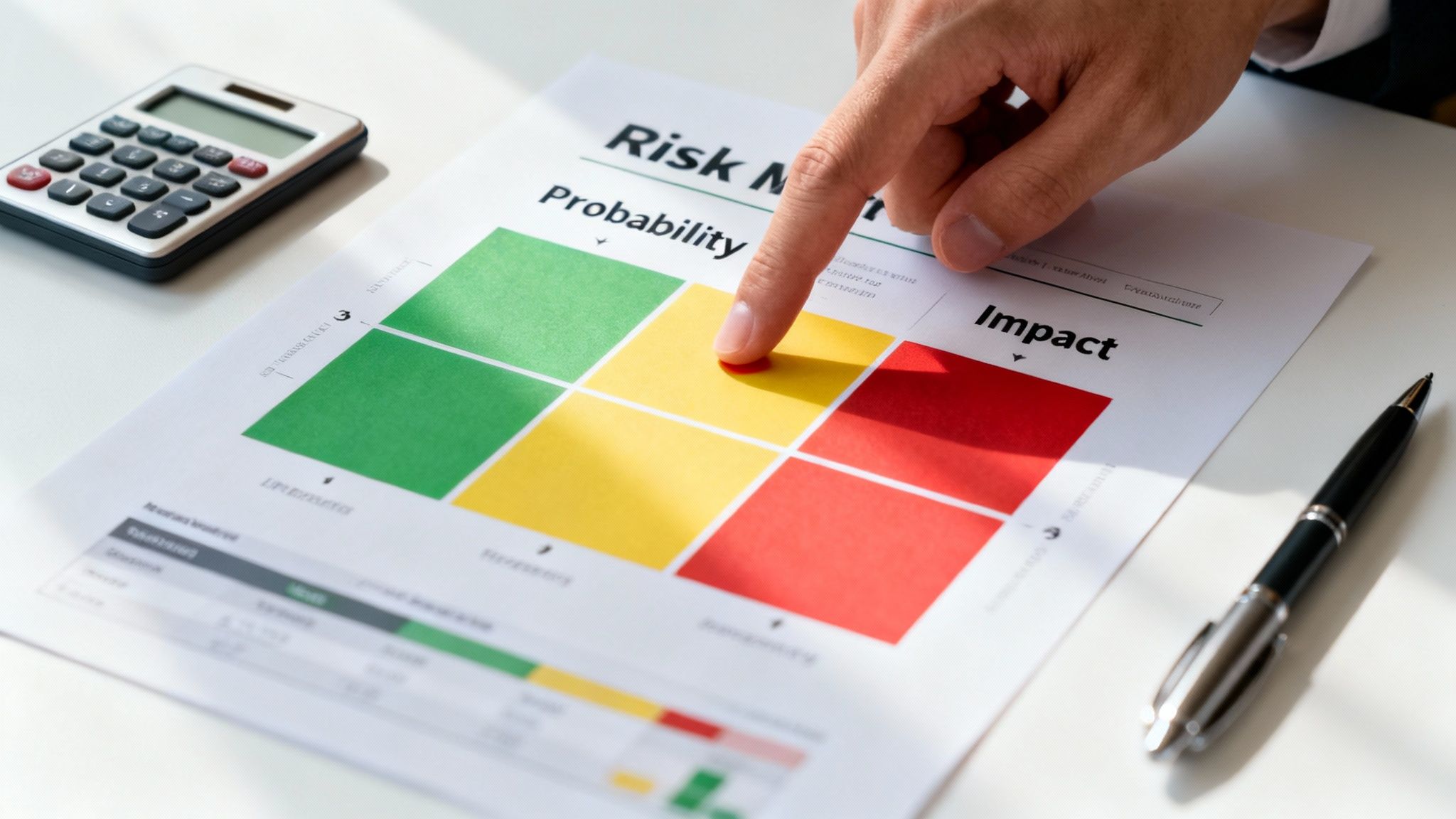
A risk matrix is an invaluable tool for visualising and prioritising mitigation efforts, ensuring that resources are not misallocated to low-impact issues.
Looking for AI Expertise?
Get in touch to explore how AI can transform your business.
This matrix classifies supply chain risks based on their potential impact and likelihood, guiding strategic resource allocation for mitigation efforts.
| Risk Category | Potential Impact (Financial, Operational) | Likelihood (Low, Medium, High) | Detection Difficulty | Prioritisation Level |
|---|---|---|---|---|
| Supplier Failure | High (Production halt, lost revenue) | Medium | Medium (Financial monitoring helps) | Critical |
| Logistics Disruption | Medium (Increased costs, delays) | High | Low (Can happen suddenly) | High |
| Geopolitical Event | Very High (Market access lost) | Low | Very Low (Unpredictable) | High |
| Demand Volatility | Medium (Inventory costs, stockouts) | High | Medium (Forecasting models help) | Medium |
| Quality Control Issue | Low (Rework costs, minor delays) | Medium | High (Can be caught internally) | Low |
This framework is not static; it should be a living document, regularly reviewed and updated by the risk management team to ensure its continued relevance.
Modelling the Financial Impact of Disruptions
To derive a meaningful Severity score, it is essential to model specific disruption scenarios. This is not a theoretical exercise but a simulation of the real-world consequences of a critical node failure.
Consider a scenario: a Tier-2 supplier of a specialised semiconductor experiences a factory fire, resulting in a three-week shutdown. A robust financial model must answer several key questions:
- Immediate Revenue Loss: How many finished products cannot be manufactured? What is the direct impact on top-line revenue?
- Increased Costs: What are the costs of premium freight for alternative parts? What is the cost to expedite the qualification of a new supplier?
- Contractual Penalties: Will customer delivery deadlines be missed? What are the associated financial penalties stipulated in contracts?
- Brand Damage: What is the long-term cost to the firm's reputation and customer relationships?
Answering these questions transforms a vague "supplier risk" into a concrete financial figure, such as a €5 million impact for a 21-day disruption. This level of clarity is essential for executive decision-making. For a more detailed examination of this process, you can explore advanced analytics and insights for your business operations.
The Power of Predictive Analytics
Calculating Probability and Detectability requires a forward-looking approach. Relying solely on historical data is insufficient, as the risk landscape is constantly evolving.
This is where AI provides a distinct advantage. Advanced analytical models can process massive datasets—weather patterns, geopolitical news, financial market shifts—to generate more accurate probability scores. For example, an AI model can analyse shipping data and meteorological forecasts to predict the probability of a delay at a major port with far greater precision than any manual process.
Ultimately, this data feeds into a dynamic risk dashboard. This replaces static reports that are obsolete upon publication, providing leadership with a prioritised, real-time view of the company’s most pressing vulnerabilities. This transforms risk management from a reactive administrative task into a strategic, forward-looking capability.
Designing Effective and Pragmatic Mitigation Strategies
With threats quantified and prioritised, the next stage is to translate analysis into concrete action. This involves architecting a defence system that is robust enough to absorb shocks without compromising the efficiency that is a hallmark of German industry.
The objective is not to eliminate risk entirely, which is an unrealistic goal. The strategic aim is to design a supply chain with the inherent capacity to withstand a disruption and recover rapidly.
Ready to Build Your AI Project?
Let's discuss how we can help you ship your AI project in weeks instead of months.
This requires moving beyond a one-size-fits-all approach. Simply increasing inventory, for example, is a common but unsophisticated reaction that often exchanges one problem (shortages) for another (high carrying costs and obsolescence). A truly resilient framework integrates multiple, complementary tactics tailored to the organisation's specific risk profile.
Mitigating Concentration Risk Through Diversification
Over-reliance on a single supplier, particularly for a critical component, is a fundamental and dangerous vulnerability. Diversification is the primary defence against this concentration risk.
Dual and Multi-Sourcing: The most direct strategy is to qualify at least two suppliers for critical inputs. This creates immediate redundancy, enabling a swift pivot if one partner experiences a disruption. It also introduces competitive tension, providing leverage on cost and quality.
Geographic Diversification (Nearshoring & Onshoring): Recent geopolitical volatility has underscored the fragility of extended, long-haul supply chains. Shifting sourcing closer to home—either within Germany or the broader EU—reduces exposure to trade conflicts, shipping disruptions, and political instability. While this may increase direct production costs, the gains in shorter lead times and improved coordination often justify the investment.
This strategic shift is already underway. An ECB survey of euro area firms revealed that 40% are diversifying sourcing to countries outside the EU, while 20% have actively relocated to EU-based partners. The trend is clear: businesses are constructing more intelligent, geographically balanced supply networks.
Re-engineering Inventory and Production Flexibility
The "lean everything" doctrine has its limits. Today's environment demands a more sophisticated approach to inventory and production—one that builds in flexibility without resorting to indiscriminate stockpiling.
Strategic Buffers, Not Blind Stockpiling: Employ data analytics to identify the precise points in the supply chain where safety stock delivers the greatest risk mitigation benefit. This typically involves holding reserves of raw materials or components with long lead times, rather than finished goods. This creates a buffer against supplier delays without trapping excessive capital in inventory that may become obsolete.
Flexible Manufacturing: Assess the agility of your production lines. Investing in systems that can be rapidly reconfigured for different products or components is a powerful source of resilience. It provides the ability to adapt to shifts in demand or material availability. If a component from Supplier A becomes unavailable, a flexible line may be able to utilise a substitute from Supplier B with minimal downtime.
Leveraging Contracts as a Strategic Tool
Legal agreements and supplier relationships are powerful but often underutilised risk management instruments. They must be actively managed to enforce accountability and foster true strategic partnerships.
Mitigation is not merely about having a 'Plan B'. It is about weaving resilience directly into 'Plan A' through stronger contracts, deeper collaboration, and intelligent operational design.
Want to Accelerate Your Innovation?
Our team of experts can help you turn ideas into production-ready solutions.
This requires a proactive stance. Contracts must include explicit terms regarding liability, performance metrics, and business continuity planning. Requiring critical suppliers to provide evidence of their own risk management programmes is no longer an unreasonable request; it is standard due diligence.
Furthermore, fostering genuine collaboration is key. Sharing demand forecasts enables suppliers to better plan their own capacity, proactively preventing shortages. Building this level of resilience is a core component of achieving true operational excellence and ensuring consistent delivery.
The optimal mix of these strategies is determined by a cost-benefit analysis, guided by the risk quantification phase. A low-probability, high-impact event may justify the investment in a dual-sourcing strategy. A high-probability, low-impact issue might be best managed with a small inventory buffer. This deliberate, data-driven approach ensures that every euro invested in resilience delivers maximum strategic value.
Leveraging AI for a Predictive and Autonomous Supply Chain
Historically, supply chain management has been a reactive discipline, relying on historical data and managerial intuition. In an era of constant, unpredictable shocks, this approach is inadequate. To build genuine resilience, organisations must transition from responding to crises to actively predicting and preempting them. This is where Artificial Intelligence moves from a technological buzzword to an essential strategic instrument.
AI possesses the unique capability to analyse massive, complex datasets in real-time, identifying patterns and anomalies that are invisible to human analysis. For German companies, particularly in the manufacturing and automotive sectors, this presents a significant opportunity. Germany currently leads Europe's supply chain risk management (SCRM) market, with a 22.5% share.
Looking for AI Expertise?
Get in touch to explore how AI can transform your business.
However, this industrial strength creates inherent complexities. A typical automotive OEM may manage 250 tier-one suppliers, each connected to an average of 150 tier-two suppliers. This results in a network of 37,500 connections, many of which are opaque and vulnerable. You can explore these market dynamics further in the comprehensive supply chain risk management report.
AI provides the tools to illuminate these hidden networks, transforming risk management from a reactive process into a predictive, strategic function.

From Demand Forecasting to Anomaly Detection
One of the most immediate applications of AI is in demand forecasting. Traditional methods struggle to adapt to sudden market shifts, leading to either costly overstocking or damaging stockouts. AI models, in contrast, can analyse thousands of variables simultaneously—from macroeconomic indicators and social media sentiment to weather patterns and competitor actions—to generate significantly more accurate predictions.
This has a direct impact on financial performance. A more precise forecast allows for the optimisation of safety stock levels, liberating working capital that would otherwise be tied up in inventory.
Ready to Build Your AI Project?
Let's discuss how we can help you ship your AI project in weeks instead of months.
Beyond forecasting, AI excels at real-time anomaly detection. Machine learning algorithms can monitor logistics data streams continuously, instantly flagging deviations from established norms.
Consider these examples:
- A container vessel deviates significantly from its planned route.
- A critical component's transit time unexpectedly increases by 20%.
- A key supplier's quality control metrics show a subtle but persistent decline.
An AI system detects these weak signals immediately, triggering an alert for the relevant team. This enables proactive intervention long before the issue escalates into a major disruption. For a practical example, see our analysis of Maersk's use of ML for predictive maintenance.
Simulating the Future with Digital Twins
Perhaps the most powerful AI-driven tool for risk management is the Digital Twin. This is not a static model but a dynamic, virtual replica of the entire supply chain network, from raw material extraction to final customer delivery. It is continuously updated with real-time data from ERP systems, logistics platforms, and external sources.
This simulation environment allows for stress-testing resilience without any real-world risk. It provides data-driven answers to critical "what-if" questions.
Want to Accelerate Your Innovation?
Our team of experts can help you turn ideas into production-ready solutions.
What is the financial impact of a two-week closure of a major port in Southeast Asia? How would our production be affected by a sudden shutdown at a Tier-2 supplier in Eastern Europe? A Digital Twin provides quantitative answers, not educated guesses.
This fundamentally changes strategic planning. Organisations can simulate dozens of disruption scenarios to identify their greatest vulnerabilities and validate the effectiveness of various mitigation strategies. It provides the hard evidence needed to build a compelling business case for investments in diversification, increased inventory buffers, or alternative logistics routes.
To put these applications into perspective, here is a comparison of their strategic value.
High-Impact AI Applications for Risk Management
| AI Application | Risk Mitigation Function | Key Business Value (Example) | Implementation Complexity |
|---|---|---|---|
| Demand Forecasting | Reduces inventory risk (over/understocking) and improves cash flow. | A 10-15% reduction in forecast error leads to millions saved in carrying costs and lost sales. | Medium |
| Anomaly Detection | Provides early warnings of logistical delays, quality issues, or supplier distress. | Proactively rerouting a shipment based on an alert saves $500k in production downtime. | Medium |
| Digital Twin | Simulates disruptions to identify vulnerabilities and validate mitigation strategies. | Justifies a €5M investment in a secondary supplier by proving it avoids a €20M loss. | High |
| Predictive Maintenance | Forecasts equipment failure in logistics or manufacturing to prevent downtime. | Avoiding a single critical machine failure prevents a 48-hour production line shutdown. | High |
Each of these tools provides a powerful means to get ahead of risk, evolving operations from a reactive posture to a proactive and predictive one.
A Pragmatic Path to AI Implementation
Embarking on an AI initiative can seem daunting, but a pragmatic, phased approach is key. The recommended strategy is to begin with a focused, high-value proof-of-concept (PoC) to demonstrate tangible value and build organisational momentum.
Looking for AI Expertise?
Get in touch to explore how AI can transform your business.
1. Isolate a High-Value Use Case: Do not attempt to solve all problems at once. Select a single, well-defined challenge. This could be forecasting demand for a highly volatile product line or mapping the dependencies for one critical component.
2. Ensure Data Integrity: The success of any AI project is contingent on the quality of its data. The initial and most critical step is to create a clean, integrated dataset from disparate enterprise systems.
3. Launch a Pilot Model: Partner with specialists to build and train an initial model. The objective is not perfection but to demonstrate a clear, measurable improvement. For example, show that an AI-powered forecast reduces the error rate by 15%, or that an anomaly detection model identifies 95% of shipping delays before they escalate.
This phased approach de-risks the investment and provides concrete results to secure executive support for broader implementation. AI can also be instrumental in data collection, particularly for ESG factors and compliance with new regulations like the CSRD. For more on this, refer to this guide on AI for ESG data collection. By taking these deliberate steps, you can begin the transformation of your supply chain into a more predictive, resilient, and autonomous strategic asset.
Embedding Governance into Daily Operations
Building a resilient supply chain is not a one-time project; it is a continuous discipline. Once mitigation strategies are designed, the enduring work is to embed risk awareness and accountability deep within the organisation's operating model. This requires a robust governance framework that integrates risk management into the daily rhythm of the business.
Ready to Build Your AI Project?
Let's discuss how we can help you ship your AI project in weeks instead of months.
The foundation of this framework is a dedicated, cross-functional risk committee. This body should comprise senior leaders from procurement, logistics, finance, and compliance, empowered to make timely, strategic decisions. Its mandate is to oversee the entire risk management lifecycle, ensuring that insights translate directly into action.
Clear accountability is non-negotiable. For every identified risk, a specific individual or team must be designated as the owner, responsible for monitoring the risk and executing the mitigation plan when required. This simple assignment of responsibility prevents organisational paralysis during a crisis.
Integrating Risk into Performance Management
To foster a culture of resilience, it must be measured and incentivised. When supply chain leaders are evaluated on risk reduction metrics alongside traditional KPIs like cost and efficiency, their strategic focus aligns accordingly.
This involves expanding performance scorecards beyond conventional metrics to include forward-looking risk indicators.
- Supplier Risk Exposure: What percentage of critical component value is sourced from a single supplier or a high-risk geographic region? This metric should be tracked and managed downward.
- Time-to-Recover (TTR): In a simulated disruption of a primary logistics hub, what is the calculated time required to restore operations to a target percentage of full capacity?
- Mitigation Plan Readiness: Conduct regular audits of incident response playbooks for high-priority risks to assess their viability and relevance.
These metrics transform resilience from an abstract concept into a tangible, measurable business objective. This structured approach is the cornerstone of a strong internal control system, as detailed in our guide on the three lines of defence model for risk management.
Automating Compliance and Enhancing Response Readiness
The regulatory landscape in Germany continues to evolve. The Supply Chain Due Diligence Act (LkSG) now requires companies to implement robust internal processes for identifying, assessing, and mitigating human rights and environmental risks across their global supply chains. As noted by industry experts, the emphasis has shifted from external reporting to documented internal risk management systems. More detail on these persistent supply chain risks on Munich Re highlights this trend.
AI-powered platforms are invaluable for this purpose. They can automate compliance monitoring by continuously screening supplier data against regulatory watchlists and ESG standards, flagging potential issues in real-time. This reduces the administrative burden and creates a clear, auditable trail of due diligence activities.
The ultimate purpose of governance is not to generate reports, but to enable rapid, coordinated action. A real-time monitoring dashboard, fed by live data, should serve as the central nervous system for the risk committee.
When a disruption occurs, pre-defined incident response playbooks are essential. These are not static documents but dynamic guides that specify actions, communication protocols, and decision-making authority for various scenarios. By regularly conducting simulations and drills, teams can transition from a reactive posture to a disciplined, methodical response, significantly mitigating the financial and operational impact of any crisis.
Concluding Thoughts
How do we initiate an AI programme for supply chain risk?
Begin with a focused, high-impact pilot project to de-risk the investment and demonstrate value quickly.
Want to Accelerate Your Innovation?
Our team of experts can help you turn ideas into production-ready solutions.
Select a single critical product line and conduct a multi-tier supply chain mapping exercise. Alternatively, apply an AI-powered demand forecasting model to a historically volatile product. A successful pilot generates tangible results, builds internal support, and provides critical learnings for a broader, scaled implementation.
How do we secure board-level investment for AI?
The business case should be framed around cost avoidance, risk reduction, and competitive advantage, not technology for its own sake.
Quantify the financial impact of a single, plausible disruption—such as a multi-day production line shutdown—and present this figure alongside the proposed AI investment. Emphasise that this is not merely a defensive measure. Enhanced visibility and agility also deliver operational benefits, such as reduced inventory carrying costs and improved efficiency, while protecting brand reputation in a volatile market.
Ready to transform risk into a source of competitive advantage? Reruption GmbH partners with enterprises as a co-preneur, embedding AI-driven strategies to secure and optimise your supply chain. Discover our approach to building production-ready solutions at https://www.reruption.com.