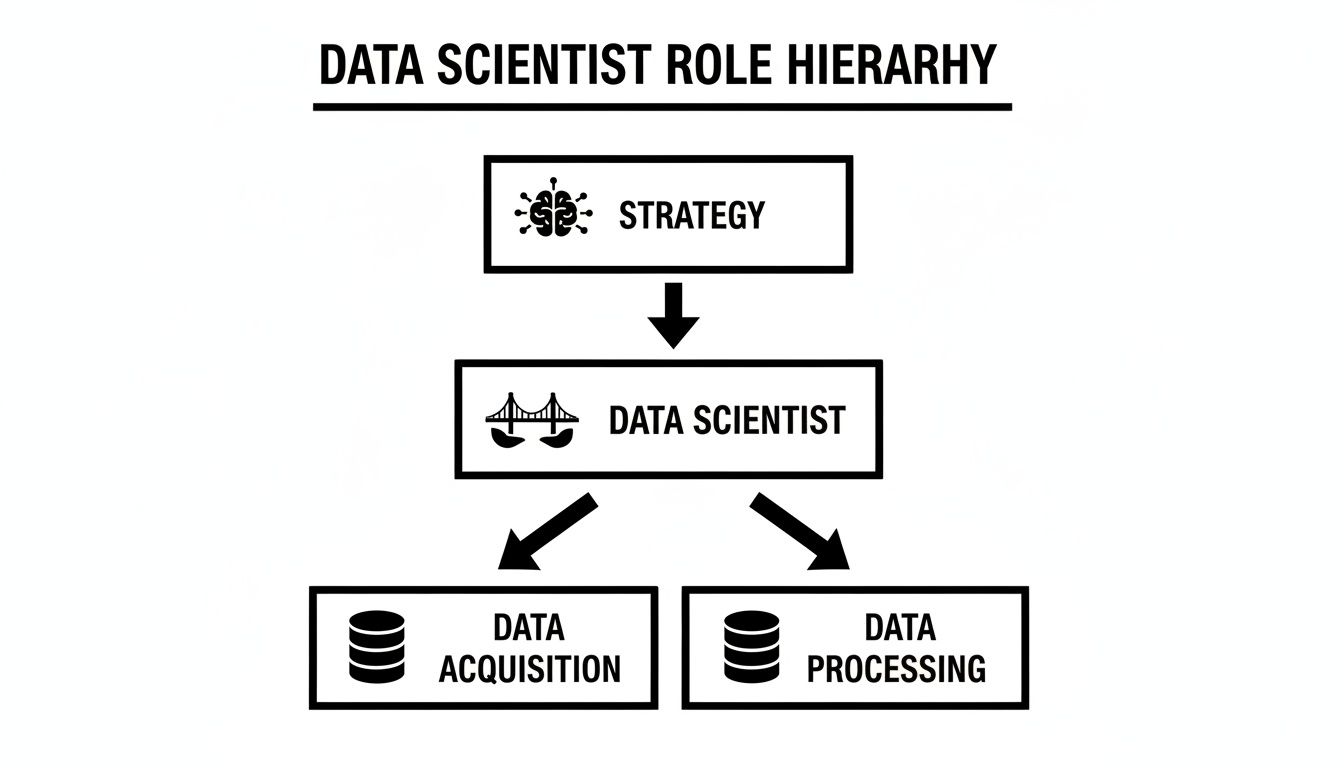
At its core, a data-driven enterprise is an organisation that systematically substitutes intuition with insight. It is a paradigm where strategic decisions are predicated on rigorous data analysis and interpretation, not on anecdotal evidence or executive instinct. Every choice, from operational tactics to corporate strategy, is guided by quantifiable evidence.
Why Becoming Data-Driven Is a Strategic Imperative
For German business leaders, this transformation is not a discretionary trend—it is an urgent necessity for competitive survival and sustainable growth. In an economy built on precision engineering and operational excellence, relying on intuition is akin to assembling a complex machine without a complete blueprint. Data provides the requisite schematics, illuminating inefficiencies and opportunities that would otherwise remain obscured.

This shift transcends the mere implementation of new software; it necessitates a fundamental re-engineering of the corporate philosophy. It requires fostering a culture where intellectual curiosity is encouraged, hypotheses are validated with data, and decisions are substantiated by empirical proof. The mandate for managers and C-level executives is to steer the corporate DNA towards this new state of continuous, informed evolution.
A compelling strategy requires an honest diagnosis of the circumstances. Data provides this objective diagnosis, stripping away assumption and bias to reveal the ground truth of your business and market environment. It is the bedrock upon which sound policy and coherent action are built.
Ready to Build Your AI Project?
Let's discuss how we can help you ship your AI project in weeks instead of months.
The Economic Imperative for German Leaders
Quantitative analysis of the German market underscores the urgency. The German Big Data market was valued at USD 4.51 billion in 2023 and is projected to reach USD 7.58 billion by 2029, driven by an exponential increase in data from manufacturing, automotive, and financial sectors.
However, a critical reality check is in order: a recent study revealed that only 6% of German companies are true pioneers in leveraging data-driven models. A significant 51% are classified as "slow movers," lagging in adoption. This disparity represents a substantial strategic opportunity for organisations agile enough to close the gap.
Executing this transition presents challenges, but it is unequivocally essential. A foundational understanding of corporate digitalisation is the first step. By embedding data into the very fabric of core processes, your organisation can shift from reacting to market dynamics to proactively anticipating them, thereby securing its competitive position in the next industrial evolution.
The Three Pillars of a Data-Driven Enterprise
Achieving the status of a truly data-driven organisation requires more than procuring the latest technology. It is a fundamental restructuring of the enterprise, architected upon three core pillars: People, Process, and Platforms. If any one of these pillars is deficient, the entire structure becomes unstable, irrespective of the strength of the others.
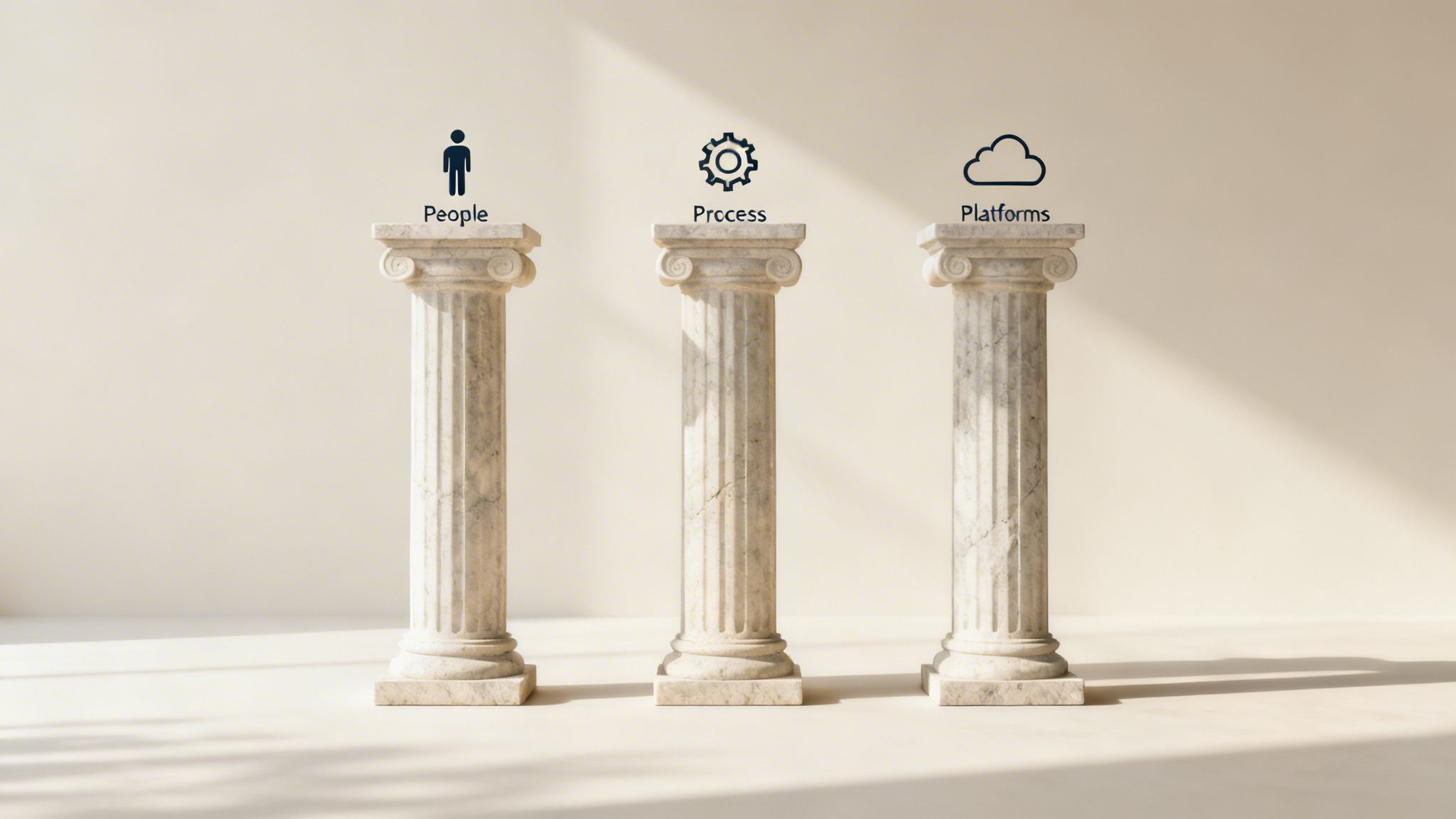
This transformation is contingent upon human capital. It demands a profound cultural shift, transitioning from a reliance on intuition to a default mode of analytical reasoning and evidence-based decision-making. This is the People pillar, and it is non-negotiable.
The Human Element: Cultivating Data Fluency
Success hinges on establishing data literacy across the entire organisation. Every employee, from junior staff to the C-suite, must be equipped to query data and interpret the resulting insights. The objective is not to convert all employees into data scientists but to cultivate a shared language where data is an integral component of daily discourse.
To operationalise this, the Process pillar must be re-engineered. Legacy workflows, often designed for a pre-digital era, require a complete overhaul. The objective is to embed data-centric touchpoints and feedback loops into the core fabric of operations, making them standard procedure rather than an afterthought.
The primary objective is to translate insights into action with minimal friction. When a process is engineered around data from its inception, the pathway from analysis to execution becomes shorter, faster, and demonstrably more effective.
The Technology Foundation: Platforms That Empower
Finally, the Platforms pillar provides the technological infrastructure. This is the integrated system that collects, processes, and disseminates the data required for informed decision-making. It must be a unified, accessible ecosystem, not a fragmented collection of siloed tools.
Want to Accelerate Your Innovation?
Our team of experts can help you turn ideas into production-ready solutions.
A critical initial step is establishing a 'single source of truth' for all enterprise information, a task significantly streamlined by a robust Product Information Management (PIM) system. A modern data platform typically includes:
- Data Ingestion and Warehousing: Tools that aggregate data from disparate sources (e.g., CRM, ERP, web analytics) and consolidate it into a central, reliable repository.
- AI-Powered Analytics: Systems that not only report historical performance but also leverage artificial intelligence to forecast future trends and recommend optimal courses of action. You can explore this further in our guide to analytics and insights.
This transition from intuition to insight fundamentally alters organisational behaviour. The table below delineates the profound nature of this transformation.
| Operational Aspect | Traditional Organisation (Intuition-Led) | Data-Driven Organisation (Insight-Led) |
|---|---|---|
| Decision-Making | Relies on experience, gut feelings, and hierarchy | Based on objective data, A/B testing, and predictive models |
| Culture | Values tradition and "the way we've always done it" | Encourages curiosity, experimentation, and evidence-based debate |
| Strategy | Annual planning cycles with slow, reactive adjustments | Agile, iterative strategy with continuous monitoring and adaptation |
| Data Usage | Data is siloed, used for historical reporting (what happened) | Data is centralised, accessible, and used for forward-looking analysis (what will happen) |
| Innovation | High-risk "big bets" based on perceived market gaps | Incremental and disruptive innovation guided by validated user data and market signals |
| Failure Response | Seen as a negative outcome to be avoided and often punished | Treated as a learning opportunity; a source of valuable data for future iterations |
This is not a minor adjustment but a complete rewiring of the organisational DNA.
These three pillars—People, Process, and Platforms—are the essential architectural components for transforming an organisation that merely possesses data into one that is truly led by it.
Translating Data-Centricity into Business Outcomes
A strategic commitment to data is meaningful only when it delivers measurable returns. For data-driven companies, this means converting analytical capability into tangible business outcomes reflected in the profit and loss statement. This value is realised across three distinct, yet interconnected, domains: Operational Excellence, Strategic Agility, and Enhanced Customer Intimacy.
Looking for AI Expertise?
Get in touch to explore how AI can transform your business.
Each domain serves as a conduit through which data generates quantifiable value, transitioning the organisation from a reactive, problem-solving posture to one of proactive value creation. The ultimate aim is to ensure every decision functions as a strategic investment in becoming more efficient, responsive, and customer-centric.
Driving Operational Excellence
For the German Mittelstand, operational excellence is the cornerstone of competitive advantage. Data acts as a powerful catalyst, optimising production floors and supply chains into highly tuned systems. For example, predictive maintenance in manufacturing can reduce equipment downtime by up to 50%. This represents a shift from a reactive "fail and fix" model to a more sophisticated "predict and prevent" paradigm.
This principle extends to logistics and supply chain management. By analysing real-time traffic, inventory, and demand data, companies can optimise delivery routes and warehousing, yielding significant cost reductions and improved service levels. This constitutes a direct, measurable impact on the bottom line.
Achieving Strategic Agility
Beyond optimising existing operations, data provides the foresight required for true strategic agility. It enables leaders to anticipate market shifts rather than merely reacting to them. By analysing real-time market signals and competitor performance, organisations can accelerate product innovation and identify new market opportunities with greater confidence and velocity.
An organisation’s ability to pivot is directly proportional to the quality of its market intelligence. Data provides this intelligence, turning market volatility from a threat into a strategic opportunity for those ready to act.
Ready to Build Your AI Project?
Let's discuss how we can help you ship your AI project in weeks instead of months.
This agility is crucial for sustained growth. Frameworks such as signal-based selling exemplify this approach, using data triggers to identify high-potential commercial opportunities as they emerge.
Enhancing Customer Intimacy
Data enables a profoundly deeper understanding of the customer. It facilitates a shift from purely transactional relationships to highly personalised interactions, enabling customisation at a scale previously unattainable. This data-powered personalisation significantly increases customer retention and lifetime value, creating a loyal customer base that is less susceptible to competitive pressures.
The economic momentum behind this shift is undeniable. Germany's data analytics market is projected to grow from USD 4.80 billion in 2024 to USD 51.20 billion by 2033. This growth underscores the immense ROI awaiting German companies that invest in AI for advanced analytics and automation. Engaging a specialised business intelligence consultant can provide a structured path to realising this potential.
A Pragmatic Roadmap for Implementation
Transforming into a data-driven company is not an abstract strategic objective; it is an engineering project that demands a methodical, phased approach to minimise risk and deliver incremental value.
A common and costly error is attempting a large-scale, enterprise-wide overhaul simultaneously. Such initiatives often fail. A more effective approach is a pragmatic, four-phase roadmap that enables controlled scaling and builds momentum through demonstrable, small-scale victories.
Want to Accelerate Your Innovation?
Our team of experts can help you turn ideas into production-ready solutions.
This journey prioritises focus and execution over exhaustive, multi-year planning. Each phase has a distinct objective and builds upon the preceding one, ensuring the overall transformation is both manageable and sustainable.
Phase 1: Strategy and Use Case Definition
The initial phase requires establishing a clear direction. The objective is not to solve every problem at once but to identify a limited number of high-impact, low-complexity business challenges amenable to a data- and AI-driven solution.
This entails convening business leaders and technology teams to translate operational pain points—such as production line downtime or inaccurate sales forecasts—into specific, data-centric questions.
Key activities for this stage include:
- Business Problem Workshops: Assemble cross-functional leadership to identify and prioritise critical challenges.
- Use Case Prioritisation: Evaluate potential projects on a matrix of business value versus technical feasibility to identify an optimal "first-win" project.
- ROI and KPI Definition: Before project initiation, define success in precise financial and operational terms.
Phase 2: Data Foundation and Governance
Once a pilot use case is selected, the focus shifts to the underlying data. The objective is to ensure the availability of clean, reliable, and accessible data specifically for this pilot project.
Looking for AI Expertise?
Get in touch to explore how AI can transform your business.
This phase is frequently underestimated but is of critical importance. One cannot erect a robust structure on an unstable foundation.
This involves mapping data sources, assigning clear ownership, and implementing foundational governance to ensure data quality. This is a targeted effort, focused solely on the data required for the initial use case, not a comprehensive, enterprise-wide data cleansing initiative. A structured approach to business transformation ensures these crucial foundational steps are executed correctly.
A common pitfall is treating data governance as a bureaucratic exercise. In reality, it is a strategic enabler that builds trust in the data, making it a reliable asset for decision-making rather than a source of debate.
This infographic illustrates the journey from raw operational inputs to high-value business outcomes.
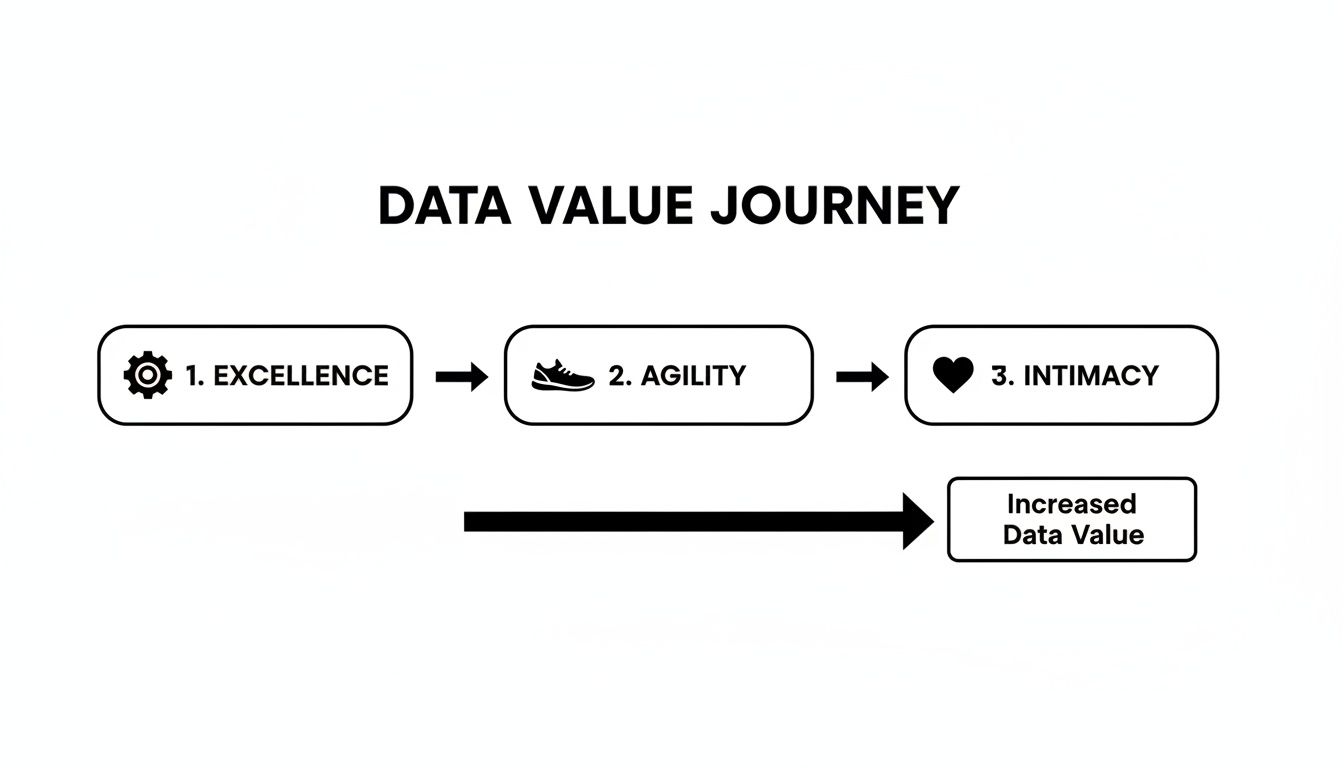
As depicted, data initiatives mature from optimising internal processes to enabling strategic agility and, ultimately, fostering a deeper intimacy with customers.
Phase 3: Pilot Project Execution
This phase focuses on implementation. The objective is to deliver the first use case within a controlled, agile framework to rapidly demonstrate its value.
A small, empowered team comprising both business and technical experts should execute the pilot. This team should operate in short, iterative sprints, continuously developing, testing, and refining the solution.
Success is contingent not only on technology but also on communication. The team must provide regular progress updates and share preliminary results with key stakeholders to build confidence and organisational buy-in.
Phase 4: Enterprise-Wide Scaling
Upon successful completion of the pilot, where KPIs are met and value is proven, the initiative proceeds to the scaling phase. The final objective is to industrialise the solution and replicate its success across other business units.
Ready to Build Your AI Project?
Let's discuss how we can help you ship your AI project in weeks instead of months.
This involves documenting processes, codifying lessons learned from the pilot, and establishing a central centre of excellence to support future projects. Scaling is not merely a technology rollout; it is about embedding a new, data-informed methodology into the corporate DNA.
The following table summarises how these phases constitute a coherent implementation roadmap.
Four-Phase Implementation Roadmap
| Phase | Primary Objective | Key Activities | Critical Success Factor |
|---|---|---|---|
| 1: Strategy | Identify a high-value, low-complexity "first-win" project. | Business problem workshops, use case prioritisation, ROI/KPI definition. | Strong alignment between business leaders and technical teams. |
| 2: Foundation | Ensure clean, reliable, and accessible data for the pilot. | Targeted data mapping, source validation, basic governance setup. | Trust in the data. Without it, the pilot is dead on arrival. |
| 3: Pilot | Deliver the first use case quickly to demonstrate tangible value. | Agile development sprints, frequent stakeholder communication, results tracking. | A small, empowered, cross-functional team with autonomy. |
| 4: Scaling | Industrialise the pilot solution and replicate success across the organisation. | Documenting best practices, creating a centre of excellence, training. | Embedding the data-driven mindset into the company culture. |
Following a structured path transforms an intimidating challenge into a series of manageable, value-creating steps.
Navigating Common Transformation Pitfalls
While the strategic rationale for becoming a data-driven organisation is compelling, the path is fraught with predictable failure points. Astute leaders anticipate these challenges and implement countermeasures to avoid costly missteps. Many data initiatives falter not from a lack of ambition, but from foreseeable operational and cultural hurdles that were not addressed at inception.
Common traps include data silos that prevent a unified business view, insufficient C-suite sponsorship, cultural resistance from entrenched teams, and technology selections misaligned with business objectives. Recognising these roadblocks is the first step toward architecting a resilient transformation strategy.
Proactively Addressing Challenges
A proactive stance is required, addressing potential issues before they escalate. Each common pitfall has a strategic countermeasure.
Dismantling Data Silos: Isolated departmental data is a significant barrier. The most effective method for dismantling these silos is to establish a cross-functional data governance council. This body, comprising leaders from IT, finance, operations, and marketing, is empowered to set and enforce enterprise-wide data standards, transforming data into a shared, trusted asset.
Overcoming Cultural Resistance: The phrase "this is how we have always done things" is a common refrain. The most effective counterargument is demonstration, not declaration. Select a high-impact pilot project that solves a tangible, painful business problem. A successful case study is more persuasive than any top-down mandate and cultivates internal champions who will advocate for the new paradigm.
A data-driven transformation is fundamentally a change management exercise disguised as a technology project. Success depends less on algorithmic sophistication and more on the organisation's willingness to trust and act on data-derived insights.
Aligning Technology with Business Value
A classic error is significant investment in complex technology without a clear business case. Technology selection must be driven by specific, prioritised business problems, not by the allure of new software. The process should begin with the business problem, followed by the identification of the simplest technology capable of delivering the solution.
Want to Accelerate Your Innovation?
Our team of experts can help you turn ideas into production-ready solutions.
This focused approach prevents over-investment and ensures that every technical decision is directly linked to a measurable business outcome. Successfully navigating these complexities is a core component of effective risk management and compliance. By proactively mitigating these common risks, leaders can ensure their transformation is not only successful but also sustainable.
Your Next Step Toward Internal Transformation
The journey to becoming a truly data-driven company is not a reactive measure to market pressures. It is a deliberate, methodical process of internal evolution—a fundamental shift in how your business operates and makes decisions.
This change requires moving from a culture where decisions are driven by hierarchy and intuition to one founded on intellectual curiosity and empirical evidence.
Success rests on the three pillars discussed: People, Process, and Platforms. It is not achieved by merely acquiring advanced technology. It requires a data-literate team, processes designed to generate insights, and a technology stack that provides accessible, actionable data. This is not a single, massive overhaul but a series of focused, strategic steps.
The success of a data-driven culture is measured not by the complexity of its models, but by the velocity at which it converts validated insights into decisive action. This is the new benchmark for competitive advantage.
Looking for AI Expertise?
Get in touch to explore how AI can transform your business.
From Strategy to Execution
For business leaders in Germany, the time for theoretical discussion has passed. The critical challenge is to move from contemplation to concrete action. The most effective starting point is to apply this framework to a single, real-world business problem.
Select one high-impact challenge within your organisation—perhaps reducing scrap rates on a production line, improving the accuracy of a sales forecast, or increasing the conversion rate of a marketing campaign.
Commit to a focused, 90-day pilot project to solve that one problem using a data-driven approach. This initial success will provide the empirical proof, organisational momentum, and internal champions required to institutionalise this change. This is how you begin to build a more resilient and prosperous future for your company.
Frequently Asked Questions
When we engage with leadership teams on transitioning to a data-driven model, a set of recurring, practical questions invariably arises. Here are concise answers to the most common queries from executives initiating this journey.
How Do We Start If Our Data Is Messy and Siloed?
Resist the impulse to initiate a large-scale, enterprise-wide data cleansing project. This approach often leads to budget overruns and organisational fatigue.
Ready to Build Your AI Project?
Let's discuss how we can help you ship your AI project in weeks instead of months.
Instead, select a single, high-value business problem. This focus allows you to identify, cleanse, and structure only the specific data required for one pilot project. Starting small proves the value of structured data in a controlled environment and establishes a battle-tested template for data governance that can be replicated for subsequent initiatives.
What Is the Role of AI in Becoming a Data-Driven Company?
AI functions as the engine that transforms data from a static, historical record into a dynamic tool for future growth. Traditional Business Intelligence (BI) excels at explaining what happened. Artificial Intelligence and machine learning, by contrast, predict what will happen next and can recommend prescriptive actions.
For example, AI can shift a manufacturing facility from reactive repairs to predictive maintenance, yielding substantial cost savings. In marketing, it enables customer experience personalisation at a scale unattainable by human teams. In essence, AI operationalises your data, turning it into automated, predictive action.
How Do We Measure the ROI of a Data-Driven Initiative?
To calculate a defensible Return on Investment (ROI), the initiative must be directly linked to a core business metric from its inception. Define the specific Key Performance Indicator (KPI) you intend to influence before any implementation begins.
Measure the baseline for that KPI, deploy the data-driven solution, and then track the change over a defined period. The methodology is straightforward.
Want to Accelerate Your Innovation?
Our team of experts can help you turn ideas into production-ready solutions.
- For an operational project, the objective might be to reduce machine downtime by a target percentage or decrease supply chain costs.
- For a commercial project, the goal could be to increase customer lifetime value or improve marketing conversion rates.
This disciplined approach ensures every data project is held accountable for delivering tangible business results.
At Reruption GmbH, we act as your co-preneurs, helping you navigate the complexities of AI adoption from strategy all the way to implementation. We de-risk innovation and turn your ideas into market-ready solutions. Learn more about how we can accelerate your internal transformation.