
Application Managed Services (AMS) represent a strategic delegation of your enterprise software lifecycle to a specialized third-party partner. This partner assumes full responsibility for proactive management, maintenance, security, and optimization, ensuring your applications deliver demonstrable business value. This constitutes a fundamental shift from a reactive IT support model to one of continuous improvement and strategic alignment.
The Strategic Imperative for Application Excellence
For senior leadership in German enterprises, a sprawling application portfolio is not merely an IT operational challenge; it is the core engine driving growth and competitive differentiation. In a market where digital capabilities define relevance, the performance, security, and agility of these applications are paramount. Allowing this core asset to stagnate introduces direct risk to innovation velocity and market position.
Modern application managed services transcend the traditional "keep-the-lights-on" IT support contracts. This is not an exercise in outsourcing a problem. It is the engagement of a strategic co-pilot, whose sole mandate is to ensure your application ecosystem delivers peak performance, robust security, and a clear return on investment. It is a partnership model designed to integrate external, specialized expertise with your internal strategic objectives.
Beyond Maintenance to Value Creation
The efficacy of a modern AMS partnership is measured in business outcomes, not in the volume of support tickets resolved. Its strategic purpose is to act as a catalyst for growth, particularly as enterprises integrate Artificial Intelligence into their core operations.
A high-impact partner will focus on:
Ready to Build Your AI Project?
Let's discuss how we can help you ship your AI project in weeks instead of months.
- Proactive Stewardship: Continuous monitoring, optimization, and security fortification to pre-empt issues long before they can impact business operations.
- Innovation Enablement: Liberating high-value internal talent from routine maintenance, enabling them to focus on core business innovation and new product development.
- Future-Proofing: Ensuring your application portfolio is not only stable for current demands but architected for future requirements, whether scaling for market expansion or integrating sophisticated AI capabilities.
At its core, modern AMS transforms your application portfolio from a cost center into a strategic asset that actively generates revenue, enhances operational efficiency, and solidifies market leadership. This is achieved by embedding deep technical and strategic expertise directly into your value chain.
This framework requires a partner fluent in both technology and business strategy. When evaluating potential providers, the central question must evolve from, "Can you maintain our software?" to, "How will you leverage our software to accelerate our business objectives?" The distinction is critical. Deeper insights into aligning business goals with technological execution are available in our analysis of strategy and technology. The right AMS provider becomes an extension of your own leadership team, sharing accountability for results and transforming digital ambition into market reality.
Selecting the Optimal AMS Operating Model
The selection of an engagement model with an Application Managed Services (AMS) partner is a critical strategic decision. It establishes the framework for the entire relationship and directly influences outcomes. This decision must extend beyond technical specifications to align with your corporate culture, strategic ambitions, and desired level of operational control. It is the foundational blueprint for your digital operations.
There is no universally superior model; the optimal structure is contingent upon your specific strategic objectives. We will delineate the three primary models—Traditional Outsourcing, the Co-Managed approach, and Productised AMS—to provide a clear framework for this decision.
This guide helps distinguish between the need for basic operational support versus a partnership geared for strategic growth.
Want to Accelerate Your Innovation?
Our team of experts can help you turn ideas into production-ready solutions.
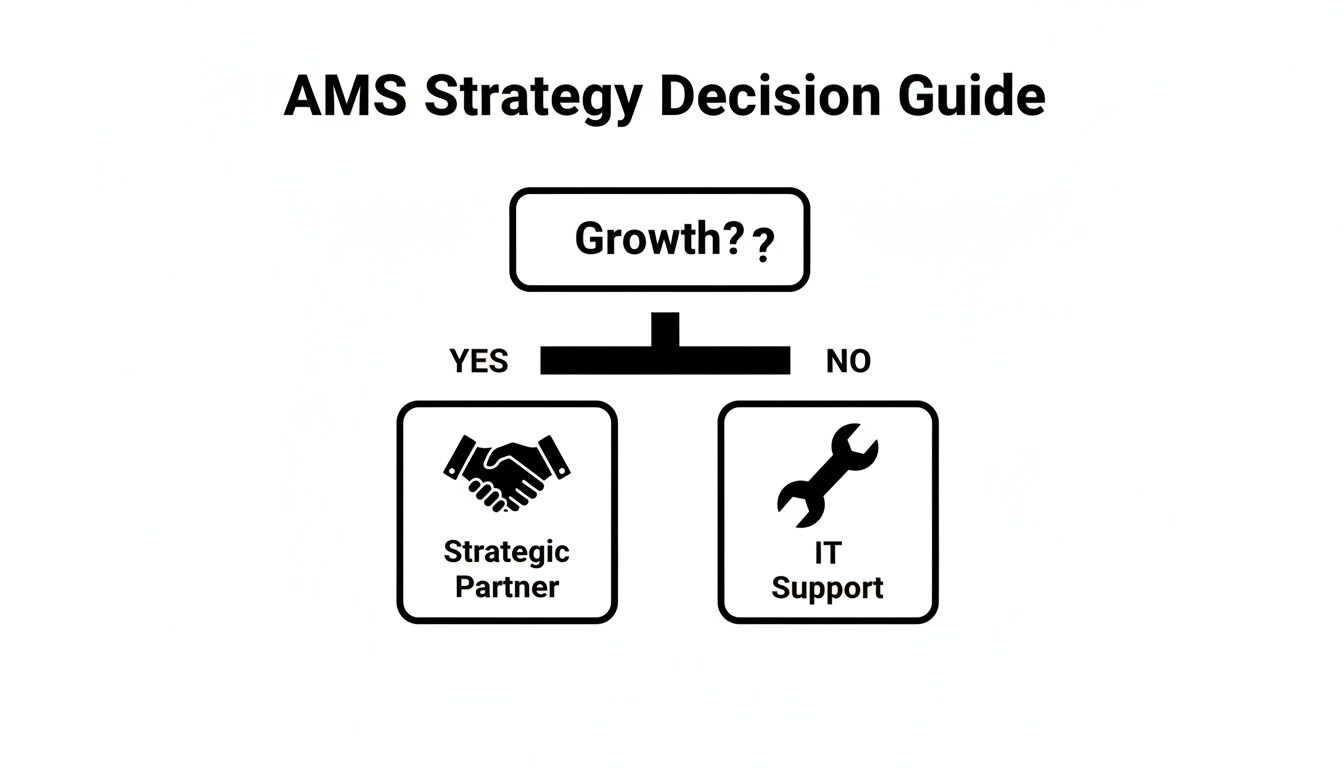
The strategic implication is clear: if growth is the primary driver, a more integrated, strategic partnership is indicated. If operational stability is the objective, a defined support model is more appropriate.
Traditional Outsourcing: The Delegation Model
Traditional outsourcing involves the complete delegation of a defined set of applications to an external provider. This model is optimal for leaders focused on operational efficiency, reduction of internal IT overhead, and predictable cost structures.
It is particularly effective for stable, legacy applications that are critical for business continuity but are not central to innovation initiatives. The inherent trade-off is a reduction in direct control and agility, as the provider typically operates within a rigidly defined scope of work.
The Co-Managed Model: The Strategic Partnership
The co-managed model transcends the conventional client-vendor dynamic, establishing a genuine strategic partnership. In this framework, external AMS experts are deeply integrated into your internal teams, collaborating to manage, maintain, and—most importantly—evolve your applications. The structure is predicated on shared knowledge, joint problem-solving, and unified value creation.
Looking for AI Expertise?
Get in touch to explore how AI can transform your business.
A co-managed model transforms the AMS provider into an embedded extension of your internal capabilities. The objective shifts from mere contract fulfillment to the achievement of shared business KPIs, such as accelerated feature deployment or enhanced customer satisfaction metrics.
This model is ideally suited for organizations that wish to retain strategic control and augment internal team capabilities with elite external expertise. It is a powerful mechanism for driving innovation without relinquishing oversight. To contextualize this partnership within a broader organizational structure, it is valuable to understand how to design an effective target operating model.
Productised AMS: The Standardised Solution
Productised AMS is defined by standardization. It offers a pre-packaged solution tailored to a specific application or platform, such as SAP, Salesforce, or a significant custom-built system. The provider delivers a defined menu of services—support, monitoring, updates—for a predictable, often subscription-based, fee.
This model provides exceptional cost predictability and reliability for systems that are business-critical but do not represent a source of competitive differentiation. It is the preferred choice when guaranteed performance for a standard enterprise application is required, without the complexity of a bespoke service agreement.
The German market for these services is experiencing significant growth, particularly within the automotive and manufacturing sectors. Research indicates that post-2024, 70% of German firms increased their adoption of cloud-based AMS for compliance purposes, and 50% of executives plan to expand their use of managed services by 2027. This signals a clear strategic shift toward leveraging external experts for specialized operational excellence. When architecting an AMS strategy, understanding the capabilities of a managed service provider AWS is essential for maximizing cloud infrastructure.
Comparative Analysis of AMS Operating Models
The choice between these models is a strategic, not merely technical, decision. Each model carries distinct implications for budget, control, and innovation capacity. This table provides a comparative analysis to help align your selection with core business objectives.
| Dimension | Traditional Outsourcing | Co-Managed Model | Productised AMS |
|---|---|---|---|
| Primary Goal | Cost reduction & efficiency | Strategic growth & innovation | Predictability & reliability |
| Control Level | Low (delegated responsibility) | High (shared responsibility) | Medium (scope is pre-defined) |
| Team Integration | Low (siloed teams) | High (deeply integrated) | Low (service-based interaction) |
| Flexibility | Low (rigid scope of work) | High (adaptive and agile) | Low (standardised package) |
| Best For | Stable, legacy systems | Core, strategic applications | Standard platforms (e.g., SAP) |
| Cost Structure | Fixed-price or T&M | Flexible, value-based | Fixed subscription fee |
Ultimately, the optimal model is one that acts as a catalyst, not a constraint, for your business. Clarity on these dimensions is paramount to making an informed strategic decision.
The Technical Pillars of High-Value AMS
When evaluating an AMS partner, it is imperative to look beyond surface-level commitments. Any provider can promise operational stability. True strategic value is derived from the technical capabilities that distinguish a basic service desk from a strategic partner.
High-value application managed services are not accidental; they are built upon four interconnected technical pillars. A clear understanding of these pillars provides a robust framework for assessing a provider's genuine capabilities.

These pillars function as an integrated system, ensuring your applications do not merely operate—they actively contribute to your competitive advantage.
Application Support and Evolution
The first pillar transcends reactive incident resolution. While rapid issue remediation is a baseline expectation, a premier partner maintains a forward-looking perspective. They are not merely patching vulnerabilities; they are continuously identifying opportunities to enhance performance, improve the user experience, and deploy incremental features that deliver measurable business value.
This entails a focus on:
- Root Cause Analysis: Moving beyond ticket closure to conduct deep-dive analyses that identify the fundamental cause of an issue, thereby preventing recurrence.
- Performance Tuning: Systematically analyzing performance data to identify and eliminate bottlenecks, ensuring a seamless experience for end-users.
- Feature Enhancement: Collaborating with business stakeholders to identify and deploy a continuous stream of small, high-impact improvements aligned with strategic goals.
Platform Operations and Management
An application's performance is intrinsically linked to its underlying infrastructure. Platform Operations encompasses the management of this infrastructure—whether cloud-based or on-premise—to guarantee stability, security, and scalability. A proficient AMS provider assumes complete ownership of this layer, abstracting its complexity from your internal teams.
This is where critical non-functional requirements are managed: server provisioning, auto-scaling to meet traffic demands, and vulnerability patching at the infrastructure level. The platform is treated as a product in itself, engineered for the resilience required by your most critical business processes. This focus liberates your internal teams to concentrate entirely on innovation at the application layer. Our guide on solutions in the cloud offers further detail on how a well-managed platform can accelerate business outcomes.
Intelligent Observability and APM
Traditional monitoring is reactive; it signals a problem after it has occurred. Intelligent observability is predictive; it provides insights that allow you to pre-empt issues. This pillar leverages advanced Application Performance Management (APM) tools to gain predictive insights across the entire technology stack.
A mature observability practice provides a unified view of your entire technological ecosystem. It correlates application behavior, user experience, and business outcomes, enabling data-driven decisions that prevent outages before they impact the business.
The German market recognizes this value. Projections indicate Germany's APM market will expand from USD 552.7 million in 2024 to USD 1,168.6 million by 2030. The fastest-growing segment is services, which is projected to capture 45% of the market as businesses demand hands-on optimization. For mid-market companies, this service-led approach to APM can reduce IT operational costs by up to 35% through early issue detection. Further details are available on Germany's APM market growth on grandviewresearch.com.
DevSecOps and Release Engineering
The final pillar integrates security into every phase of the development and release lifecycle. In an environment of continuous delivery, speed cannot compromise security. A strategic AMS partner instills a DevSecOps culture, automating security checks and compliance protocols directly into the software delivery pipeline.
This ensures security is not a final, pre-launch checklist item, but an intrinsic quality of the software. It becomes a shared responsibility, supported by automated tools for vulnerability scanning, static code analysis, and configuration management from the project's inception. This methodology enables faster, safer innovation, allowing for confident deployment of new features while systematically reducing the corporate risk profile. A disciplined release engineering practice ensures every update is stable, secure, and deployed without business disruption.
Navigating Security and Compliance in AMS
For any German enterprise, discussions surrounding application management are invariably anchored in security and compliance. In a jurisdiction with some of the world's most stringent regulations, these are not mere procedural hurdles; they are foundational to operational integrity. A true application managed services partner understands this reality implicitly. They do not treat security as an add-on; they function as a compliance accelerator, embedding it into the fabric of your operations.
The complexities of GDPR, TISAX for the automotive sector, and various ISO certifications demand specialized, continuous attention. A sophisticated AMS provider views these not as contractual obligations, but as opportunities to build a culture of compliance that transforms a potential liability into a competitive advantage and a pillar of customer trust.

This strategic shift ensures your application portfolio is not just operationally sound, but also legally and technically defensible. It elevates security from a reactive, incident-driven activity to a proactive, intelligence-led discipline.
Embedding Security into the Application Lifecycle
A modern AMS partnership integrates security from the initial code commit through to daily operations. This is not about a last-minute security scan; it is about engineering security as an inherent quality of the application itself. Your provider acts as the first line of defense, implementing robust protocols to protect your data and, by extension, your corporate reputation.
Ready to Build Your AI Project?
Let's discuss how we can help you ship your AI project in weeks instead of months.
This operationalizes as:
- Proactive Threat Intelligence: Continuously monitoring the global threat landscape to anticipate and mitigate potential attacks.
- Continuous Vulnerability Scanning: Automating the identification of weaknesses within your code, configurations, and third-party dependencies.
- Secure Code Development Practices: Enforcing stringent coding standards and conducting regular peer reviews to eliminate vulnerabilities at their source.
This is a systematic process, not a one-time task, that continuously reduces your attack surface. As your applications evolve, your security posture should strengthen, not degrade. With the increasing integration of AI, it becomes critical to understand how to construct audit-proof AI systems to maintain resilience.
From Data Governance to Incident Response
Security extends far beyond application code. A mature AMS offering establishes clear, auditable governance over your data. This includes defining access controls, establishing usage parameters, and maintaining an immutable record of all actions. It is about managing data as the critical business asset it is.
A world-class AMS provider delivers a battle-tested incident response playbook. In the event of a security incident, the focus is not on assigning blame, but on swift, coordinated action: containment, eradication, recovery, and a transparent post-mortem analysis to prevent recurrence.
This capability is non-negotiable. A well-defined incident response plan is the critical differentiator between a minor operational disruption and a major reputational crisis. Your AMS partner must demonstrate clear, rehearsed procedures that integrate seamlessly with your own business continuity strategies. It is also vital to understand the wider legal context, including principles of ethical data use and compliance in the digital age.
Want to Accelerate Your Innovation?
Our team of experts can help you turn ideas into production-ready solutions.
Ultimately, the right partner transforms your approach to security and compliance. They provide the deep expertise and operational discipline required to master Germany's complex regulatory landscape, freeing your teams to focus on innovation, confident that your digital assets are secure.
Calculating the True Cost and Return of AMS
Any C-level decision requires a robust financial justification. When evaluating application managed services, it is easy to focus narrowly on the provider's monthly fee. This, however, represents only a fraction of the total economic impact. A comprehensive analysis must consider the Total Cost of Ownership (TCO) and the full spectrum of Return on Investment (ROI).
The most immediate benefits are direct cost reductions. Transitioning application maintenance to an AMS partner frequently allows for the reduction or, more strategically, the redeployment of internal staff. It also obviates significant capital expenditures on on-premise hardware, software licensing, and data center operations, as the provider absorbs this operational burden. These are the quantifiable line items that initiate the financial analysis.
However, the complete financial narrative of AMS extends beyond cost-cutting. A strategic partnership delivers substantial indirect value by enhancing operational resilience and mitigating critical business risks.
Beyond Direct Savings to Strategic Value Creation
The true business impact of AMS is measured by the value it creates, not merely the expenses it eliminates. This is where a strategic partner demonstrates their worth, transforming a historical cost center into a driver of revenue and competitive advantage. The conversation shifts from "What are our savings?" to "What is our gain?"
Looking for AI Expertise?
Get in touch to explore how AI can transform your business.
This value materializes in several key areas:
- Increased Application Uptime: Every minute of application downtime represents lost revenue and customer erosion. A premier AMS provider, leveraging sophisticated monitoring, can reduce downtime by 25-30%, directly impacting the bottom line.
- Mitigated Security Risks: The financial and reputational consequences of a security breach are severe, encompassing regulatory fines, brand damage, and operational disruption. Proactive security management from an AMS partner serves as a crucial risk mitigation strategy.
- Accelerated Feature Deployment: Reducing the time-to-market for new features or products is a direct revenue accelerator. By liberating internal teams from maintenance, AMS enables a focused effort on innovation, allowing the organization to capitalize on market opportunities more swiftly.
The core of a compelling business case for AMS is not cost avoidance, but the enablement of strategic growth. When you reallocate your most talented personnel from operational maintenance to future-focused innovation, you are making a direct investment in the long-term trajectory of the business.
Consider Germany's manufacturing sector. For many Mittelstand companies, AMS is the engine of digital transformation. To comply with Germany's stringent data sovereignty regulations, on-premise AMS deployments are growing at a 24.6% CAGR. In 2024 pilot programs, these manufacturers have already reduced operational disruptions by an average of 25%, creating the foundation for AI-driven predictive maintenance. Additional insights are available from the application management services market on snsinsider.com.
Constructing a Measurable Business Case
To develop a comprehensive financial model, you must synthesize direct savings with these indirect gains. Your TCO calculation should begin with provider fees, then subtract savings from reduced internal headcount and infrastructure overhead. Critically, it must also factor in the financial impact of avoided costs, such as downtime and security incidents.
This approach yields a clear, defensible business case for a strategic partnership. For a more detailed guide on this type of financial modeling, review our framework for conducting a Make-or-Buy Analysis.
Ready to Build Your AI Project?
Let's discuss how we can help you ship your AI project in weeks instead of months.
Ultimately, the ROI from application managed services is realized when operational stability becomes the foundation for corporate innovation and sustained market leadership.
The Partnership Model in Practice
Theoretical models are instructive, but the definitive test of a strategic application managed services partnership lies in tangible business results. The co-preneurial approach transcends technical SLAs, embracing shared P&L accountability. In this model, your provider evolves from a vendor to a genuine partner, equally invested in your commercial success.
Let us examine two distinct scenarios: the launch of a corporate venture at startup velocity and the AI-driven optimization of a mature enterprise operation. These cases illustrate how the right partnership framework creates a robust platform for market acceleration, risk mitigation, and true innovation.
Case Study 1: Launching a Corporate Startup
A major German industrial conglomerate sought to launch a new B2B digital platform, operating it as a lean, autonomous startup. They faced a classic dilemma: the need for venture-level speed and agility constrained by the risk management and reporting requirements of a large enterprise. Their internal IT infrastructure was architected for stability, not for the rapid iteration and pivoting essential for a new venture.
A co-managed AMS model was selected to provide the venture with an agile technology backbone. The partner assumed full ownership of the application platform, ensuring it was scalable, secure, and production-ready from inception. This liberated the small internal product team to focus exclusively on high-value activities: customer discovery, feature development, and go-to-market strategy.
Want to Accelerate Your Innovation?
Our team of experts can help you turn ideas into production-ready solutions.
The results were decisive:
- Accelerated Time-to-Market: The minimum viable product (MVP) was launched in just 12 weeks—a timeline unattainable using internal resources.
- Transparent P&L Accountability: The AMS partner operated on a clear cost model directly aligned with the venture’s budget, providing leadership with real-time financial visibility.
- Zero Operational Friction: The venture team was completely insulated from infrastructure management, enabling them to pivot rapidly based on market feedback without technical constraints.
This partnership provided a stable foundation for high-velocity innovation, allowing the venture to test its business model in the market with confidence in its underlying technology.
Case Study 2: AI-Infused Process Optimization
A large manufacturing firm was constrained by its supply chain management software. The application was business-critical but suffered from performance bottlenecks and manual workarounds, leading to costly operational delays. They required significant efficiency gains but could not justify a high-risk, multi-year replacement project.
An AMS partner with deep expertise in AI and process automation was engaged. The initial step was to deploy intelligent observability tools across the entire application stack. These tools moved beyond simple uptime monitoring to analyze performance patterns, user behavior, and data flows, identifying the true root causes of inefficiency.
The AI-driven analysis revealed a critical insight: 40% of all manual data entry was redundant, caused by a suboptimal integration between two internal systems—a flaw that traditional monitoring had consistently overlooked.
Looking for AI Expertise?
Get in touch to explore how AI can transform your business.
Armed with this data, the AMS team implemented a series of targeted automations and API integrations. The impact was immediate. The AI-infused application managed services drove significant cost savings by resolving these latent inefficiencies. Rather than applying a temporary fix, they engineered a more resilient, efficient process for the long term, transforming a legacy liability into a streamlined asset.
C-Level Inquiries Regarding AMS
As senior leaders consider engaging an application managed services partner, several key questions consistently arise. Acknowledging the strategic importance of this decision, we address the most common inquiries with the clarity required for an informed evaluation.
What is the distinction between AMS and our current IT support function?
Think of traditional IT support as a reactive force. Its purpose is to respond to incidents after they have occurred. Success is measured by the speed of resolution following a service disruption. This is the classic "break-fix" model.
A strategic AMS partner functions as a proactive agent. They are architect and engineer, focused on preventing incidents from ever occurring. The model shifts entirely from reactive problem-solving to proactive value creation. This involves continuous optimization, security hardening, and performance tuning to ensure your applications are not merely operational, but are performing at their peak potential to drive business outcomes. It is the fundamental difference between closing a support ticket and owning a business result.
How does this engagement model enable my team to focus on innovation?
By delegating the day-to-day operational responsibility for your applications, you remove a significant burden from your internal teams. Routine maintenance, security patching, performance monitoring, and incident response are no longer their primary concerns.
Ready to Build Your AI Project?
Let's discuss how we can help you ship your AI project in weeks instead of months.
This reallocation of focus is the strategic catalyst. Your most valuable technical and product talent are freed from the operational treadmill of "keeping the lights on." They can now dedicate their expertise to high-value initiatives that directly impact growth: developing new product features, exploring AI for new revenue streams, and driving the core innovations that create competitive separation.
How is AI integrated into a modern AMS offering?
In a contemporary AMS framework, AI is not a marketing term; it is a core operational tool. Premier providers leverage AI-driven observability and Application Performance Management (APM) to generate predictive insights. Instead of receiving an alert that an application is down, these systems identify the subtle performance anomalies and behavioral deviations that signal an impending problem. This allows the team to intervene proactively, before any impact to the customer.
Furthermore, AI automates critical operational tasks:
- Intelligent Alerting: Filters immense volumes of system notifications to isolate signals that require human intervention.
- Root Cause Analysis: Accelerates diagnostics by instantly identifying the probable source of complex issues.
- Predictive Scaling: Automatically provisions additional resources in anticipation of traffic surges.
This is not merely about operational efficiency. It is about architecting a more intelligent, resilient operation that transforms application management from a necessary cost into a data-driven strategic asset.
At Reruption GmbH, we do not simply manage applications; we function as co-preneurs, implementing AI-driven strategies that deliver measurable business value. We assume P&L accountability for outcomes, transforming your technology portfolio into a powerful engine for growth. Turn your ideas into innovations with us.
Want to Accelerate Your Innovation?
Our team of experts can help you turn ideas into production-ready solutions.