In the contemporary business landscape, technology has evolved beyond a support function; it now constitutes the central nervous system of corporate strategy. For C-suite leaders in Germany, the critical challenge is to penetrate the hype surrounding AI and forge a genuine fusion of strategy and technology that directly impacts the profit and loss (P&L) statement. This profound integration is the key to securing a sustainable competitive advantage and building organisational resilience.
Unifying Strategy And Technology In The AI Era

For decades, technology was managed as a cost centre—a utility essential for operational continuity. Strategic mandates were formulated in the boardroom, and the IT department was tasked with implementation. This paradigm is now obsolete.
Today, technology, particularly artificial intelligence, is the primary enabler of strategic possibilities. The objective is no longer to align IT with business objectives, but rather to construct the business upon a technological foundation. This fusion of strategy and technology unlocks novel business models, optimises value chains, and creates previously non-existent markets.
This necessitates a fundamental mindset shift within the executive team. Leadership must transition from a reactive to a proactive posture, where technology initiatives are not siloed projects but core pillars of the corporate agenda. If you wish to explore this new paradigm in greater detail, our guide on the essentials of corporate digitalisation provides an excellent starting point: https://reruption.com/en/knowledge/blog/digitalisierung-der-unternehmen.
The Imperative For German Enterprises
The German market, distinguished by its world-renowned engineering and industrial capabilities, stands at a critical juncture. The opportunity is substantial, but so is the risk of inaction.
Germany's AI market is poised for exponential growth. It generated USD 29,671.1 million in revenue in 2025, a figure projected to increase to USD 203,894.9 million by 2033. This represents a compound annual growth rate (CAGR) of 26.3%. For enterprises in the automotive, manufacturing, and e-commerce sectors, these are not mere statistics—they are a clear imperative to formalise an AI strategy immediately.
The objective is not to pursue technology for its own sake, but to embed intelligent systems into the core of the business to drive measurable results—from the factory floor to the customer transaction.
This guide outlines a partnership model designed for this new reality. We term it our 'Co-Preneur' philosophy, which prioritises P&L accountability over the traditional consulting model. We provide practical frameworks and clear roadmaps to help you position technology at the heart of your enterprise, transforming it into your most potent engine for growth. A firm understanding of how AI is reshaping the market is also critical, which is why we recommend this guide to AI search engine optimization.
A Framework for Aligning Technology with Business Goals
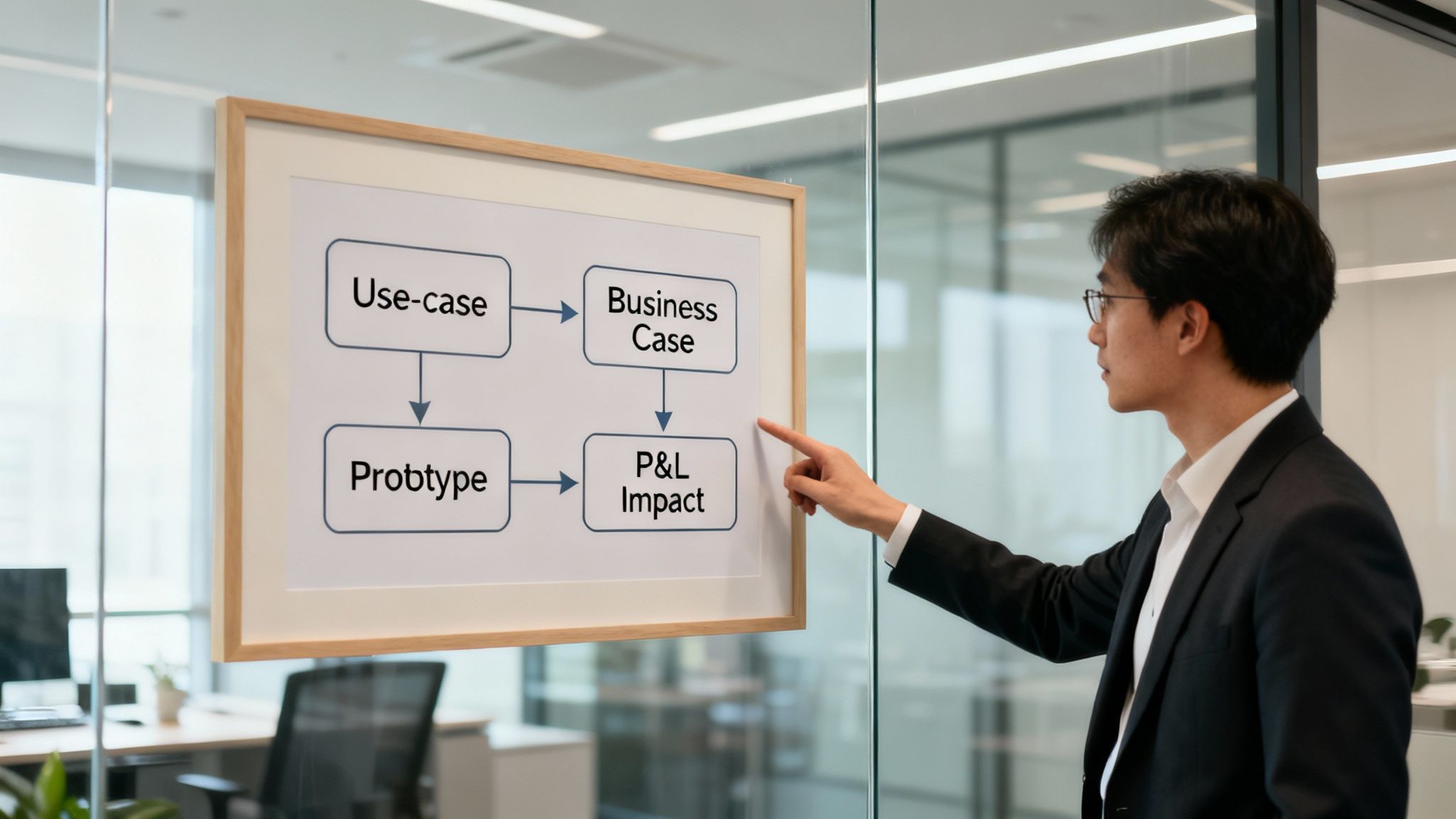
To effectively integrate technology with strategy, abstract theories are insufficient. A clear, actionable framework is required, particularly when budgets are constrained and P&L impact is the primary metric of success. The process must systematically translate a business problem into a value-generating solution.
The process commences not with technology, but with the identification of high-value use cases. The critical question is not "How can we use AI?" but rather, "What is our most pressing business problem?" This simple reorientation grounds all activity in tangible business needs, ensuring technology serves strategy, not the reverse.
From Business Problem to P&L Impact
Once a critical business problem has been isolated, the next step is to construct a robust business case. This is not a perfunctory cost-benefit analysis, but a strategic document that establishes a direct causal link from the proposed initiative to the key drivers of your P&L.
Every potential technology project, especially in AI, must demonstrate its value in one of three areas:
- Cost Reduction: How will this initiative decrease operational expenditures, reduce waste, or enhance process efficiency?
- Revenue Generation: Will it unlock new revenue streams, increase sales conversions, or improve customer lifetime value?
- Market Expansion: Does it facilitate entry into new markets, increase market share, or create a sustainable competitive advantage?
This disciplined approach ensures that every euro invested is tied to a measurable financial outcome. It fundamentally reframes the conversation, repositioning technology from a cost centre to a collaborative engine of profitable growth between strategy and technology.
The Power of Rapid Prototyping
With a compelling business case, the traditional approach involves a lengthy, expensive, and high-risk development cycle. An entrepreneurial methodology, however, focuses on systematic risk mitigation through rapid prototyping. The objective is to validate the core strategic hypothesis in days, not months.
A prototype, or Proof of Value, is not a scaled-down version of the final product. It is a focused experiment designed to answer the single most critical question: "If we build this, will it deliver the expected business value?"
This agile process provides executives with empirical data at an early stage. It enables strategic pivots, course corrections, or project termination before significant capital has been committed. This velocity is crucial for maintaining momentum and demonstrating tangible progress to stakeholders, thereby building the confidence required for further investment. This exact methodology is central to the prioritisation framework we developed for Minimum Viable Products, which you can explore in our guide to building a successful AI Strategy for 2025.
The following table illustrates the paradigm shift from traditional methods to this integrated, modern approach.
Bridging the Strategy and Technology Gap
| Dimension | Traditional IT Alignment (The Past) | Integrated Strategy & Technology (The Future) |
|---|---|---|
| Starting Point | Technology capabilities ("What can we build?") | Business problem ("What should we solve?") |
| Goal | Deliver a pre-defined technical solution | Deliver a measurable business outcome |
| Process | Linear, waterfall development; long cycles | Agile, iterative prototyping; rapid feedback loops |
| Risk Management | Big upfront investment, risk managed late | Small, staged investments; de-risking is constant |
| Metric for Success | On-time, on-budget project delivery | P&L impact (cost, revenue, market share) |
| Mindset | Technology as a support function or cost centre | Technology as a core driver of business value |
This table highlights a fundamental change: moving from viewing IT as a service provider to embedding technology directly into the fabric of business strategy.
Establishing a Repeatable Process
This framework—Use Case Discovery, Business Case Modelling, and Rapid Prototyping—is not a one-time exercise. It is a repeatable, scalable process that equips your organisation with a powerful engine for continuous innovation. It cultivates a culture of entrepreneurial action within the corporate structure, where ideas are systematically tested and validated against real business metrics.
By embedding this methodology, leaders ensure that every technology investment has a clear, quantifiable business purpose. This structured approach closes the gap between high-level corporate objectives and the daily execution of technical teams. It creates a direct, transparent link between your strategy and technology investments and their impact on the bottom line. It is how you transform ambitious ideas into measurable innovations.
Building a Robust AI Governance and Accountability Model
Successful AI implementation is not merely a technological challenge; it is fundamentally a matter of organisational structure and discipline. For German enterprises, where precision and reliability are core corporate values, a robust foundation of governance and clear accountability is non-negotiable. This framework is what enables risk management while creating the necessary space for innovation to flourish.
This requires moving beyond traditional IT governance. AI introduces a new set of complexities, from data integrity and algorithmic bias to regulatory compliance. Delegating these challenges solely to the IT department is a formula for strategic misalignment and missed opportunities. A more effective model integrates governance directly into the business units that will utilise and benefit from the technology.
Shifting Accountability to the P&L Owners
The most significant paradigm shift is the adoption of a P&L accountability model. In this structure, the business unit leader—the executive responsible for a specific profit and loss statement—assumes ownership of the AI initiative from inception to completion. This structure mandates that every AI project be directly linked to a measurable business outcome, whether it is revenue growth, cost reduction, or market share expansion.
Ready to Build Your AI Project?
Let's discuss how we can help you ship your AI project in weeks instead of months.
This model injects a necessary entrepreneurial spirit into the organisation. When a business unit owns the P&L impact, technology ceases to be an external cost centre and becomes an internal engine for achieving strategic targets. This approach, however, requires new roles and clearly defined responsibilities.
Key roles in a P&L-driven model typically include:
- The Business Unit Leader: The ultimate owner. This individual defines the strategic objective and champions the budget.
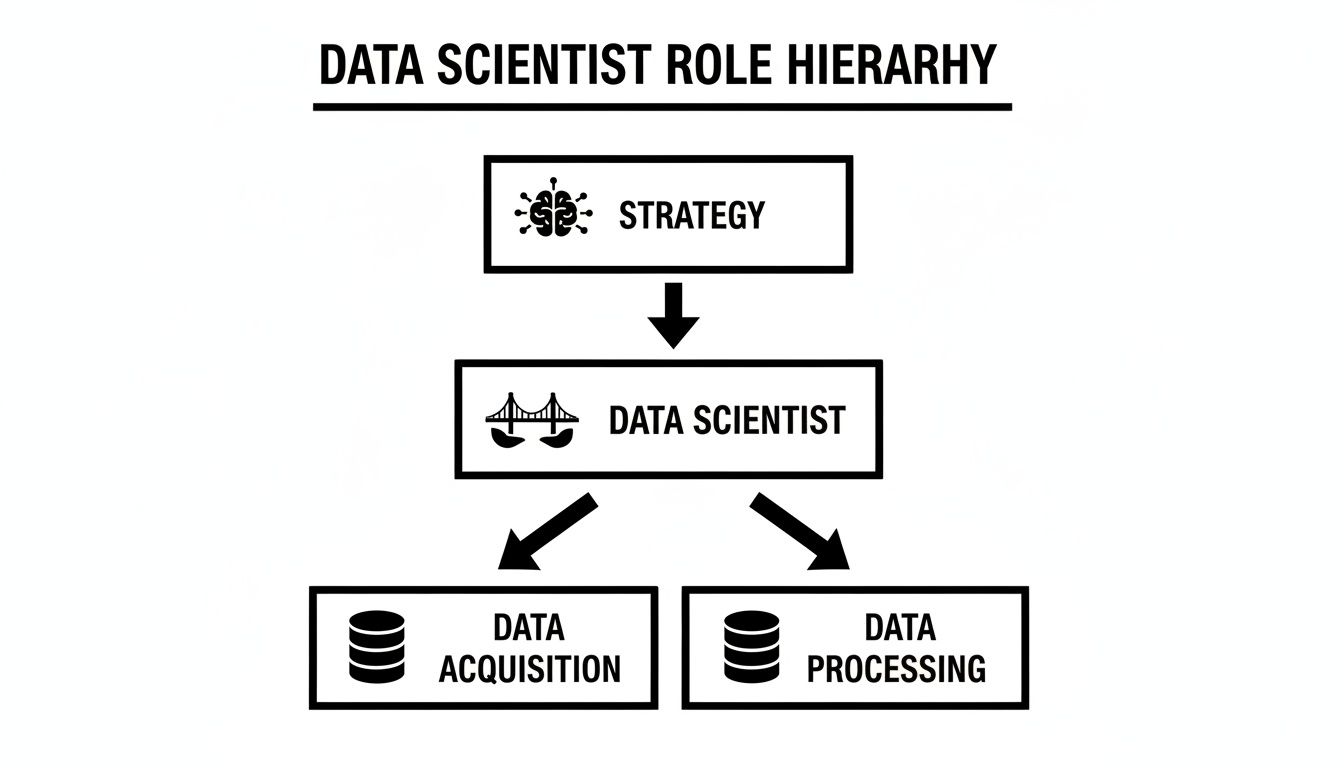
- The AI Product Owner: The critical liaison between business and technology. They translate business requirements into technical specifications and ensure the final solution effectively addresses the identified problem.
- The Cross-Functional Team: A dedicated group of data scientists, engineers, and domain experts from the business unit, collaborating to build and deploy the solution.
Establishing Ethical and Compliant AI Frameworks
For German companies operating within a complex regulatory environment, governance must extend beyond financial considerations. It must encompass ethical principles and strict compliance with both national and European standards. This is where the fusion of strategy and technology becomes a critical function of risk management.
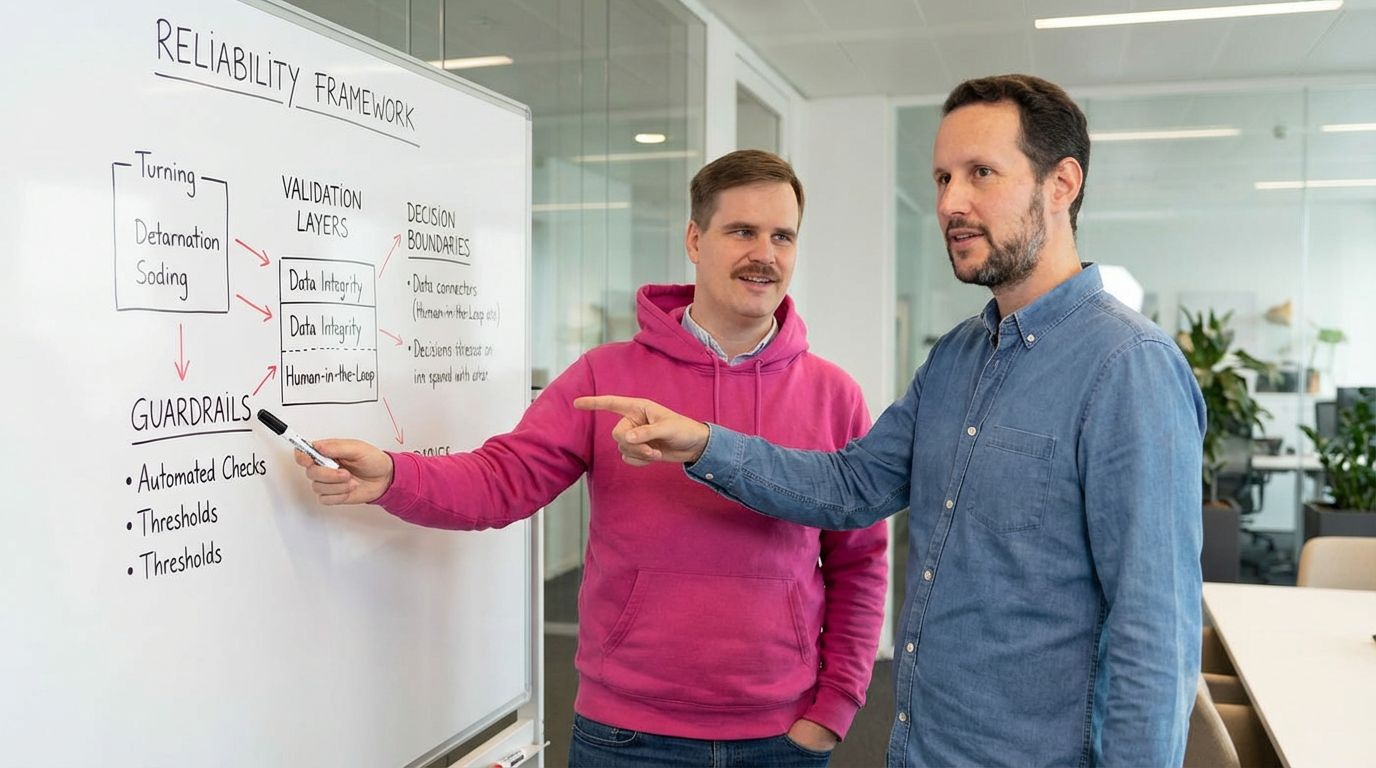
An effective AI governance framework must proactively address potential risks. This entails establishing clear guidelines for data usage, ensuring algorithmic transparency and explainability, and building systems that are fair and unbiased. The objective is to create a set of foundational rules that guide the entire AI lifecycle, from data acquisition to model deployment.
A robust governance model is not an impediment to innovation; it is an enabler. By defining the rules of engagement upfront, it provides teams with the confidence to experiment and build solutions that are not only powerful but also responsible and trustworthy.
Want to Accelerate Your Innovation?
Our team of experts can help you turn ideas into production-ready solutions.
Adherence to established German and EU regulations is a baseline requirement. This means designing AI systems for compliance with standards such as TISAX in the automotive sector, various ISO certifications, and GDPR. Integrating these requirements into the development process from the outset is far more efficient than attempting to retrofit compliance later. To better understand the integration of these controls, you can explore our detailed insights on comprehensive risk management and compliance strategies.
Ultimately, fostering a culture of accountability is as important as the formal structures themselves. It requires a C-suite commitment to rewarding technology-driven results and empowering teams to own their outcomes. When governance is viewed as a shared responsibility and accountability is directly linked to business success, AI transitions from a complex technical problem to a powerful, reliable engine for growth.
The Implementation Roadmap from Pilot to Production
A brilliant strategy is worthless without execution. For German enterprises, where precision and tangible results are paramount, transforming an AI concept into a robust, production-ready system requires a methodical and pragmatic roadmap. The journey from idea to a full-scale, value-generating asset is not a single leap, but a series of deliberate, de-risked phases.
This roadmap is engineered for velocity and P&L impact, moving systematically from hypothesis to scaled reality. It ensures that strategy and technology are not merely aligned in theory but are fused in practice to deliver real products that strengthen the business.
Phase 1: Ideation and Hypothesis
Every successful AI initiative originates not with code, but with a well-defined business problem and a testable hypothesis. This foundational stage is focused on identifying a high-value opportunity—an inefficiency to eliminate, a customer need to satisfy, or a new revenue stream to create.
Looking for AI Expertise?
Get in touch to explore how AI can transform your business.
The objective here is specificity. For example: "By deploying an LLM-powered copilot for our customer service team, we can reduce average ticket resolution time by 30%." This statement is precise, measurable, and directly tied to a business metric, setting a clear target for the entire project.
Phase 2: Rapid Prototyping for Proof of Value
With a clear hypothesis, the subsequent step is to validate it—quickly and cost-effectively. This is the Proof of Value (PoV) or rapid prototyping phase. The aim is not to build a complete product, but to conduct an experiment designed to answer one critical question: "Does our core assumption hold true?"
The purpose of a prototype is to generate data, not perfect code. Its success is measured by how rapidly it provides a definitive "yes" or "no" on the business hypothesis, thereby de-risking further investment.
This agile approach prevents organisations from committing significant resources to unviable ideas. The ability to progress from concept to a validated prototype within weeks provides a substantial competitive advantage. To understand how this accelerated approach functions in detail, review our guide on the 21-Day AI Delivery Framework.
Phase 3: Minimum Viable Product Development
Once the PoV confirms the project's viability, it progresses to Minimum Viable Product (MVP) development. The MVP is the initial version of the product released to actual users. It contains only the essential features required to solve the core business problem and begin delivering measurable value.
Ready to Build Your AI Project?
Let's discuss how we can help you ship your AI project in weeks instead of months.
The focus now shifts to production-grade AI engineering. This involves building reliable data pipelines, creating intuitive user interfaces for tools like copilots, and ensuring the system's stability and security. This phase transforms the validated concept into a functional, deployable asset that begins its operational life.
Phase 4: Scaling to Full Production
The final phase involves scaling the successful MVP across the entire organisation. This extends beyond merely increasing server capacity. It requires robust monitoring, continuous improvement based on user feedback, and seamless integration with other enterprise systems.
For data-sensitive German enterprises, infrastructure is a critical component of this phase. A secure, self-hosted infrastructure is often non-negotiable, ensuring full control over proprietary data and compliance with stringent regulations like GDPR and TISAX. This commitment to data sovereignty is essential for protecting a company's most valuable digital assets.
This entire implementation process is governed by a clear model that balances control with agility, as illustrated in the flow below.
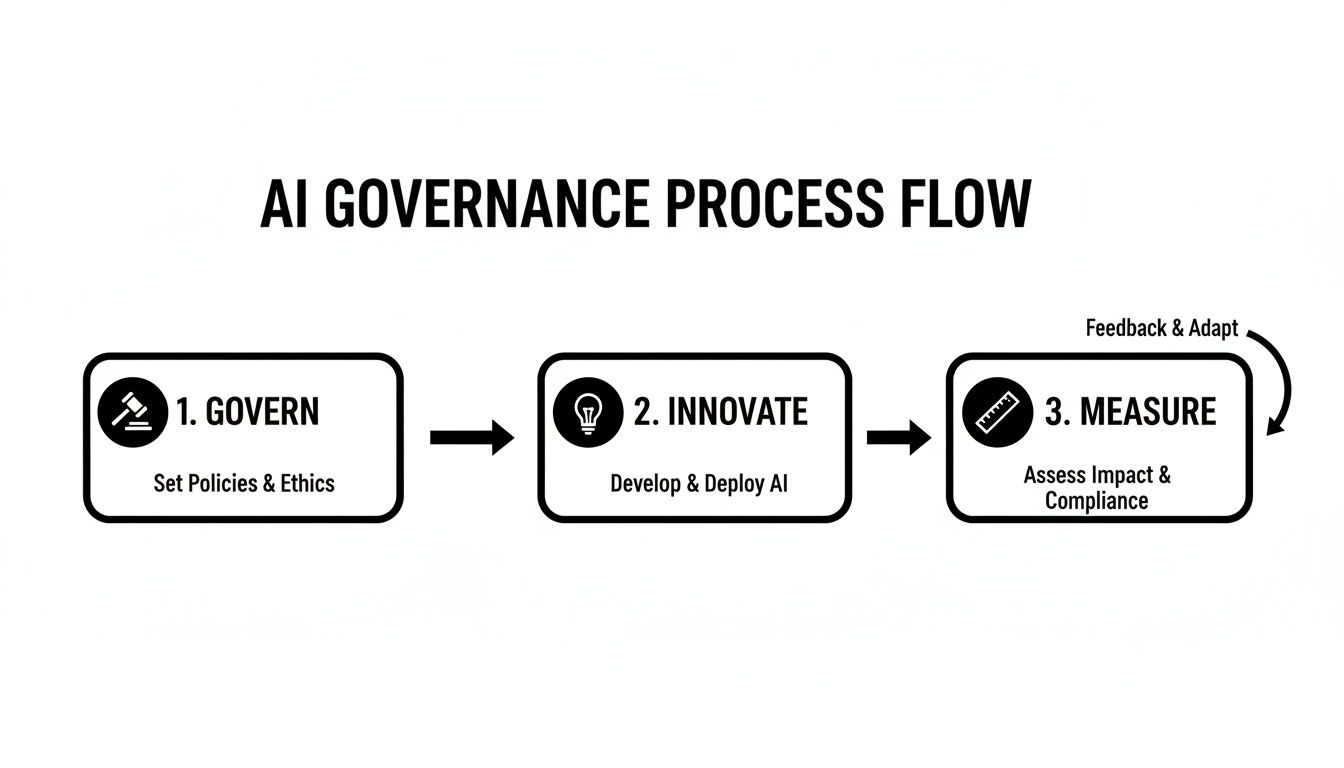
This visual depicts the continuous cycle: governing inputs, fostering innovation, and measuring outcomes. This feedback loop ensures that learnings from one phase inform the next, creating a self-improving system for translating strategy into effective technology.
How to Navigate Common Pitfalls in AI Initiatives
Even the most promising AI projects can falter. Failure is rarely technological; it is almost always attributable to predictable human errors in strategy and organisation. For German business leaders, identifying these potential traps is the first step toward building a resilient fusion of strategy and technology. An AI initiative should be managed as an internal entrepreneurial venture—it carries analogous risks if not governed with rigorous discipline.
Many organisations are lured into pursuing novel technologies without a clear purpose. They identify a new tool, such as a large language model, and then search for a problem it might solve. This technology-first approach is a recipe for developing technically interesting but commercially irrelevant solutions that have no impact on the P&L statement.
Avoiding Pilot Purgatory and Skill Gaps
One of the most prevalent failure modes is “pilot purgatory.” A project demonstrates initial promise in a small-scale pilot but fails to gain the momentum or executive sponsorship necessary for broader implementation. It remains a perpetual experiment, consuming resources without ever delivering tangible business value.
This scenario often arises from a lack of clear ownership by an individual with P&L responsibility. Without a dedicated business leader championing the project and holding it accountable for results, there is no urgency to advance it from a prototype to a production system that delivers impact.
Want to Accelerate Your Innovation?
Our team of experts can help you turn ideas into production-ready solutions.
Another significant barrier is the internal skills gap. In Germany, the ambition to adopt AI is accelerating. In 2023, only 32% of companies reported using AI, but investment increased to 37% in 2024, indicating its rising priority. However, ambition alone does not bridge the capability gap. Success is often hindered by a lack of specialised expertise, a challenge that can be effectively addressed by partnering with experienced practitioners. You can explore more AI adoption trends in Germany on Statista.com.
Concrete Strategies for De-Risking AI Ventures
Overcoming these challenges requires a proactive, de-risking mindset from the outset. The focus must remain steadfastly on solving genuine business problems, not merely experimenting with new technology.
To ensure the success of your initiatives, begin with these strategies:
- Secure Executive Sponsorship Early: An AI project without a committed C-level sponsor is an orphan. This individual's role is not just to approve budgets but to remove organisational impediments and advocate for the project's strategic importance.
- Maintain Continuous Stakeholder Alignment: The project team must maintain constant communication with business units, end-users, and leadership. This is the only way to ensure the solution being developed meets evolving needs and avoids becoming a product without a market.
- Start with the Business Problem: Before any code is written, the team must be able to articulate a precise, high-value business problem. The entire initiative must be framed as the solution, with success measured by its ability to resolve that problem.
The single most critical de-risking strategy is velocity. Demonstrating value in days or weeks—not months—builds momentum and confidence more effectively than any other action. A rapid prototype showing tangible progress is your most potent tool for securing continued investment and buy-in.
Ultimately, the path from concept to production is fraught with potential obstacles. An experienced partner acts as a co-preneur, providing not only technical expertise but also the strategic foresight to anticipate these challenges. They help maintain focus on the P&L, ensure stakeholder alignment, and provide the velocity needed to escape pilot purgatory, guaranteeing that your strategy and technology investments deliver measurable returns.
Measuring the Success of Your Technology Strategy
How do we measure the business impact of our technology investments? This is the critical question that distinguishes a true fusion of strategy and technology from a costly science experiment.
For German leadership, where precision and accountability are paramount, it is essential to move beyond vague, superficial metrics. The objective is to define Key Performance Indicators (KPIs) that establish a direct, undeniable link from a technology initiative to the P&L.
A well-conceived technology strategy is not an expense line item; it is a measurable, manageable investment in the company's future. To manage it as such, a disciplined framework is required to capture its full impact across the organisation.
A Balanced Scorecard for Technology Impact
Relying on a single metric like Return on Investment (ROI) is overly simplistic and fails to capture the full spectrum of a technology project's value. A more sophisticated approach is to use a balanced scorecard that assesses performance across several key dimensions. This provides a holistic view, ensuring that gains in operational efficiency do not come at the expense of strategic positioning or customer loyalty.
We recommend organising this scorecard around three core pillars:
Looking for AI Expertise?
Get in touch to explore how AI can transform your business.
Financial Metrics: These provide the most direct link to your P&L and quantify the value being generated.
- Return on Investment (ROI): The classic metric comparing net profit to total investment.
- Cost Savings: Quantifiable reductions in operational costs, such as decreased manual labour or reduced material waste.
- Revenue Growth: Measurable increases in top-line revenue attributable to the technology, such as sales from a new digital product or improved online conversion rates.
Operational Metrics: These KPIs focus on internal efficiency and process improvement. They measure how technology enables the business to operate faster, smarter, and more smoothly.
- Process Efficiency: Increased output for the same level of input—for example, producing more units with the same resources.
- Cycle Time Reduction: Decreasing the time required to complete a key business process, from product development to customer order fulfilment.
- System Uptime and Reliability: A critical metric for mission-critical systems, ensuring technology provides a reliable backbone rather than a source of disruption.
Strategic Metrics: These are forward-looking indicators that measure how technology contributes to long-term competitive advantage.
- Market Share Growth: An increase in your portion of the market, often driven by superior products or customer experiences enabled by new technology.
- Customer Satisfaction (CSAT/NPS): Gauges how technology investments are improving the customer journey and fostering loyalty.
- Time-to-Market: The speed at which new products or services can be introduced, a significant advantage in dynamic industries.
By tracking a balanced set of KPIs, leadership gains a complete and accurate understanding of how technology investments are truly performing. For a deeper dive into transforming raw data into this type of business intelligence, please refer to our comprehensive guide on analytics and insights.
Quantifying the Impact of AI
Measuring AI projects requires this same balanced approach. Consider an LLM-powered copilot for your customer service team. Its performance can and should be assessed across all three pillars.
Ready to Build Your AI Project?
Let's discuss how we can help you ship your AI project in weeks instead of months.
The success of an AI project is defined not by its technical sophistication, but by its ability to solve a specific business problem and deliver a quantifiable result that management can clearly understand.
Here is what that looks like in practice:
- Financial: Calculate the cost savings resulting from a 25% reduction in the average time to handle a support ticket.
- Operational: Track the cycle time reduction for resolving customer queries and measure the improvement in the first-contact resolution rate.
- Strategic: Monitor changes in Customer Satisfaction (CSAT) scores. Does the faster, more accurate service lead to higher customer satisfaction and loyalty?
This multi-faceted view demonstrates the project's value far beyond a simple efficiency gain. When undertaking such projects, a practical guide to engineering productivity measurement can provide useful metrics and help avoid common pitfalls.
Ultimately, this type of rigorous measurement transforms the conversation around strategy and technology. It shifts the basis from faith to fact, grounding every decision in clear, data-driven evidence of its impact on the P&L.
Got Questions? We've Got Answers
When integrating strategy and technology, German business leaders frequently encounter similar challenges. Here are some of the most common questions we address, along with direct, actionable advice.
We Don’t Have AI Experts on Our Team. Where Do We Even Begin?
This should not be an impediment. The most prudent first step is to engage a partner with expertise in both high-level strategy and technical implementation.
Begin with a collaborative workshop to identify optimal use cases—those with high business impact and low technical complexity. This approach de-risks the initial investment and familiarises your team with the potential of AI. The objective is not merely project completion, but also to build internal capabilities and confidence.
How Long Does It Realistically Take to Get an AI Idea into a Working Prototype?
The timeline should be measured in days or weeks, not months. By employing an agile, entrepreneurial methodology, a meaningful proof-of-concept can be developed with remarkable speed. The primary goal is to validate the core business hypothesis quickly.
This velocity is your most effective defence against "pilot purgatory." Presenting tangible results to stakeholders swiftly is the only way to build momentum and secure the buy-in necessary for scaling.
You want to ensure resources are allocated to viable ideas, maintaining high energy and focus throughout the organisation.
How Can We Be Sure Our AI Projects Meet Strict EU Data Regulations?
Compliance must be integrated from the project's inception; it cannot be an afterthought. This requires a robust AI Security & Compliance framework embedded within your process, encompassing secure deployment, clear data governance, and adherence to standards like TISAX and ISO.
For any German enterprise, maintaining full control over sensitive data is non-negotiable. This often necessitates self-hosted infrastructure to ensure strict alignment with GDPR. This is a proactive measure that protects your digital assets and builds trust with your customers.
At Reruption GmbH, we are not merely consultants; we are your Co-Preneurs for the AI era. We transform ambitious concepts into real-world innovations with demonstrable P&L impact. Discover our methodology at https://www.reruption.com.