
Solutions in the cloud represent a paradigm shift in corporate IT. Rather than owning and managing physical infrastructure, enterprises access computing services—servers, storage, databases, and software—via the internet. For German enterprises, this is not merely a technological upgrade; it is a foundational business strategy for enhancing agility and enabling future innovation, particularly in the domain of artificial intelligence.
The Strategic Imperative for Cloud Solutions
For decision-makers in Germany's leading enterprises, the dialogue surrounding cloud adoption has matured beyond the question of if, to the critical question of how. A strategic integration of cloud capabilities is now a prerequisite for competitive advantage. Viewing this transition through a purely technical lens is to miss its profound business implications. This is a core corporate decision impacting financial models, operational resilience, and speed to market.
A well-architected cloud strategy can be conceptualised as the digital equivalent of Germany's Autobahn system. Its value lies not in the road itself, but in the meticulously engineered infrastructure that enables unprecedented velocity, efficiency, and connectivity. This digital backbone empowers an organisation to operate with greater speed, respond to market shifts with enhanced resilience, and develop innovative services that would be infeasible with legacy on-premises infrastructure.
A Foundation for Growth and Innovation
This strategic shift is substantiated by market data. Germany's cloud computing market is forecast to reach USD 34.07 billion in 2024 and is projected to expand to USD 116.95 billion by 2030. This rapid growth underscores the increasing reliance of German enterprises on cloud platforms to power core operations.
For any leadership team, the strategic mandate is unequivocal. Adopting solutions in the cloud is about positioning the company for long-term success by establishing a platform that directly supports key business objectives.
Ready to Build Your AI Project?
Let's discuss how we can help you ship your AI project in weeks instead of months.
- Operational Resilience: Cloud platforms provide superior disaster recovery and business continuity capabilities, safeguarding operations against unforeseen disruptions—a non-negotiable component of modern risk management.
- Accelerated Innovation: By removing the constraints of physical hardware, development teams can prototype and deploy new applications and services in days or weeks, rather than months. This velocity is essential for maintaining a competitive edge.
- AI and Data Enablement: The cloud delivers the scalable computing power necessary for demanding workloads such as artificial intelligence and machine learning, transforming data from a passive byproduct into a strategic corporate asset.
Adopting the cloud fundamentally transforms a company's operating model. The focus shifts from managing depreciating assets to consuming services that generate direct business value. This liberates capital for investment in innovation rather than infrastructure maintenance.
Ultimately, a robust cloud strategy is the enabler of global competitiveness. It fosters an internal culture of innovation and provides the technical foundation required to thrive in a dynamic economic landscape. For a broader perspective on this transition, refer to our guide on the digitalisation of companies. This evolution empowers your organisation to build, adapt, and lead.
Understanding Your Cloud Service Model Options
A comprehensive understanding of cloud service models is essential for executive decision-making. This is not a technical detail to be delegated to the IT department, but a strategic choice that defines the balance between organisational control and agility. Selecting the appropriate model is critical to aligning technological capabilities with business objectives.
To clarify these options, we can compare the three primary models—IaaS, PaaS, and SaaS—to establishing a manufacturing operation. Each offers a different level of control and requires a distinct set of in-house capabilities, allowing you to select an approach that aligns with your company's competencies and strategic ambitions.
A sound cloud strategy, predicated on the correct service models, is the bedrock of operational resilience and, ultimately, the driver of innovation.
Want to Accelerate Your Innovation?
Our team of experts can help you turn ideas into production-ready solutions.
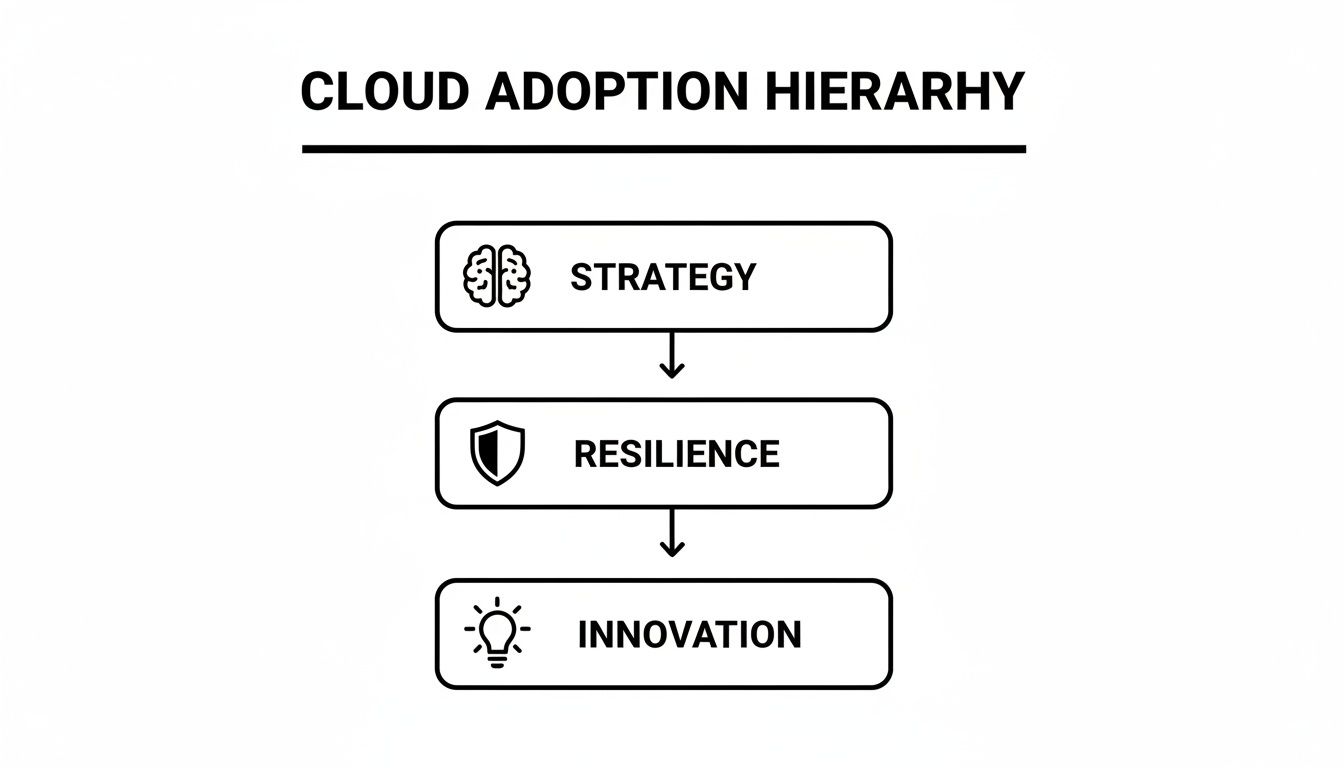
As illustrated, a clear strategy supports operational resilience, which in turn creates the capacity for true business innovation.
IaaS: The Foundation of Control
Infrastructure as a Service (IaaS) represents the most fundamental layer of cloud services. Analogously, it is like leasing a fully equipped but empty factory floor. The provider supplies the physical facility, power, cooling, and network connectivity. The lessee is responsible for installing and managing all machinery, production lines, and personnel.
In technological terms, the cloud provider manages the physical servers, storage, and networking hardware. Your technical teams retain complete control over operating systems, applications, and data. This model offers maximum flexibility and control over your IT environment.
IaaS is optimal for organisations with highly specific or complex IT requirements, or for those possessing the in-house technical expertise to manage infrastructure from the operating system upward. It is also well-suited for "lift-and-shift" migrations, enabling the transfer of existing systems to the cloud without immediate re-architecting.
PaaS: Accelerating Development
Platform as a Service (PaaS) provides an additional layer of abstraction. In our manufacturing analogy, this is akin to leasing a fully managed assembly line. The provider supplies not only the factory floor but also all essential machinery and tools, and handles all maintenance. Your team can focus exclusively on designing and manufacturing your product.
With PaaS, the provider manages all hardware, operating systems, and other underlying middleware. This liberates development teams to concentrate on a single objective: building, testing, and deploying high-quality applications. It dramatically accelerates the development lifecycle by abstracting away infrastructure complexity.
PaaS offers a powerful equilibrium. It conceals the complexity of infrastructure management while affording developers the freedom to build custom solutions. It acts as a catalyst for speed and innovation, allowing human capital to be focused on value creation rather than system maintenance.
This model is an excellent fit for businesses aiming to develop and launch custom applications rapidly. It provides the necessary tools and environment for swift innovation without the overhead of managing a full technology stack.
SaaS: The Ultimate Convenience
Software as a Service (SaaS) offers the highest level of convenience. Continuing our analogy, this is equivalent to subscribing to a specialised manufacturing service. You do not lease a factory or manage an assembly line; you simply utilise the finished product on demand to perform a specific function.
Looking for AI Expertise?
Get in touch to explore how AI can transform your business.
With SaaS, you access ready-to-use software over the internet, typically on a subscription basis. The provider manages the entire stack—the software, the underlying infrastructure, maintenance, and all updates. Your responsibility is limited to using the application and managing your users and data within it.
SaaS solutions are ubiquitous in modern business, including CRM, ERP systems, and collaboration platforms like Slack or Microsoft 365. This model delivers immediate business value with minimal technical overhead, making it an ideal choice for standardised business functions that do not require extensive customisation.
Cloud Service Model Comparison: Control vs Convenience
This table summarises the strategic trade-offs between IaaS, PaaS, and SaaS. The decision matrix is a function of required control versus desired level of managed service.
| Service Model | Business Analogy | Level of Control | Required In-House Expertise | Best For |
|---|---|---|---|---|
| IaaS (Infrastructure) | Leasing an empty, equipped factory floor | Maximum | Deep infrastructure & network skills | Companies with complex, specific needs; "lift-and-shift" migrations; businesses with strong in-house IT teams. |
| PaaS (Platform) | Leasing a fully managed assembly line | Medium | Strong application development skills | Teams focused on rapid application development and deployment; businesses wanting to innovate without managing underlying infrastructure. |
| SaaS (Software) | Subscribing to a finished manufacturing service | Minimum | User & data administration skills | Standard business functions (CRM, HR, email); companies seeking immediate, out-of-the-box solutions with minimal technical overhead. |
The selection of a service model is not about determining which is "best" in absolute terms, but which is optimal for your specific strategic context. This decision will shape your operational model, innovation velocity, and resource allocation for years to come.
Architecting Your Enterprise Cloud Journey
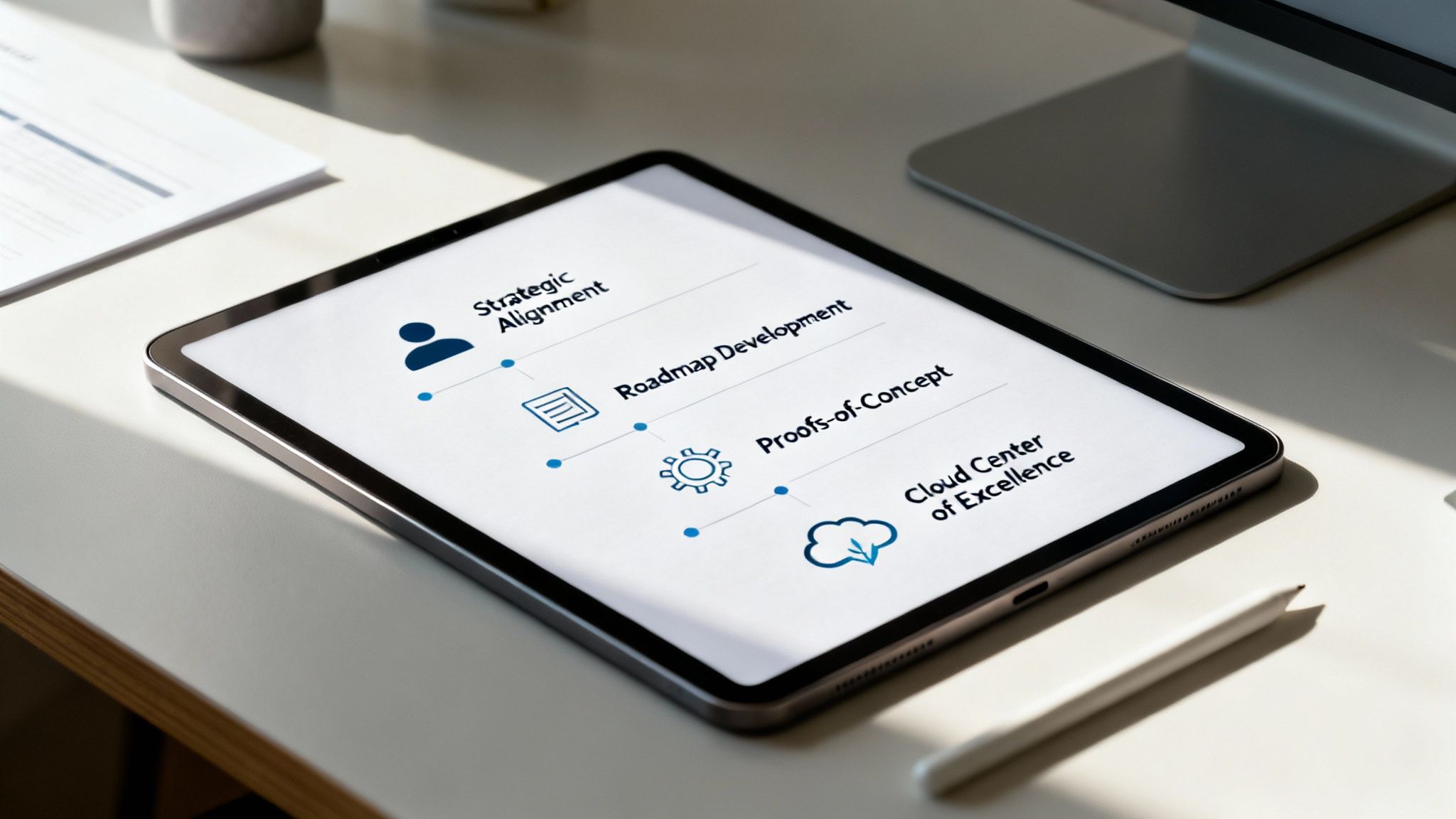
Migrating to the cloud is not an IT project; it is a fundamental transformation of the corporate operating model. For leaders of large German enterprises, treating this transition as a simple technology refresh is a common and costly error. A successful cloud journey demands a methodical, business-first approach that links every technical decision to a tangible commercial outcome.
The process must be deliberate. It is about building a new corporate capability that drives efficiency, resilience, and innovation across the entire organisation. The cloud should be viewed not as a destination, but as the new platform for your company's continuous evolution.
Phase 1: Strategic Alignment
The foundational step is achieving executive consensus. Before any application is migrated, the leadership team must define success in clear, measurable business terms.
This requires moving beyond ambiguous goals like "improving efficiency." A successful objective would be to reduce time-to-market for a new product line by 30%, or to lower operating costs in a specific division by 15%. These are the concrete Key Performance Indicators (KPIs) required.
A cloud strategy without clearly defined business outcomes is merely a technical migration plan. True transformation occurs when technology serves a precise, quantifiable corporate objective.
Ready to Build Your AI Project?
Let's discuss how we can help you ship your AI project in weeks instead of months.
This alignment ensures the initiative is governed by business priorities, not technological novelty. It establishes a common language for all stakeholders and a solid baseline for measuring return on investment.
Phase 2: Roadmap Development
With clear objectives established, the next phase is to construct a pragmatic, phased roadmap. Not all applications are suitable for immediate migration, and a "big bang" approach is a classic recipe for failure. The key is to prioritise based on a matrix of business impact and technical complexity.
Begin with an application portfolio analysis. Some systems may be candidates for a simple 'lift-and-shift' migration—moving them to the cloud with minimal architectural changes. This approach can deliver rapid, visible wins.
Other core applications, however, may yield greater long-term value from being re-architected or rebuilt as cloud-native solutions. While this requires more upfront investment, it unlocks the full potential of the cloud—such as auto-scaling, serverless computing, and managed databases—delivering superior performance and long-term cost efficiencies. This level of planning is a core discipline of effective strategic system engineering for the modern enterprise.
Your roadmap should sequence these migrations, prioritising high-impact, low-complexity workloads to build momentum and demonstrate value early.
Phase 3: Rapid Proofs of Concept
Before committing to a large-scale migration, it is imperative to validate assumptions and mitigate risk. This is the role of rapid Proofs-of-Concept (PoCs). A PoC is a small, time-bound project designed to test a specific cloud solution against a real-world business problem. It is an opportunity to learn quickly and fail inexpensively.
For example, a manufacturing firm could execute a PoC to test a cloud-based predictive maintenance solution on a single production line. If the pilot demonstrates a measurable reduction in downtime, it provides a powerful business case for a company-wide deployment.
The critical variable here is speed. An effective PoC should deliver tangible results within weeks, not months. This provides the empirical evidence required to secure broader stakeholder buy-in and justify further investment in solutions in the cloud.
Establishing a Cloud Centre of Excellence
The organisational construct that underpins a successful cloud journey is an internal Cloud Centre of Excellence (CCoE). This is not another IT committee, but a dedicated, cross-functional team comprising experts from IT, finance, security, and key business units.
The CCoE is tasked with:
Want to Accelerate Your Innovation?
Our team of experts can help you turn ideas into production-ready solutions.
- Governance: Establishing the standards, policies, and best practices for cloud usage across the enterprise.
- Cost Management: Implementing financial operations (FinOps) to monitor, control, and optimise cloud expenditure.
- Skill Cultivation: Driving the internal training and upskilling programs necessary to build a cloud-fluent workforce.
This central team ensures your cloud adoption is consistent, secure, and cost-effective, transforming it from a series of siloed projects into a unified and sustainable corporate capability.
Getting Security Right in the German Regulatory Landscape
For any German enterprise, data security and regulatory compliance are not operational checklist items; they are foundational to corporate integrity. Migrating to **solutions in the cloud** can seem daunting, but a well-architected cloud strategy can significantly strengthen an organisation's security posture.The evidence is compelling: 97 percent of German companies with 50 or more employees already utilise cloud computing. This near-universal adoption demonstrates that the perceived risks are being successfully managed through appropriate security frameworks.
Leading cloud providers invest billions in security capabilities that are economically unfeasible for most individual companies to replicate in their own data centres. Their global teams of cybersecurity experts provide a level of physical and digital protection that is exceptionally difficult to achieve in-house.
Navigating German Compliance Requirements
In Germany, compliance with regulations such as the General Data Protection Regulation (GDPR) is non-negotiable. For many in the automotive supply chain, TISAX (Trusted Information Security Assessment Exchange) certification is equally critical. Modern cloud platforms are designed with these requirements as a core tenet. They provide a suite of tools for managing data governance, enforcing stringent access policies, and generating the audit trails necessary for demonstrating compliance.
This innate focus on regulation means that leveraging a major cloud provider can actually simplify your compliance efforts. They provide the certified infrastructure and configurable tools that serve as the foundation for your own security and governance models. For deeper insight into the strategic aspects, consider our guide on cyber security consultancy.
Looking for AI Expertise?
Get in touch to explore how AI can transform your business.
The pertinent question for leadership is not whether the cloud is secure, but how to correctly implement its powerful security controls. A strategic approach transforms security from a reactive burden into a proactive business advantage.
When these tools are implemented correctly, you can create an environment that adheres to the highest standards of data protection, ensuring that customer and corporate data is managed with the rigour that German regulations demand.
Understanding the Shared Responsibility Model
A common point of confusion is the delineation of security responsibilities. The Shared Responsibility Model provides clarity by dividing duties between the cloud provider and you, the customer. It is vital that executives grasp this division.
Consider it analogous to leasing an office in a secure building. The landlord is responsible for the security of the building—the main entrance, structural integrity, and perimeter. However, you are responsible for the security within your office—locking doors, managing key access, and protecting sensitive documents.
In the cloud context, this translates as follows:
Ready to Build Your AI Project?
Let's discuss how we can help you ship your AI project in weeks instead of months.
- The Cloud Provider's Responsibility: Securing the underlying infrastructure. This includes the physical data centres, network hardware, and core compute, storage, and database services. They ensure the platform itself is secure.
- Your Organisation's Responsibility: Securing everything you place on the cloud. This encompasses managing user access and identity, encrypting data, configuring firewalls and network controls, and ensuring application security.
This model empowers your organisation by providing direct control over the security elements most critical to your business: your data and applications. To better understand data protection, it is worthwhile to explore these essential cloud computing security best practices. Adopting this mindset is key to building a secure, compliant, and resilient enterprise in the cloud.
Using the Cloud to Power AI and Machine Learning

Artificial intelligence has transitioned from a research concept to a core driver of business strategy. The pivotal question for leaders is no longer if to leverage AI, but how to build the requisite computational power to do so effectively. The answer, invariably, is a robust cloud infrastructure.
Modern AI, particularly compute-intensive Large Language Models (LLMs), demands a scale of processing power and data throughput that traditional on-premises servers cannot provide. A strategic investment in solutions in the cloud is therefore a non-negotiable prerequisite for any serious AI ambition. Without it, most AI initiatives fail to progress beyond the proof-of-concept stage, starved of the resources required for real-world application.
This demand for computational power is fundamentally reshaping Germany's digital infrastructure. The German data centre market is experiencing explosive growth, driven almost entirely by AI. Capacity is projected to increase from 2,980 megawatts in 2025 to nearly 5,000 megawatts by 2030. AI's share of this capacity is expected to grow from approximately 15 percent to a staggering 40 percent.
Enabling Sovereign LLMs and Data Pipelines
For German enterprises, data sovereignty is not merely a preference; it is a mandate. While public LLMs are powerful, transmitting sensitive corporate or customer data to them presents significant compliance challenges. The cloud offers a transformative solution: the ability to host self-managed, private LLMs in a secure, isolated environment.
By running proprietary models on dedicated cloud infrastructure, you retain complete control over your data. This is crucial for maintaining GDPR compliance and protecting intellectual property. However, training these private models effectively requires vast quantities of clean, well-structured data.
This introduces another critical function for the cloud: the construction of scalable data pipelines. The cloud enables the creation of automated workflows that ingest, cleanse, and transform large datasets from disparate sources across your organisation. These pipelines are the arteries of your AI strategy, continuously supplying your models with the high-quality information required for optimal performance.
Deploying AI Copilots to Augment Your Workforce
Beyond the intensive task of model training, the cloud is the ideal platform for deploying AI-powered assistants—or 'Copilots'—to support your teams. The objective is not to replace human personnel, but to augment their capabilities. These tools integrate directly into existing workflows, whether in software development or customer service, to automate repetitive tasks and provide intelligent recommendations. This liberates your employees to focus on high-value creative and strategic work.
The true value of AI in the enterprise lies not just in large-scale automation, but in its ability to amplify human expertise. Cloud-deployed Copilots act as intelligent partners for your teams, making them more productive, creative, and effective.
Want to Accelerate Your Innovation?
Our team of experts can help you turn ideas into production-ready solutions.
Consider a Copilot for your sales team that identifies high-potential leads in your CRM or drafts personalised follow-up communications. Or a Copilot for your engineers that detects potential code vulnerabilities before they escalate. Deploying these assistants via the cloud ensures they have the requisite real-time data access and computational power to function effectively, with the ability to scale seamlessly as your organisation grows.
This is precisely the work we do at Reruption. We assist companies in building these production-ready systems, from secure, self-hosted LLM clusters to intelligent Copilots that deliver measurable productivity gains. For a technical overview of this process, see our deep-dive on building a secure and cost-efficient self-hosted LLM cluster. The goal is to translate the abstract promise of AI into a tangible business advantage, built upon a strategic cloud foundation.
So, What's Next on Your Cloud Journey?
Understanding the theory is one step; executing a successful cloud transformation is another. For senior leadership, the task is to translate high-level strategy into a pragmatic execution plan that delivers results. It is time to move beyond analysis and take concrete steps that build momentum, demonstrate tangible value, and position the organisation to compete in the era of AI.
The time for protracted debate has passed. Awaiting a perfect, comprehensive strategy is a formula for inaction. While you deliberate, your competitors are making iterative progress and capturing market share.
Start Small, Win Big: The Power of a Cloud Pilot
The most prudent initial step is a tightly focused, high-impact Proof-of-Concept (PoC). Avoid the temptation of a massive, complex migration at the outset. Instead, select a single, persistent business problem that a cloud solution can address quickly. This approach de-risks innovation and delivers the empirical results needed to secure organisational buy-in.
Looking for AI Expertise?
Get in touch to explore how AI can transform your business.
Consider a real-world example:
- The Problem: A German manufacturing firm experienced unpredictable machine downtime on a critical production line, incurring significant costs with each stoppage.
- The Pilot Solution: A cloud-based PoC was initiated to develop a predictive maintenance model. Using cloud infrastructure, sensor data from the machines was streamed directly into a machine learning algorithm.
- The Result: Within weeks, the model was accurately predicting potential equipment failures 24-48 hours in advance. The pilot immediately demonstrated its value by reducing downtime, providing a clear business case for a company-wide rollout.
The victory was not the completion of a large IT project, but the rapid validation of a business hypothesis.
Your Action Plan for Cloud Transformation
To translate this concept into reality, leadership requires a straightforward, sequential plan. This checklist serves as a starting point for any German enterprise prepared to leverage the power of solutions in the cloud.
- Define One Business Goal: Begin with a single, clear, and measurable objective. Is it to reduce operational costs by 15%? Or to accelerate new product development cycles? Be specific.
- Assemble a Small, Empowered Pilot Team: Form a dedicated group with representation from IT, finance, and the relevant business unit. Grant them the autonomy to operate with speed.
- Engage a Strategic Partner: Do not undertake this journey alone. Collaborate with experts who can accelerate your progress. Seek a "Co-Preneur"—a partner who shares accountability for the outcome and helps you avoid common pitfalls.
- Execute a Time-Boxed PoC: Launch your pilot with a firm deadline, typically 4-8 weeks. The objective is to prove value and build momentum, not to deliver a perfect, finalised product.
The purpose of these initial steps is not to perfect your cloud architecture, but to prove its business value. A successful small-scale pilot generates the political and financial capital required to fuel a larger, more ambitious transformation.
A critical component of this process is implementing actionable cloud cost optimization strategies from the outset to ensure financial discipline. This reframes cloud adoption from a technology project to a financially managed business strategy. Ultimately, the decision of whether to build a solution internally or procure it from a vendor is a major strategic choice. For further analysis on this topic, our guide on conducting a Make-or-Buy Analysis for technology initiatives may prove helpful.
Frequently Asked Questions
When considering a move to the cloud, numerous questions arise, particularly at the leadership level. Below are direct, business-focused answers to some of the most common inquiries to aid your strategic decision-making.
How Can We Ensure Our Sensitive Data Remains Secure in the Cloud?
Cloud security operates on a ‘Shared Responsibility Model’. Major cloud providers like AWS or Azure are responsible for the physical security of their data centres and the core network—a level of protection that most individual companies cannot achieve independently.
Your responsibility is to secure the assets you place within that secure infrastructure. This involves implementing robust access controls, encrypting data at rest and in transit, and ensuring correct service configuration. With the powerful security tools available on cloud platforms, it is often possible to establish a more secure environment than was achievable on-premises, while adhering to stringent German standards like GDPR and TISAX.
What Is the Key Financial Benefit Beyond Direct Cost Savings?
The most significant financial advantage is the shift from a Capital Expenditure (CapEx) model to an Operating Expenditure (OpEx) model.
Instead of investing significant capital in servers that depreciate immediately, you pay for services on a consumption basis. This provides tremendous financial flexibility. You can scale resources up for a major project and scale them down upon completion, eliminating the costly problem of over-provisioning. This freed capital can then be reinvested into innovation and core business activities rather than being tied up in infrastructure.
Our Organisation Lacks Deep Cloud Expertise. What Is the First Step?
The optimal starting point is a small, focused Proof-of-Concept (PoC) that solves a tangible business problem. Defer a large-scale "lift and shift" migration for now.
Identify a specific pain point—for example, automating a laborious data analysis task to improve sales forecasting. Develop a small-scale cloud solution to address it. By delivering a quick win, you demonstrate real value to key stakeholders. This builds organisational momentum and provides the empirical evidence needed to justify a larger investment in solutions in the cloud.
At Reruption GmbH, we do not just devise strategy; we deliver results. As "Co-Preneurs for the AI Era," we partner with you to rapidly de-risk innovation and build production-ready solutions that generate measurable business impact. Discover how we can accelerate your cloud and AI journey at https://www.reruption.com.