
When most executives hear “Service Delivery Manager,” they often picture an operational role focused on IT uptime and process adherence. This is a legacy definition. In the age of AI, the Service Delivery Manager has evolved into a strategic leader who ensures that complex AI initiatives translate from conceptual proofs-of-concept into reliable, enterprise-grade services that deliver measurable business value.
Redefining Service Delivery Management for Strategic Advantage

Across Germany's leading industrial and technology sectors, the Service Delivery Manager (SDM) role is undergoing a fundamental redefinition. What was once a function centered on ITIL frameworks and maintaining operational stability is now a strategic business partnership, critical for the successful deployment and governance of complex AI systems.
The focus has pivoted from mere process management to end-to-end service ownership. A high-performing SDM is not a passive monitor of dashboards; they are accountable for the entire performance lifecycle and business impact of the service they oversee. For senior leadership, this represents a pivotal shift in organisational mindset.
Do not view the SDM as a process administrator. View them as the Chief Operating Officer for a specific service. They effectively own the service's P&L, ensuring every euro invested in technology—particularly AI—returns measurable, defensible business outcomes.
Ready to Build Your AI Project?
Let's discuss how we can help you ship your AI project in weeks instead of months.
Bridging Strategic Vision and Operational Reality
At its core, the modern SDM is the critical link between an organisation's strategic vision and the technical teams executing it. For instance, when a manufacturing firm aims to deploy an AI-driven predictive maintenance system, it is the SDM who ensures the resulting service is reliable, scalable, and achieves the promised return on investment.
This function is therefore essential for de-risking innovation. AI projects are notorious for high failure rates during the transition from pilot to production. An effective SDM manages this high-risk transition by:
- Establishing Governance: They architect not just technical SLAs, but outcome-focused agreements that tie directly to strategic business objectives.
- Orchestrating Communication: They ensure seamless alignment among all stakeholders—from business leaders to AI engineers and end-users—by translating complex technical realities into clear business implications.
- Driving Continuous Improvement: They leverage data and user feedback to continuously refine the service, pre-emptively addressing potential issues before they impact business operations.
From Cost Centre to Value Driver
For German enterprises competing on a global stage, integrating a strategic SDM is a non-negotiable prerequisite for realizing the full value of AI initiatives. A foundational understanding of effective service delivery is the baseline for any professional in this capacity.
By appointing a leader with ownership of the entire service lifecycle, an organisation can transition its technology function from a cost centre to a potent engine for growth and efficiency. This strategic realignment is a cornerstone of successful digital transformation.
Core Responsibilities and Performance Metrics for the Modern SDM

To maximize the strategic impact of the Service Delivery Manager (SDM), leadership requires more than a job description; it requires a clear blueprint of accountabilities and a framework for measuring success. This is particularly true for the modern SDM, whose primary purpose is to connect service operations to tangible business results.
The contemporary SDM's remit extends far beyond technical maintenance. They are held accountable for the value a service delivers, whether it is a client-facing platform or an internal AI-driven process. This accountability is structured around three core pillars of responsibility.
Establishing and Governing Service Outcomes
First, the SDM is responsible for defining and governing service level agreements (SLAs) that are meaningful to the business. Legacy approaches focused on technical metrics such as 99.9% uptime—a figure that provides little actionable insight to a CEO.
An outcome-based SLA, conversely, measures the business value derived from that availability. For an AI-powered logistics platform, instead of tracking uptime, the KPI shifts to a metric like "percentage of on-time deliveries." This re-frames the service not as a technical cost, but as a direct contributor to operational excellence and client satisfaction.
Orchestrating Stakeholder Communication
The SDM functions as the central communication hub, interfacing with executives, technical teams, and clients. They are tasked with the unique challenge of translating C-level strategy into precise requirements for engineers, and subsequently reporting performance back to leadership in the language of business impact.
Want to Accelerate Your Innovation?
Our team of experts can help you turn ideas into production-ready solutions.
This role is critical in AI projects, where a significant gap often exists between the business vision and the technical realities of model performance and data pipelines. The SDM closes this gap, ensuring stakeholder alignment and managing expectations throughout the service lifecycle.
The Service Delivery Manager's primary function is to articulate a compelling vision for a digital service and its evolution. They are the pivotal figure who guides teams from concept to a fully realized service that delivers demonstrable value.
This level of leadership transforms experimental projects into integrated, value-creating organisational assets. Executing this requires a deep understanding of which metrics matter, a topic further explored in our guide to analytics and insights.
Leading Continuous Service Improvement
Finally, a strategic SDM instills a culture of continuous service improvement (CSI). This is not a reactive, break-fix methodology. It is a proactive, data-driven cycle of measurement, analysis, and refinement designed to enhance service value over time.
For an AI service, CSI could involve several activities:
Looking for AI Expertise?
Get in touch to explore how AI can transform your business.
- Monitoring for model drift and triggering retraining protocols to maintain output accuracy.
- Analysing user interaction patterns to simplify workflows and increase adoption.
- Identifying opportunities for new features based on emerging business needs.
Mastery of this discipline depends on tracking the right performance indicators. These 10 Project Manager Performance Metrics offer a solid starting point for any leader focused on delivery excellence.
Essential KPIs for the AI-Era Service Delivery Manager
To quantify this strategic contribution, an SDM's performance must be measured with KPIs that resonate with the C-suite. The correct KPIs demonstrate the financial and operational impact of service delivery, validating its role as a value driver.
Below is a breakdown of KPIs that are strategically relevant in the context of AI.
| KPI Category | Metric | Strategic Importance for C-Level | Target Example |
|---|---|---|---|
| Business Impact | Customer Lifetime Value (CLV) Uplift | Measures the direct financial contribution of service enhancements to customer profitability and loyalty. | Achieve a 5% increase in CLV for users of the new AI feature within 6 months. |
| Operational Efficiency | Cost Per Transaction/Interaction | Quantifies the direct cost savings generated by the AI service, proving its ROI. | Reduce the average cost per support ticket by 15% through AI-powered automation. |
| User Adoption & Value | Active User Engagement Rate | Shows how many users are not just accessing the service but actively deriving value from it. | Maintain a 70% weekly active user rate for the internal analytics platform. |
| Service Reliability | Business Uptime | Moves beyond technical availability to measure the percentage of time the service is available and meeting its business outcome goals. | 99.5% Business Uptime (e.g., on-time delivery rate is met). |
By focusing on such metrics, leadership can ensure that investments in AI and service delivery generate a clear, defensible return, contributing directly to the company’s bottom line.
The Economic Case for the Service Delivery Manager
For any C-level executive, investments demand a clear return. The Service Delivery Manager (SDM) role is no exception. While this function might have been categorized as an operational cost in the past, this perspective is now obsolete. A strategic SDM is a direct investment in revenue protection, cost reduction, and sustainable growth. The business case is not merely compelling; it is critical.
Ready to Build Your AI Project?
Let's discuss how we can help you ship your AI project in weeks instead of months.
This holds particularly true within Germany's robust technology landscape. The German IT services market is projected to reach USD 86.43 billion in 2026 and is forecasted to grow at a compound annual rate of 8.59% to USD 130.5 billion by 2031. This expansion, especially in managed services and AI security, introduces significant operational complexity. Without expert oversight, client-facing service delivery can become unstable, eroding value. A deeper analysis of these trends is available in this detailed report about Germany's IT Services market.
A skilled SDM is the organisation's primary instrument for navigating this growth while preserving profitability.
From Cost Centre to Profit Centre
The fundamental economic shift lies in viewing the SDM not as a cost to be minimized, but as a value generator. They actively contribute to the bottom line in three crucial ways:
- Revenue Protection: In sectors like automotive or manufacturing, service downtime is not a minor inconvenience but a significant financial event. An SDM who ensures service continuity directly shields the company from substantial revenue loss.
- Driving Operational Efficiency: Rather than reacting with budget cuts, a modern SDM proactively identifies and eliminates operational inefficiencies through continuous service improvement and intelligent automation.
- Enhancing Customer Lifetime Value (CLV): Reliability builds trust. By guaranteeing that services are delivered as promised, an SDM increases client satisfaction, secures contract renewals, and creates opportunities for upselling. This directly grows the long-term value of each customer relationship.
The SDM's salary is therefore not an expense, but a high-return investment in financial stability. Their role in overseeing IT assets is a major component of this value, a topic we cover in our guide to software and asset management.
Quantifying the Return on Investment
While the precise ROI of an SDM will vary by organisation, the financial impact is consistently positive. Consider a manufacturing firm reliant on an AI-powered supply chain platform. A single hour of downtime could halt production, incurring costs in the hundreds of thousands of euros.
Want to Accelerate Your Innovation?
Our team of experts can help you turn ideas into production-ready solutions.
An effective SDM mitigates this risk by implementing robust monitoring, enforcing vendor accountability, and ensuring business continuity plans are viable. If their efforts prevent just one major outage per year, their position is more than justified financially.
The operative question is not whether you can afford a skilled Service Delivery Manager. The question is whether you can afford the financial and reputational damage of not having one.
In the context of AI, this value is amplified. AI models are not static assets; they require continuous monitoring for performance drift, data integrity, and compliance. The SDM acts as the custodian of these complex systems, ensuring the AI service delivers accurate, reliable results over its entire lifecycle, thereby transforming an expensive project into a dependable, value-generating asset.
Integrating the SDM into Your AI Strategy
Successfully deploying artificial intelligence is fundamentally a service delivery challenge, not merely a technological one. A common failure pattern observed in German enterprises is the inability to transition promising AI proofs-of-concept from the lab into reliable business functions. This gap exists because they were not designed with operational reality in mind.
This guide provides a pragmatic framework for integrating a Service Delivery Manager (SDM) into AI projects from their inception. The objective is to engineer new solutions for reliability, scalability, and maintainability from day one.
Looking for AI Expertise?
Get in touch to explore how AI can transform your business.
In an AI project, the SDM acts as a "Co-Preneur"—an internal entrepreneur who assumes ownership of the AI service's operational success, managing it with the rigor of a P&L. Early involvement transforms a fragile experiment into a durable business asset.
This diagram illustrates the value proposition of an SDM, converting the chaos of disruption into predictable profit.
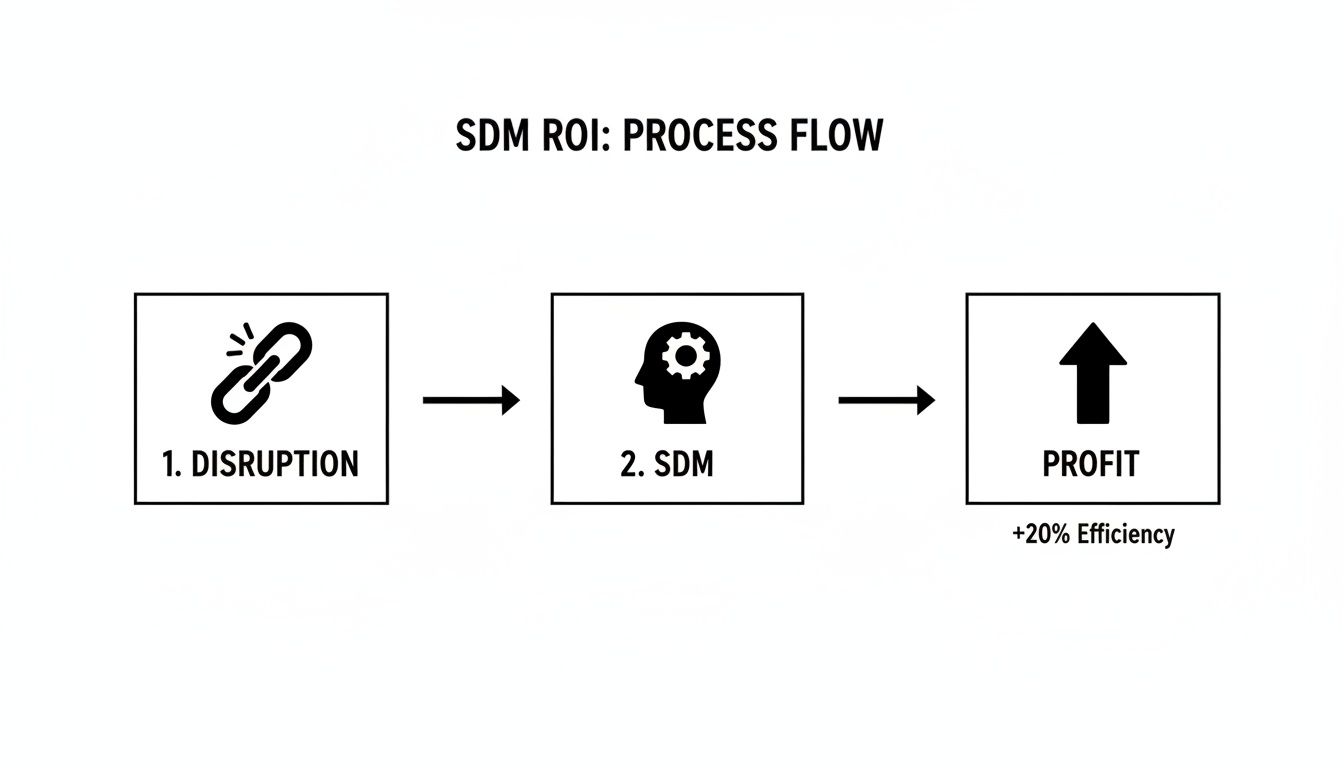
The insight is clear: a strategic service delivery manager serves as the critical bridge, converting potential service failures and their associated costs into consistent performance and measurable financial gains.
Structuring the SDM Role in AI Projects
To operationalize this, the SDM's responsibilities must be defined across the entire AI service lifecycle. Their focus is not on algorithm development but on building the operational scaffolding that enables the AI to perform reliably in a production environment. This requires a structured approach that encompasses everything from data integrity to end-user support.
Ready to Build Your AI Project?
Let's discuss how we can help you ship your AI project in weeks instead of months.
This structured involvement is key to creating a robust operational framework. A well-defined Target Operating Model can provide the blueprint for how the SDM role integrates with other business functions to deliver these AI services effectively.
An SDM's primary role in any AI initiative is to shift the conversation from "Does the model work?" to "Does the service deliver sustained business value?" They are the guardians of operational excellence, ensuring the AI solution is not just intelligent, but dependable.
A Checklist for AI Service Governance
To operationalize the SDM’s role, leadership should use a clear checklist to define their mandate. This ensures that the critical, non-technical aspects of the AI service are managed with the same discipline as the code. The SDM's oversight should cover several key domains.
Here is a practical checklist for defining the SDM’s core responsibilities within an AI initiative:
- Data Pipeline Integrity: The SDM ensures the data feeding the AI model is consistently available, accurate, and secure. They own the processes for data quality management throughout the service's lifecycle.
- Model Performance & Governance: While data scientists build the model, the SDM is accountable for the processes that monitor its real-world performance. This includes managing model drift, and scheduling retraining and redeployment to maintain accuracy.
- User Support & Escalation: The SDM designs and governs the complete support structure for the AI service, mapping clear escalation paths from first-level user inquiries to complex technical investigations.
- Compliance & Security Management: In the German market, adherence to standards like TISAX and ISO 27001 is non-negotiable. The SDM is accountable for ensuring the daily operation of the AI service meets all security protocols and data governance policies.
- Stakeholder Communication & Reporting: The SDM translates complex performance data into clear business intelligence for leadership. This involves reporting on KPIs that matter—cost reductions, efficiency gains, or customer satisfaction improvements directly attributable to the AI service.
By embedding a Service Delivery Manager with this clear mandate from the project's outset, an organisation dramatically increases the probability that its AI investments will mature from isolated projects into core, value-generating business functions. This strategic action separates companies that merely experiment with AI from those that profit from it.
How to Identify and Recruit an Elite Service Delivery Manager
The efficacy of a service delivery function is determined by the quality of its leader. An average manager can maintain operational stability. An elite Service Delivery Manager (SDM), however, transforms the function into a source of competitive advantage. Recruiting this caliber of leader for the challenges of 2026 and beyond requires a precise understanding of what differentiates a competent operator from a strategic business partner.
For C-level executives and senior managers in Germany's advanced industries, the search must look beyond technical certifications. The objective is to identify a strategic partner who can govern complex services, particularly those involving AI, and connect their operational performance directly to financial outcomes.
Distinguishing Hard and Soft Skills
The most effective SDMs possess a balanced portfolio of competencies. Hard skills are the baseline requirement, but sophisticated soft skills are what enable them to operate at a strategic level and influence executive decisions.
Essential Hard Skills:
- Process and Governance Mastery: Deep expertise in frameworks like ITIL is a prerequisite. More importantly, they must be able to design, implement, and enforce robust governance structures for service management.
- Financial Acumen: A top-tier SDM operates with a business owner's mindset. They must be fluent in P&L statements, budgeting, and the construction of business cases for technology investments.
- Project and Vendor Management: This role requires the discipline to oversee complex projects and hold third-party vendors accountable to stringent performance standards and contractual obligations.
These skills ensure the operational engine runs smoothly. However, to create strategic value, a candidate must possess a rarer set of capabilities.
Want to Accelerate Your Innovation?
Our team of experts can help you turn ideas into production-ready solutions.
The ideal Service Delivery Manager is a solution-oriented leader who drives rapid resolution and demonstrates adaptability under pressure. The role demands resilience and a commitment to continuous improvement.
Critical Soft Skills:
- Executive Presence: The ability to communicate with clarity and confidence before a board is paramount. They must translate dense technical information into concise, business-relevant insights that enable decisive leadership action.
- Negotiation and Influence: An SDM must often drive change without direct authority over all involved teams. They must be skilled negotiators, capable of aligning disparate groups—from engineering to finance—around a common service objective.
- Strategic Foresight: An elite SDM manages today's services while anticipating tomorrow's needs. This involves identifying potential disruptions, recognizing opportunities for innovation, and planning the evolution of the service portfolio.
Crafting a Compelling Job Description
To attract this level of talent, the job description must be positioned as a strategic business leadership role, not a technical management one. Emphasize ownership, impact, and accountability.
A well-crafted job posting is the primary tool for attracting premier candidates. This concept is explored further in our guide on attracting talent for innovation manager jobs.
Sample Job Description Snippet: "As our Service Delivery Manager for AI Platforms, you will hold full ownership of the operational and financial performance of our strategic AI services. You will be accountable for translating business objectives into flawlessly executed service delivery, governing outcome-based SLAs, and steering a culture of continuous improvement. This is a high-visibility role requiring direct engagement with C-level stakeholders to demonstrate service ROI and shape our future technology roadmap."
Understanding the Salary Landscape
Securing the right individual requires a competitive compensation package. In the German market for 2026, Service Delivery Managers command an average base salary of €67,138. This figure reflects their critical role in ensuring seamless IT operations within a booming services sector.
This average, however, is just a baseline. Mid-career experts can command salaries approaching €96,000 annually, while entry-level salaries are around €44,000. This wide range reflects the direct correlation between experience, scope of responsibility, and earning potential. You can explore more about salary trends for this critical role. Offering compensation at the upper end of this range signals that the organization recognizes the strategic value this position delivers.
The question is no longer whether a service delivery manager is needed. The question is how rapidly this strategic function can be embedded into your core operations.
We have established that the modern SDM is not a legacy IT process manager. They are the single point of accountability for a service's business and financial success. This role is the lynchpin connecting innovation to stability, particularly in the context of AI.
Time to Audit Your Capabilities
The starting point is a shift in mindset. The SDM is not a cost centre; they are a driver of revenue protection and operational efficiency. Their value is measured in hard business metrics: enhanced customer lifetime value, reduced operational waste, and minimized financial impact from service disruptions.
Looking for AI Expertise?
Get in touch to explore how AI can transform your business.
Pose a direct question to your leadership team: who, at this moment, is genuinely accountable for the end-to-end performance and business value of your critical services, including new AI initiatives? If the answer is ambiguous or fragmented across multiple departments, you have identified a significant strategic vulnerability.
It is time to stop treating service delivery as a tactical IT function. It must be embraced as a core strategic pillar that drives competitive advantage and future growth. Your organisation's ability to innovate and disrupt from within depends on it.
This internal audit is your first concrete action. It will highlight weaknesses in accountability and reveal where the absence of a dedicated service owner is impeding the translation of technology investments into reliable, profitable business functions.
Embrace the "Co-Preneur" Model
Your final, decisive action is to fully integrate the SDM as a "Co-Preneur" for your most critical projects. This entails granting them the authority and resources to govern the entire service lifecycle, from conceptual design to continuous improvement.
For AI, this is non-negotiable. An effective SDM ensures a promising model evolves into a dependable, value-generating asset. By making this commitment, you are not merely filling a role; you are building the operational foundation required to secure long-term prosperity in an increasingly complex market.
Frequently Asked Questions
Integrating a new strategic function like the Service Delivery Manager inevitably raises questions for executives and managers. Here are direct answers to the most common inquiries.
What is the primary difference between a Project Manager and a Service Delivery Manager?
While often confused, the roles are fundamentally different in scope and timeline. A Project Manager operates within a defined project lifecycle with a distinct beginning and end. Their objective is to deliver a specific outcome on time and on budget. Upon delivery, their primary responsibility concludes.
A Service Delivery Manager, in contrast, assumes ownership for the entire operational life of a service post-launch. Their focus is on ongoing performance, reliability, and continuous improvement. They do not merely complete a project; they manage a living business function. For a new AI model, the Project Manager builds it; the Service Delivery Manager ensures it performs and delivers value, month after month.
At what point should our organisation hire its first Service Delivery Manager?
A Service Delivery Manager becomes necessary the moment your services are critical to daily operations or are governed by formal commitments to clients. For an organisation with over 500 employees, this typically marks the point where informal support models are no longer viable and formalized service guarantees are required.
For AI initiatives, the timing is even more critical. The SDM should be engaged during the strategy and design phase, not after launch. This ensures the service is architected for operational reality from its inception, preventing costly and reactive problem-solving later.
Ready to Build Your AI Project?
Let's discuss how we can help you ship your AI project in weeks instead of months.
Appointing an SDM is a mark of organisational maturity. It signals a shift from building technology to owning the business outcomes that technology enables. It is a commitment to reliability.
How does an SDM contribute to AI security and compliance?
The Service Delivery Manager is the operational arm for implementing security and compliance policies. They translate the high-level strategy from the CISO into daily practice, ensuring adherence to rigorous German and international standards such as TISAX or ISO 27001.
In practice, this includes:
- Audit Management: Acting as the central point of contact for coordinating and managing internal and external security audits for the AI service.
- Control Implementation: Ensuring that all access controls, data handling protocols, and privacy measures are correctly implemented and enforced in the production environment.
- Documentation and Reporting: Maintaining the necessary documentation to demonstrate regulatory compliance.
The SDM is the crucial link between security strategy and technical execution. They are vital for managing risk, maintaining client trust, and ensuring AI services operate within legal and corporate governance frameworks.
At Reruption GmbH, we function as your Co-Preneurs to build and scale AI solutions that deliver measurable P&L impact. We assist organisations in implementing the strategic functions, such as the Service Delivery Manager role, required to transform innovative ideas into market-ready, enterprise-grade services. Discover how we can help you innovate from within at https://www.reruption.com.
Want to Accelerate Your Innovation?
Our team of experts can help you turn ideas into production-ready solutions.