
The paradigm of data science consultancy has evolved. No longer a temporary resource for numerical analysis, today's data science consultant is a strategic partner, essential for driving growth and innovation. For Germany's industrial leaders, this role is the catalyst for translating AI's potential into a tangible competitive advantage—moving from abstract concepts to robust, production-ready systems.
The Modern Role of a Data Science Consultant

In a data-driven economy, the traditional view of a consultant as an external analyst is obsolete. The modern data science consultant functions as a strategic co-creator, deeply integrated with your organisation’s objectives. Their primary mandate is to bridge the gap between complex data capabilities and measurable business outcomes.
This evolution is significant. An exceptional consultant does not merely deliver a report; they architect and implement solutions designed for real-world production environments. They translate high-level AI ambitions into viable business cases, engineer resilient data infrastructures, and ensure seamless integration with your existing operations. The objective is to create sustainable value that endures long after the engagement concludes.
Architecting Your Organisation's Future
This advanced role demands a skillset that transcends technical proficiency. A true strategic consultant possesses an entrepreneurial mindset, focused on accelerating progress and mitigating innovation risk. They understand the imperative to validate an idea’s commercial viability swiftly.
Ready to Build Your AI Project?
Let's discuss how we can help you ship your AI project in weeks instead of months.
The core mandate of a modern data science consultant is to catalyse innovation. They do more than analyse data; they build the future of your business by creating tangible assets that generate revenue and secure a competitive advantage.
This approach is critical within the German market, where precision, security, and compliance are non-negotiable principles. A consultant must be adept at navigating complex standards such as TISAX or ISO, ensuring any AI solution is not only effective but also secure and compliant by design.
The demand for these capabilities reflects a significant market transformation. In Germany, the data analytics market was valued at USD 4.80 billion in 2024 and is projected to expand to USD 51.20 billion by 2033. This represents a compound annual growth rate (CAGR) of 26.70%, underscoring the urgency for organisations to secure experts who can deliver tangible results. This growth forecast is based on analysis by the IMARC Group.
From Analysis to Strategic Partnership
To deliver transformative impact, a modern data science consultant must operate across multiple functions. They are not only data scientists but also part product strategist, part engineer, and part business leader. To illustrate the distinction between a strategic consultant and a conventional analyst, we can dissect their core functions.
Core Functions of a Modern Data Science Consultant
| Core Function | Strategic Business Implication for Your Organisation |
|---|---|
| Business Case Development | Moves beyond "what if" scenarios to construct a robust financial and operational justification for AI initiatives, securing executive buy-in. |
| Rapid Prototyping (MVP) | Quickly develops a functional, minimum viable product to test assumptions and prove value before committing to large-scale investment. |
| Production System Architecture | Designs AI systems for reliability, scalability, and seamless integration into your existing factory or business workflows. |
| Compliance & Security by Design | Integrates critical standards like GDPR, TISAX, and ISO from project inception, avoiding costly retrofits and regulatory risks. |
| Knowledge Transfer & Team Upskilling | Actively collaborates with your internal teams to build their capabilities, ensuring your organisation can manage and evolve the solution independently. |
This table underscores the strategic shift: the focus is on creating durable business assets, not on generating ephemeral reports. You can gain a deeper understanding of the foundational competencies required by exploring what it takes to be a data scientist today.
Want to Accelerate Your Innovation?
Our team of experts can help you turn ideas into production-ready solutions.
The field has also professionalised, with consultants utilising specialised tools like AI consultant software to manage projects with the same discipline as any other core business initiative. Ultimately, the goal is a partnership that enhances your internal capabilities and embeds a data-driven culture throughout your organisation.
When to Engage a Data Science Consultant
Determining the opportune moment to engage a data science consultant is a strategic decision. Correct timing can accelerate your organisation past persistent challenges; incorrect timing results in inefficient capital allocation.
The clearest indicator is when your existing dashboards and reports reach their analytical limit. They reveal what is occurring but offer no insight into why it is happening, nor what is likely to occur next. This is precisely the gap a data science consultant is equipped to address.
Identifying Strategic Inflection Points
The need for a data science consultant typically crystallises at a critical business juncture. These are moments when the path forward is ambiguous, or a significant opportunity is inaccessible due to a lack of specialised in-house expertise.
Recognising these triggers is the first step toward effective engagement. Common inflection points include:
Looking for AI Expertise?
Get in touch to explore how AI can transform your business.
- Stagnating Growth: Your growth has plateaued, and conventional sales and marketing strategies are yielding diminishing returns. A consultant can analyse customer and market data to uncover latent patterns and identify new avenues for expansion.
- Persistent Operational Inefficiencies: If you are consistently battling bottlenecks in your supply chain or on the factory floor, a data-driven model can diagnose the root cause and optimise the entire process in a manner that standard analysis cannot.
- De-Risking a Major Initiative: You have a potentially transformative idea for an AI-powered product, but the associated risk feels substantial. A consultant can rapidly build a working prototype to validate the concept with empirical data, providing the confidence needed for full-scale investment.
- Unrealised Data Assets: Your company collects vast amounts of data, but it remains dormant. A consultant can formulate a clear strategy to convert that latent data into a tangible, revenue-generating asset.
The demand for these skills in Germany is escalating for clear reasons. Projections indicate the data analytics market will grow from USD 3,946.93 million in 2024 to an estimated USD 57,320 million by 2035. This is driving a significant need for talent, with an expected 22.5% increase in skilled professionals by 2026. You can read more on the drivers behind this surge in recent analyses of Germany's data science talent market.
Practical Scenarios for Engagement
To make this concrete, consider the types of challenges that concern leaders in Germany's industrial sector. This is where engaging a consultant transitions from a theoretical benefit to a practical necessity.
A data science consultant becomes essential when you must move from observing business outcomes to actively shaping them. They provide the bridge between knowing what happened and making the right thing happen next.
A classic example derives from manufacturing. An automotive supplier is contending with unpredictable machine failures on its production line. While maintenance crews excel at reactive repairs, a data science consultant can construct a predictive maintenance model. By analysing sensor data in real time, the system can flag a component likely to fail before it breaks down, enabling scheduled maintenance and avoiding costly operational shutdowns.
Another common trigger is the "make vs. buy" decision. Your organisation may have a compelling idea for an AI feature but lack the internal team to develop it. A consultant can assist in validating the concept and even build the initial version before you commit to a long-term hiring strategy. We explore this specific choice in our guide on conducting a make-vs-buy analysis for technology projects.
Ready to Build Your AI Project?
Let's discuss how we can help you ship your AI project in weeks instead of months.
Ultimately, the decision to engage should always be tied to a core business objective. Whether you aim to optimise a factory, enter a new market, or de-risk a strategic venture, the right expert provides the focus and capability to achieve it efficiently.
Comparing Data Science Engagement Models
Selecting the appropriate engagement model for a data science consultant is a critical business decision. It determines the speed of results, the allocation of accountability, and the degree of knowledge transfer to your internal team. It is the difference between hiring a temporary resource for a task and forging a genuine partnership invested in your long-term success.
The engagement model establishes the framework for the entire relationship, from risk allocation to invoicing structure. When evaluating different models, it is essential to understand the pricing strategy for consulting services underpinning each. The chosen structure must align precisely with your project goals, corporate culture, and risk tolerance.
This decision tree offers a visual guide for selecting the optimal model based on your immediate objectives.
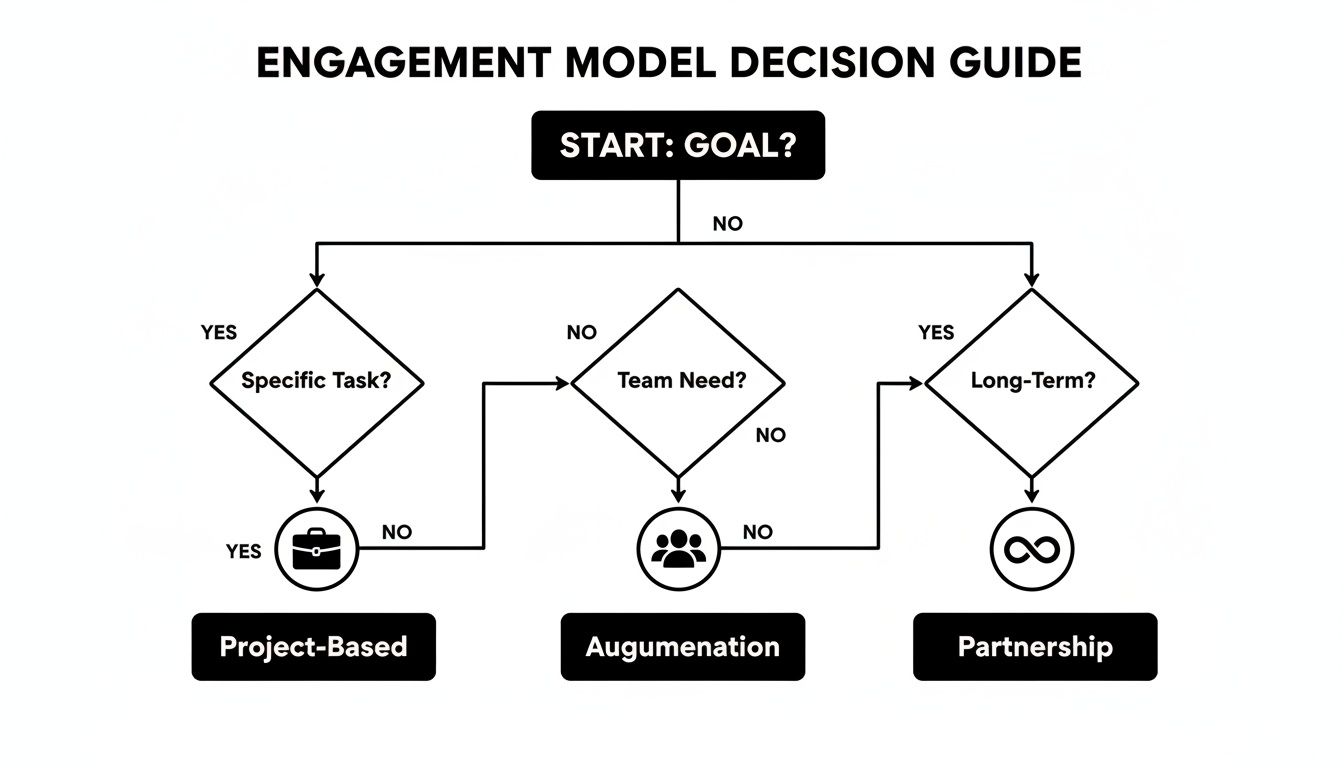
The key takeaway is that your primary objective should be the single most influential factor in your decision. Are you aiming to resolve a specific, contained problem, or are you seeking to build a lasting strategic advantage?
The Project-Based Model
This is the most traditional form of consulting. You engage a consultant or firm to deliver a specific outcome within a fixed scope, timeline, and budget. It is analogous to commissioning a specialist to build a custom machine for a designated location on your factory floor.
This model is ideal for well-defined problems where the desired outcome is clear. Examples include building a predictive maintenance model for a specific set of machines or conducting a customer segmentation analysis for an upcoming marketing campaign.
Key characteristics include:
- Clear Deliverables: Success is measured by the delivery of the promised report, working model, or software prototype.
- Fixed Scope: The work is confined to the predefined parameters. Scope changes typically require a formal change request and budget adjustment.
- Limited Knowledge Transfer: You receive the final product, but opportunities for direct involvement and learning for your team may be minimal.
This approach offers predictability in terms of cost and timeline. The primary limitation is that accountability is tied to completing the task, not necessarily to achieving the broader business objective.
The Team Augmentation Model
With team augmentation, you embed a data science consultant directly into your existing team. They report to your internal manager, filling a critical skill gap or providing additional capacity for an ongoing project. This is akin to temporarily adding a specialist engineer to your R&D team for a crucial development phase.
This model is most effective when you have strong internal project leadership but lack specific expertise, such as advanced Natural Language Processing (NLP) or computer vision. The consultant functions as a temporary employee, contributing their expertise within your established workflows. The distinction between a data science consultant and a business intelligence consultant is important here; the data scientist typically brings deeper algorithmic and engineering capabilities.
The primary advantage of team augmentation is the flexibility and direct control it provides. You can scale your team’s capabilities up or down without the commitment of a full-time hire.
However, the ultimate responsibility for the project's success remains with your organisation. The consultant is accountable for their individual contributions, but you are accountable for the overall outcome.
The Strategic Partnership Model
A strategic partnership transcends traditional consulting. In this model, the consultancy acts as a "Co-Preneur," sharing both the risks and rewards of the initiative. They become accountable for tangible business results, not merely for delivering code or a presentation deck. This is not hiring a contractor; it is akin to launching a joint venture.
Want to Accelerate Your Innovation?
Our team of experts can help you turn ideas into production-ready solutions.
This model is designed for large-scale, complex, high-stakes initiatives, such as creating a new AI-driven business unit, executing a technology spin-off, or fundamentally overhauling a core operational process. The consultancy collaborates at an executive level, shaping strategy and architecture with a clear focus on the P&L.
Accountability is shared, and success is measured by concrete business KPIs—such as revenue growth, cost reduction, or market share gains. This deep integration ensures continuous knowledge transfer, building your organisation's internal innovation capacity for the future. It is the most intensive of the three models but offers the highest potential for creating genuine, long-term value.
To assist in your evaluation, this table compares the core trade-offs of each model.
Consultancy Engagement Model Comparison
An evaluation of different data science partnership models to help leaders select the right fit for their business objectives.
| Model | Accountability | Speed and Velocity | Knowledge Transfer | Best Suited For |
|---|---|---|---|---|
| Project-Based | Consultant is accountable for deliverables and scope. | Fast for defined tasks, but slow to adapt to changes. | Low. You get the solution, not necessarily the know-how. | Well-defined, one-off problems with a clear endpoint (e.g., a specific analysis). |
| Team Augmentation | You are accountable for the overall project outcome. | Moderate. Adds capacity but relies on your internal management. | Medium. Your team works alongside the expert. | Filling specific skill gaps or adding temporary capacity to an existing internal team. |
| Strategic Partnership | Shared accountability for achieving business KPIs (e.g., revenue). | Can start slower due to alignment, but accelerates and scales. | High. Builds lasting capability and institutional knowledge. | Complex, high-stakes initiatives aimed at creating long-term competitive advantage. |
Ultimately, there is no single "best" model—only the model that is best suited to your specific context. Your choice should reflect not just the immediate task but also your organisation's strategic vision for the next 2 to 5 years.
How to Choose the Right Partner
Selecting the right data science consultant is one of the most pivotal decisions you will make on your company's AI journey. To be clear: you are not merely hiring a temporary analyst. You are choosing a partner to architect future value. A misstep here consumes budgets, stalls projects, and can erode your organisation's confidence in the potential of AI.
For German business leaders, the evaluation criteria must extend far beyond the technical skills listed on a curriculum vitae. The market has many individuals who can build a model. The true challenge is finding a partner who can build a business.
Look Beyond Pure Technical Skill
Your evaluation must be laser-focused on business acumen and an entrepreneurial mindset. While technical expertise is a prerequisite, it is not the sole determinant of value. You require evidence that they operate with the drive and accountability of a founder.
A truly valuable data science consultant will have a proven track record in two key areas:
- Shipping Production-Ready Systems: They must provide concrete examples of taking a project from a proof-of-concept to a resilient, scalable system integrated into a live business environment.
- Mastering German Compliance: Expertise in standards such as TISAX and ISO is not optional—it is non-negotiable. Your partner must demonstrate the ability to build secure and compliant solutions from the ground up, not as an afterthought. This is fundamental to de-risking any AI initiative within the German industrial landscape.
The best indicator of a high-value data science partner isn’t what they know, but how they think. You're looking for an entrepreneurial problem-solver who takes ownership of the business outcome, not just the technical task.
Looking for AI Expertise?
Get in touch to explore how AI can transform your business.
This focus on business results has never been more vital. Germany's data analytics market—the engine for data science consulting—is projected to reach USD 17,926.5 million by 2030. A significant 39.13% of that market's revenue in 2024 came from predictive analytics, indicating a clear demand for consultants who deliver tangible outcomes in forecasting and optimisation. You can explore these figures in greater detail in recent research on Germany's data analytics market.
The Right Questions for Your Interview
Your interview process must cut through superficialities and reveal how a candidate actually thinks. The objective is to assess how they approach problems, manage risk, and connect their work to business objectives. Disregard standard technical trivia.
Instead, structure your discussion around real-world scenarios that test their strategic thinking. Use these questions as a starting point to determine if they are a true partner in the making.
Questions to Uncover Their Problem-Solving Method:
- "Describe a time you were presented with a vague business problem. What were the first three steps you took to translate it into a concrete data science project plan?"
- "Walk us through a project that failed. What was the root cause, what did you learn, and what would you do differently today to prevent a recurrence?"
Questions to Assess How They De-risk a Project:
Ready to Build Your AI Project?
Let's discuss how we can help you ship your AI project in weeks instead of months.
- "We have a major AI initiative with a 12-month roadmap. How would you propose we validate the core business assumptions and deliver a first tangible result within 90 days?"
- "How do you balance the pursuit of a perfect, high-accuracy model against the business imperative for speed and a 'good enough' solution that delivers value now?"
Questions to Test for Business Accountability:
- "Imagine our project's primary KPI is not model accuracy, but a 10% reduction in operational costs. How would that change your day-to-day approach compared to a purely technical objective?"
- "How would you communicate progress—and potential setbacks—on this project to our executive board, who are not data scientists?"
Their responses will provide a far clearer indication of their value than any list of certifications. This is how you identify a partner who contributes to your strategy, much like a seasoned digital transformation consultant. Look for answers that demonstrate a bias for action, a focus on business metrics, and a practical understanding of what is required to ship a real product, not just an academic paper.
Case Studies from German Industry Leaders

Discussing the theoretical value of a data science consultant is straightforward. But what does this look like in practice, within Germany's industrial powerhouses? To make it tangible, let us examine outcomes inspired by real-world projects.
These examples illustrate how the right partnership can transform an ambitious presentation into a concrete business asset. These are not academic exercises; they are blueprints for successful execution.
From Corporate Venture to Market-Ready Product
A major German manufacturer had a compelling idea related to its core products. The challenge was that it remained only an idea. Their internal teams were constrained by traditional, slow-moving R&D cycles, making it impossible to explore the concept with start-up agility.
- The Challenge: They needed to test a new business model without being hindered by corporate bureaucracy or incurring significant costs for an unproven concept.
- Our Approach: We acted as a "Co-Preneur," assuming full ownership of the venture. This involved conducting customer research, building a minimum viable product (MVP) in weeks, and iteratively refining it based on direct user feedback.
- The Result: Over a two-year period, we guided the venture from a simple hypothesis to a business with demonstrated product-market fit. This hands-on, de-risked process enabled the corporation to launch a new, validated business unit built on a solid foundation of data and genuine market demand.
This is a prime example of a consultant functioning as an entrepreneurial strike team within a large organisation, bridging the gap between a promising idea and a profitable business.
Architecting a Successful Technology Spin-Off
A global technology leader had developed exceptional core technology but struggled to commercialise it. They had the "what" but lacked the "how." They required more than a technical roadmap; they needed a comprehensive business strategy to transform their innovation into a successful, standalone company.
True partnership in data science is measured not by reports delivered, but by businesses built. It is about taking shared accountability for creating new revenue streams and lasting competitive advantage.
The primary challenge was to construct a robust business case, identify the target market, and create an operational plan for a spin-off that could survive and thrive independently.
Want to Accelerate Your Innovation?
Our team of experts can help you turn ideas into production-ready solutions.
- Our Approach: We conducted an in-depth market analysis and developed a comprehensive go-to-market strategy. This was not a high-level plan; it included a defined product offering, a detailed financial model, and the organisational structure for the new entity.
- The Result: The data-backed strategy received approval from the executive board, leading to the successful launch of a new spin-off. The parent company was able to monetise its innovation, while the new business gained the focus and autonomy to pursue its own growth trajectory.
Developing a Sophisticated Recruiting Tool
An automotive giant was overwhelmed by job applications. Their HR team could not manage the volume, leading to slow response times, frustrated candidates, and a damaged employer brand. They urgently needed a solution to engage with applicants around the clock.
- The Challenge: The high volume of inquiries created a significant bottleneck. The existing recruiting process was not scalable, placing them at a disadvantage in a competitive talent market.
- Our Approach: We designed and built an intelligent recruiting tool using Natural Language Processing (NLP). This chatbot could handle initial screening questions 24/7, provide candidates with instant feedback, and qualify applicants based on core criteria.
- The Result: The impact was immediate. The new system drastically reduced the manual workload, allowing the HR team to focus on high-quality interviews rather than administrative tasks. More importantly, candidate engagement and satisfaction increased, enhancing the company's competitive edge in attracting top-tier talent.
Your First 90 Days with a Consultant

Engaging a data science consultant is not the final step; it is the beginning. The first 90 days are critical. They establish the tenor for the entire partnership, determining whether you build momentum or merely expend resources. This period is your opportunity to convert abstract objectives into a concrete, low-risk plan that demonstrates value almost immediately.
The primary goal is to achieve a quick, tangible win. To do this, you must adopt a start-up mentality: test your most significant assumptions first, validate the business case with empirical data, and establish the foundation for future scaling. A successful pilot is not just a technical experiment—it is a business asset that generates enthusiasm and alignment across the organisation.
Month One: Discovery and Scoping
The initial 30 days are dedicated to achieving laser focus. A proficient consultant will collaborate closely with your team to transform a vaguely defined problem into a tightly scoped project. This is not the time for overly ambitious goals.
Looking for AI Expertise?
Get in touch to explore how AI can transform your business.
The objective is to identify a specific pain point where a data-driven solution can deliver a measurable impact quickly. It is analogous to finding the first domino that, once toppled, will trigger the most significant and valuable chain reaction.
This phase typically includes:
- Stakeholder Workshops: Convening business leaders, domain experts, and IT personnel to understand operational realities and internal dynamics.
- Data Feasibility Assessment: A thorough examination of your data sources to confirm that the necessary data exists and is accessible before development begins, thus avoiding subsequent complications.
- Use Case Prioritisation: Mapping potential projects on a matrix of business impact versus technical feasibility. The ideal initial project is always high-impact and highly feasible.
By the end of this month, you should have a single, agreed-upon pilot project with a crystal-clear objective understood by all stakeholders.
Month Two: Building the Prototype
With a clear target defined, month two is dedicated to execution speed. Your consultant transitions from strategist to builder, focusing on creating a minimum viable product (MVP). This is not a polished, production-ready system but a functional prototype designed exclusively to prove that the core concept works and delivers business value.
A prototype's purpose is not to be perfect, but to be tested. It is a tool for learning, designed to answer your most critical business questions with real data, not with slide decks.
Ready to Build Your AI Project?
Let's discuss how we can help you ship your AI project in weeks instead of months.
Maintaining momentum requires a small, agile, and empowered project team. Daily or weekly check-ins are essential for clearing roadblocks and sustaining progress. The focus is on rapid iteration, not on exhaustive documentation. For more ideas on structuring this learning process, you can explore our advice on training for data analytics.
Month Three: Validation and Roadmapping
The final 30 days are the moment of truth. The consultant presents the working prototype and its initial results to key stakeholders. This is where the business case formulated in month one is validated with empirical evidence.
The success metrics here must transcend technical jargon like model accuracy. They must be directly tied to business value:
- Did the predictive maintenance model successfully identify assets at risk of failure?
- Did our new customer segments reveal a genuinely profitable new audience?
- Did the process optimisation prototype indicate a potential 15% reduction in cycle time?
Armed with these results, the consultant then presents the roadmap for the next phase. This plan details the steps, budget, timeline, and resources required to evolve the prototype into a fully integrated, production-ready solution. It provides your board with a data-backed justification for the next level of investment.
Frequently Asked Questions
Considering engaging a data science partner is a significant decision that naturally raises important questions. Here are direct answers to the questions we most frequently hear from executives and managers in Germany.
How Is a Data Science Consultant Different from a Data Analyst?
Consider a data analyst as a business historian. They analyse existing data to report on past performance. They excel at building dashboards and reports that visualise historical trends.
A data science consultant, in contrast, is an architect of your future. They do not merely report on what happened; they build systems—such as predictive models or AI tools—to determine what will happen and, more importantly, how you can orchestrate the optimal outcome. It is a creative, strategic role focused on endowing your business with entirely new capabilities.
What Does a Typical First Project Cost?
Many expect a large, prohibitive figure. However, a strategic approach avoids this. Instead of seeking approval for a large budget filled with unknowns, we begin with a time-boxed pilot project, typically lasting 90 days.
The objective is to de-risk the investment for you. You commit to a manageable, upfront cost to test a specific business case. At the conclusion, you possess not just a prototype but a data-backed justification for whether a larger investment is warranted. This process replaces speculation with certainty.
A well-structured pilot isn't really a cost—it's an investment in certainty. It's the fastest way to know if a big AI project will actually pay off before you commit serious capital.
Want to Accelerate Your Innovation?
Our team of experts can help you turn ideas into production-ready solutions.
How Much of Our Internal Team's Time Is Required?
While the consultant manages the technical heavy lifting, the input of your team is non-negotiable for success. We require modest time commitments from key individuals, such as a product owner and a subject-matter expert who possesses deep knowledge of the business area in question.
This typically translates to a few hours per week for workshops and check-ins, particularly during the initial and final stages of the project. This collaboration is the essential ingredient. It ensures the solution addresses a genuine business problem and facilitates knowledge transfer to build your team's long-term capabilities.
What If We Don't Have "Perfect" Data?
This is perhaps the most common concern, and the answer is straightforward: no organisation has perfect data. An experienced consultant understands this and is an expert at working with the data you actually possess.
One of the initial steps is always a data deep-dive to assess what is available, identify gaps, and understand its quality. From there, your consultant will either design a system robust enough to handle imperfect, real-world data or develop a clear plan to improve data collection processes. The goal is to begin creating value now, not to wait for a perfect state that may never materialise.
At Reruption GmbH, we are not just consultants; we are Co-Preneurs. We share the risk and the reward, making us as accountable for your business outcomes as you are. If you are ready to transform your ideas into market-leading products, let's talk. Learn more about our approach and start your journey at https://www.reruption.com.
Looking for AI Expertise?
Get in touch to explore how AI can transform your business.