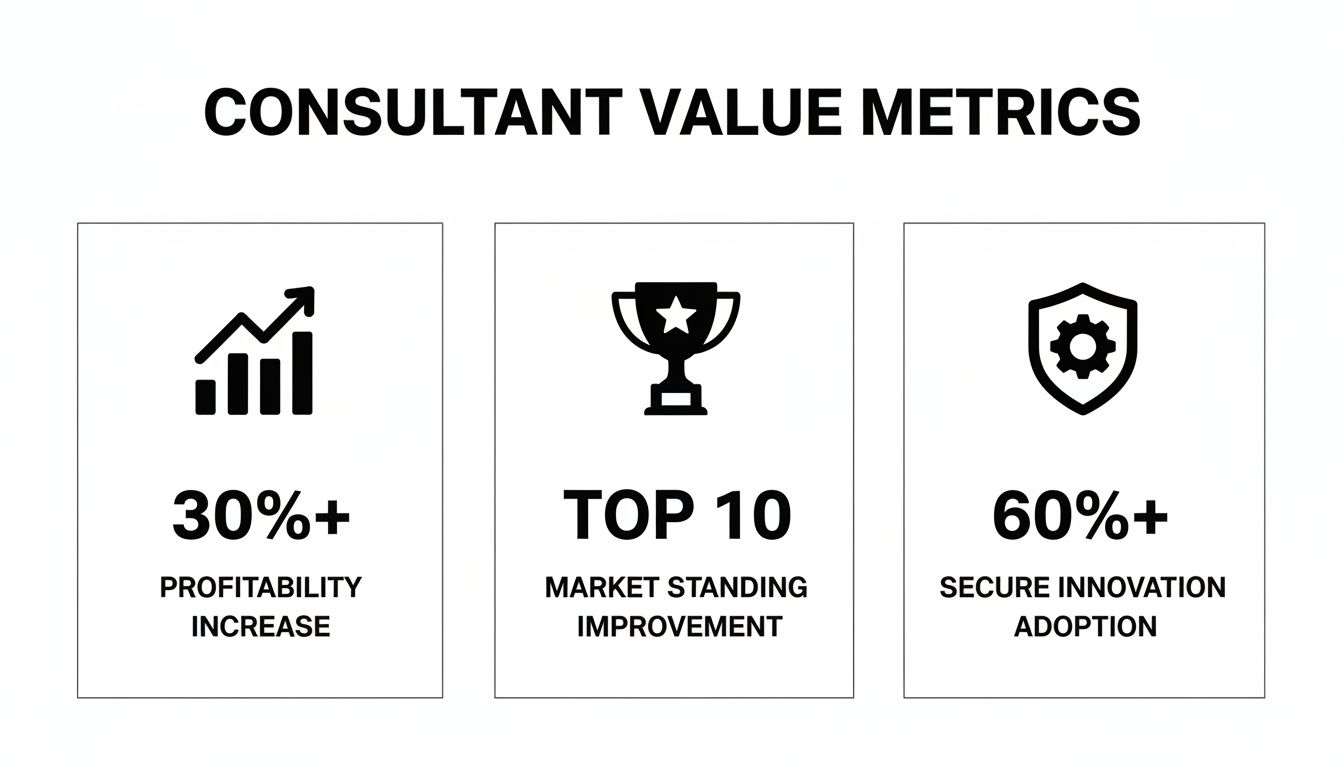
For leaders in German enterprises, traditional methods of technology asset tracking are no longer sufficient. Spreadsheets and manual audits cannot keep pace with modern operational complexity. Asset management software provides a single, strategic command centre to govern your entire digital estate—from on-premise servers to complex cloud subscriptions and emerging AI models—enabling rigorous cost control and risk mitigation.
Why Asset Management Has Become a Strategic Imperative
Viewing asset management as a mere IT inventory function is a significant strategic miscalculation in the current market. For German enterprises, particularly in sectors like automotive, manufacturing, and finance, it is now a core component of business strategy. Key executive concerns—escalating software expenditure, complex licensing in hybrid cloud environments, and adherence to regulations like GDPR and TISAX—are precisely the challenges that a modern asset management framework is designed to address. It provides the stable foundation required for secure innovation and sustainable growth.
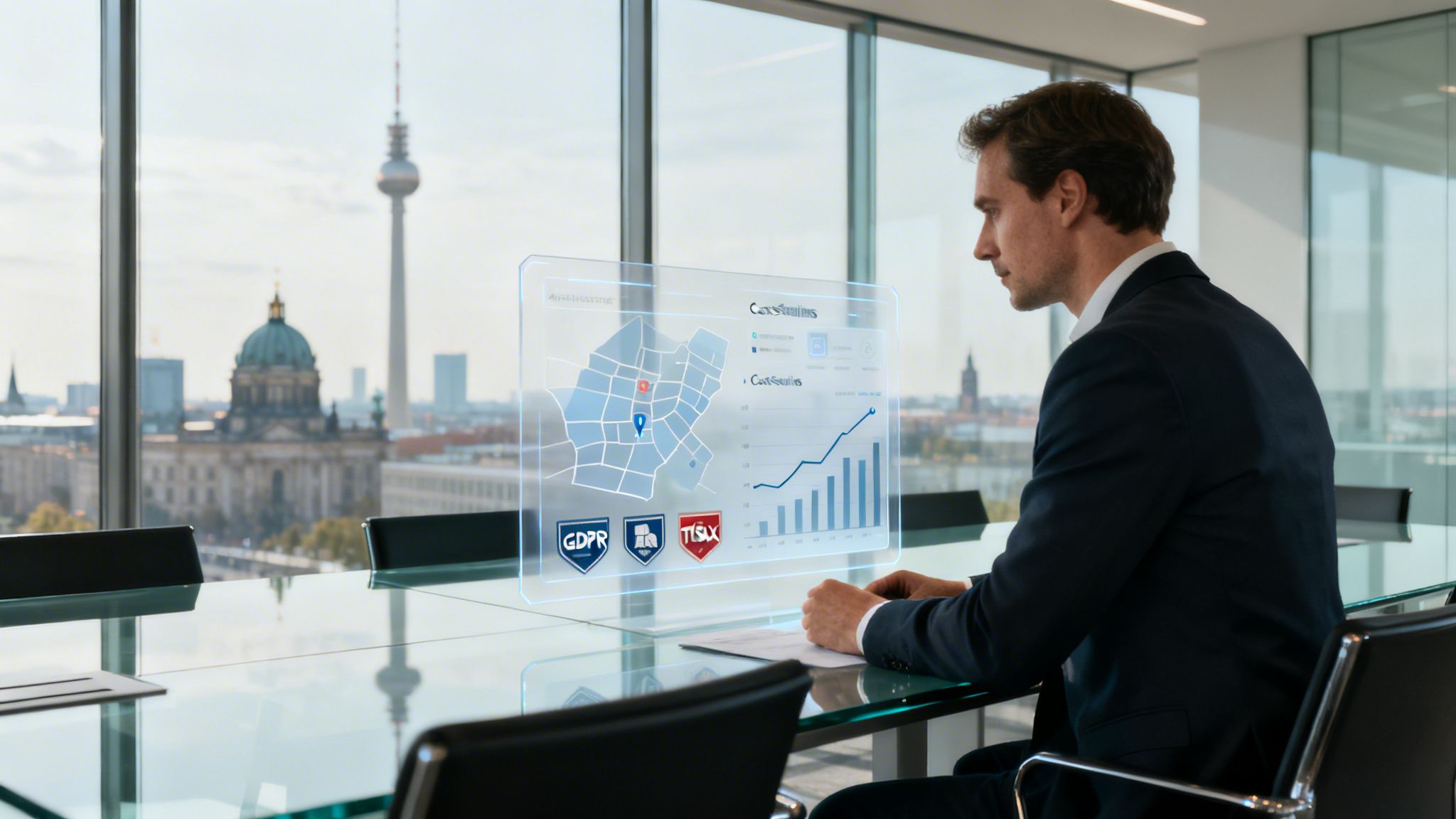
From Static Inventory to Business Intelligence
It is critical to reframe asset management software not as a static ledger, but as a dynamic control panel for your entire technology portfolio. A best-in-class platform aggregates disparate data sources, delivering a unified view across all departments and systems. This transforms fragmented data points into clear, actionable intelligence.
Without such oversight, organisations risk significant capital leakage from underutilised software licenses. This represents a silent but substantial drain on budgets. Industry analysis indicates that average SaaS utilisation stands at just 57%, highlighting a considerable opportunity for cost recovery.
Ready to Build Your AI Project?
Let's discuss how we can help you ship your AI project in weeks instead of months.
A centralised platform enables organisations to:
- Optimise expenditure: Identify and eliminate redundant software and reclaim capital from unused licenses, directly impacting the bottom line.
- Ensure compliance: Automate the tracking of software and hardware assets, simplifying adherence to TISAX and GDPR and reducing the burden of audits.
- Govern innovation: Establish a controlled environment for managing new technologies like AI models, de-risking pilot projects and facilitating secure scaling.
The objective is to transition from a reactive, compliance-focused posture to a proactive, strategic approach. This involves actively managing technology to build a durable competitive advantage, transforming a cost centre into a driver of efficiency and security.
Establishing the Foundation for AI Governance
As German companies intensify their adoption of Artificial Intelligence, the need for robust governance becomes paramount. A sophisticated asset management platform provides the ideal foundation for overseeing AI initiatives.
It treats AI models as any other strategic asset by inventorying them, tracking their usage, and monitoring associated cloud infrastructure costs. This level of transparency is essential to ensure that AI projects are secure, compliant, and deliver a quantifiable return on investment. For a more detailed analysis, you can learn more about software and asset management. This degree of control is what enables the transition of promising AI concepts into production-ready solutions that generate tangible business value.
The Architecture of a Modern Asset Management Solution
When we refer to modern asset management software, we are not describing an enhanced spreadsheet for inventory tracking. That paradigm is obsolete. Instead, envision a central nervous system for your enterprise's entire digital ecosystem—a unified platform that converts chaotic data into a strategic advantage.
Want to Accelerate Your Innovation?
Our team of experts can help you turn ideas into production-ready solutions.
A fitting analogy is a sophisticated financial portfolio management system. A portfolio manager does not merely list assets; they monitor performance, manage risk, and optimise returns. This software performs the same function for your technology assets, encompassing everything from software licenses and cloud subscriptions to physical hardware and the AI models shaping your future.
This single, unified view facilitates the shift from a reactive, firefighting mode to proactive, strategic decision-making.
The Four Pillars of the Ecosystem
This ecosystem is built upon four core functions that work in concert to reduce financial waste and mitigate operational risk. For German companies, particularly in critical sectors like automotive and manufacturing, mastering these functions is not merely an IT objective—it is a core business imperative.
The breakdown is as follows:
- Automated Discovery: This function continuously scans the entire enterprise environment—from internal data centres to multi-cloud platforms and remote employee endpoints. It identifies every asset, eliminating the significant risks posed by "shadow IT."
- Unified Inventory: Once discovered, each asset is catalogued in a single, structured repository. This provides a complete and accurate inventory of what you own, where it is located, and its usage context.
- Licence Optimisation: This is the primary driver of cost savings. The software analyses usage patterns to identify underutilised or unused licenses. This enables cost recovery and prevents over-expenditure on renewals, directly enhancing profitability.
- Security Monitoring: The system automatically flags unsupported software, unpatched systems, and configurations that deviate from security policies. This provides security teams with the necessary visibility to harden defences against cyber threats.
The strategic value is realised through the deep integration of these functions. An asset discovered today can be assessed for security vulnerabilities tomorrow, and its license utilisation can be optimised well in advance of its renewal date. It is this cohesive process that elevates asset management from a simple tracking exercise to a true strategic capability.
Looking for AI Expertise?
Get in touch to explore how AI can transform your business.
Market data validates this shift. Germany's software market, which includes these powerful asset management tools, reached a revenue of USD 42,293.5 million in 2024. Application software, the category to which these tools belong, accounted for 51.12% of this total. Projections show the market nearly doubling by 2030, driven largely by the German Mittelstand's pursuit of productivity gains in the Industry 4.0 era. You can examine the complete market analysis to understand the drivers behind this growth.
This trend underscores a fundamental shift: German businesses are moving beyond basic inventory management. They are now investing in intelligent platforms that provide a comprehensive command centre for their entire digital footprint. For a deeper examination of this topic, our article on digital asset management software may prove valuable. Ultimately, this level of strategic control is essential for navigating modern business complexity and maintaining a competitive edge.
Evaluating the Core Capabilities of Enterprise-Grade Solutions
For leaders at large German enterprises, selecting an asset management software platform is a decision of strategic consequence. While the market is saturated with options, few possess the depth required for complex, large-scale operations. It is imperative to look beyond superficial feature lists and scrutinise the core capabilities and their direct impact on business objectives.
This framework outlines the non-negotiable elements that distinguish a basic tool from a true strategic platform.
The diagram below illustrates the three pillars that support a modern digital asset ecosystem.
Ready to Build Your AI Project?
Let's discuss how we can help you ship your AI project in weeks instead of months.
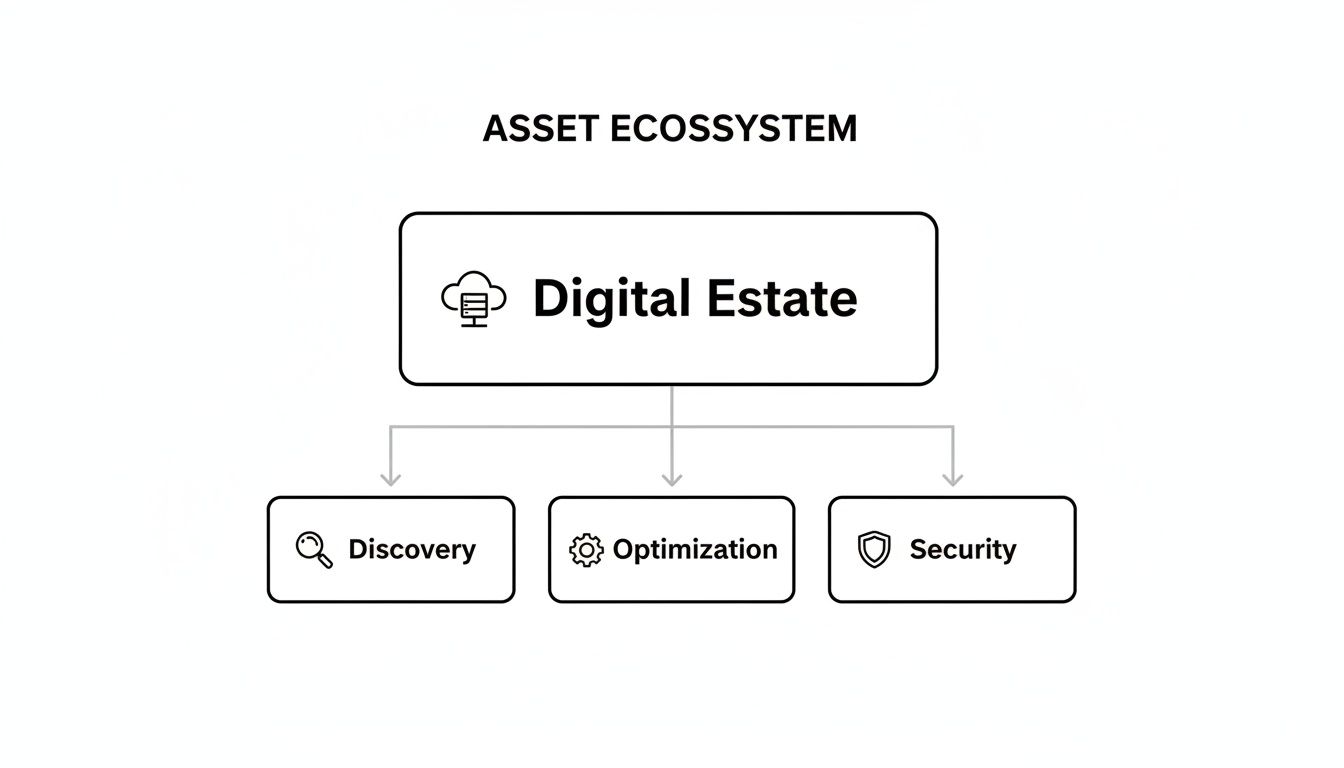
Consider Discovery, Optimisation, and Security as interconnected functions. When these three pillars operate seamlessly, they provide a complete and, most importantly, actionable view of every technology asset. This is the foundation of genuine enterprise control.
Automated Discovery Across Hybrid Environments
The foundation of any robust asset management strategy is complete visibility. An organisation cannot manage what it cannot see. For a large German enterprise with infrastructure distributed across on-premise data centres, multiple cloud providers like AWS and Azure, and thousands of employee devices, manual tracking is not merely inefficient; it is impossible.
An enterprise-grade platform must offer automated, agent-based, and agentless discovery capabilities. It must continuously scan the entire hybrid IT landscape. This is how you eliminate the dangerous blind spots created by "shadow IT"—software and services procured by departments without central oversight. This is not just about inventory creation; it is about risk management. By identifying every asset, you establish the foundation for effective security and cost control.
AI-Powered Licence Optimisation
Beyond simple enumeration, the primary financial value lies in optimisation. Escalating software costs, particularly from major vendors, represent a significant and often uncontrolled expense. An advanced platform addresses this by using AI to analyse asset utilisation patterns with precision.
Want to Accelerate Your Innovation?
Our team of experts can help you turn ideas into production-ready solutions.
An enterprise-grade solution transcends static reporting. It should deliver predictive insights—forecasting future requirements, identifying underutilised licenses, and automatically recommending rightsizing strategies for contracts before renewal cycles. This capability alone can yield a 15-20% reduction in total software spend.
This transforms asset management from a reactive, compliance-driven task into a proactive cost-containment discipline. Imagine discovering that only 60% of your high-cost engineering software licenses are actively used. An AI-powered system not only flags this but also facilitates the reclamation of those unused seats, converting insight directly into significant budget savings.
To truly understand what separates a basic tool from a strategic platform, let's break down the essential capabilities and their direct impact on business outcomes.
Essential Capabilities of Enterprise Asset Management Software
| Capability | Technical Function | Strategic Business Value |
|---|---|---|
| Complete Visibility | Automated, multi-environment discovery (cloud, on-prem, endpoints). | Eliminates "shadow IT" risks and establishes a single source of truth for all technology assets. |
| Licence Optimisation | AI-driven usage analysis, contract rightsizing, and harvest recommendations. | Directly reduces software spend by identifying waste and preventing over-provisioning. |
| Seamless Integration | Bi-directional API connections with ERP (e.g., SAP) and ITSM (e.g., ServiceNow). | Enriches asset data with business context and ensures data consistency across core systems. |
| Compliance & Security | Real-time dashboards mapped to standards like TISAX, ISO 27001, and GDPR. | Automates audit readiness, simplifies compliance reporting, and provides instant risk visibility. |
| Lifecycle Management | Tracking assets from procurement to retirement, including all dependencies. | Optimises hardware refresh cycles, minimises security gaps from end-of-life assets, and improves financial forecasting. |
These capabilities work in concert to transform asset management from a tactical IT task into a powerful strategic function that drives both efficiency and security across the enterprise.
Seamless Integration and Compliance Dashboards
An asset management platform cannot operate in isolation. It must function as a central hub, integrating smoothly with existing systems of record, particularly ERP (e.g., SAP) and ITSM (e.g., ServiceNow). This bi-directional synchronisation is critical. It enriches asset data with business context—such as cost centre allocation, ownership, and criticality—and ensures data consistency across all core systems. For a closer look at how integration works in related fields, some of the best facility management software solutions share these same core principles.
Looking for AI Expertise?
Get in touch to explore how AI can transform your business.
Furthermore, for German companies, compliance is non-negotiable. A top-tier solution must provide robust, real-time dashboards specifically configured for standards like TISAX, ISO 27001, and GDPR. These dashboards must translate raw asset data into clear, actionable compliance metrics. You should be able to identify security risks or compliance gaps at a glance, transforming audit preparation into a continuous, automated process rather than a periodic, high-stress event.
Ultimately, selecting the right asset management software requires a shift in mindset. The goal is not merely to count assets, but to unlock their strategic value. By demanding these core capabilities—automated discovery, AI-driven optimisation, and seamless integration—you ensure an investment in a platform that will bolster security, drive efficiency, and deliver a sustainable competitive advantage.
Strategic Use Cases in German Industrial Sectors
While the theory is compelling, the true power of enterprise-grade asset management software is realised in demanding, real-world industrial environments. For Germany's industrial leaders, this is not an abstract concept; it is a critical tool for driving operational excellence, strengthening security, and fostering innovation. Let us examine how strategic asset management delivers tangible results in key sectors.

These examples extend far beyond simple inventory management. They demonstrate how a single, unified view of all assets—both physical and digital—can create a formidable competitive advantage.
Automotive Excellence Through TISAX Compliance and R&D Governance
Consider a leading German automotive manufacturer managing the immense complexity of modern vehicle development. They oversee thousands of specialised software licenses across global R&D centres and production facilities. These are not commodity assets; they are high-value tools such as CAD software and proprietary simulation platforms, crucial for protecting sensitive intellectual property.
A single unlicensed software instance could trigger a substantial audit penalty or, in a worst-case scenario, halt production. In such a high-stakes environment, asset management software becomes the central engine for governance.
- Ensuring TISAX Compliance: The platform functions as a persistent monitoring system, continuously scanning the network to discover and inventory every software asset. It then automatically reconciles installations against procurement records, providing the company with a perpetually current view of its license compliance status. This automated evidence is a prerequisite for satisfying the stringent TISAX (Trusted Information Security Assessment Exchange) requirements necessary to operate within Germany's automotive supply chain.
- Optimising R&D Spend: The system does not merely count licenses; it analyses actual usage data. It rapidly identifies underutilised or dormant licenses on engineering workstations. This allows the manufacturer to reclaim and reallocate these assets, saving millions in renewal fees and redirecting that capital toward strategic innovation projects.
The strategic outcome is twofold. The manufacturer secures its position in the supply chain with auditable compliance while simultaneously funding its next innovation through intelligent cost recovery. This elevates asset management from a defensive necessity to a proactive financial instrument.
Manufacturing and the Rise of the Smart Factory
Another compelling use case emerges from the manufacturing sector, where companies are advancing their Industry 4.0 initiatives by developing IoT-enabled smart factories. These environments are characterised by interconnected machinery, sensors, and robotic systems, each representing a critical asset that generates vast amounts of operational data.
Here, asset management expands its scope beyond software to encompass the entire physical and digital production environment.
Ready to Build Your AI Project?
Let's discuss how we can help you ship your AI project in weeks instead of months.
The software becomes the definitive source of truth for every asset in the factory. It tracks not only the machine itself but also its firmware version, maintenance schedule, real-time operational status, and network connectivity. For industrial businesses, the efficiency of managing physical stock can be taken to another level with tools like warehouse automation software, which perfectly complements a wider asset oversight strategy.
This deep visibility unlocks powerful strategic capabilities.
Securing and Optimising Digital Twins
This manufacturer leverages rich asset data to construct and maintain digital twins—precise virtual replicas of its physical production lines. The asset management platform provides the robust data foundation for these twins, ensuring they remain perfectly synchronised with real-world factory floor operations. For a deeper analysis of this topic, our article on Siemens' digital twins in modern industry offers valuable insights.
This capability is transformative for several key reasons:
- Predictive Maintenance: By feeding live asset data into AI models, the company can predict imminent machine failures. Maintenance can then be scheduled during planned downtime, eliminating disruptive and costly unplanned production stoppages.
- Enhanced Security: The platform instantly detects unauthorised changes to a device's configuration or network connection, flagging potential security breaches that could compromise the entire production environment.
By unifying the management of both physical and digital assets, the company ensures its smart factories are not only efficient and productive but also resilient and secure against emerging threats. It represents a holistic governance model for the modern industrial landscape.
A Pragmatic Framework for Implementation and Scaling
The deployment of enterprise-grade asset management software should not be a protracted, multi-year endeavour with an uncertain outcome. The traditional "waterfall" methodology for large IT projects is no longer viable; it is too slow, too rigid, and delivers value too late.
A more intelligent, agile approach is required. The focus should be on generating demonstrable value rapidly. This framework moves away from a high-risk, monolithic rollout toward a phased implementation that proves its worth in weeks, not years.

Stage 1: The Fast Pilot for Immediate Impact
The initial step is to execute a tightly scoped "fast pilot." The objective is not to address every asset-related challenge simultaneously. Instead, select a single, high-impact area where a quick, measurable victory can be achieved. This is about building momentum and securing executive sponsorship for the broader initiative.
A prime candidate for a pilot is often a single, high-cost software contract. For example, could you optimise the licenses for a critical engineering platform or a major cloud provider? The objective must be clear and quantifiable: achieve a 15-20% cost reduction within a 90-day window.
Want to Accelerate Your Innovation?
Our team of experts can help you turn ideas into production-ready solutions.
Success at this stage is contingent upon two factors:
- Stakeholder Alignment: Before any technical work begins, convene leaders from IT, Finance, Procurement, and the relevant business unit. All parties must agree on the pilot's objectives. This is not merely an "IT project"; it is a strategic business initiative.
- Define Success Metrics: Success must not be ambiguous. It must be measured against concrete KPIs agreed upon at the outset. These should be simple and tied to business value, such as "reduce the annual spend on Vendor X by €500,000" or "reclaim 200 unused licenses."
Stage 2: Phased Technical Integration
Once the pilot has delivered a tangible ROI, the next step is expansion. Avoid a "big bang" deployment, which invites unnecessary risk and complexity. Instead, roll out the software methodically, progressing from one business unit or asset category to the next.
Each phase builds upon the previous one. The lessons learned and expertise gained during the pilot are applied to subsequent stages. This controlled rollout minimises operational disruption and allows for fine-tuning the system to meet the specific needs of different departments, whether R&D or Sales.
The guiding principle is velocity with control. By starting small and proving value, you convert a potentially high-risk, high-cost project into a series of manageable, low-risk wins. This agile approach dramatically de-risks the investment and accelerates time-to-value.
Stage 3: Establishing a Governance Model for Scale
The final stage is about ensuring sustainability. The software is a tool; its true power is unlocked through disciplined processes and clear accountability. This is where you establish the operational rhythm that makes asset management a permanent business capability.
Looking for AI Expertise?
Get in touch to explore how AI can transform your business.
A robust governance model typically includes:
- A Centralised Asset Management Office (AMO): A small, cross-functional team responsible for platform oversight, data integrity, and continuous optimisation. This team becomes the enterprise's centre of excellence for asset management.
- Standardised Processes: Clear, repeatable processes for the entire asset lifecycle—procurement, onboarding, tracking, and retirement—are essential. Standardisation is what prevents the re-emergence of "shadow IT."
- Regular Performance Reviews: Institute quarterly business reviews where the AMO presents performance against KPIs to executive stakeholders. This maintains asset governance on the strategic agenda and ensures its value is visible across the organisation.
By implementing this structure, you are not merely completing a project; you are embedding asset management into your organisation’s operational DNA. For leaders tasked with structuring such programmes, understanding the principles of a target operating model can be highly beneficial. This is what ensures your asset management software continues to deliver value long after the initial deployment.
Building the Business Case and Modelling ROI
Securing board approval for an enterprise asset management software investment depends on a compelling quantitative analysis. The proposal must transcend technical features and speak the language of the C-suite: cost savings, risk reduction, and clear strategic value. A robust business case must be constructed, demonstrating a clear, quantifiable Return on Investment (ROI).
Your business case should be framed not as a request, but as a financial forecast. A compelling ROI model is built on three pillars that every executive understands and prioritises.
Quantifying the Primary Value Drivers
The core of your ROI model is assigning a monetary value to the projected benefits. This centres on direct savings, cost avoidance, and operational efficiency gains.
Ready to Build Your AI Project?
Let's discuss how we can help you ship your AI project in weeks instead of months.
Direct Cost Savings: This is the most immediate and tangible source of value. It involves identifying and eliminating spend on underutilised or unused software licenses. By gaining a precise understanding of utilisation, companies can confidently renegotiate major contracts with vendors like Microsoft or SAP. It is not uncommon to achieve a 15-20% reduction in annual software costs in the initial phase.
Cost Avoidance: This pillar focuses on mitigating financial risks. This includes the substantial penalties associated with failed software vendor audits or the financial repercussions of a security breach originating from an unmanaged, outdated asset. In many cases, avoiding a single major audit penalty can be sufficient to justify the entire platform investment.
Operational Efficiency: While seemingly less tangible, the impact of efficiency gains is significant. It translates to reduced manual effort in audit preparation, streamlined procurement workflows, and the reallocation of high-value IT personnel from administrative tasks to strategic, revenue-generating projects. For a deeper analysis of workflow improvement, you can learn about the power of process mining in our guide.
A Sample ROI Calculation Framework
A well-constructed ROI model demonstrates how quickly the platform can achieve payback. Consider a large German enterprise with a substantial software budget. By focusing on a single high-cost vendor, the value can often be proven within one fiscal year.
Example: An enterprise spends €5 million annually on licenses for a specific engineering software package. The asset management platform identifies that 20% of these licenses are dormant. By reclaiming these unused seats, the company generates €1 million in direct annual savings. This single action can fund the entire platform and its implementation.
Want to Accelerate Your Innovation?
Our team of experts can help you turn ideas into production-ready solutions.
Starting with a targeted, high-impact initiative like this builds significant momentum and makes the case for a full, enterprise-wide rollout virtually undeniable.
The market dynamics in Germany underscore the urgency of this initiative. In 2024, the German Software Asset Management (SAM) market was valued at USD 333.52 million. This figure is projected to grow to USD 1,861.3 million by 2035. This growth is not speculative; it is driven by stringent regulations and the recognition that SAM tools are no longer a discretionary expense but an essential lever for fiscal discipline, with the potential to reduce software overspending by up to 30%. You can discover more insights about these market projections and the factors driving them.
When presenting this case to the board, frame it as a strategic investment. Effective asset governance is not just about cost savings; it is about de-risking digital transformation, securing innovation, and establishing the control required to outperform competitors.
Your Enterprise Asset Management Questions, Answered
A major strategic investment like this naturally warrants careful consideration and incisive questions. Below, we address some of the most common inquiries from leaders in large German organisations, focusing on the practical realities of implementation.
How Long Does a Typical Implementation Take?
The era of 6-12 month enterprise software deployments is over. A modern, agile approach yields results much faster. We advocate a phased rollout, beginning with a focused, 60-90 day pilot. The key is to concentrate this pilot on a single, high-impact area, such as your largest software vendor or primary cloud provider.
Looking for AI Expertise?
Get in touch to explore how AI can transform your business.
This "fast pilot" is not merely a technical trial; it is designed to prove ROI and build internal sponsorship. Following this initial success, a full enterprise-wide rollout can be methodically executed over the subsequent 6-9 months. The primary benefit is that savings and improved compliance begin to accrue from day one, not a year later.
Can Asset Management Software Help With AI Governance?
Yes, unequivocally. This is one of the most critical emerging functions of a modern asset management platform. These systems are now essential for cataloguing, tracking, and managing your AI and machine learning models with the same rigour as any other strategic asset. It is a prerequisite for responsible innovation.
This involves tracking everything from model versions and data lineage to access rights and the associated cloud compute costs. For German companies grappling with AI compliance and ethics, this establishes the necessary governance layer to make AI initiatives transparent, secure, and auditable. It transforms a potential liability into a well-managed asset.
By building a structured inventory of your AI models, you establish the fundamental control needed to govern their development, deployment, and performance.
How Does a Single Tool Handle Our Complex Hybrid IT Environment?
This is the core problem that an enterprise-grade platform is engineered to solve. The solution lies in a combination of powerful discovery agents and an extensive library of API integrations. This is what enables the platform to bridge disparate systems.
Ready to Build Your AI Project?
Let's discuss how we can help you ship your AI project in weeks instead of months.
A robust platform will automatically scan your entire IT estate—from on-premise data centres to your subscriptions with AWS, Azure, and Google Cloud—and aggregate the data into a single, unified dashboard. This creates the 'single source of truth' that is non-negotiable for informed decision-making in today's complex IT landscapes. That unified view is what finally dismantles data silos and eliminates the blind spots that drive up costs and create risk.
Ready to transform asset management from a cost centre into a strategic advantage? As Reruption GmbH, we act as your co-preneurs to implement AI-driven solutions that deliver measurable business outcomes. Let us help you launch a fast pilot and prove the value in under 90 days. Discover how we de-risk innovation at https://www.reruption.com.