
At its core, a trainee data analytics programme is a structured framework for cultivating foundational data capabilities within your organisation. It involves identifying high-potential internal talent or recent graduates and systematically developing them into skilled data professionals equipped to solve real-world business challenges. This is not merely a training initiative; it is a strategic investment in creating a sustainable, in-house AI competency.
Why Internal Talent Is Your Greatest AI Asset

In the race to adopt AI, many German enterprises default to competing for a limited, high-cost pool of external data science experts. This approach is often inefficient and overlooks a more potent resource: your existing workforce. Launching an internal trainee data analytics programme represents a superior strategic alternative, transforming a perceived training expenditure into a P&L-accountable engine for innovation and growth.
The key differentiator is business context. An external hire may quickly master your technology stack, but an internal trainee already possesses an ingrained understanding of your corporate culture, operational processes, and unique market dynamics. This institutional knowledge is invaluable for identifying high-impact AI opportunities and is a competitive advantage that cannot be acquired externally.
De-Risking AI Adoption from Within
By cultivating talent internally, you substantially de-risk your AI adoption strategy. Instead of making significant capital outlays on external experts who may not align with your organisational objectives, you are systematically upskilling individuals already invested in your company's success. This approach establishes a reliable pipeline of data-literate professionals who can effectively bridge the gap between technical teams and business units.
Ready to Build Your AI Project?
Let's discuss how we can help you ship your AI project in weeks instead of months.
This internal enablement model is designed to build a lasting capability, not merely address a temporary skills deficit. These newly skilled employees become internal advocates for data-driven decision-making, embedding analytical rigour into the fabric of your corporate DNA.
Developing talent internally ensures the resulting analytical capability is perfectly aligned with your strategic imperatives. It is the most direct path to guaranteeing that AI initiatives deliver tangible business value, not just technical novelty.
Building a Sustainable Talent Pipeline
A structured programme provides ambitious employees with a clear trajectory for professional growth. It also addresses the need for a full spectrum of data roles beyond the senior data scientist, enabling the construction of a well-rounded analytical team. This approach enhances employee loyalty and mitigates the substantial costs associated with continuous external recruitment.
To effectively nurture this internal talent and measure its impact, applying the principles of Human Resource Analytics is essential. Ultimately, this methodical playbook builds organisational resilience and secures a long-term competitive advantage.
Laying a Successful Programme Foundation
Initiating a trainee data analytics programme requires more than budget allocation; it demands a strategic framework anchored to clear business objectives and backed by executive sponsorship. Without this foundation, even the most promising initiative risks becoming an academic exercise with no bottom-line impact. This preliminary phase is not administrative; it is where the long-term value of the entire undertaking is determined.
Want to Accelerate Your Innovation?
Our team of experts can help you turn ideas into production-ready solutions.
The first critical action is to secure a dedicated executive sponsor. This C-level champion must not only approve funding but also possess a deep understanding of the programme's strategic importance and be prepared to advocate for it at the highest levels. Their role is to eliminate organisational impediments and ensure the programme remains aligned with core business goals, preventing it from being marginalised by shifting corporate priorities.
Defining Objectives and Modelling the Business Case
With leadership commitment secured, the next step is to translate high-level strategic goals into measurable objectives. Vague statements such as "become more data-driven" are insufficient.
Specificity is paramount. Objectives should be articulated as follows: "Reduce supply chain inefficiencies by 10% within 18 months through the development of predictive maintenance models," or "Increase customer retention by 5% via enhanced personalisation algorithms developed by our trainees."
This level of precision facilitates the construction of a compelling business case. The projected ROI can be modelled by directly linking the programme's outputs to tangible business value:
- Process Optimisation: What are the projected cost savings from automating a specific, time-intensive manual reporting task?
- Innovation Velocity: What is the potential value if the trainee team prototypes three novel product features within the fiscal year?
- Reduced Recruitment Costs: How does the programme's cost compare to the expense of recruiting senior data scientists in a highly competitive market?
A robust Learning and Development Strategy serves as the backbone for this entire process, ensuring the foundation is built to support broader organisational growth.
Crafting the Ideal Trainee Profile
The programme's success is contingent upon the calibre of its participants. While technical aptitude is a prerequisite, an entrepreneurial mindset is the distinguishing characteristic of exceptional candidates. You are not merely hiring analysts; you are cultivating future innovators. The ideal trainee data analytics candidate combines technical curiosity with commercial acumen.
An effective trainee programme identifies individuals who can not only write Python code but can also articulate how that code solves a specific customer problem or unlocks a new revenue stream. This synthesis is the critical ingredient for building a powerful internal AI engine.
This necessitates looking beyond traditional computer science degrees. Consider candidates from quantitative disciplines such as physics, economics, or engineering who demonstrate superior problem-solving abilities. The individual leading this initiative, often an innovation manager, plays a pivotal role. Their ability to identify raw potential is crucial. A deeper understanding of this function can be found in our guide to the innovation manager job.
A leading example within Germany's analytics landscape is the European Central Bank's traineeship, which reports a 90% post-completion employment rate. Trainees are immersed in high-stakes projects, such as building models that predict HR talent trends with 85% accuracy, demonstrating the significant value a structured, hands-on programme can deliver.
Crafting a Curriculum That Delivers Real Value
A trainee programme structured like a university lecture series is a misallocation of resources. The objective is not academic certification but the creation of a talent pipeline capable of solving concrete business problems. From inception, the curriculum must be relentlessly focused on delivering business impact.
Looking for AI Expertise?
Get in touch to explore how AI can transform your business.
This requires a carefully calibrated balance. Foundational technical skills are essential, but trainees must immediately apply their learning to projects of strategic importance. A purely theoretical approach is inadequate for developing professionals who can operate effectively within a dynamic business context.
A modular structure is the most effective implementation. The curriculum begins with core, non-negotiable competencies and progressively layers on specialised topics as trainees gain proficiency. The goal of this initial phase is not rote memorisation but the development of the analytical "muscle memory" that will serve them throughout their careers.
Laying the Groundwork: The Technical Essentials
The initial three months should function as an intensive bootcamp focused on the fundamentals of data analytics. This period ensures all participants achieve fluency in the language of data.
- Mastering Python and SQL: Proficiency must extend beyond basic syntax. Trainees need to write clean, efficient code to manipulate data with libraries like Pandas and extract information from large-scale databases using SQL.
- Data Storytelling, Not Just Chart-Making: The ability to construct a compelling narrative from data for non-technical stakeholders is a critical skill. This involves hands-on application of visualisation tools like Tableau or Power BI, with an emphasis on clarity and persuasive communication.
- A Solid Grip on Statistics: A robust understanding of probability, hypothesis testing, and regression analysis is what distinguishes sound analysis from flawed assumptions and provides an essential intellectual safeguard.
Significant preparatory work is required before this stage. Securing the right stakeholders and building a robust business case for the programme are crucial prerequisites.
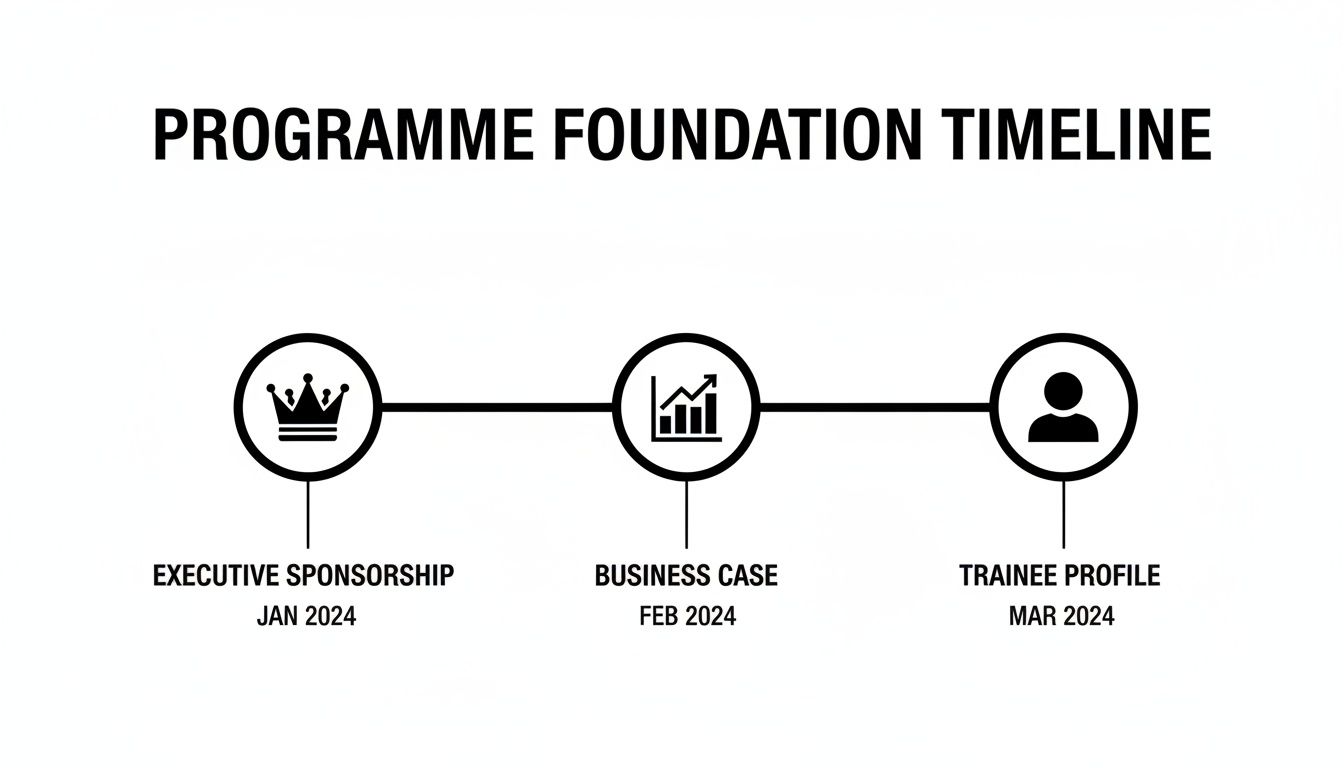
As illustrated, securing executive sponsorship and defining the ideal trainee profile are foundational steps that dictate the success of all subsequent phases.
From Theory to Practice: Advanced Skills and Rotations
Once foundational skills are established, the curriculum transitions to more complex domains. It is at this stage that the return on investment becomes tangible, as trainees begin to address live business challenges. This methodology is central to increasing learning effectiveness, as it directly connects abstract knowledge to concrete outcomes.
The primary objective is not to teach the definition of machine learning. It is to empower a trainee to identify an operational inefficiency, prototype a model to resolve it, and confidently articulate its value proposition to the C-suite.
To achieve this, several key modules are necessary:
- Practical Machine Learning: Trainees must build predictive models using real, anonymised company data. Applications should focus on high-impact areas such as customer churn prediction or sales forecasting.
- AI Ethics and Governance: This is a non-negotiable component, particularly within the German and broader European regulatory context. Trainees must develop a thorough understanding of data privacy, algorithmic bias, and the principles of responsible AI to build trustworthy solutions.
- Business Unit Rotations: This is the most critical element of the programme. Immersing trainees in departments such as marketing, logistics, or finance transforms theoretical knowledge into genuine expertise. They gain firsthand experience with the unique challenges and data ecosystems of each function, enabling them to deliver targeted value and transition from students to internal consultants.
This combination of deep technical training and practical immersion is what distinguishes a premier trainee data analytics programme.
Ready to Build Your AI Project?
Let's discuss how we can help you ship your AI project in weeks instead of months.
The following roadmap illustrates how these elements can be structured over a 12-month period, balancing intensive technical learning with the invaluable context gained from direct collaboration with business units.
Sample 12-Month Trainee Curriculum Roadmap
| Quarter | Core Technical Focus | Business Unit Rotation | Key Deliverable |
|---|---|---|---|
| Q1 | Python, SQL, Statistics, Data Visualisation (Tableau) | None (Foundational) | End-to-end exploratory data analysis project on a historical dataset. |
| Q2 | A/B Testing, Product Analytics, Git/Version Control | Marketing Analytics | Design and analyse a simulated marketing campaign A/B test. |
| Q3 | Intro to Machine Learning (Regression, Classification) | Supply Chain / Ops | Build a predictive model to forecast product demand or identify bottlenecks. |
| Q4 | Advanced ML (Clustering), Cloud Basics (AWS/Azure) | Finance / BI | Capstone Project: Solve a real business problem from a chosen department. |
By the end of this 12-month cycle, the structure ensures the output is not merely a coder or a dashboard creator, but a well-rounded data professional who understands the business, communicates effectively across departments, and is prepared to deliver a tangible impact.
Building a Robust Support and Measurement System
A superior curriculum is necessary but not sufficient. For a trainee data analytics programme to succeed and demonstrate a clear return on investment, it must be supported by a robust mentorship and measurement framework.
Without this infrastructure, trainees can become isolated, their work disconnected from business priorities, and their potential impact unrealised. This is not about simple supervision; it is a strategic framework designed to accelerate development and validate the programme's value to the wider organisation.
A Multi-Layered Mentorship Framework
The most effective programmes implement a dual-mentorship model. This provides trainees with guidance from two distinct but equally critical perspectives, ensuring the concurrent development of technical proficiency and commercial acumen.
Want to Accelerate Your Innovation?
Our team of experts can help you turn ideas into production-ready solutions.
- The Technical Mentor: This role should be filled by a senior data scientist or engineer. They are the primary resource for complex coding challenges, model validation, and data architecture inquiries. Their objective is to maintain a high technical standard and accelerate the trainee's skill development.
- The Business Mentor: This individual should be a senior manager from a commercial unit, such as marketing or operations. They provide the business context—the "why"—behind the data, helping the trainee connect their analytical projects to the P&L and navigate stakeholder relationships.
This two-pronged approach is essential. It prevents trainees from operating in a technical vacuum, ensuring their solutions are not just elegant algorithms but are directly aligned with solving pressing business problems. This is the foundation for generating meaningful analytics and insights.
Selecting the Right Technology Stack
Trainees must be equipped with appropriate tools. The strategy is to strike a balance between powerful, industry-standard open-source technologies and the enterprise platforms already integrated into your company’s technology stack.
A solid technical foundation should include:
- Core Programming: Python and SQL are non-negotiable. They form the bedrock of data manipulation and analysis.
- Cloud Platforms: Trainees require hands-on experience with services from AWS, Azure, or Google Cloud. This is not optional for any modern data role.
- Visualisation Tools: Proficiency with platforms like Power BI or Tableau is essential for communicating complex findings to non-technical leadership.
Leading management consultancies, such as Roland Berger in Germany, mandate this precise blend of skills for their junior talent. Their Stuttgart teams, for instance, are engaged in projects spanning from ML model development to full-scale data pipelines, managing petabytes of data and creating Power BI dashboards that inform multi-billion euro decisions.
Measuring What Truly Matters
Finally, a world-class programme must transcend vanity metrics like course completion rates. True success is measured by the tangible business impact delivered by trainees. Key Performance Indicators (KPIs) must be directly linked to corporate objectives.
Looking for AI Expertise?
Get in touch to explore how AI can transform your business.
The ultimate measure of a trainee programme's success is not the number of certificates earned, but the number of business decisions improved. Focus on quantifiable outcomes, not just educational milestones.
Consider tracking metrics such as:
- Process Efficiency Gains: Can you quantify the time or cost savings generated by an automation project a trainee developed?
- Successful Prototype Delivery: What is the conversion rate of projects from concept to a functioning proof-of-concept?
- Contribution to Revenue: Can a direct line be drawn from a trainee's insight to a new sale or improved customer retention?
By defining these KPIs from the outset, you establish a clear, defensible link between the programme’s activities and bottom-line results, building an undeniable case for continued investment.
Scaling Your Programme for Long-Term Impact

Successfully launching the pilot programme is a significant achievement, but the ultimate objective is to transform it into a self-sustaining talent engine for the organisation. This final phase involves transitioning the initiative from a standalone project into a permanent, scalable component of your corporate structure.
Ready to Build Your AI Project?
Let's discuss how we can help you ship your AI project in weeks instead of months.
This transition requires a clear blueprint for post-programme integration. It begins with creating well-defined career pathways that seamlessly guide graduates into full-time roles. This must be more than a job offer; it must be a compelling roadmap illustrating their potential progression from junior analyst to future leadership positions. Having invested significantly in these individuals, retention is paramount.
Without this strategic foresight, you risk creating a "revolving door" where newly skilled analysts depart for more attractive opportunities elsewhere.
Building a Self-Sustaining Knowledge Cycle
The most advanced programmes establish a virtuous cycle of mentorship and knowledge transfer. Your first cohort of graduates represents your most valuable asset for scaling the initiative. They possess the ideal combination of current technical skills and a deep, firsthand understanding of the programme's strengths and weaknesses.
Position these graduates as mentors for the subsequent intake of trainees. This strategy not only alleviates the mentorship burden on senior staff but also cultivates a strong sense of ownership and community. The programme evolves from a mere training function into a true internal academy where expertise is continually cascaded and amplified.
Standardising for Scalable Growth
Transitioning from a small pilot to a continuous talent pipeline requires standardisation. The initial, flexible curriculum must be refined into a repeatable, documented framework. This is the only way to guarantee a consistent, high-quality foundational experience for every trainee, regardless of their cohort.
Want to Accelerate Your Innovation?
Our team of experts can help you turn ideas into production-ready solutions.
Key actions to achieve this include:
- Document and Standardise: Codify the curriculum, project templates, and assessment criteria in a centralised knowledge base.
- Automate Onboarding: Implement automated workflows for administrative tasks. This liberates mentors and programme managers to focus on high-value coaching and development.
- Establish a Community of Practice: Create a formal internal network where trainees, graduates, and senior experts can share insights and collaborate on complex, cross-departmental challenges.
This structured approach is what converts an ad-hoc initiative into an efficient, predictable talent pipeline. Deploying an internal LLM, for example, can dramatically accelerate knowledge sharing and automation within this community. Discover more in our detailed guide on how to build an internal LLM engine for cross-functional automation.
A powerful benchmark is the German banking giant ING. Its Global Analytics Graduate Programme achieves a 95% retention rate by granting trainees direct P&L influence from day one. Graduates typically start with an average salary of €65,000 and frequently advance to senior roles within 18 months, demonstrating the substantial ROI these programmes can generate.
Answering the Tough Questions About Trainee Data Analytics Programmes
Before launching a new talent initiative, senior leadership will invariably pose challenging, strategic questions. Addressing these concerns directly and transparently is essential for securing genuine buy-in and clearing the path for your trainee data analytics programme.
Here are the most common inquiries from executives and department heads, along with direct, data-informed responses.
What’s the Real ROI on This Investment?
An expectation of a simple, immediate ROI figure may overlook the programme's primary strategic value. While direct financial returns vary, top-tier programmes consistently deliver substantial value. We have observed financial institutions report annual savings exceeding €200 million from projects driven by their analytics graduates.
However, the principal value is strategic: you are building an in-house capability and a sustainable talent pipeline that confers a long-term competitive advantage. Therefore, beyond a simple ROI calculation, it is crucial to track metrics such as project success rates, documented efficiency gains within business units, and the retention rate of these high-potential individuals.
We Don't Have In-House Experts, So How Do We Pick the Right Candidates?
This is a common challenge, but it is surmountable. The key is to shift focus from specific tool knowledge—which can be taught—to core aptitudes. The ideal candidates will possess exceptional problem-solving skills, strong logical reasoning, and a genuine intellectual curiosity about data.
Replace standard interview protocols with practical case studies that mirror your actual business challenges. This method is highly effective for identifying an "entrepreneurial mindset"—the combination of resilience, proactivity, and a focus on delivering results. For the initial cohort, partnering with a specialised consultancy can help structure the assessment process and mitigate selection risk.
The most valuable trait in a trainee is not their current knowledge of Python. It is their ability to deconstruct a messy, ambiguous business problem and formulate a data-driven path to its solution. That is the core skill that creates future innovators.
Looking for AI Expertise?
Get in touch to explore how AI can transform your business.
How Do We Make Sure Trainees Actually Integrate with Our Established Teams?
Simply embedding trainees within existing teams without a structured plan is a recipe for failure. Integration must be a deliberate, managed process from day one. Involve senior team members as mentors immediately to build relationships and accelerate knowledge transfer.
Crucially, the programme must be positioned as a resource that supports existing teams, not one that threatens them. Assign trainees to specific, high-impact projects with clear deliverables that help established teams achieve their own objectives. When colleagues see that trainees are there to contribute to their success, the dynamic shifts positively. Regular cross-functional meetings where trainees present their progress are also highly effective for building transparency and a sense of shared mission.
At Reruption GmbH, we act as your Co-Preneurs, helping you build and scale internal AI capabilities with P&L accountability. We turn your strategic ideas into tangible innovations. Discover how we can help you launch a successful trainee data analytics programme.