The relationship between an enterprise and its clientele is built upon a sequence of critical interactions. The customer journey constitutes the complete narrative of this relationship, from initial awareness to sustained loyalty. The individual moments within this narrative are the touchpoints—each discrete point of contact. Mastering these two concepts is not merely an operational task; it is a fundamental pillar of modern strategic leadership.
Why Customer Journey Orchestration Is a Strategic Imperative

In the contemporary market landscape, mastering the customer journey has transcended its departmental origins to become a core strategic objective, essential for sustainable growth. For German enterprises, where a reputation for quality and reliability is paramount, a fragmented or inconsistent customer experience presents a significant risk. It erodes trust, devalues the brand equity, and ultimately impacts financial performance.
Conversely, a well-orchestrated journey yields substantial returns. It not only satisfies customers but converts them into brand advocates. This requires viewing the customer lifecycle not as a linear funnel, but as a dynamic ecosystem of digital and physical interactions. Each touchpoint, from an initial website visit to a post-purchase support inquiry, shapes the aggregate perception of the organisation.
The Business Case for Prioritisation
The commercial logic for prioritising the customer journey is unequivocal. Organisations that excel in this domain achieve direct, measurable improvements in key performance indicators. These are not intangible benefits; they are tangible results that enhance profitability and strengthen market positioning.
Ready to Build Your AI Project?
Let's discuss how we can help you ship your AI project in weeks instead of months.
Consider these strategic advantages:
- Enhanced Customer Loyalty: A seamless and positive experience, particularly at critical moments, fosters high retention rates. A customer who feels understood and valued is significantly less likely to defect to a competitor, even when faced with a lower price point.
- Increased Revenue Growth: By identifying and eliminating points of friction in the journey, the path to purchase is streamlined. Furthermore, a deep understanding of the customer's path reveals natural opportunities for upselling and cross-selling, thereby increasing revenue from the existing customer base.
A focus on the customer journey moves an organisation from reactive problem-solving to proactive value creation. It reframes customer interaction from a cost centre to a primary driver of long-term business resilience and competitive advantage.
Ultimately, orchestrating this journey necessitates a unified approach that aligns technology with business objectives. As you begin to map these interactions, bridging the gap between strategy and technology becomes the crucial subsequent step. The insights gained will form the foundation for leveraging intelligent solutions, such as AI, to deliver exceptional experiences at scale.
Understanding the Modern German Customer Journey
To orchestrate a superior customer experience, one must first comprehend its architecture. Conceive of the customer journey less as a traditional marketing funnel and more as a high-precision ‘experience supply chain’. Every interaction—each touchpoint—must be meticulously managed to deliver the end product: a loyal, high-value customer.
For business leaders in Germany, this level of precision is not just an advantage; it is an expectation.
Want to Accelerate Your Innovation?
Our team of experts can help you turn ideas into production-ready solutions.
This journey typically progresses through five distinct stages, each presenting unique challenges and opportunities for engagement. Mapping your interactions against this established framework is the foundational step toward building a robust strategy.
The Five Core Stages of the Customer Journey
The classic model provides a reliable structure for analysing customer behaviour, from initial brand exposure to the point of advocacy.
- Awareness: The initial moment a potential customer encounters the brand, product, or service.
- Consideration: The active research phase, where the offering is evaluated against competitors.
- Purchase: The transaction itself, converting a prospect into a paying customer.
- Service: The post-purchase experience, encompassing support, onboarding, and initial product usage.
- Loyalty: The ultimate objective, where a positive experience fosters repeat business and transforms customers into brand advocates.
However, mere knowledge of the model is insufficient. Effective application in the German market requires acknowledging a critical market reality: the initial stages of the journey are dominated by a small number of massive digital platforms.
In the German e-commerce market, an astonishing 83% of all online traffic is captured by major marketplaces like Amazon.de, Zalando, eBay, and Otto. This fundamentally shapes how German consumers discover and consider new products. Further insights can be found in the RetailX report on the DACH customer experience.
The implication of this statistic is clear: German shoppers do not typically commence their search on individual brand websites. They begin on marketplaces they already trust. Consequently, your visibility and reputation on these third-party platforms are non-negotiable. They are the initial touchpoints that determine whether a customer's journey with your brand even begins.
Looking for AI Expertise?
Get in touch to explore how AI can transform your business.
Furthermore, German customers expect a seamless omnichannel experience. They demand consistency, whether interacting online, in a physical store, or via a service centre. This complex reality necessitates a sophisticated approach, where data from every touchpoint is unified to create a coherent, personalised experience. Understanding technology's role is critical, and it is evident how AI will transform the German Mittelstand in the coming years.
By mapping these specific behaviours and integrating intelligent systems, businesses can transition from merely reacting to customer needs to proactively shaping a superior journey.
How to Map Your Critical Customer Touchpoints
It is one thing to discuss the customer journey conceptually; it is another to translate it into a practical, visual tool that drives strategic decisions. This is the function of a customer journey map. View it not as a marketing graphic, but as a strategic blueprint that reveals where processes are succeeding, where they are failing, and where intelligent interventions can be made.
The initial step is not diagramming but assembling the correct stakeholders. To holistically understand the customer journey and touchpoints, a cross-functional team is essential. Convene leaders from marketing, sales, customer service, and product development. Each department views the customer through a distinct lens, and a comprehensive picture requires all these perspectives. Failure to do so results in mapping internal silos, not the actual customer experience.
A Structured Approach to Journey Mapping
With the team assembled, the methodical work can begin. This is not an exercise in conjecture but a structured process of data aggregation, synthesis, and visualisation, creating a map that can confidently justify strategic investments, particularly in AI.
Ready to Build Your AI Project?
Let's discuss how we can help you ship your AI project in weeks instead of months.
A robust map illustrates the entire customer path, from initial awareness through to long-term loyalty.
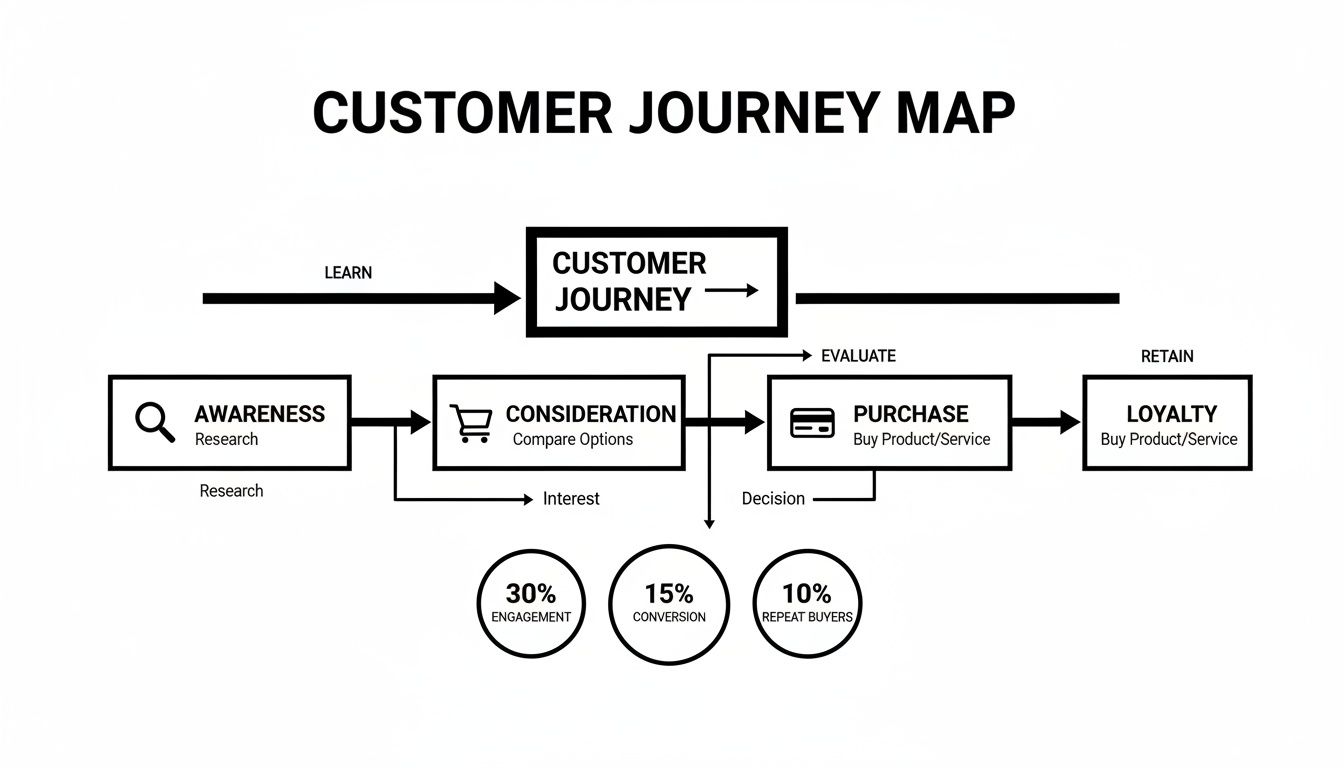
This type of visualisation makes it unequivocally clear that stages like Awareness, Consideration, and Purchase are not discrete events but interconnected components of a single, continuous experience.
The core of this exercise is the collection and analysis of data from all available sources to understand what customers are doing and, critically, why. Both quantitative and qualitative insights are required.
- Quantitative Data: This is empirical evidence from CRM systems, web analytics, and sales reports. It reveals what customers are doing—pages visited, session duration, and points of abandonment in the conversion funnel.
- Qualitative Data: This provides the narrative behind the numbers. It is sourced from customer surveys, support call transcripts, and direct interviews, explaining why certain actions are taken and revealing their frustrations, goals, and emotional state.
A customer journey map built on robust, multi-source data transforms ambiguity into clarity. It exposes the precise moments where the customer experience breaks down and, more importantly, where targeted AI solutions can deliver the greatest operational and commercial impact.
Want to Accelerate Your Innovation?
Our team of experts can help you turn ideas into production-ready solutions.
Synthesising this information is analogous to modelling business processes. You are constructing a dynamic model of customer interaction that will guide your strategy. For a practical example of this structure, consider a modern customer journey mapping template. The final map should clearly categorise each touchpoint by journey stage, channel (e.g., website, app, physical store), and internal ownership. This organised visual becomes the definitive guide for targeted improvements.
The following provides a practical overview of common touchpoints German consumers might encounter.
Key Touchpoints Across the German Customer Journey
This table delineates typical digital and physical interactions at each stage of the customer journey, with a specific focus on the German market.
| Journey Stage | Digital Touchpoints | Physical Touchpoints |
|---|---|---|
| Awareness | Social media advertising (e.g., on Xing, Instagram), influencer content, online articles, search engine results (SEO), digital PR. | Trade fairs (Messen), print advertisements in trade magazines, word-of-mouth recommendations, billboards. |
| Consideration | Product comparison websites (e.g., Idealo), detailed product pages, webinars, customer reviews, case studies, chatbot interactions. | Visiting a retail store, consulting with a sales representative, product demonstrations, requesting brochures or samples. |
| Purchase | Online checkout process, mobile app purchase, clicking a "buy now" link in an email, subscription sign-up. | In-store purchase at the point of sale, signing a contract in person, placing a telephone order. |
| Service & Loyalty | Post-purchase follow-up emails, customer support portal, loyalty programme app, customer feedback surveys, community forums. | In-store returns or service desk, customer service phone calls, loyalty cards, attending exclusive customer events. |
As illustrated, the journey is a hybrid of online and offline experiences. Mapping these ensures the transition between them is seamless, preventing any experiential disconnect as the customer moves from a digital advertisement to a physical store.
Using AI to Enhance the Customer Experience
Once a clear map of your customer journey and touchpoints is established, the strategic work begins. Your map now functions as a high-value asset, pinpointing moments of customer friction and opportunities for differentiation. Artificial intelligence is the enabling technology to capitalise on these insights, transforming standard interactions into intelligent, responsive experiences that generate measurable business value.
Looking for AI Expertise?
Get in touch to explore how AI can transform your business.
This is not about adopting technology for its own sake. It is about the surgical application of specific AI capabilities to solve pre-identified business problems. The objective is clear: deliver tangible improvements to the P&L by enhancing the effectiveness and efficiency of the customer experience.
High-Impact AI Applications for Key Touchpoints
Deploying AI across the customer journey should be a calculated, risk-managed initiative, focused squarely on high-impact applications. For German enterprises, this means leveraging proven technologies that address common challenges in service, sales, and customer retention. Each application must be directly linked to a superior outcome at a specific touchpoint.
Here are three core areas where AI delivers significant impact:
- Conversational AI for Service Automation: Natural Language Processing (NLP) underpins today’s sophisticated chatbots and voice assistants. Deployed at key service touchpoints, these systems can resolve a high volume of routine inquiries 24/7 with remarkable accuracy. This liberates human agents to manage complex, high-value interactions, thereby increasing both operational efficiency and customer satisfaction.
- Predictive Analytics for Proactive Engagement: AI excels at identifying patterns in vast datasets that are invisible to human analysis. By processing CRM data, purchase history, and behavioural signals, predictive models can identify customers at risk of churn. This enables proactive intervention with targeted offers or support before the customer disengages.
- Computer Vision for In-Store Optimisation: For businesses with a physical footprint, computer vision is a transformative technology. It can analyse foot traffic patterns, detect long queues before they become problematic, and monitor shelf-stock levels. This data provides concrete insights to optimise store layouts and staffing, directly improving the physical customer experience and reducing operational inefficiencies.
The strategic use of AI moves the customer experience from a series of passive, reactive moments to a dynamic, predictive, and personal conversation. It gives you the power to anticipate needs instead of just reacting to problems.
To maximise the value of these technologies, it is crucial to understand how an AI Customer Journey Map can help visualise where and how these enhancements integrate into the existing framework.
Turning Data into Personalised Experiences
Beyond automation and prediction, AI’s most potent capability is delivering personalised experiences at scale. Your journey map identifies precisely where customers seek relevant information or tailored advice. AI can provide it at that exact moment.
Consider an e-commerce platform. AI can analyse a visitor's browsing behaviour in real-time. Instead of presenting generic recommendations, it can surface products that align precisely with that individual’s immediate interests and past purchasing patterns. A standard transaction is thus elevated to a curated shopping experience. You can explore how to personalise customer interactions with these intelligent systems in our dedicated guide.
Ultimately, by integrating AI into critical touchpoints, your journey map evolves from a static blueprint into a dynamic engine for continuous improvement and innovation, delivering a sustainable competitive advantage.
How to Prioritise Touchpoints for Maximum Impact
After mapping the complete customer journey, you will inevitably identify more areas for improvement than can be addressed with available resources. This presents a critical strategic question: where do you begin?
Attempting to improve every touchpoint simultaneously is a common error. It dilutes resources and ensures no single initiative receives the necessary focus to succeed. The strategic challenge is not identifying what to improve, but deciding which improvements will generate the greatest return on investment.
Ready to Build Your AI Project?
Let's discuss how we can help you ship your AI project in weeks instead of months.
Effective prioritisation must transcend subjective opinion and internal politics. To make tangible progress, especially when integrating AI, a clear, data-driven methodology is required to pinpoint the touchpoints that are most critical to both your customers and your financial outcomes.
A Framework for Strategic Prioritisation
The most effective method for this is a two-by-two matrix. One axis plots the Impact on Customer Value, while the other plots the Feasibility of AI Implementation. This provides an immediate visual guide for strategic resource allocation.
- High-Impact, High-Feasibility (Top Right): These are priority initiatives. They represent low-hanging fruit with significant returns. Example: deploying an AI chatbot to provide instant answers to common service inquiries, resolving a major customer pain point with mature, readily available technology.
- High-Impact, Low-Feasibility (Top Left): These are strategic, long-term investments. The potential payoff is substantial, but realisation requires significant effort or technological development. Example: building a predictive model to identify customers at risk of churn.
- Low-Impact, High-Feasibility (Bottom Right): These are quick wins. While not transformative, they are simple to implement and deliver incremental improvements. Example: using AI to personalise email subject lines.
- Low-Impact, Low-Feasibility (Bottom Left): These initiatives should be deferred. Resources are better allocated elsewhere.
To accurately position touchpoints on this matrix, empirical data is essential. Analyse metrics such as Customer Effort Score (CES) or Net Promoter Score (NPS) collected at various stages of the customer journey and touchpoints. A significant drop in NPS post-purchase is a clear indicator of a high-impact area requiring immediate attention.
A prioritisation framework turns your journey map from a simple diagnostic tool into a strategic roadmap. It gives leadership a defensible, evidence-based way to decide where to invest, ensuring every project is tied to a measurable business outcome.
Consider German consumers, whose preferences indicate a balanced omnichannel journey. 72% expect to maintain their current mix of online and in-store shopping, while another 13% plan to increase their online activity. This data underscores the importance of prioritising both digital and physical touchpoints, particularly for manufacturers and e-commerce companies.
Want to Accelerate Your Innovation?
Our team of experts can help you turn ideas into production-ready solutions.
This disciplined approach ensures your AI strategy is more than a conceptual document; it becomes a practical plan for creating tangible value. For a more structured methodology, our guide on building an AI prioritisation framework details the subsequent steps.
An Actionable Checklist for AI Implementation
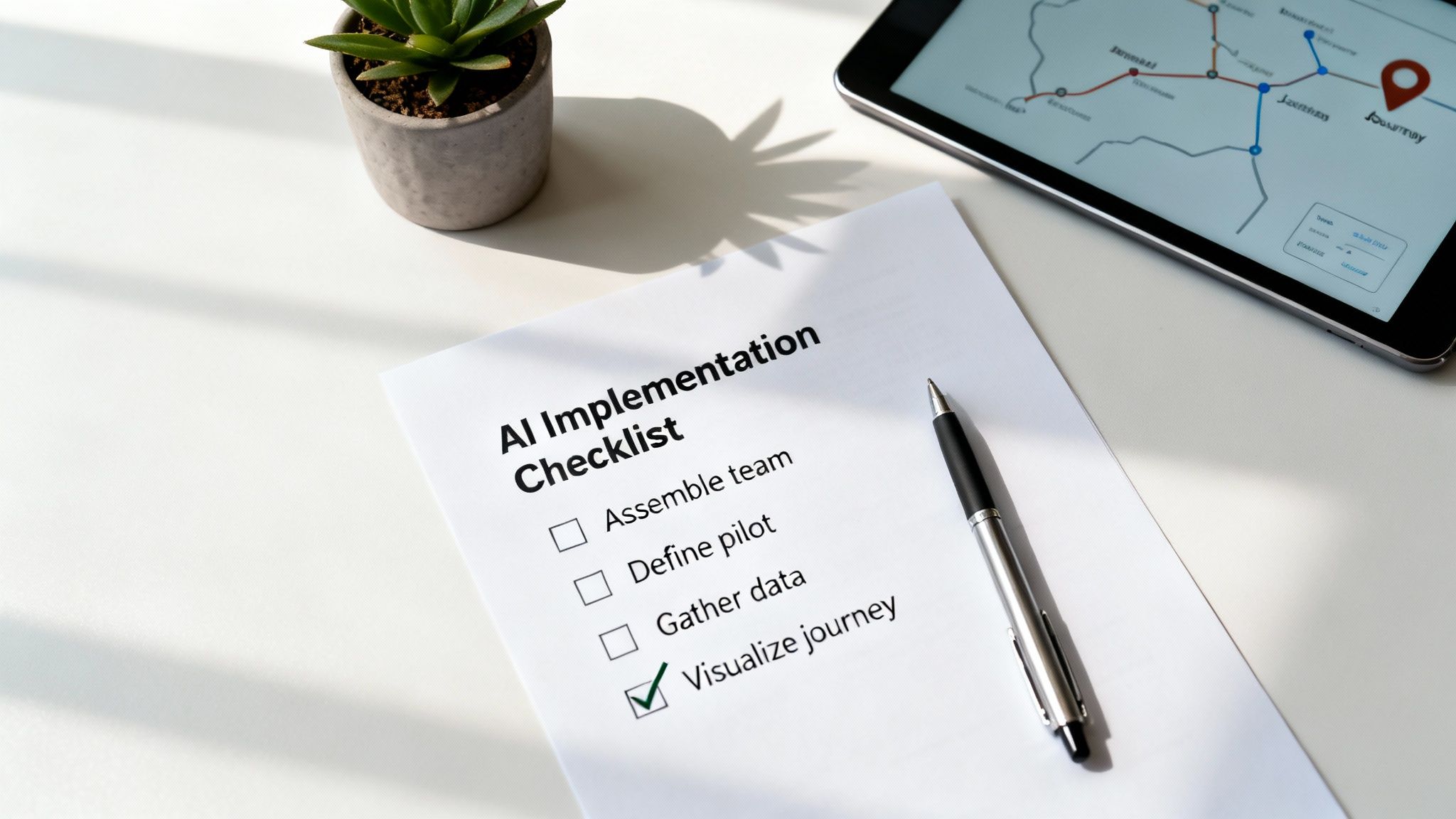
Understanding the strategic imperative for AI is one thing; executing its implementation without disrupting core operations is another. This straightforward, seven-step execution plan is designed to guide your organisation’s initial project for enhancing the customer journey with AI.
The objective is to de-risk the process by focusing on a single, high-value pilot project. This enables the team to build momentum and prove the business case before considering a full-scale deployment.
A Phased Approach to Your First Pilot Project
This is not a theoretical exercise but a sequential, step-by-step process. It ensures your initial AI initiative is founded on solid data, addresses a genuine customer problem, and delivers measurable results swiftly. Each step builds upon the last, providing a clear path from concept to a functional innovation.
Looking for AI Expertise?
Get in touch to explore how AI can transform your business.
Execute the following steps to initiate the project:
Assemble the Core Team: Convene a dedicated, cross-functional team. Representation from marketing, sales, customer service, and IT is mandatory from day one to ensure a holistic view of the customer experience.
Define the Scope: Do not attempt to address the entire journey at once. Select one specific, high-value customer journey for the initial focus. Prime candidates include new client onboarding or the post-purchase support process. Map this journey exclusively.
Aggregate Intelligence: Collect both quantitative metrics (e.g., website abandonment rates, support ticket volumes) and qualitative feedback (e.g., customer interviews, survey responses) specific to the selected pilot journey.
Visualise the Journey and Identify Pain Points: Create a detailed map of the pilot customer journey and touchpoints. This visual artifact is not merely illustrative; it is essential for pinpointing the exact moments of friction and opportunity.
Ready to Build Your AI Project?
Let's discuss how we can help you ship your AI project in weeks instead of months.
A journey map built on evidence is not a marketing asset; it is a strategic diagnostic tool. It moves the conversation from departmental opinion to a shared, objective understanding of the customer's reality.
Hypothesise AI-Driven Solutions: With a clear understanding of the problem areas, brainstorm specific, practical AI solutions. For example, if slow service response times are identified as a key issue, a conversational AI bot is a logical hypothesis.
Develop a Minimum Viable Product (MVP): Deploy an MVP for a single, high-impact touchpoint. The goal is to test the hypothesis and demonstrate viability within weeks, not months.
Measure, Learn, and Scale: Rigorously measure the MVP's impact against predefined KPIs. Utilise the learnings to refine the solution and develop a data-backed plan for scaling it to other relevant touchpoints.
Frequently Asked Questions
To conclude, let us address several common questions that arise as leadership begins to implement these concepts. The following are direct answers to practical challenges in optimising your customer journey and touchpoints.
How Do We Start If Our Data Is in Silos?
This is the most prevalent obstacle. The initial step is not a massive IT infrastructure project but a focused pilot.
Select a single, critical journey, such as new client onboarding. Manually extract the necessary data from marketing, sales, and service for this specific process. This small-scale effort demonstrates the value of a unified view and builds a compelling business case for investing in superior data infrastructure, such as a Customer Data Platform (CDP).
What Is a Realistic Timeframe for Seeing ROI?
This is not a multi-year initiative with a distant payoff. For a well-defined pilot project, tangible results should be evident within a single business quarter. This could manifest as a measurable improvement in a key metric, such as a 15% reduction in support ticket resolution times or a 10% increase in conversions at a critical touchpoint.
The objective is to secure a quick win to prove the concept, learn from the process, and use the evidence to justify a broader, more ambitious rollout.
How Does This Affect Our Existing Teams?
Adopting a customer journey perspective is a powerful catalyst for breaking down internal silos. It aligns disparate departments around a single, shared objective: the customer's success. AI tools function as powerful augments, not replacements. They automate repetitive, low-value tasks, freeing expert personnel to focus on complex, high-value interactions where human expertise is indispensable.
Want to Accelerate Your Innovation?
Our team of experts can help you turn ideas into production-ready solutions.
At Reruption GmbH, we are your Co-Preneurs for the AI Era. We move beyond strategy, helping you transform journey maps into innovations that directly impact your P&L. We de-risk implementation and deliver production-ready AI solutions that provide a decisive competitive advantage. Begin building your AI-powered future with us at https://www.reruption.com.