
At its core, Sales & Operations Planning (S&OP) is the pivotal management process that ensures commercial objectives are met through operational execution. It is the engine that drives profitable growth, particularly within Germany’s competitive industrial sector, by synchronizing sales goals with supply chain capabilities.
Aligning Sales Ambitions With Operational Reality

For senior leadership in medium to large enterprises, this principle is foundational. The strategic purpose of S&OP is to establish a viable equilibrium between Demand Planning vs Supply Planning, preventing ambitious sales targets from colliding with operational constraints. It functions as the connective framework between high-level strategy and daily operational execution.
However, conventional S&OP frameworks are demonstrating their limitations. Legacy models, constrained by monthly cycles, static spreadsheets, and siloed data, frequently generate costly imbalances. This friction materializes as excess inventory, which ties up working capital, or as stockouts, which erode customer trust and result in lost revenue.
The Deficiencies of a Reactive Model
Operating in today's volatile markets with a reactive planning model is analogous to navigating the Autobahn with a map updated only monthly. By the time information is processed, market conditions have fundamentally shifted. This latency between observation, analysis, and decision-making creates a significant competitive disadvantage.
Ready to Build Your AI Project?
Let's discuss how we can help you ship your AI project in weeks instead of months.
The consequences of this reactive posture impact the entire organization:
- Sales teams cannot confidently commit to large orders due to a lack of real-time visibility into product availability.
- Operations departments are forced into a constant state of reaction, contending with demand volatility that leads to inefficient production schedules and escalating overtime costs.
- Finance leaders must work with unreliable forecasts, rendering accurate P&L projections and effective working capital management exceedingly difficult.
This disconnect is not merely an operational inconvenience; it is a direct impediment to profitable growth. For German industrial leaders, the imperative is clear: transition from this outdated, reactive model to a proactive, integrated, and data-driven planning process.
This guide serves as a roadmap for leading that AI-driven transformation. We will analyze the common pain points of legacy S&OP and demonstrate precisely how integrating Artificial Intelligence builds a more resilient, agile, and forward-looking operational backbone. For a more detailed analysis of forecasting, consult our guide on how to improve sales forecasting with AI. This is not an incremental upgrade—it is a necessary evolution to secure a sustainable competitive advantage.
Finding The Cracks In The Classic S&OP Model
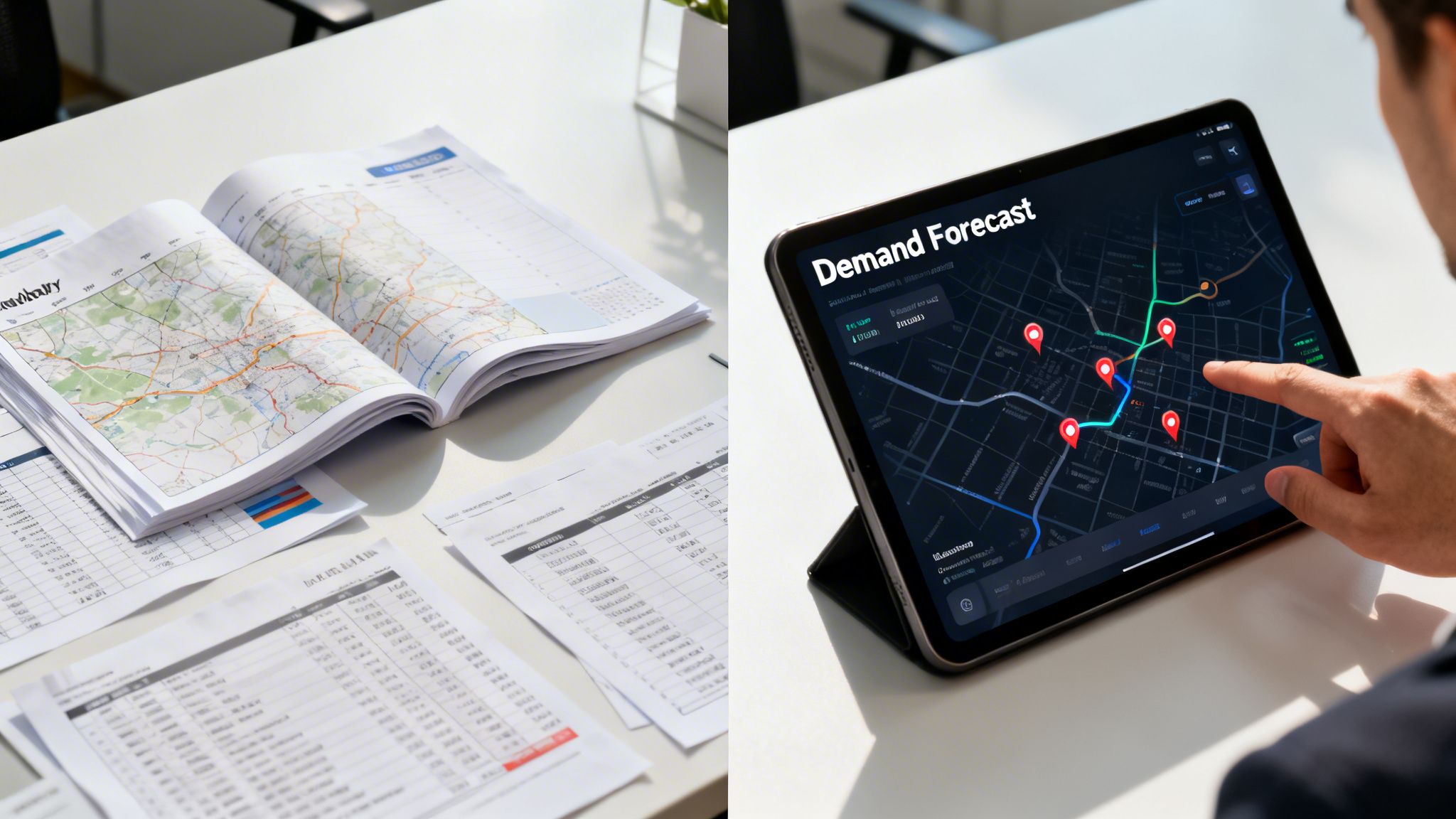
To fully appreciate why an AI-first approach is transformative, it is essential to examine the architecture of the classic S&OP framework. For decades, this model was the standard for aligning commercial ambitions with operational reality in large enterprises. It established a predictable, cyclical rhythm for cross-functional teams to develop a single, unified business plan.
Want to Accelerate Your Innovation?
Our team of experts can help you turn ideas into production-ready solutions.
At its heart, the conventional process is a five-step monthly cycle. It is a structured sequence designed to convert raw data into executive-level decisions, ensuring organizational alignment.
The Five Steps Everyone Knows
The traditional S&OP process unfolds in a logical sequence, with each stage building upon the previous one. It is a monthly cadence that involves stakeholders from across the business.
- Data Gathering: The cycle commences with the extraction of historical sales figures, current inventory levels, and production data from disparate systems.
- Demand Planning: Sales and marketing teams utilize this data to generate an unconstrained forecast—their best estimate of potential sales.
- Supply Planning: Operations and supply chain teams then assess this forecast against operational reality. They evaluate manufacturing capacity, warehouse inventory, and supplier lead times to determine feasibility.
- Pre-S&OP Review: Mid-level managers from sales, marketing, finance, and operations convene to reconcile discrepancies between demand projections and supply capabilities. They resolve conflicts and prepare recommendations for senior leadership.
- Executive Meeting: Finally, senior leaders review the balanced plan, make final decisions on unresolved issues, and provide executive approval.
The challenge is that this classic model is ill-equipped for the complexities of modern business. Its heavy reliance on historical data and a rigid monthly schedule represents a significant vulnerability in a rapidly changing world.
The traditional S&OP framework is like navigating with a paper map that is updated once a month. In today’s dynamic German market, a GPS is required—a system that provides real-time, predictive guidance.
Where It Really Starts To Hurt
The breaking points in this legacy framework are becoming increasingly apparent to executives. They manifest as inefficient operations and misaligned strategic plans, both of which directly impact the bottom line. These are not minor issues; they are major obstacles to growth.
Looking for AI Expertise?
Get in touch to explore how AI can transform your business.
Let us examine how the traditional process, theoretically sound, often breaks down in practice.
Traditional S&OP Process vs Modern Pain Points
| S&OP Step | Intended Objective | Common Pain Points |
|---|---|---|
| Data Gathering | Collect a single source of truth for planning. | Data is extracted from siloed, often incompatible systems (ERP, CRM), creating a fragmented and delayed snapshot. |
| Demand Planning | Create an accurate, unconstrained sales forecast. | Relies on historical data and heuristics, leading to significant inaccuracies when market conditions shift abruptly. |
| Supply Planning | Create a realistic plan based on operational capacity. | Without real-time visibility, planners cannot react to supply chain disruptions until it is too late. |
| Pre-S&OP Review | Align departments and resolve conflicts early. | Becomes a forum for departmental disputes, with decisions based on outdated information from previous weeks. |
| Executive Meeting | Make strategic decisions and authorise the plan. | Leaders are forced to approve a plan based on a historical view, not the dynamic reality of the present. |
As illustrated, the gap between theory and practice is where value is lost. The most critical issues stem from a few core problems:
- Stale Data: A monthly data pull means that by the time a decision is made, the underlying information is already weeks old. This is akin to driving forward while looking in the rearview mirror, making it impossible to anticipate market shifts.
- Inaccurate Forecasts: Legacy forecasting methods cannot account for modern complexities. The resulting errors are costly—either through excess inventory tying up capital or stockouts that lead to lost sales and diminished customer loyalty.
- Operational and Financial Disconnect: A significant gap often exists between the operational plan developed in S&OP and the financial targets set by the finance department, making it nearly impossible to align budgets with operational realities.
These deficiencies point to a system that is fundamentally reactive and unable to manage the volume and velocity of modern data. To gain a competitive edge, organizations must identify process bottlenecks, sometimes using tools like Celonis process mining. A technological step-change is no longer optional.
Integrating AI Into Your Sales & Operations Planning
Artificial Intelligence transforms Sales & Operations planning from a backward-looking reporting exercise into a forward-looking strategic capability. While "AI" can be an ambiguous term for many leaders, its practical application here is straightforward: leveraging intelligent algorithms to discern patterns in vast datasets that are beyond human capacity, thereby converting complexity into clear, actionable insights.
Consider traditional forecasting. It relies almost exclusively on historical sales data. An AI-powered system, in contrast, simultaneously analyzes market trends, competitor pricing, macroeconomic indicators, logistical constraints, and even granular variables like local weather patterns. This multi-dimensional analysis enables machine learning models to generate demand forecasts with a level of accuracy unattainable by legacy methods. The result is a plan based on probable futures, not a mere extrapolation of the past.
Practical AI Applications Beyond Forecasting
Accurate forecasting is a significant achievement, but it is merely the starting point. The true strategic value is unlocked when AI is embedded across the entire sales & operations cycle. It equips teams with the tools to anticipate and mitigate problems rather than merely react to them.
Consider these concrete applications:
- Dynamic Inventory Optimisation: Static safety stock rules become obsolete. AI models can recommend optimal stock levels for each SKU at every location, continuously balancing holding costs against the risk of stockouts. This creates an adaptive system that adjusts in real-time to shifting demand signals.
- Supply Chain Risk Simulation: Instead of speculating on the impact of a key supplier disruption, it can be modeled. AI enables the simulation of P&L impacts from various disruptions—from production stoppages to sudden freight cost increases—facilitating the development of robust contingency plans.
- Automated Scenario Planning: The leadership team can pose complex "what-if" questions and receive data-driven answers in minutes, not weeks. An AI copilot can model the end-to-end impact of a new product launch in a specific region, from production capacity requirements to its effect on the bottom line.
Envision this scenario: your S&OP team enters the executive meeting. A key supplier is exhibiting signs of instability. Before the question is even raised, an AI copilot has already modeled the financial impact, identified three viable alternative suppliers, recalculated production schedules, and presented optimized response plans. This is the tangible power of production-ready AI.
Turning Potential Into Operational Advantage
This is not a futuristic concept; it is being realized today with production-ready AI systems. These are not academic exercises but robust, integrated solutions that generate measurable value—from Large Language Model (LLM) dashboards that allow executives to query data in natural language, to the sophisticated data pipelines that ensure system reliability.
These tools convert abstract potential into a concrete operational advantage. In the dynamic German retail environment, where e-commerce is projected to reach €116 billion, market resilience is key. Recent figures show a surprisingly robust market, with total retail volume growing 3.72% year-over-year in Q1 2025. Leading manufacturers like Bosch and STIHL leverage AI to de-risk their operations and meet such fluctuating demand. More data on the German online market in 2025 on marketplace-universe.com is available for review.
Ready to Build Your AI Project?
Let's discuss how we can help you ship your AI project in weeks instead of months.
By integrating these capabilities, the entire S&OP function becomes more intelligent and agile. It evolves from a static monthly review into a continuous, adaptive process that drives a genuine competitive advantage. For a detailed exploration of these applications, see our guide on AI use cases in sales. This is how an organization equips itself to not only survive market volatility but to capitalize on it.
Architecting A Modern Data-Driven S&OP Ecosystem
Achieving results with AI is not about procuring another software license; it is about architecting a robust and secure data foundation. Transitioning to an AI-enhanced sales & operations process requires a fundamental re-evaluation of how an organization manages information. The ultimate objective is to create a single source of truth that enables both personnel and algorithms to make superior, faster decisions.
This journey begins by dismantling the data silos that impede so many organizations. A modern S&OP ecosystem is built upon a centralized data platform—such as a data lakehouse—that unifies information from all relevant sources. This includes data from ERP and CRM systems, external market intelligence, and real-time IoT sensor data from the factory floor.
The diagram below provides a high-level overview of this architecture, illustrating the flow from raw data to business impact.
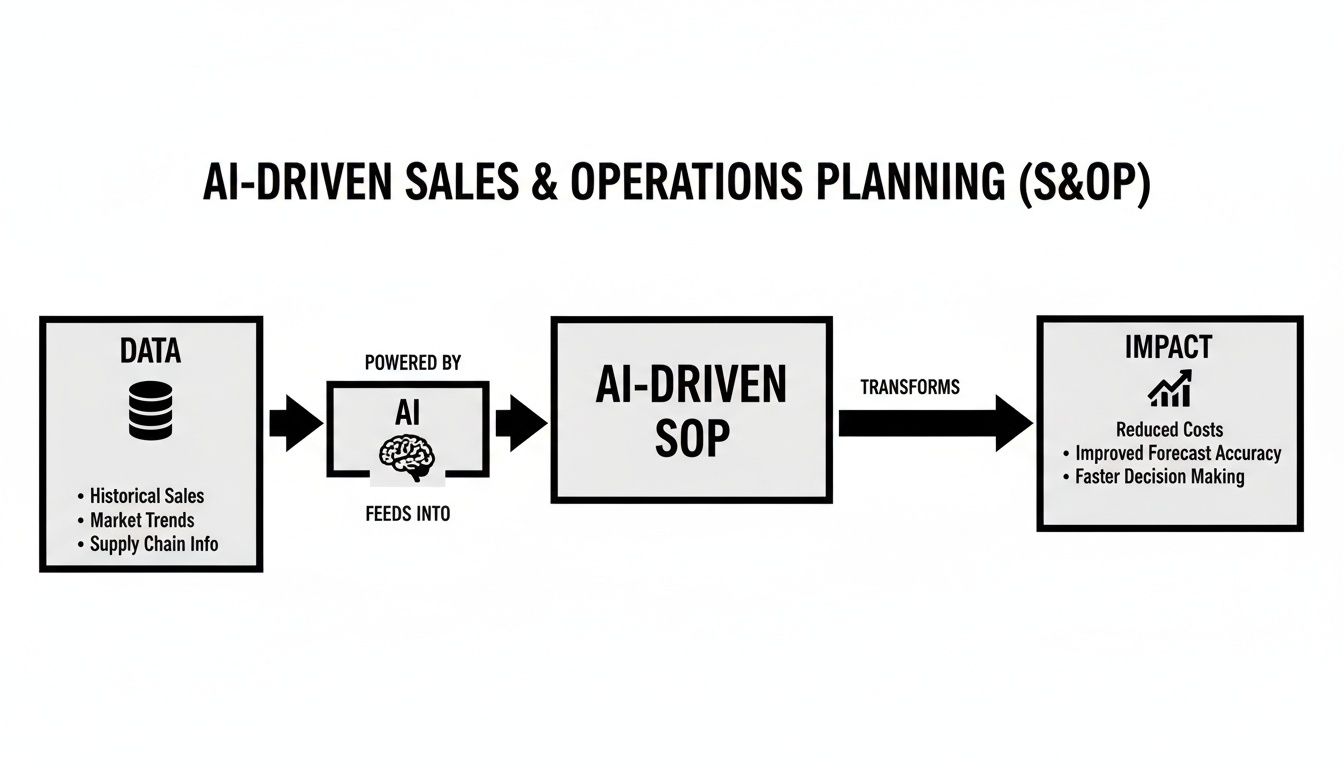
This illustrates a critical principle: high-quality, centralized data is the fuel for any successful AI initiative. A sound data architecture directly translates into measurable improvements in operational efficiency and strategic planning.
Building The Foundational Data Layer
Simply aggregating data is insufficient. It must be meticulously prepared to be useful for advanced analytics. This is where the critical discipline of data engineering is applied.
- Data Ingestion: This involves establishing automated pipelines that continuously pull data from disparate sources into the central platform, often in near-real time.
- Data Cleansing and Transformation: Raw data is then cleansed to correct inconsistencies and errors and standardized into a common format. Subsequently, it is transformed into a structured model optimized for analysis.
- Data Enrichment: To provide the AI models with necessary context, internal data is often enriched with external information, such as supplier lead times, weather forecasts, or macroeconomic indicators.
This foundational work is indispensable. It ensures that the data feeding the AI systems is accurate, timely, and comprehensive. Without this discipline, any AI-driven insights would be unreliable, rendering the entire initiative ineffective.
A well-architected data strategy is the engine for velocity. It provides the momentum to move methodically from a business concept to a validated prototype, significantly de-risking the entire innovation process.
Ensuring Governance And Security By Design
For any German enterprise, data governance and security are non-negotiable requirements. A modern data architecture for S&OP must be designed from its inception to meet stringent regulatory and industry standards. This is particularly crucial for companies in sectors like automotive, which are subject to rigorous information security audits such as TISAX.
Want to Accelerate Your Innovation?
Our team of experts can help you turn ideas into production-ready solutions.
In practice, this entails:
- Robust Access Controls: Implementing role-based access controls ensures that individuals can only view or modify data essential to their function.
- Data Lineage and Auditing: A complete and transparent record of data origin, transformations, and access is maintained. Full traceability is paramount.
- Compliance Frameworks: The entire architecture must be built for compliance with standards like ISO/IEC 27001 and GDPR by design, not as an afterthought.
An effective way to strengthen this ecosystem is by leveraging simulation and IoT to mitigate risk as system complexity increases. By embedding security and governance into the core architecture, a trusted environment is created, enabling the organization to unlock the full potential of its commercial and operational data. For a deeper dive into building such robust systems, refer to our articles on modern IT system engineering. This secure-by-design approach is the only way to transform S&OP data into a true strategic asset.
Your Phased Roadmap To An AI-Enhanced S&OP
The transition to an AI-driven S&OP process is not a single project but a phased journey. For any leader in a large organization, a phased approach is essential to manage complexity, demonstrate early value, and secure organizational buy-in. This roadmap outlines a practical sequence that de-risks the transformation and positions the organization for sustained success.
This is a strategic progression, starting with a controlled pilot and scaling to a fully integrated, enterprise-wide capability. Each phase validates the value of the previous one, transforming initial concepts into scaled solutions with a demonstrable P&L impact.
Phase 1: Establish The Foundation And Launch A Pilot
The journey begins with data, not algorithms. The initial, critical step is to establish a solid data foundation. This involves identifying and integrating key data sources—from ERP and CRM systems to external market signals—that will power the AI models. This foundational data engineering work is non-negotiable for generating trustworthy insights.
Looking for AI Expertise?
Get in touch to explore how AI can transform your business.
Concurrently, a pilot project with a high probability of impact must be selected. Rather than attempting a complete overhaul, focus on a specific, well-defined pain point. A classic starting point is improving the demand forecast for a single, high-volume product line, where even a marginal increase in accuracy can yield a significant financial return.
The objective for Phase 1 is clear: achieve a quick, tangible win. This early success serves as powerful validation for the rest of the organization, demonstrating that AI is a practical tool for solving real business problems.
This initial victory builds credibility and secures the executive sponsorship required for the more ambitious phases that follow.
Phase 2: Develop And Validate The Prototype
With a successful pilot, the next step is to develop a robust prototype. A dedicated team refines the AI solution, advancing it from a proof of concept to a minimum viable product (MVP). This stage involves rigorous testing, model validation, and iterative feedback from key stakeholders in sales, operations, and finance.
The prototype serves as more than a technical demonstration; it is a critical alignment tool. It allows managers and executives to interact with the solution, understand its capabilities, and visualize its integration into their daily workflows.
Ready to Build Your AI Project?
Let's discuss how we can help you ship your AI project in weeks instead of months.
At this point, the business case becomes concrete, supported by tangible evidence rather than projections. For insights into executing such a rapid development cycle, review Reruption's guide on the 21-Day AI Delivery Framework. Securing executive approval here is essential for unlocking the resources needed for full-scale implementation.
Phase 3: Scale The Solution And Enable The Organisation
With a validated prototype, the final phase focuses on scaling the solution across the broader organization. This involves a carefully managed rollout, extending the AI capabilities to other product lines, business units, or geographical regions. The technical focus shifts to ensuring the architecture is robust, secure, and capable of handling enterprise-level data volumes and user traffic.
However, technology is only half the equation. Successful adoption is paramount. This phase must include a comprehensive enablement and training program.
- Targeted Training Workshops: Equip teams with the hands-on skills to utilize the new AI tools and interpret their outputs effectively.
- Workflow Integration: Embed the AI-driven insights directly into core S&OP meetings and decision-making processes.
- Change Management: Communicate the benefits clearly and consistently, fostering a culture where data-driven recommendations are trusted and acted upon.
This focus on people is the determining factor for success. In a dynamic market like Germany, where e-commerce is projected to reach €92.4 billion in 2025, synchronizing sales and operations is the only way to capture this growth. This figure signals a strong recovery for digital retail, a sector where an optimized supply chain provides a significant competitive advantage. Further insights on the German e-commerce recovery on ecommercegermany.com are available.
By following this phased roadmap, an organization can methodically build an AI-enhanced S&OP capability that not only improves efficiency but also becomes a core driver of long-term growth.
Ditching the Old Playbook: A Partnership Model for S&OP Transformation
The traditional consulting model is often inadequate for a complex endeavor like modernizing S&OP. Typically, it delivers a comprehensive strategy document and a significant invoice, after which the consultants depart, leaving the internal team to manage implementation. This approach is ill-suited for transformations where the stakes are high and execution is paramount.
A more effective alternative exists: a genuine partnership that extends beyond advisory services. We call this our 'Co-Preneur' model, based on a simple principle: we are fully invested in your success. Our success is directly tied to your tangible, P&L-level results. This model fundamentally alters the engagement dynamic, ensuring all parties are focused on the business outcome, not merely on project deliverables.
An Entrepreneurial Drive, Backed by Methodical De-Risking
This partnership model is effective because we bring an entrepreneurial mindset to your challenges—we treat them as our own. However, this is not about taking reckless risks. We balance this drive with a disciplined process for de-risking every stage of the initiative. In contrast to large-scale, multi-year projects with delayed value realization, our focus is on rapid business idea validation through prototypes.
This is how leading German companies accelerate the journey from concept to scalable solution. We identify a high-impact S&OP problem, build a working prototype to test a potential solution, and use real-world data to validate its efficacy—often within weeks, not years.
This methodical validation provides C-level leaders with the confidence required to invest in scaling. It replaces speculation with empirical evidence, ensuring that significant resources are allocated only to initiatives with a proven business case.
Want to Accelerate Your Innovation?
Our team of experts can help you turn ideas into production-ready solutions.
This velocity is critical in the German market. Consider e-commerce, where online marketplaces are projected to drive growth in 2025, with revenues increasing by 4.7% to €44 billion. This trend compels leaders to fundamentally re-engineer their sales & operations to integrate with these new platforms. A fast, accountable partnership is the only viable way to adapt in time. More information on this trend can be found in this analysis of German e-commerce strategies on magnalister.com.
Delivering Real Outcomes, Not Just Reports
Ultimately, the measure of success is quantifiable results. This model is not about a vendor relationship; it is about a true partnership aligned on a shared mission: creating sustainable commercial success.
For any leader tasked with driving organizational change, this model offers a faster, safer, and more effective path to modernizing S&OP from within. It is about building internal capabilities while delivering real-world solutions that provide a lasting competitive advantage.
Frequently Asked Questions
When considering the integration of AI into sales & operations planning, several key questions consistently arise. Here are direct answers for German business leaders contemplating this strategic move.
How Can We Start Using AI In S&OP Without A Massive Upfront Investment?
The most prudent approach is to start small and be highly targeted. Avoid a large-scale, "big bang" overhaul. Instead, select a single, specific pain point—such as poor forecast accuracy for a key product line—where a measurable improvement can deliver significant value.
Looking for AI Expertise?
Get in touch to explore how AI can transform your business.
Engage a partner capable of co-developing a rapid prototype. This allows you to test the hypothesis and validate the business case with minimal risk. The objective is to demonstrate value quickly, which facilitates broader leadership buy-in and maintains focus on tangible outcomes from the outset.
The biggest change here is a cultural one. You're shifting from a culture that’s always looking in the rearview mirror to one that’s looking ahead. Traditional S&OP asks, 'What happened?'. An AI-powered S&OP asks, 'What’s likely to happen, and what’s our best move?'.
Our Company Data Is All Over The Place. How Can AI Even Work With That?
This is the most common—and most critical—challenge. It must be addressed directly. Any successful AI initiative must begin with robust data engineering.
This is the foundational layer. First, establish reliable data pipelines to consolidate information from disparate systems (ERP, CRM, etc.) into a central repository. Next, the data must be cleansed, standardized, and structured to create a trustworthy asset. This preparatory work is not optional; it is what transforms fragmented, siloed data into the high-quality fuel required for reliable machine learning models.
What's The Single Biggest Mindset Shift We Need To Make This Work?
The fundamental shift is toward trust and empowerment. Your teams must learn to trust the data-driven recommendations and become comfortable using AI tools to simulate various "what-if" scenarios.
Ready to Build Your AI Project?
Let's discuss how we can help you ship your AI project in weeks instead of months.
This represents a significant cultural change. It elevates the planning process from a rigid, monthly review to a continuous, intelligent dialogue across the organization. Successfully navigating this cultural evolution is the ultimate key to unlocking the full strategic value of your sales and operations.
At Reruption, we are not conventional consultants; we are your Co-Preneurs. We share accountability for the P&L impact of your S&OP transformation. We accelerate your journey from initial concept to a validated, production-ready solution. Learn more about our approach at https://www.reruption.com.