Handel im Wandel is no longer a forecast—it is the new operational reality for German enterprises. For senior leadership, legacy playbooks for growth and stability are now obsolete. The only viable path forward is a fundamental strategic pivot towards proactive, technology-driven adaptation. This is not a transient trend; it is a permanent state of heightened market volatility and intensified competition.
The New Strategic Context of German Commerce

For decades, German enterprises operated within a framework of relative predictability. Stable supply chains, consistent consumer behavior, and well-defined market boundaries provided a reliable foundation for strategic planning.
That era is definitively over.
Today, executives face a convergence of pressures that legacy operating models were not architected to withstand. This persistent state of flux is what we define as Handel im Wandel. The challenge is no longer to weather a temporary storm; it is to re-architect the enterprise to navigate permanently turbulent waters. A strategy of waiting for a "return to normal" is a strategy for failure.
Key Forces Driving the Transformation
The pressures on German commerce are multi-faceted and concurrent. To provide executives with a clear strategic overview, we have synthesized the primary macroeconomic and technological drivers reshaping the market.
| Driving Force | Strategic Implication for the Enterprise | Required Organizational Response |
|---|---|---|
| Digitalization & Platformization | Marketplaces (Amazon, Zalando) and social commerce redefine customer access. Direct-to-consumer (D2C) relationships become paramount. | Develop a robust omnichannel presence, invest in D2C capabilities, and master platform ecosystems. |
| Shifting Consumer Behavior | Buyers demand hyper-personalization, seamless experiences, and sustainable options. Loyalty is earned at every interaction. | Leverage data analytics to gain deep insights into customer journeys. Transition from mass-market to "segment-of-one" engagement. |
| Supply Chain Disruption | "Just-in-time" has yielded to "just-in-case." Geopolitical shifts and climate events expose systemic vulnerabilities. | Engineer resilient, multi-source supply networks. Implement predictive analytics for demand forecasting and risk mitigation. |
| Regulatory & ESG Pressure | Legislation (Lieferkettengesetz) and market demands for sustainability require unprecedented transparency and compliance. | Integrate ESG metrics into core operations. Utilize technology for automated supply chain compliance tracking and reporting. |
Individually, each of these forces presents a significant challenge. Collectively, they constitute a paradigm shift that necessitates a new organizational mindset and an advanced toolkit.
Confronting Unprecedented Market Volatility
The need for a new strategic approach is empirically evident. In Germany's retail sector, sales have become extraordinarily volatile. While the Federal Statistical Office reports an average monthly growth of a mere 0.06 percent since 1994, the fluctuations are extreme: a 11.20 percent surge in May 2020 was followed by a record -9.70 percent decline in January 2021.
This is not statistical noise; it is systemic chaos. Such unpredictability renders traditional forecasting and inventory management dangerously unreliable, resulting in capital being tied up in excess stock or revenue lost to stockouts. The leadership imperative is clear: the enterprise must evolve from reactive adjustment to predictive control.
The central question for every C-suite is no longer "How do we react to market shifts?" but rather "How do we build an organization that anticipates and shapes them?" This requires embedding intelligence into the core of the business.
Ready to Build Your AI Project?
Let's discuss how we can help you ship your AI project in weeks instead of months.
The Mandate for Proactive Adaptation
The strategic imperative in this new environment is proactive adaptation—the organizational capability to not only react to change but to anticipate it and act decisively. This extends far beyond incremental digitalization or process optimization. It demands a rewiring of the corporate nervous system with intelligent systems capable of sensing, interpreting, and acting upon market signals in real time.
This transformation is non-negotiable, driven by critical pressures:
- Fluctuating Consumer Demand: Customer loyalty is fragile. Purchasing patterns can pivot overnight based on economic sentiment, social trends, or the emergence of a new digital channel.
- Supply Chain Fragility: Global disruptions have exposed the vulnerabilities of lean logistics. The new standard is resilient, transparent, and predictive supply networks.
- Digital-First Competition: Agile, data-native competitors can penetrate markets and capture share with a velocity that traditional enterprises are not structured to match.
To navigate this landscape successfully, a new engine for growth and resilience is required. Artificial Intelligence (AI) is that engine. It provides the capabilities to transform vast data stores from a passive record into a strategic asset for forecasting, automation, and decisive action.
The path forward involves translating strategic intent into market-leading innovations, powered by proprietary internal AI capabilities.
The Four Pillars of Commercial Transformation

To master the persistent state of Handel im Wandel, leadership must move beyond isolated projects toward a structured, integrated framework. This requires focusing strategic capital on four interconnected pillars that form the foundation of a resilient, modern enterprise.
These are not discrete initiatives to be delegated to functional silos. They are interdependent, each amplifying the others. Achieving a defensible competitive advantage requires a coordinated strategy that addresses all four simultaneously, with Artificial Intelligence serving as the enabling capability that integrates them.
1. Radical Digitalization
For years, "digitalization" meant applying new software to legacy processes. That approach has reached its limits. True transformation demands Radical Digitalization—a fundamental redesign of the operational core, from the ground up. This involves migrating from antiquated legacy systems to an AI-native architecture.
This is not about launching another application or e-commerce channel. It is about embedding intelligence into every facet of the business, from automated inventory management that anticipates demand shifts to financial models that run real-time market scenarios. The objective is to build an organization that does not just use digital tools, but thinks and acts digitally by default.
Analogy: One can renovate a historic building or construct a modern skyscraper. While the renovation may be aesthetically pleasing, the skyscraper is built on a foundation engineered for future growth and complexity. Radical Digitalization is the process of laying that new, intelligent foundation for your enterprise.
Want to Accelerate Your Innovation?
Our team of experts can help you turn ideas into production-ready solutions.
This pillar is foundational. Without a modern, data-centric core, any attempts at personalization, supply chain optimization, or compliance will be inefficient, disjointed, and unscalable.
2. Hyper-Personalization at Scale
Modern customers expect recognition and relevance. They demand interactions that are contextual, timely, and tailored to their specific needs. Mass-market communications and generic offers are obsolete. Hyper-Personalization at Scale is the capability to deliver these one-to-one experiences to millions of customers simultaneously—a previously unattainable goal.
Here, AI becomes a powerful commercial engine. By analyzing vast customer datasets, AI identifies patterns and predicts future needs with high precision. This enables a shift from reactive customer service to proactive relationship management.
Consider the practical applications:
- Predictive Offers: An algorithm identifies that a B2B client's machinery is approaching its maintenance interval and automatically generates a customized service and parts proposal before a failure occurs.
- Dynamic Pricing: An e-commerce platform adjusts prices in real-time based on demand, inventory levels, and user-specific data, optimizing both revenue and customer satisfaction.
- Segment-of-One Marketing: Marketing efforts are tailored to each customer's unique journey, delivering the right message through the right channel at the optimal moment.
Mastery of this capability builds profound customer loyalty and creates a competitive moat that slower-moving rivals cannot easily replicate.
3. Supply Chain Reinvention
The fragility of "just-in-time" global supply chains has become a primary boardroom concern. Supply Chain Reinvention is the strategic imperative to transition from lean, brittle networks to resilient, predictive, and transparent systems. The objective has shifted from pure cost efficiency to operational survival and advantage.
AI provides the necessary tools for this reinvention. Predictive analytics can model the impact of geopolitical events, weather disruptions, or supplier failures, enabling proactive re-routing and sourcing before a crisis materializes. Intelligent automation can manage warehouse operations and optimize logistics with a level of precision unattainable by human teams alone.
This reinvention is focused on achieving specific outcomes:
- Resilience: Engineering multi-source, geographically diversified supplier networks to eliminate single points of failure.
- Predictability: Using AI to forecast demand and identify potential supply disruptions with a higher degree of accuracy.
- Transparency: Achieving end-to-end visibility across the supply chain, from raw material sourcing to final delivery.
A reinvented supply chain ceases to be a source of risk and becomes a durable source of competitive advantage.
4. The New Regulatory and ESG Landscape
Compliance and sustainability are no longer peripheral corporate functions; they are core drivers of business strategy. Navigating The New Regulatory and ESG Landscape—from Germany’s Lieferkettengesetz to increasing consumer demand for sustainable products—requires a new level of diligence and transparency.
Looking for AI Expertise?
Get in touch to explore how AI can transform your business.
Attempting to manage this complexity through manual processes is inefficient and introduces significant risk. AI-powered systems can automate supplier compliance verification, track carbon footprints across the value chain, and generate the detailed reports required by regulators and investors.
This transforms compliance from a cost center into a strategic opportunity. Companies that can verifiably demonstrate their commitment to ESG standards attract superior talent, win the loyalty of a growing base of conscious consumers, and gain preferential access to capital. This pillar ensures the enterprise is not only profitable but also sustainable and socially responsible—a non-negotiable attribute for long-term viability.
AI as the Engine for Proactive Adaptation
The ongoing Handel im Wandel is not a problem to be solved with incremental adjustments or another traditional IT project. It requires a new engine at the core of the business—one capable of processing immense complexity and converting market volatility into a competitive advantage. That engine is Artificial Intelligence. For senior leadership, it is crucial to view AI not as a technology initiative, but as a suite of strategic business capabilities.
To demystify AI, consider two analogies. Predictive analytics functions as the corporate nervous system, constantly sensing market signals, customer sentiment, and supply chain tremors, allowing the organization to perceive a shift long before it escalates into a crisis. Similarly, intelligent automation acts as a digital workforce, executing complex, repetitive tasks with a speed and precision that surpasses human capability, thereby freeing top talent to focus on high-value, strategic work.
This framing shifts the conversation from technical jargon to business outcomes. It places the focus squarely on how AI can address the four pillars of commercial transformation—digitalization, personalization, supply chain resilience, and compliance—by de-risking operations and unlocking new growth vectors.
From Reactive Measures to Predictive Strategy
For decades, business strategy has been a retrospective exercise. We analyze past performance to extrapolate future possibilities. That model is now broken. AI enables a fundamental shift from reactive course correction to a proactive, predictive strategy. It empowers leaders to ask—and definitively answer—questions about the future.
- Anticipating Demand: Instead of reacting to last month's sales data, AI models can forecast demand based on a multitude of variables, from macroeconomic indicators to local weather patterns. This facilitates optimized inventory, lower carrying costs, and fewer lost sales due to stockouts.
- De-risking Supply Chains: AI can run simulations on what-if scenarios, identifying vulnerabilities in the network before they fail. It can then recommend alternative suppliers or logistics routes, building resilience directly into operational DNA.
- Foreseeing Customer Needs: By identifying subtle patterns in behavior, AI can predict which customers are at risk of churning or are prime candidates for an upsell. This allows for targeted, preventative actions that build stronger, more profitable relationships.
This proactive posture is no longer a luxury. It is a fundamental requirement for survival and growth in a state of perpetual flux.
The ultimate power of AI in the context of Handel im Wandel is its ability to transform uncertainty from a threat into an opportunity. It provides the foresight to act decisively while competitors are still diagnosing the problem.
Integrating Intelligence Across the Value Chain
The full potential of AI is realized not when it is siloed within a single department, but when it is integrated across the entire commercial value chain. This creates an intelligent, cohesive ecosystem where an insight in one area instantly informs an action in another, generating a powerful flywheel effect.
Germany's retail sector, constituting 16 percent of GDP—or €525 billion as of 2019—is a prime example. The sheer scale of this market makes it fertile ground for AI-driven transformation. Amazon's deployment of AI-powered 'try before you buy' services in Germany signals a future where technology permeates every step, from manufacturing to the end customer. This illustrates the expansive role of AI, from initial use case identification to the enablement of corporate teams.
Ready to Build Your AI Project?
Let's discuss how we can help you ship your AI project in weeks instead of months.
By architecting an integrated AI framework, an enterprise can achieve a new echelon of operational excellence. For a deeper analysis of how to structure these systems for long-term viability, refer to our guide on building a maintainable AI architecture.
AI as a Catalyst for Innovation
Ultimately, AI is more than a tool for optimization. It is a catalyst for genuine business model innovation. It unlocks capabilities that were previously economically or technically infeasible, enabling established companies to innovate with the agility of a startup.
Consider the strategic possibilities:
- Dynamic Product Development: Use AI to analyze market trends and customer feedback in real time, guiding the creation of new products and services with a high probability of market acceptance.
- Automated Market Entry: Deploy machine learning models to analyze new geographies or demographics, identifying optimal go-to-market strategies and predicting revenue potential with greater accuracy.
- Intelligent Business Ventures: Rapidly prototype and validate new business concepts using AI-driven simulations, significantly de-risking new investments and accelerating the path from concept to launch.
By embracing AI as a core strategic asset, German leaders can do more than defend their market position against digital-native disruptors. They can begin to rewrite the rules of competition themselves. This is the essence of proactive adaptation—using intelligence to engineer the future of commerce.
Practical AI Use Cases for the German Mittelstand
High-level discourse on AI is insufficient for C-level decision-making. It is time to move from the abstract to tangible business opportunities.
Want to Accelerate Your Innovation?
Our team of experts can help you turn ideas into production-ready solutions.
Let us examine scenarios that translate AI capabilities into specific, high-impact applications designed to solve real-world problems for German industrial leaders. Consider these as concise case studies. Each identifies a distinct business challenge, an AI-driven solution, and the measurable impact on the bottom line.
These are not futuristic concepts. They are practical applications being deployed today to build sustainable competitive advantage. They demonstrate that intelligent adaptation is not about acquiring technology, but about solving core business problems with intelligence.
Case Study 1: The Demand Forecasting Copilot
A leading German manufacturer of specialized industrial components was persistently battling the bullwhip effect in its supply chain. Its reliance on historical sales data was inadequate, creating a cycle of costly overstocking during downturns and lost revenue from stockouts during demand surges. The core problem was a lack of foresight into market needs, which resulted in significant capital being tied up in unproductive assets.
The solution was the development of a Demand Forecasting Copilot. This was not merely another analytics dashboard. It moved beyond simple historical data by integrating a wide array of external signals:
- Macroeconomic trends and raw material price volatility.
- Geopolitical risk assessments for key supplier regions.
- Sentiment analysis from industry publications and customer feedback.
By feeding these diverse inputs into predictive machine learning models, the copilot provided planners with probabilistic forecasts, not static figures. It delivered clear recommendations for inventory adjustments and flagged emerging risks before they materialized. The impact was immediate: a 15% reduction in inventory carrying costs within six months and a significant decrease in stockout incidents, directly improving P&L performance.
Case Study 2: The Intelligent Recruiting Assistant
A major automotive sector enterprise faced protracted hiring cycles for critical engineering roles—a significant challenge in Germany's competitive talent market. The HR department was inundated with applications, spending hundreds of hours manually screening CVs, the majority of which were unsuitable. This administrative burden delayed the entire process, leading to the loss of top candidates to more agile competitors and impeding key innovation projects.
The solution was the implementation of an Intelligent Recruiting Assistant. Leveraging Natural Language Processing (NLP), this AI tool automated the initial screening phase. It could:
- Analyze and comprehend the complex requirements of technical job descriptions.
- Scan thousands of applications to identify candidates with the most relevant skills and experience.
- Rank and shortlist top applicants against predefined criteria, providing hiring managers with a curated, high-quality candidate pool.
The AI did not replace human judgment; it augmented it. It liberated recruiters from low-value administrative tasks, allowing them to focus on strategic activities: interviewing candidates and building relationships. This initiative reduced the hiring cycle by over 40%, enabling the firm to secure key engineering talent far more rapidly than its competition.
Case Study 3: The Go-to-Market Strategy Engine
A corporate venture within a large enterprise was tasked with launching a new digital service into a crowded market. Traditional methods—months of manual research and strategic planning—were too slow and laden with risk. The business problem was clear: how to de-risk market entry and identify the optimal launch strategy with speed and confidence.
The team developed a Go-to-Market Strategy Engine. This machine learning platform analyzed vast quantities of market data, from competitor pricing and customer demographics to social media trends and regulatory changes. It then simulated thousands of potential launch scenarios to identify the one with the highest probability of success.
Looking for AI Expertise?
Get in touch to explore how AI can transform your business.
This engine transformed strategic planning from an intuitive art into a data-driven science. It provided clear, quantifiable answers to critical questions regarding target audience, pricing models, and marketing channel allocation.
The result was a highly targeted and efficient product launch that achieved its initial customer acquisition targets in half the projected time. The applicability of such technology is broad; a review of various AI in ecommerce examples demonstrates how the online retail experience is being similarly reinvented. These real-world successes prove the wide-ranging utility of AI in refining commercial strategy.
The following matrix helps map these concepts to your organization, designed to initiate dialogue on where AI can deliver the greatest immediate value across functions.
AI Opportunity Matrix for Enterprise Functions
| Business Function | High-Impact AI Use Case | Primary Business Benefit |
|---|---|---|
| Supply Chain & Logistics | Predictive Maintenance for Machinery | Reduced downtime; lower repair costs |
| Finance & Controlling | Automated Invoice Processing & Anomaly Detection | Increased efficiency; fraud reduction |
| Human Resources | Personalized Employee Training & Development Paths | Higher employee retention; skill gap closure |
| Sales & Marketing | Dynamic Pricing Optimization | Maximized revenue; improved market responsiveness |
| Research & Development | Automated Material Discovery & Simulation | Accelerated innovation cycles; reduced R&D costs |
| Customer Service | Intelligent Service Ticket Routing & Triage | Faster resolution times; improved customer satisfaction |
These are merely illustrative starting points. The true value is unlocked by identifying the unique friction points within your own operations and asking how intelligent automation can resolve them. By focusing on specific, high-value problems, AI transitions from a buzzword into a powerful tool for building a more resilient and profitable enterprise.
Implementing Your AI Roadmap from Within
Identifying high-impact AI use cases is a necessary first step, but a list of ideas generates no value in itself. The central challenge in navigating Handel im Wandel lies in execution—transforming strategic vision into production-grade systems that deliver measurable business outcomes. This requires a disciplined, internal roadmap that proceeds methodically from discovery to deployment, building organizational capability along the way.
A successful AI roadmap is not a monolithic, multi-year IT project. It is an agile, phased approach designed to demonstrate value rapidly, secure stakeholder buy-in, and build momentum. By focusing on rapid, iterative cycles, companies can de-risk their investment and accelerate the learning curve, integrating AI as a core operational component.
The process outlined below illustrates how strategic AI initiatives are brought to fruition, flowing from high-level forecasting and talent acquisition directly into a concrete strategy.
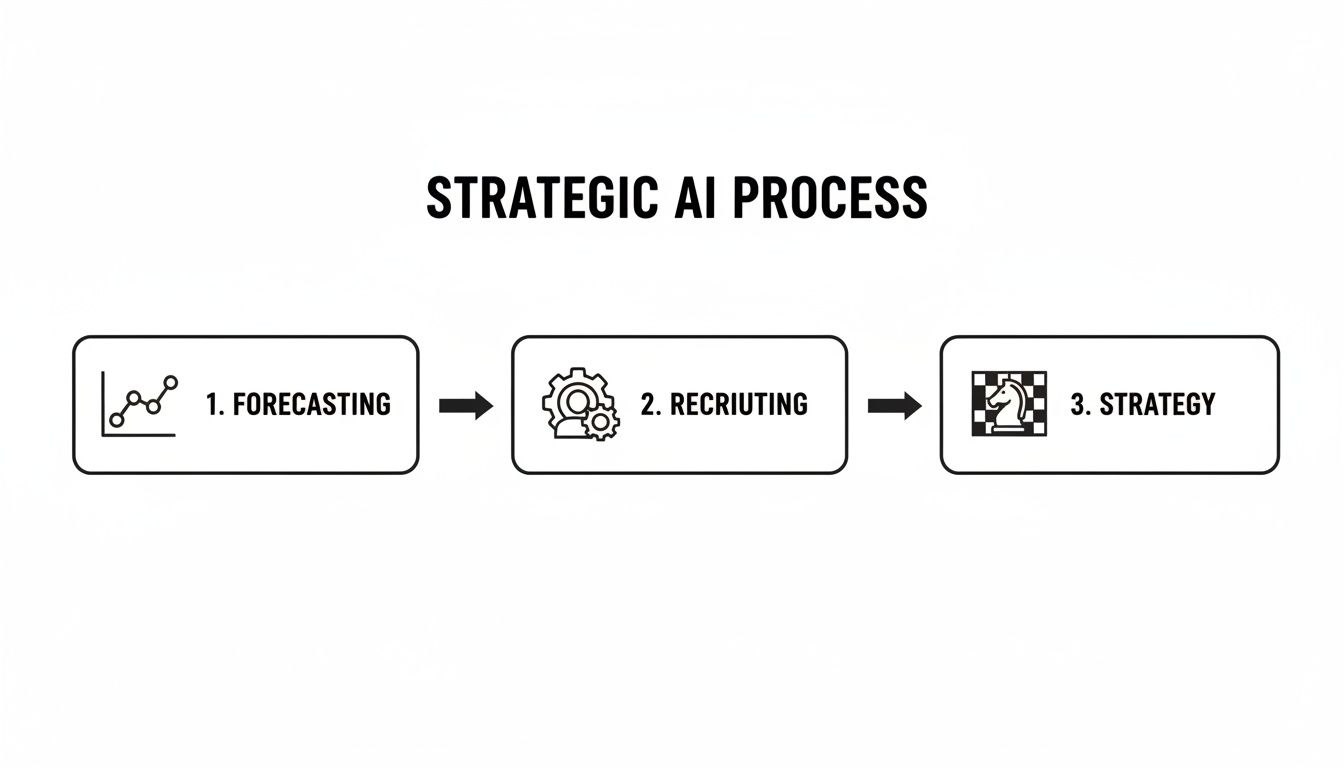
This demonstrates that successful implementation requires the integration of predictive insights and human capital into the strategic planning cycle from the outset.
Phase 1: Use Case Discovery and Prioritization
The journey begins not with technology, but with a rigorous focus on business value. The objective of the Use Case Discovery phase is to generate a portfolio of potential AI projects and then prioritize them based on two criteria: potential impact and feasibility of implementation.
The initial focus should be on "low-hanging fruit"—high-value, low-risk starting points. These are often found in processes hindered by manual labor, data-rich areas where human analysis is a bottleneck, or customer touchpoints with clear opportunities for enhancement. The goal is to identify a problem where a successful AI prototype can deliver a clear, quantifiable win within weeks, not years.
Phase 2: Rapid Prototyping and Engineering
Once a primary use case is selected, the focus shifts to speed and tangible results. The Rapid Prototyping and Engineering phase is dedicated to building a functional, production-ready system as quickly as possible. Velocity is critical; prolonged pilot projects destroy momentum and erode stakeholder confidence.
The objective is not to build a perfect, all-encompassing system initially. It is to deliver a Minimum Viable Product (MVP) that solves a core business problem and validates the technology's potential. This builds crucial internal credibility.
This agile methodology demonstrates that AI can deliver practical solutions rapidly. For a detailed framework, our guide on the 21-Day AI Delivery Framework offers a blueprint for deploying productive systems in three weeks.
Phase 3: Security, Compliance, and Enablement
Operating a successful AI prototype is one challenge; operating it securely and scaling that capability across the enterprise is another entirely. This final phase concentrates on two non-negotiable pillars for sustainable success.
First is AI Security and Compliance. Once these systems handle sensitive corporate or customer data, they must adhere to stringent security protocols and regulatory standards such as TISAX or ISO 27001. This entails building secure data pipelines, implementing robust access controls, and ensuring data governance is integrated into the system's architecture from inception, not as an afterthought.
The German grocery retail market exemplifies this. As giants like Edeka and REWE consolidate market share and e-commerce grows, the opportunity for AI-driven process optimization is immense. However, the critical prerequisite is to establish robust AI security and compliance to de-risk these data-intensive ventures.
Second is AI Enablement. A single successful project is a good start, but true transformation occurs when internal teams are empowered. This requires hands-on training, knowledge transfer, and fostering a culture where business and technology experts collaborate effectively on future AI initiatives. The ultimate goal is to build a self-sustaining internal capability, reducing reliance on external partners and embedding AI competence into the company’s DNA.
Becoming an AI-First Enterprise
Navigating the perpetual state of Handel im Wandel is not about completing a checklist of IT projects or experimenting with isolated technologies. It is about cultivating a new organizational mindset of continuous, proactive adaptation. For the leadership of the German Mittelstand, this requires a deliberate strategy to build sustainable AI capabilities from within. This is the transition from merely using AI to becoming an AI-First enterprise.
Ready to Build Your AI Project?
Let's discuss how we can help you ship your AI project in weeks instead of months.
This is not an incremental adjustment; it is a fundamental change in corporate philosophy. AI can no longer be viewed as an experimental cost center within the IT department. It must be treated as a core driver of competitive advantage, operational efficiency, and long-term resilience. This means weaving intelligent systems into the fabric of decision-making, from the factory floor to the C-suite.
The Mindset of Proactive Adaptation
An AI-First company does not just react to market shifts; it anticipates them. It uses predictive analytics to foresee customer needs and deploys intelligent automation to build supply chains that are resilient by design.
This mindset is founded on several core principles:
- Data as a Strategic Asset: All business functions are oriented towards generating, capturing, and leveraging high-quality data for superior decision-making.
- Agile Execution: The focus shifts from multi-year projects to rapid prototyping and iterative development, transforming an idea into a working system in weeks.
- Empowered Internal Teams: The end-state objective is self-sufficiency, where internal teams possess the skills and autonomy to identify opportunities and execute AI initiatives.
Building this internal capability creates a competitive advantage that is difficult to replicate. To truly lead, businesses must now also consider their visibility to AI models themselves. This new frontier can be explored through strategies detailed in How to Be The Brand ChatGPT Recommends.
The strategic goal is to transcend "doing" AI and begin thinking like an AI-native organization. This is the path to securing strategic control and future-proofing the enterprise in a competitive global market.
Want to Accelerate Your Innovation?
Our team of experts can help you turn ideas into production-ready solutions.
From Cost Center to Value Creator
The call to action for leadership is therefore clear. It is time to reframe the conversation around AI. We must move beyond a narrow focus on cost and technical complexity and view it as a strategic investment that empowers people and amplifies capabilities.
Every AI system deployed should be directly tied to a key business metric—be it reducing operational costs, increasing revenue, or accelerating time-to-market.
By building a robust internal AI engine, German enterprises can regain control of their destiny. This is not merely about surviving the challenges of Handel im Wandel. It is about actively architecting a more intelligent, resilient, and profitable future. To explore this further, learn more about the critical steps in a successful transformation in business in our detailed guide.
Frequently Asked Questions
As leaders navigate the realities of Handel im Wandel, practical questions regarding AI implementation inevitably arise. This section provides direct answers to common concerns voiced by C-level executives and senior managers during their strategic planning.
Where should we begin our AI journey to secure early wins?
Start with a high-impact, low-complexity problem. Identify a specific challenge within a single business unit—for instance, optimizing a particular supply chain process or automating a routine customer service function.
Looking for AI Expertise?
Get in touch to explore how AI can transform your business.
The objective is to deploy a prototype or Proof of Concept (PoC) within weeks. This demonstrates tangible value quickly, builds internal momentum, and provides critical learnings for more ambitious projects. Avoid "big bang" initiatives in favor of an agile, iterative approach. This is the most effective way to de-risk the investment and accelerate the return.
How do we measure the ROI of AI beyond technical metrics?
The return on AI investment must be linked directly to core business KPIs. Before commencing any project, define the specific business outcome you intend to influence. This elevates the conversation from technical specifications to strategic impact.
Success is not measured by the number of algorithms deployed, but by measurable improvements to the P&L and customer satisfaction. Frame results in the language of the boardroom to secure ongoing support and investment.
This could mean a reduction in operational costs (e.g., a percentage decrease in inventory holding costs), an increase in revenue (e.g., higher cross-sell conversion rates from personalized recommendations), or enhanced efficiency (e.g., a reduction in hours spent on manual data entry).
What is the most significant mistake companies make when adopting AI?
The classic error is treating AI as an IT project rather than a fundamental business transformation. Success is not determined by algorithmic sophistication but by the effective solution of a real business problem.
Ready to Build Your AI Project?
Let's discuss how we can help you ship your AI project in weeks instead of months.
This requires deep collaboration between business leaders, domain experts, and technology teams from the outset. Without a clear business case and executive sponsorship, AI projects seldom advance beyond the pilot stage. The focus must remain steadfastly on creating business value, ensuring every deployment directly supports the strategic objectives required to master this new era of commerce.
At Reruption GmbH, we act as your Co-Preneurs for the AI Era, helping you turn strategic ideas into production-ready innovations. We partner with you to navigate the challenges of Handel im Wandel by building the internal AI capabilities that secure long-term prosperity. Start your transformation journey with us at www.reruption.com.