Models of business innovation are structured frameworks for creating, delivering, and capturing value. These are not academic theories; they are strategic blueprints for growth, guiding decisions from incremental product improvements to complete market redefinitions. Selecting the appropriate model is critical for maintaining competitive advantage in a dynamic global landscape.
The Mandate for Innovation: Why German Leaders Must Act Now
For decades, the German engineer has been a global symbol of excellence—a master of precision, optimisation, and incremental improvement. This legacy built industries. Today, that same engineer confronts a new reality. It is no longer sufficient to refine existing tools; the imperative is to master a new toolbox powered by artificial intelligence. This transition requires not just new skills, but a fundamental shift in strategic mindset.
Innovation is often mischaracterised as an unpredictable, high-risk cost centre. Managed through proven frameworks, it becomes a disciplined engine for sustainable growth. The key is recognising that different challenges demand different solutions. Optimising a production line is fundamentally different from launching a disruptive digital service.
Navigating the New Competitive Arena
Today's economic climate, marked by supply chain volatility and intense global competition, has rendered a reactive posture untenable. Proactive adaptation, guided by structured models of business innovation, is the new baseline for survival and growth. The objective is to shift from reaction to anticipation.
For German leadership, this necessitates addressing critical strategic questions:
Ready to Build Your AI Project?
Let's discuss how we can help you ship your AI project in weeks instead of months.
- Where are our current revenue streams most vulnerable? Identifying vulnerabilities is the first step toward building resilience.
- Which operational bottlenecks can AI solve now? Focusing on high-impact, achievable projects builds momentum and demonstrates value.
- How can we create new value beyond our core products? This line of inquiry drives the transition from product enhancement to business model reinvention.
The imperative is clear: companies must learn to "re-rupt" from within before they are disrupted from the outside. This internal transformation views innovation not as a department, but as a core business capability integral to long-term success.
This internal reinvention is the essence of modern corporate strategy. It demands a systematic approach to opportunity identification and risk management, a process central to the successful digitisation of your enterprise. By understanding and applying the right models, leadership can steer the organisation with confidence, converting uncertainty into a distinct competitive advantage. This guide provides the frameworks to achieve that.
Navigating Your Innovation Portfolio: A Framework for Growth
Reliance on a single innovation approach leads to stagnation. A robust growth strategy requires a diversified portfolio of innovation efforts, analogous to a financial portfolio that balances different assets to manage risk and achieve specific objectives. Understanding the primary models of business innovation differentiates reactive problem-solving from the proactive construction of the company’s future. It provides the executive team with a common language and a clear framework for diagnosing needs and deploying the appropriate strategic tools.
This section details the essential models every German executive must command. We will analyse how to select the right approach for specific business contexts, creating a robust decision-making framework for long-term growth.
The map below delineates the core pathways for innovation, illustrating how engineers can leverage AI to drive initiatives ranging from incremental improvements to radical, market-defining developments.
Want to Accelerate Your Innovation?
Our team of experts can help you turn ideas into production-ready solutions.
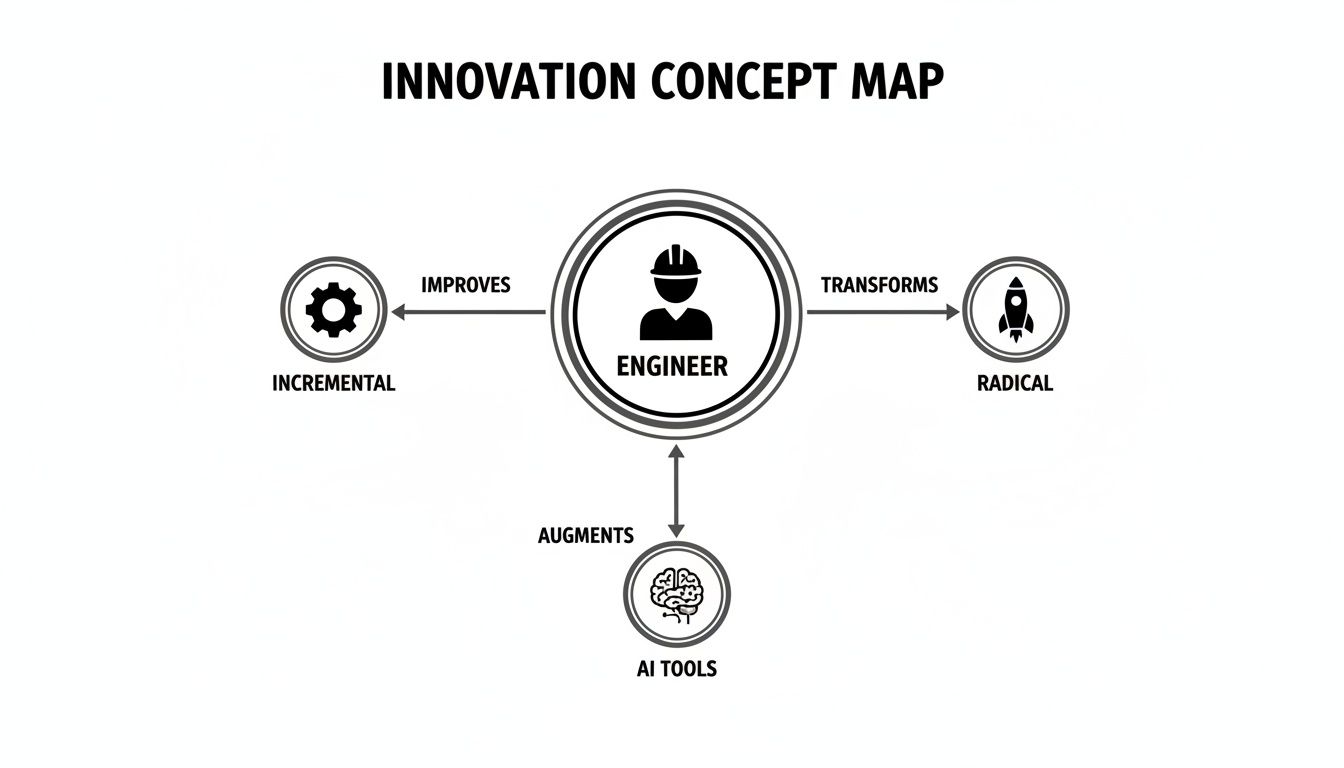
As illustrated, AI has become a central component across the entire innovation spectrum—whether refining existing systems or creating new markets.
Sustaining and Disruptive Innovation
The most critical distinction within an innovation portfolio is between sustaining and disruptive innovation. These two models occupy opposite ends of the strategic spectrum, addressing distinct market needs and opportunities.
Sustaining innovation focuses on improving existing products for current customers. Consider a premium German automotive manufacturer refining its combustion engine year after year—enhancing efficiency, power, and reliability. This is the mechanism for defending market leadership in established categories, but it is insufficient to secure the future alone.
Disruptive innovation, conversely, creates new markets or reconfigures existing ones. It often originates by serving overlooked customers with a simpler, more affordable, or more convenient offering. For the same automaker, this would be the development of an electric vehicle platform from first principles—a technology that initially appealed to a niche audience but ultimately challenged the dominance of the internal combustion engine.
Looking for AI Expertise?
Get in touch to explore how AI can transform your business.
This is not an "either/or" decision. An effective strategy integrates both. Sustaining innovation protects and grows the core business, while calculated disruptive ventures ensure future relevance.
Open Innovation: Looking Beyond Your Own Walls
Historically, innovation was conducted internally, relying exclusively on proprietary R&D. Open innovation inverts this paradigm. It is predicated on the principle that valuable ideas and talent exist outside the organisation. This model involves systematically collaborating with external partners—universities, startups, suppliers, and even customers—to co-create technologies and solutions.
This approach is particularly effective for large enterprises whose internal processes can impede agility. By partnering with nimble, external innovators, they can access fresh perspectives and accelerate development while distributing risk and cost. A critical component of this strategy is determining what to develop in-house versus what to source externally, a decision clarified by a rigorous make-or-buy analysis.
Business-Model Innovation: Changing How You Compete
Perhaps the most potent—and frequently overlooked—form of innovation is Business-Model Innovation. This concerns not what you sell, but how you create, deliver, and capture value. An entire industry can be transformed without a single new invention.
Consider a manufacturer of heavy industrial machinery. The traditional model involves a one-time, high-capital sale of equipment. A business-model innovation would be to shift to an "Equipment-as-a-Service" model, where customers pay for usage or guaranteed uptime. This fundamentally alters the competitive dynamics:
Ready to Build Your AI Project?
Let's discuss how we can help you ship your AI project in weeks instead of months.
- From Product to Outcome: The offering shifts from a machine to guaranteed performance.
- From Transaction to Relationship: The sale evolves into a long-term, service-based partnership.
- From CapEx to OpEx: This makes the solution accessible to a broader customer base.
Such a transformation is challenging, often requiring the redesign of core processes, financial models, and corporate culture. However, the potential return is a profound and defensible competitive advantage.
To assist in strategic selection, the following table maps these innovation models to specific business objectives.
Mapping Innovation Models to Strategic Business Goals
| Innovation Model | Primary Goal | Best For | Risk Profile |
|---|---|---|---|
| Sustaining Innovation | Defend and grow core market share by improving existing products. | Mature, stable markets where customer needs are well-understood. | Low |
| Disruptive Innovation | Create new markets or capture overlooked customer segments. | Entering new territories or preempting future market shifts. | High |
| Open Innovation | Accelerate R&D and access external expertise to solve complex problems. | Industries with rapid technological change or complex ecosystems. | Medium |
| Business-Model Innovation | Reshape the value proposition and create new, defensible revenue streams. | Commoditised markets or when facing margin pressure. | High |
This table serves as a foundational guide. The most effective strategies often blend elements from multiple models to build a resilient, forward-thinking organisation.
To gain a more comprehensive understanding of the available options, you can explore various models of business innovation and assess their alignment with your corporate vision. Mastering these foundational concepts is the first step toward building an organisation poised not merely for survival, but for long-term, sustainable growth.
Putting Innovation Models to Work in the AI Era
Understanding the theoretical models of business innovation is necessary but not sufficient. The primary challenge lies in implementation—translating strategic frameworks from executive presentations into operational reality. For German enterprises, this requires constructing governance structures that can navigate internal politics and deliver measurable results, particularly as AI redefines the competitive landscape.
Want to Accelerate Your Innovation?
Our team of experts can help you turn ideas into production-ready solutions.
Success is not achieved through top-down mandates. It requires a clear blueprint for governing new initiatives, allocating capital, and assembling the right talent. It is at this execution stage that most innovation efforts fail. A brilliant idea without the requisite organisational structure to support it remains a squandered opportunity.
Let's examine three powerful implementation models: the Ambidextrous Organisation, corporate venturing powered by Lean Startup methodology, and the ecosystem-driven Platform model. Each offers a distinct pathway from strategy to tangible business impact.

The Ambidextrous Organisation: Balancing Today and Tomorrow
The Ambidextrous Organisation model addresses a classic conflict within large corporations: how to maintain the efficiency of the core business (exploit) while simultaneously pursuing novel opportunities (explore). Attempting to house both functions within the same rigid hierarchy is a recipe for failure. The core business is optimised for efficiency and predictability—attributes that stifle the experimental, iterative work required for new ventures.
The solution is to create two structurally separate units, each with its own culture, processes, and metrics for success.
Looking for AI Expertise?
Get in touch to explore how AI can transform your business.
- The 'Exploit' Engine: This is the core business—the primary revenue and profit generator. It is focused on operational excellence, incremental improvements, and maximising returns from existing products. Its key performance indicators (KPIs) are familiar: margins, market share, and efficiency.
- The 'Explore' Engine: This is the innovation lab or corporate venture unit. It operates with agility, prioritises learning, tests assumptions, and seeks a viable business model. Its KPIs are fundamentally different: speed of learning, customer validation metrics, and time to product-market fit.
An effective Head of Digital Products, for example, will shield the 'explore' team from the corporation’s standard budget cycles and risk-averse culture. This separation provides the new venture with the necessary autonomy to develop without being constrained by the parent organisation's processes.
Corporate Venturing with a Lean Startup Playbook
For the 'explore' engine to be effective, it requires its own operating system. Lean Startup principles, originating from the agile startup world, provide an invaluable framework for corporate venturing. This methodology eschews comprehensive, speculative business plans in favour of small, rapid experiments designed to reduce risk. This approach is central to how we rapidly bring AI systems to market, a process detailed in our 21-Day AI Delivery Framework.
Imagine a Director of Venture Development seeking C-suite approval. Instead of requesting a multi-million Euro budget for an unproven concept, they secure a small seed investment to test a single critical assumption with a Minimum Viable Product (MVP). This evidence-based approach shifts the conversation from one of managing risk to one of validated learning.
The core principle is simple yet powerful: invest minimally to learn maximally, and only increase investment in ideas that demonstrate clear market validation. This is how established corporations can innovate with startup-like agility.
This focus on tangible outcomes aligns directly with Germany's established strengths. The country consistently demonstrates excellence in converting ideas into impact, ranking 8th globally in innovation outputs. This reflects not just inventive activity but concrete results, such as high employment in innovative companies, proving a national talent for commercialising innovation.
Platform and Ecosystem Models: The New Frontier
The final model extends beyond the boundaries of the individual firm. Platform and ecosystem models shift the strategic focus from selling a discrete product to creating a central hub that connects different user groups—such as producers and consumers, or developers and end-users—to facilitate value creation and exchange. Consider a heavy machinery manufacturer that develops an open IoT platform, enabling third-party developers to create new applications for its equipment.
This model's power is amplified by artificial intelligence. A significant advance is the ability to empower partners by building apps without coding using AI, which dramatically lowers the barrier to entry for ecosystem participation. By fostering this network effect, the platform owner captures value from the entire system, not just its own transactions.
Executing this model requires a significant mindset shift from control to orchestration. The objective is no longer to own the entire value chain but to become the indispensable hub that enables the success of all participants. This demands clear rules of engagement, strong governance, and a steadfast commitment to creating shared value for every member of the ecosystem.
AI: The Engine Driving Modern Innovation
If the innovation models are the strategic blueprints, then Artificial Intelligence is the high-performance engine that executes those plans. For German corporate leaders, AI is not merely an add-on technology; it is the catalyst that accelerates every form of innovation, from incremental refinement to complete market reinvention. It functions as a force multiplier, unlocking efficiencies and creating opportunities that were previously unattainable.
This section demystifies AI's role, translating abstract technological concepts into tangible business applications. We will map specific AI capabilities to the innovation models discussed, providing a clear guide for secure and effective integration.
Ready to Build Your AI Project?
Let's discuss how we can help you ship your AI project in weeks instead of months.

Supercharging Sustaining and Disruptive Models
AI provides distinct advantages across the innovation spectrum, offering tools to fortify the core business while simultaneously exploring radical new ventures.
For sustaining innovation, AI serves as the ultimate optimisation tool. In a manufacturing facility, predictive maintenance algorithms can analyse sensor data to anticipate equipment failures, reducing downtime and directly improving operational efficiency. Similarly, AI-powered quality control systems can identify microscopic defects on a production line with superhuman accuracy, enhancing product quality and protecting brand reputation.
For disruptive innovation, Generative AI creates entirely new possibilities. A traditional industrial goods company could leverage it to launch a new "as-a-service" offering. Instead of selling machinery, it could offer a subscription that includes AI-driven performance analytics and automated operational guidance. This creates a recurring revenue stream from a novel business model. This transformative power is at the core of The Generative AI Revolution and is fundamentally altering what is achievable for established firms.
AI's true power lies in its versatility. It can be precisely deployed to strengthen existing competitive advantages or wielded boldly to forge new ones. This makes it an essential component of modern models of business innovation.
Want to Accelerate Your Innovation?
Our team of experts can help you turn ideas into production-ready solutions.
Mapping AI Applications to Innovation Frameworks
To move from theory to practice, consider how specific AI tools map to these innovation frameworks. The following offers a menu of options for an Innovation Lead building a business case.
- For Sustaining and Business-Model Innovation: LLM-powered "copilots" integrated into existing ERP or CRM systems can automate routine tasks, analyse complex datasets for employees, and suggest process improvements in real time. This enhances productivity and frees expert personnel for higher-value strategic work.
- For Disruptive and Open Innovation: Generative AI platforms are exceptionally effective for rapid ideation and prototyping. Marketing teams can generate dozens of campaign concepts in minutes, while engineering teams can create initial design mock-ups for new products, dramatically compressing the R&D cycle.
Germany's industrial leaders are demonstrating a profound commitment in this domain. In 2023, German industry invested a record €88.7 billion in research and development, part of a national R&D expenditure that has consistently exceeded the EU's strategic targets. This level of investment signals a clear understanding: competitive advantage depends on the relentless integration of advanced technologies.
A Secure Framework for AI-Driven Innovation
However, integrating AI presents significant challenges. Risks related to data security, regulatory compliance, and implementation reliability are substantial and cannot be overlooked. Unstructured experimentation with AI tools can lead to costly errors and security vulnerabilities.
A structured, comprehensive approach is therefore non-negotiable. Reruption's 4-Pillar Model provides the necessary guardrails for any AI initiative:
- AI Strategy: Defines the business case, sets clear objectives, and establishes governance to align all AI projects with corporate goals.
- AI Engineering: Focuses on building and deploying production-ready AI systems that are scalable, reliable, and properly integrated into existing workflows.
- AI Security & Compliance: Implements robust security protocols and ensures full adherence to regulations like GDPR and industry standards such as TISAX.
- AI Enablement: Provides hands-on training and knowledge transfer to internal teams, building the capabilities required to sustain and scale AI innovation over the long term.
By adopting this holistic framework, your organisation can progress beyond isolated proofs-of-concept to confidently build and deploy AI solutions that drive measurable business value, converting AI's potential into a tangible competitive advantage.
From Theory to Reality: Case Studies from German Industry
Strategic frameworks are validated by their application in the marketplace. To demonstrate how these models of business innovation deliver tangible results, we present several anonymised case studies from Germany's industrial sector. These examples represent the types of ventures we build in partnership with our clients.
Each case study follows a clear narrative: the business problem, the selected innovation model, the critical role of AI, and the measurable outcomes. They illustrate our "Co-Preneur" philosophy in action, where we share P&L accountability to move projects from concept to commercial reality.
Automotive Leader Ventures into NLP Services
A leading German automotive manufacturer faced a significant operational challenge: its highly skilled service technicians were spending excessive time navigating dense technical manuals to diagnose issues. This inefficiency increased costs and led to inconsistent service quality across its global network.
The solution was not a simple software update but a strategic corporate venture. A dedicated, cross-functional team was established to operate with the agility of a startup. Their mission was to develop a new digital service powered by Natural Language Processing (NLP). The AI tool would enable technicians to ask complex diagnostic questions in natural language and receive immediate, precise answers extracted from technical documentation.
The result was a successful "spin-in"—a new internal service that reduced diagnostic times by over 40%. The project not only resolved a major operational bottleneck but also cultivated a powerful new AI capability within the organisation, demonstrating that large corporations can successfully develop disruptive solutions internally.
Manufacturing Champion Incubates a Corporate Startup
A renowned manufacturing champion, a leader in specialised equipment, identified a promising opportunity in an adjacent market. However, its existing organisational structure was too rigid to pursue this opportunity effectively. Rather than forcing the new initiative through established channels, the company chose to incubate a corporate startup.
This small, independent unit was tasked with a single objective: achieve product-market fit. Adhering to Lean Startup principles, the team rapidly built and tested a series of Minimum Viable Products (MVPs) with real customers. This iterative, feedback-driven approach de-risked the venture, ensuring that significant investment was committed only after market demand had been validated. The insights gained also provided a powerful case study in how AI can reshape the industrial sector. We explore this further in our article on how AI will transform the German Mittelstand by 2025.
Technology Firm Spins Off a New Venture
A large technology corporation achieved a significant materials science breakthrough during internal R&D. While the technology was promising, its most compelling applications lay outside the company's core business focus. To prevent this valuable intellectual property from remaining unexploited, leadership made a strategic decision: launch it as an independent spin-off.
This structure afforded the new entity the freedom to attract external funding and build a team singularly focused on commercialising the technology. This strategy unlocked the innovation's full potential, creating a new, high-growth business in which the parent company retains a significant equity stake. It serves as a classic example of how spinning off non-core innovations can create substantial value.
These cases demonstrate that Germany's Mittelstand and larger corporations are actively innovating. While many SMEs excel in process innovation—outperforming the EU average by an extraordinary 161.3%—a significant, untapped opportunity remains to create new products and services using these structured innovation models. Further data on these trends is available in KfW's latest research on innovation.
Looking for AI Expertise?
Get in touch to explore how AI can transform your business.
Your Path to Internal Re-ruption: A Practical Action Plan
Translating strategy into tangible results is the primary challenge for leadership. The value of models of business innovation lies not in theory but in disciplined, pragmatic execution. The objective is not to launch a massive, high-risk transformation program, but to build momentum through methodical, risk-mitigating steps.
This roadmap provides a clear path from your current state to measurable outcomes, empowering you to drive change from within your organisation.
First, Assess Your Innovation Maturity
Before defining a new course, you must understand your starting position. This requires an objective assessment of your company's innovation capabilities. Identify your strengths and, more importantly, the cultural habits and internal processes that impede progress.
This assessment provides the necessary baseline to select an appropriate pilot project—one that is ambitious enough to be meaningful yet realistic enough to be achievable within current organisational constraints. This focuses energy where it will have the greatest impact.
Identify a High-Impact Pilot Project
Your initial action should be a targeted initiative, not a broad campaign. Select a single, high-impact business problem that a focused pilot project can address. An ideal pilot is one where a successful outcome will be highly visible, demonstrating the value of a new working model to the entire organisation.
Ready to Build Your AI Project?
Let's discuss how we can help you ship your AI project in weeks instead of months.
Our core principle is to de-risk innovation. We advocate for proving value with a working prototype in days, not debating theoretical business cases for months. This velocity maintains executive engagement and team motivation.
Assemble a Cross-Functional 'Co-Preneur' Team
Innovation requires a multidisciplinary approach. Assemble a small, dedicated "Co-Preneur" team with representation from key functions such as engineering, marketing, finance, and operations. This team must be empowered with autonomy and shielded from the bureaucratic impediments that typically stifle progress.
Their mission is clear: own the problem, test hypotheses rapidly, and be prepared to pivot based on market feedback. This entrepreneurial ethos is the engine of genuine internal innovation.
Define Success with Clear KPIs
Finally, establish clear metrics for success from the outset. For a nascent venture, success is not measured by immediate revenue but by validated learning.
- Initial KPIs: Focus on metrics such as speed-to-prototype, customer engagement data, and the rate at which initial assumptions are validated or invalidated.
- Later-Stage KPIs: As the project gains traction, shift the focus to more traditional metrics like customer acquisition cost, adoption rates, and, ultimately, return on investment.
This approach provides a clear framework for measuring progress. It is how we, as your hands-on partners, build and ship real innovations alongside you. We invite you to move beyond traditional consulting and join us in securing your company’s future by re-rupting from within.
Frequently Asked Questions
Which innovation model is right for a traditional German manufacturing company?
There is no single correct answer; the optimal model depends on the strategic objective.
If the goal is to enhance existing operations—for example, by improving production efficiency or product quality—a Sustaining Innovation model is most appropriate. Augmenting this with AI for process optimisation can yield significant, measurable improvements to the core business.
If, however, the objective is to enter new markets or defend against agile, digital-native competitors, a different approach is required. A Corporate Venturing model, utilising Lean Startup methods to develop a new digital service, is better suited for this purpose. The first step is always a candid maturity assessment to determine which path the organisation is prepared to undertake.
How can we measure the ROI on AI-driven innovation?
ROI must be viewed through a portfolio lens. For projects focused on internal process improvement, KPIs are direct and tangible: cost savings, increased output, and reduced error rates. These metrics have a clear impact on the balance sheet.
For more ambitious, disruptive ventures, the initial goal is learning, not profit. Early metrics should include the number of customer discovery interviews conducted, user engagement with prototypes, and the speed to achieving product-market fit. As the venture matures, the focus can shift to traditional financial KPIs such as revenue and market share. The key is to apply the appropriate metric for each stage of the innovation lifecycle.
Our company culture is pretty risk-averse. How do we start innovating?
Attempting to force innovation in a risk-averse culture is ineffective. The optimal approach is to start small in a controlled environment. Create a psychologically safe ‘sandbox’ for a hand-picked team to address a single, well-defined problem.
Employ the Lean Startup model, which prioritises fast, low-cost experiments designed to prove or disprove core hypotheses. It is critical to reframe ‘failure’ as learning gained from a debunked assumption—this itself is progress.
As these contained projects begin to deliver results, they build organisational momentum and confidence. You will have tangible evidence to present to the C-suite, facilitating broader support for fostering an innovative culture throughout the organisation.
Ready to turn these ideas into reality? Reruption GmbH works as your hands-on 'Co-Preneur' to build, launch, and grow your next AI-powered venture. Let's build your future, together.