
A Business Analyst for IT serves as the critical bridge between an organisation's strategic objectives and its technological execution. This role ensures complex IT initiatives, particularly in high-stakes domains like artificial intelligence, deliver quantifiable business value rather than becoming mere technical exercises. They are responsible for translating boardroom vision into a concrete, actionable blueprint for technology teams.
The Strategic Imperative of the IT Business Analyst

In an environment defined by relentless technological disruption and a significant scarcity of specialised talent, the function of the IT Business Analyst has evolved. It is no longer sufficient to merely gather requirements and act as an intermediary between business and IT departments. The contemporary landscape demands a strategic partner—a "Co-Preneur"—who actively drives the success of transformative initiatives like artificial intelligence and digital integration.
This modern Business Analyst operates not as a scribe, but as a master architect. An architect does not simply draft plans based on a client's stated preferences. They conduct deep analysis to ensure the final structure aligns with the city's long-term economic and functional vision. They challenge assumptions, model diverse outcomes, and guarantee the foundation is robust enough to support future demands.
From Technical Translator to Business Co-Preneur
This is precisely the function a strategic IT Business Analyst performs for a technology project. When an organisation commits to implementing an AI system, the BA's mandate extends far beyond feature cataloguing. They are accountable for ensuring the project is not only technically sound but also perfectly aligned with the company's financial targets and market strategy.
Ready to Build Your AI Project?
Let's discuss how we can help you ship your AI project in weeks instead of months.
This alignment is the cornerstone of successful technology investment, preventing the costly deployment of projects that fail to deliver strategic impact. The BA's core function is to de-risk innovation by verifying that every technical decision directly supports a measurable business outcome. They achieve this through:
- Defining Measurable Success: Translating ambiguous goals like "enhance efficiency" into specific, trackable Key Performance Indicators (KPIs) that eliminate ambiguity.
- Ensuring Strategic Fit: Confirming that the technology solution addresses a core business problem and provides a tangible competitive advantage.
- Validating Financial Viability: Constructing a robust business case that justifies the investment with a clear, projected return.
- Aligning Stakeholders: Orchestrating consensus among all relevant parties, from C-level executives to frontline teams and IT specialists.
In essence, the Business Analyst for IT ensures the organisation builds the right system before resources are allocated to building the system right. This fundamental shift in focus is what prevents the launch of technically brilliant but commercially irrelevant solutions.
A distinguished BA also possesses a comprehensive understanding of the broader IT services landscape. For an overview of what comprehensive IT solutions entail, one might review providers such as Dr3am IT. This expansive perspective enables the BA to connect internal project objectives with the larger technology ecosystem. This holistic viewpoint elevates the BA from a mere project facilitator to a vital partner in value creation.
Bridging the Gap Between Business Strategy and Execution

Consider the business analyst for IT a professional translator. They do not translate languages, but something far more complex and costly if misinterpreted: the language of executive vision into the language of technical reality. They are the essential conduit that transforms a high-level strategic goal into a tangible, operational technology solution.
Want to Accelerate Your Innovation?
Our team of experts can help you turn ideas into production-ready solutions.
This function transcends simple note-taking. It involves decoding intent, identifying potential obstacles before they materialise, and ensuring the final product directly serves the organisation's financial objectives. Without this bridge, even the most promising technology initiatives can deviate from their commercial purpose, evolving into expensive engineering exercises rather than instruments for growth.
The failure of countless technology projects is rarely attributable to technical incompetence. The primary cause is often a fundamental disconnect between what the business requires and what the technology delivers. The IT Business Analyst is positioned at the nexus of this gap, ensuring the dialogue between leadership and engineering is precise, contextual, and focused on a unified objective. They prevent the "lost in translation" errors that can jeopardise a project.
Core Responsibilities and Their Strategic Business Impact
While the daily activities of a BA may appear tactical, each task is strategically designed to link technical execution with business value. The following table illustrates how traditional BA activities directly influence C-level objectives, clarifying the role's critical importance for business success.
| Core Responsibility | Technical Activity | Strategic Business Impact |
|---|---|---|
| Requirements Elicitation & Analysis | Conducting stakeholder interviews, workshops, and document analysis to define project scope and detailed specifications. | Ensures the final product solves the correct business problem, preventing misallocation of capital on features that do not drive revenue or efficiency. |
| Process Modelling & Design | Creating 'As-Is' and 'To-Be' process maps using BPMN or similar notations to visualise workflow improvements. | Identifies operational bottlenecks and designs streamlined processes, leading directly to increased productivity and reduced operational costs. |
| Stakeholder Communication | Acting as the primary liaison between business units, technical teams, and project managers to ensure constant alignment. | Mitigates the risk of scope creep and project delays by ensuring all parties maintain a shared understanding of goals and progress. |
| Solution Validation & Testing | Defining acceptance criteria and participating in User Acceptance Testing (UAT) to confirm the solution meets business needs. | Guarantees that the technology delivers the promised value and meets user expectations, improving adoption rates and ROI. |
By translating business needs into technical blueprints, the BA does not merely manage requirements; they architect the foundation of a project's success, ensuring every technical decision supports a larger strategic goal.
A Practical Example from Manufacturing
Consider a large German manufacturing firm experiencing costly, unplanned downtime on its assembly lines. The board approves a significant investment in an AI-powered predictive maintenance system. The stated objective is broad: "reduce unplanned stops."
Looking for AI Expertise?
Get in touch to explore how AI can transform your business.
An effective Business Analyst for IT intervenes to convert this ambiguous goal into a concrete execution plan.
- Stakeholder Workshops: They convene all relevant parties—plant managers, maintenance engineers, and data scientists. They move beyond superficial requests to understand the precise failure points, data sources, and operational frustrations.
- Process Mapping: They meticulously map the entire maintenance lifecycle, from initial sensor alerts to final repair validation. This visual representation immediately highlights opportunities for AI-driven intervention.
- Requirements Definition: They translate these insights into a detailed requirements document for the development team. This document specifies the exact data the AI model requires, the protocol for alert generation, and—most critically—the KPIs for measuring success, such as a 15% reduction in downtime within six months.
In this scenario, the BA's work is the indispensable link connecting a major technology investment to a measurable improvement in operational efficiency and profitability. Their blueprint ensures the company acquires a powerful business tool, not merely a piece of advanced technology. Understanding how to connect strategy with technology is a skill that distinguishes successful leaders.
The Toolkit of a High-Impact IT Business Analyst
A highly effective business analyst for IT relies on a sophisticated blend of tools and competencies. For leadership, understanding this toolkit is essential for identifying premier talent and structuring an environment conducive to success. The role demands a combination of analytical rigour, communication prowess, and strategic perspective.
This individual is not a generalist but a specialist, equipped with specific capabilities for distinct challenges. Their toolkit can be categorised into three core domains: foundational technical skills that ground initiatives in reality, crucial soft skills that foster alignment, and the key deliverables that convert strategy into an executable plan.
Foundational Technical Competencies
Technical skills form the bedrock of an IT Business Analyst's credibility. While they need not be senior developers, they must possess sufficient knowledge of architecture and systems to engage in substantive discussions with engineering teams and discern what is technically feasible. This fluency differentiates a mere note-taker from a genuine strategic partner.
Ready to Build Your AI Project?
Let's discuss how we can help you ship your AI project in weeks instead of months.
Key technical competencies include:
- Data Modelling and Analysis: Proficiency in interpreting and modelling data is non-negotiable. BAs utilise SQL queries and create entity-relationship diagrams (ERDs) to map information flows, ensuring new systems can access the requisite data.
- System Architecture Knowledge: A firm grasp of system design concepts—such as microservices, APIs, and cloud infrastructure—enables the BA to contribute meaningfully to solution design. This provides a critical check against business requests that are technically complex or financially prohibitive.
- Prototyping and Wireframing: Using tools like Figma or Balsamiq, they create low-fidelity mock-ups of the software interface. This renders the concept tangible, allowing stakeholders to provide concrete feedback long before development commences.
These technical skills are the instruments for validating whether a strategic business idea is technologically viable. Without them, even the most compelling vision remains an unachievable blueprint.
The Art of Strategic Influence
While technical skills define what can be built, soft skills determine what should be built—and ensure successful delivery. In any complex organisation, the ability to negotiate, persuade, and align diverse stakeholders is often more critical than technical expertise. These are the tools of influence and risk management.
A Business Requirements Document (BRD) is not merely a technical specification; it is the formal contract defining what the business requires the technology to accomplish. It translates executive vision into a clear, binding agreement for the delivery team.
This "contract" is realised through key interpersonal skills:
Want to Accelerate Your Innovation?
Our team of experts can help you turn ideas into production-ready solutions.
- Negotiation and Conflict Resolution: BAs consistently mediate between competing departmental priorities. They must skillfully broker compromises that serve overarching business goals without alienating key stakeholders.
- Strategic Communication: They must be master translators, capable of explaining complex technical limitations to a non-technical board and, moments later, conveying nuanced business objectives to an engineering team. This prevents catastrophic misunderstandings.
- Critical Thinking and Problem-Solving: A top-tier BA does not simply document requests—they challenge them. By repeatedly asking "why," they often uncover the underlying need or identify a more efficient path to the same objective.
Key Deliverables That Drive Action
The final component of the toolkit comprises the formal documents and artefacts that transform analysis into a concrete plan. These are not bureaucratic formalities but essential instruments for creating clarity, securing alignment, and de-risking major investments.
A Business Analyst for IT is accountable for producing clear, actionable documents that guide the entire project. These are the tangible outputs of their analytical work. The value of these insights is growing; Germany's data analytics market—where IT business analysts are instrumental in extracting value from data—is projected to expand from USD 4.80 billion in 2024 to USD 51.20 billion by 2033. This growth is driven by AI integration and the critical need for data-backed decisions.
By mastering these deliverables, BAs convert raw data into strategic assets. To understand this process in greater detail, review our guide on analytics and insights.
How a Business Analyst Operationalises AI Initiatives
Artificial intelligence is no longer a future concept but a present-day tool for competitive advantage. For senior leaders, the primary challenge is not the technology itself but its translation into tangible, profitable business outcomes. This is precisely where the Business Analyst for IT becomes indispensable, serving as the critical link for any successful AI implementation.
They are responsible for moving AI from abstract strategy to a production-ready system that creates demonstrable value. A BA identifies strategic opportunities for tools like Microsoft AI Copilot to genuinely enhance productivity and decision-making, ensuring AI projects are sound business investments from inception.
From AI Potential to Practical Reality
The effectiveness of an AI model is contingent upon the problem it solves and the data upon which it is trained. The business analyst functions like a master chef sourcing ingredients for a complex recipe. The AI model is the recipe, but its success depends entirely on the quality and relevance of the data.
The BA is tasked with identifying the highest-value AI use cases within the organisation. They meticulously construct the business case, projecting the return on investment and defining success metrics before significant resources are committed. This crucial initial step prevents costly "science projects" and focuses efforts on initiatives with a clear path to bottom-line impact.
This infographic illustrates the integrated workflow of a business analyst's skills and deliverables.
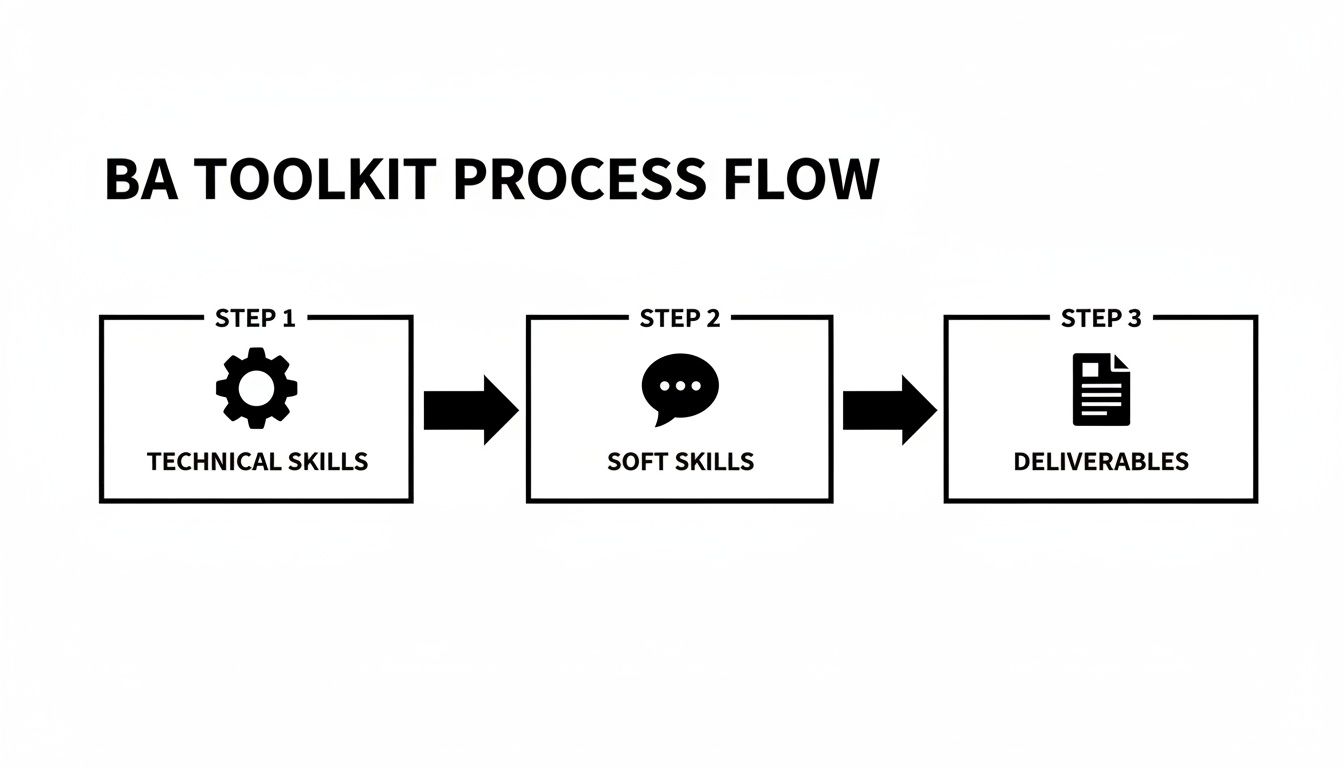
It demonstrates how technical expertise, interpersonal skills, and formal documentation must synchronise perfectly to achieve strategic goals.
Defining Data Requirements for Machine Learning
Once a high-impact use case is approved, the BA's focus shifts to data. This is a detailed, methodical process:
- Data Identification: They collaborate with subject matter experts to pinpoint the precise internal and external data sources required to train the machine learning model.
- Data Quality Assessment: They conduct a thorough analysis of the data, assessing its integrity, completeness, and accuracy. Any gaps or biases that could compromise the AI's performance are identified and addressed.
- Feature Engineering Collaboration: The BA partners with data scientists to define the specific features (variables) the model will use for prediction, ensuring each is relevant to the business problem.
This foundational work is paramount. An AI model trained on poor or irrelevant data will, at best, be ineffective and, at worst, lead to detrimental business decisions. The BA acts as the guardian of data quality, ensuring the foundational components are perfect.
Ensuring Governance and Stakeholder Alignment
The integration of AI introduces new complexities in governance, compliance, and risk. A skilled IT Business Analyst navigates this terrain, ensuring the organisation remains secure and compliant.
The true value of a business analyst in an AI project is their ability to de-risk innovation. They ensure that enthusiasm is tempered with rigorous analysis, transforming a technological possibility into a predictable business outcome.
They manage stakeholder expectations with precision, translating the complex, often probabilistic nature of AI into clear business language. This builds trust and maintains leadership confidence. They also ensure any AI system adheres to stringent German and European standards, such as TISAX or ISO requirements, which is non-negotiable for large enterprises.
Looking for AI Expertise?
Get in touch to explore how AI can transform your business.
This strategic role is more critical than ever. In Germany's expanding IT sector, business analysts are essential, particularly given the talent shortage and the growth driven by small and medium-sized enterprises (SMEs). Projections show the German IT market will grow by USD 33.3 billion between 2025 and 2029, at a compound annual growth rate of 4.2%, largely fuelled by SME adoption of IT solutions.
Ultimately, the business analyst ensures that promising AI concepts successfully transition into robust, production-ready systems that deliver sustained value. For organisations seeking rapid execution, our 21-Day AI Delivery Framework offers a structured approach.
Identifying and Empowering the Right Strategic Talent
Securing the right individual distinguishes a technology investment that yields returns from one that depletes the budget. When hiring a business analyst for IT, it is imperative to look beyond standard technical qualifications. You are not merely filling a role for a requirements-gatherer; you are onboarding a strategic partner who will shape project outcomes.
The objective is to identify a candidate with a "Co-Preneur" mindset—individuals who demonstrate ownership, understand business imperatives, and can translate high-level executive concepts into clear, actionable plans. This requires a different approach to interviewing and, subsequently, creating an environment that enables them to perform optimally.
Outcome-Focused Interviewing
Standard interview questions are often inadequate for revealing the strategic thinking that characterises an elite business analyst. To assess candidates effectively, questions must compel them to connect ambiguous business goals with tangible technical work and measurable results.
Interview Questions to Identify a Strategic Business Analyst
To ascertain if a candidate thinks like a strategic partner, it is necessary to move beyond technical trivia. The goal is to evaluate how they navigate the complex, often ambiguous realities of business. The table below provides a framework for interview questions designed to uncover this co-preneurial mindset.
| Assessment Area | Sample Question | Desired Outcome and Insight |
|---|---|---|
| Vision Translation | "An executive provides a vague directive: 'improve our logistics efficiency'. What are your first five steps to translate this into a concrete technical plan with measurable KPIs?" | This assesses their ability to structure ambiguity. An ideal candidate will begin by defining "efficiency" rather than proposing solutions, demonstrating a methodical, discovery-led approach. |
| Stakeholder Alignment | "You discover that the marketing and sales departments have conflicting success metrics for a new CRM system. How do you resolve this to ensure the project delivers unified business value?" | This tests their political acumen and facilitation skills. A strong response will focus on establishing common ground and reframing the project around shared business objectives, not departmental preferences. |
| Pragmatic Risk Mitigation | "During analysis, you determine a proposed AI project has a 50% chance of failure due to poor data quality, yet it has strong executive sponsorship. How do you communicate this risk without derailing the initiative?" | This reveals their courage and communication style. You seek an individual who presents problems with potential solutions, speaks in terms of business impact, and can navigate difficult conversations with leadership. |
These questions test judgement, not just knowledge. The responses provide far greater insight into a candidate's ability to manage ambiguity, navigate complex stakeholder dynamics, and make value-driven decisions under pressure—the hallmarks of a true strategic partner.
The most effective interviews simulate real work. They identify individuals who can devise solutions when no textbook answer exists.
Creating an Environment for Maximum Impact
Hiring the right individual is only the initial step. To fully leverage their expertise, you must create an environment conducive to their success. A top-tier business analyst cannot operate effectively in a silo; they require access, authority, and accountability.
To foster this environment, focus on three key elements:
Ready to Build Your AI Project?
Let's discuss how we can help you ship your AI project in weeks instead of months.
- Direct Access to Decision-Makers: Provide your BA with a direct line of communication to key stakeholders and project sponsors. This eliminates bureaucracy, facilitates rapid clarification of strategic goals, and helps resolve obstacles before they impede progress.
- Shared Accountability for Outcomes: Hold your BA accountable not just for a requirements document, but for the project's business results. This cultivates a powerful sense of ownership and maintains focus on commercial objectives.
- Integration with Delivery Teams: Embed the business analyst within the technical team. This close collaboration creates a continuous feedback loop between the business vision and technical reality, enabling intelligent adjustments and preventing costly misunderstandings.
By cultivating this environment, you transform the business analyst for IT from a simple intermediary into a core driver of change. Their work becomes directly linked to value creation, making the role a high-return investment. Developing this talent internally, perhaps through a Trainee in Data Analytics program, can be an effective strategy for cultivating your own strategic thinkers.
Forget Consultants, Find a Co-Preneur
The traditional consulting model is often inefficient. It frequently concludes with the delivery of a strategic document, leaving the client with the complex and high-stakes task of implementation. This approach is no longer viable, particularly in the fast-paced domain of AI. The gap between advice and results represents a luxury most organisations cannot afford.
A new model is required—one founded on shared risk and a genuine entrepreneurial ethos. We term this the 'Co-Preneur' model. Instead of an external advisor who delivers a plan and disengages, you gain a partner who is equally accountable for business outcomes. This partner, often championed by a strategic business analyst for it, is fully committed from initial concept to final deployment.
From Advisor to Accountable Partner
This distinction is not merely semantic; it represents a fundamental shift in mindset. An advisor is compensated for their time and expertise. A Co-Preneur succeeds only when the business succeeds. This reorients the objective from delivering documents to delivering tangible value—metrics that resonate with the C-suite, such as increased revenue, reduced operational costs, or expanded market share.
This partnership approach is particularly effective for complex AI projects, which are rarely linear. They involve unforeseen technical challenges and shifting market dynamics. A partner who shares the risk is incentivised to solve problems with a founder's urgency and creativity. Key characteristics of this model include:
Want to Accelerate Your Innovation?
Our team of experts can help you turn ideas into production-ready solutions.
- Shared Accountability: Your partner assumes P&L responsibility for the project, aligning their incentives directly with your financial goals.
- Entrepreneurial Urgency: They operate with the speed and focus of a startup founder, prioritising rapid validation and agile adaptation.
- Methodical De-risking: Each step is designed to reduce uncertainty, from building rapid prototypes to testing business hypotheses with real customer data.
Securing Your Competitive Edge
Viewed through this contemporary lens, the value of the business analyst becomes evident. They are the engine that drives innovation, ensuring ideas are not only technologically interesting but also commercially viable and strategically sound before significant capital is committed. They de-risk the entire venture by maintaining a tight feedback loop between high-level business goals and daily technical execution.
In the age of AI, success is not achieved by hiring advisors. It is achieved by forging partnerships. You need collaborators who share the risk and are singularly focused on delivering measurable business outcomes.
Ultimately, this ensures every technology investment is a calculated move toward building a sustainable competitive advantage. The challenge for today's leaders is to reimagine their approach to digital projects, embracing a true partnership model that transforms ambitious ideas into market-leading realities and ensures the organisation not only survives but thrives.
Your Questions Answered
When leadership considers adding a dedicated business analyst for IT to their team, several key questions consistently arise. Here are direct answers for decision-makers.
How Is a BA Different from a Project Manager?
A Project Manager (PM) is focused on the when and the how. Their primary concerns are timelines, budgets, and resource allocation, ensuring the project adheres to its plan.
Looking for AI Expertise?
Get in touch to explore how AI can transform your business.
A Business Analyst (BA), conversely, is focused on the what and the why. Their responsibility is to define the project's destination, ensuring the proposed solution addresses the correct business problem and delivers strategic value.
In short, the PM ensures the project is executed correctly. The BA ensures the correct project is executed.
Can't We Just Use Our Existing Staff?
While possible, this is a high-risk approach. Assigning BA responsibilities to a product owner or system architect typically results in the neglect of their primary duties and subpar analytical work. These are distinct roles with unique, critical functions.
A dedicated BA serves as a neutral, objective translator between business requirements and technical feasibility. This is a full-time responsibility that is difficult to perform effectively when divided among other duties.
Hiring a dedicated IT Business Analyst is not an increase in headcount; it is a form of risk insurance. Their sole purpose is to prevent the expensive disconnects between a strategic idea and a flawed execution, thereby protecting your investment.
Ready to Build Your AI Project?
Let's discuss how we can help you ship your AI project in weeks instead of months.
What's a Good First Project for a New IT Business Analyst?
Avoid assigning a high-stakes, complex project initially. An ideal first assignment has a well-defined scope, offers tangible results, and provides sufficient visibility for impact, without jeopardising a major corporate initiative.
Consider a process optimisation project, such as automating an inefficient workflow within a single department. This allows the new BA to secure an early success, build relationships with key stakeholders, and learn the organisation's operational dynamics. This experience builds the foundation necessary for tackling a large-scale, cross-functional AI program.
At Reruption GmbH, we are not merely advisors; we are Co-Preneurs. We share accountability for transforming your strategic vision into market-defining innovations. If you are ready to move from planning to execution, let's connect at Reruption.com.