For German business leaders, analytics and big data are no longer emerging trends; they are foundational pillars of competitive advantage. Think of big data as the immense, latent potential residing within your organisation's daily operations. Analytics is the sophisticated refinery that transforms this raw material into strategic intelligence.
The New Competitive Imperative in German Industry
Imagine discovering a vast oil reserve beneath your corporate headquarters. This is your big data—a massive store of latent value generated by every transaction, customer interaction, sensor reading, and operational process. In its raw form, however, it is simply noise: a chaotic sea of unstructured information.
Analytics provides the critical refining process. It applies advanced methodologies, including artificial intelligence and machine learning, to transform this crude data into high-value strategic assets. These assets are the clear, actionable insights that empower senior leadership to make faster, more precise, and more profitable decisions. The fundamental importance of analytics and reporting in business cannot be overstated.

To clarify the strategic relationship between these two concepts, it is useful to deconstruct their distinct roles.
Distinguishing Big Data from Analytics
| Concept | Big Data | Analytics |
|---|---|---|
| Primary Role | The raw material—massive, unstructured, and high-velocity information from disparate sources. | The process—a set of techniques and tools for examining data to identify patterns and derive conclusions. |
| State of Data | A vast collection of dormant facts and figures awaiting processing and interpretation. | Active investigation of data to answer specific business questions and uncover strategic opportunities. |
| Output | A resource: datasets, logs, streams, and databases. | An outcome: reports, visualisations, predictive models, and actionable insights. |
| Analogy | Crude oil in a strategic reserve. | The refinery transforming oil into high-grade fuel and other valuable products. |
Effective analytics is impossible without a foundation of robust data, and big data remains inert without the analytical frameworks to interpret it. They are two sides of the same strategic coin.
The Urgency for German Enterprises
For the German Mittelstand and large corporations alike, mastering this domain is not an optional initiative but an imperative for securing future prosperity. A cohesive analytics and big data strategy unlocks tangible opportunities across the enterprise:
- Operational Excellence: Optimise supply chains, predict maintenance requirements to eliminate downtime, and extract maximum efficiency from every production cycle.
- Customer Centricity: Move beyond surface-level demographics to deeply understand customer behaviour, enabling personalised experiences and fostering long-term loyalty.
- New Revenue Streams: Identify market gaps before competitors and develop innovative, data-driven products and services that meet validated customer demand.
The economic data underscores this urgency. The German data analytics market is projected to expand from USD 4.80 billion to USD 51.20 billion by 2033, driven by a compound annual growth rate of 26.70%. This signals an accelerating race among German businesses to convert data into a decisive competitive advantage.
The real advantage lies not in data collection, but in building the organisational capability to consistently translate insights into profitable action. This capability is the defining characteristic of a modern, resilient enterprise.
Making the leap from raw information to strategic foresight requires a clear grasp of these core concepts. We take a deeper look into the differences between analytics and insights here. This guide will provide a clear, actionable framework for your organisation's journey.
How to Convert Raw Data into Strategic Decisions
For German enterprises, the strategic value of analytics and big data is realised not through data collection, but through the methodical conversion of that raw material into strategic action. This disciplined process is what transforms data initiatives from a cost centre into a core profit driver. It is analogous to refining crude oil; the raw input must undergo several value-adding stages before it can power the organisational engine.
The foundational step is ensuring data quality. If the underlying data is unreliable or inconsistent, any insights derived from it will be equally flawed. It is critical to understand the tangible cost of bad data quality and its impact on executive decision-making. Once data is cleansed and validated, the process of uncovering patterns invisible to the naked eye can commence.

From Production Lines to Predictive Insights
Consider the manufacturing and automotive sectors, the backbone of the German economy. Here, the application of analytics and big data creates a pronounced competitive advantage. Machine learning algorithms, for example, can analyse sensor data from production machinery to predict component failures before they occur.
This practice, known as predictive maintenance, enables organisations to schedule repairs proactively, dramatically reducing unplanned downtime and optimising production schedules. Instead of reacting to a costly breakdown, leadership can manage assets with genuine foresight. This transition from reactive to proactive management is the hallmark of a data-driven enterprise.
Ready to Build Your AI Project?
Let's discuss how we can help you ship your AI project in weeks instead of months.
The ultimate objective is a closed loop where operational data continuously informs strategic adjustments. Analytics becomes the central nervous system, translating signals from the factory floor or supply chain into intelligent, automated responses that drive continuous performance improvement.
Optimising the Entire Value Chain
The impact of analytics extends far beyond the factory floor. By analysing logistical data, companies can identify and mitigate bottlenecks in their supply chains, reducing transit times and inventory carrying costs. Similarly, analysing customer data can reveal buying patterns that inform sales strategies and drive measurable revenue growth.
Consider two powerful, real-world applications of analytics:
- Supply Chain Optimisation: An automotive supplier leverages analytics to map its entire logistics network. By analysing transit times, customs delays, and carrier performance, it identifies an optimised shipping route. The result is a 15% reduction in delivery times and an 8% reduction in transport costs, directly impacting the bottom line.
- Customer Behaviour Analysis: A large B2B manufacturer analyses its transaction data to identify which customers are most likely to purchase a new product line. This enables the sales team to focus on high-probability leads, increasing the campaign's conversion rate and maximising its return on investment.
These examples illustrate how a structured approach to business intelligence translates directly into strategic victories. You can explore this topic further in our guide on the role of a consultant in business intelligence.
The Economic Imperative for German Leadership
The momentum behind data-driven decision-making is not just evident; it is accelerating. Germany's data analytics market is projected to reach USD 57,320 million by 2035, propelled by a compound annual growth rate of 27.54%. Predictive analytics is at the forefront of this expansion, empowering companies to forecast demand with high accuracy and optimise inventory levels, which can reduce waste by as much as 15-25%.
Want to Accelerate Your Innovation?
Our team of experts can help you turn ideas into production-ready solutions.
This growth underscores a critical reality for German business leaders: proficiency in analytics and big data is no longer an optional capability. It is a fundamental requirement for maintaining competitiveness and securing future growth. The ability to convert raw data into intelligent, profitable decisions now defines a modern, resilient organisation.
Architecting Your Data-Driven Enterprise
To effectively transform your organisation into a data-driven enterprise, a deliberate architectural blueprint is required. This is not a matter of procuring new software licenses; it is about architecting a cohesive system that aligns data sources, analytics tools, and business objectives. For German business leaders, this architecture must be built upon a foundation of security, compliance, and strategic clarity.
This entails dismantling the departmental data silos where valuable information remains trapped. The objective is to establish a unified data platform—the central nervous system for the entire business. This platform serves as the single source of truth, making high-quality data accessible to the appropriate teams at the point of need.

Building a Modern Data Strategy from the Ground Up
Constructing this architecture involves several key pillars. Each is non-negotiable for creating a system that is not only powerful but also resilient and scalable. Establishing these fundamentals correctly from the outset is what separates long-term successes from costly failures in analytics and big data.
Looking for AI Expertise?
Get in touch to explore how AI can transform your business.
An effective data strategy is composed of three core components. Here is an overview of what they are and why they are critical.
Core Components of an Enterprise Data Strategy
| Pillar | Objective | Key Considerations |
|---|---|---|
| Unified Data Platform | The technical core, integrating all data (ERP, CRM, IoT) into one accessible hub. | Cloud vs. on-premise deployment? The decision depends on security requirements, budget, and operational constraints. |
| Advanced Analytics & AI Tooling | The intelligence layer that enables analysis and predictive modelling on top of the data platform. | Which tools will empower your teams to not just report on the past but also accurately forecast the future? |
| Robust Governance & Compliance | The framework of rules for secure, ethical, and legal data handling. | This is not an afterthought; it is a Day One priority, particularly for enterprises operating in Germany. |
As the table illustrates, each pillar plays a distinct yet interconnected role in building a functional and compliant data ecosystem.
A well-designed data architecture does more than store information; it creates an environment where insights can flourish. It is the framework that enables your teams to graduate from simply reporting on past events to actively shaping future outcomes.
Navigating the German Compliance Landscape
For any business operating in Germany, data governance is a legal mandate, not a suggestion. Regulatory requirements are stringent, and penalties for non-compliance are substantial. A modern data architecture must be designed with compliance integrated from its inception.
Two standards are of paramount importance:
Ready to Build Your AI Project?
Let's discuss how we can help you ship your AI project in weeks instead of months.
- General Data Protection Regulation (GDPR): This regulation defines how personal data must be handled. Your architecture requires built-in mechanisms for data anonymisation, strict access controls, and the capability to honour a citizen's "right to be forgotten."
- Trusted Information Security Assessment Exchange (TISAX): For any organisation in the automotive supply chain, TISAX is a mandatory standard for information security, ensuring that sensitive prototype, supplier, and customer data is protected.
Building a robust governance framework is about more than mitigating penalties. It fosters trust with customers and partners, creating a secure foundation upon which innovation can be built. For a deeper examination of the technical backbone, our article on system engineering for modern IT infrastructures provides valuable context.
The Strategic Prize: Predictive Power
A well-architected data platform truly demonstrates its value through predictive analytics. This capability is transforming German industries, particularly in manufacturing and automotive. The market for predictive analytics in Germany is forecast to grow from over USD 5 billion to nearly USD 18 billion by 2030, a clear indicator of its strategic importance. You can read more about this market's trajectory on grandviewresearch.com.
Ultimately, designing your data-driven enterprise is a strategic mission. It involves creating a clear, secure, and scalable blueprint that empowers your organisation to leverage analytics and big data not as a technical function, but as a core driver of competitive advantage.
A Phased Roadmap from Quick Wins to Enterprise Scale
Embarking on a comprehensive analytics and big data transformation can seem like an overwhelming endeavour. The key to success is not a single, monumental leap, but a series of deliberate, value-driven steps. This phased approach de-risks the investment, builds organisational momentum, and ensures each stage delivers tangible value that justifies subsequent phases.
This roadmap outlines a progression from immediate, high-impact results to deep, enterprise-wide integration. It is a strategic plan for building capability, confidence, and a data-first culture incrementally.
Phase 1: Identify and Execute Quick Wins
The initial phase is focused on a single objective: demonstrating value rapidly. The goal is to identify projects that are high-impact yet low in technical and organisational complexity. These "quick wins" serve as proofs of concept, building a compelling business case for further investment and addressing scepticism.
This phase is a surgical strike, not an attempt to solve every problem simultaneously. The focus is on a specific, well-defined business pain point where data can deliver a clear, measurable improvement.
Examples of effective quick-win projects include:
- Optimising a specific marketing campaign: Utilising customer data to target a high-value segment, leading to a direct and verifiable increase in conversions.
- Reducing waste on a single production line: Analysing sensor data to identify the root cause of material defects, delivering immediate cost savings.
- Improving the sales forecast for one key product: Applying simple predictive models to historical sales data to generate a more reliable projection for the upcoming quarter.
The political capital generated from these early successes is invaluable. A successful quick-win project transforms the abstract concept of "analytics" into concrete results that resonate with leaders in finance and operations.
Success in Phase 1 is defined by speed and impact. The ability to move from concept to result within a condensed timeframe proves the viability of the approach and builds enthusiasm for future initiatives.
Phase 2: Scale and Integrate Successful Pilots
With validated successes established, Phase 2 focuses on transitioning these pilots into robust, production-ready systems. This marks the graduation from a focused experiment to an integrated business tool. The challenge shifts from proving value to ensuring reliability, scalability, and seamless integration into core business workflows.
This entails formalising data pipelines, hardening analytical models, and embedding the new insights directly into team decision-making processes. A pilot that remains a siloed project is a wasted opportunity; real value is unlocked when it becomes part of the company's operational rhythm. For a deeper look at accelerating this process, our guide on the 21-Day AI Delivery Framework outlines a structured methodology for moving from concept to production efficiently.
At this stage, technical and governance discipline becomes non-negotiable. The architecture must be prepared to handle increased data volumes and user loads, and data quality processes must be automated to maintain system trustworthiness over the long term.
Phase 3: Drive Enterprise-Wide Adoption
The final and most ambitious phase is the transformation of the entire organisation into a data-driven enterprise. This is less a technological challenge and more a cultural one. It involves moving beyond pockets of excellence to make a data-first mindset the default operational standard for all employees.
Achieving this requires a concerted effort in strategic enablement and training. It is insufficient to merely provide dashboards; it is necessary to equip teams with the skills and context to ask the right questions and the confidence to act on the answers they uncover.
Want to Accelerate Your Innovation?
Our team of experts can help you turn ideas into production-ready solutions.
Key initiatives in this phase include:
- Establishing a Centre of Excellence (CoE): A central team that defines best practices, provides expert support, and champions analytics and big data across the business.
- Developing tailored training programs: Creating role-specific training that demonstrates how to use the tools and insights relevant to specific job functions.
- Communicating successes: Consistently sharing case studies of how data-driven decisions are improving business outcomes to reinforce the new operational model.
This systematic, three-phase journey transforms a high-risk technology project into a managed, value-led strategic initiative. It ensures that every investment is tied to proven results, building a powerful and lasting competitive advantage one victory at a time.
How to Measure Success and Model ROI for Data Initiatives
For any executive, an investment in analytics and big data must deliver a clear, measurable return. Demonstrating this value is paramount—it justifies the budget allocation and secures the buy-in required for future scaling.
The key is to move beyond abstract "vanity metrics" and focus on key performance indicators (KPIs) that directly impact the company’s financial performance. It is about translating technical achievements into the language of the C-suite. The conversation must shift from model accuracy or data processing speeds to tangible business outcomes.
Defining Business-Centric KPIs
To construct a compelling business case, your KPIs must reflect genuine value creation. Vague objectives like “improving insights” are insufficient. Success must be measured with precision, and the most powerful metrics are always linked directly to the profit and loss statement.
Looking for AI Expertise?
Get in touch to explore how AI can transform your business.
Here are examples of strong, business-focused KPIs that command executive attention:
- Operational Cost Reduction: This is often the most direct path to demonstrating value. This includes concrete savings from predictive maintenance (reduced downtime), supply chain optimisation (lower logistics spend), or process automation. For a deeper analysis, explore the applications of process mining for business optimisation.
- Increased Customer Lifetime Value (CLV): Use analytics to determine how to retain customers longer and increase their spending. Track how data-driven personalised marketing or enhanced service experiences lead to a measurable increase in long-term customer profitability.
- Revenue Lift from New Offerings: When a new data-driven product or service is launched, the ultimate measure of success is market adoption. Measure the direct revenue and profit margins to demonstrate clear top-line growth.
This roadmap illustrates a simple, effective methodology for achieving these results, starting with small-scale quick wins before scaling across the entire organisation.
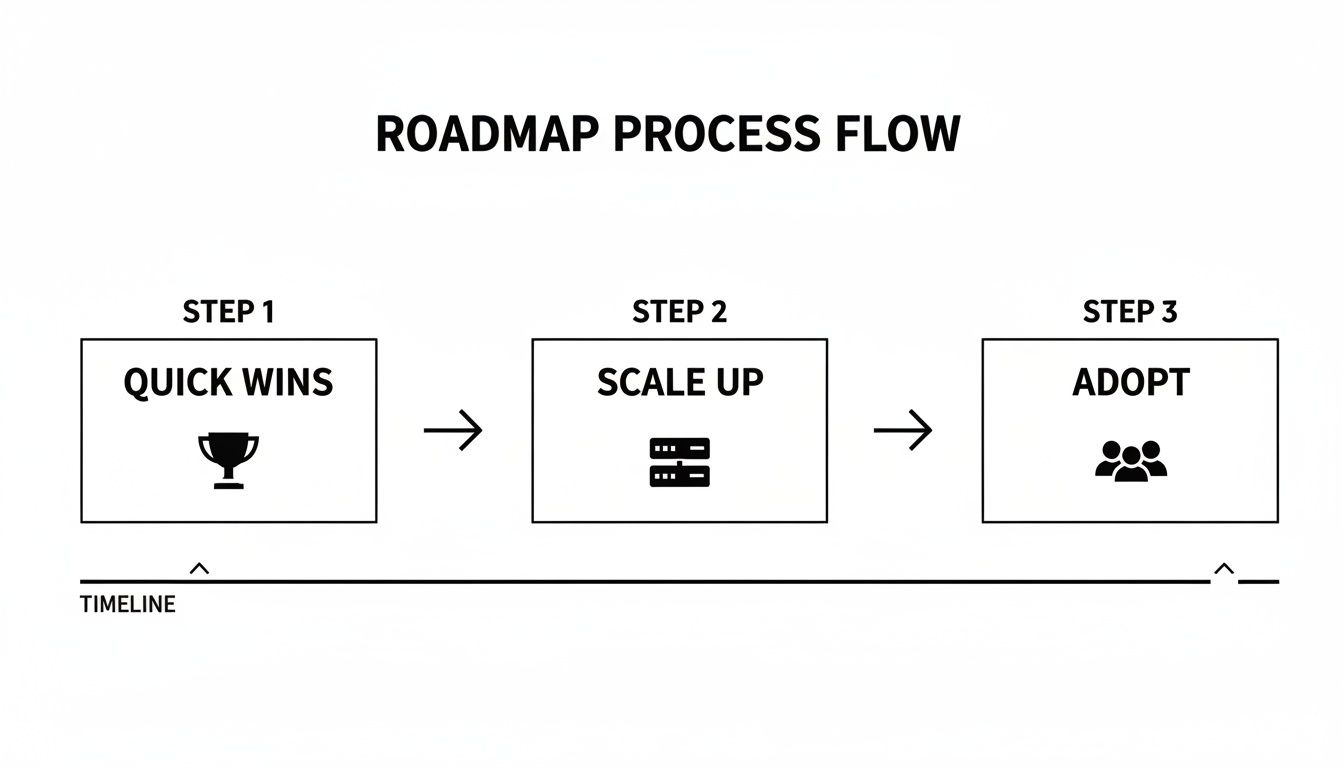
Progressing from quick wins to a full-scale rollout is an intelligent strategy to de-risk the investment while building momentum and conviction within the company.
A Simple Framework for ROI Modelling
Modelling the potential return on investment for an analytics and big data project does not require a doctorate in finance. A straightforward framework can communicate the value proposition effectively and build a robust case for moving forward.
Ready to Build Your AI Project?
Let's discuss how we can help you ship your AI project in weeks instead of months.
A credible ROI model does more than project future gains; it creates a shared understanding of what success looks like and establishes a baseline against which performance will be rigorously measured.
Here is a simple, step-by-step process for building your business case:
- Establish a Clear Baseline: Before initiating any project, you must define the starting point. What is the current machine downtime rate? What is your existing customer churn percentage? This baseline is the non-negotiable starting point for measuring improvement.
- Estimate the Potential Impact: Use industry benchmarks and results from small-scale pilots to project a realistic improvement. For instance, a predictive maintenance pilot might indicate a potential 20% reduction in unscheduled downtime.
- Quantify the Financial Value: Translate the operational improvement into a monetary figure. What is that 20% downtime reduction worth in saved repair costs, preserved production output, and avoided overtime?
- Calculate the Total Investment: Be exhaustive. Sum all costs—technology licenses, infrastructure, implementation services, and the time your internal team will dedicate to the project.
- Determine the ROI: Finally, perform the calculation: (Financial Gain - Total Investment) / Total Investment. This yields a clear, defensible percentage that speaks directly to leadership's primary concerns.
By following this disciplined approach, you can reframe your analytics and big data initiatives from a perceived cost centre into a proven engine for strategic value and profitability.
Navigating Your Journey with a Strategic Partner
Recognising the potential of analytics and big data is one thing; achieving enterprise-wide adoption that drives tangible value is another challenge entirely. The path is often impeded by technical complexity, formidable compliance hurdles such as GDPR and TISAX, and internal projects that fail to keep pace with market demands.
It is a common scenario: promising initiatives stall, and potential competitive advantages devolve into costly, protracted exercises.
Want to Accelerate Your Innovation?
Our team of experts can help you turn ideas into production-ready solutions.
This is where the traditional consulting model often proves inadequate. It delivers theoretical roadmaps that frequently lack the entrepreneurial speed and shared risk required to translate strategy into functional, working systems. A different approach is needed—one built on genuine partnership, not just arm’s-length advice.
The Co-Preneurial Alternative
We advocate for a "Co-Preneur" model—a true partnership at eye-level, designed for the AI era. We replace the standard consultant-client dynamic with shared accountability for business outcomes. This model blends the methodical de-risking of corporate strategy with the focused velocity of a start-up. Ideas are not merely discussed; they are rapidly validated with functional prototypes.
This approach is designed to accelerate your journey from a promising concept to a market-ready innovation. It focuses on building momentum through rapid, validated learning cycles and ensuring every step forward is secure, compliant, and directly aligned with your strategic objectives.
A true strategic partner does not simply provide a map; they join your expedition. They share the risks, celebrate the victories, and remain accountable for reaching the destination together. This shared commitment is the key to navigating the complexities of modern data initiatives.
An End-to-End Approach for Faster Outcomes
To succeed, you need a partner whose capabilities span the entire innovation lifecycle. A fragmented approach—where strategy, engineering, security, and team enablement are managed by separate vendors—creates friction and delays. An integrated, end-to-end partnership ensures smooth and rapid progress.
Looking for AI Expertise?
Get in touch to explore how AI can transform your business.
This unified model is built on four critical pillars:
- Strategy: Defining clear use cases and constructing a business case that withstands scrutiny.
- Engineering: Building robust, production-ready AI systems and data pipelines that perform reliably.
- Security: Ensuring every deployment meets the highest standards of compliance and data governance.
- Enablement: Equipping your teams with the skills to foster a data-first culture from within.
By integrating these disciplines, a co-preneurial partner significantly shortens the path to value. This is not merely about implementing technology; it is about co-creating a lasting competitive advantage and securing your company's future. Let's start a conversation about how we can build that future together.
Frequently Asked Questions
When discussing analytics and big data, several key questions consistently arise in leadership meetings. Here are direct answers to the most common queries we hear from business leaders in Germany.
What is the Appropriate Budget for Such an Initiative?
There is no single figure; the investment is contingent upon the scope of the initiative. A quick-win project focused on a single pain point, such as optimising one production line, represents a modest investment. A full-scale, enterprise-wide transformation is a more significant line item.
The key is to reframe the expenditure as an investment with a clear return. First, calculate the current cost of the problem you aim to solve. For example, if unscheduled downtime costs your business €500,000 annually, an investment of €150,000 in a predictive maintenance solution that reduces that downtime by 50% presents a clear and rapid return.
Is It Necessary to Hire a Team of Data Scientists?
Not immediately. While complex modelling will eventually require specialised expertise, the initial phases are centered on data engineering and sound business analysis. The immediate priority is to establish a solid data foundation and identify the use cases that will deliver tangible business value.
Many companies achieve an optimal balance by engaging a strategic partner. This provides immediate access to top-tier expertise without the significant costs and challenges of recruitment. It is an intelligent way to prove the value of an initiative before committing to building a large internal team.
How Should We Address Data Privacy and GDPR Compliance?
This is non-negotiable. Compliance cannot be an afterthought; it must be integrated into your data architecture from day one. Any project involving analytics and big data demands a robust governance framework.
In practice, this framework includes several key components:
- Data Mapping: Maintain a precise inventory of what data you collect, where it is stored, and who has access to it.
- Anonymisation & Pseudonymisation: Employ technical methods to remove personal identifiers from data wherever possible.
- Access Controls: Implement strict, role-based access to ensure individuals only see the data essential for their job functions.
- Appoint a Data Protection Officer (DPO): Assign accountability. Clear ownership is crucial for maintaining compliance.
By embedding these principles into your strategy from the outset, you build a secure and trustworthy foundation for your data initiatives.
Ready to Build Your AI Project?
Let's discuss how we can help you ship your AI project in weeks instead of months.
At Reruption GmbH, we are more than consultants; we are your co-preneurial partners. We transform complex data challenges into measurable business outcomes—with the speed and accountability you require. Discover how we can accelerate your journey from concept to impact at https://www.reruption.com.