
Integrating artificial intelligence on a project-by-project basis often creates more organisational friction than strategic value. A systems-level approach is required to translate technological potential into a durable competitive advantage.
Why Ad-Hoc AI Integration Fails

Business leaders across Germany face mounting pressure to integrate artificial intelligence into their operations. The immediate impulse is to launch individual AI tools within separate departments to demonstrate rapid progress. However, this fragmented approach—a chatbot in marketing, a forecasting model in finance—consistently generates long-term complexity that outweighs any short-term gains. It is a classic case of solving a minor problem today at the cost of creating a significant systemic challenge tomorrow.
This common misstep originates from a fundamental misunderstanding. The primary challenge in enterprise AI is not technological; it is a systems problem. Treating it as anything less guarantees significant capital misallocation and a failure to achieve strategic objectives.
The Engine Analogy
Consider the construction of a high-performance engine. One could procure superior pistons, a cutting-edge turbocharger, and a sophisticated fuel injection system. Individually, each component represents a feat of engineering. Yet, assembling them without a master blueprint leads to a predictable outcome: friction, inefficiency, and eventual catastrophic failure. The components operate in conflict rather than in concert.
Ready to Build Your AI Project?
Let's discuss how we can help you ship your AI project in weeks instead of months.
This serves as a direct parallel for ad-hoc AI integration. The marketing department deploys a new chatbot, finance implements an automated forecasting tool, and manufacturing trials a predictive maintenance model. Each tool may show promise in isolation, but they function as disconnected entities.
An organisation’s ability to generate value from AI is not determined by the quality of its individual models, but by the coherence of the system into which they are integrated. Without a blueprint, you are building a collection of parts, not a capability.
This fragmentation inevitably leads to significant operational impediments:
- Data Silos: Each AI tool becomes an isolated data repository, precluding a holistic, cross-functional view of the enterprise.
- Fragile Workflows: Key business processes become brittle, vulnerable to disruption from minor application updates or changes in data sources.
- Inability to Scale: Solutions effective for one team cannot be efficiently replicated or expanded across the organisation, resulting in duplicated effort and escalating costs.
A Strategic Framework Is Essential
These disconnected initiatives create an IT architecture that is complex, expensive to maintain, and fundamentally incapable of supporting strategic goals. To circumvent these pitfalls, a structured methodology for successful AI integrations is not merely advantageous—it is mission-critical for sustained success. The alternative is a collection of siloed AI projects that fail to deliver a meaningful return on investment. This is a primary reason why many ambitious AI initiatives, such as internal copilots, often underperform. For a detailed analysis of this topic, see our guide on how to build AI copilots that deliver real value.
This is precisely where the discipline of system engineering in IT provides its value. It offers the strategic framework—the architectural blueprint—that ensures all technological components, including new AI models, function as a cohesive, high-performance whole. It shifts the corporate mindset from procuring technology to systematically building an enterprise-wide capability. This methodical approach is the sole means of transforming AI investments into predictable, reliable, and scalable business advantages.
Defining System Engineering for Your IT Organisation

At its core, system engineering in IT is the executive discipline for managing the entire technology estate as a unified system. It applies architectural rigour to ensure every component—from legacy ERP systems to nascent AI models—operates in concert predictably. This practice governs the complete lifecycle, from initial business concept through to eventual decommissioning.
Consider the role of a city planner. No planner would permit developers to construct roads, utilities, and high-rises in a random, disconnected manner. They operate from a master plan, ensuring each new structure integrates seamlessly into the existing infrastructure to support the city's long-term viability and growth. System engineering performs this exact function for your IT organisation.
It represents a deliberate transition from managing isolated projects to delivering holistic, enterprise-wide outcomes. The objective is to construct a technology ecosystem that reliably serves core business objectives.
Shifting Focus From Parts to Performance
Traditional IT management is often constrained by departmental silos. Disparate teams oversee their respective applications with limited insight into how a change in one domain might precipitate a failure in another. This is the root cause of many unforeseen integration failures, schedule overruns, and brittle systems that are difficult to adapt.
Want to Accelerate Your Innovation?
Our team of experts can help you turn ideas into production-ready solutions.
System engineering is the antidote to this fragmentation. It concentrates on the critical interactions between system components.
It establishes a stable, well-documented architecture where the rules of engagement for every component are explicitly defined. Such foresight is non-negotiable when introducing powerful technologies like AI. For example, instead of merely connecting a new AI sales forecasting model to a database, a systems approach defines precisely how that model must securely access data, interface with the CRM, and transmit insights to the inventory management system—all without degrading overall system performance.
System engineering is the architectural discipline for guaranteeing that the sum of your technology parts creates a strategic advantage, not just a collection of expensive, disconnected assets.
This methodical approach delivers tangible business value by ensuring technology investments mature into operational capabilities. The benefits are clear and measurable:
- Reduced Integration Costs: Designing for interoperability from the outset obviates the expensive, time-consuming effort of forcing disparate systems to communicate post-implementation.
- Predictable Project Timelines: A clear architectural blueprint drastically reduces unforeseen technical hurdles and dependencies, enhancing the reliability of project delivery.
- Enhanced System Reliability: A holistic, end-to-end understanding of the system enables more robust testing and validation, which significantly mitigates the risk of critical production failures.
The Growing Mandate for a Systems Approach
The imperative for this discipline is reflected in market data. In 2023, Germany’s market for engineering and system-related software generated approximately USD 3.38 billion in revenue. This figure is projected to reach roughly USD 11.36 billion by 2030, a surge driven by the immense integration challenges of digital twins, electrification, and AI-powered workflows. You can explore the full research on Germany's engineering software market.
Looking for AI Expertise?
Get in touch to explore how AI can transform your business.
This growth underscores a critical reality for German enterprises: as technology stacks become more complex, a structured, engineering-led methodology is the only viable path to maintain control and extract value. The principles of system engineering provide the foundation for building resilient, adaptable IT ecosystems. For companies seeking to apply these principles specifically to artificial intelligence, a structured AI engineering service offers a clear implementation path.
Ultimately, adopting a system engineering in IT mindset is no longer optional. It is a prerequisite for any organisation serious about building a durable competitive advantage through technology.
The System Lifecycle From Concept to Retirement
A primary source of anxiety for any executive sponsoring a major technology initiative is the perception of losing control. Projects frequently disappear into a technical 'black box', only to re-emerge months later over budget and misaligned with business requirements. System engineering in IT addresses this challenge directly by replacing uncertainty with a clear, structured governance model: the system lifecycle.
This should be viewed not as a technical checklist but as a strategic framework for leadership. It decomposes a large, complex project into distinct, manageable phases, each with clear, business-focused objectives. This structure ensures decision-makers retain control and visibility, from initial concept to final system retirement.
To illustrate, consider the deployment of a new, enterprise-wide, AI-powered platform to optimise the supply chain.
Phase 1: Requirements Definition
The process begins not with code, but with a precise understanding of the business problem. In this initial phase, executive and technical teams collaborate to translate high-level strategic goals into measurable system requirements. For our supply chain platform, this means moving beyond a vague objective like "improve efficiency."
Instead, we establish tangible, quantifiable outcomes:
- The system must reduce warehouse carrying costs by 15% within the first fiscal year.
- It must decrease stock-out incidents for top-selling products by 25%.
- It must integrate seamlessly with the current ERP and logistics partners' systems via secure, well-documented APIs.
Success in this phase is critical. It prevents scope creep and ensures the final product is engineered to solve specific business challenges.
Phase 2: Architectural Design
With clear requirements established, the next step is to develop the master blueprint. This is the architectural design phase, where the system's structure, its components, and their interconnections are mapped. This stage is paramount for preventing the creation of isolated data islands—a classic error that neutralises the value of large-scale AI investments.
For our AI platform, architects would delineate how the predictive model ingests data from sales, inventory, and supplier feeds. They would define precise data formats, specify security protocols, and chart the flow of information across the entire business ecosystem.
Ready to Build Your AI Project?
Let's discuss how we can help you ship your AI project in weeks instead of months.
The architectural design phase is where strategic foresight prevents future technical debt. It guarantees that new capabilities, like an AI platform, are woven into the enterprise fabric, not just bolted on at the edge.
This deliberate design ensures the AI system can access the necessary data from across the organisation, preventing it from becoming another expensive, isolated silo.
Phase 3: Integration and Verification
This phase translates the architectural vision into a functional reality. Individual components—the AI model, the user interface, the database connectors—are developed and then systematically integrated into a cohesive system. Once assembled, the system undergoes rigorous verification and validation.
This process extends beyond simple bug detection. Verification confirms that the system meets the specific business requirements defined in Phase 1. Does the platform accurately predict demand spikes? Can it process high data volumes at month-end without performance degradation? Answering these questions confirms not only that the system was built correctly, but that the correct system was built.
Rapid, iterative cycles offer a significant advantage here. For example, applying an agile framework like Reruption’s enables teams to deliver productive AI systems in just three weeks by focusing on accelerated integration and validation cycles.
Phase 4: Operations and Retirement
Following successful verification, the system is deployed into the live business environment. This initiates the operations and maintenance phase, which encompasses performance monitoring, update management, and ensuring sustained reliability. It is a continuous process to guarantee the system continues to deliver its intended value.
However, every system eventually reaches the end of its useful life. The retirement phase ensures a clean decommissioning, with data securely archived and dependent business processes smoothly transitioned to a successor system. This planned exit strategy prevents the accumulation of unsupported legacy systems that pose security risks and operational burdens. By managing the full lifecycle, leadership ensures technology serves its purpose and is gracefully retired before it becomes a liability.
Building Your System Engineering Capability
A robust systems engineering framework is not self-generating. It is constructed upon a foundation of skilled personnel and disciplined practices, deeply embedded within the organisation's operating model. A mere declaration of intent is insufficient. A deliberate plan is required to establish this function, providing teams with the roles, skills, and tools necessary to manage complexity and achieve predictable outcomes.
This is fundamentally an organisational design challenge. It requires creating new roles with clear mandates and equipping them with proven engineering disciplines to mitigate risk and ensure technology investments align with business strategy.
Establishing Essential Roles and Responsibilities
To operationalise system engineering in IT, two roles are non-negotiable: the Systems Architect and the Integration Lead. These should be viewed not merely as job titles, but as strategic functions that bridge the gap between executive objectives and technical execution.
Want to Accelerate Your Innovation?
Our team of experts can help you turn ideas into production-ready solutions.
The Systems Architect serves as the master planner for the entire technology landscape. They are responsible for creating and maintaining the high-level blueprint, ensuring that every new component—particularly a complex AI system—integrates coherently. Their primary business impact is risk mitigation, preventing the creation of costly data silos and brittle solutions that fail under operational stress.
The Integration Lead functions as the on-the-ground commander, ensuring that disparate systems communicate as designed. They manage the complex technical work of achieving interoperability. Their core contribution is delivery assurance, transforming the architect’s strategic vision into a functional, reliable reality.
Sourcing personnel with this strategic, cross-domain skillset is a significant challenge. Germany's technology sector is highly competitive, with projections of over 137,000 open roles in 2025 across AI, cybersecurity, and cloud infrastructure. The competition for talent capable of building and managing complex systems underscores the need for strategic workforce planning. A broader perspective on Germany's competitive tech job market on Nucamp.co provides additional context.
Implementing Key Engineering Practices
Beyond personnel, specific practices must be institutionalised. Two of the most impactful are disciplined requirements management and Model-Based Systems Engineering (MBSE).
The diagram below illustrates how this structured approach proceeds logically from a business need to an operational system, guided by these engineering disciplines.
Looking for AI Expertise?
Get in touch to explore how AI can transform your business.
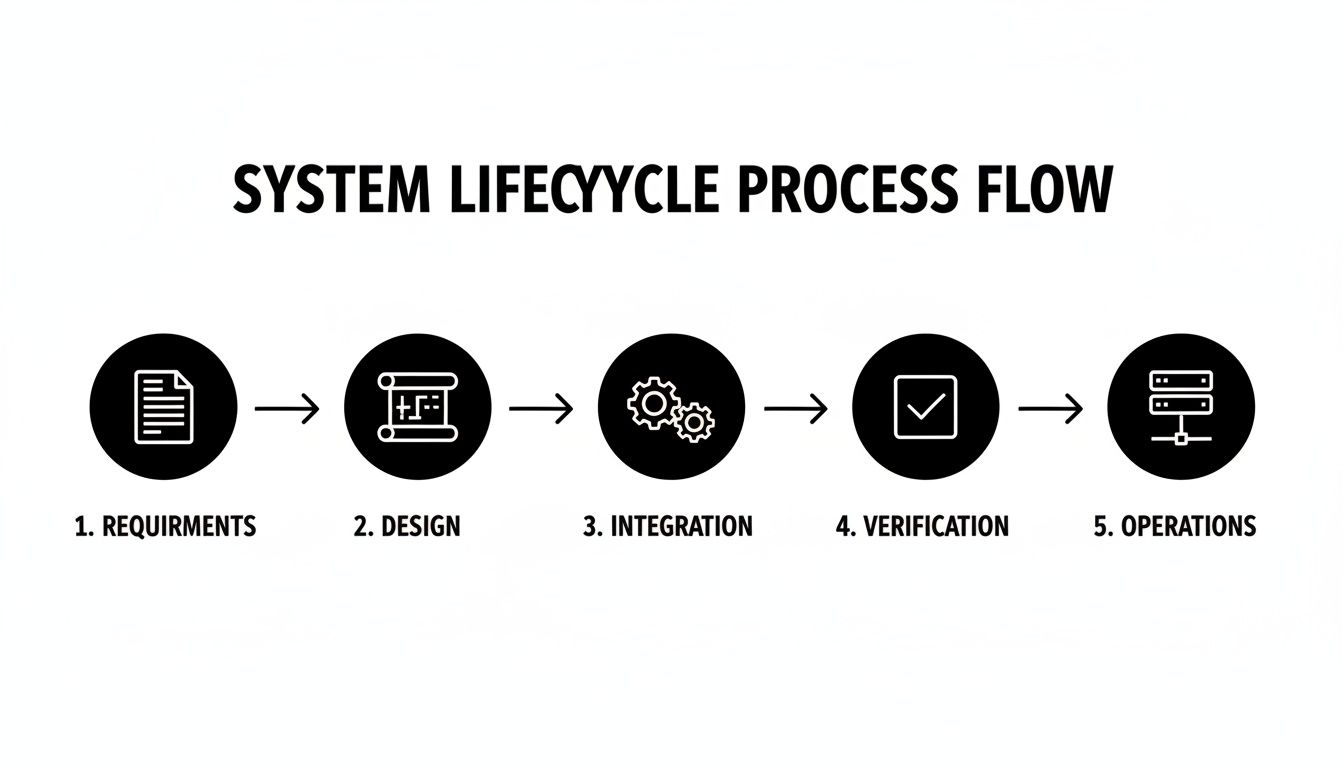
This lifecycle is not a theoretical model; it is a roadmap for avoiding the costly rework and project delays that result from ambiguous requirements and inadequate architectural planning.
Model-Based Systems Engineering (MBSE) is a particularly potent tool. It involves creating a dynamic 'digital twin' of the entire IT system. This is not a static diagram but a live model that allows leadership to simulate the impact of changes—such as integrating a new AI tool—on performance, security, and cost before committing capital or development resources.
This simulation capability radically reduces deployment risk and provides executives with empirical data to support major technology decisions. A grasp of these methods is essential for any leader aiming to deploy AI effectively, a point reinforced in discussions of Top 10 MLOps Best Practices.
Ultimately, building this capability is a strategic journey requiring intentional design, targeted recruitment, and a commitment to disciplined execution. While challenging, it is the only reliable method for transforming an IT department from a cost centre into a strategic asset. Acquiring these skills can be accelerated through targeted training and knowledge transfer, which are core components of any serious AI enablement strategy.
Measuring Success and Navigating the Pitfalls
The transition to a disciplined system engineering in IT model represents a significant operational transformation, and like any substantive change, it presents challenges. Proactive identification of these hurdles is crucial for effective navigation. Leaders who anticipate these issues can guide their organisations through the transition and ensure the investment yields tangible strategic returns.
The most formidable barrier is typically cultural, not technical. Departments accustomed to autonomous operations may resist new governance models and design reviews, often stemming from a fear of losing control or being encumbered by process. This is a predictable human response that requires direct and strategic leadership.
Another significant hurdle is the upfront investment in tools and training. The adoption of practices like Model-Based Systems Engineering (MBSE) necessitates new software and, more critically, a concerted effort to upskill technical teams. This initial expenditure can be difficult to justify if not framed as a long-term investment in operational excellence and risk reduction.
How Leaders Can Overcome Resistance
Overcoming these challenges requires clear, decisive leadership. The key is to demonstrate that system engineering enables faster, more reliable delivery of high-quality solutions, rather than impeding progress.
- Execute a Pilot Project: Do not attempt an enterprise-wide rollout initially. Select a single, high-visibility project to serve as an internal proof-of-concept. Its success will generate momentum and cultivate the internal champions necessary for broader adoption.
- Communicate the 'Why' Continuously: Frame the change in business terms. Explain how a systems approach reduces costly rework, prevents service outages, and accelerates the delivery of stable, valuable products.
- Invest in Personnel: Provide high-quality training and establish clear career progression paths for roles such as the Systems Architect. This demonstrates a genuine organisational commitment to valuing these skills.
While overcoming these hurdles is critical, the ultimate goal is to deliver demonstrable business value. This requires defining success with clear, business-centric Key Performance Indicators (KPIs), not technical jargon.
Defining Success with Business-Centric KPIs
To validate the investment and monitor progress, leadership requires a dashboard that links engineering discipline directly to financial and operational performance. The focus must be on outcomes, not activity.
Measuring success in system engineering isn't about counting how many design reviews you’ve held. It’s about putting a number on how much business risk you’ve reduced and how much faster you’re delivering value to your customers.
The right KPIs shift the conversation from technical minutiae to strategic impact. They provide the empirical evidence needed to substantiate the approach and maintain executive support.
Consider the following metrics that demonstrate the return on investment from a system engineering approach.
Key Performance Indicators for System Engineering Success
| Metric Category | Key Performance Indicator (KPI) | Business Impact |
|---|---|---|
| Financial Efficiency | Reduction in project rework costs by 20-30% | Directly cuts wasted expenditure and frees up capital for new innovation projects. |
| Operational Stability | Decrease in critical system outages post-deployment | Enhances customer trust, protects revenue streams, and reduces strain on support teams. |
| Market Agility | Improvement in time-to-market for new digital services | Increases competitive advantage by allowing the organisation to respond faster to market demands. |
| Quality & Reliability | 40% reduction in high-severity defects found in production | Lowers maintenance costs and protects brand reputation by delivering more reliable products. |
By monitoring these KPIs, leaders can transform the abstract concept of system engineering in IT into a powerful, data-driven strategy for building a more resilient and innovative enterprise. This focus on a measurable return is the ultimate justification for the discipline required.
Your Phased Enterprise Adoption Roadmap
Integrating a system engineering in IT discipline does not require a high-risk, 'big bang' overhaul. The proven path, particularly for large enterprises, is a pragmatic, phased rollout.
The strategy hinges on initiating with a single, high-impact pilot project. A successful execution that demonstrates undeniable business value will generate the internal support required for broader implementation.
This approach transforms a daunting organisational shift into a sequence of manageable, value-creating steps. The primary objective is to build a lasting internal capability, which begins with securing early, decisive victories. This is especially true when integrating complex AI solutions, where a successful initial deployment builds critical momentum for subsequent initiatives.
Selecting the Right Pilot Project
The first priority is selecting a pilot project that is both highly visible and strategically meaningful. The ideal candidate addresses a persistent operational pain point or creates a new, tangible benefit for customers.
For example, developing a customer-facing AI application to personalise service offerings is an excellent choice. The objective is specific, the value is clear, and success is easily measurable.
Ready to Build Your AI Project?
Let's discuss how we can help you ship your AI project in weeks instead of months.
A successful pilot must meet several criteria:
- Clear Business Case: It must have a direct, quantifiable impact on revenue, cost, or customer satisfaction. Ambiguous metrics are not acceptable.
- Defined Scope: The project must be complex enough to be meaningful but contained enough to be completed within a reasonable timeframe.
- Executive Sponsorship: A dedicated senior leader must serve as a champion, empowered to remove obstacles and advocate for this new methodology.
Once the project is selected, a dedicated, cross-functional team is essential. This team must include representatives from the business units directly impacted by the project, not just engineers. This ensures the resulting solution is not only technically sound but also precisely aligned with real-world operational requirements. This principle helps avoid the common pitfalls of legacy migrations, as detailed in our guide on lift-and-shift strategies.
Accelerating the Journey with Strategic Partnerships
For most organisations, the initial pilot project serves as a significant learning opportunity. A strategic partnership can accelerate this process considerably. Engaging external experts, such as Reruption's 'Co-Preneurs', embeds deep expertise directly within your team during the critical design and integration phases.
A partnership is not about outsourcing the work; it’s about importing the methodology. The right partner works with your team, transferring knowledge and embedding best practices. They’re helping you build the organisational muscle for every initiative that comes next.
This co-creation model de-risks the crucial first project while building a solid foundation of internal skill. As your team internalises these new ways of working, the reliance on external support diminishes, leaving a self-sufficient, high-performing engineering culture.
Want to Accelerate Your Innovation?
Our team of experts can help you turn ideas into production-ready solutions.
The demand for these integrated skills is escalating. Germany's IT market is projected to grow by approximately USD 33.3 billion between 2024 and 2029, fuelled by digital infrastructure investments that require precisely these robust systems integration capabilities. A detailed analysis of Germany’s IT market trends provides further data.
By starting with a focused pilot, proving value, and strategically leveraging external expertise, you can build a powerful system engineering function. This measured, step-by-step roadmap transforms the grand ambition of enterprise-wide AI adoption into an achievable reality.
Frequently Asked Questions
Is Systems Engineering Only for Large Hardware Projects?
This is a common misconception, originating from the discipline's roots in the aerospace industry. Today, its principles are indispensable for developing complex software systems, particularly those involving AI, cloud infrastructure, and distributed architectures.
It provides the only viable framework for managing the modern challenge of ensuring disparate technologies interoperate to deliver a reliable, high-performing system. Without it, organisations are left with a project-by-project assembly approach that inevitably leads to costly failures and operational instability.
How Can We Adopt This Without a Massive Upfront Investment?
A large-scale, 'big bang' implementation is not necessary and is often inadvisable. The most effective approach is to begin with a single, high-impact pilot project.
Looking for AI Expertise?
Get in touch to explore how AI can transform your business.
This allows the team to learn the methodology in a focused context, demonstrate tangible business value, and build a compelling case for wider adoption. It validates the concept without disrupting the entire organisation.
Partnering with external experts on that first project is a smart move. It takes a lot of the risk out of the equation and dramatically speeds up your team's learning curve, embedding the new way of working without a painful, top-down restructure.
Does Systems Engineering Conflict With Agile Methodologies?
On the contrary, they are highly complementary. The two methodologies form a powerful combination for delivering modern technology solutions.
Systems engineering provides the high-level architectural blueprint. It defines the stable interfaces between system components—the what the system must do and how its parts connect.
Agile methodologies then empower teams to rapidly build and iterate on individual components within that stable framework. It governs the how the work is executed, providing speed and flexibility. This synergy offers the best of both worlds: a robust, strategic architecture and fast, iterative delivery.
Ready to Build Your AI Project?
Let's discuss how we can help you ship your AI project in weeks instead of months.
Ready to turn your AI concepts into enterprise-grade capabilities with a proven engineering discipline? As Co-Preneurs, Reruption partners with you to implement robust systems that deliver measurable business outcomes. Let's build your next innovation together. Discover our AI Engineering services.