
In the arena of corporate strategy, a major transaction is not a mere financial entry; it is a pivotal event that defines a company's trajectory. For C-suite executives in Germany, navigating these high-stakes manoeuvres requires exceptional foresight and analytical rigour. This is the domain of transaction advisory services—a critical strategic partnership designed to provide the intelligence and objectivity necessary to execute transformative deals with confidence.
Why Transaction Advisory Is a Strategic Imperative
For any leadership team, a merger, acquisition, or divestiture represents a moment of profound strategic consequence. The success of such an undertaking hinges on a series of critical decisions made under significant pressure. Attempting this complex process with only an internal team is akin to navigating treacherous waters without an expert navigator—the risk of overlooking hidden liabilities or misjudging valuation is unacceptably high.
This is the core purpose of transaction advisory. It is not a procedural cost to be minimised but a strategic investment that guides leadership through the entire transaction lifecycle. The scope extends far beyond a standard due diligence checklist; it is about ensuring every facet of the deal aligns with the company’s long-term value creation objectives.
From Tactical Execution to Strategic Vision
An expert advisor transforms the deal process from a reactive, tactical exercise into a proactive, strategic endeavour. They introduce an objective, data-driven perspective that is nearly impossible to maintain from within the organisation during a high-pressure transaction. This external viewpoint is essential for challenging internal assumptions and rigorously validating the strategic rationale underpinning the deal.
Key contributions typically include:
Ready to Build Your AI Project?
Let's discuss how we can help you ship your AI project in weeks instead of months.
- Comprehensive Risk Assessment: Identifying and quantifying the financial, operational, and commercial risks that could derail a transaction or erode its value post-close.
- Defensible Valuation: Employing robust methodologies to establish a fair and defensible valuation, strengthening the negotiating position and preventing overpayment.
- Post-Merger Integration Strategy: Architecting a clear roadmap to capture synergies and ensure a seamless operational transition, where the true value of a transaction is ultimately realised or lost.
A successful transaction is not measured on the day it closes, but by the value it continues to generate years later. Expert advisory ensures the foundation for this long-term success is laid before any definitive agreements are signed.
The market itself underscores the reliance on this expertise. Germany's management consulting sector, which encompasses transaction advisory, expanded to a market size of €47.7 billion in 2025. According to an IBISWorld industry report, this growth is propelled by the need for specialised guidance to navigate the complexities of the modern M&A landscape.
Ultimately, engaging a transaction advisor is a matter of sophisticated corporate governance. It equips the C-suite with the business intelligence required to de-risk pivotal decisions and maximise shareholder returns. For a deeper analysis of this function, consider our guide on what a business intelligence consultant contributes. In an environment of economic uncertainty, this form of strategic partnership is not merely beneficial—it is indispensable.
What Are The Core Components Of A Transaction?
To leverage a transaction advisory team effectively, leadership must first understand the fundamental components that constitute a successful deal. These are not discrete steps on a timeline but interconnected disciplines that synergise to mitigate risk and extract maximum strategic value from the transaction. Viewing the deal through this integrated framework provides executives with enhanced clarity and facilitates more informed decision-making at every stage.
Each component addresses a critical aspect of the transaction, from financial validation to the realisation of synergistic gains. A robust strategy integrates these elements, ensuring that insights from one area directly inform actions in another. This approach prevents the siloed thinking that frequently undermines a deal's value post-close.
Want to Accelerate Your Innovation?
Our team of experts can help you turn ideas into production-ready solutions.
To clarify how these elements interrelate, the following table deconstructs the core components of a typical transaction advisory engagement. It illustrates not only the function but also the strategic importance for leadership and the critical questions each component is designed to answer.
Core Components of Transaction Advisory Services
| Advisory Component | Strategic Function | Key Executive Question Answered |
|---|---|---|
| Financial Due Diligence | Validates the target's financial health and exposes hidden liabilities or risks. | "Are the reported financials accurate, and what latent risks exist?" |
| Valuation | Determines a defensible price range for negotiation and strategic decision-making. | "What is the intrinsic value of this enterprise, and what is our optimal offer?" |
| Deal & Tax Structuring | Designs the transaction's architecture to maximise financial returns and tax efficiency. | "What is the most intelligent way to structure this deal to preserve and enhance value?" |
| Post-Merger Integration (PMI) | Creates a tangible roadmap to combine operations and realise projected synergies. | "How do we ensure the successful capture of the value we are acquiring?" |
By understanding these functions, executive leadership can better direct their advisory team and ensure that every action taken aligns with the ultimate strategic objectives.
Financial Due Diligence: The Financial X-Ray
At the foundation of any transaction lies financial due diligence. This process is best understood as a forensic financial examination—a high-resolution analysis of the target company that reveals the reality beneath the surface of its financial statements. The objective is to verify reported figures, challenge underlying assumptions, and uncover any hidden liabilities or risks that could fundamentally invalidate the deal's strategic premise.
This goes significantly beyond a standard audit. Advisors delve into the quality of earnings, dissect working capital trends, and identify potential off-balance-sheet exposures. For leadership, this provides a clear, objective verdict on the target's financial stability and the credibility of its projections, forming the bedrock upon which the valuation is built.
Valuation and Strategic Deal Structuring: Determining Price and Method
With a clear financial picture established, the focus shifts to valuation. This is where quantitative analysis meets strategic judgment. It involves a blend of methodologies—such as Discounted Cash Flow (DCF) analysis and comparable company analysis—to arrive at a price range that can be confidently defended. A precise valuation is a powerful negotiation tool; it provides the conviction to justify an offer or, equally important, to withdraw from a transaction that is overvalued. For businesses navigating complex M&A, the intricacies of these valuation processes are critical. These dynamics are explored further in this guide on Mergers & Acquisitions services in Dubai.
Looking for AI Expertise?
Get in touch to explore how AI can transform your business.
Concurrently, the method of the transaction must be architected. This is the domain of strategic deal structuring and tax advisory. An optimal structure can unlock significant financial benefits and mitigate tax inefficiencies. Key considerations include:
- Asset vs. Share Purchase: Determining the most advantageous acquisition method based on liability transfer and tax implications.
- Financing Mix: Structuring the right blend of debt and equity to finance the transaction without over-leveraging the combined entity.
- Tax Efficiency: Engineering the structure to minimise tax liabilities for all parties, thereby directly enhancing the net return on investment.
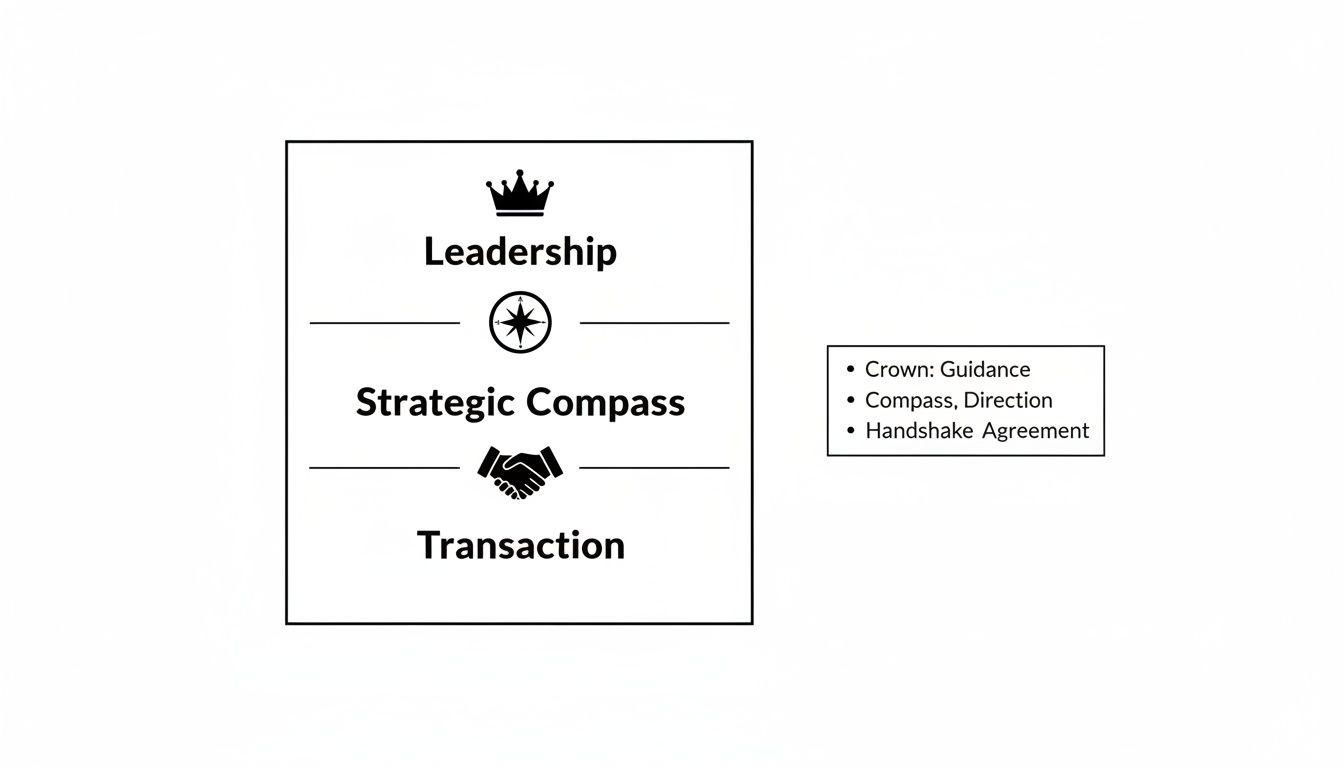
As illustrated, a successful transaction is not a product of chance. It is the direct outcome of a clear strategic vision, translated into executable action through expert advisory and decisive leadership.
Post-Merger Integration: Where Value Is Realised
The final and arguably most critical component for long-term success is Post-Merger Integration (PMI). A transaction is only successful if the promised synergies are actually achieved. PMI represents the operational blueprint for combining two organisations, capturing that value, and minimising business disruption.
A common strategic error is to treat integration as a post-close concern. Elite advisory firms begin planning for PMI during the due diligence phase, identifying operational synergies and potential cultural conflicts long before any agreement is signed.
Ready to Build Your AI Project?
Let's discuss how we can help you ship your AI project in weeks instead of months.
This proactive approach ensures that from day one, a clear plan exists to unify systems, processes, and personnel. A robust PMI plan is laser-focused on retaining key talent, maintaining business momentum, and rigorously tracking the achievement of synergy targets. Data is indispensable here; for further reading, see our guide on analytics and insights. Without a meticulously planned integration, even the most strategically sound acquisition will fail to deliver its intended value.
Knowing When to Engage a Transaction Advisor
Timing is a critical determinant of success. The decision of when to engage external advisors is as crucial as the selection of the firm itself. A premature engagement can be inefficient, while a late one relegates the advisor to a validation role for a pre-determined course of action. For leadership teams, particularly in Germany, identifying the optimal moment for engagement separates proficient deal-making from strategic excellence.
Engaging an advisor early transforms the nature of the dialogue. Instead of merely validating a decision laden with emotional and strategic investment, an advisor engaged at the conceptual stage can pressure-test core assumptions. They can identify market opportunities that may have been overlooked and architect the deal for maximal value from inception. This is about pre-empting costly missteps before significant resources are committed to a specific path.
Strategic Triggers Beyond the Obvious
While a planned acquisition is the archetypal trigger, numerous other strategic situations possess a latent complexity that may exceed the specific expertise of an internal team. Recognising these moments is a hallmark of forward-thinking leadership.
Consider these key triggers:
Want to Accelerate Your Innovation?
Our team of experts can help you turn ideas into production-ready solutions.
- Preparing for a Capital Raise: Before engaging with investors, an impartial and robust assessment of the company's financial health and growth narrative is paramount. Advisors prepare the company for the intense scrutiny of due diligence, helping to construct a clear, defensible valuation and a compelling investment thesis.
- Divesting a Non-Core Asset: Carving out a business unit is a complex undertaking, akin to surgical separation. Advisors manage the intricate process of creating standalone financial statements, identifying the optimal pool of potential buyers, and structuring the sale to minimise tax liabilities and operational disruption.
- Receiving an Unsolicited Offer: An unexpected acquisition proposal can create a high-pressure environment in the boardroom, leading to reactive decisions. An objective advisor provides an immediate and dispassionate assessment of the offer's intrinsic value, the bidder's credibility, and the strategic fit, enabling a response from a position of strength and control.
Case Study: A German Mittelstand Divestiture
Consider a successful German automotive supplier with a division manufacturing components for internal combustion engines. This unit, historically a strong cash generator, is now misaligned with the company's strategic shift towards electric mobility. The board decides to divest the legacy division and reinvest the capital into EV technology development.
By engaging transaction advisors early, the company moved beyond a simple sale process. The advisors conducted a deep operational analysis, revealing that the division's true value lay not in its existing contracts, but in its specialised manufacturing equipment and highly skilled workforce—assets directly transferable to the aerospace industry.
This shift in perspective—from selling a "legacy auto parts maker" to marketing a "high-precision engineering asset"—fundamentally altered the strategic options. It unlocked a new universe of potential buyers and significantly increased the valuation potential. The advisors then orchestrated a discreet, competitive process, securing a premium valuation from an aerospace firm the supplier had never considered.
What could have been a standard divestiture became a strategic masterstroke, unlocking value that would have remained invisible through an internally managed process focused on conventional buyers.
Understanding these critical inflection points—and acting decisively—is what differentiates companies that merely execute deals from those that leverage deals to architect their future. The real value is created long before the negotiation begins. For German companies navigating such transitions, aligning operations with modern strategies is vital; our guide on the digitalisation of companies offers broader context on this corporate transformation.
How to Select the Right Advisory Partner
The selection of an advisory firm is one of the most consequential decisions a leadership team will make during a transaction. The right partner acts as a force multiplier, sharpening strategy and maximising value extraction. The wrong choice can lead to strategic friction, misjudged valuation, and potential deal failure.

Therefore, the selection process must be as rigorous as the due diligence you expect the firm to conduct. It requires moving beyond polished presentations to methodically vet for technical proficiency, strategic alignment, and a genuine commitment to your company's success, not merely the closing fee.
A C-Level Checklist for Vetting Advisors
When evaluating potential firms, executives must seek tangible evidence of expertise, a direct commitment from senior personnel, and a deep, intuitive understanding of your business environment. Utilise this framework to guide your selection process.
- Deep Sector Expertise in Germany: Does the firm possess profound, demonstrable knowledge of your industry within the specific context of the German market? They must be fluent in its unique regulatory landscape, competitive dynamics, and business culture. Request case studies from analogous companies.
- Proven Track Record with Similar Complexity: Has the firm navigated transactions of a comparable scale and complexity? A €50 million domestic acquisition presents different challenges than a €500 million cross-border merger. Scrutinise their deal sheet for recent, relevant successes.
- Guaranteed Senior Partner Engagement: The senior partners who present the pitch must be the same individuals who will be deeply involved in the day-to-day execution. Secure a clear commitment in the engagement letter that senior expertise will be consistently applied, not merely supervisory.
- Cultural and Strategic Alignment: Does the firm's advisory style align with your corporate culture? This partnership requires trust and transparent communication. You need an advisor who will challenge assumptions and act as a true counsellor, not a mere validator.
This structured approach enables leadership to see past superficial marketing and focus on the attributes that drive successful outcomes in high-stakes transaction advisory services.
Red Flags to Identify During Selection
Equally important to knowing what to look for is recognising what to avoid. These warning signs often indicate a misalignment between your needs and their service offering, or a lack of the specialised focus your transaction demands.
A one-size-fits-all methodology is a significant red flag, indicating a superficial, template-driven approach. Every transaction is unique, and your advisor’s strategy must be a bespoke analysis of your specific situation, not a recycled presentation.
Be vigilant for these other classic indicators:
- The 'Bait and Switch' Team: The senior team impresses during the pitch, only to be replaced by a more junior team for the actual engagement. This signals a lack of genuine commitment. You are procuring senior expertise; ensure its consistent delivery.
- Absence of Probing Questions: A superior advisor will pressure-test your strategy and ask the difficult questions you may be avoiding. If they passively agree with every assertion, they are not a strategic partner but a simple executor.
- Vague or Opaque Fee Structures: If a potential firm cannot provide a crystal-clear breakdown of its fee structure and the triggers for additional costs, it is cause for concern. Ambiguity regarding fees invariably leads to conflict and unexpected expenses.
Making the right choice is critical in the German M&A market. In the first half of 2025 alone, the market witnessed 1,296 transactions. While domestic M&A remained stable, private equity involvement increased significantly, accounting for 35% of all deals. This trend highlights a growing demand for sophisticated advisors who can navigate complex buy-and-build strategies in a competitive environment. You can discover more insights about Germany's M&A market. In this landscape, your choice of partner is not a peripheral detail—it is fundamental to success.
The Impact of AI on Transaction Advisory
Artificial intelligence is fundamentally reshaping the practice of transaction advisory. What was once an endurance-based discipline, reliant on large teams and extensive manual review, is rapidly evolving into a precise, data-driven science. For non-technical executives, it is essential to understand that AI does not replace human expertise; rather, it amplifies it, enabling a level of analytical depth previously unattainable.
Looking for AI Expertise?
Get in touch to explore how AI can transform your business.

This technology allows advisory teams to transition from analysing data samples to scrutinising entire datasets. It dramatically compresses timelines, converting weeks of labour-intensive work into days. Most importantly, it furnishes leadership with insights that were previously inaccessible.
Accelerating Due Diligence with Machine Learning
The most immediate application of AI in transaction advisory services is during due diligence. Traditionally, this process involved the manual review of thousands of contracts, financial records, and other documents within a data room—a slow, laborious process prone to human error.
AI-driven platforms fundamentally alter this paradigm. Utilising natural language processing (NLP) and pattern recognition, these systems can analyse vast quantities of unstructured data in minutes. They can instantly identify non-standard contractual clauses, flag anomalous revenue recognition patterns, or detect irregularities in supply chain data that a human analyst might overlook.
Practical applications include:
Ready to Build Your AI Project?
Let's discuss how we can help you ship your AI project in weeks instead of months.
- Risk Identification: An AI model can scan 10,000 customer contracts to isolate every instance of a specific high-risk liability clause—a task that would occupy a legal team for weeks can be completed in an afternoon.
- Opportunity Sourcing: AI can analyse operational data to pinpoint specific inefficiencies within a target company, directly quantifying potential post-acquisition synergies before the deal is even signed.
This synthesis of speed and depth results in a more rigorous and accurate risk assessment, elevating due diligence from a compliance exercise to a source of strategic intelligence. For further context on this technological shift, our guide on The Generative AI Revolution Is Here provides an excellent overview.
Enhancing Valuation with Predictive Analytics
Beyond due diligence, AI is also enhancing the precision and reliability of company valuations. Predictive modelling leverages historical data and market variables to run thousands of "what-if" scenarios, providing a more robust forecast of a target company's future performance.
Instead of relying on a few static assumptions, predictive analytics can model a target's revenue response to various macroeconomic shocks, such as a sudden increase in commodity prices, a downturn in consumer demand, or the entry of a new competitor. This yields a dynamic valuation range rather than a single, and often misleading, point estimate.
By employing predictive models, advisors can stress-test a transaction's financial assumptions against a multitude of potential future states. This provides the board with a much clearer understanding of the risk-reward profile, which is essential for making a confident final investment decision.
This data-centric approach strengthens the negotiation position, as it is grounded in statistical probabilities rather than conjecture. To understand how this is already transforming the investment landscape, consider this resource on AI's impact on VC value creation. It demonstrates how modern advisory models are integrating technology with deep human insight to achieve superior outcomes. The focus remains on leveraging AI as a tool to facilitate smarter, faster decision-making in the boardroom.
Measuring the ROI of Expert Advisory Services
For any significant corporate expenditure, the C-suite requires a clear, quantifiable return on investment. Transaction advisory fees are subject to the same scrutiny. It is essential to move beyond qualitative benefits and focus on how elite advisory work directly impacts financial outcomes.
These services should be viewed not as a cost centre, but as a high-yield investment in the success of the transaction. The return can be demonstrated through specific, measurable metrics tied to financial performance.
Defining Key Performance Indicators
To accurately gauge the return, the board should establish clear KPIs at the outset of the engagement. These metrics serve as the definitive measure of the advisor's direct contribution to the transaction's financial success.
Commonly utilised metrics include:
- Valuation Multiple Enhancement: This tracks the quantifiable increase in the final sale price or reduction in the purchase price attributable to negotiation strategy, due diligence findings, or intelligent deal structuring.
- Accelerated Closing Timeline: This measures the reduction in the transaction timeline achieved by pre-empting common roadblocks and efficiently managing complexities. Each week saved reduces operational disruption and associated costs.
- Avoided Post-Deal Liabilities: This calculates the financial value of risks identified by the advisors that were either mitigated through contractual protections or avoided entirely. This represents a direct and tangible cost saving. Our guide on risk management and compliance explores this critical area in greater detail.
Real-World German Case Examples
These KPIs are best understood through practical application. Consider two anonymised examples from Germany's core industrial sectors.
Want to Accelerate Your Innovation?
Our team of experts can help you turn ideas into production-ready solutions.
Manufacturing Sector Example
A German machine tool manufacturer was acquiring a smaller competitor. During due diligence, the advisory team identified significant underfunded pension liabilities and potential environmental compliance issues, quantifying the total risk exposure at €12 million. Armed with this data, the acquirer successfully renegotiated the purchase price downward by €10 million, generating a direct and substantial return on the advisory fees.
Technology Sector Example
A German software firm was being acquired by a major international corporation. The transaction advisors uncovered over €8 million in unrecognised R&D tax credits and undervalued intellectual property. By restructuring the deal to properly highlight these assets, they increased the final valuation by nearly 15%, directly creating significant shareholder value.
The definitive measure of success is when the value created or preserved by the advisor substantially exceeds their fee. A well-executed advisory engagement should generate a multiple of its cost in return, whether through a higher sale price, a lower acquisition cost, or the avoidance of a catastrophic financial liability.
This focus on measurable results has never been more critical. A late 2024 KPMG study revealed that an overwhelming 77% of German corporate and private equity leaders are planning at least one M&A transaction in 2025. With valuation gaps and legal disputes cited as the primary reasons for deal failure, the role of a transaction advisor in bridging these divides with robust data and expert negotiation is absolutely essential.
Got Questions? We've Got Answers.
During the course of a major corporate transaction, it is natural for critical questions to arise. We frequently address a common set of inquiries from German leadership teams. The following provides direct answers to help you achieve clarity and facilitate informed decision-making.
When is the Engagement of Transaction Advisors Necessary?
While there is no single monetary threshold, these services become indispensable when a transaction presents a material strategic or financial risk to the organisation. For most mid-sized German enterprises, transactions exceeding €15-€20 million in value typically involve a level of complexity in due diligence, valuation, and structuring that warrants professional advisory support.
However, the transaction's value is not the sole determinant. The strategic impact on the company's balance sheet and market position is equally important. Engaging advisors for a smaller but strategically vital transaction can prevent significant future costs and complications, ensuring the deal achieves its long-term objectives.
How Is Confidentiality Maintained During Due Diligence?
Confidentiality is paramount and is maintained through a rigorous, multi-layered approach. Any reputable advisory firm operates under a strict non-disclosure agreement (NDA). All sensitive information is managed within secure, encrypted virtual data rooms (VDRs), which provide granular control over data access.
Access rights are granted on a "need-to-know" basis, and detailed audit trails track precisely who has viewed or downloaded specific documents. Furthermore, clear communication protocols are established at the outset, ensuring all sensitive discussions occur through pre-approved, secure channels. The advisory firm acts as a professional intermediary, managing the controlled flow of information between parties.
What Does a Typical Advisory Fee Structure Involve?
Fee structures can vary, but a common model is a combination of a retainer and a success fee.
Looking for AI Expertise?
Get in touch to explore how AI can transform your business.
- Retainer Fee: This is a fixed fee, typically paid monthly or on a project basis, which secures the advisory team's dedicated time and resources for your engagement.
- Success Fee: This constitutes the larger portion of the compensation and is contingent upon the successful closing of the transaction. It is typically calculated as a percentage of the final transaction value, often using a tiered structure such as the Lehman formula.
This blended model is designed to align our incentives directly with yours—our primary compensation is tied to your successful outcome. Complete transparency regarding the fee structure and any potential ancillary costs must be established from the beginning to ensure a clear, predictable, and fair partnership.
At Reruption GmbH, we do not merely advise. We act as your "Co-Preneurs for the AI Era," assuming genuine P&L accountability for the outcomes we help you achieve. If you are prepared to transform ambitious strategy into tangible innovation, let's connect and build the future together.
