
For senior leaders in Germany, public sector consulting has transitioned from a niche service to a strategic imperative for navigating the nation’s profound economic, regulatory, and technological shifts. Government agencies are increasingly compelled to engage elite external experts to manage the sheer complexity of modern governance, creating a significant opportunity for firms that can demonstrate genuine strategic value.
The New Strategic Imperative of Public Sector Consulting
For managers and C-level executives in Germany, a clear understanding of the drivers behind public sector consulting unlocks substantial commercial opportunities. This extends beyond securing government contracts; it involves partnering with public bodies to solve systemic challenges that directly impact national competitiveness and social well-being.
The optimal approach requires a mindset shift from transactional service delivery towards building strategic, value-driven partnerships.
The core motivation for government agencies to engage external advisors typically stems from three primary pressures. These forces create a compelling business case for specialised expertise that internal teams often lack.
The Core Drivers for Engagement
Demand is largely fuelled by an environment where public administrations must deliver superior outcomes with constrained resources, all under intense public scrutiny. The need for deep domain knowledge, objective external perspectives, and rapid execution has never been more acute. This creates distinct opportunities for firms that can prove they understand these pressures.
Ready to Build Your AI Project?
Let's discuss how we can help you ship your AI project in weeks instead of months.
Three key areas consistently drive the need for external expertise:
- Regulatory Complexity and Compliance: Navigating dense legal frameworks such as GDPR or national security mandates requires highly specialised knowledge. Consultants ensure public projects meet stringent compliance standards, mitigating significant legal and financial risks for all stakeholders.
- Urgent Digital Modernisation: German public services are under immense pressure to digitalise. This involves more than technology adoption; it demands a fundamental redesign of core processes, from citizen service portals to internal administrative workflows. Expert partners are essential to guide such complex transformations.
- Socio-Economic Challenges: Addressing large-scale issues like demographic shifts, sustainable infrastructure, and healthcare reform requires sophisticated analytical and strategic planning capabilities. Consultants provide the data-driven insights and project management discipline needed to manage these multifaceted problems effectively.
A Market Defined by Growth and Opportunity
This rising demand is reflected in market data. The global public sector consulting market, in which Germany is a key participant, was valued at USD 73.22 billion in 2024. Projections indicate an expansion to USD 110.59 billion by 2035, underscoring the sustained need for strategic advisory services. Further analysis is available at MarketResearchFuture.com.
For corporate leaders, this growth represents more than a market trend. It is an arena where private-sector innovation can create substantial public value—and, in turn, generate reliable, long-term revenue streams.
This intersection of public need and private capability is where a true strategic advantage can be forged. By aligning your firm’s core competencies with government priorities, you can position your organisation not merely as a vendor, but as an indispensable partner in national progress. A solid grasp of business management and consulting principles is foundational to succeeding in this demanding field.
Understanding the Public and Private Sector Divide
For executives accustomed to the private sector, entering public sector consulting is akin to operating in a different paradigm. The pace, procurement rules, and definitions of success are fundamentally distinct. This is not a minor shift in perspective but a complete recalibration. A failure to appreciate this divide is the primary reason why highly capable firms falter when pursuing government contracts.
Want to Accelerate Your Innovation?
Our team of experts can help you turn ideas into production-ready solutions.
A private company's objective is linear and clear: deliver shareholder value and grow profits. A public entity, conversely, is accountable to a complex and often contradictory network of stakeholders, including citizens, elected officials, regulatory bodies, and various internal departments—each with distinct agendas. This intricate web of accountability fundamentally alters how projects are defined, managed, and measured.
Navigating Different Definitions of Success
In the corporate world, success is typically quantified by metrics on a balance sheet: profit margins, revenue growth, and market share. Public sector projects, however, are evaluated against a much broader and often less tangible set of criteria.
The primary objective is not profit; it is the creation of public value. This can manifest as improved citizen services, enhanced public safety, greater social equity, or increased trust in government. ROI in this context is measured in socio-economic impact, not solely in financial terms.
Consider a municipal government upgrading its digital services. The project's success is not determined merely by its adherence to budget. True success is achieved when it demonstrably reduces administrative burdens for residents, improves accessibility for marginalised communities, and ensures the responsible stewardship of public data. This focus on service and social good is paramount, a point explored in our analysis of the value of civic engagement.
The key pressures driving these engagements are illustrated below.
Looking for AI Expertise?
Get in touch to explore how AI can transform your business.
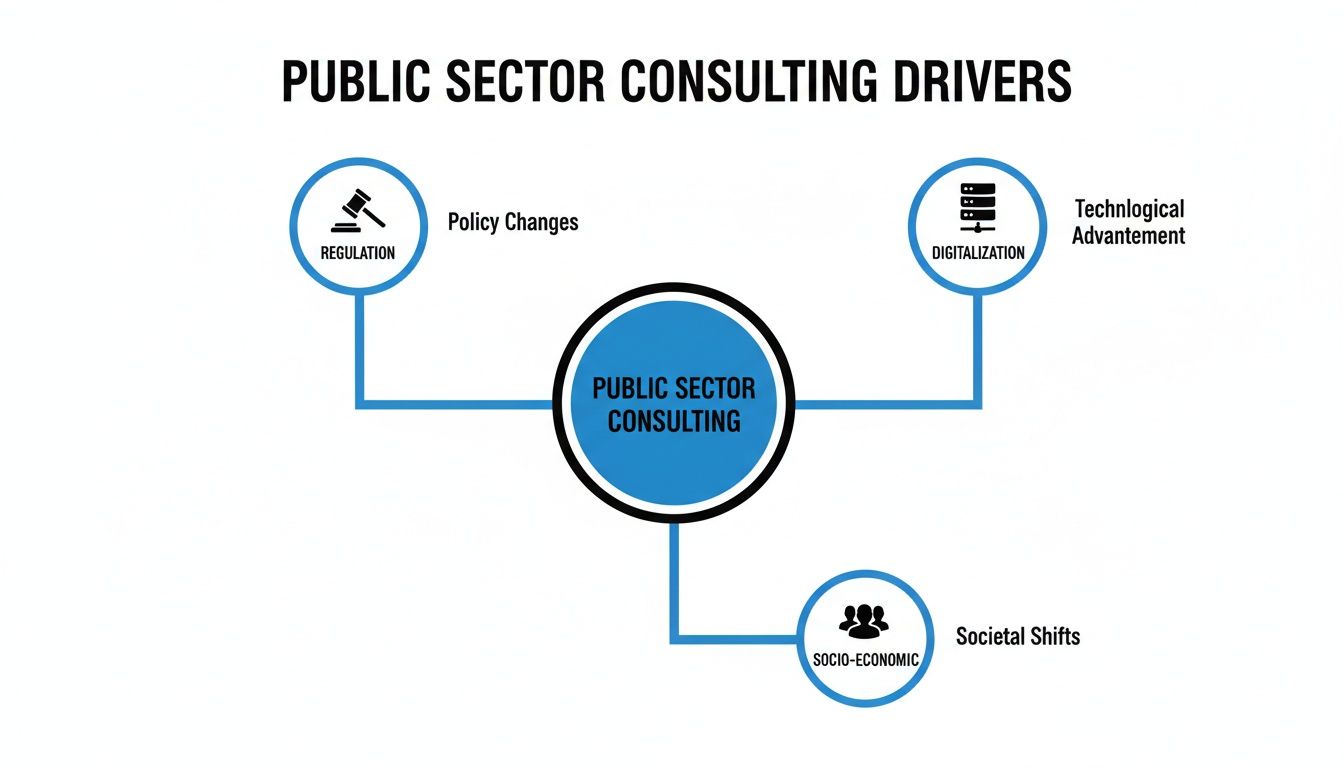
This diagram highlights how new regulations, the imperative for digitalisation, and evolving societal needs create a unique operating environment that differs significantly from the private market.
The Influence of Political Cycles and Procurement
In a corporation, a five-year strategic plan may provide stability. In government, that timeline can be disrupted by a single election. A change in leadership can abruptly shift priorities, reallocate funding, or terminate a project. This inherent uncertainty demands that a project's business case be exceptionally robust, demonstrating undeniable public benefit resilient enough to withstand political turbulence.
Furthermore, public procurement is designed to be rigid, transparent, and fair to prevent corruption—a stark contrast to the flexible negotiations common in the private sector. In Germany, strict adherence to the formal tender process (Vergabeverfahren) is non-negotiable. Any deviation can lead to disqualification.
A side-by-side comparison clarifies these differences.
Key Differentiators in Public vs Private Sector Consulting
This table outlines the core operational and strategic differences.
| Attribute | Public Sector Consulting | Private Sector Consulting |
|---|---|---|
| Primary Objective | Delivering public value and policy outcomes | Maximising shareholder value and profit |
| Key Stakeholders | Citizens, politicians, regulatory bodies | Shareholders, customers, board of directors |
| Decision-Making | Consensus-driven, bureaucratic, transparent | Top-down, agile, often confidential |
| Success Metrics | Social impact, public trust, compliance | ROI, market share, revenue growth |
| Procurement Process | Formal, highly regulated tenders | Flexible negotiations, relationship-based |
| Project Timelines | Long-term, influenced by political cycles | Market-driven, focused on speed |
Mastering these nuances is critical. It requires developing strategies that can withstand political shifts, navigating procurement with meticulous precision, and maintaining an unwavering focus on delivering genuine, measurable value to the public. For any leader seeking to make an impact in this domain, this understanding is the foundation for success.
Winning High-Value Digital Transformation Contracts

Germany's initiative to modernise its public sector is a funded, national strategy creating significant commercial opportunities. For executive leaders, understanding this agenda is key to positioning their firms to secure high-value, long-term government contracts.
Success in this arena requires moving beyond conventional sales approaches. It is about mapping your company's core competencies directly to the nation's strategic digital objectives. The government has defined a clear roadmap for investment, indicating precisely where private sector expertise is not just welcome, but essential.
Ready to Build Your AI Project?
Let's discuss how we can help you ship your AI project in weeks instead of months.
The executive's task is to translate this policy roadmap into a winning commercial strategy.
Mapping The Investment Landscape
The German government is channelling substantial capital into digital transformation, creating clear entry points for technology and consulting firms. These financial commitments are the engine driving demand for public sector consulting.
The Federal Ministry's Digital Decade roadmap has earmarked €102.1 billion for digital projects, with €46.8 billion sourced directly from public budgets. Additionally, Germany's Recovery and Resilience plan contributes €13.3 billion, supplemented by €2.2 billion from Cohesion funds.
These funds are targeted at several key domains:
- Cloud Infrastructure: Migrating from legacy systems to cloud environments is a priority. Agencies require partners for services ranging from migration strategy to implementation. This is rarely a simple "lift and shift"; the work is far more complex.
- Cybersecurity: The digitalisation of public services elevates the importance of protecting citizen data and critical infrastructure. Expertise in securing vast, interconnected government systems is in high demand.
- AI and Data Analytics: The public sector is beginning to leverage AI to enhance efficiency and service delivery. This creates opportunities for firms that can implement AI responsibly, with rigorous data governance and transparency.
- Public Service Modernisation: This focuses on reimagining citizen-state interactions through initiatives like digital identity solutions and streamlined administrative processes.
Aligning Your Capabilities With National Priorities
Securing these contracts requires more than superior technology. It necessitates speaking the language of the public sector and understanding its unique metrics for value and success. Your proposal must demonstrate how your solution actively contributes to Germany's strategic goals.
Want to Accelerate Your Innovation?
Our team of experts can help you turn ideas into production-ready solutions.
The core challenge is to frame your offerings in the language of public benefit. Articulate not only your technological superiority but also how your solution improves citizen outcomes, strengthens national security, or generates sustainable economic savings for the state.
This demands a sophisticated approach to business development, one focused on building advisory relationships with administrative bodies long before a tender is announced. The goal is to be perceived as a trusted expert, not merely another vendor.
Crafting A Winning Proposal
Developing a successful bid for the German public sector is an exercise in precision. It requires flawless compliance, a clear articulation of value, and a robust risk management plan. Decision-makers in this environment are inherently risk-averse and constrained by stringent regulations.
Your proposal must adhere strictly to the formal tender process (Vergabeverfahren). Beyond compliance, it must present a clear and compelling picture of the measurable outcomes you will deliver. While external resources offer strategies for responding to selection criteria, the fundamental principle is straightforward.
Present a business case so compelling that selecting your firm becomes the most logical and lowest-risk decision for the public officials accountable for the project's success.
An Executive Playbook for AI Implementation

Integrating Artificial Intelligence into the public sector represents a fundamental reimagining of government operations and service delivery. For leaders, the primary challenge is to translate AI from a conceptual buzzword into a tangible, value-generating asset.
This requires a structured, phased approach that respects the unique constraints of government, including data governance, algorithmic transparency, and strict GDPR compliance.
A prudent AI journey begins with a robust business case framed within a public context. The focus is not on profit margins but on demonstrable improvements to citizen services, operational efficiency, or policy outcomes. The central question to be answered is: how will this initiative create tangible public value while maintaining public trust?
This playbook provides a practical, business-first framework, offering clear, actionable steps for leaders to guide their organisations from concept to a fully operational AI-powered service.
Phase 1: Foundational Readiness and Pilot Projects
This initial phase is focused on establishing a solid foundation. A premature, large-scale AI deployment without adequate preparation is a common pitfall, particularly within the risk-averse culture of public administration. The objective here is to de-risk the initiative through small, controlled experiments.
Begin by identifying a specific, high-impact problem that AI is well-suited to address. This could range from automating a highly repetitive administrative task to enhancing fraud detection or analysing public sentiment to inform policy. The key is to select a pilot project with clear, measurable objectives.
This stage also demands meticulous attention to data governance. Public sector data is highly sensitive, and its use is governed by stringent regulations. Establishing an unassailable framework for data access, security, and privacy is a non-negotiable prerequisite. An experienced public sector consulting partner can be invaluable in ensuring these first steps are both ambitious and compliant.
The purpose of a pilot extends beyond technology validation. It is to demonstrate value and build organisational momentum. A successful pilot serves as a powerful internal proof point, securing stakeholder buy-in for broader adoption.
Phase 2: Scaling Implementation and Building Capability
Following a successful pilot, the next phase involves scaling the solution and developing internal capabilities. Many initiatives falter at this stage. Scaling is not merely a matter of increasing server capacity; it requires integrating the AI tool into existing workflows and organisational structures.
Looking for AI Expertise?
Get in touch to explore how AI can transform your business.
Effective scaling demands a deep understanding of systems and human factors. This involves significant change management, training, and communication to ensure public employees are comfortable with and trust the new tools. The goal is to position AI as a supportive co-pilot, not a replacement. This requires a holistic view of IT infrastructure, a topic covered in our guide on the fundamentals of system engineering in IT.
Furthermore, this phase must address the critical issue of algorithmic transparency. Public bodies must be able to explain how an AI model arrives at its decisions, particularly when those decisions impact citizens. Developing "explainable AI" (XAI) models is not an optional extra; it is essential for maintaining public trust and accountability.
Phase 3: Establishing Governance and Continuous Improvement
The final phase transcends individual projects to create a permanent, organisation-wide governance structure for AI. This framework ensures that all future AI initiatives are developed and deployed according to a consistent set of ethical, legal, and security standards.
This governance body should have a clear mandate:
- Ethical Review: Vetting new AI use cases against public values and ethical guidelines.
- Compliance Monitoring: Ensuring continuous adherence to GDPR and other relevant regulations.
- Performance Measurement: Systematically tracking the impact of AI systems on public value metrics.
- Risk Management: Proactively identifying and mitigating potential risks, from data bias to cybersecurity vulnerabilities.
Such a structure enables a sustainable path for AI adoption, allowing the organisation to innovate with confidence. To maximise the value of these systems, leaders must ask insightful questions. As a useful external resource suggests, there are 10 Key Questions to Ask AI to Unlock Deeper Insights that can help transform raw data into strategic intelligence. By embedding this disciplined approach, public sector leaders can ensure AI delivers on its promise of a more efficient, responsive, and effective government.
Mastering German Public Procurement

Attempting to secure contracts in Germany's public sector using a private sector sales methodology is a strategy destined for failure. Aggressive tactics and informal negotiations are ineffective. Success is predicated on a profound respect for a formal, risk-averse culture and flawless execution of the procurement process, the Vergabeverfahren. For any leader aspiring to win major, long-term government contracts, mastering this environment is essential.
Your entire go-to-market strategy must be recalibrated. The objective is not merely to close a deal, but to build institutional credibility. Public officials are driven by regulatory compliance, public accountability, and the mandate to deliver demonstrable citizen value, not by market trends. You must be perceived as a stable, reliable partner capable of navigating this complex landscape.
This requires significant preparatory work long before a tender is issued. Building relationships and establishing your firm as a source of credible expertise is crucial. It is during these early stages that trust is cultivated, providing deep insights into an agency's challenges and objectives.
Building a P&L-Accountable Partnership
To truly differentiate your firm in German public sector consulting, frame your engagements as P&L-accountable partnerships. This is more than a semantic distinction; it directly counters the traditional consulting model of delivering a report and disengaging from the outcome. By linking your commercial success to the project's tangible results, you create an incentive structure that resonates with value-conscious officials.
Ready to Build Your AI Project?
Let's discuss how we can help you ship your AI project in weeks instead of months.
Structure proposals around shared outcomes and measurable KPIs that are meaningful in a public context—such as verified cost savings, improved service delivery times, or a quantifiable increase in citizen satisfaction. This demonstrates a commitment to the outcome and a willingness to share risk, which is a powerful differentiator.
The market is receptive to this approach. Germany's management consulting sector reached a market size of €47.7 billion in 2025, with a compound annual growth rate of 3.0% over the past five years. This growth, driven by both large corporations and the vital Mittelstand, has created a competitive environment where outcome-based models provide a distinct advantage. You can discover more insights about this growing market and its key drivers.
When you assume accountability for an initiative's P&L, you transition from an external advisor to a co-preneur, fully invested in its success. This is the most effective way to establish your firm as an indispensable strategic asset.
Navigating the Formal Tender Process
Once a formal tender is released, the rules of engagement become rigid and non-negotiable. The Vergabeverfahren is designed for maximum transparency and fairness, and any procedural error can result in immediate disqualification. Success at this stage depends on precision.
Your proposal must be a comprehensive business case that addresses every specified criterion. To succeed, mastery of several key elements is required:
Want to Accelerate Your Innovation?
Our team of experts can help you turn ideas into production-ready solutions.
- Meticulous Compliance: Adherence to all procedural rules is paramount. Your submission must be flawless, from structure and formatting to the final piece of documentation.
- Demonstrable Value: Do not simply describe benefits; prove them. Use data to quantify the long-term socio-economic impact your solution will deliver.
- Risk Mitigation: Demonstrate a thorough understanding of potential challenges. Present a robust plan for managing risks related to data security, regulatory changes, and project implementation.
- Referenceable Credibility: Past performance is the most compelling evidence of capability. Include detailed case studies and client testimonials that validate your ability to deliver within a public sector context.
By combining a P&L-accountable model with masterful execution of the formal tender process, your firm can establish a formidable presence in the German public sector, securing high-value contracts and building a reputation for delivering what matters most: public value.
The Questions We Hear Most from Executive Leaders
Engaging in public sector consulting in Germany presents a unique set of challenges. For leaders accustomed to the velocity and metrics of the private sector, it requires a new strategic playbook. Here, we address the high-level questions that frequently arise in executive discussions, providing direct answers to inform your strategy.
It is critical to understand that public sector projects are not mere transactions; they are long-term partnerships. Success is built on a foundation of trust, absolute transparency, and a genuine, shared objective of creating public value.
What is the realistic sales cycle for a major public contract?
The sales cycle for a major public sector contract in Germany is protracted, typically extending far beyond private sector benchmarks. A realistic timeline is 12 to 24 months from initial engagement to contract execution. This duration is not a symptom of inefficiency but a feature of a deliberate, structured process designed to ensure fairness and accountability.
Success requires a long-term strategy. It necessitates significant investment in relationship-building and a deep understanding of an agency's needs well before a tender is published. It is a marathon that demands patience and a steadfast commitment to demonstrating value at every stage of a highly formalised process.
Looking for AI Expertise?
Get in touch to explore how AI can transform your business.
The primary objective is to position your firm as a trusted advisor and subject-matter expert before the procurement process officially commences. This preparatory work is often the decisive factor in securing a major contract.
How do we mitigate the risk of political changes?
Political cycles introduce a variable not typically encountered in corporate planning. A new government or a change in ministerial leadership can reshape priorities, reallocate budgets, or terminate projects. Mitigating this risk requires a multi-layered strategy.
The most effective defence is to anchor your project in long-term, bipartisan national objectives rather than transient political agendas. Focus on initiatives that deliver clear, undeniable value that transcends politics, such as verifiable cost savings, measurable improvements in citizen services, or critical infrastructure upgrades. When a project's benefits are self-evident and broadly supported, its resilience to political shifts increases significantly.
Contractual mechanisms can also manage risk. Clauses that protect against sudden termination or provide clear exit strategies can offer a financial and operational safety net. Furthermore, building a broad base of support among career civil servants is crucial; they represent continuity through political transitions and act as a vital stabilising force.
What are the most common reasons private sector firms fail in this market?
Many highly competent private companies have attempted and failed to penetrate the German public sector. The cause is rarely a lack of technical expertise. Failure almost invariably stems from a fundamental misunderstanding of the public sector’s unique culture, constraints, and core values.
Ready to Build Your AI Project?
Let's discuss how we can help you ship your AI project in weeks instead of months.
Common pitfalls include:
- An overly aggressive sales approach: High-pressure tactics common in B2B sales are counterproductive and can damage credibility with risk-averse public officials.
- Disregarding formal procurement rules: The Vergabeverfahren is a rigid legal framework, not a set of guidelines. Minor procedural errors can lead to immediate disqualification.
- Failing to demonstrate socio-economic value: A proposal focused solely on technical features or financial returns for your firm will not succeed. You must clearly articulate how your work benefits society.
- Underestimating data security and compliance: In the public sphere, data protection and GDPR are paramount. A proposal must demonstrate an uncompromising commitment to security from the outset.
How should we measure ROI when profit is not the objective?
Measuring return on investment in the public sector cannot be reduced to a simple financial formula. While cost savings and efficiency gains are important, they represent only one dimension of value. A much broader definition of return is required.
Success metrics must be directly linked to the agency's public mission. Key Performance Indicators (KPIs) should reflect tangible societal outcomes, such as:
- Improved Citizen Satisfaction: Measured through surveys and direct feedback on the accessibility and effectiveness of public services.
- Enhanced Public Trust: Tracking public confidence in the government's ability to deliver on its commitments.
- Achievement of Policy Goals: Assessing whether the project successfully contributed to the implementation of a specific policy or social programme.
- Operational Efficiency: Quantifying improvements such as reduced processing times, lower administrative overhead, or waste reduction.
For technology-intensive projects, a skilled consultant for Business Intelligence can be instrumental. They can help define and track these nuanced metrics, translating complex data into a clear narrative of public value creation. When you can articulate ROI in these terms, you demonstrate a genuine understanding of your public sector client's objectives.
At Reruption, we do not merely advise; we function as co-preneurs. We embed within your team to drive genuine innovation, assuming full P&L-accountability to transform your AI concepts into market-ready solutions that secure your future. Let's build the future together.
Want to Accelerate Your Innovation?
Our team of experts can help you turn ideas into production-ready solutions.