
Implementing AI is a strategic imperative. Executing it successfully is a different challenge entirely. Traditional methods for partnering with external experts are ill-suited for the pace and complexity of AI integration. They are structured for advisory reports, not bottom-line impact. To achieve tangible results, firms must adopt a co-entrepreneurial partnership model grounded in shared accountability and measurable outcomes.
Why Traditional Partnership Models Fail in the AI Era
For German executives, AI has moved from a technological curiosity to a critical boardroom topic. Yet, the conventional approach—engaging a consultancy for strategic guidance—is fundamentally flawed. Such transactional, arm's-length relationships lack the velocity and direct profit and loss (P&L) accountability required for successful AI implementation. This disconnect creates a significant chasm between strategy and execution, leaving substantial shareholder value unrealised.
This deficiency is particularly acute in the current economic climate. According to a recent ifo Institute survey, only 12.6% of German companies are optimistic about business improvements in 2025, while 31.3% anticipate worsening conditions. In this environment, investments in partnerships that do not guarantee a return are untenable.
The Disconnect Between Advice and Execution
The structural flaw of the traditional advisory model is its separation from results. It delivers a diagnosis and perhaps a strategic roadmap, but the advisor's engagement concludes before the impact on the firm's P&L can be measured.
This is the primary point of failure for most AI partnerships, leading to significant wasted capital and protracted, inefficient execution.
Ready to Build Your AI Project?
Let's discuss how we can help you ship your AI project in weeks instead of months.
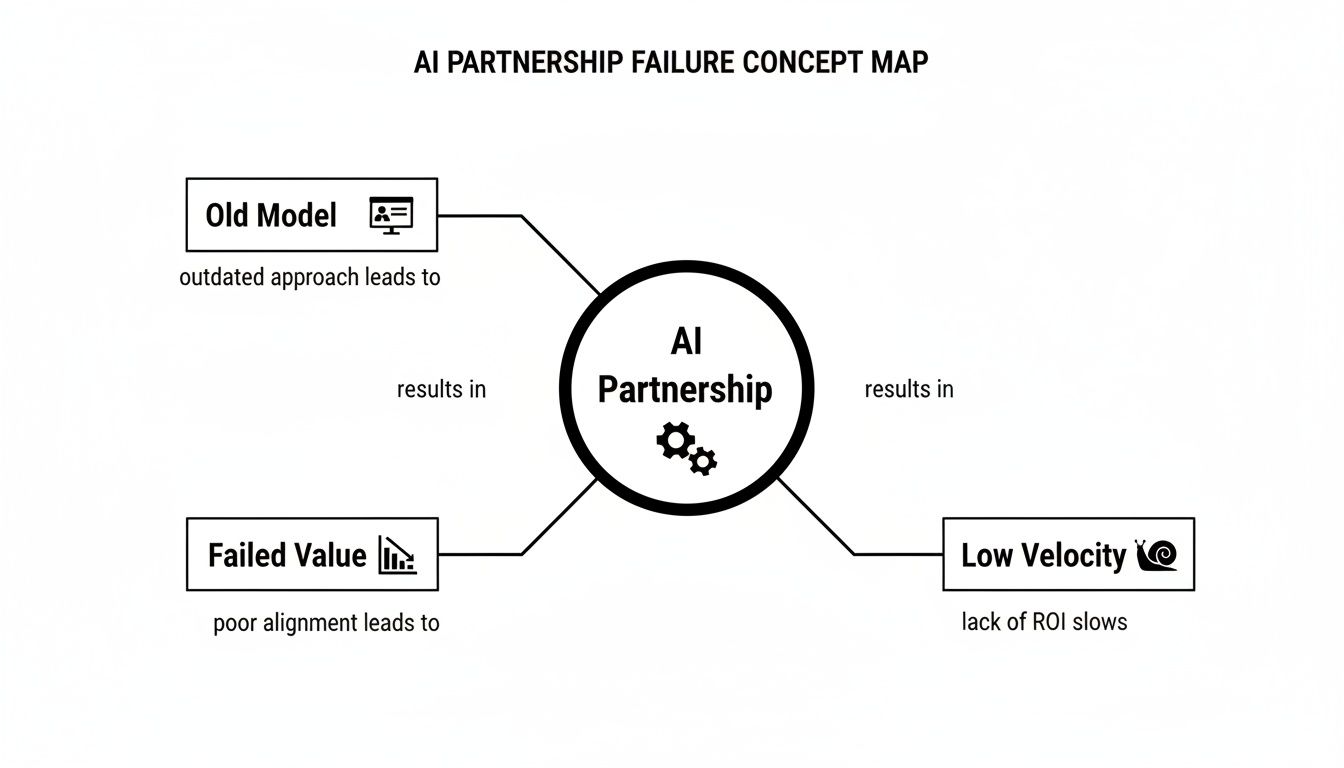
Without shared risk and deeply integrated teams, even the most promising AI initiatives devolve into costly academic exercises. A new strategic playbook is required—one that replaces transactional engagements with a true entrepreneurial alliance.
The success of an AI initiative is determined not by the technology, but by the human collaboration model. The most effective way to de-risk innovation and secure a sustainable competitive advantage is to structure a genuine partnership from the outset.
This necessitates dismantling the conventional client-vendor dynamic. Leadership must cultivate a co-entrepreneurial environment where external experts and internal teams operate as a unified entity, singularly focused on achieving shared P&L objectives.
This paradigm shift also enables the adoption of modern, efficient methodologies. For instance, innovative development approaches like low-code for agencies demonstrate how integrated teams can deliver value more rapidly and profitably.
Want to Accelerate Your Innovation?
Our team of experts can help you turn ideas into production-ready solutions.
If an AI partnership is to deliver more than a strategic presentation, it must be structured around P&L accountability. This is non-negotiable.
Structuring P&L-Accountable Partnerships
We must progress beyond the traditional model of paying project fees and awaiting outcomes. It is time to structure engagements where all parties have a vested interest—where your AI partner’s success is directly tied to your business unit’s bottom line.
This is not about procuring a service from a vendor. It is about forging an entrepreneurial alliance.

How is this achieved in practice? There are two powerful models that have proven highly effective.
The Venture Team Model
One of the most effective constructs is the Venture Team. This is a dedicated, hybrid entity—akin to an internal startup—comprising top talent from your business unit and specialist experts from your AI partner.
This is not a peripheral project. The Venture Team is allocated its own budget and, critically, is accountable for its own P&L targets. Its mission is not merely to develop a solution; it is to launch and scale an initiative that delivers a quantifiable financial impact.
Consider a manufacturing firm partnering with an AI specialist to address machine downtime. The Venture Team's objective would not be to 'deliver predictive maintenance software.' It would be to 'achieve a 15% reduction in downtime-related costs within 12 months.' The distinction is critical.
Aligning incentives in this manner creates a co-entrepreneurial dynamic. The dialogue immediately shifts from 'What was delivered?' to 'What business outcome did we achieve together?' This is the essence of a true partnership.
This model fosters exceptional ownership and agility. The team is empowered to make rapid decisions, pivot as necessary, and maintain a relentless focus on achieving its financial objectives.
Outcome-Based Engagements
An alternative structure is the Outcome-Based Engagement. The principle is simple yet potent: a significant portion of your AI partner’s compensation is directly linked to the achievement of predefined business Key Performance Indicators (KPIs).
This model strategically shifts risk from the client to the partnership itself. It compels all stakeholders to define success with rigorous precision and aligns all efforts toward achieving those measurable results.
Forget vanity metrics. The focus is on KPIs that are material to the Chief Financial Officer:
- Cost Reduction: A specified percentage decrease in operational expenditures.
- New Revenue Generation: Attainment of a specific revenue target from a new AI-enabled service.
- Market Share Growth: Capturing a defined share of a new market segment.
For example, an e-commerce firm might tie its partner’s compensation to delivering a 10% increase in customer lifetime value via a new personalisation engine. If the target is met, the partner shares in the financial upside. If it is missed, their compensation is adjusted accordingly.
This structure ensures your partner is incentivised not just to build, but to build something that works and generates demonstrable economic value.
Partnership Model Comparison: From Transactional to Transformational
| Attribute | Traditional Consultant Model | Integrated Partnership Model |
|---|---|---|
| Accountability | Focused on deliverables and project scope. | Focused on business outcomes and P&L impact. |
| Incentives | Fixed fees, time, and materials. Paid for effort, not results. | Shared risk/reward, success fees, and equity. Paid for results. |
| Risk | Primarily on the client. | Shared between the client and the partner. |
| Relationship | Transactional; client-vendor. | Collaborative; co-entrepreneurial. |
| Mindset | 'Tell us what to build.' | 'Let's determine how to win together.' |
Ultimately, migrating to an integrated model transforms the relationship from a simple transaction to a shared journey toward a common financial goal. A well-defined partnership structure is as foundational to success as a robust operational framework. To understand how these components integrate at an enterprise level, our guide on establishing a future-proof target operating model provides valuable insights.
Implementing Agile Governance for Speed and Discipline
In the context of AI partnerships, "governance" is often misconstrued as bureaucratic process and slow-moving committees. This is an outdated view. Effective governance is not about control; it is about enabling speed and disciplined execution.
The objective is to establish a lean framework that promotes rapid validation. We must move away from traditional, heavy-handed oversight that stifles the very agility AI innovation requires. The goal is to create a structure ensuring the partnership with business units yields tangible progress, not merely another series of meetings.
This requires a fundamental shift away from slow, stage-gated approval processes toward a more dynamic model. Strategic Business Process Management (BPM) can serve as an excellent starting point for redesigning these critical workflows for efficiency.
The Role of a Lean Steering Committee
At the core of this agile governance framework is a focused Steering Committee. To be clear, this is not another reporting layer. It is a small, empowered group of decision-makers whose primary function is to remove obstacles.
Looking for AI Expertise?
Get in touch to explore how AI can transform your business.
This committee typically comprises the business unit lead, the AI partner’s lead, and a senior executive sponsor. Its mandate is clear and concise:
- Resource Allocation: Provide swift "yes" or "no" decisions on requests for budget and personnel.
- Roadblock Removal: Intervene decisively when internal politics or cross-departmental friction impedes progress.
- Strategic Alignment: Serve as the strategic compass, ensuring the project remains aligned with broader business objectives.
The committee should convene briefly but regularly, focusing on high-level guidance and problem-solving, not the minutiae of the team's daily activities. This provides just enough oversight to maintain strategic alignment without compromising velocity. For a more detailed framework on this type of oversight, our guide on the Three Lines of Defense model offers additional structure.
Implementing Rapid-Validation Sprints
The engine of this model is the Rapid-Validation Sprint. These are short, time-boxed cycles—typically two weeks—with a single, explicit goal: to test a specific business hypothesis with a functional prototype. The output may be minimal, but it must be operational.
This approach compels a critical shift from debating abstract concepts to generating tangible evidence. For example, instead of spending months discussing a new AI-powered forecasting tool, a sprint team would build a basic version in two weeks. Their mission: to validate a core assumption, such as "Can an AI model improve forecast accuracy for our top-selling product by more than 5%?"
The purpose of a Rapid-Validation Sprint is not to build a perfect, polished product. It is to learn as quickly and cost-effectively as possible. This methodology enables you to discard unviable ideas with confidence and allocate resources to those that demonstrate genuine potential.
Ready to Build Your AI Project?
Let's discuss how we can help you ship your AI project in weeks instead of months.
Establishing Clear Roles for Momentum
To maintain momentum, ownership must be unequivocally clear. Two roles are non-negotiable for the success of this structure:
The Business Product Owner: This individual is the ultimate decision-maker for the product, defining the "what" and the "why." They are embedded within the business unit, prioritise development based on business value, and are accountable for the solution's success.
The AI Tech Lead: This is the technical expert, often from the partner organisation. They own the "how," determining technical feasibility, designing the architecture, and guiding the execution of the prototype. They ensure the team builds the right solution, correctly.
This clear division of responsibility eliminates the ambiguity that plagues many projects. It empowers the team to move decisively, transforming governance from a frustrating bottleneck into a powerful accelerator for business innovation.
Defining Success Metrics That Matter
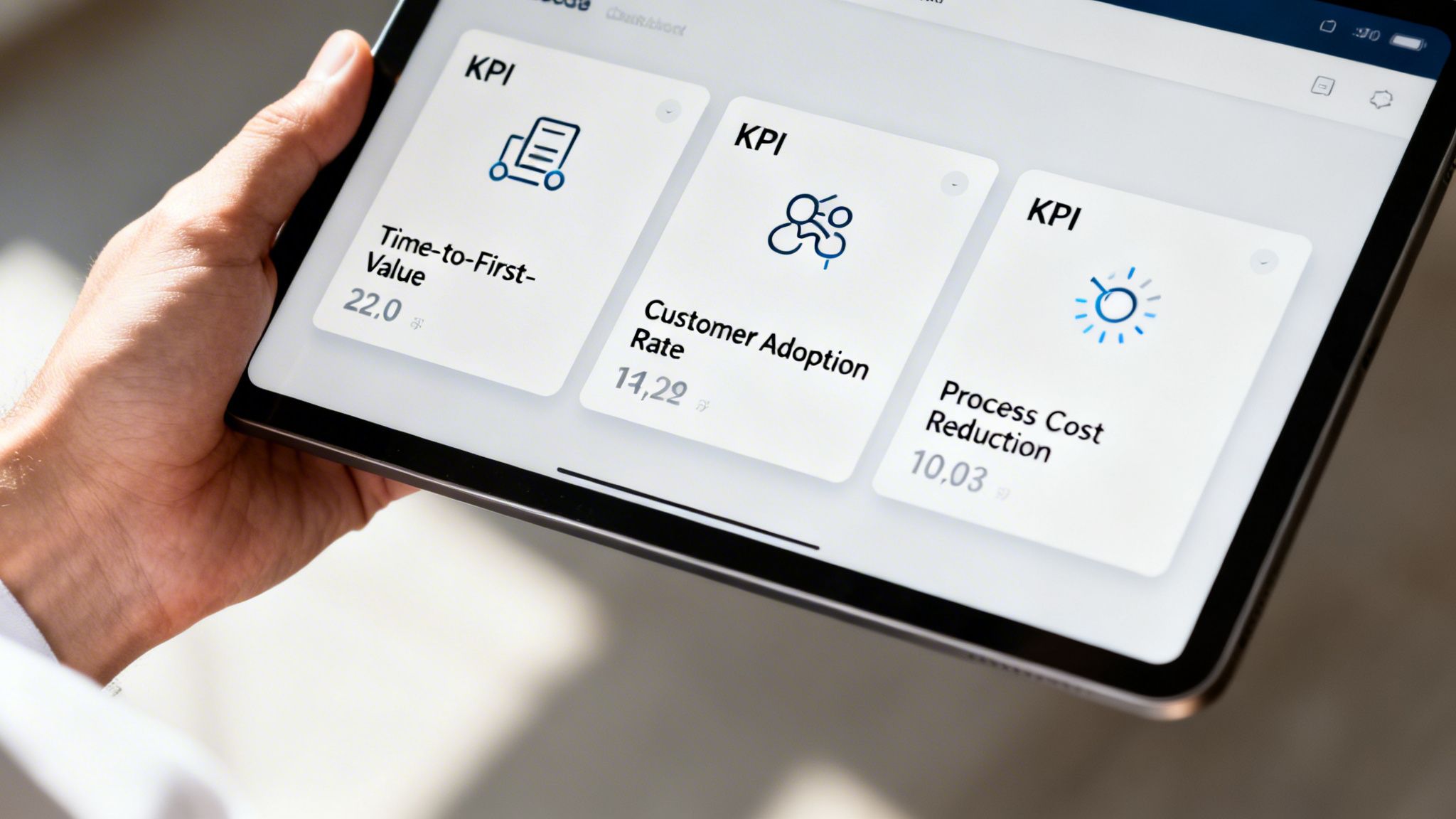
In any genuine partnership with a business unit, the metrics you track define the strategic game you are playing. It is time to move beyond superficial vanity metrics like 'number of AI models deployed', which provide no insight into business impact.
Success must be measured in terms of direct business value and tangible P&L impact. Period.
This requires a sharp focus on both leading and lagging indicators to provide a comprehensive view of performance. Leading indicators signal future success, while lagging indicators confirm it. A key leading indicator, for example, is Time-to-First-Value—how rapidly a new AI tool begins delivering tangible benefits to its initial user group.
Conversely, critical lagging indicators include Customer Adoption Rate for a new AI feature or a specific Process Cost Reduction percentage achieved over a quarter. These are the figures that validate the project's economic justification.
From Business Case to Reality
To ensure AI projects deliver on their promise, it is essential to adopt an entrepreneurial mindset of rigorous testing and learning. De-risking techniques are critical tools in this process, transforming a business case from a document of assumptions into a validated plan for investment.
Want to Accelerate Your Innovation?
Our team of experts can help you turn ideas into production-ready solutions.
A powerful tool for this is Assumption Mapping. This simple exercise compels the team to identify and prioritise the most critical and uncertain beliefs upon which the project's success depends. By mapping assumptions on two axes—'Importance' and 'Certainty'—the riskiest hypotheses that require immediate testing become immediately apparent.
A partnership built on validated learning is a partnership built to last. The objective is not to be right from the start, but to arrive at the right answer as quickly and cost-effectively as possible, de-risking innovation with each step.
This approach is particularly vital for German companies navigating complex international markets. With the EU remaining Germany's primary trading partner, highly integrated trade flows demand smarter solutions for everything from supply chain visibility to regulatory compliance. The ability to de-risk and validate cross-border AI solutions is not a luxury; it is critical for maintaining competitiveness. The depth of these trade relationships is detailed in this 2025-2026 trade partner analysis from Import Globals.
Validating Experience Before Engineering
Another proven de-risking method is Wizard-of-Oz Prototyping. This technique allows you to test a user experience without significant upfront engineering investment. Users interact with what appears to be a fully automated prototype, while behind the scenes, a human manually performs the functions.
For instance, a team could test a new AI-powered chatbot by having a support agent secretly provide the responses in real time. This is an intelligent way to gather genuine user feedback on the solution's utility and interface long before any complex AI code is written.
Looking for AI Expertise?
Get in touch to explore how AI can transform your business.
These de-risking methods provide leadership with a practical toolkit for cultivating a truly entrepreneurial culture. By rigorously testing assumptions and validating user value early and often, you ensure that major investment is directed only toward AI projects with a validated, high-potential business case. This disciplined approach is the foundation for building a successful analytics and insights capability, a topic we explore in our deep dive on analytics and insights.
Avoiding Common Pitfalls in AI Business Partnerships
Even the most meticulously structured AI partnership can be derailed by predictable, yet frequently overlooked, obstacles. A robust partnership with business units requires more than a strong contract; it demands a proactive strategy to mitigate the classic failure modes that undermine high-potential AI initiatives.
We have identified several critical pitfalls based on direct experience. More importantly, we have developed concrete countermeasures to keep your initiatives on track. This is not simply project management; it is about transforming your plan into a strategic risk register, enabling you to identify and neutralise threats before they materialise.
The Solution in Search of a Problem
One of the most common traps is developing a sophisticated AI solution before fully understanding the business problem it is intended to solve. This technology-first approach almost invariably results in elegantly engineered tools that deliver zero business value because they fail to address a real, pressing need.
A clear red flag is when conversations are dominated by technology buzzwords rather than specific business pain points.
Ready to Build Your AI Project?
Let's discuss how we can help you ship your AI project in weeks instead of months.
To prevent this, every project must originate with a validated business problem, not a novel technology. The focus must be on the user, their workflow, and the P&L impact from day one. There are no exceptions.
Misaligned Incentives and Diverging Goals
A partnership quickly deteriorates when the AI team’s objectives do not align with the business unit's core KPIs. This occurs when the partner is compensated for delivering technology, while the business unit is evaluated on metrics such as cost savings, revenue growth, or customer satisfaction.
When incentives are not shared, you create two separate teams with conflicting priorities. The AI team declares victory upon deployment, while the business struggles to extract real value.
The solution is to embed shared financial outcomes directly into the partnership agreement, as discussed previously. Success must be defined by a single set of metrics that are material to the business P&L. For example, the partner’s success fee can be tied directly to the business unit achieving its target for Process Cost Reduction or New Revenue Generated. This ensures all parties are pulling in the same direction.
The Dreaded Pilot Purgatory
A great number of promising AI prototypes end up in "pilot purgatory." They demonstrate potential but are never scaled into full production, ultimately failing due to a lack of budget, stakeholder buy-in, or a clear path forward. This is perhaps the most frustrating and costly pitfall.
Want to Accelerate Your Innovation?
Our team of experts can help you turn ideas into production-ready solutions.
To avoid this outcome, you must define the scaling pathway before writing the first line of code.
This requires you to:
- Secure conditional buy-in: Obtain a firm commitment from key stakeholders for a full-scale rollout if the pilot meets predefined success criteria.
- Define the operational handover: Clarify precisely who will own, maintain, and support the solution post-launch. Eliminate ambiguity.
- Budget for scale: Earmark the necessary budget for production deployment as part of the initial project approval.
Anticipating these potential traps is a core component of effective risk management. For a deeper exploration of this topic, you can learn more about creating a robust framework in our detailed guide on risk management and compliance.
Your Questions Answered: Making AI Partnerships Work
Embarking on a new AI initiative invariably raises challenging questions. For executives responsible for steering the organisation, achieving strategic clarity from the outset is paramount.
Here are the most frequent questions we receive from managers and C-level leaders as they prepare to partner with business units on AI implementation.
How Do We Select the Right Business Problem for Our First AI Partnership?
Select a problem that is both high-value and clearly defined. You are looking for challenges where a solution would have a direct, measurable impact on the P&L, either through cost reduction, revenue generation, or efficiency gains.
Avoid vague objectives like ‘improving customer satisfaction’. Be specific. A more effective target would be ‘reduce customer service response times for Tier-1 inquiries by 30%’ or ‘automate the initial screening of job applications to decrease time-to-hire’.
Your initial project should be significant enough to be meaningful but scoped tightly enough to be completed within a three- to six-month rapid validation cycle. The right partner will assist in connecting these business challenges to viable AI use cases and prioritising them based on feasibility and financial return.
What Is Our Internal IT Department’s Role in This?
Your internal IT department should be viewed as a crucial partner, not a gatekeeper. In this co-entrepreneurial model, their role evolves. They transition from being sole implementers to strategic enablers and guardians of the enterprise architecture.
Their involvement from the project's inception is mandatory. This is the only way to ensure that any prototype or solution aligns with existing security protocols, data governance policies, and future integration requirements—particularly with core systems like your ERP or CRM.
Looking for AI Expertise?
Get in touch to explore how AI can transform your business.
The goal is not to create 'shadow IT'. A true partnership leverages the specialised skills of the AI partner for speed while relying on the internal IT team’s deep institutional knowledge of your company's systems. This ensures a seamless transition from prototype to a scalable, secure, and maintainable enterprise solution.
This collaborative approach from the start prevents the accumulation of technical debt and ensures that what is built has a viable future within the organisation.
How Do We Measure ROI for Innovation When It’s Not Just About Cost-Cutting?
Measuring the return on innovation requires a broader perspective than a standard cost-benefit analysis. While cost reduction is straightforward to track, the true ROI from innovation is a composite of leading and lagging indicators.
- Leading Indicators: These are early signals of success. Examples include 'speed of learning' (the number of business hypotheses tested per quarter), 'time-to-first-prototype', or 'customer validation scores' for a new concept.
- Lagging Indicators: These are the long-term financial results that confirm value creation. This includes metrics like 'new revenue from an AI-powered product', 'market share gained with a new service', or 'increased customer lifetime value'.
For transformative, high-impact initiatives, you might also consider strategic value metrics. Is the initiative creating a new competitive advantage? Is it opening an entirely new market? These qualitative benefits can be quantified through robust business case modelling, ensuring you capture the complete value proposition of your AI partnership.
At Reruption GmbH, we function as your co-entrepreneurs. We structure partnerships engineered to deliver a material impact on your P&L, transforming ideas into market-ready innovations with velocity. If you are prepared to build a partnership that delivers results, not just reports, let's have a discussion. Learn more about our approach at https://www.reruption.com.
Ready to Build Your AI Project?
Let's discuss how we can help you ship your AI project in weeks instead of months.