Every senior executive is familiar with the strategic tension: balancing the consistent performance of reliable, profitable business units with the relentless imperative to innovate, particularly in Artificial Intelligence. The critical question remains constant: how do we fund the future without jeopardising the present?
This is where a classic strategy framework, the BCG Growth-Share Matrix, gains renewed relevance. Specifically, our focus is on the Cash Cows. These are established products or business units possessing a commanding market share within a slow-growing, mature market. They do not require substantial new investment to sustain their position; instead, they consistently generate significantly more cash than they consume.
Consider them the financial heart of your enterprise, pumping capital into more experimental, high-growth ventures.
Funding Your AI Transformation with Existing Corporate Assets

For enterprise leaders in Germany and globally, the challenge is not a scarcity of AI concepts, but securing the capital and de-risking the implementation journey. While pressure to act is high, budgets remain constrained, and every investment demands a rigorous business case. The Cash Cow framework provides a pragmatic, data-driven playbook for navigating these C-level decisions.
Ready to Build Your AI Project?
Let's discuss how we can help you ship your AI project in weeks instead of months.
This is not merely theoretical; it is a structured methodology for self-funding your organisation's future.
The Four Quadrants of the BCG Growth-Share Matrix
To fully appreciate the role of Cash Cows, it is essential to understand their position within the broader strategic context. The BCG Matrix classifies business units into four distinct categories based on their market growth rate and relative market share.
| Quadrant | Market Growth | Market Share | Cash Flow Characteristics | Strategic Role |
|---|---|---|---|---|
| Stars | High | High | Often neutral; high earnings are reinvested to fuel growth. | Build for long-term growth; these are future Cash Cows. |
| Cash Cows | Low | High | Strongly positive; generate more cash than they consume. | Harvest profits to fund Stars, Question Marks, and R&D. |
| Question Marks | High | Low | Negative; require significant investment to increase share. | Decide whether to invest heavily to become a Star or divest. |
| Dogs | Low | Low | Neutral or negative; may break even or drain cash. | Divest or liquidate to free up strategic resources. |
Each quadrant fulfils a specific strategic function. Your Stars require capital to expand their market leadership, and this capital is most effectively sourced from your Cash Cows.
A Framework for Strategic Self-Funding
The core principle is simple yet powerful: identify your established, high-performing business units and strategically allocate their profits to catalyse a new generation of AI initiatives.
A business unit qualifies as a Cash Cow by exhibiting these characteristics:
Want to Accelerate Your Innovation?
Our team of experts can help you turn ideas into production-ready solutions.
- High Relative Market Share: They are established leaders within their niche, commanding customer trust and loyalty.
- Low Market Growth: They operate in stable, mature industries where market consolidation has largely concluded.
- Significant Positive Cash Flow: They generate substantial profits that far exceed the capital required for their own maintenance.
This represents a disciplined approach to self-funding. It enables you to leverage the strength of your legacy business to build resilience for the AI era. For instance, the steady profits from a mature industrial components division can finance the development of a proprietary AI copilot for your engineering teams.
The art lies in utilising the stability of today to finance the velocity of tomorrow. This transforms what could be perceived as static profit centres into dynamic engines for internal innovation.
A Modern Investment Perspective
This internal funding model mirrors the disciplined approach of the venture capital sector. As detailed in the Modern AI Venture Capital Playbook, investors allocate capital with a sharp focus on potential returns. Adopting this mindset for internal AI projects is critical.
By thinking like a venture capitalist, you ensure the capital extracted from your cash cows is channelled into initiatives with the highest probability of creating tangible new value. You can dig deeper into making data-backed strategic moves by exploring our other articles on https://reruption.com/en/knowledge/blog/analytics-and-insights.
This guide will provide a methodology for using the cash cows matrix to identify these assets, manage them effectively, and channel their profits to build a sustainable competitive advantage through AI. It is a systematic process for turning promising concepts into market-leading innovations.
Identifying Your True Cash Cow Business Units

In a challenging market, misidentification can be a costly error. A Cash Cow is more than a profitable division; it is the financial engine of your entire corporate portfolio. For German industrial and financial leaders, precise identification is the foundational step toward funding transformation from a position of strength.
This process is akin to a financial MRI for your business portfolio. It requires a rigorous, data-driven approach that penetrates beyond surface-level profit reports to reveal the true financial health of each unit. Only with this level of clarity can you confidently allocate capital towards your most promising AI initiatives.
Core Metrics for Pinpointing Cash Cows
How does one differentiate a true Cash Cow from a high-performing but resource-intensive 'Star' or a declining 'Dog'? The distinction rests on a few specific financial and market indicators. These metrics provide a clear, objective framework, removing subjectivity from major strategic decisions.
Key metrics for evaluation include:
Looking for AI Expertise?
Get in touch to explore how AI can transform your business.
- Relative Market Share (RMS): This metric measures your market share relative to your single largest competitor, providing a true assessment of market dominance. A genuine Cash Cow typically possesses an RMS significantly above 1.0x.
- Market Growth Rate: The classic indicator of a Cash Cow's domain is market maturity. The focus is on markets with a stable, low annual growth rate—typically under 10%. In this context, the strategic imperative shifts from aggressive expansion to intelligent defence and optimisation.
- Cash Generation Efficiency: This is the definitive test. How effectively does the unit produce disposable cash? Strong free cash flow is the lifeblood of the cash cows strategy, generating the capital required for strategic investments in AI. Critically, this cash surplus must dwarf the investment needed merely to maintain its market position.
This disciplined, quantitative analysis ensures you are not just identifying profitable units, but the right kind of profitable units—those capable of funding future growth without requiring significant capital injections themselves.
A genuine Cash Cow operates with the efficiency of a finely-tuned industrial process. It consumes minimal new investment while consistently producing a surplus of high-value output—cash—that can be strategically deployed elsewhere in the organisation.
The German Mittelstand: A Prime Example
The strategic power of the cash cows matrix is particularly evident in Germany's industrial core. Consider the German Mittelstand, the backbone of the national economy. A detailed analysis often reveals that approximately 40% of business units in major manufacturing firms are classic cash cows. These mature, stable divisions generate the cash required for AI-driven innovation.
For instance, a leading power tools segment reporting €4.2 billion in sales with operating margins exceeding 12% in a slow-growth market is a prime example. Its stability is precisely what enables it to fund €800 million in AI R&D. This model provides an excellent template. You can explore more about applying proven frameworks to your organisation by understanding the 7-S Model from McKinsey.
This approach demonstrates how established divisions, even without explosive growth, become the strategic launchpad for a company's entire AI roadmap. By applying these metrics, leaders can make decisive, evidence-based choices and channel resources with precision to secure a long-term competitive edge.
Choosing Your Strategic Path: Harvest, Maintain, or Reinvest?
You have successfully identified a Cash Cow within your portfolio. The next step is not passive observation but an active management decision. For any German enterprise executive, this decision directly shapes your capacity to fund game-changing AI initiatives and maintain market leadership.
The strategic path chosen for each Cash Cow dictates the flow of capital and resources throughout your entire organisation. A correct decision creates a powerful internal funding mechanism. An incorrect one starves your most promising innovations. There are three primary strategies to consider, each with distinct implications for your AI roadmap.
The Harvest Strategy: Maximising Capital for AI Ventures
The most aggressive strategy is to harvest. This involves deliberately "milking" the business unit to maximise cash extraction. Investment is reduced to the bare minimum required to maintain operations and sales, thereby maximising short-term cash flow.
This freed-up capital is then redirected to high-potential ventures elsewhere in the portfolio. It is the fuel needed to accelerate a promising ‘Star’ or the investment required to transform a high-risk ‘Question Mark’ into a future market leader.
- When to Harvest: This strategy is appropriate when the Cash Cow operates in a highly stable market with minimal competitive threats, and there is an urgent need for capital to fund a breakthrough AI project.
- The Risk: Executing this strategy requires caution. Harvesting too aggressively over an extended period will degrade the business unit, transforming a reliable asset into a declining ‘Dog’ and eliminating a vital source of funding.
This strategy demands a disciplined balance between value extraction and asset preservation.
The Maintain Strategy: Defending the Funding Engine
A more conservative, and often more prudent, approach is to maintain. This is analogous to performing routine maintenance on a critical power generator. The objective is not growth but stability. You invest just enough to defend the Cash Cow's market share and ensure its cash flow remains predictable.
This entails modest expenditures on marketing, process optimisation, or minor product enhancements. The goal is not to reinvent the unit but to protect its dominant position and the reliable profits it generates. That steady stream of cash can then support daily operations and provide consistent funding for longer-term innovation programs.
A ‘Maintain’ strategy acknowledges that the Cash Cow’s greatest value is its reliability. By protecting it, you ensure the financial engine that powers the rest of your portfolio continues to run smoothly, year after year.
This approach is most effective when competitive pressure is moderate and the priority is a dependable, long-term funding source rather than a large, one-time cash injection.
The Reinvest Strategy: Modernising for an Extended Life
The third option, reinvest, is a forward-looking strategy. Instead of simply extracting profits, a portion is used to modernise the Cash Cow itself, often through AI implementation. The objective is to enhance efficiency, reduce costs, and ultimately extend its profitable lifespan.
Ready to Build Your AI Project?
Let's discuss how we can help you ship your AI project in weeks instead of months.
For example, a German manufacturing Cash Cow could deploy an AI-driven predictive maintenance system to significantly reduce costly downtime. A logistics division could implement an intelligent automation platform to optimise its supply chain, thereby boosting its own margins and resilience. Deciding whether to build these capabilities in-house or acquire them is a critical choice, further explored in our guide on conducting a make-or-buy analysis.
This "renovation" can solidify a Cash Cow's market leadership and sometimes uncover new revenue streams. It is the ideal path when a clear opportunity exists to fortify the core business against future disruption, securing its role as a funding engine for years to come. The key is to ensure the investment delivers a strong return without compromising the unit's primary function: generating surplus cash for the rest of the company.
A Step-by-Step Guide to Evaluating Your AI Portfolio
Let us now transition from theory to practical application. This requires applying the cash cow matrix directly to your business portfolio. This is not an academic exercise; it is a vital diagnostic tool that creates a clear, visual map illustrating where your capital is generated and where it should be allocated for maximum strategic impact.
The true breakthrough occurs when this model is applied not just to traditional business units, but also to your portfolio of AI initiatives. This provides innovation leaders with a powerful, data-backed methodology for making decisions tied directly to profit and loss, ensuring every euro invested in AI serves a sound strategic purpose.
Step 1: Gather and Define Your Data
The foundational step is data acquisition. To position any business unit or AI project on the matrix, two key data points are required for each entity.
Want to Accelerate Your Innovation?
Our team of experts can help you turn ideas into production-ready solutions.
- Market Growth Rate: The annual growth percentage of the relevant market. For an internal AI project, "market growth" can be analogised as the increasing demand or adoption rate for that capability within your organisation.
- Relative Market Share (RMS): This metric compares your market share to that of your largest competitor. An RMS above 1.0x indicates market leadership. For internal AI tools, RMS can be measured by comparing user adoption or process penetration against alternative solutions, including manual processes.
Data collection is a cross-functional effort. Finance will provide revenue and profit data, while Sales and Marketing will contribute market intelligence. For AI projects, you will need to collaborate with product owners and IT to obtain user metrics and operational data.
Step 2: Plotting Your Portfolio
With the data compiled, you can now plot each entity on the two-by-two grid. The horizontal axis represents Relative Market Share (from high to low), and the vertical axis represents Market Growth Rate (from low to high).
This visualisation instantly reveals the strategic position of every asset. Your most profitable, stable divisions will naturally cluster in the bottom-right quadrant as Cash Cows. Your high-potential AI projects, still in their investment phase, might appear in the top-right as Question Marks.
This map represents your strategic landscape, clearly showing which assets are funding your growth and which are consuming that funding.
Step 3: Interpreting the Results for AI Investment
This is where strategy is formulated. The matrix compels you to view your portfolio not as a list of disparate items, but as an interconnected ecosystem.
Looking for AI Expertise?
Get in touch to explore how AI can transform your business.
Consider Germany’s manufacturing sector, which is replete with classic cash cows. A core chainsaw product line might command a 35% global share in a market growing at only 1-2% annually. A division producing petrol-powered tools could generate €2.8 billion in sales with strong EBIT margins, yielding over €450 million in free cash flow. This is the capital that can be used to develop AI-optimised data pipelines for the entire company. As one leading strategy resource notes, cash cows are crucial for funding innovation and debt repayment, securing the company's financial foundation.
The same logic applies internally. A mature, widely adopted CRM automation tool within your sales department can be considered an internal 'Cash Cow'. It requires minimal new investment but delivers significant efficiency gains (a form of profit). The resources it frees up can be channelled into speculative R&D for a new generative AI business model—your 'Question Mark'.
The flowchart below illustrates the primary strategic paths available based on the output from your Cash Cows.
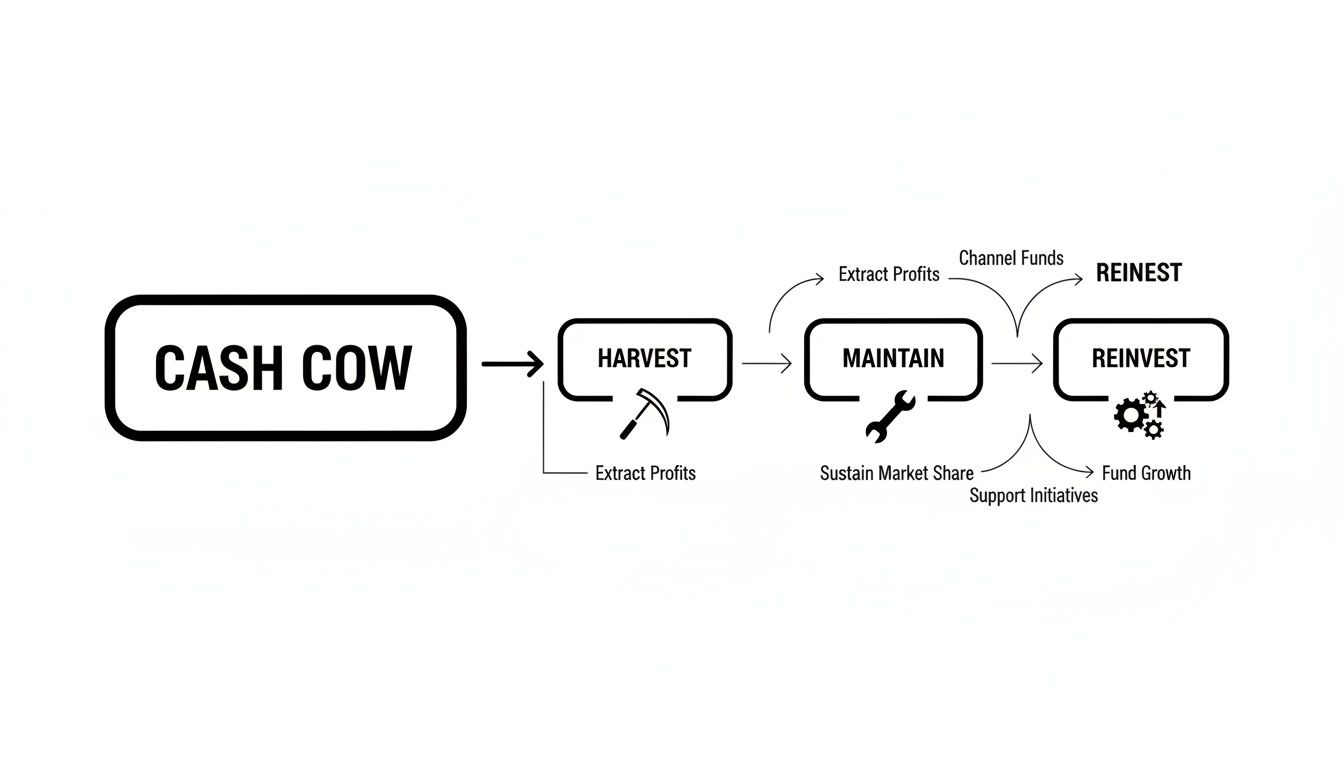
This visual guide underscores the active decisions required. Capital from Cash Cows must be intentionally directed—either to maintain them, harvest profits for new ventures, or reinvest for modernisation.
Ready to Build Your AI Project?
Let's discuss how we can help you ship your AI project in weeks instead of months.
By applying the cash cow matrix to your AI portfolio, you transition from managing projects to managing a strategic internal economy. You create a system where proven, high-adoption tools fund the development of your next game-changing innovations.
This disciplined approach transforms your portfolio from a static list of assets into a dynamic engine for growth. The result is a clear mandate for action, enabling you to build an AI-powered future by leveraging your existing strengths. Further practical guidance on organising these initiatives can be found in our article on creating an AI prioritisation framework for 2025.
Case Study: How Financial Services Firms Fund AI

To observe the cash cows matrix in a real-world application, let us examine the German financial services sector. This industry, constrained by heavy regulation and operating in mature markets, provides an excellent example of how established assets can fund the AI ventures of the future. For any executive tasked with balancing stability and innovation, this serves as a clear model.
Consider a major German reinsurance firm. Its core business—underwriting risk and managing large, diversified investment portfolios—is the textbook definition of a mature, low-growth environment. While the market is not expanding rapidly, the firm's commanding market share and deep expertise position its investment arm as a perfect Cash Cow.
Want to Accelerate Your Innovation?
Our team of experts can help you turn ideas into production-ready solutions.
This division consistently generates predictable, substantial cash flows that far exceed its operational needs. It is this dependable surplus that becomes the strategic fuel for making bold investments in high-growth, high-risk areas.
From Stable Portfolios to AI-Powered Platforms
The primary function of the reinsurance Cash Cow is capital generation. The critical question for the C-suite is where to direct this capital to achieve a significant competitive advantage. The matrix provides a clear map, showing how to channel funds from the stable core into more dynamic, uncertain ventures.
One clear path is to fund a future ‘Star’—a high-growth project where the company has a strong potential to capture a high market share. For a reinsurer, a prime example would be a proprietary AI platform for advanced cyber risk assessment. Developing such a platform requires a massive upfront investment in data scientists, machine learning engineers, and specialised technology infrastructure.
The reliable returns from the investment portfolio provide the necessary capital to build this ‘Star’ without compromising the firm’s financial stability. The Cash Cow effectively de-risks a high-stakes bet on what could become a future market leader.
Funding ‘Question Marks’ in a Compliant World
The surplus cash is also vital for exploring a select number of ‘Question Marks’. These are calculated investments in emerging technologies—ventures in high-growth areas where the company currently has little to no market share. In finance, a perfect example is the development of compliant Large Language Model (LLM) applications for internal use.
Looking for AI Expertise?
Get in touch to explore how AI can transform your business.
A major German reinsurance firm, with €60 billion in gross premiums, exemplifies this principle. Its investment portfolio, projected to yield over 3.0% in a low-growth market, generated an impressive €9.1 billion in net investment income last year. This sum, constituting 28% of total earnings, provides a stable source of capital to fund strategic AI initiatives and absorb the risk of new ventures. You can explore a more detailed analysis of how such firms create portfolio value on portersfiveforce.com.
This capital allows the firm to establish small, agile teams to experiment with technologies like self-hosted LLMs for claims summarisation or internal knowledge retrieval. These projects begin as ‘Question Marks’ due to their uncertain ROI and initial low adoption. However, if successful, they could evolve into internal ‘Stars’ that unlock massive efficiency gains.
This case provides a concrete blueprint for finance executives. It demonstrates a methodical approach to using core assets to fund a digital and AI transformation roadmap. This model ensures that the pursuit of innovation is always anchored by financial stability, enabling rapid progress without undue risk. For more on this topic, you may find our deep dive on digital transformation strategies for the banking sector insightful.
Turning Strategy into Execution
The cash cow concept is not a static model for an unread report. It is a dynamic tool for execution. Effective management of your cash cows transforms these stable, mature assets into an engine for internal innovation—particularly for AI.
This is not merely about reallocating funds. It is about making intelligent, calculated, and even bold decisions from a position of deep financial stability. You are leveraging the predictable profits from your core business to fuel the development of your next market-leading solutions. This is how you secure your company's future.
Ready to Build Your AI Project?
Let's discuss how we can help you ship your AI project in weeks instead of months.
It is the art of self-funding your own "re-ruption."
From Stability to Velocity
The fundamental concept is to manage your portfolio of business units as an internal economy. Your steady, cash-generating units provide the capital required to build entirely new capabilities. This creates a virtuous cycle where current strengths directly finance future relevance.
The most resilient organisations do not wait to be disrupted. They leverage their own financial power to proactively shape their future, turning today’s predictable earnings into tomorrow’s competitive edge.
This internal funding model operates with a discipline similar to that of venture capital. You are not simply allocating budget to a problem; you are making strategic investments from a secure financial base. This affords you the freedom to experiment without putting the core business at risk. It is precisely how established leaders can begin to move with the agility of a start-up.
Making It Happen with Reruption
Of course, making the leap from static asset manager to dynamic innovator requires a specific mindset and skillset. You need a partner who understands the pressures of P&L responsibility as well as the breakneck pace of modern technology. This is where Reruption acts as your "Co-Preneur."
Want to Accelerate Your Innovation?
Our team of experts can help you turn ideas into production-ready solutions.
We integrate with your teams to:
- Identify and model the financial output from your cash cow units, creating a robust investment thesis for your AI projects.
- De-risk new ventures by building functional prototypes rapidly, ensuring capital is deployed on viable ideas.
- Build production-ready AI systems that translate funded concepts into tangible business value—whether an internal copilot or a new customer-facing platform.
By tapping into your company’s inherent strengths, we help you build your AI-powered future from a position of power. This is not about disruption from the outside; it is about strategic re-rupt from within.
Frequently Asked Questions
When funding new AI ventures, a strategic approach to capital sourcing is paramount. The BCG matrix is an excellent tool for this purpose, but its application raises practical questions. We address a few of the most common ones below.
How Often Should We Re-evaluate Our Portfolio?
For large enterprises, a formal portfolio review using the matrix should be a cornerstone of your annual strategic planning cycle. It is the most effective way to ensure capital allocation aligns with annual business objectives. However, markets do not operate on an annual schedule.
If a disruptive technology emerges in your industry or a competitor makes a significant strategic move, an immediate reassessment is required. Your strategy must be agile enough to respond to real-world events, not just a calendar.
Looking for AI Expertise?
Get in touch to explore how AI can transform your business.
For internal AI projects, the pace must be even faster. We recommend a quarterly review. AI initiatives can succeed or fail rapidly; a promising ‘Question Mark’ can evolve into a ‘Star’ or decline into a ‘Dog’ much faster than a traditional business unit. This necessitates nimble resource management.
Can a Business Unit Be a Cash Cow and an Area for AI Innovation?
Absolutely. This is often termed a 'renovation' or 'modernisation' strategy. While a Cash Cow's primary function is to generate cash for other ventures, strategically reinvesting a portion of that cash back into the unit with AI can be incredibly powerful.
Consider a mature manufacturing division—a classic Cash Cow. If it were to use its own profits to implement an AI-powered predictive maintenance system, costly equipment downtime would plummet, directly boosting operating margins. The cow becomes more productive.
The key is to strike the right balance. The investment must be sufficient to generate a strong return, but not so large that it chokes off the unit's primary function as the company's funding engine.
This approach not only extends the profitable life of your Cash Cow but also fortifies it against future competitive threats.
What Is the Biggest Mistake Leaders Make When Managing Cash Cows?
The most common mistake is neglect born of complacency. It is easy to become focused on the excitement of new ‘Stars’ or speculative ‘Question Marks’. The reliable Cash Cow can seem 'boring' by comparison. This often leads to chronic underinvestment, which slowly erodes its market position.
Such neglect is an open invitation for a focused competitor to capture market share, thereby strangling your primary source of innovation funding. The second most common mistake is harvesting too aggressively. If cost-cutting measures are so severe that they damage product quality, customer service, or brand reputation, you will only accelerate the unit's decline into the ‘Dog’ quadrant. This is not harvesting; it is value destruction.
Managing a Cash Cow requires active, disciplined stewardship. It is a fine-tuned balancing act, but when executed correctly, it secures your company's long-term prosperity.
Turning strategy into tangible business outcomes requires more than a framework; it demands a partner with entrepreneurial grit and a proven methodology for execution. Reruption acts as your "Co-Preneur," working within your teams to transform your established strengths into a powerful engine for AI-first innovation. We help you build your future from a position of power. Find out how we can help you re-rupt from within.