
A supply chain consultant is an external expert engaged to analyze and enhance a company's operational performance, from initial supplier engagement to final customer delivery. In Germany, however, this traditional definition is becoming insufficient. The role is evolving from high-level advisory to hands-on implementation, particularly in the integration of production-ready Artificial Intelligence (AI).
The New Mandate for Supply Chain Consultants

The traditional consultant who delivers a strategic analysis and then disengages is no longer a strategic asset. In an era defined by geopolitical volatility and relentless technological shifts, this model presents a liability.
For Germany's industrial leaders—from the Mittelstand champions to global automotive corporations—the strategic landscape has fundamentally changed. The demand is not for incremental optimization but for strategic reinvention, driven by tangible AI and data analytics. This shifts the consultant from a detached advisor to a deeply embedded partner—a "Co-Preneur" who shares genuine accountability for business outcomes.
Geopolitical shocks and economic headwinds demand a level of resilience that theoretical models cannot provide. Recent data indicates that 63% of procurement leaders are actively diversifying their supplier bases. This is a direct response to real-world pressures, highlighting a significant pivot towards proactive, not reactive, strategy.
From Theoretical Optimisation to P&L Accountability
The primary requirement now is for partners who can build and deploy solutions, not merely recommend them. This involves moving beyond spreadsheets and into operational execution, creating functional AI systems that solve concrete business problems.
Consider the complexity of today's environment. A single tariff modification can disrupt an entire sourcing strategy. When trade uncertainty escalated, U.S. imports surged as firms scrambled to stockpile inventory. A traditional consultant might analyze that risk. A Co-Preneur partner builds the AI-powered forecasting tool that models tariff impacts in real-time, providing the agility to pivot instantly.
This new class of supply chain consultant is defined by several non-negotiable attributes:
- Execution over Advice: Their value is measured by the systems they implement and the performance gains they generate, not the volume of their reports.
- P&L Responsibility: They structure engagements around shared risk and reward, linking their compensation directly to bottom-line results.
- Deep Technical Expertise: They possess profound capabilities in AI engineering, able to build and deploy secure, compliant data pipelines and machine learning models from the ground up.
- Velocity and De-risking: They operate with entrepreneurial urgency, validating concepts with functional prototypes in days, not months, to rapidly de-risk innovation.
The modern supply chain consultant's value is not in the strategy they present. It is in the intelligent, automated systems they build shoulder-to-shoulder with your team. The engagement concludes not with a final presentation, but with a scalable, production-ready solution delivering measurable ROI.
Why a New Evaluation Framework Is Essential
This evolution demands a completely new methodology for evaluating potential partners. The traditional checklist—firm reputation, theoretical frameworks, historical case studies—is no longer sufficient. Executives must now conduct deep due diligence to assess a firm's technical execution capabilities and its willingness to commit to performance-based outcomes.
Ready to Build Your AI Project?
Let's discuss how we can help you ship your AI project in weeks instead of months.
During the selection process, it is crucial to distinguish between firms that sell strategy and those that build enterprise value. The right partner will not just help you plan for the future; they will help you build it.
You can explore how to vet a potential partner's true capabilities in our guide on the modern supply chain consultant. It contains the critical questions you must ask to ensure you engage a team genuinely equipped for the AI era.
Knowing When to Engage a Consultancy
Engaging external experts is a strategic decision, not a reactive measure. Identifying the opportune moment to bring in a supply chain consultancy is critical to success. The triggers are not always as apparent as escalating costs or logistical failures; often, they are subtle strategic shifts that signal an opportunity for a significant capability uplift.
For many German enterprises, these moments arise when the internal team lacks the capacity—or the specific niche expertise—to manage a high-stakes, complex transformation. The objective is not to find a temporary fix for an operational issue, but to secure a partner for fundamental business reinvention. Precisely defining the required capabilities is the first step toward a successful partnership.
The Key Moments: Strategic Inflection Points
Certain business challenges are too complex and carry too much risk to address internally. These are not routine problems; they are pivotal moments that will define your operational model for years to come. Identifying these triggers early provides a strategic advantage in selecting the right partner to co-create value from the outset.
Want to Accelerate Your Innovation?
Our team of experts can help you turn ideas into production-ready solutions.
Consider these common scenarios:
- Launching a Corporate Spin-Off: Establishing a new business unit, particularly one centered on a novel technology, requires building a supply chain from the ground up. This involves sourcing, logistics network design, and regulatory compliance, all under stringent deadlines. An experienced consultancy can be the difference between a rapid, successful launch and a protracted, costly failure.
- Implementing AI-Driven Demand Forecasting: Transitioning from legacy statistical models to an AI-powered forecasting system represents a significant technical and cultural shift. It requires expertise in building secure data pipelines, selecting appropriate machine learning models, and integrating the solution into existing ERP systems. This is a highly specialized skill set often found in consultancies focused on AI engineering.
- Redesigning Your Network for Sustainability: Achieving ambitious ESG targets or complying with regulations like the German Supply Chain Act (Lieferkettensorgfaltspflichtengesetz) often necessitates a complete network redesign. Consultants provide the analytical capability to model carbon footprints, conduct sustainability-focused supplier vetting, and design financially viable circular supply chains.
The optimal time to engage a consultancy is when facing a challenge that is not only operationally complex but also fundamental to your future strategy. It is about acquiring new capabilities, not merely renting additional resources.
When Compliance and Security Mandate Action
In the contemporary business landscape, particularly within the German automotive and manufacturing sectors, data security is paramount. Achieving certification against stringent standards is no longer just an IT issue; it is a core supply chain imperative and a significant trigger for seeking external expertise.
A prime example is achieving TISAX (Trusted Information Security Assessment Exchange) certification. For suppliers to major German automotive manufacturers, it is a non-negotiable requirement. Here, a consultancy becomes indispensable. They can:
- Audit Data Flows: Map every touchpoint where sensitive data is transmitted, from design specifications to production schedules.
- Engineer Secure Pipelines: Build the technical infrastructure required to protect this data in accordance with strict TISAX protocols.
- Manage Third-Party Risk: Vet suppliers and logistics partners to ensure their security protocols are equally robust. To create a truly resilient network, the fundamentals of managing risk in supply chains must be applied across every tier.
By viewing these inflection points as opportunities rather than crises, executives can leverage consultants to build more intelligent, resilient, and compliant operations. The key is to act when the stakes are highest and the potential for transformational change is greatest.
A Playbook for Evaluating and Selecting Your Partner
Selecting the right supply chain consultant is a critical business decision that extends beyond evaluating a polished presentation or a firm's brand recognition. For German executives, the primary challenge is identifying a partner who not only comprehends strategy but also possesses the technical expertise and entrepreneurial drive to build and deploy production-ready AI solutions.
The selection process itself should serve as an initial diagnostic of a potential partner's operational methodology.
The German supply chain consulting market is experiencing significant growth. The European market was valued at USD 7,245.66 million in 2024 and is projected to grow at a 17.1% CAGR through 2031. This expansion is driven by necessity. After recent disruptions cost the German economy an estimated €100 billion, 78% of executives are now planning major supply chain transformations by 2026. The focus is squarely on resilience and intelligent AI governance. This climate makes it imperative to select partners who deliver tangible results.
Differentiating Strategists from Builders
The first and most critical filter is to distinguish between firms that can build and those that merely advise.
A traditional consultancy will deliver a comprehensive report on market trends. A true "Co-Preneur" partner will deliver a working AI prototype within a week to validate a business case. This is the fundamental distinction.
Looking for AI Expertise?
Get in touch to explore how AI can transform your business.
Look for these non-negotiable attributes:
- Speed in Prototyping: Have they built Minimum Viable Products (MVPs) or proofs-of-concept in days, not months? Request specific examples of how they have used this approach to de-risk an idea quickly.
- P&L Accountability: Are they prepared to align their financial interests with yours? A partner confident in their ability to drive results will readily link their fees to P&L improvements.
- In-House Engineering Talent: Do they employ their own team of AI engineers, data scientists, and security experts, or do they subcontract technical work? For AI initiatives, direct access to the builders is non-negotiable.
This is not about incremental improvements. It is about foundational shifts triggered by major events—a corporate spin-off, a move to AI-driven forecasting, or a critical security mandate.
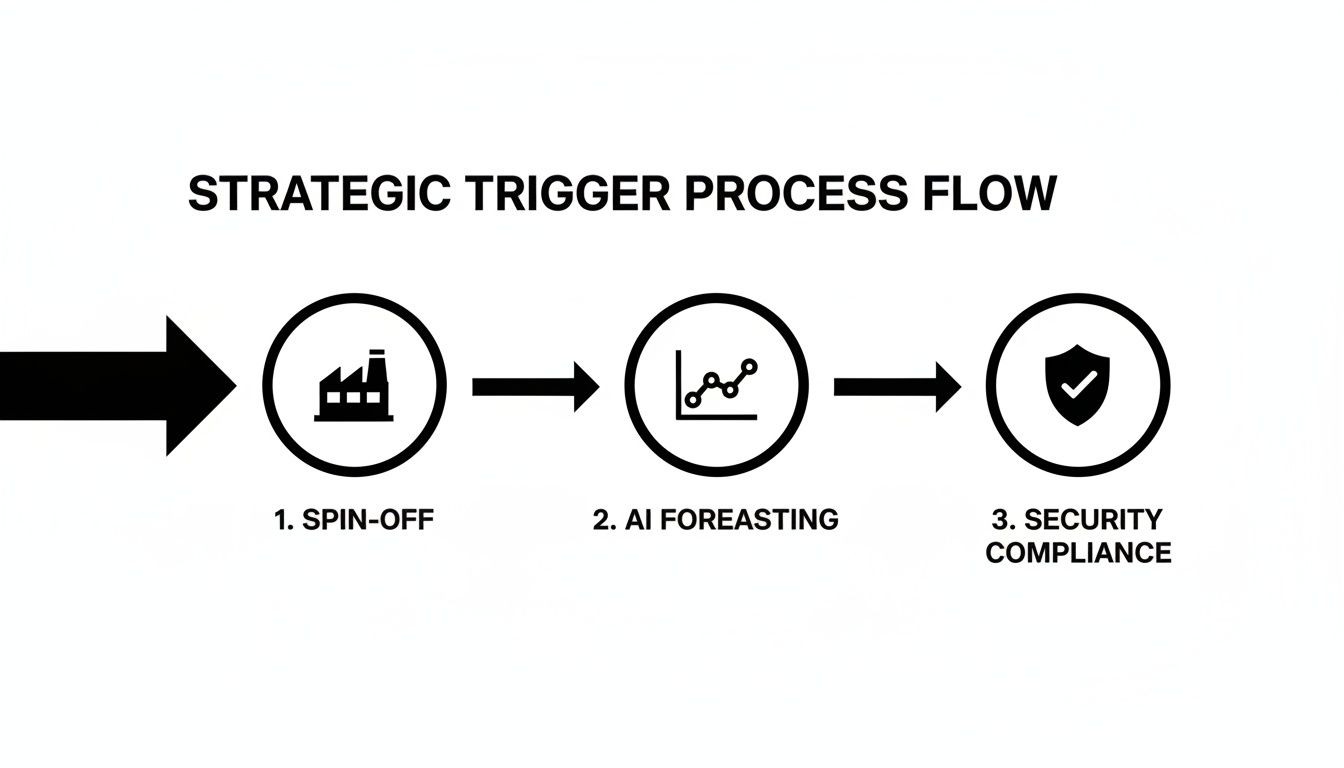
As illustrated, modern supply chain challenges are not siloed. Strategy, AI, and security are interconnected, requiring a partner fluent in all three disciplines.
Crafting an RFP that Reveals True Capability
Your Request for Proposal (RFP) must function as a precision instrument, designed to cut through marketing rhetoric and expose a firm’s genuine operational and technical capabilities. Generic questions will elicit generic, uninformative responses.
Ready to Build Your AI Project?
Let's discuss how we can help you ship your AI project in weeks instead of months.
The objective is to compel potential partners to demonstrate, not just describe, their expertise. The focus should be on evidence of past performance and their analytical approach. Many principles from choosing the right 3PL partner are applicable here, particularly regarding the assessment of cultural fit and execution ability.
Your RFP is not a procurement document. It is the initial test of a consultant's ability to solve your specific problems. The depth and clarity of their response will be indicative of the quality of their work.
Do not ask, "How would you improve our demand forecasting?" Instead, ask: "Given a sample dataset of X, Y, and Z, outline the first three steps you would take to build and validate a predictive model. Specify your choice of architecture and data pipeline."
Only genuine practitioners can provide a substantive answer to the second question. For further guidance on structuring such deep-dive evaluations, our guide on vendor due diligence offers robust frameworks.
To assist in this process, the following checklist outlines questions designed to test both strategic thinking and execution capability.
RFP Checklist for Selecting an AI-Enabled Supply Chain Partner
This table outlines essential criteria for your RFP, designed to probe beyond surface-level answers and assess a potential partner's true strategic and technical capabilities.
| Evaluation Area | Key Questions to Include | What to Look for in the Response |
|---|---|---|
| Problem Diagnosis | "Based on the problem we've outlined, what is your initial hypothesis? What critical assumptions are you making, and what data would you need to validate or disprove them in the first week?" | Look for a response that reframes the problem, challenges your assumptions, and demonstrates a clear, data-driven diagnostic process. They should ask more questions than they answer. |
| Technical Approach | "Describe a past project where you built a production-grade AI model. Walk us through the architecture, the tech stack used (e.g., data pipelines, MLOps), and the biggest technical hurdle you overcame." | They should provide a specific, non-confidential case study. Look for clear justification of their technology choices and a pragmatic approach to problem-solving, not just a list of buzzwords. |
| Execution & Velocity | "Provide a 30-day plan for a proof-of-concept for our use case. What are the key milestones, the required resources from our side, and what tangible output can we expect by day 30?" | The plan should be aggressive but realistic, focused on delivering a tangible outcome (e.g., a working model, a validated data pipeline) quickly. Vague plans are a red flag. |
| Team & Expertise | "Who from your team would be assigned to this project? Please provide brief bios focusing on their hands-on experience with similar challenges, not just their academic credentials." | Look for a team of builders—engineers, data scientists, and product people—not just project managers. The experience should be directly relevant and demonstrate a track record of shipping products. |
| Commercial Model | "We prefer an outcome-based engagement. Propose a commercial model where your compensation is tied to achieving specific KPIs (e.g., a 15% reduction in forecast error, a 10% increase in inventory turns)." | A confident partner will embrace this. Look for a well-structured proposal that clearly defines the metrics, measurement methodology, and risk-sharing. Hesitation to engage on outcomes is a major warning sign. |
A well-crafted RFP process incorporating these elements will quickly differentiate true partners from mere vendors.
The Litmus Test: Technical and Cultural Fit
Ultimately, the decision rests on two key factors: technical competence and cultural fit. You can engage the most brilliant engineers, but if they cannot integrate with your team and operate at your pace, the project is destined for failure.
Assessing Technical Depth
- Live Problem-Solving: During the final selection meeting, present them with a small, anonymized version of a real business problem. Observe how their team collaborates to deconstruct it. Note the questions they ask.
- Code and Architecture Review: Request a walkthrough of a non-confidential architectural diagram from a previous project. This reveals their approach to building scalable, secure, and maintainable systems.
- Toolchain Transparency: Inquire about their technology stack for AI and data engineering. A modern, agile firm will not just provide a list; they will have strong, experience-based justifications for their tool choices.
Evaluating Cultural Alignment
- Entrepreneurial Mindset: Do they communicate like business owners—focusing on outcomes, risk, and opportunity? Or do they rely on consultant jargon like "deliverables" and "project management"?
- Collaborative Approach: How do they plan to integrate with your team? You require a partner who prioritizes knowledge sharing and joint ownership, not a "black box" operation.
- Pragmatism and Candour: A true partner will provide honest feedback, even if it challenges your assumptions. They should be comfortable identifying risks from day one, always maintaining focus on the optimal business outcome.
Structuring Engagements for Measurable Success
The traditional consulting model is no longer fit for purpose. Paying substantial fixed fees for strategic recommendations is an outdated practice, particularly for German businesses navigating AI implementation and market volatility. The structure of the engagement is not a mere contractual detail; it is the single most important factor in determining whether tangible results will be achieved.
A fundamental shift in mindset is required. Cease purchasing "deliverables" and begin investing in tangible business outcomes. This necessitates moving away from project-based fees and toward partnerships where the consultant has a vested financial interest in your success.
From Deliverables to Shared P&L Accountability
The most effective supply chain consultants operate not as vendors, but as "Co-Preneurs." This is more than a neologism; it is a commercial model built on shared risk and shared reward. Their compensation must be contractually linked to your business objectives. Only then are your incentives truly aligned.
This is not a matter of preference but of necessity. The European supply chain consulting market is projected to reach USD 24,510 million by 2025. In Germany, where 62% of companies experienced disruptions in 2024, the pressure to deliver results is immense. We are seeing 45% of these firms engaging consultants to build TISAX-compliant AI pipelines.
Crucially, without a partner who accepts P&L accountability, an estimated 30% of these projects fail. You can review further market data at supply chain strategy consulting on datainsightsmarket.com. Aligned incentives are the mechanism to de-risk innovation.
What do these "Co-Preneurial" engagements entail?
- Performance-Based Incentives: A portion of the fee is contingent upon achieving specific, pre-agreed KPIs.
- Outcome-Oriented Partnerships: Compensation is directly tied to the value created or costs saved. No impact, no significant financial reward.
- Equity Partnerships: For major transformations, such as a corporate spin-off, the consulting firm may take an equity stake, ensuring long-term commitment.
Do not ask, "What will you deliver?" The critical question is, "For which business outcome are you willing to be held accountable?" The answer is revelatory.
Want to Accelerate Your Innovation?
Our team of experts can help you turn ideas into production-ready solutions.
Defining Success Metrics from Day One
A successful partnership begins with crystal-clear success metrics, agreed upon before any work commences. These metrics must be quantifiable, time-bound, and directly linked to your P&L. They form the basis of a contract that guarantees value.
This approach moves beyond simple project completion milestones. The objective is tangible business improvement. For example, if implementing an AI logistics solution, "success" is not the go-live date; it is the measurable reduction in freight costs or the increase in delivery velocity.
Practical Examples of Quantifiable Metrics
To make this concrete, here are the types of metrics that should be embedded in your contracts:
- Operational Cost Reduction: A 15% reduction in warehousing and transport costs within 12 months, verified by financial audits. We often leverage process mining with tools like Celonis to validate these savings.
- Service Level Improvement: An increase in the on-time-in-full (OTIF) delivery rate from 92% to 97% within two quarters.
- Inventory Optimisation: A 20% reduction in safety stock for top product lines without compromising service levels, driven by a more accurate AI forecasting model.
- New Product Launch: A successful launch of a new AI-driven service, defined as achieving 500 paying customers and €1 million in annual recurring revenue within the first year.
By embedding these hard metrics into your contracts, the engagement transitions from a cost center to a strategic investment. It ensures your consultants are not merely working for you—they are invested in building value with you.
Making it Work: Onboarding, Governance, and Mitigating Common Pitfalls

Signing the contract is not the conclusion; it is the commencement.
A poorly executed onboarding process can undermine a consulting engagement from the outset, leading to miscommunication, team friction, and missed objectives. The key is to shift from a "vendor" mindset to treating the consultants as an embedded component of your team.
A successful onboarding process is not exclusive to new employees; it is essential for integrating external experts into your operational fabric and initiating a true partnership.
The initial weeks are critical for translating the contractual agreement into an operational reality. This is where you define the practical modalities of how your teams will collaborate, communicate, and make decisions.
Building a Joint Governance Structure
Effective governance eliminates the "us versus them" dynamic. It creates a unified command structure where your internal experts and the consultants operate as a single entity. Without it, accountability becomes diffuse, and decision-making stalls in cycles of emails and unproductive meetings.
Looking for AI Expertise?
Get in touch to explore how AI can transform your business.
A robust joint governance framework requires several key elements:
- A Steering Committee: This is your high-level governance body, comprising senior leaders from both your organization and the consultancy, meeting bi-weekly. Its purpose is to monitor strategic progress, remove major obstacles, and ensure alignment with business objectives.
- Dedicated Workstream Leads: Assign specific individuals from both teams to own key project areas, such as data engineering or logistics modeling. This establishes clear points of contact and streamlines day-to-day accountability.
- A Shared Communication Protocol: Define the rules of engagement for communication. Establish standard meeting cadences, create dedicated channels for urgent matters (e.g., a shared Slack or Teams channel), and agree on progress reporting formats.
This type of structure is non-negotiable for complex AI projects. The German supply chain analytics market is projected to grow to USD 1,132.3 million by 2030, driven primarily by cloud solutions. When an industrial leader like Bosch or STIHL engages consultants for AI-driven analytics, this level of integrated governance is the only way to manage the vast data streams and technical complexities involved.
Onboarding is not about introductions. It is about fusing two teams into a single high-performance unit with a unified mission and a clear execution plan.
Dodging Predictable (and Expensive) Pitfalls
Even with a strong governance model, certain common pitfalls can derail a project. The key is to anticipate them and build mitigation strategies directly into the project plan. This protects your investment and ensures the partnership delivers on its promise.
One of the most significant risks is a failure to secure stakeholder buy-in. If key department heads or operations managers are not engaged early, they can become obstacles rather than champions. The consultants' mission must be clearly communicated from the C-suite down, positioned as a company-wide priority.
Ready to Build Your AI Project?
Let's discuss how we can help you ship your AI project in weeks instead of months.
Another critical error is failing to plan for the knowledge handover from day one. You are engaging elite supply chain consultants to build internal capabilities, not to create a long-term dependency.
Here are three common pitfalls and how to avoid them:
The "Black Box" Problem: The consultants operate in isolation, and your team lacks visibility into their methods. This prevents knowledge transfer and leaves you with solutions you cannot maintain.
- Solution: Insist on a "paired working" model. Your engineers and analysts must work side-by-side with their consultant counterparts. This ensures transparency and builds institutional knowledge throughout the project.
Uncontrolled Scope Creep: The project's objectives expand continuously without corresponding adjustments to the timeline, resources, or strategic justification.
- Solution: Implement a formal change control process managed by the steering committee. Any proposed scope change must be rigorously evaluated against the original business case and P&L impact before approval. Our guide on the three lines of defense can offer a useful framework for this.
Pilot Purgatory: A successful proof-of-concept is completed but never transitions to full production. It fails due to a lack of planning for integration, security, and operational handover.
Want to Accelerate Your Innovation?
Our team of experts can help you turn ideas into production-ready solutions.
- Solution: Define the "path to production" in the initial project charter. This includes identifying internal system owners, defining security and compliance requirements (e.g., TISAX), and allocating the budget for the full-scale rollout before the pilot begins.
Frequently Asked Questions
The decision to engage external expertise invariably raises important questions. Below, we address some of the most common inquiries from executives considering the engagement of supply chain consultants, particularly in the context of AI implementation.
How Do We Measure the ROI of an AI Initiative?
Measuring the return on an AI-focused project extends beyond simple cost savings. While achieving a 15-20% reduction in logistics spend is a tangible and significant result, it represents only one facet of the value created.
A comprehensive ROI calculation must incorporate strategic advantages. Consider the competitive edge gained from reducing time-to-market. Evaluate the risk mitigated by building a more resilient, predictive supply network. Furthermore, account for new revenue streams enabled by AI-powered services or corporate spin-offs.
To do this effectively, these multi-layered metrics must be defined at the outset of the engagement and embedded in a performance-based contract where the consultant's compensation is tied to achieving business outcomes, not merely completing a task list.
What is the Difference Between a "Consultant" and a "Co-Preneur"?
The distinction lies in their operational model and incentive structure—their "skin in the game."
Looking for AI Expertise?
Get in touch to explore how AI can transform your business.
A Traditional Consultant operates on a deliverable-based model. You pay a fee in exchange for analysis, reports, and strategic recommendations. Their engagement typically concludes upon delivery of the final report, with little to no accountability for subsequent implementation or results.
A Co-Preneur Partner operates on an outcome-based model. They are deeply embedded in your operations, often sharing P&L accountability. They are hands-on builders, developing AI prototypes and deploying data pipelines. Their financial success is directly linked to the real-world performance of the project. They function as a true extension of your team, focused on execution.
A traditional consultant sells you a map. A Co-Preneur partner helps you excavate and shares in the value uncovered. For high-stakes innovation, this alignment is indispensable.
How Do We Ensure Knowledge is Transferred to Our Team?
This is a critical objective that must be formally structured into the engagement from day one. The entire project should be framed as an enablement initiative, designed to enhance your internal capabilities, not create dependency.
In practice, this includes:
Ready to Build Your AI Project?
Let's discuss how we can help you ship your AI project in weeks instead of months.
- Hands-on training and workshops as standard components.
- Paired programming sessions where your engineers work directly alongside their counterparts.
- Co-development of all project elements, from data architecture to the final machine learning models.
The goal is not for the consultants to operate the new system on your behalf, but for them to build it with you. A superior partner measures their success by how quickly they can make your organization self-sufficient, leaving behind a capable, confident team, not just a black-box solution.
At Reruption GmbH, we do not merely advise; we operate as Co-Preneurs. We share P&L accountability and work in the trenches with your team to build and launch production-ready AI solutions. Our mission is to transform your strategic concepts into market innovations and ensure you retain the capability long after our engagement concludes.
Discover how our model de-risks your next AI initiative at https://www.reruption.com.