
Think of a digital marketing strategist as the architect of your company's online growth. They're not just running ads or posting on social media; they’re designing the entire blueprint that connects every single marketing activity back to your core business goals. While specialists are deep in the trenches executing specific tasks, the strategist is the one with the map, ensuring every move pushes the business forward.
What a Digital Marketing Strategist Actually Does
To really get what a strategist does, it helps to see them as the "why" behind everyone else's "what." Most companies have marketing specialists—an SEO expert, a content writer, a social media manager. These are the talented cooks in the kitchen, each brilliant at their specific dish.
The strategist, in this analogy, is the executive chef. They don't just cook; they design the entire menu. They figure out which ingredients are needed, how each dish complements the others, and ensure the final dining experience is exactly what customers will love and pay for. They connect the day-to-day tasks of the marketing team to the big-picture business objectives, like increasing customer lifetime value or breaking into a new market.
A specialist asks, "How can we get more followers on Instagram?" A strategist asks, "How will more Instagram followers help us achieve our 20% revenue growth target this year, and is that the most effective use of our resources?"
This distinction is absolutely critical. Without a strategist, marketing can feel like a bunch of random, disconnected activities. You might have a great blog and an active social media presence, but if they aren't working together toward a common goal, you’re probably leaking money and effort. The strategist ensures every euro spent is a deliberate investment in growth.
Strategy vs. Tactics: The Core Difference
The main job of a strategist is to build the overarching plan, not to get lost in the weeds of executing individual steps. Their work is all about foresight, big-picture planning, and making sure all the moving parts fit together.
They are ultimately responsible for:
- Defining the Finish Line: Translating vague business goals into clear, measurable marketing outcomes.
- Mapping the Terrain: Conducting deep-dive research into the market, competitors, and target audience.
- Drawing the Blueprint: Developing a comprehensive, multi-channel marketing plan that outlines the path to success.
- Measuring What Matters: Focusing on KPIs that directly impact the bottom line, like ROI and customer acquisition cost, not just vanity metrics.
It's easy to confuse the high-level planning of a strategist with the hands-on work of a specialist. This table should clear things up.
Strategist vs Specialist Key Differences
| Area of Focus | Digital Marketing Strategist | Digital Marketing Specialist (e.g., SEO Manager) |
|---|---|---|
| Perspective | Holistic, long-term view of all marketing channels and their connection to business goals. | Deep, tactical view focused on optimising a single channel or specific discipline. |
| Primary Goal | To create an integrated plan that achieves overarching business objectives like revenue growth. | To execute specific tasks and hit channel-specific KPIs like organic traffic or click-through rates. |
| Core Question | "Why are we doing this, and how does it drive the business forward?" | "How can I execute this task most effectively to improve my channel's performance?" |
| Deliverables | Comprehensive marketing strategy, budget allocation plans, performance dashboards, and market analysis reports. | SEO audits, content calendars, ad campaign reports, and social media posts. |
In short, the strategist sets the destination and draws the map, while specialists are the expert drivers who navigate the specific roads to get you there. Both roles are essential, but they operate at completely different altitudes.
The Strategist's Core Responsibilities and Daily Work
So, we’ve drawn a line between strategy and tactics. But what does a digital marketing strategist actually do all day? It’s not just about high-level meetings and whiteboards. Their role is a hands-on cycle of deep analysis, creative planning, and constant measurement that directly fuels business growth.
Ready to Build Your AI Project?
Let's discuss how we can help you ship your AI project in weeks instead of months.
Their work doesn't start with picking channels or dreaming up campaigns. It begins with a deep, almost obsessive, understanding of the business and its place in the market. They act like digital detectives, constantly digging into market trends and competitor moves to spot opportunities and sniff out threats before they become problems.
Analysing the Competitive Landscape
A strategist's analysis is far more than a quick glance at a competitor's homepage. They get their hands dirty with powerful tools like SEMrush or Ahrefs to completely deconstruct what rivals are doing. This means figuring out which keywords are sending them organic traffic, what content is actually working for them, and where their ad budget is going. The entire point is to find the gaps—the strategic weak spots where your business can outmanoeuvre them.
For instance, a strategist might find that a major competitor is dominating broad, high-volume keywords but is completely ignoring specific, long-tail questions that high-intent customers are asking. That’s not just an observation; it’s an immediate action plan to create targeted content that scoops up that underserved audience.
Defining Audiences and Objectives
Once the lay of the land is clear, the focus turns inward. Who are we actually trying to talk to? The strategist is responsible for creating detailed buyer personas – not just generic profiles, but rich, semi-fictional representations of ideal customers, built from real data and market research. These personas become the North Star for every marketing action, ensuring every blog post, ad, and email feels like it was written just for them.
With the "who" locked in, the strategist then defines the "what" by setting crystal-clear, measurable objectives. We’re not talking about vague goals like "increase brand awareness." These are hard-nosed Key Performance Indicators (KPIs) that tie directly back to the company's bottom line.
Want to Accelerate Your Innovation?
Our team of experts can help you turn ideas into production-ready solutions.
- Increase Marketing Qualified Leads (MQLs) by 30% in the next quarter.
- Reduce Customer Acquisition Cost (CAC) from €50 to €35 within six months.
- Improve the sales conversion rate from lead-to-customer by 15% by year-end.
This level of precision makes marketing accountable and ensures it's always pulling in the same direction as sales and the rest of the business. This kind of strategic thinking is in high demand. In Germany, the digital marketing sector is a huge economic driver, contributing around €22.9 billion to the economy. The need for people skilled in "Planning & conception" is booming, with jobs in this area growing by over 8,000 roles and salaries jumping 37.6% in a recent two-year span. It’s clear that businesses value this expertise. You can dive deeper into the numbers in this detailed Bitkom study.
This visual perfectly captures the difference between the strategist's big-picture blueprint and the specialist's day-to-day execution.
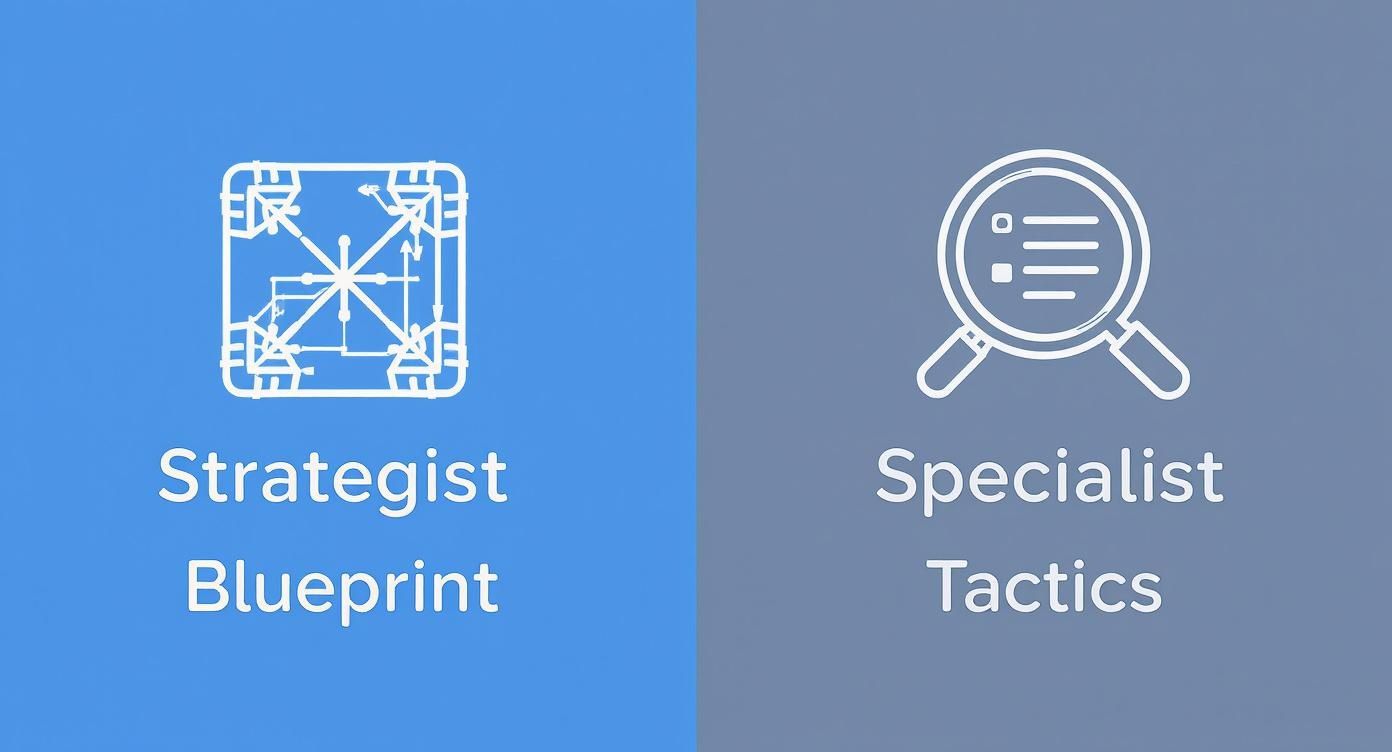
As you can see, the strategist creates the framework—the "blueprint"—that allows specialists to execute their specific tasks effectively with a clear sense of direction.
Allocating Budgets and Resources
Finally, a huge part of a strategist’s daily job is deciding where to put the money. This is where tough calls are made about which channels will deliver the best return on investment.
Looking for AI Expertise?
Get in touch to explore how AI can transform your business.
A strategist doesn’t just ask, "Should we use Google Ads?" They ask, "What’s the smartest way to spend our next €10,000? Should we build our audience with top-of-funnel content, or should we go for the kill with bottom-of-funnel ads to drive immediate sales?"
This isn’t a one-and-done decision, either. The strategist is constantly watching campaign performance, ready to shift money away from channels that aren’t delivering and into those that are crushing their targets. It's a fluid, agile approach that makes sure the marketing budget is always working as hard as possible to hit those all-important business goals.
What Separates a Good Strategist from a Great One?
So, what’s the real difference between a competent digital marketing strategist and an exceptional one? While a solid grasp of marketing channels gets you in the door, true excellence is a mix of sharp analytical skills, strong business sense, and a knack for seeing what’s coming next. The best in the business are often called ‘T-shaped’ professionals.

Picture a letter 'T'. The wide, horizontal bar represents a broad knowledge across all key marketing disciplines. But the deep, vertical stem is where the magic happens—that’s their deep-seated expertise in one or two core areas, usually strategy, data analysis, and tying it all back to business goals. Let's dig into the skills that make up this powerful combination.
Foundational Channel Knowledge
A strategist doesn’t need to be a world-class expert in every single channel, but they absolutely need more than a surface-level understanding. They have to know how all the different parts of the marketing engine fit together to build momentum.
Think of them as an orchestra conductor. The conductor can't play every instrument like a virtuoso, but they know exactly what the violins, the percussion, and the brass section are capable of. That’s how they create harmony.
A great strategist needs to be fluent in:
- SEO Principles: Understanding how organic search builds long-term value and how content and technical tweaks influence rankings.
- PPC and Paid Media: Knowing how to use paid channels to zero in on specific audiences, test messages quickly, and drive immediate results.
- Content and Email Marketing: Appreciating how to build an audience, nurture leads, and keep customers coming back with valuable content and direct communication.
- Social Media Dynamics: Recognising how each platform works differently for brand building, community engagement, or generating leads.
This broad knowledge is what lets them build a truly integrated strategy, one where every channel supports the others. It’s the only way to avoid the common pitfall of siloed marketing efforts that just don’t talk to each other.
Future-Focused Strategic Capabilities
While channel knowledge is the bedrock, the skills that truly elevate a strategist are all about data, technology, and business impact. This is where they go from being a marketing manager to a genuine business leader. The demand for these advanced skills is climbing fast, especially in strong markets.
Ready to Build Your AI Project?
Let's discuss how we can help you ship your AI project in weeks instead of months.
For instance, the German digital marketing sector is expected to rocket from USD 15.65 billion to over USD 33.48 billion by 2035, powered by trends like AI integration and data-driven campaigns. That kind of growth screams for strategists who can handle the complexity. You can find more insights on European digital marketing trends in Ironhack's 2025 salary report.
A top-tier digital marketing strategist doesn't just manage campaigns. They interpret data to find hidden growth levers, use technology to work smarter, and translate marketing metrics into the language of the C-suite: revenue, profit, and market share.
Data Literacy And Analytical Prowess
This might be the most crucial skill of all. A great strategist has to be obsessed with data—not just for the sake of it, but for the stories it tells.
This means:
- Translating Numbers into Narratives: They can look at a dashboard and see beyond the charts to understand user behaviour, pinpoint friction in the customer journey, and spot what’s trending.
- Understanding Attribution: They’ve moved past simplistic "last-click" models. They appreciate how different touchpoints contribute to a conversion, giving them a much clearer picture of what’s really working.
- Asking the Right Questions: They use data to challenge assumptions and form smart hypotheses for testing. They're constantly asking things like, "Why are mobile users abandoning their carts?" or "Which content format is actually bringing in the best leads?"
Business Acumen and AI Proficiency
Finally, two skills connect the dots between marketing and the business's bottom line. First is business acumen—the ability to see how marketing activities directly impact the company's profit and loss. A strategist with solid business sense can confidently allocate budgets and justify their decisions with solid ROI projections.
Want to Accelerate Your Innovation?
Our team of experts can help you turn ideas into production-ready solutions.
Second is a growing proficiency with AI tools. This doesn't mean they need to be a data scientist. It means they know how to use AI for practical tasks like audience research, brainstorming content, optimising campaigns, and even predictive analytics. This is no longer a "nice-to-have"; it's a core competency for any modern strategist worth their salt.
How to Measure a Strategist's Success
Bringing a digital marketing strategist on board is a serious investment. So, how do you know if it's actually paying off? The answer isn't in surface-level "vanity metrics" like a spike in social media likes or a bump in website traffic. A great strategist lives and breathes the numbers that truly matter to your bottom line.
Their real value isn't just in launching campaigns; it's about delivering measurable business outcomes. This means shifting your focus from activity to results. Instead of asking, "How many blog posts did we publish?", the right question is, "How did those blog posts reduce our cost to acquire a new customer?". That change in perspective is everything when it comes to evaluating their contribution.
Key Metrics That Tell the Real Story
To get a true picture of success, you need to track the KPIs that tie marketing directly to revenue. These are the numbers that tell the story of your return on investment and prove a strategist's worth.
Here are the metrics that really count:
Looking for AI Expertise?
Get in touch to explore how AI can transform your business.
- Customer Acquisition Cost (CAC): Put simply, how much does it cost you in sales and marketing to win a single new customer? A strategist's job is to consistently find ways to drive this number down, either by optimising channels or improving conversion rates.
- Customer Lifetime Value (CLV): This is a projection of the total revenue your business can expect from one customer over the entire relationship. When CLV is on the rise, it’s a great sign that your strategist is helping you attract and keep the right kind of customers.
- Return on Ad Spend (ROAS): For every euro you put into advertising, how much revenue comes back? ROAS gives you a crystal-clear look at the profitability of your paid campaigns. A strong ROAS means your budget is being spent wisely.
- Marketing-Sourced Revenue: What percentage of your company's total revenue comes directly from marketing efforts? This is the ultimate proof that the strategy is driving sales and contributing directly to growth.
A strategist's core mission is to move these numbers in the right direction. If your CAC is dropping while your CLV is climbing, your business is getting more profitable and sustainable. That’s the clearest sign of an effective strategy at work.
Expected Deliverables and Outputs
Beyond the hard numbers, a strategist’s success is also visible in the quality and clarity of their work. We're talking about the tangible documents and tools they create to guide the entire marketing operation. You should expect professional, clear, and actionable outputs.
A competent strategist will consistently deliver:
- A Comprehensive Strategy Document: This is the master blueprint. It should lay out everything from market analysis and target audience personas to overarching goals, channel-specific plans, budget allocation, and an execution timeline.
- Detailed Channel Roadmaps: Think of these as the tactical plans for each marketing channel, like SEO, content, or PPC. They should detail specific campaigns, content themes, and schedules for the next quarter or year.
- Performance Dashboards: A strategist must provide regular, easy-to-digest reports that track progress against your main KPIs. Good dashboards make the data visual, so stakeholders can see what's working—and what isn't—at a glance.
These aren't just documents for the sake of it. They are vital tools for keeping everyone aligned and holding the strategy accountable. They turn a complex plan into a transparent roadmap the whole organisation can get behind, making the strategist a true partner in your growth.
Choosing Between an In-House Strategist and an External Consultant
So, should you hire a full-time digital marketing strategist or bring in an external consultant? This is a huge decision, and it’s about far more than just the budget. It's about matching your company's culture, immediate needs, and long-term vision with the right kind of expertise.
Ready to Build Your AI Project?
Let's discuss how we can help you ship your AI project in weeks instead of months.
Think of it this way: are you building a professional kitchen from scratch, or are you hiring a world-class chef to cater a critical event? The in-house kitchen gives you daily control and becomes part of your home, but it’s a massive upfront investment. The caterer brings specialised skills and fresh ideas for a specific purpose, without the overhead.
Ultimately, the choice comes down to deep integration versus specialised, on-demand expertise. An employee lives and breathes your company culture. A consultant brings a wealth of outside experience, offering a bird's-eye view that’s free from internal politics.
When to Hire an In-House Strategist
Bringing a strategist onto your permanent team is a serious commitment to building your marketing muscle from within. This path makes the most sense for businesses that have hit a certain scale, where marketing isn’t just a series of campaigns but a central, continuous part of the operation.
An in-house strategist does their best work when they're truly embedded in the business. They're in the product development meetings, they understand the sales team's daily struggles, and they build real relationships across departments. That proximity is gold—it allows them to craft strategies that are perfectly tuned to your company's DNA.
Consider hiring in-house if:
Want to Accelerate Your Innovation?
Our team of experts can help you turn ideas into production-ready solutions.
- Your business is complex: If your products or services require deep, nuanced understanding, you need someone who can live with that complexity day in and day out.
- You're building a marketing-first culture: You want a dedicated leader to own the strategic vision and champion marketing's role throughout the entire organisation.
- Marketing is a core, daily function: Your business depends on constant optimisation and quick reactions to the market. You need someone on deck full-time to steer the ship.
- You can support a senior role: You have the budget not just for the salary but also for the benefits, tools, and ongoing training a top-tier strategist needs to thrive.
When an External Consultant Is the Smarter Choice
For many companies, particularly start-ups, scale-ups, or those facing a very specific challenge, an external consultant or agency is a more agile and often more cost-effective move. You get access to senior-level thinking without the long-term financial commitment of a full-time hire.
Think of an external consultant as a strategic shot in the arm. They’re perfect for tackling a high-stakes project, conducting an unbiased audit of your current efforts, or filling a temporary leadership void. Their real value comes from their broad experience and their ability to get to the point and deliver results, fast.
An external strategist brings a "been there, done that" perspective from solving similar problems for dozens of other companies. They spot patterns and opportunities that an internal team, with its singular focus, might overlook.
An external partner is probably your best bet when:
- You need niche expertise for a specific project: You’re launching into a new market, overhauling your entire SEO approach, or building a complex data model, and you need a specialist for a defined period.
- You need an objective, outside perspective: Your marketing has gone stale. You need a fresh pair of eyes to challenge old assumptions and point out blind spots without getting tangled in company politics.
- You can't afford a full-time senior salary just yet: You need C-suite-level strategic guidance but aren't ready for that payroll commitment. A consultant on a project or retainer basis is the perfect bridge.
- You need flexibility above all else: Your strategic needs ebb and flow. A consultant allows you to scale that support up or down as your business evolves.
In-House vs External Strategist: A Comparison
To make the decision clearer, it helps to see a direct comparison. This table breaks down the key differences based on what might matter most to your business right now.
Looking for AI Expertise?
Get in touch to explore how AI can transform your business.
| Factor | In-House Strategist | External Consultant/Agency |
|---|---|---|
| Integration | Deeply embedded in company culture and processes. | Objective, outside perspective free from internal politics. |
| Knowledge | Develops profound institutional and product knowledge over time. | Brings broad industry experience and best practices from many clients. |
| Cost | Fixed cost (salary, benefits, overhead). A long-term investment. | Variable cost (project-based, retainer). No overhead like benefits. |
| Flexibility | Less flexible; a long-term commitment to a single individual. | Highly flexible; can scale engagement up or down as needed. |
| Speed | May have a longer ramp-up time to get fully integrated. | Can often start quickly and deliver focused results faster. |
| Focus | 100% dedicated to your business and its long-term goals. | Splits time and focus across multiple clients. |
| Accountability | Directly accountable as an employee, tied to company performance. | Accountable for specific deliverables and project outcomes (SOW). |
Looking at this table, the "right" answer isn't universal. It’s about being honest about your company's current stage, resources, and most pressing strategic needs. The best choice today might not be the best choice in two years, and that's okay.
Finding and Interviewing the Right Candidate
Hiring the right digital marketing strategist can feel like a shot in the dark, but it doesn't have to be. With a structured approach, you can turn what feels like a guessing game into a clear-headed, strategic decision. The real work begins long before you ever sit down for an interview; it starts with crafting a job description that pulls in the right kind of talent and pushes away the purely tactical thinkers.

Forget the dry laundry list of required skills. Instead, frame the job around the outcomes you need. Talk about the problems they will solve and the business results you expect them to deliver. This simple shift in perspective attracts true strategists—people who are driven by making a tangible impact, not just checking off a list of daily tasks.
Crafting a Compelling Job Description
To get high-calibre candidates in the door, your job description needs to act as a magnet for strategic minds. It all comes down to focusing on the "why" behind the role.
Ready to Build Your AI Project?
Let's discuss how we can help you ship your AI project in weeks instead of months.
- Describe the Mission: Start with the actual business challenge. For example: "We're looking for a strategist to grow our market share in the DACH region by 25% in the next two years by completely rethinking our digital customer acquisition model."
- Frame Responsibilities as Goals: Don't just say "Manage SEO." Instead, write: "Develop and execute an SEO strategy that will double our organic lead generation within 12 months."
- Showcase the Opportunity: Make it clear what's in it for them. Highlight the autonomy they'll have, the resources at their disposal, and the impact they can make. Mention things like direct access to key data, regular contact with stakeholders, and the chance to build a marketing function from the ground up.
Asking Questions That Reveal Strategic Thinking
The interview is where you get to see how their mind really works. You need to move beyond simple knowledge-check questions like, "Do you know how to run Google Ads?" The real insights come from situational and behavioural questions that force them to walk you through their strategic process.
The goal isn't to test their memory of marketing buzzwords. It's to see if they can genuinely connect marketing activities to real business outcomes. A great candidate naturally thinks in terms of ROI, customer lifetime value, and competitive positioning.
Here are a few powerful questions designed to see if you're talking to a true strategist:
- Past Performance: "Walk me through a campaign you built from the ground up. What was the business problem you were trying to solve? How did you come up with the strategy, what were the results, and what would you do differently today?"
- Future Application: "From what you've learned about our company so far, how would you approach building a marketing strategy in your first 90 days? What information and data would you need to get started?"
- Problem-Solving: "Let's imagine our lead volume suddenly drops by 40%. Talk me through your step-by-step process for diagnosing the issue and creating a recovery plan."
Successful Onboarding for Immediate Impact
Once you’ve found your person, the final piece of the puzzle is setting them up for success from day one. A great onboarding process is about empowerment, not just HR paperwork.
Make sure your new digital marketing strategist has everything they need right away. This means immediate access to historical performance data, analytics platforms, and clear business goals. It also means introductions to key people across sales, product, and leadership.
Want to Accelerate Your Innovation?
Our team of experts can help you turn ideas into production-ready solutions.
A clear, honest briefing on the current challenges and objectives allows them to start adding value from the get-go, turning your excellent hire into an indispensable part of your growth engine.
Final Questions Before You Hire a Strategist
Even when you've decided whether to hire in-house or externally, a few practical questions always pop up. Getting these sorted will help you lock in your budget, set the right expectations, and walk into the hiring process with confidence.
Think of this as your final pre-flight check. Nailing these details now means no nasty surprises later and helps you shape a role or project brief that the best talent will want to jump on.
What's the Going Rate for a Digital Marketing Strategist in Germany?
Whether you're hiring an employee or a freelancer, you need to know the market rate to budget properly. As you’d expect, salaries and day rates swing quite a bit depending on experience, niche skills, and just how complex the job is.
In Germany, you’re generally looking at these salary brackets:
Looking for AI Expertise?
Get in touch to explore how AI can transform your business.
- Junior Strategist: Someone with a couple of years under their belt will usually start around €45,000 per year.
- Mid-Level Strategist: A professional with a proven track record of successful campaigns typically earns between €60,000 and €75,000.
- Senior Strategist: For the heavy hitters with deep experience and leadership qualities, salaries often start at €85,000 and go up from there.
If you're bringing in outside help, remember that freelancers and consultants have their own business costs to cover, so their rates are higher. Expect to see hourly rates from €70 for solid mid-level support to over €150 for top-tier strategic thinking.
What Tools Should a Good Strategist Have Mastered?
Look, a great strategist doesn’t need to be a hands-on wizard with every marketing tool ever created. That’s not their job. Their real value is in knowing which platforms to use to pull the right data, analyse what’s happening, and turn it all into a smart plan. They're paid to interpret the outputs, not just click the buttons.
That said, any competent strategist should be perfectly comfortable with a core set of tools:
- Analytics: A deep understanding of Google Analytics 4 (GA4) or a similar platform like Matomo is completely non-negotiable. This is how they understand what people are actually doing.
- SEO & Competitor Analysis: They need to be proficient with tools like Ahrefs or SEMrush to dig into market trends and find those golden opportunities your competitors have missed.
- CRM & Automation: Having experience with a system like HubSpot or Salesforce is vital for mapping out the customer journey and understanding how leads are nurtured.
What's most important is that they see how these tools connect, creating a complete system for measuring performance and guiding execution.
The best strategists are tool-agnostic but data-centric. They don't get hung up on features; they focus on the insights the tools provide to make smarter decisions that actually grow the business.
Ready to Build Your AI Project?
Let's discuss how we can help you ship your AI project in weeks instead of months.
Can a Small Business Even Afford a Strategist?
Yes, absolutely. A full-time senior strategist's salary might feel out of reach, but that's far from your only option. In fact, getting your strategy right from the beginning is one of the smartest, most cost-effective things a small business can do.
You could hire a freelance strategist for a one-off project, like building your first go-to-market plan. This gives you access to top-tier thinking without the long-term overhead. Another great option is a monthly retainer, which provides ongoing strategic guidance for a fraction of what a full-time hire would cost. The goal is to get the "why" and the "how" figured out before you start spending your marketing budget.
