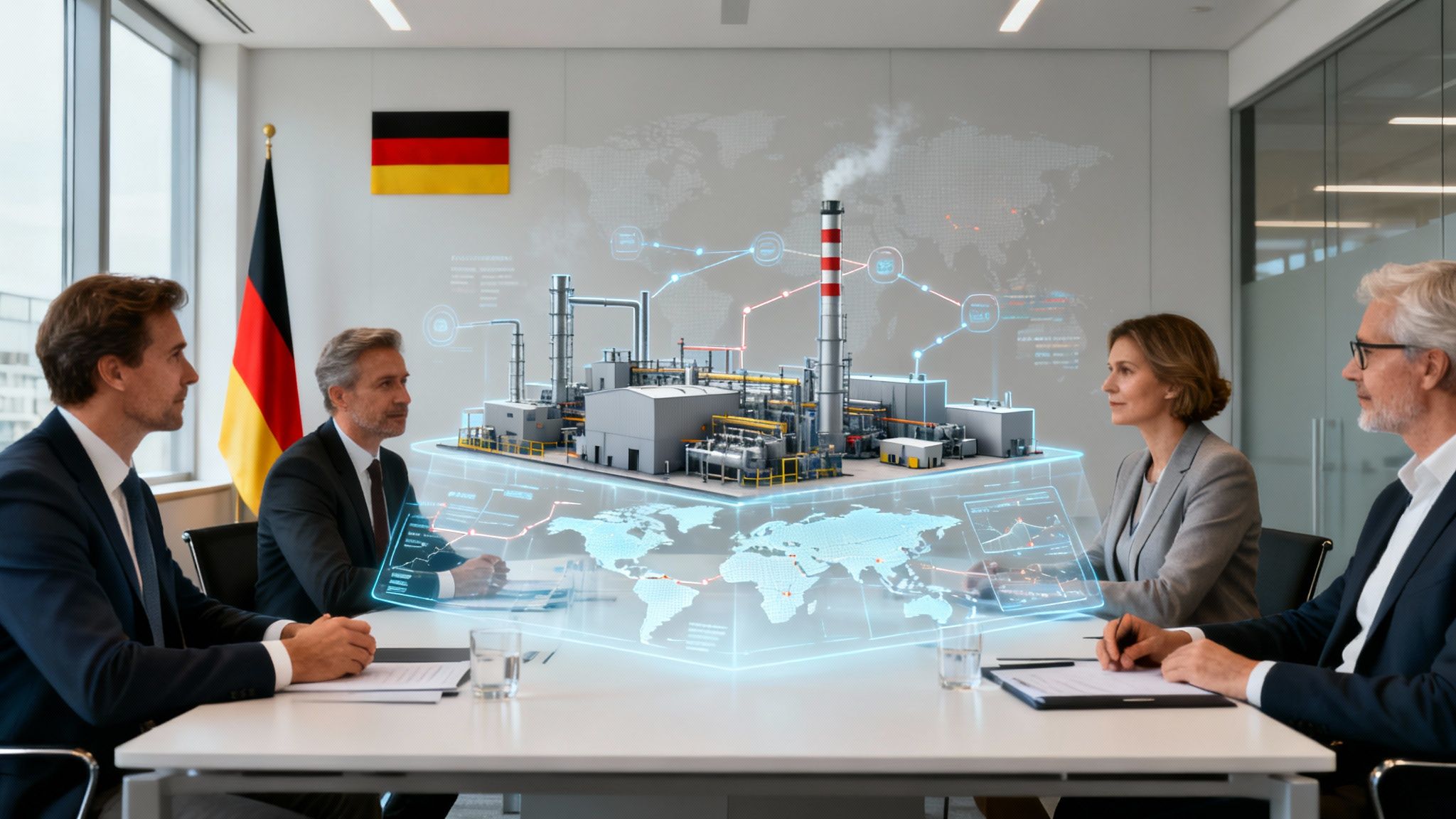
For German industrial leaders, robotics in the industry is no longer a subject of technological exploration. It is a core strategic imperative for securing a competitive position in the global market. This guide serves as a high-level briefing for C-level executives, designed to distill complex technical concepts into actionable strategic insights. We focus on how robotics addresses today’s most urgent market pressures, particularly for Germany’s established industrial base.
The Strategic Imperative for Robotics in German Industry
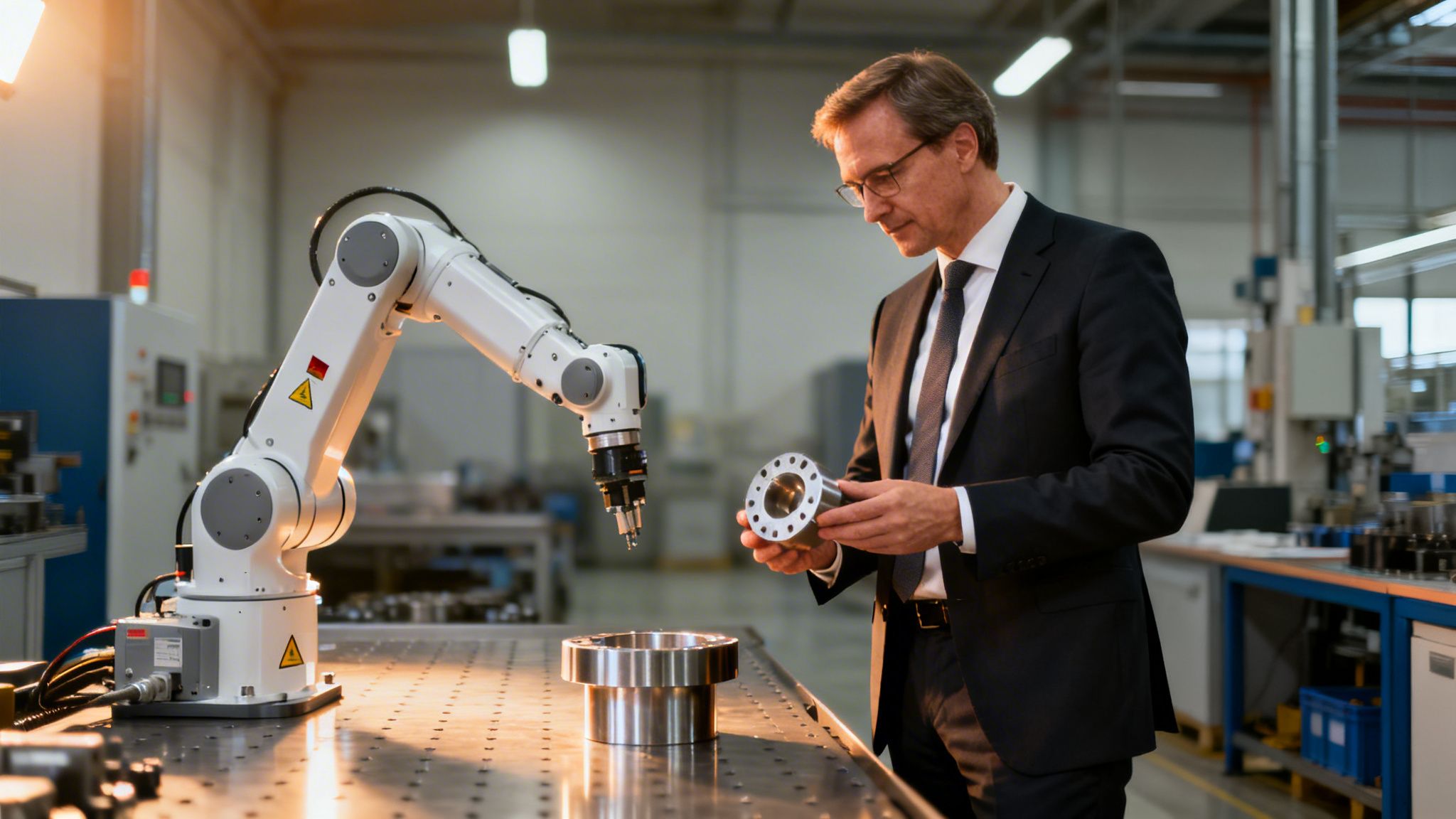
For Germany’s industrial champions, the strategic question has evolved from if to how and how fast robotics should be integrated. A confluence of persistent labour shortages, volatile supply chains, and intensified global competition has fundamentally reshaped the operational landscape. A passive "wait-and-see" approach is no longer a viable option; proactive adaptation is now the baseline requirement for market relevance and growth.
Targeted robotics adoption represents the most decisive response to these challenges. This is not a simple matter of substituting manual labour. It is about elevating the entire operational value chain. By automating repetitive, physically demanding, or high-precision tasks, you enable your skilled workforce to concentrate on higher-value activities: critical thinking, quality assurance, and process optimisation.
Responding to Critical Market Pressures
Adopting robotics can be viewed as a direct strategic countermeasure to the primary headwinds facing German industry. The advantages are immediate and tangible:
Ready to Build Your AI Project?
Let's discuss how we can help you ship your AI project in weeks instead of months.
- Mitigating Labour Shortages: Intelligent automation directly addresses the skills gap. It assumes responsibility for tasks where qualified personnel are scarce, ensuring production continuity and reducing dependency on a contracting labour market.
- Enhancing Supply Chain Resilience: On-site automation reduces reliance on external partners and remote suppliers. Repatriating critical processes—from component handling to final assembly—insulates operations from global disruptions.
- Boosting Global Competitiveness: Robots deliver a level of consistency, quality, and speed that manual processes cannot sustain. This allows German enterprises to compete on both quality and cost-effectiveness, reinforcing their position in the international arena.
For the forward-thinking executive, robotics is not a cost centre. It is a powerful instrument for building a more agile, innovative, and resilient enterprise—the very foundation required to future-proof the organisation.
A New Philosophy for Internal Innovation
This technological transition requires more than capital investment; it demands a new corporate mindset. We term this a "Co-Preneur" philosophy. It frames this technological leap as an opportunity to innovate from within—to 're-rupt' your own processes before an external force does. This reframes the implementation of robotics in the industry from a defensive reaction into a proactive strategy for building sustained competitive advantage.
By taking this measured yet decisive step, your company can shift from reacting to market pressures to actively shaping its own future. The objective is to build an enterprise that is not merely surviving but thriving, powered by intelligent automation and a culture of continuous internal improvement. To explore this concept further, you can learn more about aligning business strategy and technology in our detailed article.
Getting to Grips with Today's Robotics
To make sound investments in automation, an engineering background is not a prerequisite. What is essential is a clear understanding of which tools solve specific operational problems. The core principle is matching the right robotic solution to the right bottleneck in your value chain.
Want to Accelerate Your Innovation?
Our team of experts can help you turn ideas into production-ready solutions.
Consider it analogous to assembling a team of specialists. Each type of robot serves a distinct function, and their correct deployment is fundamental to a successful automation strategy. A misallocation of resources—such as assigning a high-precision welding robot to warehouse logistics—results in a gross underutilisation of capital and capability.
The landscape of robotics in the industry is primarily segmented into three main categories. Understanding their specific strengths enables executives to identify high-impact opportunities across the factory floor, warehouse, and quality assurance processes.
The Powerhouses: Traditional Industrial Arms
Traditional industrial robots are the high-performance assets of modern manufacturing. They excel at high-speed, high-precision, repetitive tasks. These systems are best conceptualised as dedicated specialists on an assembly line, typically isolated within safety enclosures due to their immense power and velocity.
These machines are optimised for static environments where the primary objective is mass production with machine-level consistency. They have been the workhorses of the automotive and heavy manufacturing sectors for decades due to their unmatched effectiveness in tasks such as:
- Welding: Executing thousands of identical welds with a degree of precision unattainable by human operators over extended shifts.
- Painting: Applying flawless, uniform coatings to automotive bodies, which minimises material waste and ensures superior finish quality.
- Heavy Lifting: Maneuvering large-scale components like engine blocks or vehicle chassis with relentless speed and reliability.
Their principal strength lies in their singular focus. They are not engineered for flexibility or human interaction; they are built to execute a specific mission perfectly, millions of times.
The Team-Players: Collaborative Robots (Cobots)
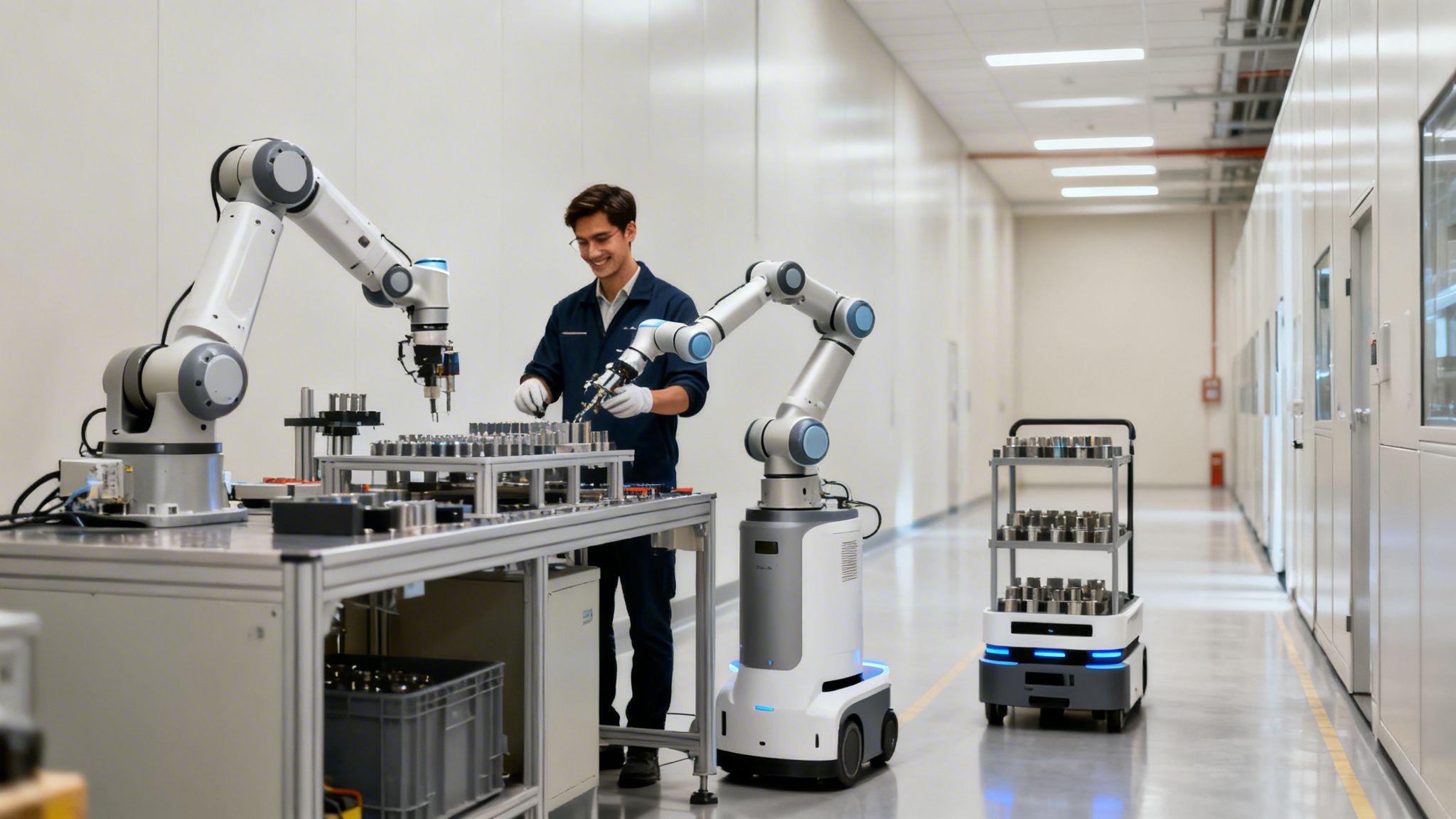
Collaborative robots, or cobots, represent a paradigm shift in automation. Unlike industrial arms, which operate in isolation, cobots are designed as skilled assistants to work safely alongside human personnel without the need for physical barriers. They are equipped with advanced sensors that enable them to slow or stop upon contact, facilitating direct human-robot collaboration.
This capability makes automation accessible for tasks that still require human intuition, dexterity, or problem-solving skills. Cobots are designed to augment your workforce, not replace it. This trend is a cornerstone of Germany’s progression towards Industry 4.0, with projected cobot sales expected to exceed 71,000 units in 2025 alone. The underlying data is available in GTAI's analysis of Germany's robotics market.
Cobots excel in applications where human-machine partnership creates superior value:
- Complex Assembly: A cobot can hold a component in a difficult-to-reach position while a technician performs a delicate fitting or wiring task.
- Quality Inspection: A cobot can present a part to a vision system or a human inspector from multiple angles, automating material handling so the expert can focus solely on the inspection.
- Machine Tending: They can load and unload CNC machines or presses, freeing an operator to supervise multiple machines simultaneously.
The Logistics Fleet: Autonomous Mobile Robots (AMRs)
Autonomous Mobile Robots (AMRs) are the strategic solution for optimising internal logistics. In contrast to traditional forklifts, AMRs function as an intelligent, self-organising fleet for material transport. Unlike their predecessors, Automated Guided Vehicles (AGVs), which require physical guides like magnetic tape, AMRs use AI and sensors for autonomous navigation.
AMRs perceive and interpret their environment. They construct digital maps of the facility and can intelligently plot new routes to circumvent obstacles—be it a person, a misplaced pallet, or another vehicle. This adaptability makes them ideal for the dynamic reality of a modern warehouse or factory.
Looking for AI Expertise?
Get in touch to explore how AI can transform your business.
They integrate with warehouse management or production systems to automate material flow. The right components are delivered to the right workstation at the optimal moment, significantly reducing worker downtime and increasing overall productivity. For further reading, explore our guide on the industrial automation sector.
Sizing Up the German Robotics Market
Germany has long been the dominant force in Europe's industrial robotics sector, but the market is exhibiting new dynamics. For executives planning investments, a clear understanding of these trends is crucial.
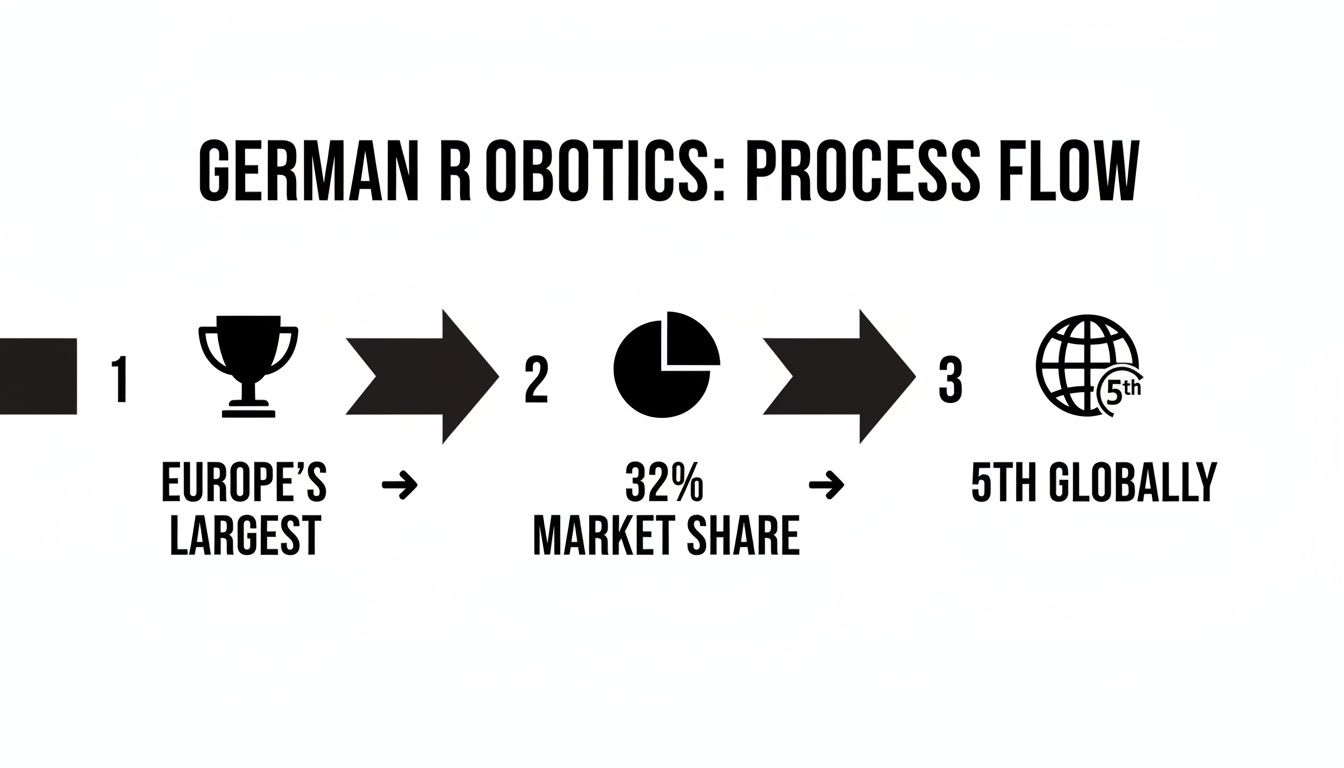
Despite a recent 5% decline from a record-breaking year, the underlying market narrative is one of resilience and sustained long-term growth. The data confirms this: Germany installed 26,982 new industrial robots last year. This figure solidifies its position as the largest market in Europe and the fifth-largest globally, comprising 32% of all installations on the continent. Even with a temporary cooling-off period, these statistics, detailed in IFR’s press release on global robot demand, underscore the deep integration of automation within the nation's industrial framework.
Key Drivers Shaping the Sector
Several core trends are sustaining market momentum, and astute leaders are monitoring them closely.
- Government Investment: The German High-Tech Strategy represents a significant commitment, channeling subsidies into R&D for automation and AI.
- Labour Shortages: The challenge of recruiting skilled labour in advanced manufacturing is intensifying, making robotics a practical necessity to bridge the talent gap.
- Supply Chain Resilience: The strategic push for onshoring critical manufacturing processes depends heavily on automation to ensure economic viability.
- The Digitalisation Push: Robots are evolving beyond mere mechanical manipulators. Their integration with AI, IoT, and advanced data analytics is unlocking substantial efficiency gains.
Furthermore, sustainability targets are encouraging companies to adopt more energy-efficient automation solutions. Therefore, while industry associations like the VDMA may indicate a short-term market contraction, it is more accurately interpreted as a strategic recalibration rather than a fundamental retreat. The long-term demand drivers remain firmly in place.
Performance Metrics at a Glance
To provide a clear perspective, the following key data points should be on every leader's dashboard.
This summary of critical market statistics offers a clear picture of the current state and future direction for Germany's industrial robotics sector, serving as a solid foundation for strategic planning.
German Robotics Market Key Performance Indicators
| Metric | Value | Implication for Business Leaders |
|---|---|---|
| Total Annual Installations | 26,982 units | Confirms the scale of automation but also signals market maturation. |
| Share of European Installations | 32% | Germany remains dominant; a crucial benchmark for competitive positioning. |
| Year-on-Year Growth | -5% | Indicates a temporary market correction. An opportune time to evaluate entry or expansion timing. |
| Government Funding (High-Tech) | €200 billion | A clear signal to leverage grants and incentives for funding pilot projects. |
| Projected Cobot Sales by 2025 | >71,000 units | Highlights a major growth area. Time to identify partnership opportunities with top vendors. |
These figures are not abstract numbers; they are direct inputs for strategic planning and capital allocation decisions.
The true strategic advantage is realised when robotics are integrated with a company's existing AI models and data infrastructure. This integration provides the real-time insights required for applications like predictive maintenance. Our pilot implementations consistently demonstrate throughput increases of approximately 15% from this type of data-driven optimisation.
Ready to Build Your AI Project?
Let's discuss how we can help you ship your AI project in weeks instead of months.
A robust integration strategy combines cobots, Autonomous Mobile Robots (AMRs), AI engines, and well-structured data pipelines. This approach ensures that business strategy is directly linked to measurable operational outcomes.
Governance and compliance must be integral to the strategy from the outset. Issues concerning data security, TISAX, ISO standards, and local regulations need to be addressed proactively. Leading executive teams establish cross-functional councils with representatives from IT, production, legal, and HR to oversee the entire automation initiative. This, combined with regular audits and risk assessments, ensures alignment with AI ethics, data privacy, and worker safety.
Strategic Responses for Executives
How can leadership act on this opportunity?
- Pilot Cobots in Low-Risk Areas: Begin with a contained project. Select a simple, repetitive task to validate the ROI within months, not years.
- Partner with AI Specialists: Do not attempt to build all capabilities in-house. Engage expert teams for services from deployment to compliance. For an example, review how BMW Spartanburg AI Robots Boost Assembly Efficiency.
- Deploy Autonomous Mobile Robots: Address internal logistics bottlenecks. AMRs can reduce material transit times by up to 30%.
- Invest in Data Pipelines: Develop the infrastructure for real-time analytics. This is critical for optimising robot workloads and pre-empting maintenance needs.
Industry case studies consistently show that for every 10% increase in automation, production costs typically decrease by about 3%. It is vital to benchmark progress against industry peers and maintain strategic agility, as ROI observed in a controlled pilot may not translate directly to full-scale factory floor implementation.
Key Takeaway: With strong government backing and a pressing need to solve labour shortages, Germany provides an ideal environment for pioneering AI-enabled robotics. The strategic imperative is to align early pilot projects with robust compliance and data governance frameworks from day one. This is how a temporary market dip is converted into a long-term competitive advantage.
Want to Accelerate Your Innovation?
Our team of experts can help you turn ideas into production-ready solutions.
This balanced approach enables executives to transform market insights into decisive, impactful action.
A Phased Roadmap for Robotics Implementation
For German industrial leaders, a successful transition to intelligent automation is a matter of methodical execution, not speculative investment. A chaotic, "big bang" rollout introduces unacceptable levels of risk and can alienate the very teams essential for success.
A structured, phased roadmap is the superior approach. It is analogous to a well-engineered production process: begin with a controlled prototype, progress to optimised small-batch runs, and only then commit to full-scale implementation. This methodology de-risks the investment, builds crucial organisational momentum, and ensures each phase delivers tangible value.
Ultimately, this strategy shifts the internal conversation from "Should we do this?" to "How fast can we scale our success?".
Germany's strong market position provides a solid foundation for precisely these kinds of strategic rollouts. We are not starting from zero; we are building upon a robust and mature ecosystem for robotics in the industry.
Looking for AI Expertise?
Get in touch to explore how AI can transform your business.
Phase 1: The 7-Day Proof
The initial phase is defined by speed and impact. The objective is to progress from concept to a working proof of concept in days, not months. This sprint is not about achieving perfection; it is about validating the core viability of the proposed solution.
Success hinges on selecting the right starting point. The ideal initial project addresses a process that is:
- High-Impact: It solves a known, significant bottleneck, such as a highly repetitive quality check or a simple material handling route.
- Low-Complexity: It does not require deep integration with complex legacy systems and can be tested in a relatively isolated environment.
- Clearly Measurable: Its KPIs are straightforward—cycle time, error rates, or parts moved per hour.
This rapid pilot serves as the internal proof point. It overcomes skepticism with empirical results and creates the first cohort of internal champions who have witnessed the potential firsthand.
Phase 2: The 30-Day Optimisation
Following a successful proof of concept, the next phase focuses on refinement and the construction of a robust business case. Over a 30-day period, the pilot is iterated upon, gathering comprehensive performance data to transition the concept into a reliable, optimised process.
Ready to Build Your AI Project?
Let's discuss how we can help you ship your AI project in weeks instead of months.
The core activities are direct and purposeful:
- Data Collection and Analysis: Continuously monitor the pilot against established KPIs. This data forms the bedrock of the business case.
- Iterative Improvements: Collaborate directly with operational teams. Their insights are invaluable for implementing small adjustments that enhance the robot's efficiency, reliability, and ease of use.
- Business Case Formulation: Translate the performance data into financial terms. Calculate the projected ROI based on improved throughput, reduced error rates, and the reallocation of human capital to higher-value tasks.
This phase provides the concrete evidence required to secure executive buy-in for a broader rollout. A focus on real-world data removes speculation and builds confidence in the strategic investment. For a deeper look at structuring these projects, refer to our guide on automation in robotics.
Phase 3: Scaling with Governance
The final phase involves the strategic deployment of the validated solution across the enterprise. Here, the focus shifts from an isolated pilot to an integrated component of daily operations. Success requires meticulous attention to governance, security, and compliance from the outset.
Key considerations for this stage include:
- System Integration: A clear plan is needed to connect robotic systems with existing MES, ERP, and other production software. A modular approach is often most effective, allowing for gradual rollouts without disrupting core operations.
- AI Governance Framework: Establish a cross-functional team to oversee the initiative. This group should define ethical guidelines, data management policies, and performance standards.
- Security and Compliance: Ensure every robotics implementation adheres to stringent industry standards, such as TISAX for the automotive supply chain or relevant ISO certifications. This is not an afterthought but a foundational requirement.
By adhering to this disciplined, three-phase roadmap, you can systematically introduce robotics in the industry, transforming a potentially disruptive technology into a well-managed and powerful competitive advantage.
Steering Clear of Implementation Pitfalls
Initiating a robotics program is not a simple activation; it is a complex navigation of operational, financial, and cultural challenges. The key to success lies in anticipating these roadblocks and planning for them from day one. For leadership, this means proactively addressing common pitfalls and converting potential setbacks into a source of competitive strength.
Notably, the most significant obstacles are rarely technological—they are strategic. A common error is selecting the wrong initial use case, where enthusiasm for new technology overrides a rigorous analysis of business impact. Another frequent mistake is underestimating the complexity of integrating new robotic systems with legacy infrastructure, which can lead to budget overruns and operational disruptions.
However, the most critical risk is neglecting the human element. Automation can be perceived as a threat. Without a clear and compelling narrative about how these tools will augment the team—not replace it—internal resistance can undermine even the most well-funded projects.
How to Dodge the Critical Risks
Navigating these challenges requires a proactive, structured approach. Every potential issue has a strategic countermove, and early implementation greatly smoothes the adoption of robotics in the industry. This is where technical foresight converges with intelligent change management.
We recommend focusing on three core areas:
Want to Accelerate Your Innovation?
Our team of experts can help you turn ideas into production-ready solutions.
- Be Smart About Your First Move: Avoid attempting to automate your most complex process initially. Identify a high-impact, low-complexity bottleneck where a "7-Day Proof" can deliver a quick, demonstrable win. This builds momentum and stakeholder buy-in.
- Think Modular, Not Monolithic: Instead of a single, massive integration, design your system in discrete modules. This allows robots to connect with existing technology through clean, standardized interfaces, simplifying both initial deployment and future scaling.
- Make Your Workforce Part of the Solution: Frame this as a workforce augmentation strategy from the outset. Implement a clear plan to upskill and retrain employees to manage, maintain, and collaborate with the new automated systems, transforming their roles into higher-value positions.
A winning robotics strategy is founded on more than technology; it is founded on foresight. By anticipating integration challenges and prioritizing your people, you de-risk the investment and establish a solid foundation for scaling intelligent automation.
Turning a Market Squeeze into Your Advantage
The broader economic climate cannot be ignored. Current forecasts present a challenging outlook for the German automation sector. According to the VDMA Robotics + Automation Association, the industry is preparing for a potential 10% revenue contraction next year, with sales projected to fall to €14.5 billion. This follows a year that has already seen a 6% decline and a 16% slump in domestic orders. You can review the complete data in the full VDMA forecast analysis on Businesswire.
While these figures may seem concerning, they conceal a significant opportunity for astute leaders. During economic tightening, most competitors reduce capital expenditure. This is a prime moment to gain a strategic advantage. Targeted, intelligent investments in AI and robotics now will build operational resilience and efficiency that will yield substantial returns when the market rebounds.
A Framework for Staying Ahead of Risk
A robust risk management plan is non-negotiable. It must encompass technology and finance, with a strong emphasis on safety and compliance. Integrating robots into the workplace necessitates addressing the associated Health and Safety Risks in Manufacturing to ensure team well-being.
To build a functional governance structure, consider these final points:
Looking for AI Expertise?
Get in touch to explore how AI can transform your business.
- Create a Cross-Functional Steering Committee: Assemble leaders from IT, operations, HR, and legal. This committee must oversee the project to ensure it aligns with overarching business objectives.
- Conduct Regular Risk Check-ins: Do not treat risk assessment as a one-time event. Continuously identify and evaluate potential issues at every project stage, from pilot to full-scale rollout.
- Have a Real Change Management Plan: Communicate openly with employees. Be transparent about project goals, the impact on their roles, and the opportunities for professional growth.
By taking a disciplined approach to risk management, potential stumbling blocks are converted into stepping stones. This topic is explored in greater detail in our guide on risk management and compliance strategies.
Building Your Path to Intelligent Automation
Integrating robotics into your industrial operations is no longer a discretionary operational improvement. For any German enterprise serious about its long-term viability, it is a strategic necessity. The objective is not merely to achieve incremental efficiency gains but to fundamentally re-architect the organisation for greater agility, resilience, and future-readiness.
The path to intelligent automation is the only viable route to building a company that can lead in the next industrial era. It involves shifting the business from a defensive posture—reacting to market dynamics—to a proactive stance, equipped with the tools to shape its own destiny.
From Careful Consideration to Decisive Action
Following a structured, pragmatic implementation plan is the methodology for innovating from within. This approach eschews high-risk, speculative ventures in favour of rapid pilot projects that deliver clear impact, followed by methodical scaling under strong governance. It transforms a daunting technological shift into a manageable, powerful advantage, building organisational confidence and validating the business case with empirical data.
The strategic adoption of robotics is the most direct route to future-proofing your enterprise. It creates a foundation of operational excellence that enables sustained growth and secures prosperity for the next generation of leadership and employees.
Ready to Build Your AI Project?
Let's discuss how we can help you ship your AI project in weeks instead of months.
For German industrial leaders, the time has come to transition from consideration to action. The strategies outlined here—from technology selection to market navigation—provide a clear blueprint. The primary obstacle is no longer the technology itself, but the leadership and vision required to begin.
Finding Your First High-Impact Opportunity
Where does one begin? The first step is to identify a single, high-impact yet low-complexity opportunity within your operations. Search for a bottleneck where a rapid pilot project can deliver a clear, measurable victory.
That initial success will serve as the catalyst for a broader cultural shift towards intelligent automation. By embarking on this path, you are not merely procuring technology. You are investing in a more competitive and prosperous future for your entire organisation. The time to begin is now.
Your Industrial Robotics Questions, Answered
When executives begin to seriously evaluate robotics, a consistent set of practical questions arises. This is a normal part of the process. Obtaining clear, straightforward answers is what facilitates the transition from consideration to confident action. Here are the most common questions we encounter regarding investment, integration, and workforce impact.
What’s the Real ROI on an Industrial Robot?
The payback period for a robotics project is contingent upon its specific application, but we frequently observe a full return on investment within 12-24 months. This is particularly true for high-volume, repetitive tasks such as welding or simple pick-and-place operations, where improvements in speed and consistency are immediate.
Want to Accelerate Your Innovation?
Our team of experts can help you turn ideas into production-ready solutions.
For more advanced systems, such as AI-powered cobots, the ROI calculation becomes more comprehensive. It extends beyond labour costs and throughput to include gains in operational flexibility, enhanced workplace safety, and the transformative potential of "lights-out" manufacturing shifts. The definitive way to determine this is by building a data-driven business case during a 7-Day Proof pilot, which provides the real-world numbers needed to project ROI and secure stakeholder alignment.
How Do We Get New Robots to Talk to Our Old Machines?
This is a classic integration challenge, but it is not the insurmountable obstacle it is often perceived to be. The solution is rarely a "rip-and-replace" overhaul of existing infrastructure, which would incur massive costs and operational disruption.
A more intelligent strategy involves the use of modern Industrial IoT (IIoT) gateways. These devices function as universal translators, enabling legacy equipment to communicate seamlessly with new robotic systems. This modular approach allows for a phased integration, minimising downtime and significantly de-risking the project.
The most prudent advice is to start small. Execute a contained pilot project to resolve the specific integration challenges unique to your environment. This validates the technology's efficacy in your setting before you commit to a full-scale rollout of robotics in the industry.
Are Robots Going to Replace Our Skilled Workers?
To be unequivocal: the strategic goal is to augment your team, not replace it. Robots are best suited for tasks that are dull, dirty, and dangerous—those that are repetitive, physically demanding, or require a level of precision that is fatiguing for a human to maintain.
Looking for AI Expertise?
Get in touch to explore how AI can transform your business.
This redeployment frees your most valuable employees to focus on higher-order tasks where their cognitive abilities create the most value. We consistently see them transition into new roles, such as:
- Overseeing Quality: Monitoring automated production lines to ensure final product quality meets exacting standards.
- Optimising the Process: Analysing performance data from robotic systems to identify opportunities for continuous improvement.
- Managing the System: Evolving from manual operators to technicians who manage and maintain the robotic cells.
Any successful robotics initiative must include a robust plan for upskilling the workforce. This is an investment not only in machinery but also in elevating the capabilities of your team. It increases their value to the company while making their jobs safer and more engaging.
At Reruption GmbH, we act as your "Co-Preneurs" to navigate these questions and build your customised path to intelligent automation. We help you innovate from within, turning strategic ideas into production-ready AI and robotics solutions. Discover our approach at https://www.reruption.com.