For senior leaders in German industry, automation in robotics is no longer a topic for future consideration but an immediate strategic imperative. This guide addresses the convergence of intelligent software and advanced hardware, enabling machines to execute complex, variable tasks autonomously. Mastering this capability is critical for sustaining competitive advantage.
The Strategic Imperative of Robotic Automation

Within the German industrial sector, the strategic discourse surrounding robotics has fundamentally shifted from tactical cost-cutting to a core driver of business value and operational resilience. Forward-thinking enterprises now view intelligent automation as an essential enabler of new productivity frontiers and innovation.
This strategic pivot is driven by a confluence of market pressures: persistent labour shortages, the demand for increasingly agile supply chains, and elevated customer expectations for quality and speed. The role of warehouse automation for next-day delivery serves as a prime example of how robotic systems can be leveraged to create a distinct market advantage.
Moving Beyond Cost Reduction
Historically, the business case for robotics centered on labour arbitrage. While still a valid benefit, the strategic value of modern robotic automation lies in its capacity to fundamentally enhance an enterprise's operational capabilities. This perspective is foundational to long-term value creation.
Ready to Build Your AI Project?
Let's discuss how we can help you ship your AI project in weeks instead of months.
The primary value drivers have evolved to include:
- Enhanced Operational Resilience: Automated systems operate continuously, mitigating vulnerabilities to labour market fluctuations and other operational disruptions.
- Superior Quality and Precision: Robotic systems execute tasks with a degree of accuracy and consistency unattainable through manual labour over extended periods, directly improving product quality and reducing material waste.
- Increased Agility and Scalability: Modern robotic platforms are reconfigurable, enabling production lines to adapt to new product variants or shifts in demand without significant capital expenditure.
A Framework for Action
Initiating a robotics program requires a structured, strategic approach, not opportunistic technology acquisition. The objective is to identify specific, high-impact operational challenges where an intelligent system can deliver a superior solution. The first step is to establish a direct link between a defined business problem and a potential automation solution.
For German enterprises, the imperative is no longer whether to invest in robotic automation, but how to deploy it strategically to secure and expand market leadership over the next decade.
This guide provides a pragmatic framework for this journey. It will dissect core technologies, present a structured implementation roadmap, and offer insights to facilitate de-risked investment decisions. Success cases, such as the AI-driven efficiency gains at BMW's Spartanburg plant, offer a compelling blueprint. A detailed examination of how BMW uses AI robots to boost assembly efficiency provides a valuable reference.
Understanding the Technologies Driving Modern Robotics
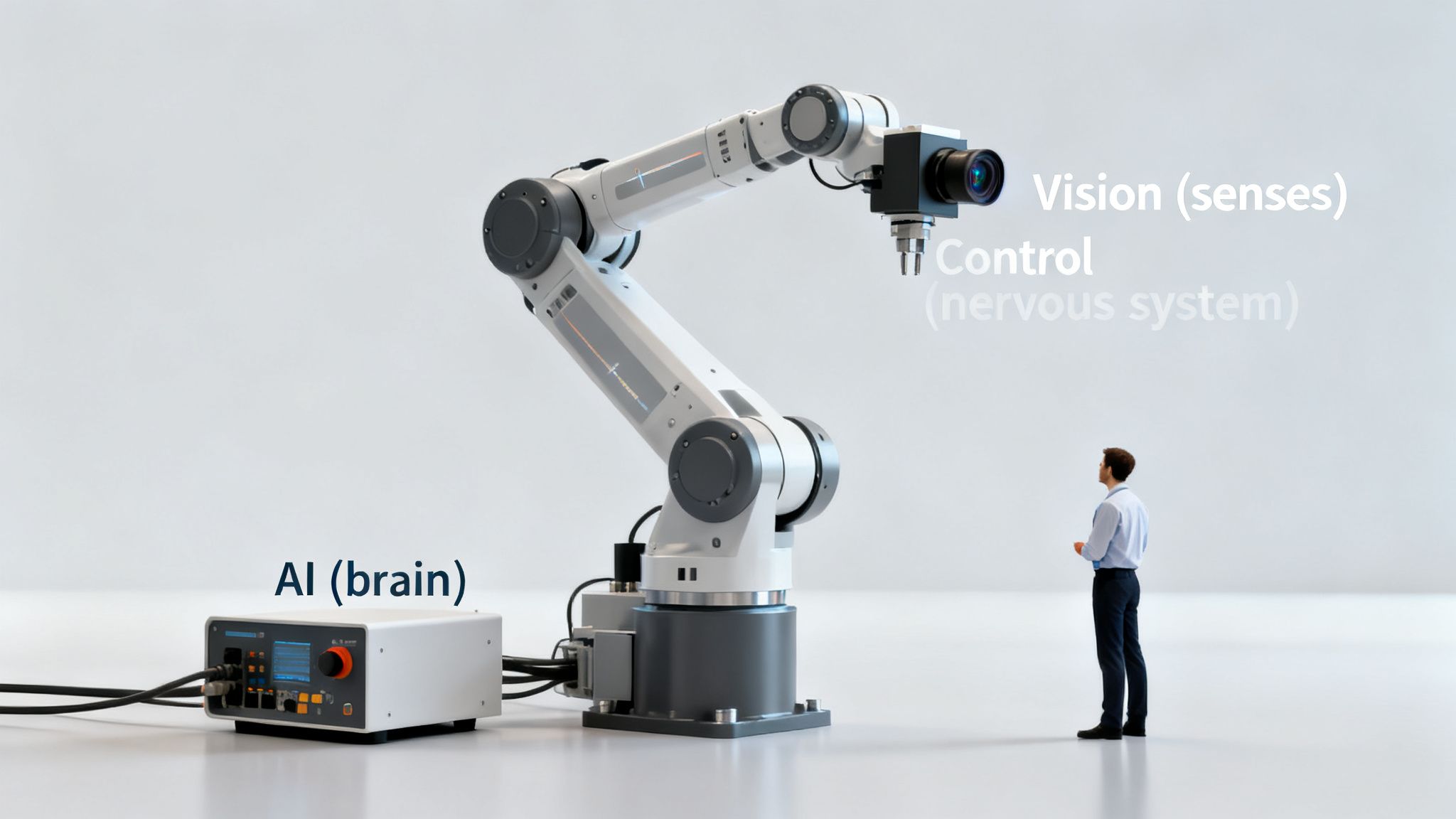
To make informed investments in automation in robotics, executives must look beyond the mechanical hardware. The transformative potential resides in the intelligent systems that grant the robot its autonomy. A useful framework analogises a modern robot to a skilled human worker, with its core components—brain, senses, and nervous system—transforming it from a passive tool into a dynamic, problem-solving asset.
This synthesis of technologies is the key differentiator between contemporary robotic systems and their predecessors. No longer confined to repetitive, caged tasks, they are evolving into adaptive partners capable of managing the variability of real-world production environments—a critical capability for maintaining Germany's manufacturing leadership.
The Brain: Artificial Intelligence and Machine Learning
At the core of any intelligent robot is its "brain"—a synthesis of Artificial Intelligence (AI) and Machine Learning (ML). This is the decision-making engine that enables the robot to process information, learn from experience, and adapt its behaviour without direct human intervention.
A traditional robot operates like a simple calculator, executing a fixed set of pre-programmed instructions. In contrast, an AI-powered robot functions more like a seasoned engineer, capable of identifying and resolving issues directly on the production line. This capability leap allows robots to undertake complex tasks like quality control, where they learn to identify subtle, non-uniform defects.
A foundational understanding of the underlying technology is essential for evaluating advanced solutions. Reviewing what AI automation is and how it works is a prudent step for any leader guiding this transition.
Want to Accelerate Your Innovation?
Our team of experts can help you turn ideas into production-ready solutions.
The following table contextualises how these core technologies translate into tangible business value.
Key Technologies in Robotic Automation and Their Business Impact
| Technology Pillar | Function (Analogy) | Business Application Example |
|---|---|---|
| AI / Machine Learning | The "Brain" | A quality inspection robot learns to identify paint defects on car bodies, reducing manual inspection costs and improving defect detection rates. |
| Perception Systems | The "Senses" | An Autonomous Mobile Robot (AMR) uses LiDAR to navigate a busy warehouse floor, avoiding obstacles and delivering parts just-in-time. |
| Control Systems | The "Nervous System" | A robotic arm uses force-feedback to delicately place a fragile windscreen, ensuring consistent pressure and eliminating costly breakages. |
This demonstrates that value is derived not from a single technology, but from their integrated application to solve specific, high-impact business challenges.
The Senses: Perception Systems
A robot's "senses" are its perception systems, providing real-time awareness of its environment. These are the inputs that feed the AI "brain" the data required for informed decision-making. Without robust sensory input, even the most advanced AI is ineffective.
Key sensory technologies include:
- Computer Vision: AI-powered, high-resolution cameras enable robots to identify objects, read labels, detect flaws, and navigate. A prime application is the visual inspection of a weld seam with superhuman precision and consistency.
- LiDAR and 3D Sensors: These systems, often using lasers, construct detailed 3D environmental maps. This is mission-critical for autonomous mobile robots (AMRs) navigating dynamic warehouses or for robots performing bin-picking tasks.
- Force and Torque Sensors: These provide a haptic sense of "touch," allowing a robot to modulate the pressure it applies. This is essential for delicate assembly tasks or handling fragile components.
The fusion of these sensory inputs creates a rich, real-time model of the robot's operating environment, enabling safe human-robot collaboration and the automation of previously intractable tasks.
The Nervous System: Advanced Control Systems
If AI is the brain and perception systems are the senses, then advanced control systems constitute the "nervous system." They translate the brain's decisions into precise, fluid, and coordinated physical movements. This is the critical link ensuring a robot's actions are both intelligent and accurate.
The quality of a robot's control system is the ultimate determinant of its performance. It bridges the gap between a high-level directive—"pick up that gear"—and the thousands of synchronised micro-movements required to execute it flawlessly.
Modern control systems continuously process sensor feedback to make real-time micro-adjustments, ensuring task accuracy. This enables a robotic welder to perfectly follow a complex contour or a collaborative robot to halt instantly upon sensing a human presence.
A deep understanding of how these components interoperate within industrial automation and robotics is crucial for selecting partners and systems truly prepared for the demands of a modern production environment.
Building the Business Case for Robotic Automation
Any successful initiative in automation in robotics must be founded on a robust business case. For the C-suite, this requires a holistic analysis that balances direct financial returns with critical strategic advantages. The investment rationale must be clear, measurable, and directly aligned with overarching corporate objectives.
Looking for AI Expertise?
Get in touch to explore how AI can transform your business.
A comprehensive approach assesses benefits from multiple perspectives. Quantitative metrics such as throughput and defect rates form the financial foundation. However, the most profound competitive advantages often arise from less tangible but highly impactful strategic gains. Achieving the right balance is key to securing stakeholder buy-in and ensuring the project delivers its full potential.
Quantifying the Tangible Returns
The most direct method for evaluating the impact of robotic automation is through tangible, measurable improvements in operational performance. These are the metrics that directly influence the P&L statement and provide a clear basis for calculating Return on Investment (ROI).
Key tangible benefits to model include:
- Increased Throughput and Productivity: Robots operate 24/7 at a consistent pace with minimal downtime, increasing unit output and enabling enterprises to meet growing demand without a proportional increase in overheads.
- Superior Quality Control: An automated system executes assembly and inspection tasks with a level of precision that eliminates human variability. This significantly reduces defect rates, scrap, and rework, directly lowering the cost of quality.
- Improved Workplace Safety: Automating physically demanding, repetitive, or hazardous tasks is a significant benefit. This not only protects personnel but also reduces costs associated with workplace injuries, compensation claims, and insurance premiums.
These operational gains are compelling and should form the core of any financial analysis, providing the empirical data required to justify capital expenditure.
The investment decision is not merely a technology purchase; it is a strategic commitment to building a more resilient, efficient, and competitive production capability. A well-constructed business case makes this imperative clear.
Ready to Build Your AI Project?
Let's discuss how we can help you ship your AI project in weeks instead of months.
Identifying Strategic Value Drivers
Beyond immediate financial returns, intelligent automation unlocks significant strategic value that fortifies a company's long-term competitive position. While more challenging to quantify, these advantages are critical for leadership in a demanding market like Germany's.
Germany, at the heart of Europe's automotive industry, accounts for approximately 30% of total robot installations, with the sector adding 23,000 new units across the region in 2024. The country's automotive robot density has reached an unparalleled 1,492 robots per 10,000 workers. This demonstrates how industry leaders leverage automation as a strategic tool—a lesson applicable to large corporations and the Mittelstand alike. Further insights on these European automation trends on IFR.org are available.
Key strategic benefits to consider:
- Enhanced Operational Flexibility: Modern robotic systems can be rapidly reprogrammed for new tasks or products. This agility enables a company to respond swiftly to shifting market demands or supply chain disruptions, transforming the production line into a strategic asset.
- Rapid Scalability: In response to demand surges, replicating an automated work cell is significantly faster and more predictable than hiring and training a new workforce. This allows a business to scale production efficiently and capture market opportunities.
- Attraction and Retention of Talent: Companies investing in advanced technology are perceived as superior employers. This helps attract and retain high-calibre engineers and technicians, a decisive advantage in a constrained talent market.
Incorporating these strategic drivers into the business case elevates the conversation from cost savings to a forward-looking strategy for building a more dynamic and future-proof organisation. To ensure projects align with these objectives, developing a comprehensive AI strategy for industrial automation and robotics is a critical step.
A Phased Roadmap for Successful Implementation
Transitioning from a compelling business case to a fully operational robotics system requires a methodical, phased approach. Ad-hoc implementation is a common cause of budget overruns, missed deadlines, and misaligned solutions. For large German enterprises, a structured roadmap is non-negotiable for managing complexity and ensuring the investment in automation in robotics delivers its intended value.
Want to Accelerate Your Innovation?
Our team of experts can help you turn ideas into production-ready solutions.
This structured methodology systematically de-risks the project by progressing from broad exploration to disciplined execution, incorporating clear go/no-go decision gates at each stage. This approach maintains stakeholder alignment, protects capital, and builds momentum through a series of measurable achievements.
Phase 1: Use Case Discovery and Prioritisation
The initial phase—and arguably the most critical—is identifying the right problems to solve. Not all processes are suitable candidates for automation; selecting a suboptimal starting point can jeopardise the entire initiative. The ideal use case lies at the intersection of high business impact and technical feasibility.
This is not a purely top-down exercise. It demands a partnership between operational teams and strategic leadership. On-the-ground personnel possess deep knowledge of bottlenecks, quality issues, and safety risks. Leadership provides the strategic context, ensuring any potential project supports broader corporate goals, such as market entry or capacity expansion for a flagship product.
A rigorous evaluation framework should score potential use cases against key criteria:
- Return on Investment (ROI): Quantify the financial return, considering not only labour savings but also gains in throughput and quality.
- Technical Feasibility: Assess the complexity of the task. Can current technology reliably solve the problem? Initial deployments should avoid overly ambitious "science projects."
- Scalability: If the pilot is successful, can the solution be replicated across other lines or facilities to amplify value?
- Strategic Alignment: Does the project directly contribute to a core business objective, such as enhancing supply chain resilience or reducing time-to-market?
This phase concludes with a prioritised portfolio of high-potential projects, forming the foundation of the automation roadmap.
Phase 2: Rapid Prototyping and Validation
Once a high-value use case is selected, the next step is to validate its feasibility—quickly and cost-effectively. The era of protracted, high-stakes pilot projects is over. Modern, agile methodologies favour rapid prototyping to test core assumptions and demonstrate tangible value in weeks, not years.
The objective is not a production-ready system but a minimum viable prototype (MVP) that addresses the central challenge. This could involve using simulation software to model robot behaviour or conducting a small-scale physical test in a controlled environment. Simulation, in particular, has become a powerful de-risking tool, allowing engineers to test and refine concepts virtually before committing to hardware procurement.
A successful prototype serves a dual purpose: it provides the technical team with critical data on performance and integration challenges while offering leadership a tangible demonstration of the potential, thereby facilitating funding for subsequent phases.
This validation stage must be governed by pre-defined success metrics. Did the prototype achieve the target cycle time? Did it meet the required quality standard? The outcome must be a clear, data-driven "go" or "no-go" decision.
Phase 3: Production and Integration
Following successful validation, the project transitions to the production phase. This involves engineering the proven concept into a robust, reliable system capable of 24/7 operation in a live environment. The focus shifts from discovery to disciplined execution.
Looking for AI Expertise?
Get in touch to explore how AI can transform your business.
Key activities include hardening the software, finalising hardware specifications (e.g., robot arms, grippers, sensors), and designing the physical work cell with safety as the paramount consideration. However, the most significant challenge is often integration with existing enterprise systems. The robotic solution must communicate seamlessly with platforms such as the Manufacturing Execution System (MES) and Enterprise Resource Planning (ERP).
When executed correctly, the robotic cell is not an isolated island of technology but a fully connected node in the digital manufacturing ecosystem, enabling real-time data flow, centralised monitoring, and coordinated workflows.
Phase 4: Scaling and Continuous Optimisation
The final phase begins after the first successful deployment and is ongoing. The focus is twofold: scaling the proven solution across the organisation and continuously improving its performance. The learnings from the initial implementation become a playbook for faster, more predictable deployments in other facilities.
Simultaneously, the data generated by the automated system becomes a valuable asset. Analysis of performance metrics—cycle times, error rates, sensor data—allows teams to identify optimisation opportunities. This continuous improvement loop ensures the investment in automation in robotics delivers compounding value long after the initial deployment.
Understanding Germany's Industrial Robotics Landscape
A strategic investment in automation in robotics requires a nuanced understanding of Germany's unique industrial environment. The nation's mature ecosystem is a significant competitive advantage, substantially de-risking large-scale implementation projects by providing deep, accessible expertise and resources.
Ready to Build Your AI Project?
Let's discuss how we can help you ship your AI project in weeks instead of months.
Germany is the undisputed leader in robot automation within the European Union, operating 40% of all factory robots in the bloc. In 2024 alone, German industries installed 27,000 new industrial robots. Globally, Germany ranks fourth in industrial robot density, with 449 robots per 10,000 manufacturing employees, cementing its position as a global innovator. Additional data on Germany's leadership in robotics from Packaging Journal is available for review.
For executives, this high density translates into a deeply embedded network of specialised suppliers, experienced system integrators, and a highly skilled technical workforce. This results in accelerated project timelines, more reliable outcomes, and access to partners with a profound understanding of sophisticated manufacturing challenges.
Capitalising on a Mature Ecosystem
While the automotive sector has been a traditional leader, the current strength of the German landscape lies in its diversity. Industries such as metalworking, chemicals, and plastics are now significant drivers of robotic innovation, creating a resilient and dynamic market for automation solutions.
This environment presents several strategic advantages for decision-makers:
- Proven Use Cases: The vast number of successful deployments across diverse industries provides a rich library of proven applications, reducing the need for greenfield development.
- Specialised Expertise: The ecosystem features a high concentration of integrators with deep, sector-specific knowledge, ensuring solutions are tailored to precise operational needs.
- Robust Supply Chains: Access to a local, responsive supply chain for robotics hardware, software, and support services minimises project delays and maintains operational continuity.
The process flow below outlines a typical implementation roadmap, from initial discovery to enterprise-wide scaling.
Want to Accelerate Your Innovation?
Our team of experts can help you turn ideas into production-ready solutions.
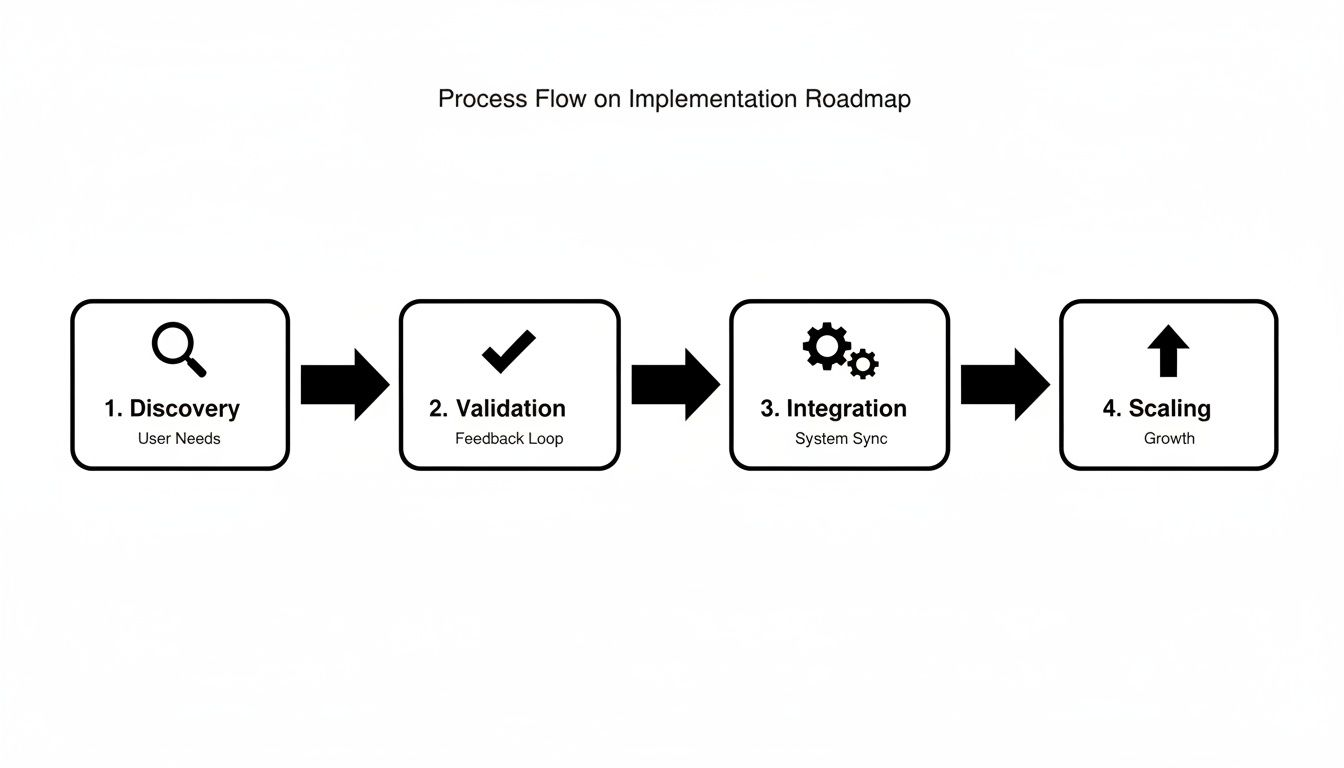
This structured four-phase approach provides a methodical framework to de-risk investment, ensuring each step validates the business case before committing to scale.
A Strategic Partnership Approach
The key to unlocking this potential is a partnership-based approach. The most successful enterprises do not simply procure technology; they collaborate with integrators and solution providers who function as strategic advisors. These partners help navigate complex integration challenges and ensure the final solution delivers on its strategic promise.
For German enterprises, the established robotics infrastructure acts as a force multiplier. It allows leaders to move beyond basic automation and focus on deploying advanced, AI-driven systems that create durable competitive advantages in the global market.
By leveraging this mature ecosystem, an organisation can accelerate its automation journey, enhance decision-making quality, and achieve a faster return on investment. The environment is structured to support ambitious projects by providing a safety net of expertise and proven methodologies. To further explore this landscape, learn more about the broader industrial automation sector in our detailed article. Understanding this context is crucial for making strategic partnership decisions aligned with long-term objectives.
Dodging the Bullets: How to Sidestep Common Implementation Traps
Deploying a major automation in robotics initiative is a significant undertaking. While the potential rewards are substantial, the path is fraught with potential pitfalls. Proactive identification of these risks is the primary differentiator between a transformative project and a costly misstep. A clear-eyed assessment of obstacles from the outset is the most effective defence.
Consider the German robotics and automation industry. While a global powerhouse, it is not immune to market headwinds. Projections for 2025 indicate sales of €14.5 billion, a 10% decline from the previous year. According to VDMA Chairman Dietmar Ley, this is largely attributable to geopolitical friction and intense competition slowing new investment.
Nevertheless, he correctly asserts that this technology is essential for Germany's high-wage economy. Despite a temporary downturn, over 450 foreign direct investment projects between 2019-2024 confirm the country's status as a major innovation hub. The German Robotics and Automation Industry forecast on Photonics.com provides additional context. This underscores the critical importance of flawless execution to realise a return.
Picking the Wrong Fight
One of the most common failure modes is improper project selection. Two classic errors prevail: pursuing a project that is technically interesting but offers minimal business value, or targeting a high-value problem with technology that is not yet mature enough for the rigours of the factory floor.
Such a misstep can exhaust budgets and erode stakeholder confidence before any meaningful progress is made.
Looking for AI Expertise?
Get in touch to explore how AI can transform your business.
The solution is a robust selection process that balances business impact with technical feasibility. Prioritise "quick wins" by solving a tangible operational pain point first. This approach builds momentum and demonstrates the value of the initiative from the outset.
Forgetting the Foundations: Data and Infrastructure
Modern robots are not standalone machines; they are data-driven assets. They require clean, accessible data to learn, adapt, and perform their functions. Many organisations underestimate the foundational work required to prepare their data and network infrastructure for intelligent automation.
The success of an advanced robotics system is often determined not by the robot itself, but by the quality of the data infrastructure supporting it. Neglecting this foundation is akin to building a skyscraper on sand.
Prior to commissioning robotic hardware, conduct a thorough audit of your data architecture and network infrastructure. Identify and address gaps proactively. This preparatory work is essential for smooth integration and optimal system performance.
Ignoring the Human Element
The introduction of robotics fundamentally alters workflows and job roles. Failure to manage the human dimension of this transition will inevitably lead to resistance, fear, and project failure. If the workforce perceives automation as a threat rather than a tool, adoption will be severely hampered.
Ready to Build Your AI Project?
Let's discuss how we can help you ship your AI project in weeks instead of months.
A formal change management program is not optional; it is essential. Key components include:
- Transparent Communication: Clearly articulate the strategic rationale for the initiative and the benefits for both the company and its employees.
- Strategic Reskilling: Invest in upskilling the workforce. Provide training to enable employees to work alongside, manage, and maintain the new systems.
- Inclusive Design: Involve shop-floor experts in the design process. Their operational knowledge is invaluable, and their participation fosters a sense of ownership.
Finally, cybersecurity is a critical and often overlooked consideration. As robots become connected to enterprise networks, they introduce new security vulnerabilities. Integrating robust security protocols from the project's inception is non-negotiable. For a detailed analysis of this critical component, consider our review of AI security and compliance for industrial automation.
Straight Answers for Leaders
When evaluating an investment in automation in robotics, executives require clear, strategic answers, not technical minutiae. The following addresses the key questions that arise at the board level to enable confident, informed decision-making.
What's a Realistic Initial Investment?
A single figure is not meaningful; the investment is directly proportional to the complexity of the application. A simple collaborative robot for a pick-and-place task may require an initial outlay of €50,000 to €80,000, inclusive of integration. Conversely, a fully automated, AI-driven quality inspection line could exceed €500,000.
Focusing solely on upfront capital expenditure is a strategic error. The correct approach is to model the Total Cost of Ownership (TCO) against projected returns, including gains from increased throughput, reduced material waste, and improved quality. A well-selected pilot project should deliver a payback period of 18 to 24 months.
How Will This Affect Our Workforce?
The strategic objective is not workforce replacement but human augmentation. Automation excels at repetitive, physically demanding, or hazardous tasks. This liberates human capital to focus on higher-value activities requiring critical thinking, creativity, and complex problem-solving—a vital shift for competitiveness in a high-wage economy like Germany's.
A successful rollout is contingent on a proactive upskilling strategy. The plan must encompass:
- Technical Training: Preparing maintenance teams to service the new robotic systems.
- Operator Upskilling: Training line operators to manage and collaborate with automated cells.
- Data Analysis Skills: Developing personnel capable of interpreting performance data to drive continuous improvement.
The narrative must shift from job elimination to job evolution. Investing in workforce skills transforms automation from a perceived threat into a tool that elevates the entire organisation's capabilities.
Can We Integrate Robots with Our Legacy Systems?
Yes; for any established enterprise, this is a prerequisite. A "rip and replace" approach to production lines is rarely feasible. Modern robotic solutions are designed for interoperability, utilising standard communication protocols like OPC UA to interface with existing Manufacturing Execution Systems (MES) and ERP platforms.
A phased implementation is the most prudent strategy. Begin with a self-contained robotic cell with minimal dependencies on legacy equipment. This allows for value demonstration and refinement of integration methodologies before tackling more complex, deeply embedded systems. The key is to partner with a systems integrator with proven expertise in bridging modern robotics with legacy industrial machinery.
Want to Accelerate Your Innovation?
Our team of experts can help you turn ideas into production-ready solutions.
At Reruption GmbH, we act as your "Co-Preneurs for the AI Era." We partner with you to turn ambitious ideas into production-ready innovations. We de-risk your automation journey by building real prototypes and taking accountability for the business outcome, ensuring your investment delivers strategic value from day one. Discover how we can help you lead your industry at https://www.reruption.com.