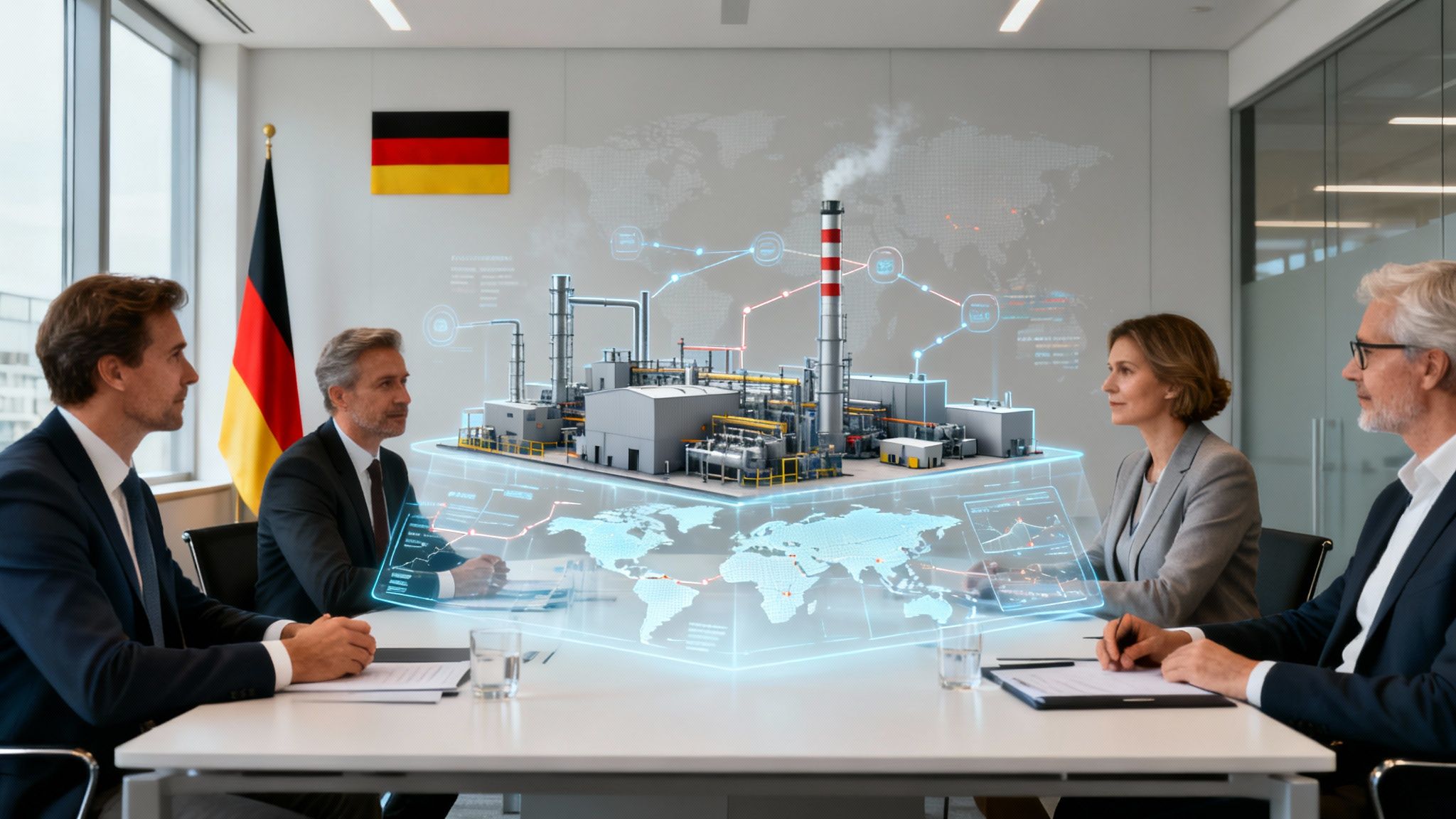
For senior leadership within Germany's industrial core, the strategic dialogue surrounding supply chains has fundamentally shifted. The legacy focus on efficiency—cost reduction and speed—has been superseded by an urgent mandate for resilience. The critical question is no longer "How can we operate faster?" but rather, "How do we ensure operational continuity and protect enterprise value when the next systemic shock occurs?"
Reactive, incident-based responses are now obsolete.

Contemporary supply networks are intricate webs of opaque dependencies. A minor disruption at a Tier-3 supplier—an entity often unknown to the end-manufacturer—can propagate through the entire value chain, precipitating significant financial impact thousands of kilometers away. This is not a theoretical exercise; it is the new operational reality, driven by a confluence of potent factors:
- Geopolitical Volatility: Abrupt trade disputes and regional conflicts introduce a complex matrix of tariffs, sanctions, and logistical impediments.
- Climate-Driven Disruption: Extreme weather events are no longer anomalies but recurring threats that can disable manufacturing hubs and critical transport corridors without warning.
- Regulatory Intensification: Evolving compliance mandates compel organizations to attain unprecedented transparency into their suppliers' operational and ethical frameworks.
The German Regulatory Imperative: LkSG
The German Supply Chain Due Diligence Act (LkSG) serves as a prime example. Implemented in 2023 and expanded in 2024 to encompass approximately 3,800 organizations, its core mandate persists despite anticipated reporting adjustments. The legal obligation for enterprises to identify, assess, and mitigate human rights and environmental risks within their supply chains is now a permanent fixture of the corporate governance landscape.
Ready to Build Your AI Project?
Let's discuss how we can help you ship your AI project in weeks instead of months.
Non-compliance can result in penalties of up to 2 percent of annual global turnover. For manufacturers and industrial leaders, this elevates supply chain risk management from an operational concern to a strategic boardroom imperative.
The message for leadership is unequivocal: your supply chain contains critical blind spots that legacy systems cannot illuminate. Proactively managing these risks is no longer an operational best practice—it is a prerequisite for survival and sustainable growth.
This is where Artificial Intelligence (AI) transcends its status as a technology and becomes a strategic capability. AI provides the means to transform ambiguous threats into quantifiable, actionable intelligence. Adopting a holistic approach, which begins with understanding the difference between trade finance and supply chain finance, enables a decisive shift from strategic planning to effective execution. For further insights, our analysis of leading supply chain consulting firms offers a valuable perspective.
Diagnosing Vulnerabilities with a Risk Identification Framework
To effectively manage supply chain risk, organizations must begin with an objective, comprehensive assessment of their current exposure. This requires moving beyond superficial checklists and conventional Tier-1 supplier audits. The most significant threats often reside deep within the sub-tier network, invisible to traditional risk management methodologies.
True visibility necessitates a structured diagnostic framework—a systematic methodology for identifying vulnerabilities across the entire value chain. This is not a perfunctory compliance exercise; it is a strategic imperative to quantify abstract risks and understand their tangible business impact.
A Four-Domain Diagnostic Model
A robust risk identification framework organizes threats into distinct, yet interconnected, domains. This structure ensures comprehensive coverage and mitigates the risk of overlooking critical vulnerabilities. For the German industrial sector, this model must be calibrated to address specific regional and market pressures.
The assessment can be structured across four key domains:
- Geopolitical and Regulatory: What is the direct impact on production costs if a new tariff is imposed on non-EU components? Are we sufficiently prepared for the extension of LkSG regulations to our Tier-2 and Tier-3 suppliers?
- Operational and Financial: What is our financial exposure in the event of insolvency at a single-source supplier for a critical component? Have we validated a contingency plan for a 48-hour disruption at a primary logistics hub?
- Environmental and Reputational: How would an environmental incident in a key sourcing region affect our material supply? Do our sub-tier suppliers adhere to the ethical standards demanded by our customers and regulators?
- Technological and Cyber: How secure are the digital interfaces with our key partners? Recent analysis indicates that supply chain providers possess digital supply chains that are, on average, 2.5 times larger than those of their customers, creating a vast and shared attack surface.
This disciplined line of inquiry compels a fundamental mindset shift—from reactive crisis management to proactive vulnerability assessment.
The Imperative to Illuminate the Sub-Tiers
A traditional focus on Tier-1 supplier due diligence creates a false sense of security. While a direct partner may be financially sound and operationally robust, their critical component supplier, three tiers removed, could represent a single point of failure for an entire production line.
The greatest risks in modern supply chains are not with the partners you know, but with their partners you do not. Illuminating these hidden dependencies is the foundational step toward genuine resilience.
Want to Accelerate Your Innovation?
Our team of experts can help you turn ideas into production-ready solutions.
This is precisely where a data-driven strategy becomes indispensable. Early-stage AI models can begin to map these complex, multi-tier relationships by integrating disparate data sources—procurement records, shipping manifests, and public domain information. This process transforms a network of unknown entities into a clear, visual map of dependencies.
By rendering these hidden connections visible and quantifiable, leadership can construct a compelling, data-backed business case for investing in more sophisticated risk management capabilities.
From Diagnosis to Strategy
A thorough diagnostic provides the foundational intelligence required to classify procurement categories and tailor risk mitigation strategies.
The Kraljic Matrix offers a proven framework for this task, segmenting all purchases based on their profit impact and supply risk. This allows for the focused allocation of resources, applying intensive management to strategic items (high impact, high risk) while streamlining processes for non-critical items (low impact, low risk).
Understanding where each component and supplier fits within this matrix is fundamental. To further refine this strategic approach, it is advisable to review the principles of thorough vendor due diligence. This diagnostic clarity enables the transition from a generic, one-size-fits-all approach to a sophisticated and effective strategy for managing supply chain risk.
Building an AI-Powered Risk Intelligence System
The transition from a reactive checklist to a proactive, intelligent system marks the mastery of modern supply chain risk. Constructing an AI-powered intelligence system is not about procuring a single software solution; it is about developing a strategic capability. This system functions as the central nervous system for your supply chain, sensing faint signals of disruption and enabling rapid, precise responses.
For German industrial leaders, the scale is formidable. A typical automotive manufacturer may engage 250 Tier-1 suppliers, each relying on an average of 150 Tier-2 partners. The result is an intricate network of approximately 37,500 hidden dependencies that traditional tools like spreadsheets cannot manage.
The 2024 fire at a Japanese semiconductor facility, which halted German EV production lines within 72 hours, is a stark illustration of this fragility. The rapid growth of the European market for supply chain risk solutions is a direct response to this reality.
The objective is to create a unified, three-layered architecture that transforms a deluge of disconnected data into clear, actionable intelligence.
This flow illustrates the primary risk categories—Geopolitical, Operational, and Technological—that an AI system must continuously monitor.
Looking for AI Expertise?
Get in touch to explore how AI can transform your business.
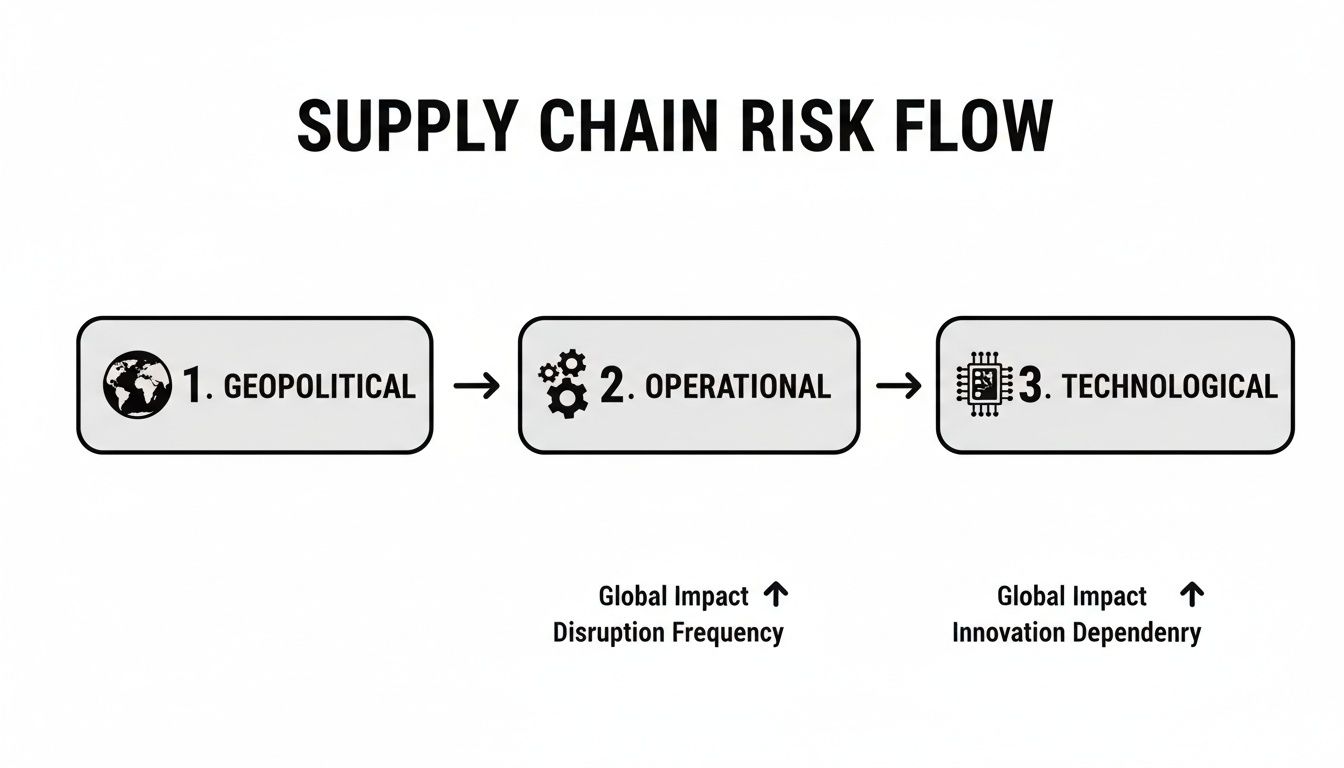
The diagram highlights how a single event in one domain can trigger a cascade effect across the others, underscoring why an integrated, holistic monitoring system is no longer optional.
The Foundation: Data Integration
The efficacy of any AI system is contingent upon the quality of its input data. The foundational layer of this architecture is data integration. Its purpose is to dismantle information silos and establish a single source of truth for the entire supply network.
This involves harmonizing two distinct types of information:
- Structured Data: Organized, quantitative data from core business systems, including ERP records, procurement orders, inventory levels, and logistics manifests.
- Unstructured Data: Qualitative, external information such as news feeds, social media sentiment, regulatory updates, weather alerts, and satellite imagery of ports and facilities.
By aggregating these data streams, the system can establish causal links. An internal event, such as a delayed parts shipment, can be correlated with an external cause, like a labor strike reported in local news, providing a complete and contextualized view for the first time.
The Core: The AI Engine
With consolidated data, the AI engine begins its work of processing raw information into predictive insights. This layer is not a monolithic algorithm but a suite of specialized AI techniques, each designed to detect specific risk signals.
Key components of the AI engine include:
- Predictive Analytics: These models analyze historical demand, sales data, and market trends to forecast potential disruptions. For example, an algorithm might flag a 30% probability of a demand surge for a specific component based on leading economic indicators.
- Natural Language Processing (NLP): NLP engines act as digital scouts, scanning and interpreting vast quantities of unstructured text. They can analyze thousands of news articles related to a key supplier to detect negative sentiment, mentions of financial distress, or operational issues long before an official report is released.
- Graph Neural Networks (GNNs): GNNs excel at mapping the complex, multi-tier relationships within a supply chain. They visualize the network not as a list of suppliers but as an interconnected web, instantly identifying hidden dependencies and critical nodes that represent single points of failure.
These technologies work in concert to identify patterns and anomalies invisible to human analysts.
The purpose of the AI engine is not to generate more reports. It is to produce a focused stream of prioritized, contextualized risk alerts that command executive attention.
To move from abstract concepts to practical application, consider how these technologies address specific, real-world risks.
AI Capabilities for Supply Chain Risk Mitigation
| Risk Category | Applied AI Technology | Practical Business Application |
|---|---|---|
| Geopolitical & Regulatory | Natural Language Processing (NLP) | Continuously scans global news, government publications, and trade journals to flag new tariffs, sanctions, or political instability affecting key production regions. |
| Operational & Logistics | Predictive Analytics & Computer Vision | Models port congestion from satellite imagery and shipping data to predict delays. Forecasts ETAs with greater accuracy than carrier estimates alone. |
| Supplier Financial Health | Sentiment Analysis & NLP | Monitors financial news, credit reports, and social media for early warnings of a supplier's financial distress, like bankruptcy rumors or executive departures. |
| Demand Volatility | Machine Learning (Time-Series Forecasting) | Analyzes historical sales data alongside external factors (e.g., economic indicators, competitor promotions) to predict sudden spikes or drops in demand. |
| Quality Control | Computer Vision | Uses high-resolution imagery to automatically detect defects in components on the production line, identifying quality fade from specific suppliers. |
| Network Dependencies | Graph Neural Networks (GNNs) | Maps the entire n-tier supply chain to identify hidden "choke points," where the failure of a single, obscure tier-3 supplier could halt multiple product lines. |
This table demonstrates that for every major risk category, a specific AI tool exists to shift from reactive problem-solving to proactive risk mitigation.
The Interface: The Command Center
The final layer translates complex data analysis into a clear, intuitive interface for decision-makers. The Command Center is an executive dashboard designed for action, not passive observation. It equips the C-suite and supply chain leadership with the tools to understand risks and simulate response scenarios.
A well-designed Command Center must deliver:
- Actionable Alerts: Instead of raw data feeds, the dashboard presents prioritized alerts. For example: "High Risk: Tier-3 semiconductor supplier in Taiwan exhibits negative financial sentiment; potential impact on Product Line X in 8 weeks."
- Scenario-Planning Tools: This feature enables "what-if" analysis. What is the operational and financial impact of a two-week port closure in Hamburg? The system can model the outcomes of different mitigation strategies, such as rerouting shipments or activating a backup supplier.
- Visual Risk Mapping: Interactive maps display the entire supply network, overlaying real-time risk data. This provides leadership with an immediate, intuitive understanding of geographical vulnerabilities.
This top layer ensures that the powerful insights generated by the AI engine translate into decisive action, strengthening the organization's overall risk management and compliance posture. A phased, agile implementation, starting with a high-impact pilot project, is often the most effective path to demonstrate value and de-risk the investment in this transformative capability.
Turning Insight Into Action with Proactive Mitigation Strategies
An AI-powered intelligence system provides early warnings, but an alert without a corresponding action plan is merely a sophisticated dashboard. True value is realized when these predictive alerts drive decisive, proactive mitigation. This is the critical transition from monitoring risk to actively managing it—transforming a defensive function into a significant competitive advantage.
Ready to Build Your AI Project?
Let's discuss how we can help you ship your AI project in weeks instead of months.
For German enterprises, the imperative is acute. Two-thirds of leading multinationals in the euro area recently reported that replacing critical inputs from high-risk countries would be "very difficult." In response, approximately 40% are now actively developing plans to source from alternative countries. You can review the full findings on supply chain vulnerabilities from the ECB here. These statistics underscore the need for intelligent systems to manage thousands of supplier relationships in real time.
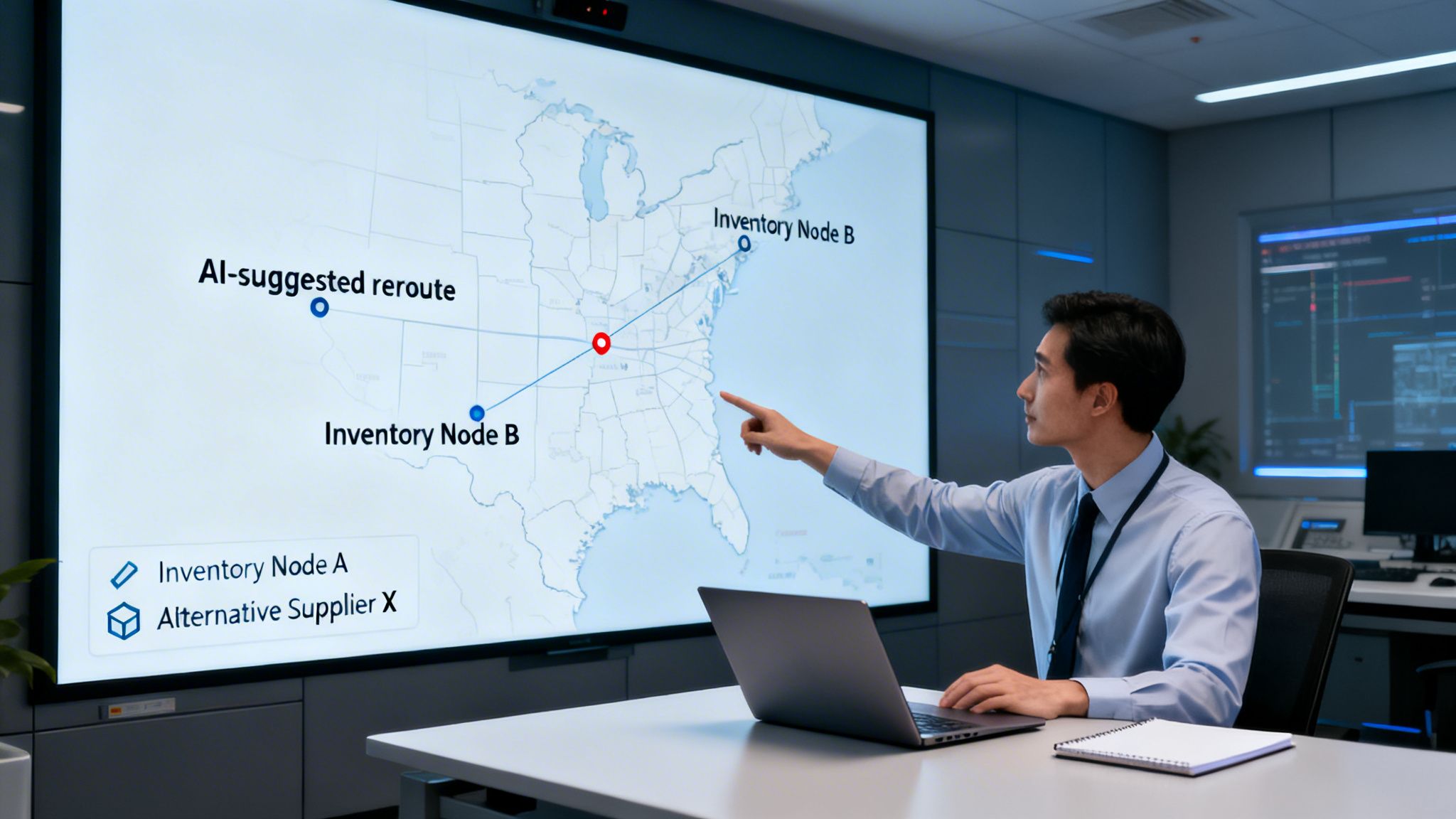
AI-enabled strategies provide the agility required. Instead of being constrained by static supplier lists or fixed inventory policies, an intelligent system empowers dynamic, data-driven responses.
Enabling Dynamic Sourcing
Traditional procurement processes are often hampered by rigid, slow supplier onboarding. When a primary supplier fails, the reactive search for and validation of an alternative can take weeks, halting production.
An AI-driven system fundamentally alters this paradigm. By continuously scanning a vast pool of potential global suppliers, the AI maintains a dynamic, pre-vetted list of alternatives. It constantly assesses them against specific criteria—quality certifications, production capacity, financial stability, and LkSG compliance—assigning a real-time risk score.
Want to Accelerate Your Innovation?
Our team of experts can help you turn ideas into production-ready solutions.
Illustrative Scenario: An automotive parts manufacturer in Bavaria receives an AI alert predicting a high probability of a labor strike at its key Tier-2 electronics supplier in Southeast Asia. Simultaneously, the system presents three pre-vetted alternative suppliers in Mexico and Eastern Europe, complete with landed cost comparisons. The procurement team can activate a contingency plan before the strike becomes public knowledge.
Implementing Intelligent Inventory Buffering
Accumulating excess inventory is a costly hedge against uncertainty, while overly lean systems are dangerously exposed. Traditional methods of setting static safety stock levels based on historical averages are inadequate in today's volatile markets.
Predictive models offer a more sophisticated approach. By analyzing demand forecasts, supplier lead times, and real-time risk signals, these models can dynamically recommend optimal inventory levels for critical components. They identify the optimal balance between holding costs and the calculated risk of a stock-out, delivering resilience without excessive capital expenditure. The discovery of such operational details is where tools like process mining with Celonis can reveal major inefficiencies.
Executing Proactive Logistics Rerouting
Logistics disruptions—port congestion, extreme weather, airspace closures—are daily operational realities. A reactive response leads to shipment delays and escalating costs as organizations pay a premium for last-minute alternatives.
An AI system enables a proactive stance. It integrates diverse data sources—live vessel tracking, weather forecasts, traffic data, and news reports—to identify potential bottlenecks well in advance. The system can then model and recommend alternative routes optimized for both time and cost, providing the logistics team with a viable Plan B before Plan A fails.
Fostering Collaborative Risk Sharing
A supply chain is a shared ecosystem; a risk to one partner is a risk to all. A mature risk strategy involves creating a secure data platform to share anonymized risk signals with critical suppliers.
This is not about divulging sensitive commercial data. It is about sharing aggregated alerts on regional disruptions, material shortages, or logistics constraints that could impact the entire network. This collaborative intelligence allows all stakeholders to align their contingency plans, strengthening the entire value chain. A collaborative ecosystem is far more robust than any single entity operating in isolation.
Embedding Resilience: Governance, Talent, and Metrics
Investing in advanced AI tools for supply chain risk is only one part of the equation. The key to building a truly resilient operation lies in the governance structure, organizational talent, and performance metrics you establish. Without the right organizational framework and skills, even the most sophisticated technology will fail to deliver its intended value. Success requires a fundamental redesign of how teams collaborate, what is measured, and how leadership guides the transformation.
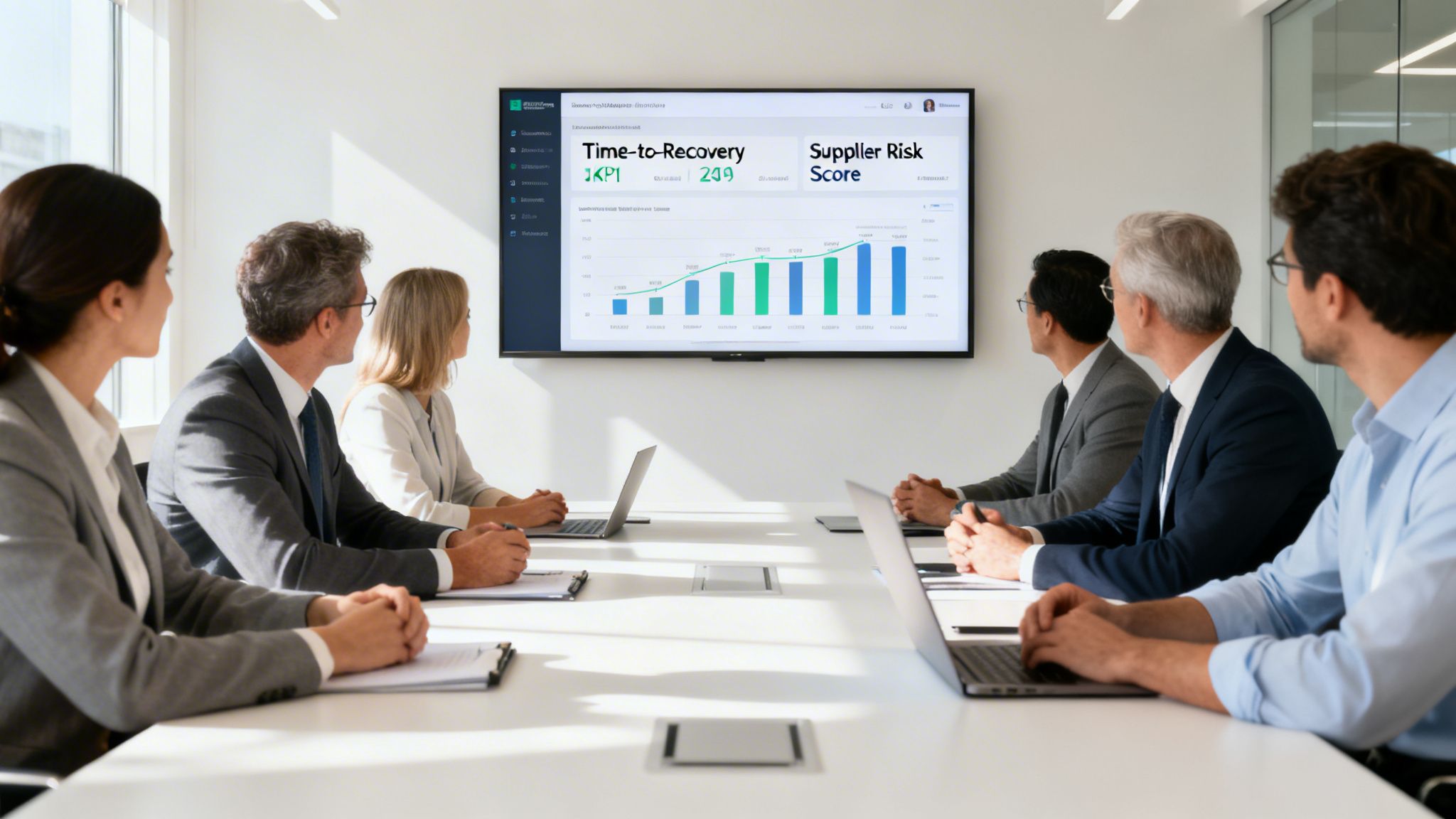
The traditional, siloed operating model—where procurement focuses on cost, logistics on delivery times, and finance on payments—is no longer fit for purpose. A risk originating in one department can rapidly escalate into a business-wide crisis. These organizational barriers must be dismantled.
Assemble a Cross-Functional Risk Council
Effective governance begins with a dedicated, cross-functional risk council. This is not another passive committee reviewing outdated data. It must be a dynamic, empowered body responsible for proactive risk oversight, with C-level sponsorship to grant it the authority to drive action.
The council should convene senior leaders from key functions to provide a 360-degree view of risk:
- Procurement: To monitor supplier health and diversification strategies.
- Logistics: To identify vulnerabilities in transport and warehousing networks.
- Finance: To model the financial impact of potential disruptions.
- IT & Cybersecurity: To secure the digital infrastructure of the supply chain.
This structure ensures that risk signals are analyzed from multiple perspectives, leading to more robust and holistic decisions. It aligns well with established frameworks such as the three lines of defense model for risk management.
The Build Versus Buy Dilemma for AI Talent
With a governance structure in place, the next challenge is talent. The specialized skills required to operate an AI-powered risk system are seldom found within traditional supply chain teams, creating a classic "build versus buy" decision.
Attempting to build an in-house AI team from scratch is a significant undertaking. For many enterprises, including those in the German Mittelstand, this can be a slow, costly, and resource-intensive path.
Looking for AI Expertise?
Get in touch to explore how AI can transform your business.
A more strategic approach is to engage a partner—a co-preneur—who provides immediate expertise and shares P&L accountability. This accelerates implementation, de-risks the technology investment, and critically, includes a plan to upskill internal teams for long-term self-sufficiency.
An effective partner does not simply deliver a solution and depart. They build the initial capability while transferring knowledge, transforming existing subject matter experts into AI-savvy strategists. This hybrid model delivers immediate value while building sustainable internal strength.
Redefine Success with a Balanced Scorecard
You cannot manage what you do not measure. Traditional supply chain KPIs, heavily weighted toward cost and on-time delivery, are insufficient for gauging resilience. A balanced scorecard is needed to provide a clear, comprehensive view of risk posture and the ROI of resilience investments.
It is time to move beyond legacy metrics and begin tracking what truly matters:
- Time-to-Recovery (TTR): The time required for a critical facility or distribution center to return to full operational capacity following a major disruption. A decreasing TTR is a direct indicator of improved resilience.
- Supplier Risk Score Improvement: This metric tracks the aggregated risk score of key suppliers over time, providing a tangible measure of the effectiveness of diversification and collaboration initiatives.
- Percentage of Spend with Resilient Suppliers: This metric quantifies the portion of the procurement budget allocated to suppliers who meet predefined resilience criteria (e.g., multi-sourcing capabilities, strong financial health, audited contingency plans).
These forward-looking indicators provide leadership with a robust framework for measuring progress and justifying investments to the board. They shift the conversation from cost reduction to strategic value protection.
Common Executive Questions Regarding AI in Supply Chain
As leadership considers integrating AI into supply chain risk management, several practical questions consistently arise. This represents a significant strategic shift, and executive confidence is paramount. Below are direct answers to the most frequent concerns voiced by leaders in the German industrial sector.
How Can We Start If Our Data Is Imperfect?
This is the universal starting point. Do not allow the prospect of a multi-year data cleansing initiative to induce paralysis. Perfect data is not a prerequisite for beginning this journey.
The optimal strategy is to start with a small, targeted pilot focused on a high-impact segment of your supply chain. Modern data integration tools can rapidly create a unified view for a specific use case by consolidating data from just a few key systems, such as an ERP and a primary supplier portal.
This approach prioritizes velocity. It delivers tangible results in weeks, not years, thereby building a compelling business case for broader investments in data governance.
What Is a Realistic Budget for a Pilot Project?
A pilot is not a multi-million Euro venture. It is a focused exercise designed to de-risk a larger strategic investment by delivering a clear proof-of-value.
Ready to Build Your AI Project?
Let's discuss how we can help you ship your AI project in weeks instead of months.
For a typical mid-sized German enterprise, a 12-week pilot project is an effective timeframe. This allows sufficient time to define strategy, integrate data for a single product line, build an initial predictive model, and present a functional dashboard to the executive team.
The objective of the pilot is to demonstrate a clear return on investment. This could be the identification of a previously unknown critical dependency or the quantification of the financial impact of a potential disruption. Such insights provide the data needed to make an informed decision on a full-scale implementation.
Will AI Replace Our Supply Chain Managers?
No. It will augment their capabilities. The goal is to provide your experts with an AI "co-pilot" that enhances their analytical capacity, not to replace their decades of accumulated experience.
AI excels at processing vast datasets and detecting faint risk signals across thousands of suppliers—a task beyond human scale. The system identifies and flags threats. However, it is the managers, with their deep business context, who interpret these signals and determine the optimal strategic response.
AI addresses the 'what' and the 'where'. This liberates your most valuable personnel to focus on the strategic 'why' and 'how do we respond?' It elevates their role from reactive fire-fighting to the proactive discipline of managing risk in the supply chain.
Want to Accelerate Your Innovation?
Our team of experts can help you turn ideas into production-ready solutions.
At Reruption GmbH, we act as Co-Preneurs to help you move from idea to implementation with speed and accountability. We turn your AI ambitions into production-ready systems that deliver measurable business value. Discover how we de-risk innovation and build resilient operations at https://www.reruption.com.