The last mile of delivery is not merely a logistical function; it is the final, critical touchpoint in the supply chain where value is either delivered or destroyed. This segment, representing the journey from a local distribution centre to the customer's doorstep, has evolved from a competitive differentiator to a strategic imperative for any German enterprise.
The Final Metres: Where Brand Promises Are Fulfilled Or Broken
The last mile constitutes the final act of your brand's commitment to the customer. It is the moment where marketing promises and product quality converge into a tangible experience. For executive leadership, the pivotal mindset shift is to reframe the last mile from a cost centre into a primary driver of brand equity and customer lifetime value. This is the stage where customer loyalty is solidified or irrevocably lost.
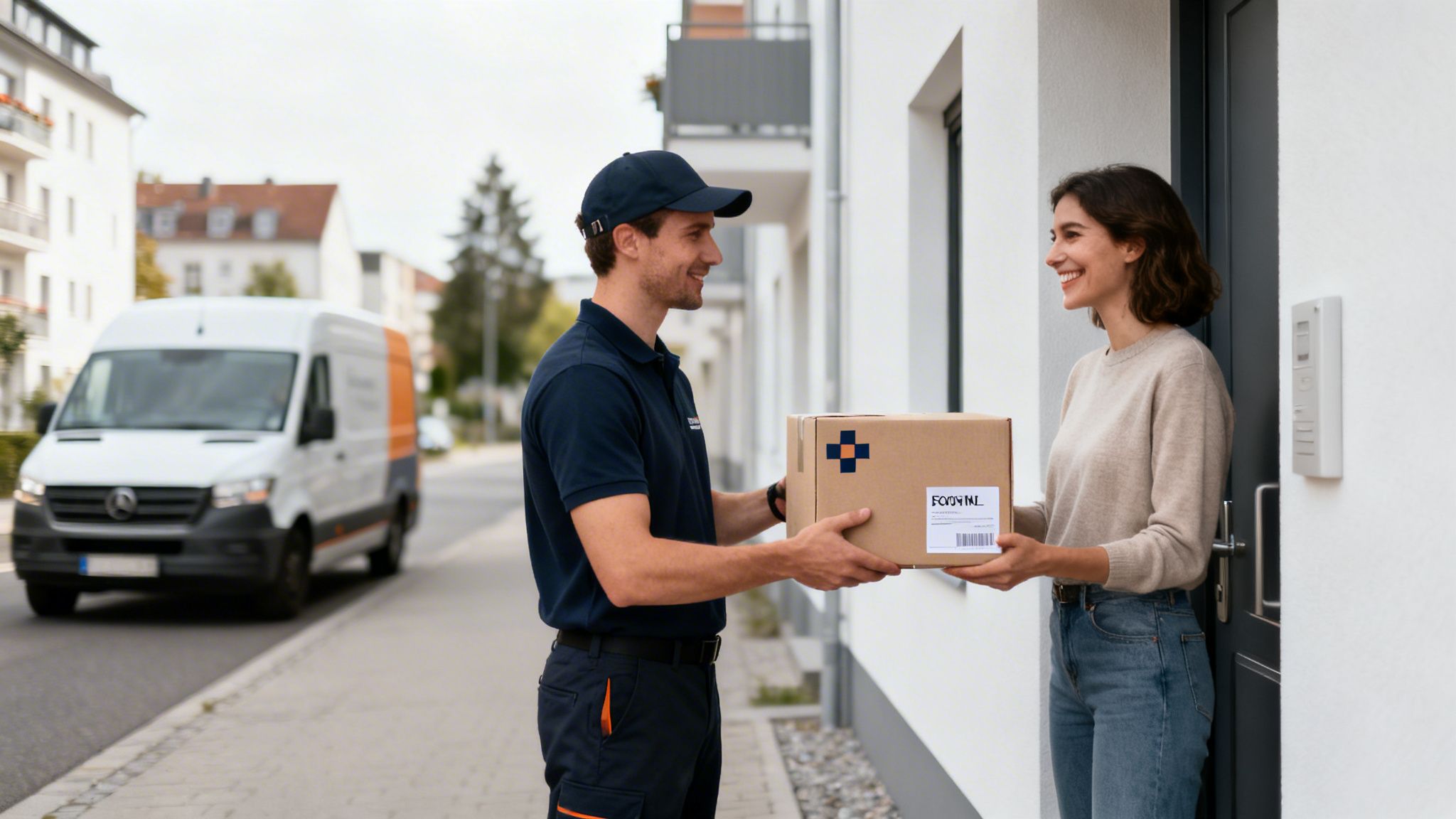
This final segment is disproportionately expensive, frequently accounting for over 50% of total shipping costs. The high cost is driven by the inherent complexity of individual, low-density drop-offs, which are susceptible to urban traffic congestion, imprecise address data, and failed delivery attempts—all of which introduce significant operational friction and financial leakage.
From Cost Centre To Strategic Asset
A fundamental re-evaluation of last-mile operations is necessary. Managing this function purely for cost mitigation is insufficient. It must be recognized as a powerful instrument for market differentiation and customer retention. The quality of this final interaction has a direct and quantifiable impact on:
Ready to Build Your AI Project?
Let's discuss how we can help you ship your AI project in weeks instead of months.
- Customer Loyalty: Flawless delivery execution builds trust and fosters repeat business. A single negative experience can permanently divert a customer to a competitor.
- Brand Perception: Punctuality, professional courier conduct, and transparent communication are the core attributes that define a brand as reliable versus high-risk in the consumer's mind.
- Profitability: Inefficient last-mile operations erode margins. Conversely, a highly optimized system protects the bottom line and establishes a sustainable competitive advantage.
The moment of delivery is the culmination of every investment made by your marketing, sales, and product development teams. Investing in its excellence is not an operational choice; it is a core business imperative for market leadership.
Why This Demands Executive Focus
In an environment of escalating customer expectations and compressed margins, inaction presents the greatest risk. As enterprises strive to optimize their end-to-end value chain, it is crucial to recognize that a world-class supply chain can be completely undermined by a deficient final delivery stage. Further strategic insights can be found in our guide to supply chain consulting. The following sections will provide a clear framework for identifying vulnerabilities and leveraging Artificial Intelligence to transform this critical final kilometre.
The Four Core Frictions In Last Mile Delivery
Executing the final leg of a delivery is analogous to solving a high-stakes, dynamic puzzle where every variable is in constant motion. For German enterprises, the last mile is not a singular challenge but a confluence of four distinct, interconnected frictions. Each exerts significant pressure on financial performance and brand reputation, transforming a simple point-to-point journey into a complex operational challenge. Mastering these pressure points is the prerequisite for effective optimization.
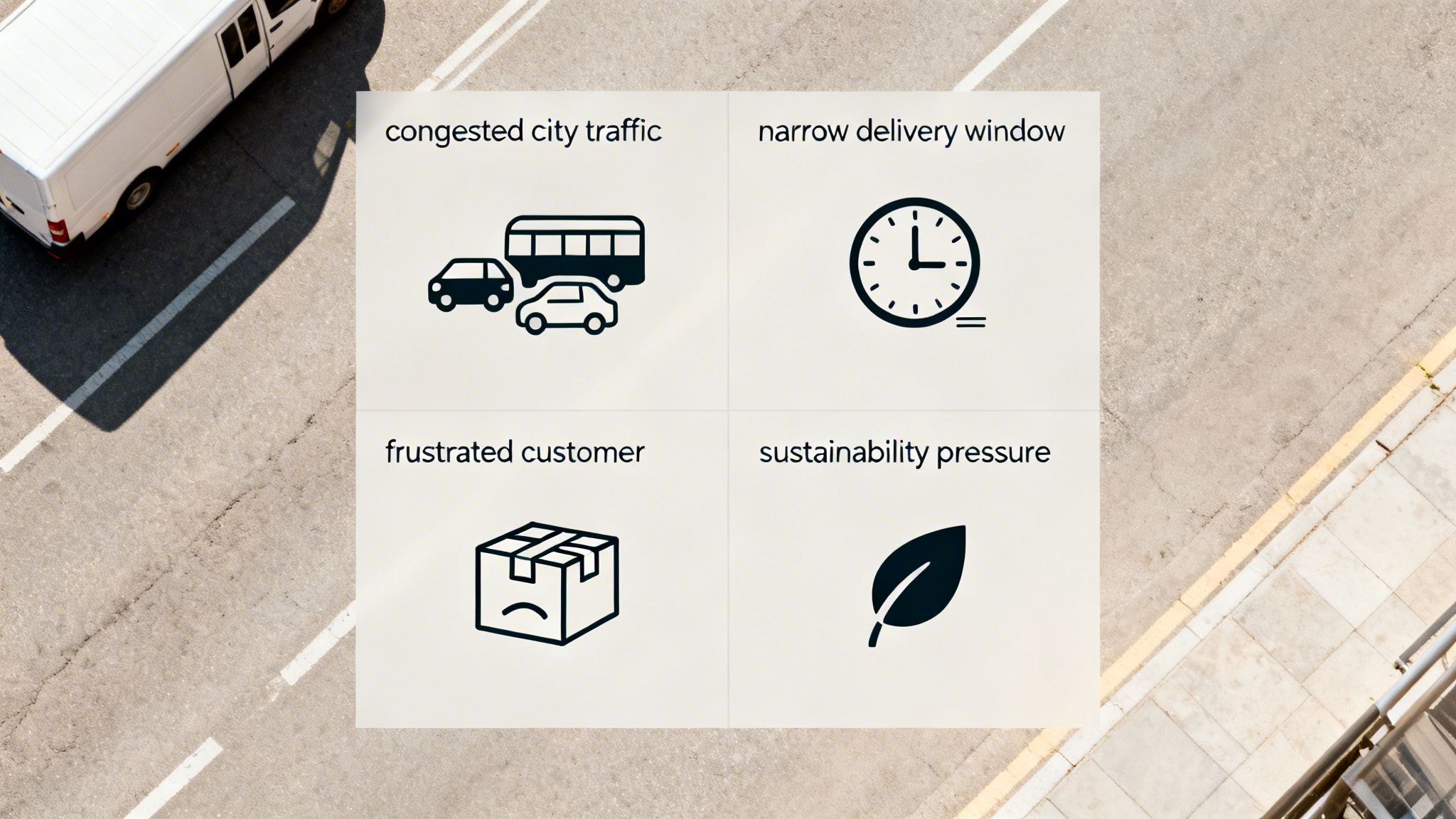
If left unaddressed, these core issues systematically degrade operational efficiency, erode margins, and ultimately limit scalable growth.
The Spiralling Cost Equation
The most acute friction is financial. The last mile consistently consumes over half of the total shipping budget due to its inherent inefficiency. Unlike full-truckload shipments to a central warehouse, this stage is characterized by numerous single, low-value stops dispersed across a wide geography.
The primary cost drivers include:
- Fuel and Fleet Maintenance: Volatile fuel prices and the significant, unpredictable expense of maintaining a delivery fleet.
- Driver Labour: Skilled drivers are a critical and costly asset. A significant portion of their time is often consumed by non-value-adding activities such as navigating traffic or searching for parking.
- Failed Deliveries: A failed delivery is a direct financial loss. The costs associated with returning the parcel, storage, and re-attempting delivery multiply the initial expense.
The Unforgiving Demand For Speed And Precision
Modern consumers demand not only rapid delivery but also punctuality and pinpoint accuracy. The market pressure to offer narrow delivery windows—often same-day or next-day—imposes a significant logistical strain. Meeting these expectations requires an operational agility that legacy, static routing systems cannot provide.
This demand for speed leaves no margin for error. A single disruption, such as traffic congestion in Hamburg or an incorrect address in a remote Bavarian village, can trigger a cascading failure across an entire delivery route, resulting in multiple broken customer promises.
Consider the first-attempt delivery rate. In Germany, this metric recently declined to 92.63%, a direct consequence of the e-commerce boom. This figure is critically important. Each failed delivery can incur an additional cost of €4-6, severely impacting customer satisfaction and causing 25% of consumers to switch to a competitor.
Want to Accelerate Your Innovation?
Our team of experts can help you turn ideas into production-ready solutions.
The Inconsistent Customer Experience
Frequently, the delivery driver is the sole human representative of an online brand. This positions them as the most critical brand ambassador. A suboptimal experience—a late arrival, a damaged parcel, or poor communication—directly erodes the trust meticulously built through other channels.
Maintaining high service standards across a distributed network of drivers, which may include both internal staff and third-party contractors, is a significant managerial challenge. Without real-time visibility and standardized communication protocols, the customer experience becomes inconsistent and unpredictable, effectively nullifying marketing investments. Explore more on this topic in our articles on last mile delivery.
The Mounting Pressure Of Sustainability
Finally, increasing pressure from both regulatory bodies and consumers for more environmentally sustainable logistics is a growing concern. The carbon footprint of a large urban delivery fleet is under intense scrutiny. Operating traditional diesel vehicles not only generates emissions but also exposes the business to escalating carbon taxes and restricted access to low-emission zones (Umweltzonen).
However, transitioning to an electric fleet introduces its own set of challenges, from substantial upfront capital investment to the logistical complexity of vehicle charging. As corporations evaluate their sustainability strategies, a thorough understanding of the economics is vital. An analysis of the costs and payback of an electric car provides a valuable starting point. This final friction compels leadership to navigate a difficult balance between financial prudence and corporate social responsibility.
Measuring Performance With Actionable KPIs
To master the last mile of delivery, one must first measure it. The principle is simple: what is not tracked cannot be improved. This requires moving beyond high-level, aggregated reports to a structured framework of Key Performance Indicators (KPIs) that function as a real-time diagnostic for the entire delivery operation. For executive leadership, this is not about micromanagement; it is about establishing strategic control.
Looking for AI Expertise?
Get in touch to explore how AI can transform your business.
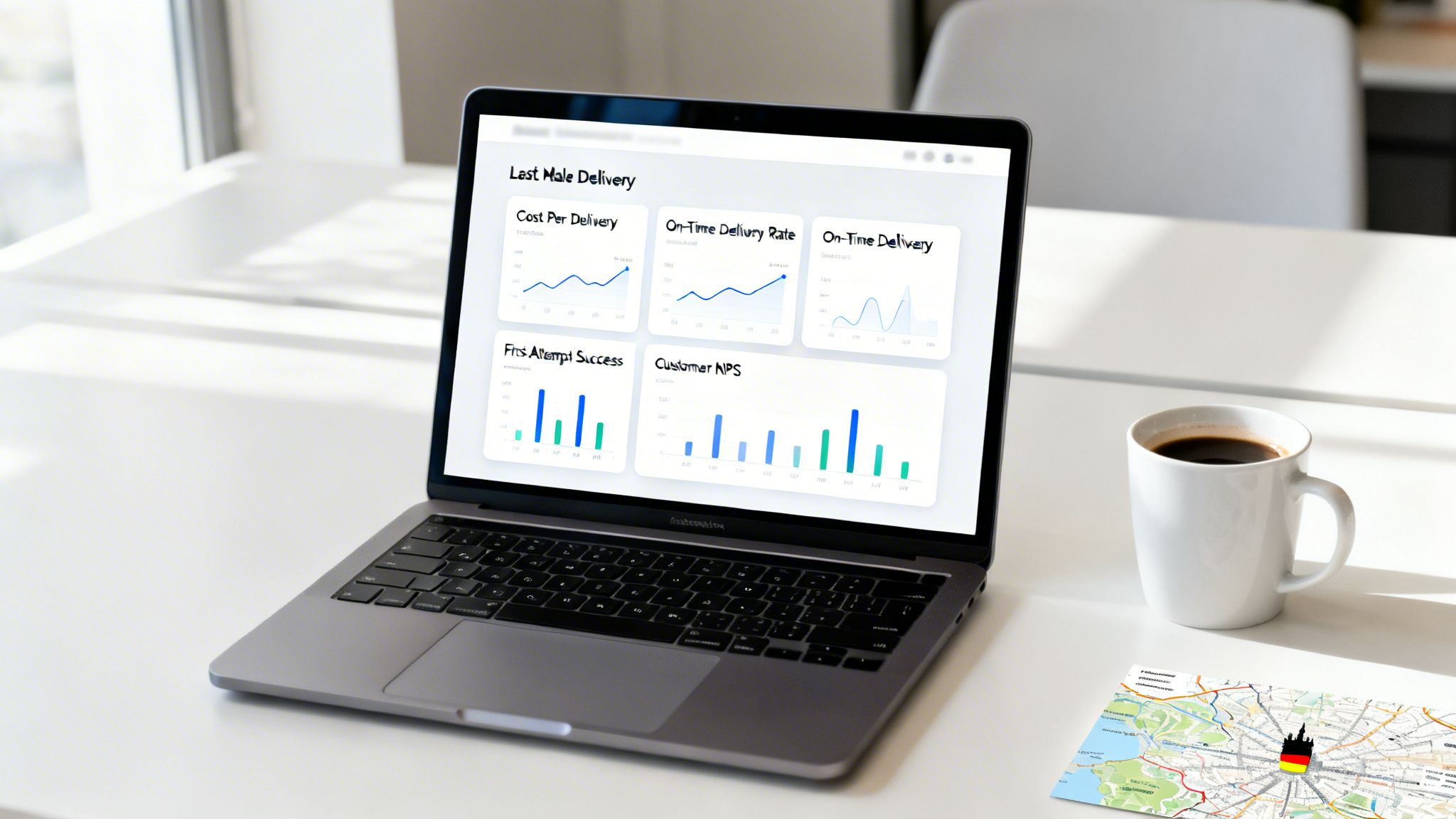
A well-designed KPI dashboard serves as a single source of truth. It distills complex logistical data into clear business intelligence, empowering leaders to formulate precise questions, ensure accountability, and make data-driven decisions that directly impact profitability.
Core Financial And Operational Metrics
While numerous metrics can be tracked, a select few provide the most critical insights into the financial health and efficiency of last-mile operations. These are indispensable for any performance management system.
Cost Per Delivery: This is the north-star financial metric. It aggregates all related expenses—fuel, labour, vehicle maintenance—and divides them by the number of successful deliveries. An upward trend in this KPI is a direct indicator of eroding profitability.
On-Time Delivery Rate: A direct measure of operational reliability, this KPI tracks the percentage of orders delivered within the promised timeframe. It is a cornerstone of customer trust.
Ready to Build Your AI Project?
Let's discuss how we can help you ship your AI project in weeks instead of months.
First-Attempt Delivery Success Rate: This metric is of paramount importance. It quantifies the percentage of deliveries completed successfully on the first attempt. A low rate signifies significant inefficiency, as each subsequent attempt incurs additional costs for re-routing and labour.
Consider Germany’s logistics market, projected to reach USD 85 billion by 2025. In this highly competitive landscape, first-attempt success rates have recently declined to 92.63%. While seemingly a minor dip, each failed delivery adds €5-8 in incremental costs, consuming 15-20% of the margin for that transaction. These costs accumulate rapidly at scale.
Measuring The Customer Experience
Operational efficiency constitutes only one part of the equation. The customer's perception of the service is what ultimately drives loyalty and repeat business. Customer-centric KPIs are not discretionary; they are non-negotiable indicators of future performance.
The most sophisticated logistics network is rendered ineffective if the end customer is dissatisfied. Customer satisfaction is not a soft metric; it is a hard predictor of future revenue streams.
Key metrics to monitor in this domain include:
Want to Accelerate Your Innovation?
Our team of experts can help you turn ideas into production-ready solutions.
- Customer Satisfaction (CSAT): Typically captured via post-delivery surveys, this provides a direct measure of customer sentiment regarding their experience.
- Net Promoter Score (NPS): This metric goes a step further, gauging the likelihood of a customer to recommend the brand. It is a powerful indicator of long-term brand health.
- Order Accuracy: This tracks the percentage of orders delivered without error—no incorrect items, no damage. Flawless execution here is fundamental.
By establishing a clear dashboard that visualizes these core KPIs, leadership can identify performance gaps rapidly and initiate root-cause analysis. This data-driven approach transforms the last mile of delivery from an opaque cost centre into a transparent, controllable, and strategic asset. Developing this level of visibility is a critical step in effectively managing risk in supply chains.
Putting AI to Work in Your Last Mile
Artificial Intelligence is not a futuristic concept; it is a practical toolkit available today to resolve the most pressing challenges in your last mile of delivery. Conceive of AI less as an autonomous replacement and more as an intelligent co-pilot for your logistics team—one that translates vast, complex datasets into clear, actionable intelligence.
This is about transitioning from a reactive, problem-solving posture to a proactive, predictive one. AI enables the anticipation of disruptions before they occur and the optimization of resources with a level of precision unattainable through manual methods. It is the mechanism by which organizations can finally impose order on the inherent chaos that makes the last mile notoriously expensive and unpredictable.
Dynamic Route Optimisation: The Self-Correcting Map
Legacy methodology involves planning a fixed driver route at the beginning of a shift. This plan, however, becomes obsolete upon encountering the first instance of unexpected traffic, a road closure, or an unavailable customer. It is a rigid model applied to a dynamic environment.
AI-powered dynamic route optimisation fundamentally inverts this paradigm. It functions as a highly intelligent, real-time navigation system. The algorithm continuously processes thousands of real-time data points:
Looking for AI Expertise?
Get in touch to explore how AI can transform your business.
- Live traffic patterns across the entire operational area.
- Weather forecasts that may impact transit times.
- New delivery or collection requests that arise during the day.
- The real-time location and progress of all drivers.
Based on this continuous data influx, the system constantly recalculates and adjusts routes dynamically. It re-sequences stops automatically to maintain maximum operational efficiency. This ensures that your drivers are always on the optimal path at any given moment, not merely the one that appeared most efficient at 7 AM.
The primary benefit is operational agility. Instead of a plan that disintegrates at the first sign of disruption, it adapts and improves. This translates directly into reduced mileage, lower fuel consumption, and an increased number of deliveries per shift.
Predictive Analytics: Foreseeing Problems Before They Materialize
Few factors erode last-mile profitability more than a failed delivery attempt. Predictive analytics is the strategic tool to mitigate this risk. By analyzing historical data, machine learning models can identify patterns and predict future outcomes with high accuracy.
This capability allows for the forecasting of demand surges in specific postal codes, enabling proactive allocation of driver and vehicle resources. More powerfully, it can predict the probability of a successful delivery for each individual stop. The AI might flag a delivery as high-risk based on a customer's past delivery history or the scheduled time of day, allowing for a proactive communication to confirm their availability.
Intelligent Dispatch: The Fleet's Central Brain
An AI-powered dispatch system functions as the central nervous system for your entire delivery fleet. Its capabilities extend far beyond simple job allocation. It makes intelligent, data-driven decisions about which driver and which vehicle are optimally suited for every single task.
Ready to Build Your AI Project?
Let's discuss how we can help you ship your AI project in weeks instead of months.
The system evaluates a multitude of variables in real time:
- Driver Proximity: The closest available driver to the next pickup point.
- Vehicle Capacity: Whether the assigned vehicle has sufficient space for the parcel.
- Delivery Windows: The probability of the driver meeting the promised delivery timeframe.
- Driver Skills: Any special handling or certifications required for the delivery.
In Germany, where standard delivery services commanded a 62.45% market share in 2025, the pressure to protect razor-thin margins is immense. With B2C shipments constituting the majority of revenue, every stop must be optimized. An inefficient route can easily add €2-3 to the cost of a single delivery. AI-driven systems transform this cost centre into a tangible competitive advantage. You can explore the dynamics of the German last-mile delivery market on Mordor Intelligence.
This intelligent, automated allocation liberates human dispatchers from tedious manual tasks. They can then apply their expertise to managing complex exceptions and providing high-level operational oversight, enhancing the overall efficiency of the last mile of delivery. For an excellent real-world case study, examine how UPS's AI-powered routing system saves millions annually. By leveraging these AI capabilities, organizations can systematically convert operational challenges into measurable financial gains.
Your Actionable AI Implementation Roadmap
A concept without a clear execution strategy remains purely theoretical. To transition AI from a boardroom discussion to a line item on your P&L statement, a structured, phased approach is essential. This roadmap is designed for corporate innovation leaders and their executive sponsors to de-risk the implementation process and build sustainable momentum within the organization.
The journey begins not with algorithms, but with data. Any effective AI system is predicated on a foundation of clean, accessible, and relevant operational data. Attempting to deploy sophisticated models on a fragmented and inconsistent data landscape is a guaranteed path to failure.
Want to Accelerate Your Innovation?
Our team of experts can help you turn ideas into production-ready solutions.
Therefore, the first critical action is a rigorous assessment of your data readiness. It is imperative to identify where critical information resides—be it in your transport management system, warehouse software, or disparate spreadsheets. Establishing interoperability between these data silos is the non-negotiable first hurdle.
Phase 1: Initial Assessment and Quick Wins
The objective of this phase is to secure a high-impact, low-complexity victory. This serves as a proof-of-concept that demonstrates tangible value to key stakeholders, thereby earning the credibility—and budget—for larger-scale initiatives.
Begin by mapping your current last mile of delivery process end-to-end. Isolate the most significant pain points. Is it the escalating cost of failed deliveries, inefficient routing in congested urban centres, or suboptimal vehicle utilization? Quantify the financial impact of these issues to construct a compelling business case.
Next, select a pilot project that addresses one of these pain points directly but is manageable in scope. A complete overhaul of the national routing system is ill-advised. Instead, focus on a contained objective, such as optimizing routes for a single depot or a specific metropolitan area for a one-month period.
The goal is not to solve every problem simultaneously. It is to isolate a specific challenge, apply a targeted AI solution, and deliver a clear, measurable result. This builds organizational confidence and provides the political capital required for subsequent phases.
Looking for AI Expertise?
Get in touch to explore how AI can transform your business.
Key actions for this phase:
- Data Audit: Assess the quality and accessibility of historical delivery data, including delivery times, driver routes, success rates, and any available vehicle telematics.
- Pilot Project Selection: Choose a project with a clearly defined success metric, such as a 10% reduction in fuel costs or a 5% increase in on-time deliveries for the pilot group.
- Partner Evaluation: Determine the necessary capabilities for execution. Assess whether the expertise exists in-house or if an external technology partner is required.
The flowchart below illustrates how the components of an AI-driven delivery system interconnect, progressing from dynamic routing to predictive analytics and culminating in smart dispatch.
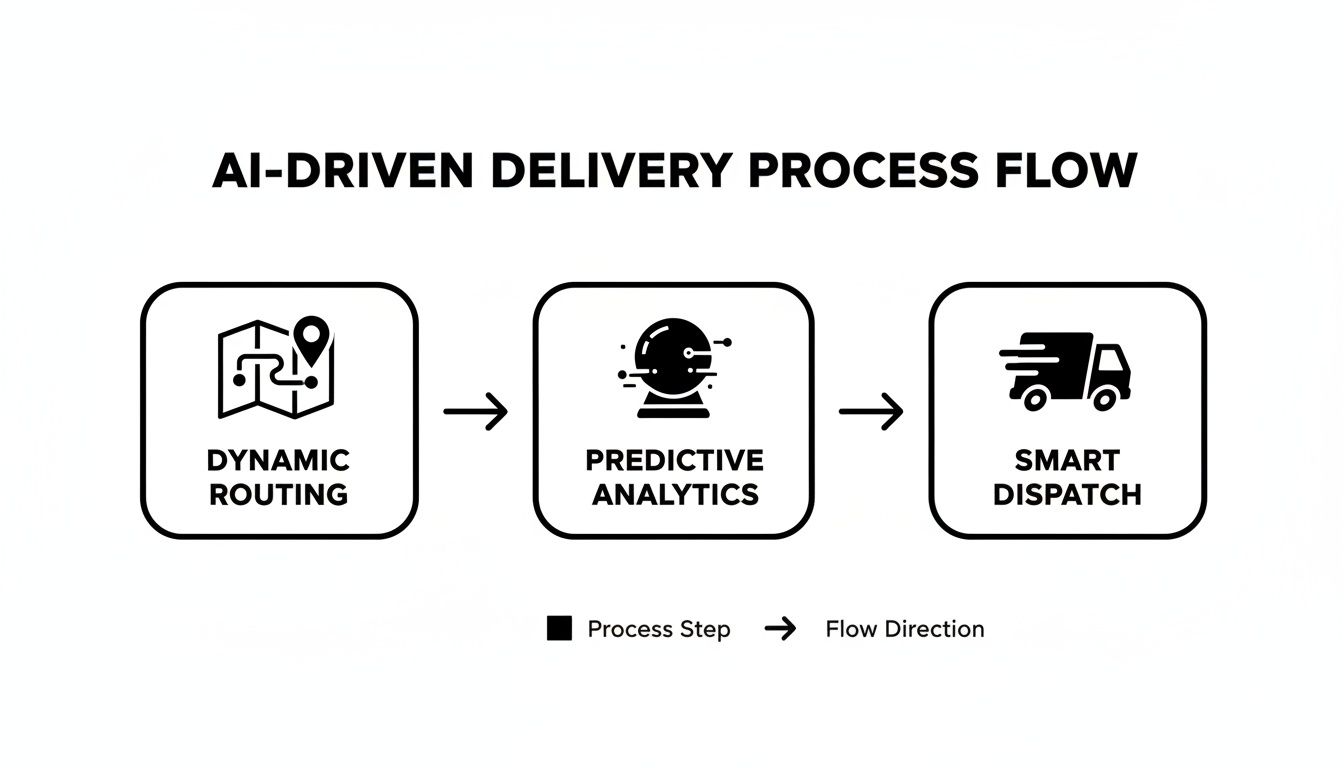
This illustrates a system where each component builds upon the last, creating a feedback loop that becomes progressively more intelligent as it learns from real-world operational data.
Phase 2: Scaled Deployment and Integration
Following a successful pilot, the next phase involves scaling the solution. The focus shifts to broader deployment and deeper integration into core operational workflows. This is where true transformation occurs, demanding meticulous planning around change management and systems integration.
Ready to Build Your AI Project?
Let's discuss how we can help you ship your AI project in weeks instead of months.
The insights gained from the pilot are invaluable. Use them to refine the AI models and streamline the deployment process. It is also critical to address the human element. Drivers and dispatchers are not being replaced; their roles are being augmented with more powerful tools. Clear communication and comprehensive training are essential to secure their buy-in and demonstrate how these tools enhance their effectiveness.
The final component is full integration with existing enterprise systems, including ERP, WMS, and TMS. This ensures seamless data flow, creating a single, authoritative source of truth for the entire last mile of delivery operation. For leaders committed to building production-grade AI systems, understanding these principles is crucial. Our perspective on AI engineering for logistics and supply chain management offers a more in-depth view. This methodical, phased approach transforms AI from a concept into a powerful operational asset that delivers a lasting competitive advantage.
Real-World Examples Of Last Mile Excellence
While theoretical frameworks are useful, observing AI-driven optimization in practice provides the most compelling evidence of its value. Let us shift from the abstract to the concrete by examining how German companies are already realizing a significant return on investment by applying AI to the last mile of delivery.
These case studies are not prescriptive templates but rather sources of strategic inspiration, illustrating the possibilities when a well-defined business problem is met with a focused, intelligent solution.
E-Commerce Player Cracks The First-Attempt Delivery Code
A major German e-commerce retailer faced a persistent and costly problem: a declining first-attempt delivery success rate, particularly in high-density urban areas. Each failed delivery not only incurred direct costs for re-attempts but also eroded their meticulously tracked customer satisfaction metrics. The core challenge was predicting customer availability.
Want to Accelerate Your Innovation?
Our team of experts can help you turn ideas into production-ready solutions.
The company implemented a predictive analytics model that analyzed historical delivery data, customer purchasing patterns, and even time-of-day success rates for specific postal codes.
- The AI Solution: The system assigned a "presence probability score" to each delivery.
- The Operational Shift: Deliveries flagged with a high risk of failure automatically triggered an SMS to the customer, providing a simple, one-click option to confirm their availability or reschedule.
- The Bottom Line: This targeted intervention increased their first-attempt success rate by 12% in pilot cities. Furthermore, their delivery-specific Net Promoter Score (NPS) improved by 8 points.
Manufacturing Firm Slashes Emissions and Fuel Bills
A mid-sized manufacturing company operating its own regional distribution network was contending with volatile fuel costs and increasing pressure to meet sustainability targets. Their static, pre-planned delivery routes were incapable of adapting to daily traffic congestion or last-minute orders, resulting in excessive fuel consumption and driver overtime. For a broader perspective on how global couriers address such challenges, a review of shipping with Aramex to Singapore provides relevant parallels.
Their objective was clear: reduce total kilometres driven without compromising delivery deadlines. This required a paradigm shift from static planning to real-time route management.
They adopted an AI-powered dynamic routing engine. This system continuously monitors live traffic, vehicle locations, and incoming orders to recalculate the optimal path for every driver throughout the day. The impact was immediate.
The company achieved a 15% reduction in fuel consumption within the first six months, leading to a significant decrease in its carbon footprint. In addition, driver productivity increased, allowing for more stops to be completed within each shift.
Looking for AI Expertise?
Get in touch to explore how AI can transform your business.
Let's synthesize these and other examples into a structured overview of problem, solution, and outcome.
AI in Action: Last Mile Success Stories
These examples demonstrate that AI is not a future technology but a practical tool currently solving some of the most complex and costly problems in the last mile of delivery.
| Industry | Challenge | AI Solution Implemented | Key Result |
|---|---|---|---|
| E-Commerce | Low first-attempt delivery success; poor customer experience. | Predictive analytics to score "presence probability" and trigger proactive customer rescheduling via SMS. | 12% increase in first-attempt success; +8 points on NPS. |
| Manufacturing | High fuel costs and CO₂ emissions from inefficient, static routes. | Dynamic route optimisation engine using real-time traffic and order data. | 15% reduction in fuel consumption; increased driver productivity. |
| Grocery Delivery | Managing fluctuating demand and tight 1-hour delivery windows. | AI-powered demand forecasting and automated driver dispatch to match capacity with predicted orders. | 20% reduction in idle driver time; improved on-time delivery rate to 98%. |
| Pharma Logistics | Ensuring temperature-controlled delivery integrity and compliance. | IoT sensors combined with an AI monitoring platform to predict and prevent temperature deviations in real-time. | 99.9% compliance with temperature standards; zero loss of sensitive medical supplies. |
The common theme across these cases is the transition from a reactive to a predictive operational model. By anticipating challenges—from customer unavailability to traffic congestion on the A3—these companies are securing a significant and sustainable competitive advantage.
Your Top Questions About AI in Last Mile Delivery
When leadership teams consider integrating AI into their last-mile operations, a consistent set of critical questions emerges. Let us address them directly.
How Much Data Do We Actually Need to Get Started?
This is perhaps the most frequent and crucial inquiry. Many executives are concerned that their data volume is insufficient or its quality is inadequate.
Ready to Build Your AI Project?
Let's discuss how we can help you ship your AI project in weeks instead of months.
The reality is that a perfect, multi-year historical dataset is not a prerequisite. For most initial projects, a solid three to six months of historical delivery data provides a sufficient foundation for building a robust baseline model. This includes essential data points: timestamps, routes, addresses, and reason codes for delivery successes and failures.
The optimal strategy is to start with a focused pilot, such as optimizing routes for a single depot. This approach contains the scope of the dataset, allowing the AI models to learn and demonstrate value quickly. It is the most efficient path to securing an early success before scaling the initiative.
What’s a Realistic ROI for AI in the Last Mile?
The return on investment from AI is multifaceted, comprising both hard cost savings and softer, yet equally valuable, strategic gains. While results vary based on the initial operational baseline, German enterprises we partner with typically realize a tangible impact within the first 12-18 months.
A realistic target is a 10-20% reduction in your cost-per-delivery. This is achieved through more efficient routes that reduce fuel consumption, increased driver productivity enabling more stops per shift, and a significant decrease in costs associated with failed delivery attempts.
However, the financial return extends beyond direct cost savings. Enhanced delivery reliability and predictability cultivate customer loyalty, which yields long-term dividends that far exceed the initial investment.
Can This AI Even Talk to Our Existing TMS and ERP Systems?
Yes, and it must. Any enterprise-grade AI platform is architected for integration, not isolation.
Modern AI solutions are developed with robust APIs (Application Programming Interfaces) designed to connect seamlessly with your existing technology stack. Whether it is your Transport Management System (TMS), ERP, or Warehouse Management System (WMS), the AI functions as an intelligence layer. It does not replace your current systems; it enhances them by providing predictive insights and automating complex decision-making processes.
Ready to transform your final delivery leg from a cost centre into a durable competitive advantage? At Reruption GmbH, we are not merely consultants. We are co-preneurial partners who build and implement production-ready AI systems that deliver a measurable impact on your P&L. Start your innovation journey with us today.