
For executive leadership within Germany's highly competitive manufacturing and automotive sectors, Siemens Digital Twins represent a pivotal strategic capability, not merely a technological upgrade. This is the creation of a comprehensive, dynamic virtual replica of a product, a production process, or an entire operational facility. It is a strategic environment for simulation, prediction, and optimisation—enabling flawless execution before committing a single physical resource.
The Strategic Value of Siemens Digital Twins in Industry 4.0
German industrial leaders face a convergence of intense global competition and escalating sustainability mandates. Incremental improvements are no longer sufficient. What is required is a step-change in efficiency, velocity, and innovation, executed without incurring unacceptable operational or financial risk. Siemens Digital Twins are engineered to address this precise strategic gap.
By leveraging a comprehensive virtual model, organisations can transition from a reactive to a proactive operational posture. Design flaws, production bottlenecks, and commissioning delays are identified and resolved in the digital domain, not on the factory floor. This methodology systematically de-risks the innovation lifecycle and significantly compresses time-to-market.
From Concept to Reality—Without Physical Constraints
Consider the commissioning of a new production line for electric vehicles. The traditional approach entails months of physical prototyping, on-site trials, and the attendant costly delays and rework. A digital twin renders this paradigm obsolete.
The new methodology enables:
Ready to Build Your AI Project?
Let's discuss how we can help you ship your AI project in weeks instead of months.
- Simulation of Material Flow: Execute dozens of virtual factory layouts to determine the optimal configuration for throughput and asset utilisation.
- Validation of Automation Systems: Program, test, and debug the entire robotic fleet within the simulation, ensuring flawless performance before physical installation.
- Optimisation of Human-Machine Interfaces: Model workforce interaction with machinery to design workstations that enhance both safety and productivity.
This provides engineering teams with the latitude to explore ambitious concepts in a risk-free environment. The outcome is a facility that is not only commissioned faster but is optimised for peak performance from its inception. This strategic advantage is amplified when integrated with technologies like advanced artificial intelligence for industrial applications, which powers many of the platform's predictive and optimisation capabilities.
A Foundation for Proactive Leadership
At its core, the adoption of Siemens Digital Twins embeds a culture of data-driven foresight into an organisation's operational DNA. It empowers leadership to address critical "what-if" scenarios with a high degree of confidence. Consequently, capital-intensive decisions are transformed from informed estimates into validated strategic initiatives.
By unifying design, simulation, and operations into one living model, organisations eliminate silos between teams and enable faster, more confident decision-making long before physical assets exist.
This proactive stance is critical for navigating the complexity inherent in modern manufacturing. As detailed in our analysis of the industrial automation sector, agility and predictive insight are the new currencies of market leadership. By embracing this approach, German enterprises can proactively reinvent their operational models, establishing a new benchmark for industrial excellence in the age of AI.
Understanding The Siemens Digital Twin Ecosystem
To make sound investments in Industry 4.0, a clear understanding of the technological framework is paramount. The Siemens Digital Twin ecosystem, while seemingly complex, is structured around three core pillars that mirror the industrial value chain. Comprehending this structure is the first step toward unlocking its strategic business value.
Want to Accelerate Your Innovation?
Our team of experts can help you turn ideas into production-ready solutions.
Fundamentally, the ecosystem facilitates a "closed-loop" integration where the digital and physical worlds perpetually exchange data. This creates a dynamic, virtual representation of the entire operation, driving more intelligent, rapid, and lower-risk decision-making. It is best conceived not as a single software product, but as an integrated intelligence layer for the enterprise.
This model illustrates how a digital twin transforms common industrial challenges into tangible business outcomes.
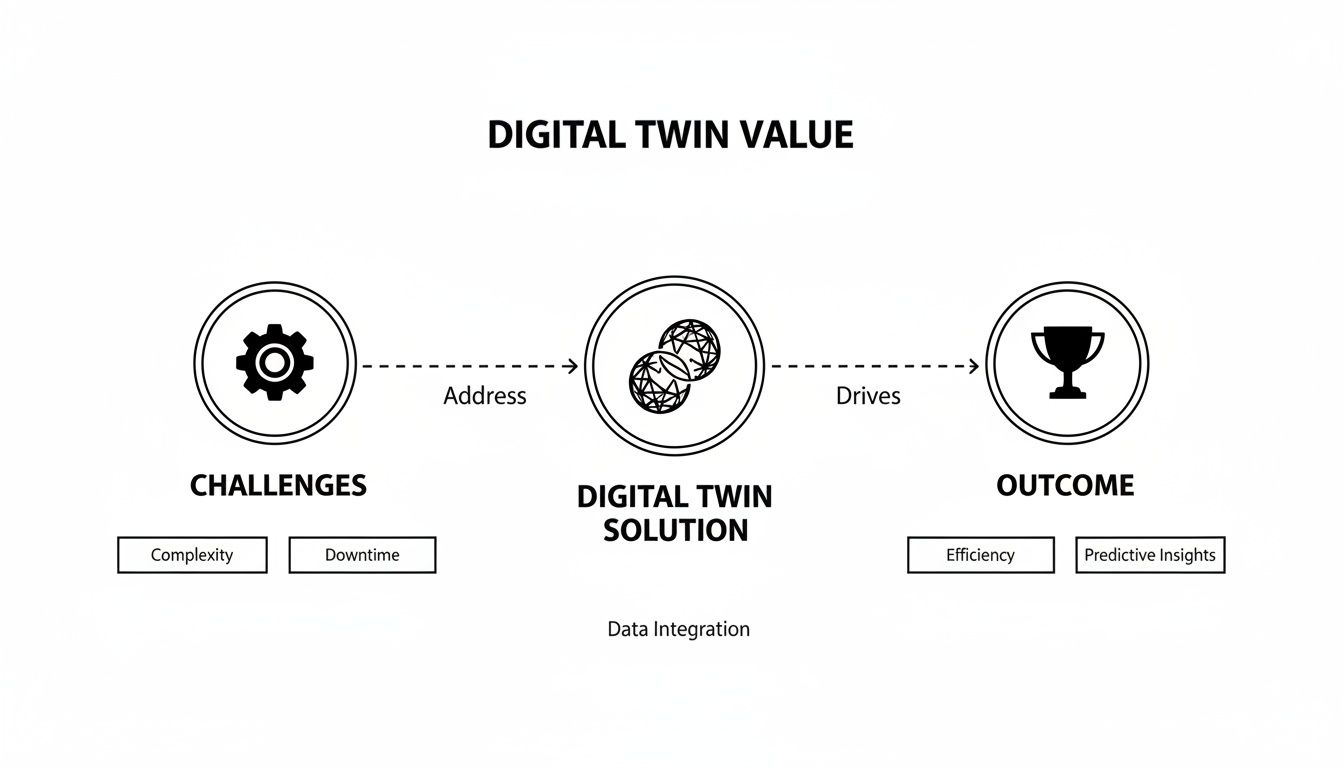
As depicted, the digital twin is central to converting operational challenges such as complexity and downtime into strategic benefits like efficiency gains and predictive insights.
The Three Pillars of The Siemens Digital Twin
To understand the practical application, the Siemens ecosystem can be deconstructed into three distinct yet interconnected components. Each serves a specific function, and their synthesis provides a complete, dynamic view of operations.
Looking for AI Expertise?
Get in touch to explore how AI can transform your business.
This table outlines the three pillars, their core functions, and their strategic value from a management perspective.
| Digital Twin Type | Core Function | Key Business Value for Management |
|---|---|---|
| The Digital Twin of the Product | Simulates the product itself, from mechanics to software, before physical creation. It is the digital prototype. | De-risks R&D, accelerates time-to-market, and reduces the cost of physical prototyping by identifying design flaws early. |
| The Digital Twin of Production | Simulates the entire manufacturing process, including factory layout, robotics, and workflows. It is the virtual factory. | Optimises factory throughput, reduces commissioning times for new lines, and enables risk-free operator training. |
| The Digital Twin of Performance | Captures real-time operational data from products and production systems in the field using IoT sensors. It is the live dashboard. | Enables predictive maintenance to reduce downtime, identifies performance bottlenecks, and provides real-world data to improve future designs. |
By linking these three twins, a powerful, continuous improvement cycle is established, where real-world performance data consistently refines both product designs and production models.
Siemens Xcelerator: The Connecting Fabric
These three pillars are not isolated. They are unified by Siemens Xcelerator, an open digital business platform that functions as the data backbone. It ensures the seamless flow of information between product design, the production floor, and in-field performance.
Xcelerator dismantles the traditional barriers between engineering, manufacturing, and service. It establishes a single source of truth, ensuring every team operates with the same up-to-date information, from initial concept through the product's entire lifecycle.
This integrated approach is the source of the Siemens ecosystem's strategic power. For German industrial leaders, this capability is a significant competitive differentiator. Siemens AG solidifies its market leadership with the Xcelerator platform, which integrates advanced simulation, industrial automation, and cloud analytics. Germany led Europe's digital twin market in 2023, and with a projected national market value of USD 26,807.7 million by 2033, the growth trajectory is clear. Siemens’ own digital business revenue reached EUR 9 billion in 2024, a 22% increase driven by Xcelerator's ability to de-risk complex projects.
Ready to Build Your AI Project?
Let's discuss how we can help you ship your AI project in weeks instead of months.
By connecting the entire value chain, the Siemens Digital Twin ecosystem delivers a level of insight and control previously unattainable. It enables businesses to shift from a reactive to a proactive posture, identifying challenges before they materialise and capitalising on emerging opportunities. To contextualise this within a broader technology stack, our guide on the principles of modern system engineering for IT provides valuable insights. This is the foundation for market leadership in the modern industrial era.
Real-World Applications in German Manufacturing
Let us transition from theory to application. The definitive test of Siemens' Digital Twin ecosystem is its performance on the factory floors of Germany's industrial leaders. Here, strategic investment translates into measurable improvements in efficiency, quality, and profitability.
These digital replicas are not static 3D models. They are dynamic, virtual environments for solving high-cost operational problems. They provide a safe, controlled space to design, test, and perfect complex processes long before any capital is expended on physical assets. For competitive sectors like automotive and heavy industry, this capability is not an ancillary benefit; it is a critical strategic advantage.
Accelerating Production With Virtual Commissioning
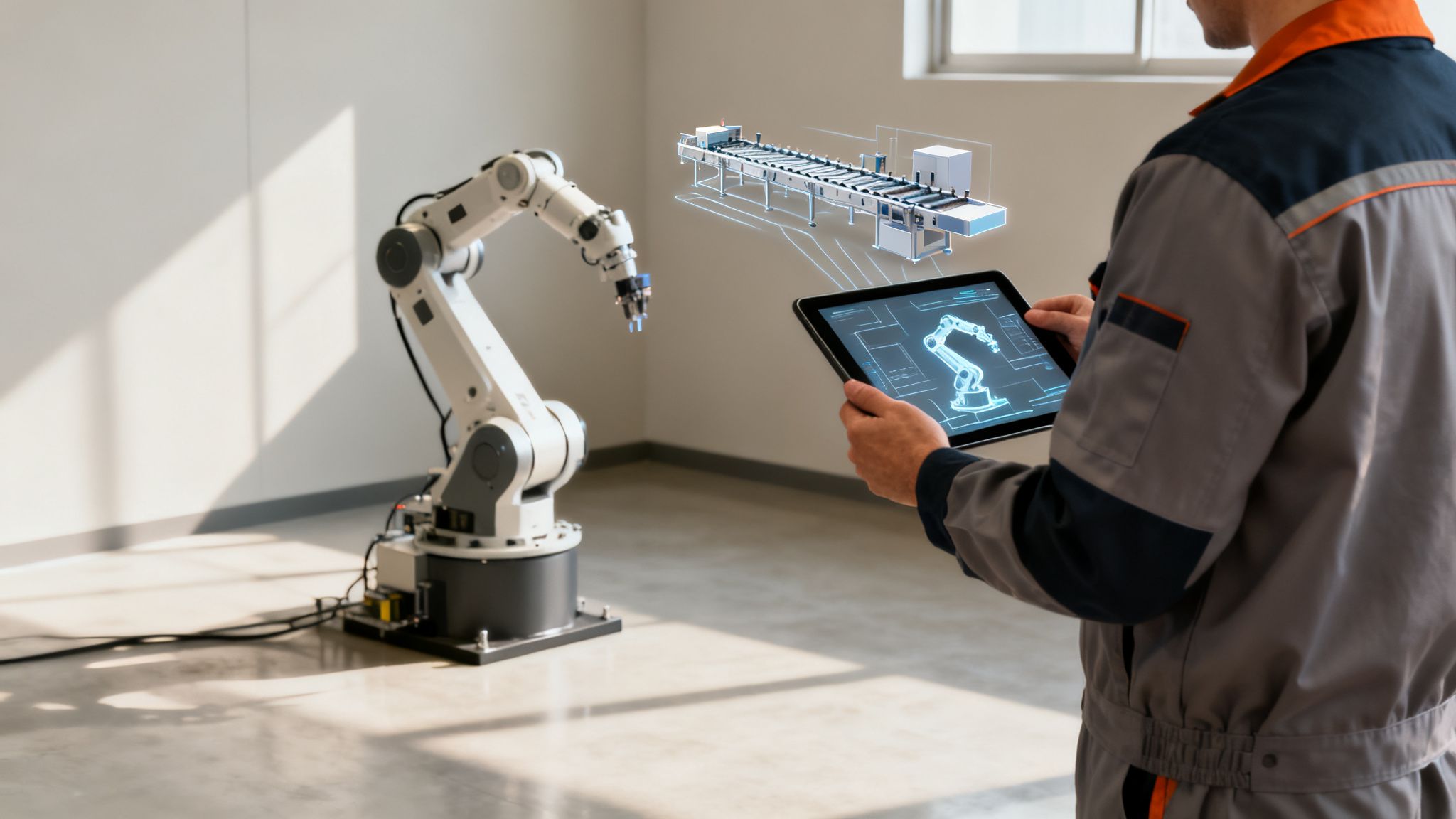
One of the most impactful applications is virtual commissioning. Consider the establishment of a new production line for electric vehicle (EV) batteries. The conventional method involves months of installing machinery, conducting extensive physical tests, and troubleshooting in real time—all leading to significant delays and budget overruns.
Want to Accelerate Your Innovation?
Our team of experts can help you turn ideas into production-ready solutions.
A digital twin inverts this entire process. The majority of the complex work is front-loaded into the virtual domain.
- Robotic Path Planning: Engineers can map, simulate, and fine-tune the kinematics of every robot, ensuring seamless, collision-free collaboration.
- Control Logic Validation: The PLC code that governs the line's operation is tested against the virtual model, allowing for the resolution of software defects before hardware is powered on.
- Throughput Simulation: Numerous scenarios can be run to identify and eliminate bottlenecks, optimising material flow and ensuring the line achieves its target production rates from day one.
This is not a minor enhancement. This methodology reduces commissioning times by weeks, and in some cases months, enabling faster market entry and a more rapid return on investment.
Eliminating Downtime Through Predictive Maintenance
Unplanned downtime is a primary driver of lost revenue in manufacturing. Across Germany, digital twins are enabling a more intelligent strategy for predictive maintenance for manufacturing that pre-empts equipment failure.
By creating a performance digital twin of a critical asset—such as a CNC machine or a robotic welder—and feeding it real-time data from IoT sensors, a predictive capability is established. The twin simulates wear and tear based on actual operating conditions, flagging subtle anomalies that indicate impending failure. This allows maintenance teams to schedule interventions proactively, converting a costly emergency shutdown into a planned, efficient service event.
A performance digital twin does not merely report current status; it predicts future states. This shifts maintenance from a reactive cost centre to a proactive, value-creating business function.
Looking for AI Expertise?
Get in touch to explore how AI can transform your business.
Optimising Factory Safety And Productivity
The benefits extend beyond machinery. Siemens' digital twins are also utilised to model the human element of production. By simulating ergonomic workflows, factory planners can design workstations that reduce physical strain on employees, minimising injury risks and improving morale. It is an established principle that a focus on human factors yields not only a safer workplace but also a more productive one.
The impact of this technology is evident across Germany's industrial heartland. The automotive and manufacturing sectors are leveraging Siemens' digital twins to enhance operational leanness and agility within the Industry 4.0 framework. Adoption rates reflect this trend, with over 60% of firms using them to gain a competitive advantage. In 2023, Western Europe, led by Germany, held the largest market share, driven by this imperative for automation and smart factory implementation.
Highlighting this trend, Siemens recently launched Siemensstadt Square in Berlin, a €750 million project. A digital twin on the Xcelerator platform is being used to optimise an entire urban district for sustainability and energy efficiency, demonstrating the technology’s power extends far beyond factory walls.
Quantifying The Business Impact
For senior leadership, the value of any new technology is ultimately measured by its impact on the profit and loss statement. A Siemens digital twin is not a discretionary engineering tool; it is a strategic financial decision. The business case is predicated on concrete improvements to key performance indicators.
These benefits are not abstract. They are direct, measurable reductions in both operational and capital expenditures. By migrating high-stakes activities from the unforgiving physical world into a flexible, low-risk digital environment, companies are unlocking significant financial efficiencies.
Reducing Operational Expenditures
The initial impact is most visible in operational expenditures (OpEx), particularly concerning maintenance and production throughput.
A performance digital twin fundamentally changes the maintenance paradigm. Instead of reacting to critical equipment failure—and the associated costly production halts—teams can anticipate and proactively address issues. This is a transformative shift.
- Reduced Unplanned Downtime: An idle asset generates no revenue. Minimising unscheduled shutdowns directly increases output.
- Optimised Maintenance Spending: Emergency call-out premiums and overtime labour are eliminated. Repairs are scheduled on business terms.
- Extended Asset Lifespan: Maintenance based on actual usage patterns, rather than generic schedules, extends the operational life of equipment, deferring major capital replacement costs.
This transforms maintenance from a reactive cost centre into a proactive function that directly preserves the bottom line.
Optimising Capital Expenditure and De-risking Investments
Beyond daily operations, Siemens digital twins significantly influence capital expenditure (CapEx) decisions. For a new factory or production line, the ability to build, test, and perfect the entire facility in a virtual environment provides a profound financial advantage.
With a production digital twin, engineers can design and stress-test layouts, program automation, and identify bottlenecks before any physical procurement. This "virtual commissioning" preempts the design flaws and integration challenges that would otherwise manifest as costly rework and delays during physical construction. Resolving these issues in simulation reduces project costs and accelerates the time-to-revenue for new facilities.
Ready to Build Your AI Project?
Let's discuss how we can help you ship your AI project in weeks instead of months.
A digital twin provides the financial confidence required for bold capital investments. It enables leadership to prove a new facility will meet its performance targets from day one, effectively de-risking multimillion-euro projects and ensuring optimal capital allocation.
The results are evident in Germany's industrial core. In 2024, Germany commanded a 26.2% share of the European digital twin market, with pioneers like Siemens being a primary driver. The company has demonstrated that its digital twins can reduce manufacturing costs by up to 30%. This aligns with the nation's broader Industry 4.0 initiative, which has seen over 60% of German companies adopt digital twins to enhance their competitive position in automotive and manufacturing.
Accelerating Time-to-Market
Finally, the impact on the product development lifecycle must not be understated. A product digital twin provides R&D teams with a virtual environment to conduct extensive tests and validations, enabling rapid iteration on new designs with high confidence.
This is not merely about efficiency; it is about competitive advantage. Launching new products ahead of competitors allows for the early capture of revenue and market share. In a fast-moving industry like automotive, a lead of even a few months can establish a durable financial advantage. For those interested in applying similar data-driven efficiencies to business operations, our analysis of process mining with Celonis covers related concepts.
A Pragmatic Roadmap For Implementation
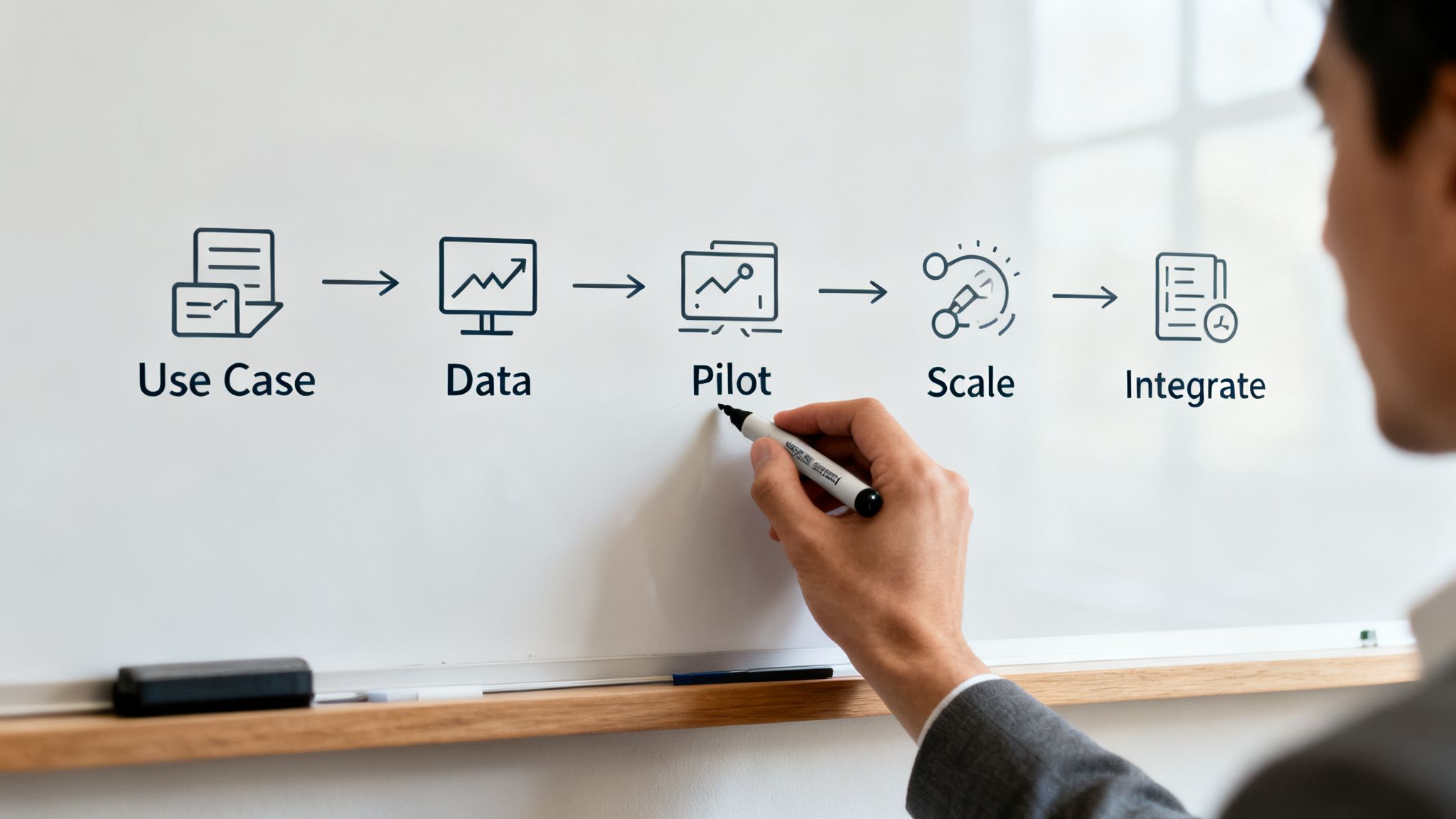
The strategic rationale for Siemens Digital Twins is compelling, but for executive leadership, the pivotal question is one of execution. Implementing a digital twin is not an IT project; it is a business transformation that requires a precise, phased approach—starting with a focused pilot and scaling intelligently.
A "big bang" implementation, attempting to digitise all operations simultaneously, is a proven path to budget overruns and project failure. The more effective strategy is a phased roadmap designed to de-risk the initiative by demonstrating tangible value quickly. This builds momentum and secures stakeholder support for broader deployment.
Phase 1: Strategic Use Case Identification
Before any technology is discussed, the first step is to identify a critical business problem. The most successful digital twin projects originate not from a desire for technology, but from a high-value operational challenge that demands a solution.
This could be unacceptable downtime on a mission-critical production line or the protracted commissioning process for a new facility.
The objective is to isolate a single, high-impact use case where a digital twin can deliver a clear, measurable return on investment (ROI). This focus is essential for securing executive sponsorship and justifying the initial investment. The temptation to address multiple challenges simultaneously must be resisted in favour of securing a decisive initial victory.
Phase 2: Data Foundation and Readiness Assessment
With a clear objective defined, the next step is a rigorous assessment of the existing data infrastructure. A digital twin's efficacy is entirely dependent on the quality of its underlying data. This involves auditing current systems—SCADA, MES, PLM—to evaluate data availability, integrity, and accessibility.
This is not an effort to build a perfect data architecture from the outset. It is a targeted gap analysis.
- Map Existing Data Streams: Identify what data is currently collected from the target asset or process.
- Assess Data Quality: Honestly evaluate the accuracy, consistency, and completeness of the data.
- Pinpoint Data Gaps: Determine what additional data, potentially from new IoT sensors, is required to build a functional twin for the selected use case.
This foundational work ensures the pilot project is built on a solid, reliable data footing.
Phase 3: Pilot Project Execution
This phase focuses on execution. The pilot should be narrowly scoped to a single critical asset—one key machine, a single robotic cell, or a known production bottleneck. The goal is to build a functional digital twin that directly addresses the business problem identified in Phase 1.
The primary metric for success is business value, not technical complexity. Success is defined by achieving a tangible result, such as a 15% reduction in unplanned downtime or a 20% improvement in cycle time.
Want to Accelerate Your Innovation?
Our team of experts can help you turn ideas into production-ready solutions.
Executing a well-defined pilot project is the most effective way to de-risk a digital twin strategy. It validates the technology's value in a real-world context and creates a compelling internal case study for broader adoption.
This concentrated effort allows for rapid learning and iteration within a controlled environment. Partnering with a specialist in rapid AI implementation can significantly accelerate this phase. The philosophy of a structured, accelerated approach is further detailed in our framework for delivering productive AI systems in just three weeks.
Phase 4: Scaling Across The Production Line
Once the pilot has demonstrated a clear ROI, the strategy shifts to scaling. The logical next step is to expand the digital twin from a single asset to an entire production line or a complete manufacturing cell.
The lessons learned during the pilot—regarding data integration, model development, and user adoption—are now applied at a larger scale. This requires careful architectural planning to manage increased complexity and data volume. It is at this stage that the full power of a production twin becomes apparent.
Phase 5: Enterprise-Wide Integration
The final phase focuses on enterprise-wide integration. This involves connecting the Digital Twin of Production with the Digital Twins of Product and Performance, creating the "closed-loop" system that defines the Siemens vision.
Looking for AI Expertise?
Get in touch to explore how AI can transform your business.
At this level of maturity, real-world performance data from the factory floor flows back to engineering teams, directly informing the design of next-generation products.
This integration elevates the digital twin from a powerful operational tool to a core strategic asset for the entire enterprise. It creates a virtuous cycle of data-driven improvement that spans the entire value chain, securing a significant and sustainable competitive advantage.
Digital Twin Implementation Roadmap From Pilot To Enterprise Scale
| Phase | Key Activities | Primary Objective | Expert Partner's Role |
|---|---|---|---|
| 1. Pilot | Identify high-impact use case. Build a minimal viable twin for a single asset. Measure ROI. | Prove tangible business value quickly. De-risk the technology. | Assist in identifying the optimal starting point. Rapidly develop and deploy the Proof of Concept. |
| 2. Expand | Scale the twin across a full production line or cell. Integrate with more systems. Refine models. | Optimise a complete process flow. Demonstrate value at a larger scale. | Design a scalable architecture. Manage complex data integration challenges. |
| 3. Integrate | Connect production, product, and performance twins. Create the closed-loop system. | Achieve enterprise-wide visibility and continuous improvement. | Provide strategic guidance. Ensure seamless integration across business units. |
Navigating this path, from a focused pilot to a fully integrated system, demands both technical expertise and strategic foresight. The selection of an implementation partner is therefore a critical decision in this process.
Securing Future Market Leadership
The integration of Siemens Digital Twins is not a mere technological enhancement; it is a fundamental transformation of operational strategy. It embeds a culture of continuous, data-driven innovation into the core of the enterprise. For Germany's industrial leaders, this is the strategic pivot from reacting to market shifts to actively shaping the future of the industry.
This technology provides the foresight to de-risk ambitious capital projects, accelerate the commissioning of production lines, and engineer market-leading products. It empowers teams to address critical "what-if" scenarios with validated, data-backed answers. Capital-intensive decisions evolve from informed estimates into confirmed strategies. By creating a closed-loop system connecting design, production, and in-field performance, a powerful engine for continuous improvement is established.
A Commitment To Proactive Innovation
A passive, reactive stance is no longer a viable strategy in the current global market. Market leadership must be actively engineered. Implementing a Siemens Digital Twin is a declaration of strategic intent—a commitment to lead, not to follow. It is the mechanism for mastering complexity, eliminating operational waste, and unlocking new efficiencies across the value chain.
The objective is not merely to defend market share, but to aggressively expand it. The ability to simulate tomorrow's factory today provides a decisive competitive advantage, ensuring that new facilities are optimised for peak performance before physical construction begins.
Adopting a comprehensive digital twin is less about acquiring new software and more about instilling a new organisational mindset. It is a commitment to visualising the future, testing its possibilities, and then building it with confidence. It transforms the organisation into a perpetual engine of innovation.
Ultimately, this is about ensuring long-term strategic viability. In a global marketplace where velocity and precision are the primary determinants of success, the ability to virtually perfect every facet of the business is the ultimate competitive advantage. For any German industrial leader committed to defining the next era of manufacturing, the adoption of Siemens Digital Twins is a strategic imperative.
Frequently Asked Questions
For leaders evaluating a strategic technology, critical questions must be addressed. The following are common inquiries regarding Siemens Digital Twins, answered with clarity and conciseness.
How does an organisation initiate a digital twin project?
A large-scale, enterprise-wide rollout from inception is ill-advised. The optimal strategy is to begin with a focused, high-impact pilot.
Identify a single, well-defined business problem, such as a critical machine with high downtime rates or a persistent production bottleneck. This becomes the initial target. This focused approach enables the rapid demonstration of value, the generation of tangible results, and the securing of executive sponsorship for subsequent phases. The objective is a quick, decisive win that provides the blueprint for scaling.
What are the data requirements for a digital twin?
The emphasis should be on the quality and relevance of data, not sheer volume. A successful pilot can often be initiated using data already available from existing SCADA, MES, and PLM systems.
The process begins with a thorough assessment of your current data landscape. This audit identifies immediately usable data sources and pinpoints any specific gaps that must be filled to address the chosen business problem. This is a targeted data strategy, not a comprehensive data collection exercise.
Is this technology viable only for large automotive and aerospace corporations?
While historically true, this is no longer the case. Platforms like Siemens Xcelerator, combined with a phased, problem-centric implementation approach, have made this technology accessible to the German Mittelstand. The strategic mindset must shift from a large, upfront capital investment to a series of focused, value-driven initiatives.
Ready to Build Your AI Project?
Let's discuss how we can help you ship your AI project in weeks instead of months.
By concentrating on a single, critical challenge—such as reducing unplanned downtime on a key asset or optimising a specific workflow—mid-sized companies can achieve a significant financial return. This initial success builds the confidence and the business case for a more extensive digital transformation.
This approach transforms Siemens Digital Twins from a tool reserved for industrial titans into a powerful lever for any forward-thinking manufacturing leader. It provides a scalable, low-risk path to enhancing operational performance and competitive positioning. It is the application of the right technology, in the right place, to solve the right problem.
At Reruption GmbH, we function as co-preneurs for the AI era, guiding enterprises from concept to productive solution with velocity. Our focus is on de-risking innovation and delivering tangible results, not theoretical reports.
Discover how we can assist in executing a high-impact digital twin pilot. Visit us at https://www.reruption.com.
