
Last mile delivery constitutes the final, decisive step in the supply chain: the journey from a local hub directly to the customer's location. For senior leadership, this is not merely a logistical function; it is the moment of truth that shapes customer perception, cultivates loyalty, and directly impacts bottom-line results. As the most cost-intensive segment of the entire shipping process, its optimization is a strategic imperative.
The Final Kilometre Challenge in German Logistics
For German enterprises, the final segment of the delivery route has evolved from a simple operational line item into a significant determinant of P&L outcomes. This concluding phase can account for over 50% of total shipping expenditures, transforming a short physical distance into a substantial financial lever. The pressure is intensifying, driven by Germany's burgeoning e-commerce market and escalating customer expectations for speed, transparency, and reliability.
These demands introduce a high degree of operational complexity, where minor inefficiencies can rapidly compound into significant costs and reputational damage. The core challenges have transcended mere logistical hurdles; they now represent strategic risks demanding executive oversight and sophisticated, technology-driven solutions.
Mounting Pressures from Market Dynamics
The German last mile delivery market is on a steep growth trajectory, projected to reach a value of USD 30.01 billion in 2025 and forecast to expand to USD 37.77 billion by 2030. This represents a compound annual growth rate (CAGR) of 4.71%, fuelled almost exclusively by e-commerce. During peak seasons, this volatility intensifies, with daily parcel volumes increasing from an average of 5.2 million to over 8 million, placing immense strain on existing infrastructure.
This growth creates a perfect storm of business challenges:
Ready to Build Your AI Project?
Let's discuss how we can help you ship your AI project in weeks instead of months.
- Intense Customer Expectations: Contemporary customers expect more than mere speed; they demand complete visibility. Real-time tracking and precise delivery windows are no longer value-added services but the established standard.
- Urban Congestion and Complexity: Navigating dense German urban centres such as Berlin, Hamburg, or Munich involves contending with traffic congestion, limited parking, and low-emission zones, all of which add time and increase fuel consumption.
- Volatile Operational Costs: Fluctuations in fuel prices, vehicle maintenance expenses, and a persistent shortage of qualified drivers render operational costs unpredictable and frequently higher than budgeted.
Reframing Challenges as Strategic Opportunities
These are not merely costs to be absorbed but clear opportunities to establish a significant competitive advantage. As organisations contend with the final kilometre, even fundamental concepts like understanding what 'out for delivery' truly signifies become critical for managing customer communications and setting accurate expectations.
For executive leadership, the pertinent question is not if these challenges will impact the bottom line, but how the organisation can transform its delivery operations into a resilient, efficient, and customer-centric engine for growth.
This strategic reframing is the foundational step toward developing a modern logistics function. The imperative is to move beyond conventional methods and embrace technologies capable of managing this complexity at scale. For any executive committed to building a future-proof supply chain, defining a coherent AI strategy for logistics, supply chain, and mobility is non-negotiable. This is how the groundwork is laid for leveraging AI to achieve tangible, sustainable success.
Pinpointing Hidden Costs in Delivery Operations
For executive leadership, the true cost of last mile delivery is rarely confined to a single line on a financial statement. It manifests as a series of cascading inefficiencies that systematically erode profitability. While fuel and labour are the conspicuous expenses, the most significant financial drains are often embedded in operational disruptions that appear minor in isolation but aggregate into a substantial problem.
Consider your delivery network as a high-performance engine. A minor fuel leak may seem trivial initially, but over thousands of kilometres, it results in wasted resources, reduced operational range, and eventual failure. Similarly, a marginal decline in the first-attempt delivery success rate creates a significant financial drag through multiplied costs and a reduction in customer lifetime value.
Want to Accelerate Your Innovation?
Our team of experts can help you turn ideas into production-ready solutions.
The German market's rapid expansion presents immense opportunity but also introduces considerable operational strain. The following infographic contextualizes the scale of this growth, illustrating market value, growth rate, and parcel volume.
This data presents a clear picture: at a scale of millions of daily parcels, even the smallest inefficiency becomes a significant financial leakage across the entire operation.
Translating Operational Metrics into P&L Impact
To construct a robust business case for technology investment, managers must establish a direct correlation between operational Key Performance Indicators (KPIs) and the profit and loss (P&L) statement. This requires shifting the discourse from logistical terminology to quantifiable financial outcomes.
To accurately diagnose operational health, tracking the correct metrics is paramount. The table below outlines the most critical KPIs, their core function, and their direct P&L impact in the event of underperformance.
Critical Last Mile KPIs and Their Business Impact
| Key Performance Indicator (KPI) | What It Measures | German Industry Benchmark | Direct P&L Impact of Underperformance |
|---|---|---|---|
| Cost Per Delivery | The total expense for a single successful delivery, encompassing fuel, driver wages, vehicle maintenance, and software. | €1.50 - €3.00 | Erodes profit margins on every order. Indicates inefficient routing or underutilised fleet capacity. |
| On-Time In-Full (OTIF) | The percentage of orders delivered on the promised date, to the correct location, without damage. | >95% | Increases customer service costs, return processing overhead, and leads to lost sales from order cancellations. |
| First-Attempt Delivery Success Rate | The percentage of deliveries successfully completed on the initial attempt. | >92% | Initiates a cascade of costs: redelivery expenses, additional fuel consumption, and increased administrative workload. |
These KPIs are not merely dashboard figures; they are the vital signs of your operation's financial viability.
The True Cost of a Failed Delivery
A failed delivery is never an isolated event. Its financial impact radiates throughout the organization, initiating a ripple effect of unforeseen costs. This is where hidden expenses accumulate rapidly, converting a profitable order into a net loss.
A mere 1.73% drop in first-time delivery success in Germany, as observed between Q1 and Q2 2025, translates to tens of thousands of additional failed attempts. In a market where e-commerce fuels a USD 30.07 billion last mile economy, such seemingly minor declines inflict serious financial damage.
A single failed delivery sets the following domino effect in motion:
- Redelivery Costs: The driver and vehicle must return, instantly doubling the labour, fuel, and maintenance costs allocated to that order.
- Increased Customer Service Load: Dissatisfied customers will contact your support centre, increasing call volumes and staff time dedicated to rescheduling and problem resolution.
- Inventory and Warehousing Strain: The returned package requires processing, storage, and preparation for a subsequent attempt, consuming valuable warehouse space and personnel time.
- Brand Erosion: A reputation for unreliability is the most damaging long-term consequence, negatively impacting customer retention and future sales potential.
Gaining control over these interconnected costs is the first critical step toward building a resilient, profitable operation. For instance, predictive maintenance powered by AI can preempt vehicle downtime, a frequent cause of delays, as detailed in this analysis of how DHL uses AI and IoT to slash downtime. As fleets transition to electric vehicles, understanding profitable EV fleet charging strategies adds another crucial dimension to managing operational expenditures.
How AI Transforms Last Mile Logistics
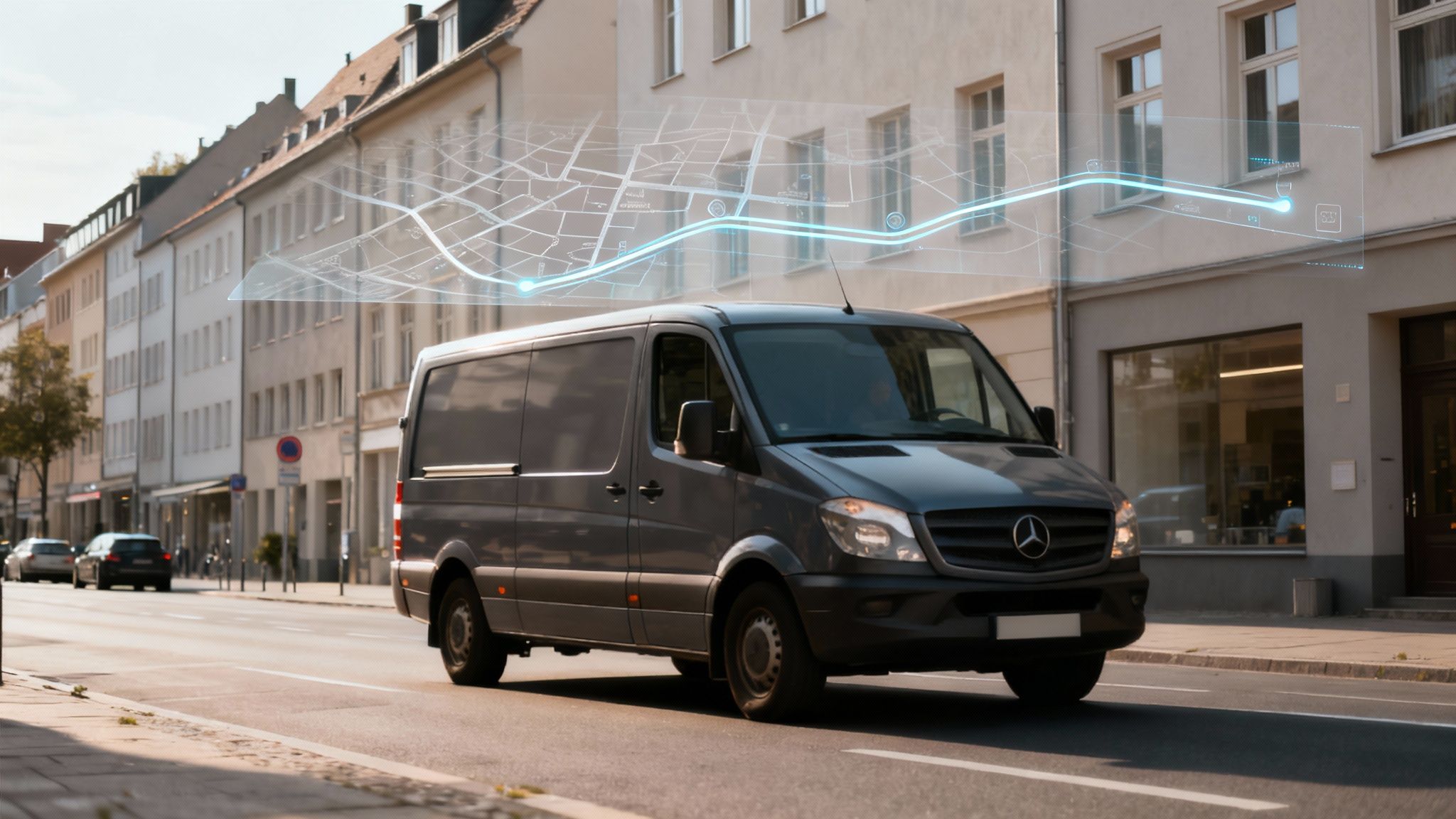
The persistent challenges of last mile logistics—traffic congestion, unforeseen costs, and high customer expectations—are not isolated issues but systemic problems. Attempting to solve them with static, conventional planning is akin to navigating a constantly evolving cityscape with an outdated paper map.
Artificial intelligence fundamentally alters this paradigm. It transforms the entire last mile delivery network from a rigid, pre-planned system into an adaptive, self-optimizing organism.
This represents not just incremental improvement but a fundamental shift from a reactive to a proactive operational posture. AI enables organizations to anticipate disruptions, adapt in real time, and convert every delivery into a data point that enhances future performance. It is the mechanism through which data becomes the most valuable competitive asset.
Intelligent Route Optimisation
Traditional route planning is a static calculation based on fixed addresses and historical traffic data. AI-powered route optimisation is a fundamentally different approach. It is dynamic, processing thousands of variables in real time to determine the optimal path for each vehicle and continuously recalculating as conditions evolve.
The system perpetually analyzes:
Looking for AI Expertise?
Get in touch to explore how AI can transform your business.
- Live traffic flows to circumvent unexpected congestion.
- Weather forecasts that could impact travel times or road safety.
- Vehicle capacity and specialized requirements (e.g., refrigeration).
- Promised delivery windows to ensure customer satisfaction.
The outcome is not merely a shorter route but a direct positive impact on the P&L through significant savings in fuel, driver hours, and emissions. The objective shifts from finding the "shortest distance" to identifying the most profitable and efficient path. The transformative power of this approach is evidenced by how machine learning helped FedEx slash its truck route miles.
By treating the entire delivery fleet as a single, coordinated system, AI ensures that each vehicle's route is optimised not just in isolation, but in relation to every other vehicle. This holistic approach prevents localised efficiencies from creating broader systemic bottlenecks.
Predictive Demand Forecasting
A primary challenge in logistics is aligning capacity with fluctuating customer demand. Overstaffing leads to idle assets and personnel, while understaffing results in service failures and customer dissatisfaction.
AI-driven demand forecasting removes the guesswork from this equation. It analyzes historical sales data, seasonal trends, marketing promotions, and even external factors like public holidays or major local events.
This predictive capability allows managers to:
Ready to Build Your AI Project?
Let's discuss how we can help you ship your AI project in weeks instead of months.
- Optimise Staffing Levels: Schedule drivers and warehouse personnel precisely when needed, eliminating wasteful over-provisioning.
- Pre-position Inventory: Relocate popular items to facilities closer to anticipated demand hotspots, dramatically reducing final delivery times.
- Proactively Manage Fleet Maintenance: Schedule vehicle servicing during predicted lulls in activity, ensuring maximum fleet availability during peak periods.
By anticipating purchasing surges, the network can be proactively prepared. This transitions the inventory strategy from a reactive, "just-in-case" model to a predictive, "just-in-time" framework tailored for the last mile.
The Frontier of Autonomous Delivery
Long-term, autonomous technologies are poised to solve some of the most intractable last mile challenges, including driver shortages and navigation in dense urban environments. While still an emerging field, the business case is compelling, particularly for high-volume urban zones.
Autonomous technologies are already making a significant impact on Germany's last mile delivery landscape. The market revenue is projected to surge from USD 172.7 million to USD 635.1 million by 2030, driven by a compound annual growth rate of 24.8%. Ground delivery vehicles are at the forefront, capturing 83.84% of the market share, a testament to Germany's automotive strength with collaborations between giants like Daimler and logistics firms testing electric autonomous vans.
Solutions such as sidewalk delivery robots and self-driving vans enable 24/7 operations and can handle small, frequent deliveries that are not economically viable for a standard-sized van. For any leader with a long-term strategic vision, this technology represents a pathway to building a more resilient, scalable, and cost-effective delivery operation.
A Pragmatic Roadmap for AI Implementation

Initiating an AI transformation can appear to be a formidable undertaking. A common concern is engaging in lengthy consulting projects that promise much but deliver little tangible value. A more effective approach exists. The objective must be to progress from concept to measurable business impact expeditiously, thereby de-risking the innovation process.
This is not a theoretical framework for deliberation; it is a blueprint for action. It outlines a clear, phased path for German enterprises to integrate AI into their last mile delivery operations, ensuring each step is directly linked to demonstrable financial and operational gains. The methodology is to start small, prove value quickly, and build organizational confidence for subsequent phases.
Phase 1: Proof in Days
Instead of commencing with a large-scale, enterprise-wide strategy, we begin with a highly focused experiment. The objective is to validate a high-impact business hypothesis within days, not months. This involves selecting a single, significant pain point within your last mile operations and applying a targeted AI solution to assess its efficacy.
A robust hypothesis might be: "Can an AI routing algorithm reduce fuel consumption by 10% for one of our high-traffic urban depots?" This narrow focus allows for the rapid development of a minimal viable product (MVP) that provides a clear, measurable outcome. A successful result provides the empirical evidence and internal momentum necessary to justify further investment.
This "Proof in Days" model is the ideal antidote to analysis paralysis. It shifts the conversation from "what if" to "what we have achieved," providing leadership with a data-backed rationale for advancing the AI initiative.
This initial phase serves as a low-risk, high-reward pilot test. It confirms that the AI model can deliver on its promise using your real-world data within your specific operational context. Such practical validation is more valuable than any theoretical business case.
Phase 2: Pilot Programme with P&L Accountability
Following a successful proof of concept, the next step is a formal pilot program. Here, the scope is expanded from a single depot to a larger, yet still controlled, segment of the business—such as an entire region or a specific division. The critical element at this stage is the attachment of direct P&L accountability.
The pilot is no longer a technology experiment; it is a fully-fledged business initiative with its own budget, success metrics, and a dedicated owner responsible for its financial performance. The KPIs previously discussed—such as Cost Per Delivery and On-Time In-Full rates—are now meticulously tracked to measure the pilot's direct impact on the bottom line. It is at this stage that the power of AI engineering for logistics and supply chain operations becomes undeniable. By linking the AI solution directly to financial results, an irrefutable case is built for enterprise-wide deployment.
Phase 3: Enterprise Rollout and Governance
With a successful pilot documented, the final phase involves scaling the solution across the entire organization. This is more than a simple technical deployment; it is a strategic transformation that requires robust governance and a commitment to upskilling your teams.
A successful rollout is predicated on three key pillars:
- Robust AI Governance: Establish clear protocols for managing AI models, monitoring their performance, and ensuring their continued alignment with business objectives. This includes a plan for model updates and retraining.
- Security and Compliance: Data security is paramount. The AI infrastructure must be architected to meet stringent German and EU regulations, including GDPR and industry-specific standards like TISAX, ensuring logistics data remains secure and fully compliant.
- Team Enablement: Effective AI tools augment the capabilities of your existing workforce. This phase must include targeted training to equip logistics managers and operations teams with the skills to effectively utilize the new AI-powered systems.
By following this phased, results-oriented roadmap, large enterprises can confidently integrate AI into their last mile delivery, transforming a traditional cost centre into a significant competitive advantage and a driver of long-term growth.
Seeing AI-Powered Delivery in Action
While theory is valuable, it is the P&L statement that provides the ultimate validation. To illustrate the tangible impact of AI, let us examine real-world cases from Germany’s industrial and e-commerce sectors. These are not abstract concepts but practical applications of targeted AI solving high-stakes problems in last mile delivery.
For each case, we will dissect the initial problem, the specific AI solution deployed, and—most importantly—the financial return on investment. These are not minor operational adjustments but strategic victories that directly improve profitability and create a sustainable competitive edge. For decision-makers, these examples serve as proven blueprints for transforming AI from an expense into a powerful engine for profit.
Helping a Manufacturer Deliver Spare Parts on Time
A leading German manufacturing firm faced a chronic, high-cost challenge: delayed delivery of critical spare parts to customer sites, resulting in costly equipment downtime. This issue was not merely an inconvenience; it incurred significant financial penalties and eroded the firm's hard-won reputation for reliability.
The root cause was static route planning. Routes were determined in the morning and could not adapt to dynamic daily conditions such as traffic congestion, road closures, or urgent new service requests. This lack of agility created a domino effect of delays and wasted resources.
The solution was to implement an AI co-pilot for the logistics dispatch team. This system served as a real-time intelligence hub, continuously processing data from vehicle telematics, live traffic feeds, and incoming service orders. It then provided dispatchers with optimized route recommendations that reduced travel time and automatically prioritized the most critical jobs.
Want to Accelerate Your Innovation?
Our team of experts can help you turn ideas into production-ready solutions.
The impact was immediate. The manufacturer reduced client vehicle downtime by 15% within the first three months. This resulted in fewer penalties, increased customer satisfaction, and a significant improvement in operating margins.
Getting E-Commerce Inventory Closer to the Customer
A major German e-commerce retailer found that its same-day delivery promise was eroding profitability. While an effective marketing tool, the cost of expediting last-minute orders across urban areas was becoming unsustainable. Their inventory was centralized in large warehouses, distant from the end customers.
This model meant every same-day order necessitated an expensive, long-distance courier trip through congested city traffic. The strategic imperative was to predict what customers would buy—and where—to position products closer to them before an order was placed.
A predictive analytics model was deployed. This AI analyzed historical sales data, seasonal purchasing patterns, local events, and even social media trends to forecast demand for specific items at a granular, neighbourhood level. Armed with these insights, the company began preemptively stocking high-demand products in small, local urban fulfilment centres.
The effect on their last mile delivery operation was profound.
Looking for AI Expertise?
Get in touch to explore how AI can transform your business.
- When a customer placed an order, the item was now located just minutes away.
- This strategic shift enabled them to slash same-day delivery costs by 20% by utilizing cheaper, short-range delivery options.
- Faster delivery times also led to a measurable increase in customer loyalty and repeat business.
These are not futuristic scenarios but practical applications delivering tangible value today. The success of industry leaders like UPS, which developed its own proprietary AI routing system, demonstrates the scale of the opportunity. To appreciate the full potential, consider our in-depth analysis of how UPS's ORION system saved 100 million miles and $400 million annually.
Time to Build Your AI-First Delivery Strategy
For business leaders in Germany, the strategic conversation surrounding the last mile has fundamentally shifted. It is no longer a simple logistical problem to be optimized but a core strategic imperative directly linked to market leadership and sustainable growth. The persistent challenges—urban congestion, rising costs, and escalating customer expectations—are not transient; they are the new operational reality.
Viewing AI as merely another technology expenditure is a critical error in judgment. It is an investment in operational resilience, efficiency, and superior customer experience. The ability to reroute an entire fleet in real time to avoid sudden traffic disruption, or to anticipate a demand surge and pre-position inventory, confers an advantage that traditional methods cannot replicate. This is not about replacing human capital but about augmenting it with powerful analytical capabilities.
The question is not if AI will disrupt logistics, but who will execute successfully first and establish a nearly insurmountable competitive advantage. Proactive adoption is the only way to transform your delivery operation from a cost centre into a profit-generating asset.
The time for action is now. A disciplined, phased approach—beginning with a rapid "Proof in Days" to demonstrate value, followed by a P&L-accountable pilot—mitigates risk. It is incumbent upon leadership to drive this change, fostering a corporate culture that prioritizes data-driven decision-making. By architecting an AI-first delivery strategy, you are not merely addressing today's challenges; you are positioning your organization for sustained success.
Your Questions About AI in Delivery, Answered
Integrating artificial intelligence into core business operations is a significant strategic decision. It is natural for leadership to have critical questions. Obtaining clear, direct answers is essential for building the confidence to move forward and resolve your last mile delivery challenges. Here are the most common questions from executives, answered directly.
How Can We Start Without a Massive Upfront Investment?
You do not need to undertake a complete system overhaul. The most prudent approach is to identify one specific, high-impact problem and solve it first.
Focus on a single, well-defined pain point. This could be route planning for your most congested urban centre or predicting delivery failures for a particular product category. A focused 'Proof in Days' project can demonstrate potential ROI without requiring significant resource allocation or risk.
This method provides you with the hard data necessary to build a compelling internal business case. You validate the value proposition first, then you scale the investment.
Can We Actually Use AI If Our Data Isn't Perfect?
Yes. The notion of "perfect" data is a myth in most real-world scenarios. Modern AI engineering is not predicated on pristine datasets. It is about constructing intelligent data pipelines capable of ingesting, cleaning, and structuring the data you already possess—from your Transport Management System (TMS), Warehouse Management System (WMS), and vehicle telematics.
Ready to Build Your AI Project?
Let's discuss how we can help you ship your AI project in weeks instead of months.
The process typically begins with a data audit to assess existing assets, identify gaps, and formulate a strategy to prepare your current data for machine learning. The objective is to begin generating value with available resources while simultaneously implementing improved data governance practices for the future.
The idea that you need perfect data before starting with AI is a misconception. Frequently, the process of implementing AI itself becomes the catalyst for an organization to establish robust data management discipline, a benefit that extends far beyond the initial project.
How Do We Keep This Compliant with German and EU Rules?
Compliance is not an add-on; it is a foundational design principle. Any credible AI strategy must integrate security and privacy from its inception. This involves employing privacy-preserving techniques, ensuring all data handling is strictly GDPR-compliant, and often architecting secure, self-hosted systems to maintain full control over sensitive logistics and customer information.
For specific sectors, such as automotive, standards like TISAX are also non-negotiable. Partnering with an expert well-versed in secure, compliant AI implementation ensures your solution is not only effective but also legally and regulatorily sound.
At Reruption GmbH, we act as your co-preneurs to turn these AI concepts into P&L-accountable realities. We de-risk innovation by proving value in days, not months, ensuring your AI strategy delivers measurable results. Discover how we can transform your last mile delivery operations by visiting us at https://www.reruption.com.
Want to Accelerate Your Innovation?
Our team of experts can help you turn ideas into production-ready solutions.