
For Germany's leading enterprises, filling innovation manager jobs has transcended routine recruitment; it is a strategic imperative. This is not about appointing another R&D functionary. It is about embedding the central nervous system for future growth—a leader mandated to convert nascent concepts, particularly those driven by artificial intelligence, into tangible, profitable business outcomes.
The Strategic Imperative of the Modern Innovation Manager

For C-level executives and division heads within the German corporate landscape, the innovation manager is far more than a manager. They are an internal "Co-Preneur"—the critical nexus between high-level corporate strategy and the agile execution required for venture building. Their mandate is to catalyse strategic disruption from within the organisation.
This role extends significantly beyond orchestrating brainstorming sessions or curating suggestion boxes. Today, these leaders are held accountable for building and scaling new business units—often AI-driven—that directly impact the company's profit and loss (P&L) statement. This represents a fundamental paradigm shift for large organisations, moving focus from incremental improvements to the creation of entirely new value streams.
From Cost Centre to Profit Engine
Historically, innovation departments were frequently perceived as cost centres—a necessary expenditure for long-term research but detached from immediate business pressures. The modern innovation manager fundamentally inverts this model. Their success is not measured by the volume of ideas generated, but by the commercial viability and financial performance of the ventures they launch.
Ready to Build Your AI Project?
Let's discuss how we can help you ship your AI project in weeks instead of months.
This demands a distinct combination of competencies:
- Strategic Foresight: The capacity to identify market shifts and technological opportunities, particularly in AI, well before they become mainstream.
- Business Acumen: The analytical rigour to construct and validate a robust business case for new ventures, ensuring alignment with corporate financial objectives.
- Execution Excellence: The operational discipline to lead cross-functional teams in the rapid development, testing, and launch of minimum viable products (MVPs).
The core function of today's innovation manager is to de-risk the future. They act as an internal venture catalyst, methodically converting high-potential hypotheses into market-ready solutions that secure the company's long-term prosperity.
Engaging a leader of this calibre is a direct investment in your organisation's resilience and competitive advantage. Executing this hire effectively requires a modern playbook for recruiting top talent. A proactive approach ensures your organisation is not merely reacting to the future, but actively architecting it.
Defining the Core Mandate and Responsibilities
What, precisely, are the duties of a high-impact innovation manager? Disregard the generic title. For German enterprises, the most effective paradigm for this role is that of an in-house venture capitalist. Their core function is to strategically allocate capital, time, and talent to internal ventures, terminating underperforming initiatives and scaling successful ones into profitable business units.
This mindset is transformative. It shifts focus from managing a passive "ideas pipeline" towards actively building a portfolio of internal start-ups. The innovation manager assumes ownership of the entire lifecycle, from initial hypothesis to a positive P&L contribution.
Want to Accelerate Your Innovation?
Our team of experts can help you turn ideas into production-ready solutions.
To render this tangible, their responsibilities can be structured into four distinct yet interconnected pillars. This framework provides a clear basis for setting expectations and measuring business impact.
Pillar 1: Strategic Opportunity Framing
Initially, the innovation manager serves as a strategic lens for the enterprise. Their primary objective is to identify where emerging technologies—especially AI—can generate genuine commercial value. This is not about pursuing technological novelty for its own sake. It demands rigorous market analysis and deep customer empathy to uncover unsolved problems that the organisation is uniquely positioned to address.
This involves:
- Mapping Enterprise AI Strategy: Collaborating with the C-suite to formulate an AI roadmap that directly supports long-term business objectives.
- Identifying High-Potential Use Cases: Moving beyond broad concepts to define specific, measurable applications where AI can either drive new revenue or create substantial operational efficiencies.
- Building the Business Case: Developing detailed financial models and strategic arguments to secure executive sponsorship and capital allocation for proposed ventures.
Pillar 2: Rigorous Validation and De-Risking
Once an opportunity is identified, the focus shifts to aggressive de-risking. Emulating the due diligence process of a venture capitalist, the innovation manager must systematically test and validate every core assumption underlying a new concept before committing significant resources. The operating principle is clear: fail fast, fail inexpensively, and fail early.
An innovation manager’s most critical function is to separate commercially viable signals from organisational noise. They do this by replacing internal opinions and assumptions with cold, hard market evidence gathered through rapid experimentation.
Looking for AI Expertise?
Get in touch to explore how AI can transform your business.
This phase is dedicated to accelerated, evidence-based learning. It requires a structured methodology to validate three key dimensions: desirability (is there market demand?), viability (is there a profitable business model?), and feasibility (can the solution be technically realised?). When crafting the job description, it is also critical to understand what recruiters look for in resumes to attract candidates who excel in this validation-driven environment.
Pillar 3: Oversight of Rapid Prototyping
With a validated concept, the next stage is to build. The innovation manager oversees the engineering of functional prototypes and minimum viable products (MVPs). While not the lead developer, they function as the product owner, ensuring the development team builds the right thing at the right speed.
This is a common failure point for corporate innovation labs, a pitfall detailed in our guide on identifying your worst enemy as an innovation lab. Success at this stage means shipping a functional, production-intent system, not merely an academic proof-of-concept.
Pillar 4: Navigating Governance and Scale
Finally, a successful innovation manager guides the new venture from a protected prototype into a fully integrated business operation. This stage involves navigating the organisation's inherent resistance to change. It requires managing the complexities of the parent company—from AI security and legal compliance (e.g., GDPR) to securing the political capital necessary for a full-scale launch.
This final pillar ensures that innovation efforts translate into tangible business value. It involves methodical integration, securing long-term budgets, and transitioning the venture to an operational owner. This completes the cycle, transforming an initial idea into a revenue-generating asset for the company.
Core Competencies of the Modern Innovation Manager
Success in today’s innovation manager jobs is not defined by traditional archetypes. It requires a rare hybrid leader—part strategist, part technologist, and fully entrepreneur.
Within established German enterprises, particularly in sectors like automotive and manufacturing, the role has evolved dramatically. The mandate is no longer to simply manage a process; it is to bridge the chasm between a company's legacy of operational excellence and the agile, often ambiguous, world of AI-first development.
This necessitates a leader who thrives in uncertainty, commands respect from engineering teams, and maintains an unwavering focus on commercial outcomes. These are hands-on leaders capable of shipping production-ready systems and owning the associated P&L.
The flowchart below illustrates the disciplined methodology they must lead—a structured mandate for value delivery, not unstructured creativity.
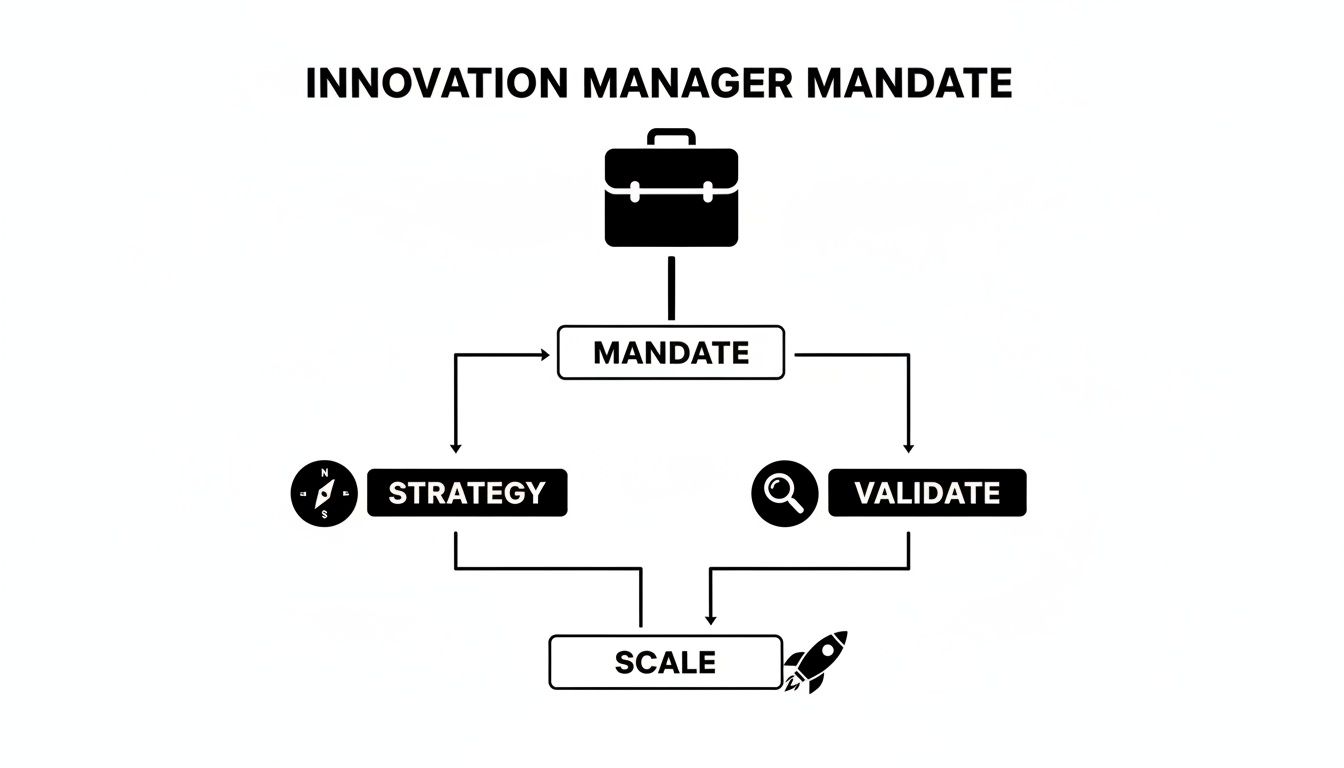
As depicted, innovation follows a clear, four-stage path: from a strategic mandate, through validation and de-risking, to a scalable, market-ready venture.
The Hybrid Skillset: Where Business Meets Technology
The most effective innovation managers possess a dual mindset, seamlessly transitioning between the perspectives of a CFO and a lead engineer.
They exhibit sharp business acumen, capable of constructing robust business cases, aligning projects with corporate financial goals, and communicating effectively with the C-suite. They possess a deep understanding of market dynamics, customer pain points, and the financial levers that drive growth.
Concurrently, they must have genuine fluency in AI and machine learning. This does not necessitate a PhD in data science, but rather a conceptual understanding sufficient to lead technical teams, pose insightful questions, and critically evaluate technological claims.
Without this dual capability, their credibility is compromised. Technical teams will not follow a leader who misunderstands the fundamentals of their work, and the board will not fund a leader who cannot articulate the link between technology and bottom-line impact.
Competency Matrix for an AI-Era Innovation Manager
To identify this unique talent, one must look beyond traditional R&D manager profiles. The modern innovator—the Co-Preneur—is defined by an entrepreneurial spirit and a relentless focus on execution. The table below contrasts legacy skillsets with current requirements.
| Competency Area | Traditional Skillset | Required AI-Era Skillset (Co-Preneur Model) |
|---|---|---|
| Mindset & Drive | Process management, risk mitigation, incremental improvement. | Entrepreneurial ownership, comfort with ambiguity, resilience to failure. |
| Technical Acumen | General understanding of technology trends. | Deep fluency in AI/ML concepts, ability to challenge technical assumptions. |
| Execution Focus | Long-range planning, managing R&D pipelines. | Rapid prototyping (MVPs), data-driven validation, ruthless prioritisation. |
| Commercial Focus | Aligning with strategic goals. | Building viable business cases, owning P&L responsibility for new ventures. |
| Stakeholder Skills | Reporting upwards, managing departmental relationships. | Securing buy-in from C-suite to engineers, translating tech value into business impact. |
| Cultural Role | Upholding established corporate processes. | Acting as a "cultural bridge," protecting teams from the corporate immune system. |
Ultimately, this new breed of leader is a translator, converting complex technical possibilities into compelling business opportunities that align the entire organisation.
The Core Skills That Drive Success
Beyond the matrix, several core competencies are non-negotiable.
- Entrepreneurial Drive: A proactive, resilient mindset essential for building new ventures within a large organisation, viewing failure as a data point for learning, and navigating internal resistance.
- Rapid Prototyping and Validation: The ability to guide teams in building and testing Minimum Viable Products (MVPs) is paramount for rapid, market-based feedback. For a detailed methodology, consult our guide on an AI strategy prioritisation framework for MVPs.
- Stakeholder Management: Exceptional communication skills are required to manage expectations and secure buy-in across a diverse range of stakeholders, from sceptical engineers to the executive board.
The ultimate skill is the ability to translate a complex, technical possibility into a simple, compelling business opportunity. This act of translation is what unlocks resources and aligns the organisation toward a common goal.
Bridging the Gap Between Legacy and Future
Finally, within an established enterprise, the innovation manager must act as a cultural diplomat. They must respect the company's heritage of operational excellence while championing the new—and often disruptive—processes of agile development and AI experimentation.
Ready to Build Your AI Project?
Let's discuss how we can help you ship your AI project in weeks instead of months.
This requires significant emotional intelligence and political acumen. They must build alliances, negotiate for resources, and shield their teams from the corporate "immune system" that naturally resists novelty.
This diplomatic skill often determines whether a project remains a theoretical exercise or becomes a catalyst for fundamental business transformation. A candidate with a proven track record in this area is an invaluable asset.
Navigating the German Market for Innovation Talent
For any company in Germany, sourcing a top-tier innovation leader is a strategic necessity, not a routine recruitment exercise. The market for talent that can genuinely integrate business transformation with applied AI is intensely competitive, demanding a departure from conventional hiring playbooks.
The core challenge is a pronounced scarcity of individuals possessing the requisite blend of P&L discipline, practical AI literacy, and the entrepreneurial drive to execute. These "Co-Preneurs"—capable of building new ventures from within a corporate structure—are in high demand across all sectors.
The Squeeze on Hybrid Talent
Demand for innovation roles has escalated dramatically across Germany, driven by large-scale digital transformation initiatives and the imperative to implement AI within both the Mittelstand and major corporations. Quantitative data corroborates this trend.
Want to Accelerate Your Innovation?
Our team of experts can help you turn ideas into production-ready solutions.
Analysis indicates that job postings for AI-related roles, including innovation managers and AI product owners, have surged. In peak months, these postings were 1.3 to 1.6 times higher than in previous years, reflecting a strategic shift from AI experimentation to operational implementation.
The consequence is a significant talent deficit. One estimate placed the number of unfilled IT positions in Germany at approximately 149,000, highlighting a critical gap in talent with the necessary product, technology, and change management skills. A deeper analysis of this trend is available in the full analysis of the AI jobs barometer from PwC.
For hiring managers, this translates to intense competition for a limited pool of qualified individuals, which in turn elevates salary expectations and necessitates more sophisticated talent attraction and retention strategies.
Beyond Recruitment: Cultivating an Internal Pipeline
Given the challenging external market, a prudent long-term strategy involves internal talent development. Your next high-impact innovation leader may already be within your organisation—an engineer with latent business acumen or a product manager with a deep interest in AI.
Building an internal talent pipeline is a strategic investment in organisational capability. This entails:
Looking for AI Expertise?
Get in touch to explore how AI can transform your business.
- Identifying High-Potential Individuals: Seek out employees who exhibit entrepreneurial traits—proactivity, resilience, and a consistent record of execution, often beyond their formal job description.
- Providing Targeted Upskilling: Offer focused training in critical domains such as AI fundamentals, venture building methodologies, and financial modelling to equip them with the necessary tools and lexicon.
- Creating 'Tours of Duty': Assign high-potential employees to short-term, high-impact innovation projects. This provides invaluable hands-on experience in a controlled, low-risk environment.
This "re-rupt from within" strategy not only addresses a recruitment challenge but also fosters a more robust innovation culture throughout the organisation, demonstrating a tangible commitment to employee development.
Leveraging Co-Preneur Partnerships for Accelerated Execution
For situations requiring immediate results, an alternative model exists. Engaging external partners who function as "Co-Preneurs" can accelerate critical projects without the protracted timeline of a typical executive search.
This is distinct from standard consulting. A Co-Preneur partnership involves embedding an experienced innovation leader directly into your team, granting them full ownership of the project's success. They bring not just expertise, but a proven methodology for de-risking and scaling new ventures. For German companies, particularly the Mittelstand, this is a highly effective approach, as explored in our analysis of how AI will truly transform the German Mittelstand by 2025.
The objective is to install the right leadership to deliver results. Whether that leader is cultivated internally or engaged via a strategic partnership, the focus must be on empowering individuals who can convert ambitious ideas into profitable innovations.
By integrating a long-term focus on internal development with the strategic use of external Co-Preneur talent, your organisation can effectively compete in Germany's demanding market, ensuring access to the leadership required to maintain a competitive edge in the era of AI.
Structuring Compensation to Attract Top Performers

When pursuing elite leadership for high-stakes innovation manager jobs, a standard compensation structure is insufficient. The offer package is not merely a salary; it is a strategic signal of the role's value and its expected impact on the P&L.
The entrepreneurial, results-oriented "Co-Preneur" profile you seek evaluates opportunities differently. Their compensation must reflect the risk-reward calculus inherent in venture building. A conventional corporate salary, while secure, often fails to attract individuals driven to create substantial new value.
Establishing German Salary Benchmarks
A thorough understanding of the market is foundational. In Germany, compensation for senior innovation roles reflects the scarcity of talent possessing the requisite blend of business, technical, and leadership competencies. A Director-level innovation role typically commands a base salary of approximately €100,000, with the full range extending from €59,000 to €159,000.
These figures vary based on industry, company scale, and the specific AI expertise required. Sectors such as automotive and high-tech manufacturing—where our firm frequently operates—tend to offer a premium to secure candidates with a proven track record of shipping production-level AI systems. For a more granular view of these trends, you can review the data on German innovation director salaries on PayScale.com.
Beyond Base Pay: Performance-Linked Incentives
A competitive base salary is merely the entry point. To secure a true Co-Preneur, the compensation structure must incorporate significant performance-based incentives. This approach directly links financial reward to tangible business outcomes, creating powerful alignment between the individual's objectives and corporate strategy.
Consider structuring variable compensation along these lines:
- Project Success Bonuses: A substantial, pre-defined bonus tied to the achievement of critical milestones, such as securing the first paying customer or reaching a specific revenue target within a defined timeframe.
- Venture-Based Equity or Phantom Stock: A stake in the internal venture they lead. This model treats the innovation manager as a founder, providing a compelling long-term incentive to build a profitable, sustainable business unit.
- Revenue or Profit Sharing: A percentage of the revenue or profit generated by the new venture for a specified period. This directly correlates their earnings to the commercial success they deliver, reinforcing P&L accountability.
The most compelling compensation packages for innovation leaders are structured like those for start-up executives. They balance a solid base salary with a high-upside potential tied directly to the commercial success of the ventures they build.
This conceptual shift is critical. It transforms the role from that of a salaried employee to a strategic partner deeply invested in the company's future growth.
Crafting a Winning Offer
The final offer must transcend mere financials. It should communicate a holistic value proposition, including a clear mandate for autonomy, guaranteed access to necessary resources, and visible C-level commitment to the innovation agenda.
Ready to Build Your AI Project?
Let's discuss how we can help you ship your AI project in weeks instead of months.
This is a critical component of your talent acquisition strategy. For further insights on refining your approach, please see our analysis on how to improve talent acquisition for specialised roles. By designing a compensation package that rewards entrepreneurial results, you will position your organisation as a premier destination for the high-impact leaders capable of driving meaningful transformation.
The Executive Mandate for Corporate Venture Building
The business case for a new class of leader is clear. The era of treating innovation as a peripheral R&D activity, disconnected from the P&L, is over. For German enterprises, adherence to incremental improvement models is no longer a viable strategy for sustained leadership. A fundamental shift is required—a transition to an agile, accountable model of internal venture building.
This places the executive mandate in stark relief. Legacy organisational structures, while effective in the past, are ill-equipped to capture the opportunities presented by AI. Future-proofing the enterprise requires the deliberate cultivation of internal innovation capabilities, led by individuals who operate with the discipline of a founder.
Why a Co-Preneur, Not Just Another Manager, Is Required
The analysis leads to a single conclusion: your organisation requires a Co-Preneur. This is not about filling one of the many innovation manager jobs advertised online. It is a strategic decision to embed a profit-driven, entrepreneurial engine within the corporate structure. This leader's sole focus is to convert the potential of AI into tangible commercial results.
However, a title and a budget are insufficient. Success requires genuine C-suite commitment to empower the role with the autonomy to experiment, the authority to de-risk new concepts, and the resources to scale validated ventures. It depends on fostering a culture where calculated risks are encouraged and rapid learning from failure is an expectation.
A Direct Call to Action
The time for passive observation has passed. Competitors are not waiting. The mandate is unequivocal: to thrive in the coming decade, your organisation must build the internal capability to launch and scale new, AI-powered business lines.
This translates into two concrete actions:
- Invest Deliberately: Commit to hiring or developing leaders who fit the Co-Preneur profile, seeking the rare combination of commercial acumen and deep AI literacy.
- Enable Fearlessly: Grant them the operational freedom to challenge established norms and build ventures that are commercially viable on their own terms.
Securing your company’s future is an active sport. It demands a deliberate investment in leaders who can navigate uncertainty and deliver actual growth. The biggest risk isn’t backing a few ventures that fail; it’s failing to build the capacity to venture at all.
By embracing this mandate, you are making a decisive investment in your company's long-term relevance and profitability.
Frequently Asked Questions: The Innovation Manager Role
When senior leadership considers this role, several key questions consistently arise. Here are concise answers tailored for executives and hiring managers in German enterprises, framed through our Co-Preneur model.
How Does This Role Differ from a Traditional R&D Manager?
The primary differentiator is P&L responsibility. A traditional R&D manager oversees research projects and technical development, operating as a cost centre focused on long-term discovery with uncertain commercial timelines.
An innovation manager, particularly one operating as a Co-Preneur, is mandated to build a profit engine. Their entire function is to incubate, test, and scale new, commercially viable business units. Success is measured not by patents filed, but by market traction and revenue generation. They are best understood as the general manager of an internal start-up.
What Is the Ideal Background for an Innovation Manager?
There is no single, definitive curriculum vitae. The ideal candidate is a hybrid professional, fluent in both commercial and technical domains.
The strongest profiles often originate from:
- Former start-up founders: They possess firsthand experience of the entire venture lifecycle.
- Product owners or managers from technology-centric companies: They have a proven record of shipping complex products.
- Venture developers or intrapreneurs from other corporate innovation units: They have demonstrated success in executing within a large organisational context.
The essential qualification is a documented history of entrepreneurial initiative and the ability to translate an idea from concept to market reality. They must possess the credibility to command respect from both engineering teams and the board of directors.
Want to Accelerate Your Innovation?
Our team of experts can help you turn ideas into production-ready solutions.
The most critical attribute isn't a specific degree. It’s a proven history of taking ownership and delivering commercial results under conditions of ambiguity. That Co-Preneurial grit is what separates the great hires from the rest.
How Should We Measure the ROI of This Position?
The return on investment for an innovation manager cannot be assessed using standard HR metrics. It must be evaluated based on the performance of the venture portfolio they manage.
The key performance indicators that matter are:
- Velocity of validated learning: The speed at which they test hypotheses and terminate unviable concepts based on market data.
- Portfolio health: The number of ventures successfully advancing from ideation to prototype to market launch.
- Commercial outcomes: The extent to which their ventures generate direct revenue, yield significant cost savings, or capture new market share.
Initially, the ROI is measured by the de-risking of opportunities and the creation of robust business cases. However, over a 12- to 24-month horizon, their impact must be reflected in tangible value on the company's P&L. This is the ultimate measure of their contribution to economic growth.
At Reruption GmbH, we do not merely advise. We partner with companies as Co-Preneurs to build and scale high-impact AI ventures. We provide the senior leadership and hands-on engineering teams required to translate strategic goals into production-ready systems that deliver measurable P&L results. Discover how we can help you build from within at https://www.reruption.com.
Looking for AI Expertise?
Get in touch to explore how AI can transform your business.