
Let's cut through the noise. What is AI in e-commerce, really?
At its core, it's about transforming a standard online shop into an intelligent, almost sentient, platform. It’s the difference between a static catalogue and a dynamic, personal shopping assistant that anticipates what your customers want, tweaks pricing on the fly, and manages the complex dance of logistics completely on its own.
Why Does AI In E-Commerce Matter So Much Right Now?

Forget the abstract buzzwords for a second. Imagine your traditional e-commerce site is a physical shop where every single customer sees the exact same product layout. Now, picture an AI-driven store that acts like a seasoned personal shopper for every visitor. It watches how they browse, learns their tastes, and instantly rearranges the entire digital storefront to feature products they'll love—sometimes before they even realise it themselves.
This isn’t some far-off concept; it’s a critical capability for staying relevant and competitive today. The online retail world is wrestling with some persistent headaches, and AI is uniquely built to solve them.
Solving E-Commerce’s Toughest Challenges
The real magic of AI is its ability to process mind-boggling amounts of data and make smart, real-time decisions. This capability directly targets the chronic pain points that have been eating into online profits for years.
- Cart Abandonment: We've all seen it. A customer is this close to buying, then hesitates and leaves. AI spots these hesitation signals and can jump in with a perfectly timed chatbot message or a small discount to nudge them over the finish line.
- Low Conversion Rates: By hyper-personalising search results and product suggestions, AI makes sure customers find exactly what they’re looking for, fast. That quick, relevant discovery dramatically boosts the chances of a sale.
- Operational Headaches: From predicting next month's demand to running the warehouse, AI automates the grunt work. It streamlines these complex backend processes, cutting costs and making out-of-stock signs a thing of the past.
AI isn’t just another tool in the box; it represents a fundamental shift in how online retail works. Businesses that get it right are seeing real, tangible gains in customer satisfaction and revenue, often seeing cost reductions of over 25%.
The German e-commerce market, which recently hit €88.8 billion, is a perfect example of this in action. With projections showing it could reach USD 142 billion by 2029, a huge chunk of that growth is being driven by AI. In fact, a staggering 44% of German e-commerce companies are already planning to implement AI-powered product recommendations to keep up.
For a deeper dive into how this tech is shaking up the industry, check out this guide on Harnessing AI in Ecommerce. And if you're curious about the mechanics behind it all, this quick explainer on how AI like ChatGPT works is a great place to start: https://www.reruption.com/insights/how-ai-like-chatgpt-works-explained-in-one-paragraph
To make this more concrete, let's break down the core functions AI brings to the table.
Core AI Capabilities Transforming E-Commerce
| AI Capability | Business Impact | Example Application |
|---|---|---|
| Personalisation Engines | Boosts customer engagement and average order value (AOV) by showing highly relevant products and content. | Netflix-style "Recommended for You" carousels on the homepage or product pages. |
| Dynamic Pricing | Maximises revenue and profit margins by adjusting prices based on demand, competition, and user behaviour in real-time. | A hotel booking site raising prices for the last few rooms during a peak travel weekend. |
| Predictive Analytics | Reduces costs and improves efficiency by accurately forecasting demand, preventing stockouts, and identifying at-risk customers. | A fashion retailer ordering more winter coats just before an unexpected cold snap is predicted. |
| Natural Language Processing (NLP) | Enhances customer service and user experience with intelligent chatbots and voice-activated search. | An AI-powered chatbot that can understand and resolve complex customer queries 24/7 without human help. |
| Computer Vision | Improves product discovery and reduces returns by enabling visual search and virtual try-on features. | A customer taking a photo of a chair they like and the website instantly showing similar items in stock. |
These capabilities are no longer just "nice-to-haves". They are quickly becoming the standard for any e-commerce business that wants to not just survive, but thrive.
How AI Use Cases Are Remaking The Customer Journey

Knowing the theory behind AI in e-commerce is one thing. Seeing it in action is where you grasp its real potential. AI isn’t some monolithic tool; it's a whole toolkit of capabilities you can plug in at every customer touchpoint. It’s what turns a standard transaction into a memorable, personal experience.
These applications are what elevate your business from a static product catalogue to an active, intelligent shopping partner.
Let's dig into the tangible ways AI is reshaping the customer journey right now, from that first moment of discovery all the way to post-purchase support. Each use case marks a clear move away from the old one-size-fits-all model towards a dynamic, one-to-one conversation that builds real loyalty and drives revenue.
Hyper-Personalised Product Recommendations
Remember the old way of recommending products? It was clunky, often based on broad categories or just what other people happened to buy. AI changes the game completely. Think of it as a personal stylist for every single visitor.
It quietly analyses a user's entire digital footprint—their past purchases, what they’ve clicked on, items they've wish-listed, and even how long they hovered over a specific image. This deep dive allows the system to build a unique profile for each shopper.
The result? Product carousels and "recommended for you" sections that feel uncannily relevant. When you get this right, you don't just boost sales; you make customers feel like you get them. Retailers who nail this level of personalisation often see a revenue lift of up to 40%.
By anticipating needs and showing people relevant products, AI-driven recommendations don't just sell items. They solve problems for the customer, sometimes before the customer even knows they have one.
This is especially critical in our mobile-first world. In Germany, for instance, 66% of all online sales now happen on mobile devices. Retailers are racing to invest in AI-powered tech that sharpens the mobile experience, from personalised recommendations right through to a frictionless checkout.
Intelligent Search That Actually Understands People
A traditional search bar is painfully literal. If a customer types "blue summer dress," it hunts for those exact keywords. An AI-powered search, on the other hand, understands intent and context. It can decipher conversational language, fix typos on the fly, and even figure out what someone means from a vague query.
For instance, a customer might search for "something to wear to an outdoor wedding in July." Instead of shrugging its digital shoulders and returning zero results, an intelligent search engine connects the dots. It analyses the phrase and suggests appropriate items like floral maxi dresses, light-coloured suits, and elegant sandals.
This simple shift massively reduces friction and keeps shoppers on your site. Smarter search is proven to lower bounce rates by showing people what they're looking for, even when they can't describe it perfectly. It's a powerful weapon against the dreaded abandoned cart, which globally hovers around a staggering 70%.
24/7 Customer Support with AI Chatbots
Customer service can no longer be a 9-to-5 affair. Today’s shoppers expect instant answers, whether it's midnight on a Tuesday or first thing Sunday morning. AI-powered chatbots meet that demand head-on, providing immediate, 24/7 support for common questions.
And these aren't the rigid, frustrating bots of the past. Modern chatbots, running on Natural Language Processing (NLP), can handle genuinely complex conversations. They can track an order, process a return, or answer detailed product questions. By tapping into a customer's history, they provide personalised responses that create a genuinely seamless experience.
Ready to Build Your AI Project?
Let's discuss how we can help you ship your AI project in weeks instead of months.
In fact, AI chatbots now successfully handle around 70% of conversations from start to finish without any human help. This frees up your human agents to tackle the more complex, high-value customer issues, boosting both efficiency and the quality of your service. If you're curious about how AI can analyse conversational data, check out our experiment using ChatGPT and NotionAI to analyse 50 research calls.
Dynamic Pricing and Real-Time Optimisation
Static pricing is quickly becoming a relic. AI makes dynamic pricing a reality, a strategy where prices adjust in real-time based on a whole host of factors. These algorithms analyse competitor pricing, current market demand, inventory levels, and even individual customer behaviour to find the sweet spot for any given moment.
For example, an AI might slightly lower the price of a product for a first-time visitor to nudge them towards a purchase. Or it might raise the price of a trending item as stock levels get low. This ensures you stay competitive while protecting your profit margins. Airlines have done this for years, but AI now makes this sophisticated strategy accessible to e-commerce businesses of all sizes, often leading to a 5-10% bump in profit margins.
Choosing Your AI E-Commerce Tech Stack
Picking the right technology for your AI e-commerce strategy is a huge decision, but it doesn't have to be a headache. Forget the technical jargon for a second. Think of it like choosing a vehicle for a road trip. Your choice really depends on where you're going (your business goals), how much you want to spend, and how much control you want behind the wheel.
The world of AI solutions really boils down to three main paths. Each has its own set of pros and cons, and understanding them will help you pick the one that actually fits your company’s resources, timeline, and what you’re trying to achieve long-term. This isn't just a task for the IT department; it's a strategic call that will define what you’re capable of for years.
The Plug-and-Play SaaS Approach
This is like leasing a fully serviced car. You don’t need to know anything about the engine; you just get in and drive. Software-as-a-Service (SaaS) platforms are basically off-the-shelf AI tools, the kind you’d find in app marketplaces like Shopify's. They’re built for very specific jobs, like product recommendations, chatbots, or smarter search.
These tools are made to be fast. You can often get a powerful AI feature up and running on your site in a matter of days, not months. The cost is usually a predictable monthly subscription, which makes it a great way for businesses to dip their toes into AI without a massive upfront investment.
This path is a perfect fit for:
- Small to medium-sized businesses looking for quick wins and immediate impact.
- Teams that don't have dedicated data scientists or AI engineers on staff.
- Solving specific, well-defined problems, like making search results better or adding a customer service bot.
Of course, that convenience comes with a trade-off. You don't get a lot of room for customisation, and you're handing over your valuable data to another company. It’s a brilliant place to start, but you might feel a bit boxed in as your needs get more specific.
The Custom-Built AI Model
Now, this is the complete opposite. It's like designing and building your own race car from scratch. You get total control over every single component, from the engine's horsepower to the fine-tuned aerodynamics. A custom-built model means using powerful frameworks like TensorFlow or PyTorch to create your very own AI solution, tailored precisely to your unique business challenges and data.
Want to Accelerate Your Innovation?
Our team of experts can help you turn ideas into production-ready solutions.
This approach can give you a massive competitive advantage. You can build AI that solves problems no off-the-shelf tool can even touch, creating a real moat around your business. You own the IP, and the model is perfectly dialled into your specific data, which often leads to far better performance and insights.
A custom model is a serious strategic asset. It lets you build capabilities that are entirely unique to your business, turning your operational data into a powerful competitive edge.
But building a custom solution is a major undertaking. It requires a significant investment in both time and money, not to mention a skilled team of data scientists and AI engineers. This path is really for larger companies with complex problems and the strategic goal of making AI a core part of what makes them different. If you're new to all this, it's a good idea to get a handle on the fundamentals first, which we break down in our AI fundamentals guide.
The Flexible Hybrid Approach
The hybrid model is that sweet spot in the middle, the "best of both worlds." Think of it as taking a high-performance production car and adding your own specialised, custom parts. The idea is to use a solid SaaS platform or a pre-trained AI model as your foundation and then build your own custom features on top of it.
For example, you could use a third-party AI service for its powerful recommendation engine but then build your own logic to push high-margin products or factor in local stock levels. This gives you the speed and reliability of a proven platform but still allows you to add your unique secret sauce where it really counts.
Looking for AI Expertise?
Get in touch to explore how AI can transform your business.
This balanced approach is becoming more and more popular because it cuts down on risk while still allowing you to stand out. It lets businesses move fast without being completely locked into one vendor's way of doing things, creating a scalable and adaptable path for their AI journey.
A Step-by-Step Roadmap to AI Integration
Jumping into AI isn't a single leap; it's a journey. And like any good journey, it needs a map. A well-thought-out roadmap is the difference between wasting time and money and ensuring every step you take adds real, tangible value.
Forget the "big bang" approach. We're big believers in the "crawl, walk, run" methodology. It’s all about breaking the process into manageable phases. This way, you minimise risk and, just as importantly, build confidence within your team as you go.
Think of it like building a house. You wouldn't start by hanging pictures, would you? You pour the foundation first—clear goals, clean data—before you even think about the walls. This approach ensures your ai e commerce initiative is built to last.
Phase 1: The Crawl Stage
This first phase is all about getting your house in order. It’s the prep work, the planning, the foundation. The goal here isn't to launch some complex AI system. It's about spotting the best opportunities and making sure you're actually ready to seize them.
Ready to Build Your AI Project?
Let's discuss how we can help you ship your AI project in weeks instead of months.
Start by defining what success really looks like. "Improve customer experience" is too vague. Get specific. How about, "reduce cart abandonment by 15% within six months"? Or, "increase the click-through rate on product recommendations by 20%"? Now that's a target you can work with.
With a clear goal in hand, it's time for a data audit. AI runs on data. Simple as that. You need to know what you have, where it is, and whether it's any good. This means digging into your CRM, sales records, and website analytics, and pulling it all together. You'll almost certainly find gaps or messy data that needs cleaning up before any AI model can do its job properly.
Phase 2: The Walk Stage
Alright, you've got a clear goal and your data is organised. Time to take your first real steps. The "walk" phase is all about launching a focused pilot project. Think of it as a small-scale, low-risk test run designed to prove that AI can work in your specific context. This is how you build momentum.
Your pilot should tackle the exact business problem you identified in the crawl phase. For instance, if your goal is better recommendations, you could roll out a plug-and-play AI tool on a single product category. It’s a controlled experiment. You can measure the impact directly without turning your whole operation upside down.
A pilot project is there to help you learn fast and show value. A successful pilot becomes a powerful internal case study, making it infinitely easier to get the buy-in and budget for bigger, more ambitious AI projects down the line.
Want to Accelerate Your Innovation?
Our team of experts can help you turn ideas into production-ready solutions.
This is also where you'll start sizing up different tech options. Do you go for a ready-made SaaS solution, a more flexible hybrid model, or a fully custom build? The answer will depend on your team's skills and the complexity of your pilot.
This diagram shows how companies typically progress through their tech choices.
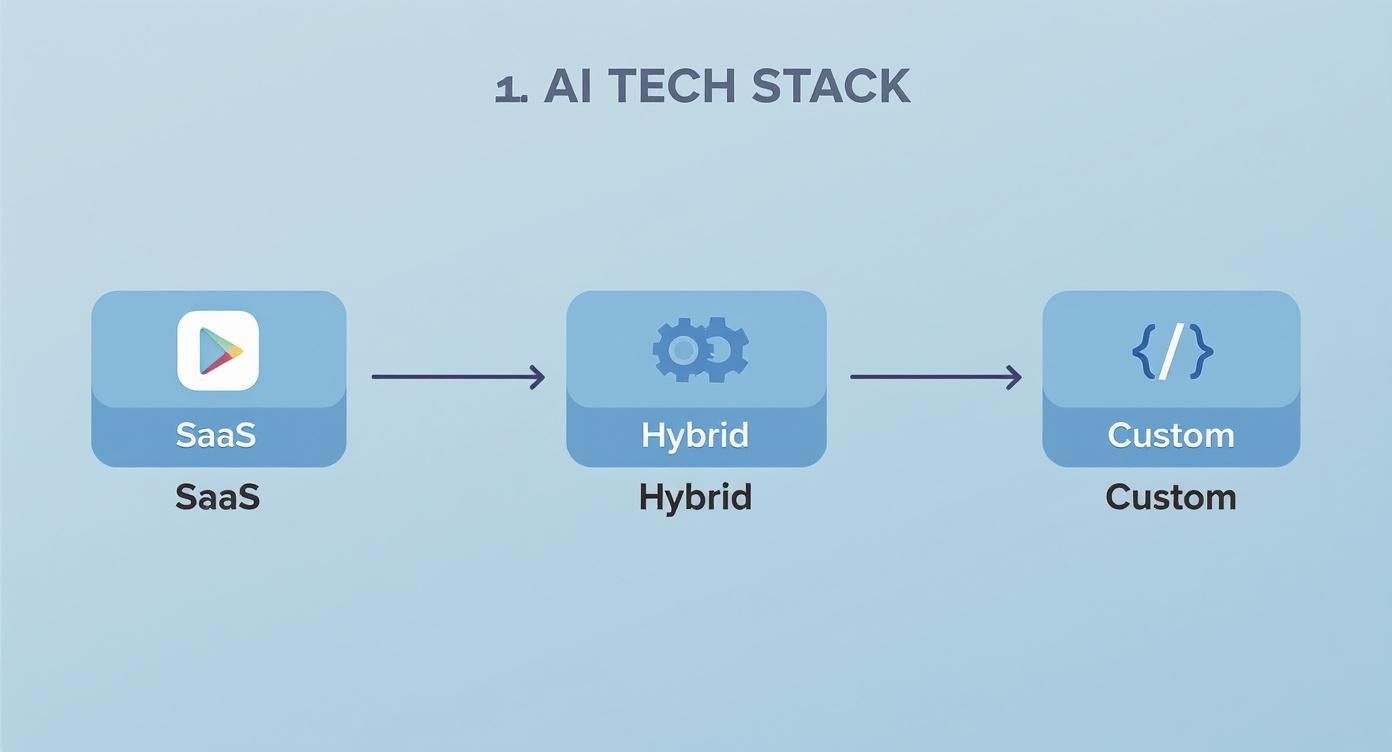 As you can see, most start with accessible SaaS tools and gradually move towards more specialised hybrid or custom solutions as their expertise and needs mature.
Phase 3: The Run Stage
With a successful pilot under your belt, you're ready to pick up the pace. The "run" phase is about scaling what works and weaving AI deeper into your core operations. This is where the real shift happens, moving you from isolated experiments to a truly AI-enhanced business.
Key activities at this stage include:
- Scaling the Solution: Systematically roll out the successful AI tool from your pilot to other departments or product lines.
- Monitoring and Optimising: Keep a close eye on your AI systems. You need to track performance against the KPIs you set from the start. AI models aren't "set and forget"—they need constant tweaking to stay sharp.
- Building a Centre of Excellence: As your AI use grows, think about creating a dedicated team or a set of best practices. This group can steer the strategy, ensure ethical use, and scout for new ways to innovate.
This final phase isn't an endpoint; it's a continuous cycle of improvement. As your business evolves, so will your AI strategy, allowing you to tackle bigger challenges and unlock new value across your entire ai e commerce ecosystem.
Measuring AI Success and Building the Business Case
Putting an AI solution live is really just the starting line. If you want to justify the investment in ai e commerce, you’ve got to prove its value with cold, hard numbers. That means getting away from vague ideas like "improved experience" and zeroing in on the Key Performance Indicators (KPIs) that actually hit your bottom line.
A good AI initiative should create a measurable lift across the entire customer journey. The trick is to tie every AI function to a specific, trackable business outcome. This doesn't just show value—it gives you the data you need to tweak and improve your strategy down the road.
Identifying the Right KPIs for AI
To know if you're succeeding, you first need to know where you're starting from. Before you switch on any AI tool, capture your current performance data. This pre-AI snapshot becomes your benchmark, creating a clear "before and after" picture to judge all improvements against.
Here are the core metrics that really show the impact of your AI work:
- Average Order Value (AOV): A smart recommendation engine shouldn't just sell more items; it should nudge customers towards higher-value or complementary products, directly pushing up the AOV.
- Customer Lifetime Value (CLV): AI builds loyalty by making customers feel understood and delivering relevant experiences. A rising CLV is a solid sign you're turning one-time shoppers into repeat business.
- Cart Abandonment Rate: This is a direct measure of friction in the checkout process. Intelligent search, a perfectly timed chatbot, or a dynamic offer can slash this rate, turning hesitant browsers into confirmed sales.
- Conversion Rate: This is arguably the big one. It's the percentage of visitors who actually buy something. Effective AI smooths the entire path to purchase, making it dead simple for customers to find what they want and click "buy."
Proving an AI project’s worth isn’t about the technical magic; it’s about business results. A 5-10% jump in profit margins from dynamic pricing or a 20% drop in cart abandonment—that’s the language that gets you future funding and gets stakeholders on your side.
Looking for AI Expertise?
Get in touch to explore how AI can transform your business.
Crafting a Compelling Business Case
With clear KPIs in hand, you can build a powerful business case to get the green light for your AI plans. Think of this document as more than a budget request; it's a strategic proposal laying out a clear path to a stronger, more profitable business.
A persuasive business case stands on three pillars: forecasting the gains, estimating the costs, and presenting a data-driven argument. This simple framework turns your AI vision from a fuzzy idea into a concrete plan with predictable returns.
Make sure your business case clearly covers these points:
- Forecast the Gains: Use your baseline KPIs and industry benchmarks to project realistic improvements. For instance: "Implementing an AI recommendation engine is projected to increase our AOV by 15% within 12 months, which translates to an estimated €500,000 in new revenue."
- Estimate the Costs: Be totally transparent about the full investment. This means software fees, implementation work, any team training, and ongoing maintenance. A complete cost breakdown builds trust.
- Calculate the Return on Investment (ROI): Present a clear timeline for when the business can expect to see a return. A solid ROI projection, backed by good data, makes it a no-brainer for decision-makers to say yes.
By focusing on these tangible outcomes, you change the conversation. AI stops being a cost centre and starts being seen for what it is: a critical engine for growth.
AI Risks and Ethical Guardrails
Jumping into AI is a big move, but it comes with serious responsibilities. It’s not just about flipping a switch on the technology; it’s about building a solid ethical framework around it. This means getting serious about data privacy, algorithmic fairness, and robust security. Think of these not as legal hoops to jump through, but as the very foundation of a brand that customers will trust and stick with for years.
Ready to Build Your AI Project?
Let's discuss how we can help you ship your AI project in weeks instead of months.
When you manage the risks of ai e commerce well, you turn potential problems into a real advantage that builds customer loyalty. It’s a proactive strategy, not just a defensive one.
The Foundation of Trust: Data Privacy and the GDPR
In the world of AI-powered personalisation, customer data is the fuel. How you handle that fuel determines whether you build trust or shatter it. Every piece of information, from browsing history to past purchases, is sensitive and needs to be protected with extreme care. This isn't just good practice; it's a legal must-have under rules like the General Data Protection Regulation (GDPR).
To get a handle on these challenges, especially when dealing with customer data in retail, it’s worth consulting a practical AI GDPR compliance guide. Resources like this help clear up your obligations around data consent, storage, and processing, making sure your AI systems are on the right side of the law from day one.
Sidestepping Algorithmic Bias
An AI model is only as smart as the data it’s trained on. If your historical data has hidden biases, your AI will learn and even amplify them. This is what’s known as algorithmic bias, and it can lead to some really unfair outcomes, like showing different prices or recommendations based on someone's demographics.
For instance, a biased algorithm might push lower-quality products to certain customer groups or completely exclude others from special deals. The only way to stop this is through active management and using diverse data sets.
Want to Accelerate Your Innovation?
Our team of experts can help you turn ideas into production-ready solutions.
Building fair, ethical AI requires constant vigilance. It’s about more than just ticking compliance boxes; it's about actively designing systems that treat every single customer equitably and transparently.
To get ahead of these risks, you need a strong data governance framework. This usually involves:
- Regular Audits: Routinely check your AI models for biased results and retrain them with better, more balanced data when needed.
- Transparent Models: Whenever possible, aim for "explainable AI" (XAI). This lets you understand why the AI made a certain decision.
- Diverse Teams: Make sure the teams building and overseeing your AI are diverse. Different perspectives are your best bet for spotting potential biases early on.
This proactive approach isn't just a suggestion; it's essential right now. By 2025, nearly 70% of German businesses had already brought generative AI tools into their workflows. But this rapid adoption is paired with caution, as major concerns about data protection and compliance are guiding how these tools are being rolled out. This shows that managing AI responsibly isn't just a nice idea—it's a business imperative.
Common Questions About AI in E-Commerce
When business leaders start thinking about bringing AI into their e-commerce operations, a few key questions always seem to pop up. Getting clear on these early on is the first step to building a strategy that actually works.
Let's cut through the noise and answer the most common queries directly. This is about getting you past the initial hurdles with practical answers, covering everything from resources and data to the classic mistakes that can sink a promising AI project before it even starts.
Do I Need a Team of Data Scientists to Get Started?
Honestly? No, not necessarily. While a big, custom-built AI project will definitely need that kind of firepower, most businesses can get going with much simpler, off-the-shelf tools. The trick is to start smart, not big.
Just look at the app marketplaces on platforms like Shopify or BigCommerce. They are full of AI-powered apps for recommendations, search, and marketing. These tools are designed to be plug-and-play, letting you score some quick wins without needing a PhD in machine learning. The best way forward is to pinpoint a specific business problem first, then find a tool that your current team can handle.
How Much Customer Data Do I Actually Need?
This really depends on what you're trying to do. If you want to set up an AI chatbot, you can often get it running and providing real value with just your existing customer service logs and FAQ pages.
Now, if you're aiming for a hyper-personalisation engine, that's a different story. You'll need more historical sales and browsing data to get those sharp, accurate results. But here's the crucial part: many modern AI services are built to work with modest amounts of data and get smarter as they collect more over time.
It's not about how much data you have, but how good it is. Clean, well-organised data is the bedrock of any effective AI system.
Looking for AI Expertise?
Get in touch to explore how AI can transform your business.
What's the Biggest Mistake to Avoid When Implementing AI?
The most common and expensive trap is grabbing an AI tool and then trying to figure out what to do with it. It’s technology in search of a problem, and it almost always leads to wasted money, frustrated teams, and zero results.
Every single successful AI project I've seen started by defining a clear business goal. Think specific, measurable targets like "reduce product returns by 15%" or "increase repeat purchases by 20%." Once you have that goal, you can bring in AI as the specific tool to hit it. A clear, business-first strategy isn't just nice to have; it's the absolute foundation for getting anything meaningful done with AI in e-commerce.
Ready to map out your AI strategy and find the right first move for your business? The team at Reruption GmbH specialises in turning complex challenges into clear, actionable roadmaps. We help you validate business cases and implement technology with a true entrepreneurial spirit. Find out how our co-preneurship model can accelerate your innovation journey at https://www.reruption.com.
