
Digital business transformation consulting is the strategic discipline of integrating advanced digital technologies—particularly artificial intelligence—into an enterprise's core operational fabric. This is not a superficial software implementation; it is a fundamental re-engineering of how an organisation operates, delivers value to its customers, and captures that value, with the explicit goal of enhancing profitability and solidifying market leadership.
Why Transformation Is a Strategic Imperative
For German enterprises, the imperative for digital evolution is no longer a future consideration but a present-day reality. Concepts like Industry 4.0 have transitioned from forward-looking ideals to the baseline expectation in a fiercely competitive global marketplace.
Operational stasis is a direct path to competitive obsolescence. Proactive, internally driven evolution is the only viable strategy for ensuring sustained growth and relevance. The mandate is unambiguous: organisations must fundamentally reshape their own business models to secure a resilient future.
Effective digital business transformation is a strategic mission grounded in quantitative analysis and measurable outcomes. It requires a complete reimagining of how an organisation creates and captures value, leveraging intelligent systems and data to inform every strategic decision. The focus must be on tangible results, not on theoretical reports that fail to drive action.
The New Competitive Landscape
The pressure to modernise is both intense and escalating. Germany's digital transformation market, valued at USD 55,459.9 million, is projected to expand to USD 223,923.8 million by 2030. This growth is not arbitrary; it is propelled by the potent convergence of AI, automation, and government incentives for sustainable technology. For any executive, this data signals a clear and present opportunity cost for inaction. Cognitive Market Research provides further analysis of this market expansion.
Ready to Build Your AI Project?
Let's discuss how we can help you ship your AI project in weeks instead of months.
Thriving in this new environment requires more than incremental adjustments; it demands a bold, objective assessment of core processes and business models. Success is now defined by an organisation's ability to:
- Innovate at Velocity: Progress from concept to a validated, functional prototype in weeks, not years. This approach dramatically de-risks capital investment and accelerates organisational learning.
- Embed Intelligence: Integrate AI and machine learning into core operations to automate complex processes, identify novel revenue streams, and generate predictive insights that were previously unattainable.
- Build Lasting Capability: The objective extends beyond project completion. It is to embed new skills and agile methodologies within your internal teams, fostering a self-sustaining culture of innovation.
The purpose of modern digital business transformation consulting is not to create a dependency on external advisors. It is to cultivate a self-sufficient, agile organisation capable of continuous adaptation. It is about equipping your teams with the tools and the entrepreneurial mindset to drive growth internally.
Moving Beyond Generic Terminology
The term "digital transformation" has been diluted by overuse and generic jargon. A meaningful consulting engagement must cut through this ambiguity to address the specific challenges and unique opportunities confronting your enterprise.
This entails a genuine partnership predicated on P&L accountability, where success is measured by concrete metrics such as a quantifiable increase in market share or a demonstrable improvement in profitability. Our guide on how strategy and technology intersect to drive these outcomes explores this concept further. This pragmatic, results-oriented methodology is what distinguishes a true transformation partner from a conventional vendor.
What Does a Digital Transformation Engagement Entail?
Translating a strategic concept from a whiteboard to tangible results requires a structured understanding of the engagement process. This is not a vague, open-ended journey; it is a disciplined, hands-on methodology designed for rapid execution and risk mitigation. For leadership, this provides clarity and confidence. For management, it delineates the precise, actionable steps required.
Want to Accelerate Your Innovation?
Our team of experts can help you turn ideas into production-ready solutions.
A proficient engagement is not a series of disconnected projects. It is a unified, logical pathway that commences with identifying high-value opportunities and culminates in the deployment of production-ready systems that deliver measurable value. Every action and decision is directly aligned with core business objectives.
A Phased Approach to Transformation
A well-structured engagement unfolds in distinct phases, each with specific objectives and deliverables. This methodical approach builds momentum while continuously validating assumptions, ensuring that resources are perpetually focused on the most valuable targets. It is the antithesis of slow, theoretical consulting projects that yield voluminous reports but no functional technology.
The process initiates with strategy and discovery.
- AI Strategy and Use-Case Identification: We begin by collaborating closely with your leadership to identify and prioritise AI use cases with the highest potential business impact. The guiding question is singular: "Where can AI generate the most significant value for our organisation?"
- Business Case Modelling: Each potential use case is subjected to rigorous analysis to calculate its projected ROI. This involves estimating development costs, forecasting incremental revenue or cost savings, and establishing clear KPIs to measure success.
- Roadmap Development: With a quantitatively supported rationale, we organise the validated use cases into a strategic roadmap. This serves as the implementation blueprint—a clear timeline outlining initiatives, their sequence, and the requisite resources. This ensures the plan is both manageable and realistic.
From Blueprint to Reality
With a robust roadmap established, the engagement transitions from planning to execution. This phase involves the core engineering work of translating strategic blueprints into functional, value-creating systems. A critical component is the integration with existing enterprise systems, as most transformations must connect with or build upon core business platforms like Microsoft Dynamics 365.
Velocity and agility become paramount at this stage. The objective is to move from concept to a working prototype as rapidly as possible. This rapid validation cycle serves as a powerful de-risking mechanism, enabling the collection of early user feedback and iterative refinement before significant capital is committed.
Looking for AI Expertise?
Get in touch to explore how AI can transform your business.
An agile, prototype-driven methodology is the antidote to analysis paralysis. It prioritises the delivery of a tangible, testable product over the protracted debate of a theoretically perfect solution. This focus on velocity delivers validated learning and business results with significantly greater speed.
The diagram below illustrates the high-level process flow, moving from a clear mandate to focused innovation and, ultimately, to measurable growth.
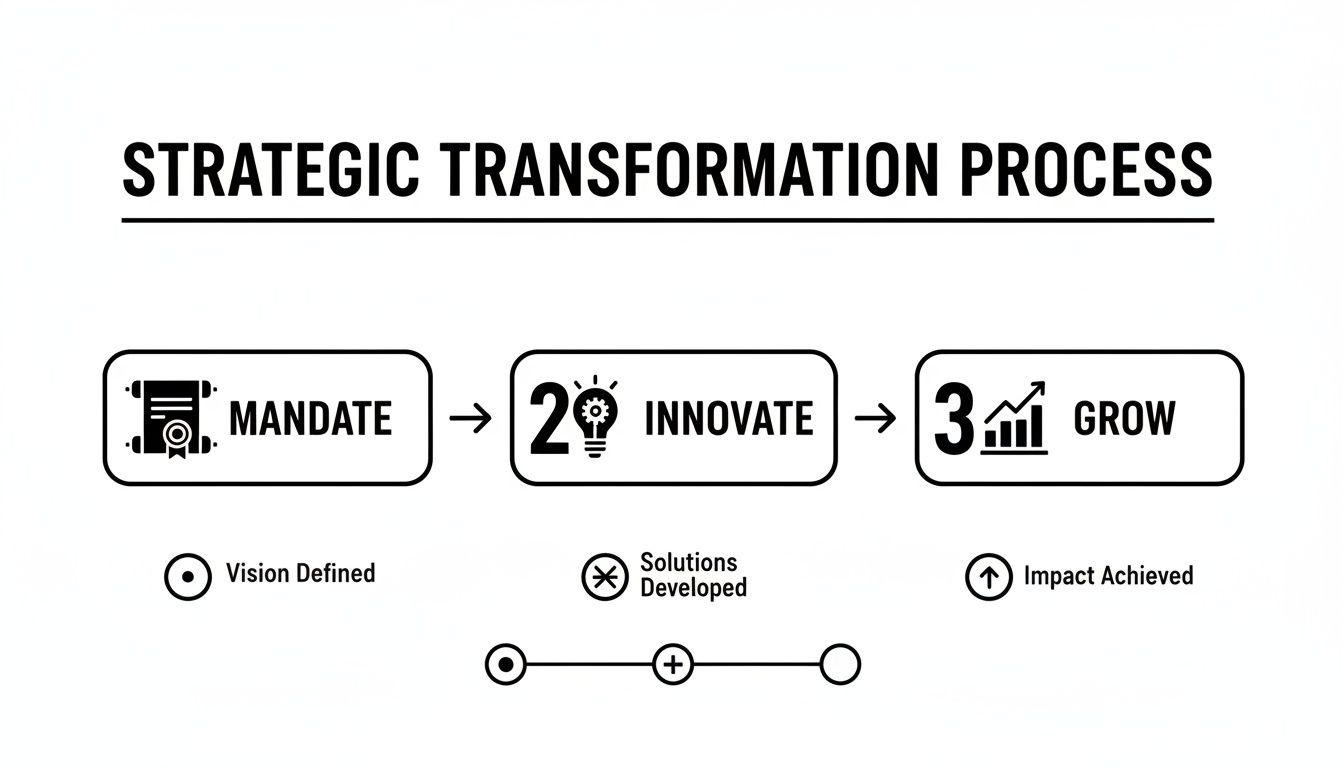
This is a simple yet powerful model: a clear directive (Mandate) fuels targeted innovation, which in turn drives measurable business growth.
Core Deliverables and Engineering Outcomes
The final phase concentrates on building and deploying the production-ready systems defined in the roadmap. In Germany, the IT Consulting & Implementation market is experiencing robust growth, primarily driven by the push towards Industry 4.0 and the adoption of AI and cloud technologies. This demand, accelerated by the pandemic, is particularly strong among the German Mittelstand and large manufacturers requiring highly robust and resilient digital infrastructure.
Ready to Build Your AI Project?
Let's discuss how we can help you ship your AI project in weeks instead of months.
The tangible outputs of the engineering phase include:
- Production-Ready LLM Applications: We construct custom AI assistants, chatbots, or internal knowledge management tools that are secure, scalable, and enterprise-ready.
- Automated Data Pipelines: We design and implement systems that automate the ingestion, cleansing, and processing of data for analytics and AI models.
- Secure Infrastructure Deployment: We configure the cloud or on-premise infrastructure required to operate your new digital solutions, ensuring compliance with standards such as TISAX or ISO.
Ultimately, a successful digital business transformation engagement delivers more than a strategic plan. It delivers a fully implemented, operational system that begins generating value from day one.
How to Select Your Transformation Partner
Selecting the right digital business transformation consulting partner is arguably the single most critical decision in the entire initiative. The right firm can accelerate your path to tangible results, while an ill-suited one can lead to costly delays and strategic missteps. The stakes are too high to rely on a conventional vendor selection process focused on rate cards and polished presentations.
German companies are acutely aware of this pressure. A recent market analysis revealed that 94% of firms now require top-tier skills in customer-centric strategies from their service providers. Yet, a stark disconnect exists: only 13% of these same companies rate their current digital experience as excellent. This gap highlights a critical need for partners who can seamlessly blend high-level strategy with grounded, execution-oriented engineering. The Lünendonk Survey 2023 provides the full details.
This reality demands a different vetting framework. The focus must shift from surface-level qualifications to the core operational DNA of a potential partner. You are not seeking a traditional consultant; you require a co-founder, what we term a Co-Preneur.
Look for P&L Accountability, Not Just Project Management
A traditional consultant's success is measured by billable hours and the completion of pre-defined milestones. Their engagement concludes with the delivery of a final report. This model is fundamentally misaligned with the objectives of a genuine transformation.
What is required is a partner who shares responsibility for the actual business outcomes. Their success should be directly linked to your P&L—whether through revenue enhancement, margin improvement, or the successful launch of a new digital product. This creates a powerful alignment of interests, ensuring every decision is made with the ultimate business objective in mind.
A true partner must have skin in the game. They think like an entrepreneur because their success is tied to the commercial success of the project, not merely its completion.
Prioritise Product Shippers Over Report Writers
The greatest risk in any transformation initiative is the chasm between strategy and execution. Many consulting firms excel at crafting sophisticated strategies and detailed roadmaps but lack the in-house engineering capabilities to build and deploy enterprise-grade systems. This leaves you with a brilliant plan but no tangible product.
Your selection criteria must heavily favour firms with a proven track record of shipping real products. Request specific case studies where they managed the end-to-end AI engineering, from data pipeline construction to LLM application deployment. A partner who has actually built, launched, and scaled digital ventures possesses a level of practical wisdom that a pure-play strategy firm cannot replicate.
Want to Accelerate Your Innovation?
Our team of experts can help you turn ideas into production-ready solutions.
A critical question for any potential partner is: "Show us a product you have built and launched, not just a strategy you have devised." The response will quickly differentiate the theorists from the builders.
A firm that builds understands the technical complexities. They comprehend the intricacies of security and compliance requirements like TISAX/ISO because they have implemented them. They can anticipate real-world challenges long before they derail your project.
Evaluate Their Approach to Risk and Collaboration
Finally, a strong partnership is defined by cultural alignment and a shared methodology for managing risk. A successful transformation journey is a process of systematic de-risking through rapid prototyping and the swift validation of assumptions. You need a partner who embodies this agile, test-and-learn approach. Our article on the role of a digital transformation consultant offers further insights on finding the right expert.
During your evaluation, inquire directly about their collaboration model. How will they integrate with your teams? What is their process for knowledge transfer? A genuine partner is focused on empowering your internal teams, not on creating a long-term dependency.
Look for a firm that operates as a true extension of your own team, working collaboratively to solve problems. This co-preneurial spirit is the foundation of a partnership that delivers faster, de-risked results and builds lasting capability within your organisation.
Partner Selection Vetting Criteria
Choosing the right partner requires asking the right questions. The following checklist is designed to help you penetrate the sales pitch and understand a potential partner's true operational model. Use these questions to distinguish vendors from genuine co-preneurs.
| Evaluation Area | Key Question | What to Look For in the Answer |
|---|---|---|
| Business Model | How do you define success for this project, and how is your compensation tied to it? | Look for performance-based models (revenue share, equity) over pure time-and-materials. They should be talking about your business metrics, not just their billable hours. |
| Execution Capability | Can you walk me through a digital product you've built and shipped for a client, from concept to launch? | They should be able to show you a live product, not just a presentation. Ask about the team structure, the tech stack, and the post-launch performance. Vague answers are a red flag. |
| Technical Depth | Describe a time you hit a major technical roadblock on a project. How did you solve it? | The answer should demonstrate deep, practical engineering knowledge and problem-solving skills, not just high-level project management speak. |
| Collaboration & Culture | How will you integrate with our internal teams and ensure knowledge transfer? | A true partner will have a clear methodology for embedded teams, pair programming, and upskilling your staff. The goal should be your independence, not their long-term indispensability. |
| Risk Management | What is your process for validating ideas and de-risking the project before we commit to a large investment? | They should talk about rapid prototyping, MVPs, and data-driven validation loops. If they only talk about a big, upfront plan, they aren't agile enough for true transformation. |
These questions are designed to cut through superficial claims and reveal the true character and capability of a potential partner. A firm that welcomes this level of scrutiny is likely the one you want alongside you.
The Four Pillars of Successful AI-Driven Transformation
A serious AI-driven transformation is not a single project but a comprehensive programme built upon a solid foundation. Similar to a building's architectural pillars, a major organisational change requires a framework of distinct yet interconnected disciplines to convert ambitious AI goals into P&L-impacting results.
An industry consensus has emerged around four essential pillars. These are not siloed functions but interdependent capabilities that must operate in concert. Understanding each pillar enables leadership to allocate resources effectively, manage expectations, and guide the entire initiative toward sustainable success.

Pillar 1: AI Strategy
All initiatives begin with strategy. Before a single line of code is written, a clear, commercially viable plan must be in place. This first pillar addresses the fundamental question: "Where can AI create the most significant business value for us?"
This involves identifying and prioritising use cases where AI can deliver a material impact. The focus is on opportunities that either unlock new revenue streams or drive significant operational efficiencies. For example, a manufacturing firm might prioritise predictive maintenance, while an e-commerce company might focus on a hyper-personalisation engine. To achieve this, businesses often need to discover new revenue opportunities with effective AI lead generation tools.
Once potential use cases are identified, each is subjected to detailed business case modelling. This is a rigorous financial analysis projecting the return on investment, establishing clear KPIs, and building a robust justification for executive buy-in. The output is a strategic roadmap that sequences initiatives based on impact and feasibility.
Pillar 2: AI Engineering
With a validated strategy, the focus shifts from planning to execution. The AI Engineering pillar is where abstract plans are translated into tangible, production-ready systems. This encompasses the hands-on work of building the technological infrastructure and applications that will power the transformation.
This pillar covers the end-to-end development of AI solutions, including:
Looking for AI Expertise?
Get in touch to explore how AI can transform your business.
- Data Pipelines: Constructing robust, reliable systems to ingest, cleanse, and process the vast quantities of data required to train and operate AI models.
- Model Development: Creating, training, and fine-tuning machine learning models or operationalising Large Language Models (LLMs) for specific business tasks.
- Application Building: Developing the software that users will interact with, whether a custom copilot, an AI-powered analytics dashboard, or an automated decision-making system.
This is not an academic R&D exercise. Professional AI engineering is about delivering secure, scalable, and maintainable systems that integrate seamlessly into existing business processes and operate reliably from day one.
Pillar 3: AI Security And Compliance
In the German market, security and compliance are non-negotiable. This pillar ensures that every component of the AI transformation adheres to stringent data governance policies and regulatory standards. For sectors such as automotive and manufacturing, meeting criteria like TISAX (Trusted Information Security Assessment Exchange) or ISO 27001 is a fundamental business requirement.
This involves addressing complex issues of data privacy, model security, and the ethical application of AI. It requires establishing clear data governance frameworks that define how data is accessed, stored, and used. It also entails implementing robust security measures to protect AI models and their underlying infrastructure from threats, safeguarding your most valuable digital assets. For a deeper analysis, refer to our insights on building a resilient and maintainable AI architecture for longevity.
Pillar 4: AI Enablement
The final and arguably most critical pillar is AI Enablement. Technology alone does not guarantee a successful transformation; people do. This pillar addresses the human element, ensuring your organisation can sustain and expand upon its new capabilities long after the consulting engagement concludes.
AI Enablement is systematic knowledge transfer. It involves hands-on training programmes designed to upskill your internal teams, from data scientists to frontline users of the new tools. The objective is to cultivate an internal culture of innovation and data literacy, empowering your employees to confidently own, operate, and enhance the new AI systems. This is what ensures the transformation is sustainable, converting a one-time project into a continuous engine for growth.
Managing Risk and Leading Your Organisation Through Change
A successful digital transformation is as much a function of human psychology as it is of algorithms. One can engineer technology, but one must lead people. For executives in large German enterprises, navigating this human element often represents the most significant risk of failure.
Ignoring the cultural and personal impact of introducing new AI-driven processes is a direct path to internal friction, project stagnation, and wasted investment. Success requires a deliberate, empathetic strategy for guiding your people through the inherent uncertainty of change. It is about building trust, demonstrating personal and professional benefits, and creating a shared sense of ownership over the company's future direction.

Building Internal Momentum and Overcoming Resistance
Resistance to change is a natural human response, often rooted in fear of the unknown or concerns about job security. The effective strategy is not to suppress this resistance with top-down mandates but to cultivate a compelling, bottom-up movement within the organisation.
This begins with clear and consistent communication from senior leadership. The narrative must be framed not as a cost-cutting exercise, but as a strategic imperative for growth and long-term stability. It is essential to articulate why the transformation is necessary and what it means for the future of both the company and its employees.
Ready to Build Your AI Project?
Let's discuss how we can help you ship your AI project in weeks instead of months.
To convert this vision into tangible momentum, consider these practical steps:
- Identify and Empower Champions: Pinpoint influential individuals at all organisational levels who are enthusiastic about the new direction. Provide them with the resources and support to act as ambassadors, capable of mitigating fears and showcasing early successes to their peers.
- Create Early, Visible Wins: Avoid initiating with the most complex project. Focus on an initiative that is high-impact but low-complexity. A rapid, tangible success—such as an AI tool that eliminates a tedious manual task—is more persuasive than any formal presentation.
- Invest in Hands-On Enablement: Fear dissipates with competence. Replace theoretical presentations with hands-on training sessions where teams apply new tools to their actual work. This builds genuine confidence and can convert sceptics into advocates.
True change management is not a separate workstream managed by HR. It must be integrated into the fabric of the transformation itself, from strategy to deployment, ensuring technology and people advance in lockstep.
De-Risking Transformation Through Agile Validation
Beyond the human element, any large-scale transformation carries significant financial and operational risks. The traditional "big bang" approach—committing massive investment to a long-term plan without prior testing—is dangerously obsolete. The modern, methodical approach to digital business transformation consulting is built on systematic risk mitigation.
This is achieved through a cycle of rapid prototyping and hypothesis validation. Instead of committing to a multi-million Euro investment based on a slide deck, we build a minimalist but functional version of the solution—a prototype—in weeks, not years. This allows us to test the core business hypothesis with real users and data.
This agile methodology manages risk by directing investment toward ideas that have already demonstrated value. If a prototype fails to deliver the expected results, it can be pivoted or shelved with minimal loss. If it succeeds, the business possesses concrete evidence to justify a larger investment. This process provides leaders with the data-driven confidence required to make bold decisions while maintaining firm financial control. Our guide on risk management and compliance offers more insight into this critical area.
How to Define and Measure Transformation Success
A digital transformation cannot be judged by the number of workshops conducted or the volume of reports produced. The sole metric of consequence is tangible business impact. For leadership, this necessitates shifting the focus from project milestones to financial outcomes. What does success look like on the balance sheet?
This requires a disciplined mindset from the outset. Vague goals like "improving efficiency" are insufficient. Success must be defined in the language of the C-suite: profit and loss (P&L) accountability. Every initiative, from launching a corporate start-up to optimising a process with AI, must be linked to clear Key Performance Indicators (KPIs) that directly impact financial performance.
This is not merely good practice; it is about establishing an unambiguous method to measure the return on your consulting investment and justify its value to stakeholders and the supervisory board.
A Framework for P&L-Accountable KPIs
Defining the right metrics requires specificity. Success is not a uniform concept; it must be tailored to the specific business objective. The goal is to draw a direct, undeniable line from the consulting engagement to the financial health of the organisation.
Consider success in these three primary domains:
Want to Accelerate Your Innovation?
Our team of experts can help you turn ideas into production-ready solutions.
- New Revenue Streams: For strategic initiatives like corporate start-ups or new digital ventures, the primary metric is net new revenue. This can be supported by leading indicators such as customer acquisition cost (CAC), lifetime value (LTV), and time to achieve product-market fit.
- Operational Efficiency: For AI-powered automation, success is measured by cost reduction and productivity gains. These are hard numbers, such as a percentage decrease in manual processing time, a reduction in error rates, or increased throughput in a business unit. A concrete example would be a 25% productivity increase for a sales team following the rollout of an AI assistant.
- Market Position and Growth: For broader strategic shifts, success can be measured through market share growth or an increase in customer satisfaction scores (e.g., NPS). These metrics demonstrate that the transformation is not only improving internal efficiency but also enhancing external competitiveness.
The most critical step in any digital business transformation is to establish these financial and operational metrics at the very beginning. This aligns all stakeholders on the definition of success and transforms the engagement from a cost centre into a transparent, value-generating investment.
Measuring the True Return on Investment
Ultimately, the ROI of a transformation is not a single calculation but a comprehensive narrative told through data. It is the combination of financial gains from new revenue and cost savings, complemented by the strategic advantages of increased agility and market relevance. A well-defined measurement framework allows leadership to track progress in real-time and make decisions based on objective evidence.
By focusing on P&L-driven KPIs, you create a clear, objective standard to measure the value being delivered. This ensures that every euro invested is directly tied to a specific business outcome. To learn how to construct the appropriate dashboards for this, review our guide on analytics and insights. This is how you prove that transformation is not just another project—it is a powerful engine for sustainable growth.
Your Questions, Answered
When considering a strategic shift as significant as digital transformation, numerous questions arise. This is to be expected. Here are concise answers to some of the most common inquiries we receive from leadership teams.
How Quickly Can We See Tangible Results?
The era of multi-year transformation programmes is over; that model is inefficient. The modern approach prioritises rapid, tangible results. Our objective is to deliver a working prototype or a Minimum Viable Product (MVP) within the first quarter, utilising focused, two-week development sprints.
Looking for AI Expertise?
Get in touch to explore how AI can transform your business.
This methodology allows you to test hypotheses in a real-world context almost immediately. It provides early validation, ensuring that capital is invested only in initiatives that demonstrate genuine promise. While the full transformation is a journey, you should expect to see measurable progress and validated learning within months, not years.
What Is the Real ROI on This Type of Consulting?
The Return on Investment is measured not by reports delivered, but by the impact on your P&L. The specific ROI is always tied to the jointly established goals, but it typically manifests in three areas:
- New Revenue Streams: Measured directly by the market success of new digital products or corporate ventures we launch together.
- Significant Efficiency Gains: Quantified through cost savings from AI-powered automation. It is common to see productivity improvements of 20-30% in targeted business units.
- Increased Market Share: Achieved by building a stronger competitive advantage through new digital capabilities.
A credible partner will model this ROI with you from the outset and link their own success to achieving these financial targets.
How Do We Ensure Our People Are Not Left Behind?
This is perhaps the most critical question. The objective is never to create a dependency on consultants but to build lasting, in-house capability through a process we call AI Enablement.
This is achieved by having your teams work directly alongside our engineering experts during the development of new solutions. This is hands-on, practical training, not theoretical instruction. This direct knowledge transfer ensures your organisation can operate, maintain, and innovate upon the new systems long after the engagement concludes. The goal is to elevate the capabilities of your people, not to replace them.
Ready to Build Your AI Project?
Let's discuss how we can help you ship your AI project in weeks instead of months.
Ready to re-architect your business from within? Reruption GmbH serves as your co-preneur in the AI era, transforming ambitious concepts into market-ready innovations with full P&L accountability. Start your transformation journey with us.