An organisation's strategic vision defines its destination. Its day-to-day operations determine its actual trajectory. When a significant gap exists between these two, sustained performance is unattainable. A Target Operating Model (TOM) serves as the architectural blueprint to bridge this gap, connecting high-level strategy to the intricate reality of execution. It provides a detailed, coherent framework that answers the fundamental question: how will the enterprise deliver superior value to its stakeholders, both today and in the future?
Why a New Operating Blueprint Is a Strategic Imperative
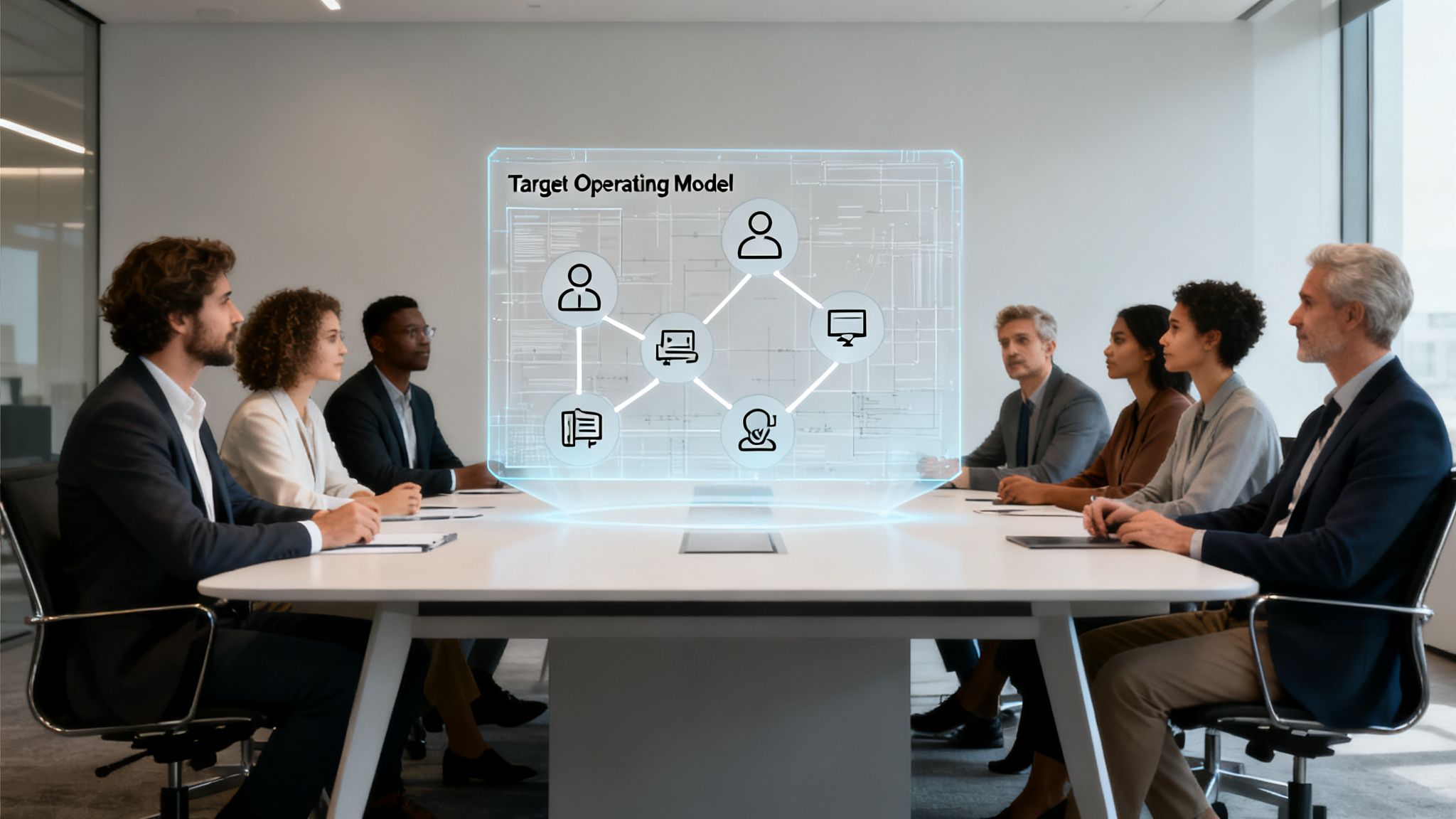
In an environment of persistent economic pressure and rapid technological disruption, incremental adjustments are insufficient. Market leadership—and indeed, survival—requires a fundamental re-evaluation of how an organisation functions. Many German enterprises operate on structures designed for a previous economic era, creating organisational friction that impedes decision-making, stifles innovation, and inflates costs. The core challenge is the widening chasm between ambitious strategic objectives and the operational capacity to achieve them.
A meticulously designed target operating model closes this critical gap. It is not an abstract mission statement but a concrete, actionable framework for organisational performance. It is best understood as the architectural plan for a high-performance engine, ensuring every component functions in precise alignment to generate maximum output.
From Vision to Value Delivery
Without a coherent operating model, even the most compelling strategy remains a theoretical exercise. A TOM translates vision into a structured reality by clearly defining the future state of the business. This clarity is the bedrock of any meaningful business transformation.
Ready to Build Your AI Project?
Let's discuss how we can help you ship your AI project in weeks instead of months.
A well-defined TOM delivers tangible strategic advantages:
- Enforces Strategic Alignment: It ensures every department, team, and process is synchronised and contributes directly to overarching corporate objectives.
- Drives Operational Efficiency: By systematically redesigning workflows and structures, it eliminates redundancies and optimises resource allocation.
- Embeds Organisational Agility: A modern TOM provides the structural flexibility to adapt to market shifts or seize new opportunities without causing systemic disruption.
- Enables AI Integration: It establishes the requisite data architecture, technology platforms, and governance frameworks essential for the successful deployment of AI and automation at scale.
The Economic Case for Redesign
The impetus for a new target operating model is grounded in compelling economics, particularly for Germany's industrial core. For instance, in the German manufacturing sector, a robust TOM is a prerequisite for any substantive digital transformation. A Tier-1 aerospace supplier, for example, projected a 10% annual increase in profitability following a comprehensive redesign of its operating model. Such initiatives are rapidly becoming a determinant of national competitiveness. Roland Berger's findings reinforce the criticality of this for contemporary organisational design.
A target operating model is the mechanism that translates strategic intent into operational capability. It is the bridge between knowing what you want to achieve and knowing precisely how it will be achieved.
Ultimately, the decision to design and implement a new TOM is a declaration of strategic intent. It signals a commitment to proactively shape the future rather than react to it. It is the foundational step in building a resilient, profitable, and forward-looking enterprise prepared for the challenges and opportunities ahead.
Understanding the Core Components of Your TOM
A Target Operating Model is not a monolithic diagram for archival purposes. It is a dynamic system composed of distinct, interdependent components that must function in concert. To construct a TOM that effectively propels strategy, it is essential to understand these individual building blocks and their integration.
Want to Accelerate Your Innovation?
Our team of experts can help you turn ideas into production-ready solutions.
Consider the enterprise as a high-performance vehicle. Each component—engine, chassis, electronics—must be expertly engineered and flawlessly integrated. A deficiency in one part compromises the performance of the entire system.
To architect the future state, one must first comprehend what an operating model is in its current state—the blueprint for how the company creates and delivers value today. The TOM is the future-state version of that blueprint, engineered to achieve specific strategic objectives.
Let us dissect the six fundamental components that constitute the architecture of any robust TOM.
Processes: The Circulatory System
Processes are the workflows—the arteries and veins of the organisation. They are the standardised sequences of activities that deliver value to customers. In an optimised state, information and value flow seamlessly. In a suboptimal state, the system suffers from blockages: manual handoffs, redundant approvals, and critical bottlenecks.
Designing a future-ready TOM involves mapping, simplifying, and automating these core processes. The objective is to surgically remove friction and engineer pathways that are efficient, repeatable, and scalable. A German manufacturing firm, for instance, might re-engineer its "order-to-cash" process. By leveraging AI for demand forecasting and automating invoicing workflows, it could significantly enhance both cash flow and client satisfaction.
Organisation: The Skeletal Structure
This component concerns human capital. The organisational structure is the enterprise's skeleton, defining reporting lines, team configurations, roles, responsibilities, and requisite capabilities. An antiquated structure creates silos, decelerates decision-making, and inhibits collaboration.
A modern TOM redesigns this structure for agility and focus. This often involves transitioning from rigid, hierarchical structures to more dynamic, cross-functional teams organised around specific products or customer journeys. If the strategy is to lead in AI, this cannot be a mere aspiration. It requires creating new roles, such as "AI Product Manager," and establishing a dedicated governance body to oversee ethical deployment. The structure must serve the strategy, not constrain it.
Technology: The Central Nervous System
Technology is the central nervous system that integrates all other components. This extends beyond the core ERP system to encompass the entire technology stack, from data architecture and client-facing applications to, increasingly, AI platforms. A fragmented or legacy technology stack is a significant impediment to executing a modern strategy.
An AI-ready TOM requires a strategic approach to technology. This is not about acquiring the latest tools, but about migrating from siloed, monolithic systems to an integrated, scalable, and secure platform architecture. A critical element is the construction of robust data pipelines and cloud infrastructure capable of supporting advanced analytics and machine learning. You can explore the intricacies of these architectures in our guide to IT system engineering.
Information: The Lifeblood
If processes are the circulatory system, data is the lifeblood. This component governs how information is collected, managed, analysed, and utilised for decision-making. Without clean, accessible, and reliable data, even the most sophisticated technology is rendered ineffective.
Looking for AI Expertise?
Get in touch to explore how AI can transform your business.
A core principle of a modern TOM is to treat data as a strategic asset, not merely an IT responsibility. This necessitates clear data governance, the establishment of a "single source of truth" for critical business metrics, and the democratisation of insights beyond data science teams. This empowers teams at all levels to make faster, more intelligent decisions based on empirical evidence rather than intuition.
In an AI-driven enterprise, the quality of your Target Operating Model is directly proportional to the quality and accessibility of your data. A flawed data strategy will inevitably lead to a flawed operational reality.
Governance and Performance
Finally, the TOM requires a steering mechanism and a dashboard. This component encompasses two critical elements that ensure coherence and accountability:
- Governance: This defines the "rules of the road"—decision rights, policies, and controls that guide the organisation. It answers the crucial question: "Who is authorised to decide what?" Without clear governance, misalignment and inefficiency are inevitable.
- Performance Metrics (KPIs): These are the quantitative measures used to track progress and evaluate success. Well-defined KPIs ensure that every part of the operating model is accountable for delivering specific business outcomes, linking daily activities directly to C-level objectives.
How to Design Your AI-Ready Target Operating Model
Constructing a target operating model is not an academic exercise; it is the practical work of architecting the company's future. For senior leaders, this requires translating abstract goals into a concrete, phased plan that delivers tangible results.
An AI-ready TOM is not created by adding an "AI layer" to existing operations. It requires embedding artificial intelligence into the fundamental design of the organisation from the outset.
Ready to Build Your AI Project?
Let's discuss how we can help you ship your AI project in weeks instead of months.
The process is structured and methodical, executed across four distinct phases. This methodology ensures the resulting design is both ambitious and grounded in operational reality, poised for immediate and impactful implementation.
Phase 1: Aligning on Strategic Vision
Before any process mapping or architectural design commences, absolute clarity on the strategic destination is non-negotiable. The leadership team must achieve unified consensus on the fundamental question: What specific business outcomes must our new operating model enable?
This initial alignment transcends high-level mission statements. It involves defining precise, measurable objectives.
- Market Positioning: Is the strategic intent to be the low-cost leader, the premium innovator, or the undisputed leader in customer intimacy? Each path necessitates a radically different operational design.
- AI Ambition: Is the goal to use AI for a 15% efficiency gain in existing processes, or is it to power entirely new, data-driven business models and revenue streams?
- Growth Levers: Will future growth be driven by geographic expansion, new product categories, or deeper penetration of existing markets?
Answering these questions establishes a "North Star" for the entire initiative. It creates strategic guardrails that prevent the project from being derailed by departmental interests and ensures every decision supports the overarching corporate vision.
Phase 2: Analysing the As-Is State
With a clear vision established, a rigorous and objective assessment of the current operating model—the 'As-Is' state—is required. This phase is akin to a comprehensive diagnostic scan of the organisation, designed to pinpoint precisely where the current model supports or hinders the future vision.
Want to Accelerate Your Innovation?
Our team of experts can help you turn ideas into production-ready solutions.
The objective is to identify the root causes of friction, not merely the symptoms. This involves mapping key value streams in detail, identifying structural bottlenecks, and auditing the technology stack for fragmented, legacy systems. By quantifying inefficiencies and identifying capability gaps, a data-driven business case for change is constructed.
This phase must also include a candid assessment of the company's AI readiness. This involves evaluating data maturity, analytical skill sets, and existing technological infrastructure. Understanding this baseline is critical for designing a realistic and achievable transformation journey. To build this foundation, review our insights on creating an AI strategy with a clear prioritisation framework.
Phase 3: Designing the To-Be Model
This is the core architectural phase where the future-state, or 'To-Be', model is designed. Utilising the strategic inputs from Phase 1 and the diagnostic findings from Phase 2, the blueprint for the AI-ready enterprise is developed. This entails reimagining each of the core TOM components.
This diagram illustrates the necessary integration of the core pillars: processes, organisation, and technology.
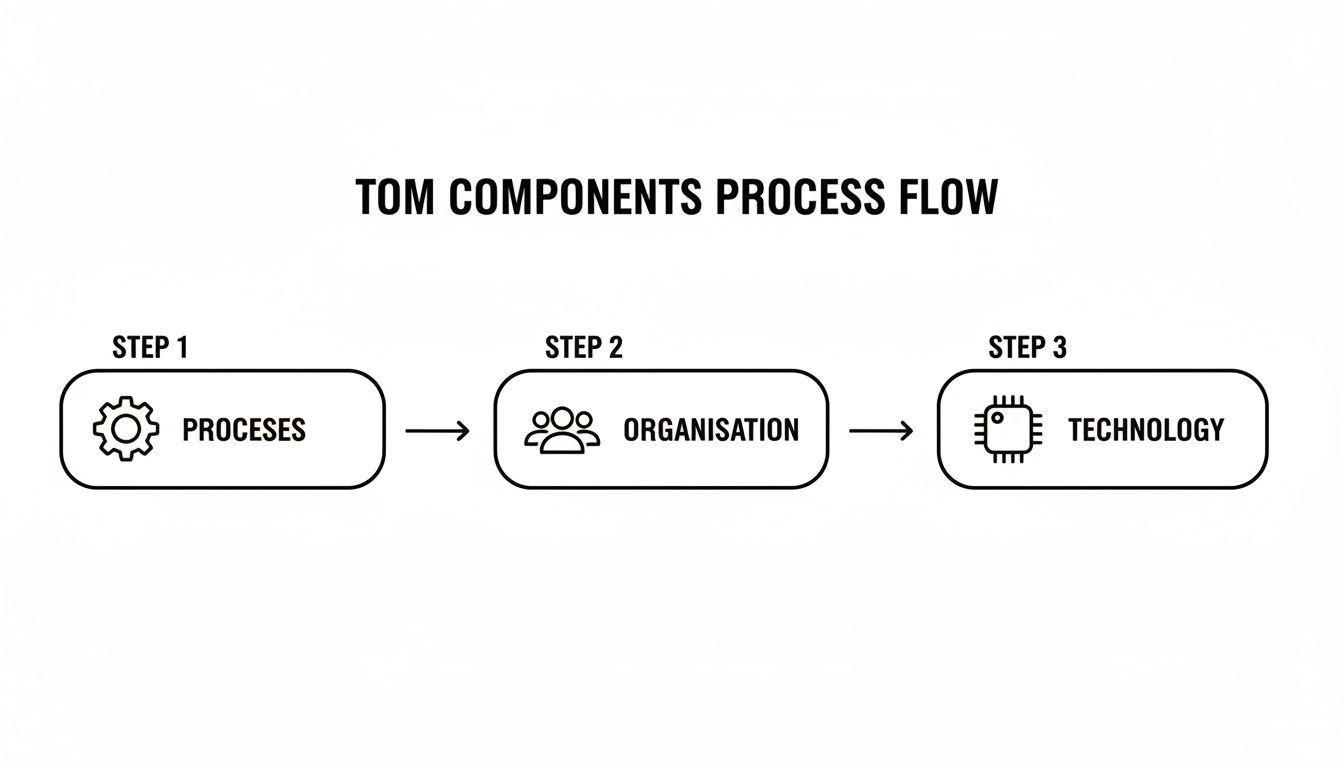
It serves as a crucial reminder that these are not independent silos but interconnected parts of a single engine that must be designed for synergistic performance.
Co-creation is paramount in this phase. The design cannot be dictated from a central command. It must be developed collaboratively with functional leaders and subject matter experts. This ensures the model is both strategically sound and operationally viable, fostering ownership across the business from inception.
To operationalise AI at scale, adopting MLOps Best Practices for Production AI is a critical design consideration for the TOM. This discipline elevates AI models from isolated experiments to robust, scalable, and continuously managed assets that deliver sustained value. For example, when designing the technology component, this means architecting for scalable cloud infrastructure, unified data platforms, and secure, governed AI/ML environments from day one.
Phase 4: Developing the Implementation Roadmap
An elegant design is of little value without a clear and credible implementation path. The final phase translates the 'To-Be' model into a detailed, sequenced implementation roadmap. This is where the Reruption "Co-Preneur" methodology excels, focusing on accelerating value delivery and de-risking execution.
A monolithic, multi-year project plan is avoided. Instead, the roadmap is segmented into a series of manageable initiatives, each with a distinct business case, timeline, and success metrics. The approach prioritises rapid prototyping and hypothesis testing.
Looking for AI Expertise?
Get in touch to explore how AI can transform your business.
- Identify High-Impact Pilots: Select initial projects that can deliver measurable value quickly, building momentum and demonstrating the new model's potential.
- Prototype and Validate: Develop minimum viable products (MVPs) to test key assumptions regarding processes, technology, or organisational changes in a controlled environment.
- Iterate and Scale: Apply learnings from these pilots to refine the design and inform the broader rollout. This iterative loop minimises risk and ensures the final implementation is battle-tested.
This pragmatic, phased approach transforms the design of a target operating model from a daunting strategic challenge into a manageable and executable program of work, converting the blueprint into a powerful business reality.
Implementing Your TOM: From Blueprint to Business Reality
A brilliant design for a target operating model is a necessary but insufficient condition for success. Its actualisation—the transition from blueprint to operational reality—is where true value is created. It is at this critical juncture that most transformations falter. Success is determined not by the technical perfection of the design, but by the mastery of the human dynamics of change.
Implementation is not a rigid project to be managed from a distance; it is a dynamic process requiring strong leadership, clear communication, and a deep understanding of the organisation's culture. Neglecting the human element invites resistance, undermines adoption, and relegates the TOM to an inert document.
Ultimately, successful implementation is about translating strategy into tangible capability, rapidly. This means abandoning the traditional "big bang" launch in favour of a more intelligent, iterative cycle of testing, learning, and refinement.
Leading the Human Side of Transformation
Significant organisational change, such as the implementation of a new operating model, naturally creates uncertainty among employees. Legitimate questions will arise: "How does this affect my role?" "What new skills are required?" Proactively addressing these concerns is the foundation of effective change management.
Ready to Build Your AI Project?
Let's discuss how we can help you ship your AI project in weeks instead of months.
Empirical evidence is clear: transformations are 5.3 times more likely to succeed when leaders at all levels are genuinely committed and aligned. This responsibility cannot be delegated solely to HR or a project management office. It requires visible, consistent sponsorship from the C-suite through to front-line team leads.
The objective is to cultivate genuine commitment, transforming employees from passive observers into active participants. This is achieved by focusing on three key pillars:
- Securing Stakeholder Buy-In: Identify key influencers and potential detractors early. Engage with them directly, understand their concerns, and co-create solutions. Make them partners in the process.
- Communicating with Impact: Develop a clear, consistent narrative that articulates the why behind the change, not just the what. This narrative must connect the new TOM to the broader corporate vision and demonstrate its value to the organisation and its people.
- Empowering Through Enablement: Equip teams with the necessary training, tools, and support. This includes technical skills for new systems as well as coaching on the collaborative behaviours required by the new model.
An Iterative Approach to Implementation
A common failure mode is treating TOM implementation as a single, monolithic project with a distant finish line. A more effective approach is to segment the rollout into manageable, value-focused increments. This iterative strategy builds momentum, facilitates learning from real-world application, and de-risks the entire initiative.
Consider the "foundations and innovations" strategy employed by market leaders. They simultaneously modernise core systems (foundations) while launching targeted new tools (innovations) that deliver immediate value. This dual focus ensures that short-term wins are not sacrificed in pursuit of long-term architectural integrity.
The objective of implementation is not to rigidly adhere to a static plan. It is to build a dynamic system that learns and adapts, using real operational data as a continuous feedback loop for improvement.
Want to Accelerate Your Innovation?
Our team of experts can help you turn ideas into production-ready solutions.
This cycle typically follows this structure:
- Pilot Programmes: Select a single business unit or value stream as a testbed. This provides a controlled environment to trial new processes, technologies, and team structures on a limited scale.
- Learn and Refine: Scrutinise pilot results. Identify successes and unexpected challenges. Use these insights to refine the TOM design and the broader implementation plan. Deep-dive techniques like process mining can uncover hidden bottlenecks. You can learn more about applying process mining in our detailed guide.
- Scale and Expand: Once the model is proven and refined, begin a phased, wider rollout. Each subsequent phase becomes more efficient, incorporating lessons from previous stages.
By adopting this agile, human-centric approach, the implementation of your target operating model is transformed from a high-stakes gamble into a strategic, data-informed process that delivers sustainable results.
Navigating the Pitfalls of a TOM Overhaul
Implementing a new target operating model is a significant undertaking. Even the most meticulously crafted blueprint can encounter execution challenges. Anticipating common failure points is not pessimism; it is prudent risk management. By identifying potential traps, a more resilient implementation plan can be developed.
Most TOM initiatives fail not due to a flawed vision, but because of predictable, human-centric issues. The most common pitfalls involve leadership alignment, communication, and a failure to correctly scope and pace the change. Addressing these issues proactively is what distinguishes a successful transformation from a costly failure.
Lack of C-Level Sponsorship
A TOM transformation is not a mere IT upgrade or departmental reorganisation; it is a fundamental change to the enterprise's core functioning. Without active, visible, and unwavering support from the C-suite, it is destined to fail.
Looking for AI Expertise?
Get in touch to explore how AI can transform your business.
Authentic sponsorship extends far beyond budget approval. It manifests as:
- Championing the Vision: Consistently articulating the strategic rationale ("the why") for the change and linking it directly to primary corporate objectives.
- Removing Roadblocks: Leveraging executive authority to dismantle organisational silos and resolve the political conflicts that inevitably arise.
- Enforcing Accountability: Ensuring that all leaders are aligned and actively driving the transformation within their respective domains.
When sponsorship is merely nominal, teams receive conflicting signals. This erodes momentum and creates an environment where resistance can flourish. The executive team must be the most vocal and persistent advocate for the new model.
Ineffective Communication and Inevitable Resistance
A perfectly designed TOM is useless if employees do not understand it, do not believe in it, or do not know how to operate within it. A communication vacuum is rapidly filled with fear, uncertainty, and rumour—the ideal conditions for organisational resistance.
Communication must be treated as a critical workstream within the project, not an afterthought. A compelling narrative is required to explain what is changing, why it is necessary now, and—critically—what the implications are for individuals and their roles. Concurrently, robust governance is essential to manage risk and maintain accountability. This concept is explored in depth in our guide to implementing a three lines of defense model, a key framework for reinforcing governance.
Scope Creep and Unrealistic Timelines
Another classic failure mode is the "big bang" approach, wherein an organisation attempts to transform everything simultaneously. This typically results in an ill-defined scope, unrealistic deadlines, and an exhausted organisation that abandons the initiative.
Ready to Build Your AI Project?
Let's discuss how we can help you ship your AI project in weeks instead of months.
A more intelligent strategy involves segmenting the rollout into manageable, sequenced phases. Begin with pilot projects that can deliver tangible wins within a short timeframe, such as 90-120 days. These early successes build critical momentum, provide invaluable lessons for the broader rollout, and demonstrate the viability of the new model. This iterative approach de-risks the entire program and ensures the transformation remains grounded in operational reality.
Your Top Questions About Target Operating Models, Answered
When discussions turn to redesigning a target operating model, senior leadership teams invariably raise a set of critical questions. Here are concise answers to the most frequent inquiries from executives preparing to lead their organisations toward a more agile and intelligent future.
How Long Does a TOM Implementation Actually Take?
A single, definitive timeline is not possible. The duration is contingent upon the organisation's size, complexity, and the scope of the transformation. For a focused pilot program targeting a single value stream, meaningful, measurable results can be achieved within 90 to 180 days.
However, a full, enterprise-wide rollout is a multi-year endeavour. The key is to avoid the high-risk "big bang" approach. A superior strategy is to structure the implementation in phases—value-driven sprints that build momentum and allow for iterative learning and adjustment.
What Is the Difference Between a Business Model and an Operating Model?
This is an excellent question, and the distinction is fundamental.
Want to Accelerate Your Innovation?
Our team of experts can help you turn ideas into production-ready solutions.
Your business model defines what your company does. It articulates how you create value for customers and, crucially, how you capture a portion of that value (i.e., generate revenue). It answers the questions: Who are our customers? What problem do we solve for them? What is our value proposition and pricing structure?
Your target operating model defines how you deliver on that promise, consistently and at scale. It is the internal engine—the specific configuration of processes, organisation, technology, and governance that brings the business model to life.
In short, the business model is the promise made to the market. The operating model is the mechanism for keeping that promise.
When Is the Right Time to Redesign Our Operating Model?
An organisation should seriously consider a TOM redesign in response to a major strategic inflection point or a persistent performance deficit. Common triggers include entry into new markets, fundamental shifts in customer behaviour, the adoption of transformative technologies like AI, or post-merger integration.
If the current mode of operation is perceived as an active impediment to achieving strategic objectives, it is unequivocally time for a change.
Looking for AI Expertise?
Get in touch to explore how AI can transform your business.
This is particularly true for sectors undergoing significant disruption. The European ETF market, for example, is forecast to reach $2.74 trillion by mid-2025, yet legacy structures are constraining growth. With only 4% of financial firms possessing AI-ready TOMs and 76% of leaders acknowledging the need to reinvent their operations, the imperative is clear. A well-designed target operating model is the key to unlocking efficiency. You can read more about these operating model challenges in the financial sector.
At Reruption GmbH, we are not merely consultants; we are your Co-Preneurs. We partner with you to design and implement a target operating model that transforms strategic vision into operational reality. We do not deliver a blueprint and depart; we share accountability for the outcome, de-risking your transformation through rapid prototyping and a relentless focus on results. Let's build your future-ready organisation together.