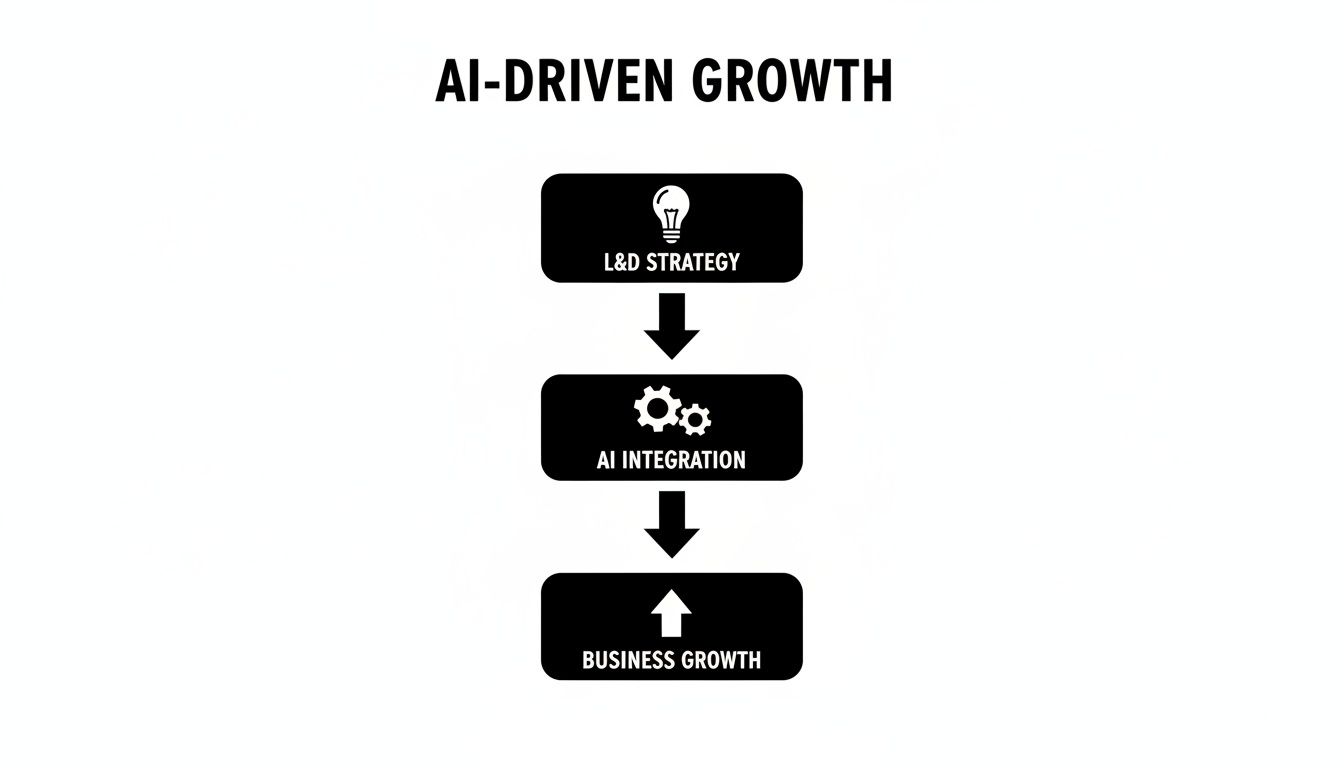
Learning and development is no longer a support function. It has evolved into a core component of the business engine, essential for driving growth, fostering agility, and achieving strategic objectives such as AI adoption and market expansion. The fundamental goal is to cultivate a culture of continuous learning that directly translates into measurable business outcomes.
The Urgent Need for a New L&D Strategy

Amidst rapid technological disruption, legacy L&D models are proving inadequate. The conventional approach of one-off, static training sessions cannot keep pace with the dynamic evolution of roles and requisite skills in today's business environment.
This challenge is exacerbated by a significant educational deficit. The global learning crisis is now so severe that the current generation of students is projected to lose US$21 trillion in potential lifetime earnings. This is not merely a societal concern; it directly impacts the talent pipeline available to corporations.
AI-driven solutions represent a strategic opportunity for organisations seeking a competitive edge. By integrating AI engineering and enablement services into their L&D framework, companies can deploy intelligent, personalised learning systems that proactively address skill gaps and mitigate future productivity losses.
From A Cost Centre To A Strategic Driver
Historically, L&D was often perceived as a necessary cost—an operational requirement to be fulfilled. This perspective is now fundamentally obsolete. Today, a robust learning and development strategy is the primary engine for continuous business transformation.
The objective has shifted from offering a mere catalogue of courses to architecting a comprehensive ecosystem where learning is continuous, integrated into daily workflows, and demonstrably linked to measurable business results. Successful implementation of any new L&D strategy hinges on cultivating a growth mindset across the workforce, fostering an environment where employees are motivated to embrace challenges and pursue continuous improvement.
A modern L&D programme is not about completing training modules; it is about building organisational capabilities. It is about equipping your people with the skills to solve tomorrow's problems, drive innovation internally, and translate strategic goals into reality.
Spearheading The Organisational Shift
For C-level executives and senior managers in Germany, leading this transformation is a defining leadership challenge. It necessitates a complete re-evaluation of corporate training, transitioning from sporadic workshops to a deeply embedded culture of learning.
This requires a strategic focus on several key pillars:
Ready to Build Your AI Project?
Let's discuss how we can help you ship your AI project in weeks instead of months.
- Strategic Alignment: Every learning initiative must be explicitly linked to a business objective, whether that is leveraging AI for efficiency gains or accelerating entry into new markets.
- Continuous Empowerment: Equip employees with the tools and autonomy to acquire new skills as needed, rather than solely through mandated training schedules.
- Future-Focused Capabilities: Proactively identify the skills the organisation will require in the next three to five years and begin developing them now.
Ultimately, treating learning and development as a strategic asset is non-negotiable for maintaining a competitive advantage. This mindset is central to the future of working and is critical for building a truly resilient and adaptable organisation.
Designing A Modern L&D Governance Framework

An effective learning programme is not a random collection of courses but a meticulously engineered ecosystem. For senior leaders, the primary task is to establish a governance framework that inextricably links every learning initiative to business performance. This structure provides the necessary stability and direction to move from disparate training activities towards a cohesive, strategic function.
Without clear governance, even well-intentioned L&D efforts can devolve into costly, low-impact activities. Constructing this framework involves thinking beyond the traditional L&D department to create a model of shared ownership where business unit leaders are active stakeholders, not passive recipients of training.
This model clarifies decision-making authority, budget allocation, and success metrics, ensuring all actions align with overarching corporate objectives.
Establishing Roles And Decision-Making Authority
The foundation of effective governance is the precise definition of roles and responsibilities. A modern L&D structure must operate like a strategic business unit, demanding clear accountability at every level. The objective is to create a system where responsibilities are unambiguous and decisions are made efficiently by the appropriate stakeholders.
Consider a three-tiered structure for accountability:
- Executive Sponsorship: The C-suite, particularly the CEO and CHRO, must champion the L&D vision. Their role is to align the learning strategy with corporate strategy and secure the necessary investment for implementation.
- L&D Steering Committee: This cross-functional body, comprising business unit leaders and senior HR partners, translates high-level strategy into concrete priorities. It approves major initiatives, allocates resources to critical capability gaps, and reviews performance against business KPIs.
- Operational Execution Team: This core L&D team, in collaboration with subject-matter experts from the business, is responsible for the design, delivery, and day-to-day quality management of learning experiences.
A well-defined governance structure is also essential for managing organisational risk. For a parallel on how such accountability frameworks apply across an enterprise, our guide on the three lines of defense model may offer valuable insights.
Identifying And Prioritising Capability Gaps
Once the governance structure is established, the focus shifts to a more surgical task: identifying the specific skills the organisation requires to achieve its strategic goals. This is not a vague brainstorming exercise but a rigorous, data-driven analysis to pinpoint the delta between existing competencies and those needed for strategic execution.
The process begins by deconstructing strategic goals into the requisite capabilities. For example, if a primary objective is to improve operational efficiency by 20% using AI, the analysis must identify the specific AI literacy, data analysis, and process automation skills required across different teams. This creates a direct, defensible link between training investment and a measurable business outcome.
Want to Accelerate Your Innovation?
Our team of experts can help you turn ideas into production-ready solutions.
A world-class learning and development function does not simply respond to training requests. It anticipates future business needs, identifies critical skill gaps before they impede performance, and architects learning solutions that build a direct bridge to strategic execution.
After identifying these gaps, they must be prioritised based on their potential business impact. Not all skills hold equal value. A capability gap in generative AI within a product development team likely offers more immediate value than a generalist course on the same topic for the entire organisation. This rigorous prioritisation ensures that resources are directed towards initiatives that will deliver the most significant and immediate returns, transforming learning and development from a support function into a potent driver of competitive advantage.
Executing High-Impact Learning Pathways
With the governance framework in place, the focus shifts from planning to execution. High-impact learning pathways are not generic course catalogues; they are carefully sequenced journeys designed to build specific, strategically-aligned skills. They function as a roadmap, translating strategic goals into tangible capabilities.
For German enterprises navigating technological transformation, three core pathways are essential. They form a powerful engine for reskilling the digital core, developing next-generation leaders, and enabling enterprise-wide AI adoption.
Reskilling For The Digital Core
The digital core—the technical backbone of a modern organisation—requires constant reinforcement. As AI automates routine tasks, teams need deeper expertise in data engineering, cloud architecture, and cybersecurity. Upskilling existing staff is a strategic imperative to retain institutional knowledge and loyalty while closing critical skill gaps.
Looking for AI Expertise?
Get in touch to explore how AI can transform your business.
- Objective: Close technical skill gaps and manage an AI-driven technology stack.
- Target Audience: IT departments, software developers, data analysts, and engineers.
- Key Skills: Advanced data analysis, MLOps, prompt engineering, and secure AI integration.
Cultivating Next-Generation Leadership
Technology alone does not create value; leaders do. This pathway develops individuals who can identify high-impact AI use cases and guide teams through ambiguity. They must balance business acumen with a capacity for experimentation.
Effective AI leaders model curiosity and create psychological safety for experimentation—then remove organisational barriers to learning.
Instead of deep technical modules, this track hones strategic foresight, change management, and empathetic leadership. The case of Khanmigo and its impact on scaling learning illustrates how intelligent tutors are reshaping education.
Enterprise-Wide AI Enablement
True transformation occurs when AI extends beyond specialists and becomes a tool for every team member. This pathway demystifies AI for non-technical roles, demonstrating practical applications for productivity enhancement. A tiered approach ensures content is relevant to each employee's current knowledge level.
A similar method drove significant gains in mathematics proficiency among learners in Delaware’s schools. Dive into Rodel’s performance findings for a detailed analysis.
Ready to Build Your AI Project?
Let's discuss how we can help you ship your AI project in weeks instead of months.
Consider co-creation to accelerate adoption. For instance, if the finance department requires automated reporting, the initial prototype should be built in collaboration with an AI partner. This hands-on engagement solves an immediate business problem while training employees to operate and enhance the solution independently.
The following tiered model provides a framework for deploying AI competence across an organisation.
AI Enablement Learning Pathway Tiers
| Tier | Target Audience | Learning Objectives | Example Module |
|---|---|---|---|
| Tier 1: Foundational Literacy | All Employees | Understand core AI concepts, terminology, and business impact | AI Fundamentals Bootcamp |
| Tier 2: Practitioner Skills | Technical & Business Professionals | Gain hands-on experience with AI tools, basic model building | Applied AI Tools Workshop |
| Tier 3: Advanced Application | Data Scientists & ML Engineers | Develop, deploy, and monitor AI solutions in production | MLOps Intensive |
| Tier 4: Expert Leadership | Senior Leaders & AI Champions | Drive AI strategy, measure ROI, and manage organisational change | AI Leadership Labs |
This structured progression ensures that all employees, from novices to experts, have a clear development path and can build upon successive achievements.
Measuring The Business Impact Of Your L&D Investment
For any learning and development programme to secure executive buy-in, it must demonstrate quantifiable business impact.
The era of tracking superficial metrics like satisfaction scores ("smile sheets") or course completion rates is over. Leaders in German enterprises demand a clear, demonstrable link between training investment and tangible returns.
Want to Accelerate Your Innovation?
Our team of experts can help you turn ideas into production-ready solutions.
This requires a fundamental shift in measurement methodology. The critical question is no longer, "Did our people complete the training?" but rather, "What business outcomes did the training enable?" This reframing is how L&D transitions from a perceived cost centre to a strategic investment, directly accountable for achieving key performance indicators.
The objective is to build a robust business case that justifies every euro invested and garners executive sponsorship by proving that upskilling directly reduces operational costs, accelerates innovation, or captures market share.
From Lagging Indicators To Strategic KPIs
Traditional L&D metrics are lagging indicators; they report on past activities but provide no insight into future performance. A high course completion rate offers no guarantee that employees can apply that knowledge to solve real-world business problems.
A strategic approach inverts this by focusing on leading indicators—the behavioural changes that precede and predict business results.

This hierarchy is a value chain. Foundational skills in the Digital Core are the prerequisite for developing authentic Leadership. That leadership is, in turn, essential for driving enterprise-wide AI Enablement and unlocking its significant business potential.
To operationalise this, L&D activities must be translated into the hard numbers that executives value. The table below illustrates this translation.
L&D Metrics Mapped To Business Impact
| Traditional Metric (Lagging Indicator) | Strategic KPI (Leading Indicator) | Direct Business Impact |
|---|---|---|
| 85% of the sales team completed CRM training. | Customer interaction logging time decreased by 40%. | A 15% increase in qualified lead conversion. |
| 90% of managers attended leadership workshops. | Manager response time to team queries improved by 30%. | 10% reduction in voluntary employee turnover. |
| 75% of engineers completed AI Copilot modules. | Time to resolve standard coding tickets fell by 25%. | Faster product release cycles and a 5% cost reduction per sprint. |
By shifting focus to the strategic KPI, an undeniable link is forged between training and the bottom line. The conversation evolves from training costs to investment and return.
A Practical Example: Measuring AI Copilot Training
Consider a common scenario: deploying an AI copilot to a software engineering team. The business goal is to accelerate development cycles and reduce manual, repetitive work.
The traditional approach would be to track training module completion—a metric of little strategic value.
Looking for AI Expertise?
Get in touch to explore how AI can transform your business.
The strategic approach involves designing a measurement plan that captures operational metrics before and after the training intervention.
A business case for L&D built on operational metrics is irrefutable. When you can demonstrate that a training programme reduced task completion time by 30%, the discussion is no longer about the cost of learning but the ROI of efficiency.
The measurement framework would focus on specific, quantifiable changes such as:
- Time to Complete Standard Tasks: Measure the duration for an engineer to perform a routine task (e.g., writing unit tests) pre- and post-training. A significant reduction is a direct measure of productivity.
- Code Commit Frequency: An increase in weekly code commits per developer is a strong indicator of accelerated workflow.
- Reduction in Boilerplate Code: Analyse code repositories to quantify the decrease in repetitive, manual code, proving the copilot is handling low-value tasks.
These data points translate directly into business value. A 25% reduction in time spent on routine tasks across a 50-person engineering team frees up thousands of hours for innovation. This is the evidence that not only justifies the initial L&D investment but also secures the budget for expansion.
To better understand how to build this data-driven culture, review our guide on analytics and insights.
Ready to Build Your AI Project?
Let's discuss how we can help you ship your AI project in weeks instead of months.
Large-scale, multi-year corporate change initiatives are relics of a bygone era. They are slow, expensive, and carry significant risk. For learning and development, German organisations cannot afford to be encumbered by outdated implementation cycles. A smarter, faster, and more pragmatic approach is required to de-risk investment and build momentum.
The solution is not a monolithic, enterprise-wide rollout but a series of targeted, iterative pilot programmes. This methodology allows for real-world validation of concepts and the accumulation of early successes before committing to a full-scale deployment.

De-Risking L&D Through Iterative Pilots
A pilot should be viewed not as a miniature version of the final programme, but as a rapid experiment designed to answer a critical business question. A well-executed pilot acts as an organisational wind tunnel, testing the aerodynamics of a new learning initiative under real conditions to identify points of friction before significant capital is expended.
This iterative model is fundamental to modern implementation. Given that 73% of digital transformation projects fail due to poor user adoption, pilots serve as the primary defense mechanism. They enable the fine-tuning of the final programme to ensure genuine alignment with employee workflows.
Want to Accelerate Your Innovation?
Our team of experts can help you turn ideas into production-ready solutions.
The primary goal of a pilot is not to succeed, but to learn. It provides a safe-to-fail environment to test assumptions, gather honest user feedback, and refine the approach. This is how you ensure the scaled-up version delivers tangible business impact.
For modern L&D, seamless learning management system integration with existing enterprise tools like SharePoint is often critical. A pilot offers a low-stakes environment to resolve technical issues before a full launch. This agile mindset facilitates speed without sacrificing precision.
Anatomy of a 90-Day AI Enablement Pilot
To make this concrete, consider launching an AI enablement programme. Instead of a year-long plan to train the entire organisation, execute a 90-day pilot with a single, high-impact group. The objective is not company-wide proficiency but to prove value and perfect the delivery model.
This focused sprint builds tangible momentum and generates the hard data required to justify a broader investment.
Phase 1: Stakeholder Alignment and Scoping (Weeks 1-2)
Looking for AI Expertise?
Get in touch to explore how AI can transform your business.
- Identify the Target Group: Select a team where AI can deliver a rapid, measurable impact, such as a marketing team for content generation or a finance department for automated forecasting.
- Define Success Metrics: Move beyond completion rates to track business KPIs. Establish goals such as "reduce report generation time by 20%" or "increase email campaign open rates by 15%."
- Secure Executive Sponsorship: Enlist a senior leader from the business unit to champion the pilot, remove roadblocks, and communicate progress.
Phase 2: Content and Technology Setup (Weeks 3-6)
- Select Technology: Choose specific, secure, and easily accessible AI tools for the pilot, such as a generative AI copilot.
- Develop 'Just-in-Time' Content: Create concise learning modules that directly address the team's immediate challenges using the new AI tools. The content must be directly applicable to their daily work.
Phase 3: Execution and Feedback Loop (Weeks 7-10)
- Launch and Support: Deploy the training and tools to the pilot group with dedicated support channels and regular check-ins.
- Gather Qualitative and Quantitative Data: Begin tracking KPIs while conducting weekly feedback sessions to understand the user experience, identify friction points, and capture new ideas.
Phase 4: Analysis and Business Case (Weeks 11-12)
- Measure Impact: Analyse the data against the initial KPIs to quantify the pilot's ROI.
- Build the Rollout Plan: Utilise all learnings—successes and failures—to construct a data-backed business case and a detailed plan for a broader rollout.
A structured 90-day cycle like this transforms a high-risk concept into a validated, de-risked strategic initiative. This rapid, focused methodology is similar to the approach detailed in our guide on the 21-Day AI Delivery Framework.
Driving Adoption With Change Management
Even the most well-designed pilot will fail without a sophisticated change management strategy. Resistance to new ways of working is a natural human response. Proactively managing this resistance is key to building support.
Ready to Build Your AI Project?
Let's discuss how we can help you ship your AI project in weeks instead of months.
- Identify Champions: Within the pilot group, identify early adopters who are influential and curious. Formally designate them as champions for the initiative.
- Communicate Early and Often: Control the narrative. Clearly articulate the "why" behind the change, consistently framing it in terms of benefits to the employees.
- Celebrate Small Wins: When a pilot team member discovers an innovative application of an AI tool, publicise this success. Success is contagious and builds the social proof necessary for wider adoption.
By integrating these change management principles into the pilot, you are not merely launching a programme; you are cultivating a culture of innovation and continuous improvement throughout your learning and development efforts.
Answering Your Top Questions About Modern L&D
As German companies intensify their focus on AI, leaders are rightly scrutinising their learning and development programmes. Here are answers to some of the most pressing questions from executives preparing their L&D strategy for the future.
How Do We Initiate An AI Enablement Programme?
The most effective approach is to start with a small, focused pilot designed for rapid, high impact, rather than attempting a large-scale, enterprise-wide rollout.
Select a single department where AI can deliver a demonstrable and measurable result, such as marketing or finance. Assign a specific, quantifiable business problem to solve. For example, the objective could be to enable the finance team to reduce manual forecasting time by 30%. Framing the initiative around a concrete business outcome creates a compelling, data-driven narrative for its strategic importance.
This surgical approach allows for testing, iterative improvement of training, and the accumulation of early successes, which is the most effective way to build momentum and secure broader leadership buy-in.
What Is The Most Significant Mistake To Avoid?
The single greatest error is treating L&D as an isolated HR function, disconnected from the strategic objectives of the business. Creating a catalogue of courses without a clear link to performance results in expensive activities with minimal impact.
Modern L&D must function as an engine for business strategy execution.
A modern L&D programme is not a library of content; it is a portfolio of strategic investments. Each investment must be designed to close a specific capability gap that is hindering the business from achieving its goals.
Therefore, instead of offering generic "AI training," define the mission with precision. For instance: "Equip the sales team with AI tools to increase lead qualification rates by 15%." This strategic focus is what transforms L&D from a cost centre into a genuine driver of business value.
How Can We Effectively Measure The ROI Of L&D?
To accurately measure return on investment, you must shift from tracking vanity metrics like "courses completed" to measuring business impact. The key is to establish a clear performance baseline before the training intervention and then measure the same metrics afterwards.
Want to Accelerate Your Innovation?
Our team of experts can help you turn ideas into production-ready solutions.
For example, if you are training engineers to use an AI copilot, you would track metrics such as:
- Time to resolve standard coding tickets: A reduction indicates a direct productivity gain.
- Frequency of code commits: An increase suggests developers are accelerating their workflow.
- Reduction in manual rework: This points to improved code quality and less wasted effort.
By quantifying these operational improvements, you can assign a direct financial value to them. A 20% reduction in development time for a team of 50 engineers translates into thousands of saved hours. This is an ROI calculation that commands C-suite attention.
Why Has Continuous Learning Become A Strategic Imperative?
The pace of technological change is accelerating exponentially. The "half-life" of a technical skill is shrinking, meaning knowledge acquired today may be half as valuable in just a few years. Consequently, one-off training events are no longer sufficient.
Data supports this urgency. While approximately 47% of adults aged 25-64 in the EU participated in some form of training, the rate for unemployed adults was a starkly low 14.1% in 2023. This disparity highlights a critical need for more efficient and accessible methods to keep the entire workforce skilled and competitive. The full Eurostat report on adult learning provides detailed figures.
A culture of continuous learning enables an organisation to adapt, integrate new technologies like AI, and maintain a competitive advantage. It is about building a workforce that can evolve in real time, transforming your people into your most dynamic and resilient asset.
Looking for AI Expertise?
Get in touch to explore how AI can transform your business.
At Reruption, we operate as "Co-Preneurs," working alongside you to execute innovation. We help you build the internal capabilities not just to adopt AI, but to lead with it. Discover how our hands-on enablement can transform your workforce by visiting us at https://www.reruption.com.