
The future of working is no longer a distant concept; it is a present-day reality compelling a strategic reset for German enterprises. This is not a matter of incremental adjustments. It is a fundamental reinvention of operational models, driven by the convergence of artificial intelligence and new workforce expectations.
The Unavoidable Shift Redefining German Industry
For C-level executives across Germany, the debate is over. The future of work has arrived, demanding decisive leadership and immediate, strategic action. We face a convergence of intelligent automation, the imperative for flexible work models, and the necessity of flatter, more agile organisational structures. This presents both a profound challenge and an unparalleled opportunity. Inaction is not a viable strategy—it is a direct threat to market leadership.

The solution lies in catalysing innovation from within. We term this 're-ruption'. Rather than passively awaiting disruption from external forces, market leaders are proactively reinventing their organisations. This entails redesigning core workflows, executing aggressive reskilling initiatives, and embedding AI into foundational processes to unlock new performance frontiers.
To navigate this transition, leaders require a clear framework. The new work paradigm is supported by four interconnected pillars that are reshaping the corporate landscape.
The Four Pillars of the New Work Paradigm
| Pillar | Core Concept | Strategic Implication for Leadership |
|---|---|---|
| AI as a Co-worker | AI is evolving from a tool for discrete automation into a collaborative partner or 'copilot' that augments human intellect and accelerates complex tasks. | The objective is to integrate AI to liberate high-value talent for strategic work, not merely to reduce costs. Prioritise augmentation over simple automation. |
| The Hybrid Workplace | Flexible work arrangements are no longer a discretionary benefit but a permanent fixture of the talent market. A successful model requires enabling technology and a culture that balances remote autonomy with in-person collaboration. | Construct a hybrid model tailored to your business. This demands deliberate investment in technology and a culture of trust and accountability. |
| Organisational Agility | Traditional, hierarchical structures lack the velocity required for the current pace of change. The future belongs to nimble, cross-functional teams empowered to make decisions and execute rapidly. | Dismantle operational silos and empower small, autonomous teams. The organisational structure must be engineered for speed and innovation, not merely control. |
| Continuous Reskilling | The half-life of professional skills is diminishing. A competitive workforce requires a culture of continuous learning and adaptation, where reskilling is an integrated part of daily operations. | Talent development is now a core business strategy. It is imperative to build internal capabilities to retrain your workforce for the roles of tomorrow. |
These pillars are not independent trends but a tightly integrated system. Success in one domain accelerates progress in the others, creating a virtuous cycle of competitive advantage.
The most critical realisation for today's leaders is that technology is merely the enabler. The true competitive advantage comes from building an organisation that can adapt, learn, and innovate at the accelerated pace AI makes possible.
Mastering this internal reinvention is the defining challenge for Germany's industrial leaders. It requires a clear vision and a pragmatic plan to convert inevitable change into strategic advantage. For a deeper analysis of this impact on the backbone of the German economy, review our analysis on how AI will really transform the German Mittelstand by 2025.
This guide provides the framework to lead your company into this new era and secure its future.
Understanding the AI Imperative
For many executives, artificial intelligence remains a complex and technical domain. However, a deep technical expertise is not a prerequisite for understanding its strategic impact.
Ready to Build Your AI Project?
Let's discuss how we can help you ship your AI project in weeks instead of months.
A simple yet effective mental model for generative AI and AI copilots is to envision providing a highly capable "digital apprentice" to every employee in your organisation.

This apprentice does not replace your experts; it amplifies their capabilities. It can analyse vast datasets in seconds, draft reports, summarise meetings, generate code, and manage routine communications. This liberates your most valuable talent to focus on what drives growth: strategic thinking, client relationships, and solving complex, non-standard problems.
This connects sophisticated technology to tangible business outcomes. The objective is not to pursue technological trends but to realise concrete gains in productivity, enhance decision-making with data-driven insights, and integrate intelligent automation into the core of your operations. To fully grasp this shift, it is useful to examine the evolution of AI in the workplace as it transitions from basic automation to strategic partnership.
The Strategic Opportunity in Germany
A clear window of opportunity exists for leaders prepared to act decisively. While AI adoption is increasing in German enterprises, the majority are in the early stages of exploration.
Want to Accelerate Your Innovation?
Our team of experts can help you turn ideas into production-ready solutions.
In 2023, only 32% of German companies had operationalised AI, slightly below the global average. However, the ambition is significant: 95% of firms plan to invest in AI and machine learning in the next five years. Projections indicate this could generate €480 billion in annual value across Europe by 2030. Furthermore, Germany’s vital machinery sector could automate 60-70% of employee time on high-value tasks.
This gap—between current adoption and future ambition—is where competitive advantage will be secured.
Organisations that move now will lock in efficiency gains, attract top talent, and define the competitive standards for their industries. Stasis represents the greatest risk, leaving enterprises vulnerable to faster, more intelligent, AI-powered competitors.
The question for leaders is no longer if AI will disrupt their business, but how quickly they can leverage it as a strategic asset. It is a foundational pillar for the future of working, with a direct correlation to profitability and market share.
From Strategy to Execution
Understanding the strategic 'why' is the initial step. The subsequent challenge is the 'how'. This does not necessitate a multi-year, enterprise-wide overhaul that paralyses the business.
Looking for AI Expertise?
Get in touch to explore how AI can transform your business.
The optimal approach begins with selecting a few high-impact, low-risk pilot projects that can deliver rapid, demonstrable results.
This methodology builds organisational momentum, secures stakeholder buy-in, and provides critical learnings about what works within your corporate culture. A successful pilot makes the business case for broader initiatives, paving the way for more ambitious transformation. You can learn how to build a robust roadmap by creating an AI strategy with a prioritisation framework for MVPs.
Ultimately, AI is an executive-level imperative. The leaders who can translate its technical promise into business value will define the next era of German industry.
Reskilling Your Workforce for an AI-First Era
The integration of AI is fundamentally a human capital challenge, not merely a technological one. The most sophisticated systems are only as effective as the people who manage, interrogate, and direct them. Therefore, the success of your AI strategy is contingent upon the deliberate transformation of your workforce.

This represents a profound shift. As AI copilots assume routine, data-intensive tasks, uniquely human skills—such as critical thinking, complex problem-solving, and creative strategy—become exponentially more valuable. We are transitioning from an economy built on repeatable processes to one that rewards analytical rigour and strategic insight.
Your most valuable employees will not be those who can execute a process most efficiently. They will be those who can pose the most incisive questions to an AI, interpret its outputs, and apply those insights to solve your most significant business challenges.
Fostering a Culture of Continuous Adaptation
The primary role of leadership is to cultivate an environment where learning is not an annual requirement but a continuous, reflexive behaviour. This begins with establishing a culture of psychological safety, where teams feel secure to experiment with new tools, request support, and even fail without fear of reprisal. This is the bedrock of organisational adaptation.
This is not theoretical. By 2030, a significant portion of the workforce could face major career transitions due to AI adoption, driving immense demand for skills in data analysis, creativity, and strategic thinking. This shift underscores the urgent need for strategic internal training and reskilling programmes to navigate the changing future of working.
To lead this transition, you must integrate learning into the fabric of daily operations. This includes:
Ready to Build Your AI Project?
Let's discuss how we can help you ship your AI project in weeks instead of months.
- Championing curiosity from the executive level. Leaders must be seen openly experimenting with and learning new AI tools.
- Allocating dedicated time for learning within the work week, signalling that skill development is a core job responsibility, not an ancillary activity.
- Celebrating experimentation. Share learnings from both successful and unsuccessful AI pilots to foster a culture of transparency and growth.
The objective is to transform your company from a place where people possess skills to an organisation where people continuously acquire skills. This agility is your most effective defence against obsolescence.
A Practical Framework for Skills Transformation
A structured plan is necessary to ensure training investments yield measurable returns. A robust framework can be distilled into three core actions.
- Identify Critical Skills Gaps: Conduct a strategic audit. Map your team's current capabilities against the skills required in an AI-first operating model. Focus on roles most impacted by automation and the new competencies needed to manage these systems.
- Develop Targeted Training Programmes: Move beyond generic e-learning modules. Training must be hands-on and focused on solving real-world business problems. Partner with experts to develop customised sessions on prompt engineering, data interpretation, and AI ethics tailored to your industry. For further insights, review our guide on how to increase the effectiveness of your corporate learning programmes.
- Communicate a Clear Vision: Your workforce must understand the strategic rationale behind this transformation. Frame reskilling not as a threat, but as a mutual investment in their future value and the company's long-term viability.
For an insightful perspective on emerging trends, see how AI will redefine learning in 2025. Ultimately, empowering your people is the only path to sustainable success. Your technology is only as capable as the team that wields it.
Building the Agile Organisation of Tomorrow
The operating models that built Germany's industrial powerhouses are, in some cases, becoming liabilities. In an era defined by AI, traditional, hierarchical structures are too slow and rigid to compete effectively. To capitalise on the velocity of AI and navigate dynamic market conditions, you must redesign your organisation for agility, innovation, and rapid execution.
This is not a matter of superficial restructuring. It requires a fundamental dismantling of departmental silos in favour of small, cross-functional, mission-driven teams. These should be viewed not as temporary project groups, but as permanent, entrepreneurial units empowered to solve specific business problems end-to-end.
From Silos to Squads
The core concept is to eliminate the barriers between functions such as engineering, marketing, and finance. A dedicated team is assembled with all the requisite skills to own an outcome—whether launching a digital product or optimising a key supply chain process.
This model delegates decision-making authority to those closest to the information. When a team possesses the autonomy to act, it can respond to customer feedback or market shifts in days, not months. This structure is essential for cultivating the entrepreneurial urgency required to thrive in the future of working.
The goal is to build an operating model that can sense and respond with the agility of a startup, but with the scale and resources of an established enterprise. Agility is not chaos; it is disciplined speed, enabled by a purpose-built structure.
Empowering Teams with Accountability
Empowerment without clear accountability leads to inefficiency. A successful agile transformation requires a new governance framework that balances speed with strategic alignment. This framework must clearly define:
- Mission and Key Objectives: Each team must have a precise understanding of its objective and the metrics by which success will be measured.
- Decision-Making Rights: It is crucial to delineate which decisions the team can make autonomously and which require leadership approval. This clarity prevents bottlenecks.
- P&L Responsibility: Where applicable, linking a team's performance directly to profit and loss instils a powerful sense of ownership and sharpens commercial focus.
This approach creates a system of ‘freedom within a framework’. It provides the necessary guardrails for compliance and strategic coherence while unleashing a team's creative and problem-solving potential. A well-designed system, such as the one explored in our guide to the McKinsey 7-S framework, ensures all components of the organisation work in concert.
Fostering Corporate Entrepreneurship
The most forward-thinking companies are extending this model by creating internal venturing and startup ecosystems. This involves establishing protected environments where new business concepts can be developed and tested with the velocity of a lean startup, incorporating rapid prototyping and market validation cycles.
These internal ventures operate with significant independence but can leverage the parent company’s resources and market access. By holding these teams accountable for their own P&L, you cultivate a true entrepreneurial mindset. They are not merely managing a budget; they are building a business.
This model is the ultimate expression of organisational agility. It allows for the exploration of new revenue streams and disruptive technologies without jeopardising core operations. For leaders, the mandate is clear: build an operating system that not only manages the present but is engineered to invent the future.
A Pragmatic Roadmap For AI Implementation
How does one transition from a strategic concept to a functioning AI solution that delivers business value? A disciplined, pragmatic plan is essential. For leaders in Germany, the path forward is not a single, monolithic project. It is a series of intelligent, calculated steps that deliver value quickly while mitigating risk.
The most effective approach is a simple but powerful framework: Think Big, Start Small, and Scale Fast. This methodology inverts the traditional, multi-year transformation paradigm, favouring agile initiatives that produce tangible results in weeks, not years.
Want to Accelerate Your Innovation?
Our team of experts can help you turn ideas into production-ready solutions.
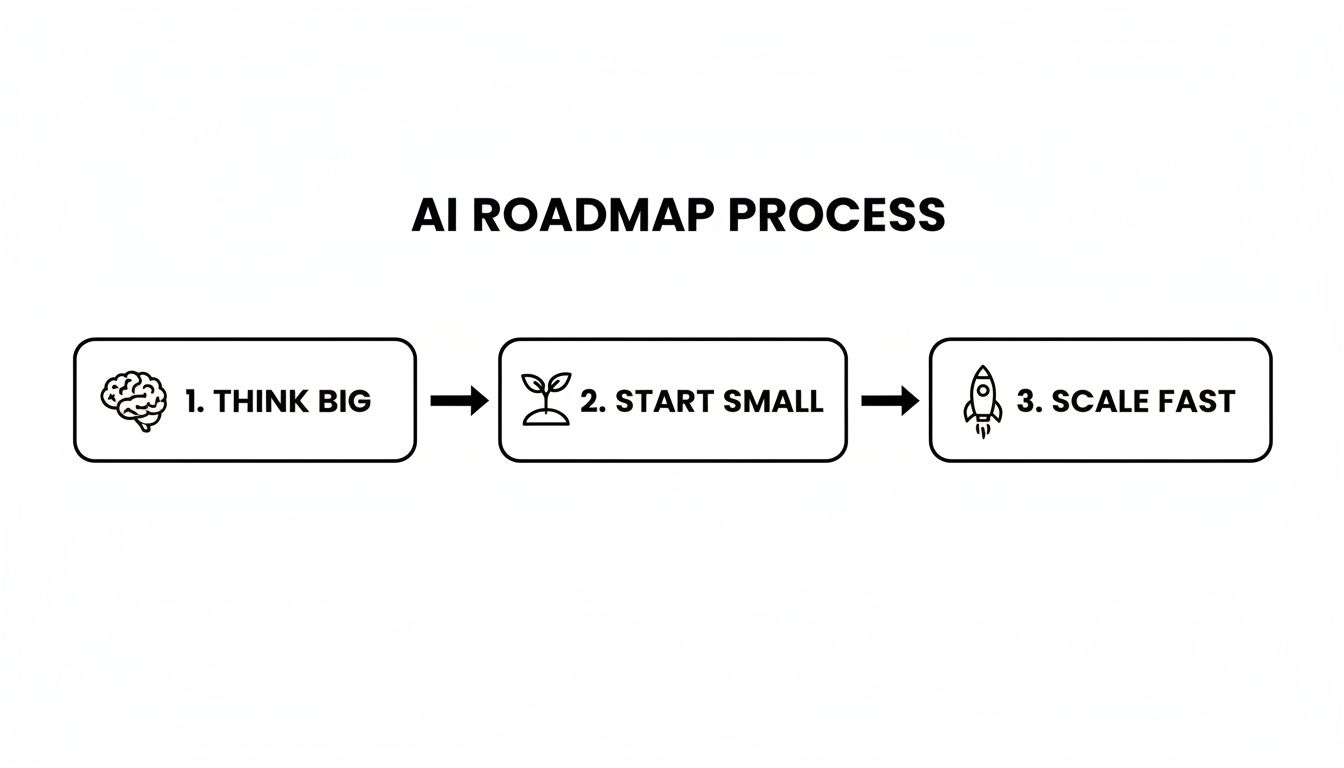
This is not merely a slogan; it is a proven method for de-risking innovation. It progresses deliberately from strategic ideation to a controlled pilot and, only then, to a full-scale rollout.
Phase 1: Think Big and Identify Value
The initial step is to map the opportunity landscape. This phase is purely strategic. Assemble a cross-functional team to brainstorm a comprehensive list of potential AI use cases across all business units.
Next, apply a rigorous prioritisation framework. Evaluate each idea against two fundamental criteria: What is the potential business impact? And what is the genuine technical and organisational feasibility? The objective is to identify "quick wins"—high-value problems that can be addressed with current AI capabilities.
To achieve this, ask targeted questions:
Looking for AI Expertise?
Get in touch to explore how AI can transform your business.
- Where are our most significant operational inefficiencies and bottlenecks?
- What are the repetitive, low-value tasks consuming our experts’ time?
- Which customer-facing process could be fundamentally redesigned with intelligent automation?
Answering these questions allows you to build a robust business case for a single, tightly-defined pilot project. The goal is not to address every opportunity at once, but to select the optimal starting point.
Phase 2: Start Small With A High-Impact Pilot
Once a target is selected, the focus shifts to execution within a controlled environment. The mission is to launch a low-cost, high-impact pilot that validates the concept and delivers a measurable return. Velocity is paramount.
Partnering with external experts who operate as "Co-Preneurs" can be a strategic accelerator. Germany's AI startup ecosystem is expanding rapidly, with a 36% increase in new companies, bringing the total to approximately 2,900. These partners can help build and test a prototype in days or weeks, not months. You can explore this ecosystem further with the latest AI fact sheet from Germany Trade & Invest.
Crucially, the pilot's success must be tied to clear Key Performance Indicators (KPIs) from inception—such as cost reduction, faster processing times, or decreased error rates. This assigns direct P&L accountability to the project and maintains focus on business value.
The pilot is your most powerful instrument for driving organisational change. A successful, well-measured project provides undeniable proof of value, which neutralises scepticism and builds the momentum required for broader adoption.
Ready to Build Your AI Project?
Let's discuss how we can help you ship your AI project in weeks instead of months.
A 90-Day Plan To Get Started
This process can be initiated rapidly. Your first AI pilot can be launched within 90 days. The following is a simple roadmap for corporate innovation teams seeking to secure an early success.
| Phase | Timeline | Key Actions | Success Metric |
|---|---|---|---|
| 1. Ideation & Scoping | Days 1-30 | Conduct workshops to identify high-value use cases. Select one pilot project. Define clear success criteria (KPIs). | A signed-off project charter with a clear business case and measurable goals. |
| 2. Prototyping & Validation | Days 31-60 | Partner with an expert team to build a minimum viable product (MVP). Test with a small, controlled user group. Gather feedback. | A functional prototype that meets core requirements and positive feedback from test users. |
| 3. Measurement & Decision | Days 61-90 | Deploy the pilot in a live (but limited) environment. Measure performance against the predefined KPIs. Analyse ROI. | A final report showing clear, quantifiable results and a go/no-go decision for scaling. |
This structured sprint forces a transition from theory to action, delivering a tangible result and valuable learnings within a single quarter.
Phase 3: Scale Fast With Strong Governance
Once the pilot has demonstrated clear value, it is time to scale. This final phase involves rolling out the proven solution across the wider organisation. This requires a robust governance framework to manage deployment, maintain security and compliance, and standardise best practices.
Scaling is more than a technology rollout; it is about embedding a new, AI-driven way of working into the corporate DNA.
This entails establishing a centre of excellence, documenting key learnings, and setting clear guidelines for subsequent AI projects. This disciplined process ensures that each success builds upon the last, creating a powerful innovation flywheel that shapes the future of working for your entire organisation.
Want to Accelerate Your Innovation?
Our team of experts can help you turn ideas into production-ready solutions.
To understand the potential velocity of this process, examine Reruption’s 21-day AI delivery framework. This is how small experiments are converted into a sustainable competitive advantage.
Leading the Transformation from the C-Suite
Transforming the enterprise operating model is not an IT project to be delegated. It is a fundamental leadership challenge, and its success rests squarely with the C-suite. This requires a different mode of leadership, one suited to an era of perpetual change.
The first and most critical responsibility is to articulate a compelling narrative. You must communicate a clear vision for this new operating model. Particularly in Germany's established industries, your people need to understand the strategic rationale. This is not about framing AI as a threat, but as the essential tool that will secure the company's future—and their own careers within it.
Modelling the Behaviours of Tomorrow
Words alone are insufficient. Executives must lead by example. This means being seen actively using AI copilots in daily work, advocating for data-driven decisions in leadership meetings, and participating directly in pilot projects.
When the board and C-level team demonstrate commitment through action, it sends a powerful signal throughout the organisation. It communicates that this is a core business priority, not a fleeting corporate initiative. It transforms AI from an abstract concept into a practical, everyday tool for achieving superior results at all levels.
Looking for AI Expertise?
Get in touch to explore how AI can transform your business.
The most powerful message a leader can send is not in a memorandum, but in their actions. Demonstrating a willingness to learn, adapt, and experiment with new tools is what ignites a truly adaptive culture.
Fostering a Culture of Managed Risk
Finally, leadership must cultivate a culture that embraces experimentation. The path to AI integration will inevitably involve failed tests and dead ends. This is an inherent part of the innovation process. For this reason, psychological safety is non-negotiable. Your teams must feel empowered to try new approaches without fear of punishment if an experiment does not yield the expected outcome.
This involves implementing simple frameworks that encourage rapid, small-scale tests. The objective is to learn quickly, discard what is ineffective, and invest decisively in pilots that demonstrate significant promise. This is an intelligent methodology for de-risking the entire transformation, ensuring that major investments are allocated only to proven, high-impact solutions.
To secure your company’s position in the next industrial chapter, the call to action for every leader is unequivocal. The time for observation is over. Decisive, visible, and persistent leadership is required to convert the immense potential of AI into a real, lasting competitive advantage.
Your AI Transformation Questions Answered
When undertaking a fundamental shift in business operations, key questions will arise. The following are the most common inquiries we receive from leadership teams, with direct answers to facilitate confident decision-making.
We lack in-house AI expertise. How do we begin?
This is a common challenge, but the solution is straightforward: start with the business problem, not the technology. Identify a tangible pain point within a specific department—for example, a time-consuming reporting task or a high-friction customer service workflow.
Once the problem is defined, engage an external partner for a small, tightly-scoped pilot project. This provides immediate access to deep expertise without the need to build a large internal team from the ground up. The primary objective is to secure a quick win that demonstrates tangible ROI, building momentum and securing buy-in for future initiatives.
How do we measure the ROI of AI initiatives?
Return on investment is a composite of quantitative and qualitative metrics. On the quantitative side, you can track metrics such as reduced processing times, lower error rates, higher sales conversion, or direct operational cost savings.
However, do not neglect qualitative indicators. Are your teams making better, faster decisions? Is employee engagement improving as a result of being freed from monotonous work? Is there evidence of increased innovation? For every project, define a clear business case with specific KPIs from the outset. This ensures every investment is directly tied to a measurable business outcome and establishes clear P&L accountability.
The most significant error is to treat AI adoption as a standard IT project. It is a fundamental change in how the organisation thinks and operates. Deploying new software without adapting processes, rethinking team structures, and leading the cultural shift from the top is a recipe for failure.
Ready to Build Your AI Project?
Let's discuss how we can help you ship your AI project in weeks instead of months.
True success is holistic. The technology must be synchronised with workforce reskilling and a redesign of the work system itself. The goal is to empower humans, not simply to install software.
How do we increase velocity without creating chaos?
Agility is not chaos; it is disciplined speed enabled by a more intelligent, flexible structure. A practical approach is to create "mission-oriented" teams—small, cross-functional groups empowered to solve a single, specific business problem.
Provide these teams with clear guardrails: defined goals, clear decision-making rights, and agreed-upon success metrics for their mission. This creates "freedom within a framework," allowing teams to move quickly and innovate while remaining aligned with broader strategic objectives. Do not attempt to transform the entire organisation at once. Begin with one or two pilot teams, learn from the experience, and then scale the model.
At Reruption GmbH, we serve as your Co-Preneurs to translate these answers into your new operational reality. We partner with you to prototype, validate, and scale AI-powered solutions that deliver measurable business results. We share in P&L accountability because we are invested in your success.
Ready to begin your internal reinvention and secure your company's future? Visit us at https://www.reruption.com.
Want to Accelerate Your Innovation?
Our team of experts can help you turn ideas into production-ready solutions.