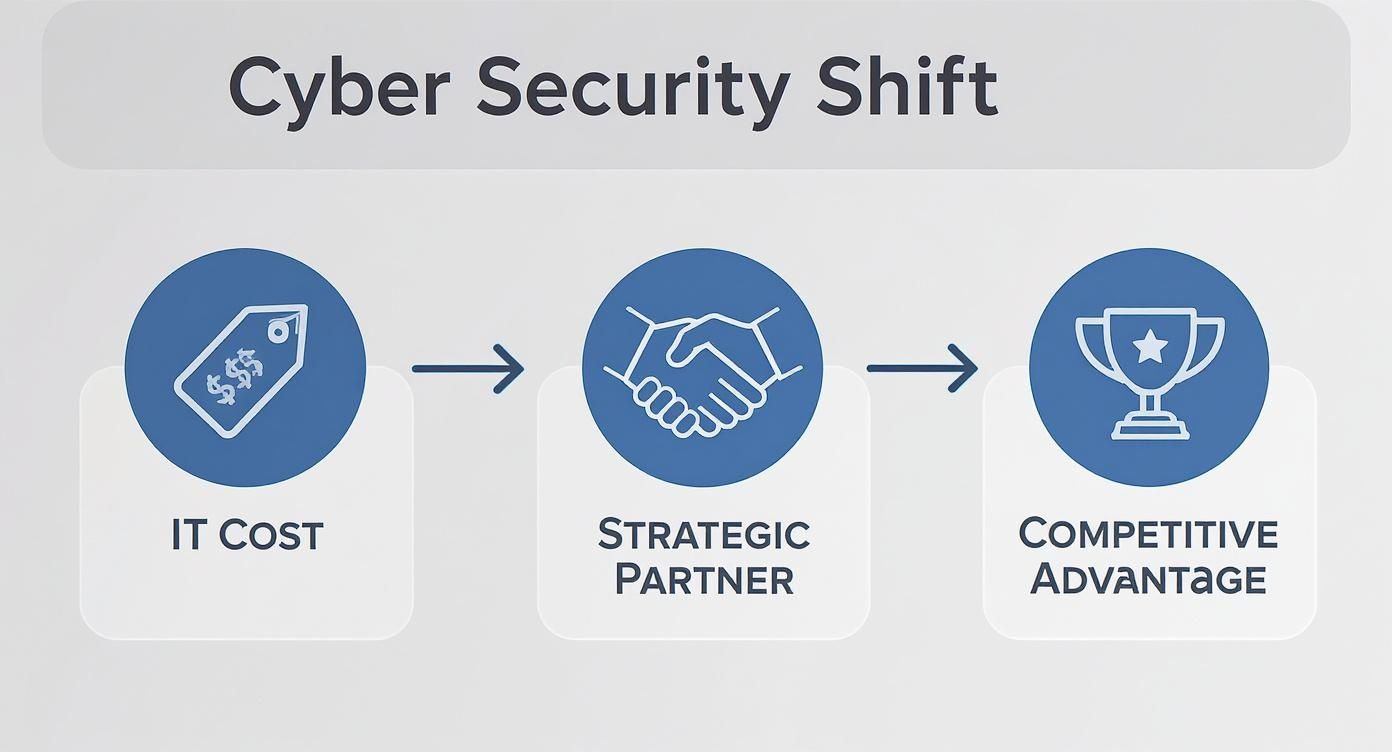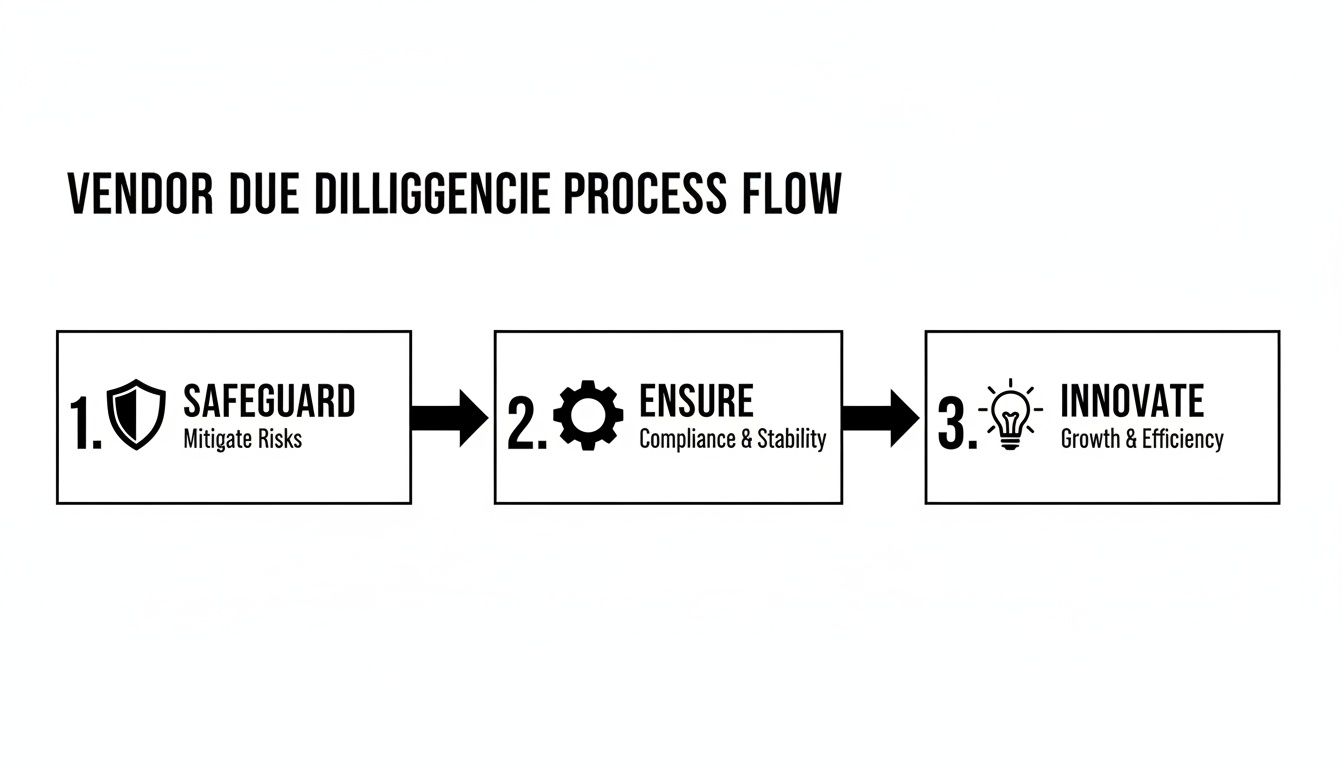
In a complex market landscape, a structured approach to risk management and control is paramount for strategic execution. The 3 Lines of Defense model provides a clear, robust framework by delineating risk management responsibilities across three distinct groups. This elegant concept establishes a powerful governance structure that is instrumental in achieving strategic objectives.
Building Resilience with The Three Lines of Defense
For German enterprises navigating a volatile global economy, resilience has evolved from a defensive posture to a competitive advantage. The spectrum of risk has expanded dramatically, moving beyond financial compliance to encompass supply chain vulnerabilities, persistent cybersecurity threats, and the rapid integration of artificial intelligence.
In this environment, a reactive, siloed approach to risk mitigation is inefficient and exposes the organization to operational and reputational damage. Consequently, a structured governance model is not a discretionary enhancement but a strategic necessity.
The Three Lines of Defense (3LoD) framework provides a blueprint for clarity and control. It elevates risk management from a back-office function and integrates it into the core operational fabric of the enterprise. It is best understood not as a rigid compliance checklist, but as a dynamic architecture for intelligent governance.
A Framework for Strategic Advantage
A properly implemented 3LoD framework enables senior leadership to pursue ambitious initiatives, such as the deployment of generative AI, with confidence. It achieves this by embedding clear accountability and intelligent oversight into core processes, ensuring that innovation does not outpace control. By defining distinct roles for day-to-day operations, risk oversight, and independent assurance, the model creates an inherent system of checks and balances that supports both agility and stability.
Ready to Build Your AI Project?
Let's discuss how we can help you ship your AI project in weeks instead of months.
This structure delivers tangible strategic benefits:
- Enhanced Accountability: It precisely defines ownership for identifying and managing specific risks, eliminating ambiguity between departments.
- Improved Decision-Making: Leadership gains a clearer, more holistic view of the enterprise's risk profile, facilitating more informed strategic decisions.
- Greater Operational Resilience: By embedding risk management at the operational front line, teams can identify and mitigate issues before they escalate into crises.
The primary value of the 3 Lines of Defense model lies in its capacity to transform risk management from a cost center into a strategic enabler. It cultivates the organizational confidence required to pursue growth and innovate responsibly.
Ultimately, this framework directly supports P&L accountability and market leadership. It equips the organization to manage not only threats but also the significant technological opportunities that will define market winners. To understand how this fits into the broader GRC landscape, learn more about risk, compliance, and governance in our comprehensive guide.
Understanding the Role of Each Defence Line
To operationalize the Three Lines of Defence model from a theoretical concept into a practical blueprint, consider an analogy. Envision your enterprise as an expedition venturing into uncharted territory—a new market, a disruptive technology, or an innovative product line. Success depends not on a single individual but on a coordinated team with clearly defined roles.
This is precisely what the 3LoD model provides: a structure that organizes risk and governance functions into three distinct yet interconnected layers. Each line has a specific mandate, but their collaboration is essential to protect the enterprise while enabling it to remain agile and decisive. This synergy is the foundation of genuine corporate resilience.
The First Line: Operational Execution
The first line of defense consists of operational management and staff. In our expedition analogy, these are the frontline explorers and engineers responsible for executing the mission. They manage the day-to-day business and, critically, own and manage the risks inherent in their activities.
They are positioned to be the first to identify an issue, whether it is a process deviation in a production line, a data privacy concern with a new AI tool, or a customer service failure. Their function is to identify, assess, and control these risks at their source. This places accountability precisely where it is most effective.
This pyramid illustrates how operational teams form the bedrock of a sound governance structure, guided by leadership's strategic direction.
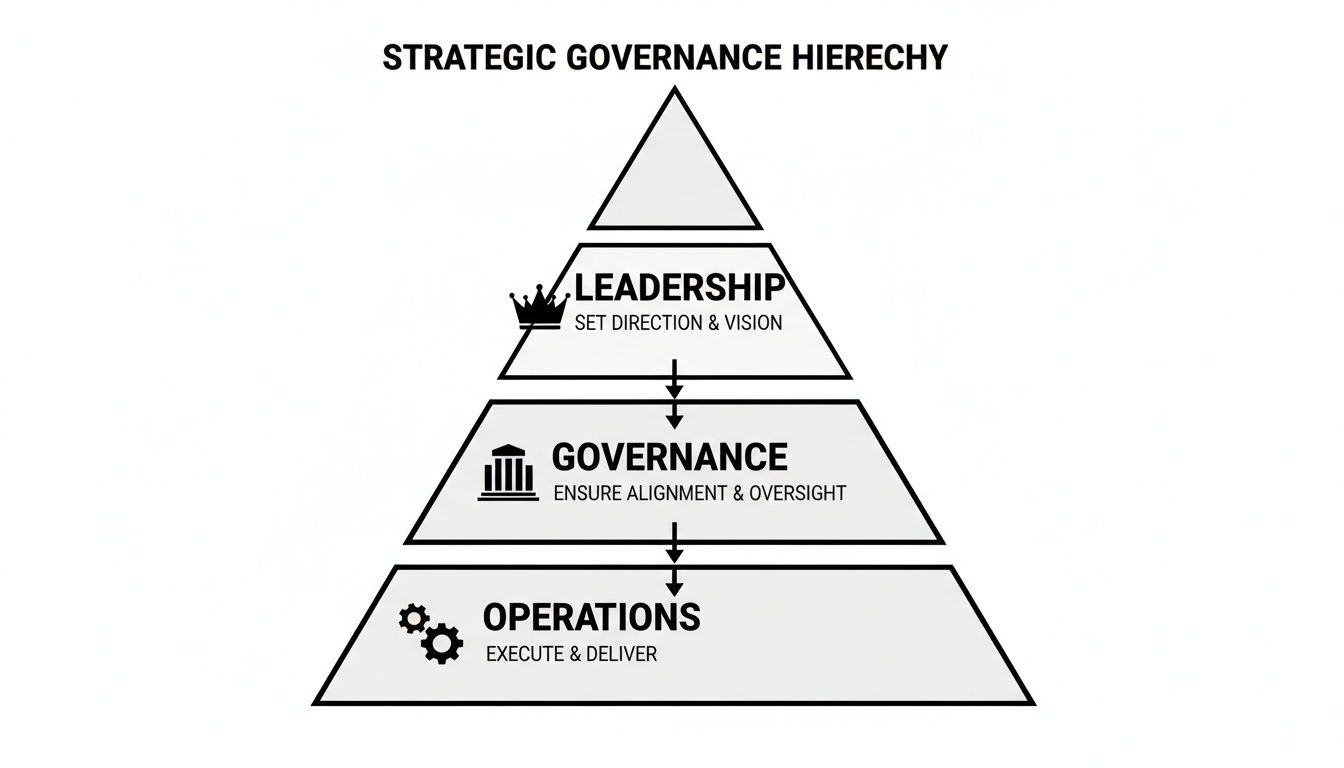
As depicted, leadership sets the strategic direction, but it is the operational layer that must execute this strategy within the established governance and risk parameters.
The Second Line: Oversight and Expertise
While the first line manages risks directly, the second line provides the expertise, policies, and oversight necessary for effective execution. This includes functions such as Risk Management, Compliance, Legal, and IT Security. In our expedition analogy, these are the navigators and strategists who equip the ground team with maps, frameworks, and expert guidance.
Their role is to ensure the first line is adequately equipped to manage risk.
- Policy Definition: They establish the risk management frameworks and internal control policies that guide enterprise-wide conduct.
- Specialist Expertise: They provide specialized knowledge on complex subjects, such as regulatory compliance or emerging cyber threats.
- Monitoring and Reporting: They monitor risk levels across the organization and report significant exposures to senior management and the board.
This line is a critical partner to the first, ensuring that operational activities align with the enterprise's risk appetite and strategic objectives. This is essential for maintaining control while pursuing growth. For a deeper understanding of how technical frameworks support this structure, you may find value in the link between IT and system engineering.
The Third Line: Independent Assurance
The third line of defence is Internal Audit. It provides independent, objective assurance to the board and senior management that the entire governance and risk management framework is designed appropriately and operating effectively. Returning to our analogy, they are the independent surveyors who periodically assess the entire expedition—its equipment, plans, and execution—to validate its path to success.
The third line does not manage risk directly; its authority is derived from its independence. Its purpose is to validate that the first and second lines are fulfilling their responsibilities effectively and in alignment with enterprise objectives.
Want to Accelerate Your Innovation?
Our team of experts can help you turn ideas into production-ready solutions.
Although the Three Lines of Defence model was formally articulated in 2013, its adoption has not been uniform. Research across Europe, including a survey of 37 Chief Audit Executives in Germany, confirms the value of internal audit as the third line. However, these studies frequently highlight maturity gaps in the first and second lines, with ambiguous accountability being a common impediment.
This distinction is crucial. The first two lines are management's instruments for controlling risk. The third line provides assurance over those instruments, confirming that the entire system is robust, resilient, and fit for purpose.
To further clarify these roles, the following table summarizes their core functions.
Roles and Responsibilities Across The Three Lines of Defence
This table offers a concise, at-a-glance overview of how duties are distributed, highlighting the distinct yet complementary roles each line plays in the enterprise's overall risk management strategy.
| Defense Line | Primary Role | Key Responsibilities | Reporting Structure |
|---|---|---|---|
| First Line | Risk Ownership | Owns and manages risks as part of daily operations. Implements controls and corrective actions. | Reports to business unit/functional management. |
| Second Line | Risk Oversight | Sets policies and frameworks. Provides expertise and tools. Monitors risk exposure and compliance. | Reports to senior management or a dedicated risk committee. |
| Third Line | Independent Assurance | Provides objective assurance on the effectiveness of the first two lines. Audits governance and risk processes. | Reports functionally to the Board/Audit Committee and administratively to the CEO. |
This clear division of labor ensures that all stakeholders, from frontline staff to the board of directors, understand their specific role in safeguarding the enterprise.
Applying the Framework to AI Governance and Innovation
The relevance of any modern governance framework is determined by its ability to manage emerging technologies. For Germany’s leading automotive, manufacturing, and technology sectors, the primary challenge is the effective governance of Artificial Intelligence (AI). Applying the 3 line of defense model provides the necessary structure to pursue AI-driven innovation while mitigating associated security and compliance risks.
This is not a theoretical exercise; it is a practical necessity for de-risking innovation throughout its lifecycle. When AI projects are managed within this framework, accountability is clear, and oversight becomes an integral part of the development process. This structure transforms AI from a high-risk gamble into a calculated, strategic investment.

The First Line in AI Development
In the context of AI, the first line of defense comprises the teams directly involved in building and deploying the technology: AI engineers, data scientists, and product managers. They are responsible for managing the immediate risks associated with their work.
Consider an AI engineering team developing a predictive maintenance model for a manufacturing facility. This team owns the operational risks. They are accountable for ensuring data privacy during model training, testing for algorithmic bias, and validating the accuracy and reliability of the model's outputs. They are the first to identify and remediate operational issues as they arise.
The Second Line as an AI Guardrail
The second line provides the essential oversight and expertise to guide the first line's activities. This function establishes the "rules of the road" for AI development and deployment across the enterprise. It typically consists of specialized groups such as an AI Ethics Committee, a Data Governance office, or the Information Security team.
Their responsibilities are focused on creating a controlled environment for safe innovation:
- Policy and Standard Setting: They author the enterprise's AI usage policies, data handling standards, and model validation protocols.
- Expert Guidance: They offer specialist advisory on complex regulations, such as the EU AI Act, ensuring projects are compliant by design.
- Monitoring and Challenge: This line monitors the organization's AI portfolio, identifies emerging risks, and challenges the first line's assumptions and controls to ensure their continued effectiveness.
For an automotive company leveraging AI for autonomous driving systems, the second line would define the safety thresholds, testing protocols, and ethical guidelines that the engineering teams (the first line) must adhere to. This ensures all development aligns with regulatory requirements and the company's risk appetite. You can gain further insight into aligning controls with strategy in our article on risk management and compliance.
The Third Line Providing Independent Assurance
Finally, the third line—Internal Audit—provides the board and senior leadership with independent, objective assurance that the AI governance system is operating effectively. This team maintains a strategic distance to assess the design and effectiveness of the controls implemented by the first and second lines.
They do not build AI models or write policy. Instead, they verify the integrity of the process. An audit might assess whether the AI Ethics Committee (second line) is adequately resourced and empowered, or it could test whether development teams (first line) are consistently adhering to model validation procedures.
Looking for AI Expertise?
Get in touch to explore how AI can transform your business.
This independent validation is critical. It provides leadership with unbiased confidence that the company's AI initiatives are not only innovative but also well-controlled and aligned with strategic objectives.
By structuring AI governance in this manner, the 3 line of defense model creates a resilient system that enables, rather than hinders, innovation. It allows teams to experiment and develop solutions within a secure and compliant framework, giving the entire organization the confidence to scale its AI capabilities responsibly. For a deeper analysis of integrating advanced technology into governance, consider the insights in articles on Mastering Modern GRC with Proactive AI-Driven Risk Prevention.
A Strategic Blueprint For Implementing 3LoD
Translating the 3 Lines of Defense model from theory into an operational reality is a critical phase where many governance initiatives falter. A structured implementation roadmap is essential. Without one, the effort can devolve into a bureaucratic exercise that adds complexity rather than clarity, impeding the very operations it is intended to safeguard.
For senior leaders, the objective is not to impose a rigid structure but to integrate a framework that enhances business resilience and decision-making. This requires a phased, pragmatic approach that aligns with the corporate culture. The focus should be on strategic priorities, not a comprehensive overhaul from day one.

Phase 1: Secure Executive Sponsorship And Mandate
Before any process is mapped, unwavering support from executive leadership is non-negotiable. The CEO and the board must actively champion the 3LoD implementation as a strategic priority, not merely offer passive approval.
This sponsorship provides the authority required to overcome organizational inertia and dismantle departmental silos. The mandate must clearly articulate the "why"—linking the 3LoD model directly to strategic objectives such as de-risking AI innovation, ensuring regulatory compliance, or achieving greater operational efficiency.
Phase 2: Conduct A Current-State Analysis
A successful implementation must be built on a clear understanding of the existing landscape. The next step is a rigorous and honest assessment of your current risk and control functions. This involves identifying which teams already perform first, second, and third-line activities, even if they are not formally designated as such.
Address these key questions:
- Who owns risk? Is risk ownership clearly defined and accepted by business units, or is it delegated to a central function?
- Where are the gaps? Are there blind spots where oversight is weak or non-existent? For example, is there a formal process for vetting the ethics of new AI models before deployment?
- What are the overlaps? Are multiple teams conducting similar compliance checks, creating redundancy and inefficiency?
This analysis provides the empirical basis for designing a future state that is tailored to your organization’s specific needs and maturity level.
Phase 3: Define Charters And Establish Protocols
With a clear picture of the current state, you can begin to formalize the future state. This involves developing clear charters or terms of reference for each line of defense. These documents must explicitly define the responsibilities, authority, and accountability of the first, second, and third lines.
Equally important is the establishment of communication and reporting protocols that connect the lines. How does the first line report incidents to the second? How does the second line escalate material risks to senior leadership? And how does the third line deliver its findings to the audit committee?
A well-defined 3LoD model is not about creating barriers; it is about building bridges. Effective protocols ensure that information flows seamlessly between the lines, enabling a coordinated and comprehensive view of risk across the enterprise.
This implementation should be viewed as a master plan, much like an enterprise IT architecture framework organizes technology to serve strategic goals. For leaders driving this transformation, an understanding of broader concepts like the target operating model is invaluable for aligning people, processes, and technology.
Phase 4: Implement With Practical Tools
The final phase brings the framework to life, translating charters into daily practice. Practical tools are essential for this transition.
Ready to Build Your AI Project?
Let's discuss how we can help you ship your AI project in weeks instead of months.
One of the most effective instruments is the RACI matrix (Responsible, Accountable, Consulted, Informed). This simple grid maps key risk management tasks to the different roles within your 3LoD structure, eliminating ambiguity about responsibilities.
Sample 3LoD RACI Matrix For An AI Project Launch
This example RACI matrix clarifies roles and responsibilities for a typical AI project launch, showing how accountability is distributed across the three lines and with key business stakeholders.
| Task / Decision | Business Unit (1st Line) | Risk & Compliance (2nd Line) | Internal Audit (3rd Line) | Executive Sponsor |
|---|---|---|---|---|
| Define AI Model's Business Objective | R | C | I | A |
| Develop and Train AI Model | R | C | I | I |
| Assess Model for Bias and Fairness | R | A | I | C |
| Approve Data Sources and Privacy Controls | R | A | I | C |
| Conduct Pre-Launch Risk Assessment | C | R | I | A |
| Approve Final Model for Deployment | C | A | I | R |
| Monitor Post-Launch Performance | R | C | I | I |
| Report on Control Effectiveness | I | R | A | I |
This simple yet powerful tool is invaluable for ensuring all participants understand their role in the new governance model, driving alignment, and preventing critical tasks from being overlooked. It converts ambiguity into actionable clarity.
Measuring the Success of Your Governance Framework
A governance framework without metrics is merely a corporate philosophy. To transform the 3 line of defense model into a high-performance management tool, its effectiveness must be measured with objective data.
This requires moving beyond subjective assessments to Key Performance Indicators (KPIs) and Key Risk Indicators (KRIs). These metrics provide leadership with tangible evidence of the framework's performance, highlighting strengths, identifying weaknesses before they become critical failures, and justifying the investment in a robust governance culture. Without metrics, your three lines are operating without visibility.
Defining Metrics for Each Line of Defense
Effective measurement requires tailoring KPIs to the specific function of each line. A one-size-fits-all approach yields ambiguous data, not the sharp insights needed for effective oversight. The objective is to create a balanced scorecard that demonstrates how each line contributes to the enterprise's overall resilience.
The first line operates at the front line, owning and managing risk daily. Its metrics must reflect execution effectiveness.
- First Line (Operational Management) KPIs:
- Rate of timely risk mitigation: The percentage of identified issues remediated within established deadlines.
- Control failure frequency: The number of instances where a control failed, resulting in a risk event.
- Policy adherence score: The degree of compliance with internal policies, as measured by spot-checks and automated monitoring.
These metrics provide a direct, unfiltered view of how risk is being managed at the operational level.
Quantifying Oversight and Assurance
For the second and third lines, the focus of measurement shifts. These lines do not manage risks directly; their function is oversight, challenge, and independent assurance. Their success is measured by the quality of their guidance and the integrity of their validation.
The second line's value is demonstrated through the quality of its frameworks and advisory.
Want to Accelerate Your Innovation?
Our team of experts can help you turn ideas into production-ready solutions.
- Second Line (Risk & Compliance) KPIs:
- Policy adoption rate: The percentage of business units that have implemented new frameworks, such as AI usage guidelines.
- Risk assessment completion: The percentage of planned risk and control self-assessments completed within a given period.
- Reduction in policy exceptions: A downward trend in the number of approved deviations from standard policy, indicating stronger alignment.
For the third line, internal audit, effectiveness is measured by its impact on the control environment.
- Third Line (Internal Audit) KPIs:
- Remediation rate of audit findings: The percentage of high-priority issues identified by audit that are remediated by management on time.
- Audit plan completion: The percentage of the annual audit plan completed as scheduled.
This structured, data-driven approach transforms governance from a theoretical exercise into a business function that can be actively managed and continuously improved. For companies deploying AI, ensuring these metrics also cover technical security is non-negotiable. You can explore our guide on how to build audit-proof AI systems for enterprises.
Ultimately, these KPIs serve a singular purpose: to provide the board and senior leadership with objective assurance that the organisation's risk posture is understood, managed, and aligned with strategic objectives.
The broader economic context underscores the importance of a strong defensive framework. For instance, a 2018 speech from the European Central Bank highlighted a significant resilience gap. While US financial markets can absorb approximately 60% of a GDP shock, markets in the euro area absorb only 20%, pointing to systemic weaknesses. This, combined with low adoption of EU-level economic recommendations, reveals major enforcement gaps—the very kind that a rigorous, data-driven corporate governance model helps to mitigate. You can discover more about the ECB's perspective on defensive frameworks.
Using 3LoD to Gain a Competitive Advantage
Thus far, we have examined the mechanics and implementation of the 3 line of defence model. However, its ultimate value is not found in process diagrams or audit reports. It resides in the model's ability to shift risk management from a defensive necessity to a powerful enabler of growth and innovation.
Looking for AI Expertise?
Get in touch to explore how AI can transform your business.
Viewing this framework solely as a mechanism for preventing adverse events is a strategic error. A well-implemented governance structure fosters the organizational stability and confidence required to pursue ambitious goals, whether launching an AI-powered product or entering a new market.
When risk is managed intelligently at every level, senior leadership is liberated from constant crisis management. Their focus can shift to strategy and the pursuit of high-value opportunities. The framework does not merely protect the business; it provides a secure foundation for innovation.
From Cost Centre to Strategic Investment
In the current landscape, responsible innovation is contingent upon integrated governance. When controls are embedded into daily operations, and oversight functions act as expert advisors rather than mere enforcers, the organization becomes more agile. Teams can execute with greater speed because they operate with greater certainty.
This perspective reframes the model's contribution:
- The First Line becomes an engine for controlled innovation, empowered to take calculated risks.
- The Second Line acts as a strategic partner, enabling the business to navigate complex environments safely.
- The Third Line provides the board with the independent assurance needed to support bold strategic decisions.
The Three Lines of Defence is not merely a compliance framework. It is an investment in your organisation’s future agility and resilience. It is the architecture that enables you to build taller, innovate faster, and secure a sustainable competitive edge.
Ready to Build Your AI Project?
Let's discuss how we can help you ship your AI project in weeks instead of months.
Consequently, leaders should view this model not as a cost to be minimized, but as a strategic investment in the company’s future. It is the mechanism that ensures that when you pursue new opportunities, you do so from a position of undeniable strength.
Burning Questions About The 3LoD Model
Even with a robust implementation plan, leaders and managers often have practical questions regarding the 3 line of defense model. Addressing these early is key to achieving alignment and building momentum. The objective is to move beyond jargon to provide clear, actionable answers that inform strategy.
How Is This Different From Traditional Risk Management?
Traditional risk management is often centralized within a single department, such as finance or compliance. This siloed structure creates a disconnect where frontline business units may perceive risk as "someone else's problem."
The 3LoD model fundamentally inverts this dynamic by embedding risk ownership directly within business operations—the first line. The guiding principle is that those who create risks are best positioned to manage them. This distributes accountability across the entire organization, resulting in a more proactive and resilient system.
Does This Framework Apply Outside of Financial Services?
Yes. While the model gained prominence in the financial sector due to regulatory pressures, its core principles—clear accountability and layered checks and balances—are universally applicable. The power of the 3LoD model lies in its adaptability.
Want to Accelerate Your Innovation?
Our team of experts can help you turn ideas into production-ready solutions.
Leading manufacturing, technology, and automotive firms in Germany are adopting the framework to govern modern, complex risks. These range from supply chain vulnerabilities and operational disruptions to the ethical and security challenges of artificial intelligence. The framework provides a proven structure for managing these diverse risk domains effectively.
What Is The Greatest Challenge in Implementing The 3LoD Model?
The most significant challenge is typically cultural, not structural. A successful implementation requires a fundamental shift in mindset across the organization. It requires moving from a perception of risk management as a function performed to the business by the second line, to a shared responsibility.
Overcoming this inertia requires visible and sustained executive sponsorship. Leadership must consistently communicate the strategic value of the framework, emphasizing its role as an enabler of faster, safer innovation, not as an impediment. Without this consistent narrative, achieving genuine enterprise-wide buy-in is exceptionally difficult.
The board and its committees reside at the apex of the governance structure, providing ultimate oversight. They rely heavily on the Third Line (Internal Audit) for an independent, unfiltered perspective on the effectiveness of the first two lines. This structure provides the board with a clear, unbiased view of the organisation’s true risk exposure and control environment.
This clean separation of duties and reporting lines ensures that senior leadership receives objective information, enabling them to govern with confidence and cementing the model's role as a cornerstone of effective corporate governance.
Looking for AI Expertise?
Get in touch to explore how AI can transform your business.
At Reruption GmbH, we act as Co-Preneurs to build robust governance frameworks that don't just mitigate risk—they fuel innovation. We partner with you to implement practical AI strategies and systems, taking P&L accountability for the results. Turn your governance into a competitive advantage with us.