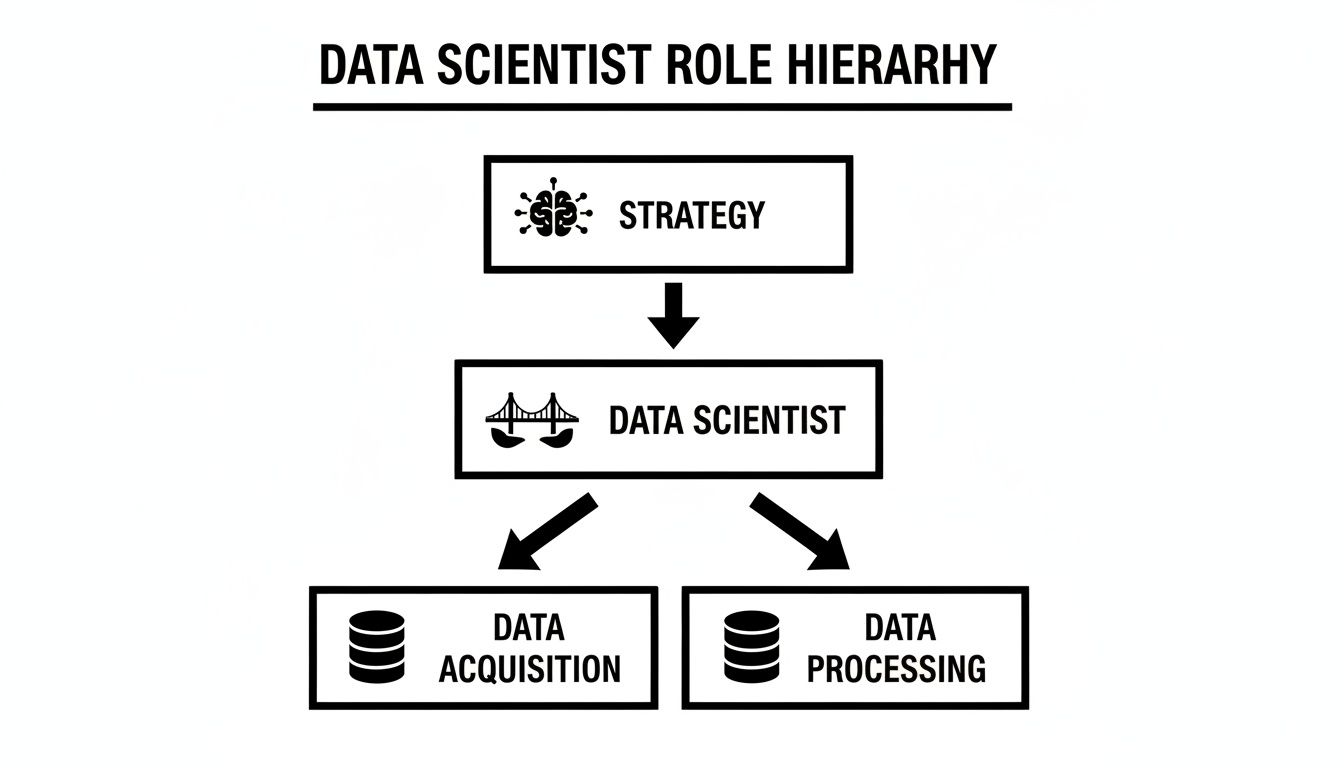
For executive leaders in Germany, the dialogue surrounding AI in management has transitioned from theoretical potential to strategic urgency. The critical question is no longer if artificial intelligence will redefine corporate strategy, but how swiftly your organisation can integrate it to establish a durable competitive advantage. This guide provides a direct, actionable framework for navigating this essential business transformation.
Why AI Is a Strategic Imperative

In today's environment of intense global competition and rapid market shifts, conventional management models are reaching their operational limits. The sheer volume of data now available exceeds the capacity of any human team to effectively process and synthesise. This creates a critical gap between possessing information and deriving actionable intelligence from it.
AI in management directly addresses this gap. Its role extends beyond simple automation, evolving into a strategic co-pilot for the C-suite.
For both the German Mittelstand and large corporations, this represents more than a technological upgrade. It is an opportunity to amplify the core principles that define Germany’s industrial strength: precision, efficiency, and quality. AI acts as a powerful multiplier for these attributes, enabling leaders to anticipate market trends, deconstruct complex supply chains, and identify operational vulnerabilities with unprecedented clarity.
The Shift from Tactical Tool to Strategic Partner
Perceiving AI as merely a productivity application is a significant strategic miscalculation. It is more accurately understood as an intelligence layer integrated into the core operational fabric of the organisation. This paradigm shift empowers management to operate with greater foresight and strategic focus.
Consider the practical implications of this shift:
- Predictive Forecasting: Transition from retroactive analysis of past performance to predictive modelling that anticipates customer demand, identifies potential supply chain disruptions, and projects financial outcomes with greater accuracy.
- Operational Agility: Move from reactive problem-solving to proactive optimisation. Utilise real-time data to dynamically adjust production lines, reallocate resources efficiently, and optimise logistics before disruptions occur.
- Enhanced Decision-Making: Augment executive intuition with robust, data-driven evidence. AI enables leaders to run complex simulations, test strategic hypotheses, and select pathways validated by rigorous analysis.
The primary value of AI in management is not the replacement of human leadership, but its augmentation. It provides the analytical horsepower required to convert vast data sets into strategic clarity, freeing leaders to concentrate on their core functions: defining vision, motivating teams, and making final, informed decisions.
This guide is structured as a C-suite briefing for business leaders. It outlines a direct path from conceptual understanding to the implementation of practical, value-generating solutions. By deconstructing the process into a clear framework—encompassing strategy, engineering, security, and enablement—you will gain the confidence necessary to lead your company’s next strategic evolution.
Understanding the AI-Powered Management Landscape

To effectively leverage AI in management, it is crucial to look beyond technical jargon and recognise its fundamental nature: a suite of powerful analytical capabilities. At its core, AI is not an opaque "black box" but a methodology for identifying patterns and extracting insights from data at a scale unattainable by human teams.
Conceptualise AI not as a replacement for leadership but as a tireless cohort of expert analysts operating continuously. This team can process immense volumes of data from your supply chain, manufacturing facilities, or customer service channels, highlighting opportunities and risks that would otherwise remain latent. Adopting this perspective is the foundational step in evolving from a traditional hierarchy to a more agile, data-driven organisation.
Translating AI Concepts into Business Value
For German industry, several categories of AI are already delivering a tangible, immediate impact. These are not futuristic concepts but practical tools generating value today. Understanding their function is key to identifying high-impact opportunities within your operations.
Germany’s burgeoning AI startup ecosystem offers clear indicators of market direction. The number of AI startups surged to 508 in 2023, a 67% increase from the previous year. Analysis reveals that specific domains are driving significant business innovation: 28% of these firms specialise in computer vision, 25.3% in natural language processing, and 15.1% in advanced forecasting, as detailed in the German AI Startup Landscape analysis.
This growth highlights three critical areas for executive focus:
Ready to Build Your AI Project?
Let's discuss how we can help you ship your AI project in weeks instead of months.
- Enterprise Intelligence: This forms the cognitive core of your AI strategy. It involves using systems to analyse internal and external data to inform superior strategic decisions, from assessing market entry risks to optimising capital allocation.
- Computer Vision: Indispensable for manufacturing and logistics, this technology enables machines to interpret the physical world. It powers automated quality control, predictive maintenance alerts for machinery, and intelligent inventory management in warehouses.
- Natural Language Processing (NLP): This discipline focuses on enabling AI to comprehend and process human language. Applications are extensive, from analysing thousands of customer reviews simultaneously to automating contract analysis and streamlining supplier communications.
In a management context, the primary function of AI is to convert raw operational data into strategic foresight. It provides the empirical evidence required to validate executive intuition and de-risk major decisions, ensuring every choice is grounded in objective data analysis.
Mapping AI Applications to Core Management Functions
The strategic value of AI is realised when these technologies are applied to specific, high-value business functions. The objective is not to adopt technology for its own sake, but to solve concrete problems, enhance efficiency, and unlock new growth avenues. For a detailed examination of the underlying technical architecture, our guide on modern system engineering principles provides valuable insights.
The following table illustrates how these AI technologies integrate with core management tasks, with particular relevance to Germany’s key industrial sectors. This mapping demystifies the technology and connects it directly to your operational reality and strategic objectives.
Mapping AI Applications to Core Management Functions
This table illustrates the practical application of different AI technologies across key management domains, providing concrete examples relevant to German industries.
| Management Function | Relevant AI Technology | Practical Application Example (e.g., Automotive, Manufacturing) |
|---|---|---|
| Strategic Planning | Enterprise Intelligence & Forecasting | Simulating market scenarios to predict the impact of pricing changes or new competitor entries, optimising long-term capital allocation. |
| Operations Oversight | Computer Vision & Predictive Analytics | Monitoring production lines in real-time to detect microscopic defects, predicting machine failures before they occur to schedule maintenance. |
| Supply Chain Management | Natural Language Processing (NLP) & Forecasting | Analysing global logistics data and news to anticipate shipping delays, automating communication with suppliers to resolve bottlenecks. |
| Customer Relationship Management | Natural Language Processing (NLP) & Analytics | Analysing thousands of customer service transcripts to identify recurring product issues and sentiment trends, personalising marketing efforts. |
This structured view provides a clear framework for identifying the most promising starting points for your organisation's AI journey. The key lies in aligning the right technological capability with the right business imperative.
Building the Strategic Business Case for AI Adoption
Ultimately, any substantive discussion about AI in management must focus on financial outcomes. For any AI initiative to secure executive sponsorship and investment, it requires a robust business case that articulates its tangible value. The central thesis is that AI enables the organisation to shift from a reactive posture to one of predictive, value-driven action.
This necessitates a move away from speculative technology pilots toward targeted, high-impact applications. The business case is not an academic exercise; it is a practical roadmap detailing specific, measurable outcomes that justify the required capital expenditure.
Identifying the Core ROI Drivers
The return on investment from AI in management is typically derived from four primary domains. A compelling business case quantifies the anticipated impact in these areas, linking each initiative directly to financial performance. This framework provides a straightforward method for tracking value creation.
The German market is well-positioned for this transformation. Projections indicate Germany's AI market will grow from $12.18 billion in 2025 to $54.71 billion by 2032, fuelled by strong demand for trustworthy AI. For leaders in manufacturing—a cornerstone of the German economy—the momentum is palpable. By early 2024, 17% of companies were already using AI, with 40% of them citing cost reduction as the primary driver.
This growth is predicated on delivering demonstrable value. Your business case should be structured around these key outcomes:
Want to Accelerate Your Innovation?
Our team of experts can help you turn ideas into production-ready solutions.
- Accelerated, Data-Informed Decisions: AI provides leadership with a data-driven validation mechanism, leading to faster, more accurate strategic choices. Examples include using predictive models for precise demand forecasting or simulating market scenarios to de-risk major investments.
- Radical Process Optimisation: This involves leveraging AI to fundamentally re-engineer core workflows for maximum efficiency. Applications include automating complex supply chain logistics, using computer vision for zero-defect quality control, or deploying intelligent agents for routine managerial reporting.
- Creation of New Revenue Streams: AI can unlock novel business models. This could involve developing AI-powered services for customers, creating "smart products" with predictive maintenance capabilities, or launching data-as-a-service offerings based on unique market insights.
- Proactive Risk Mitigation: By analysing vast datasets for subtle anomalies, AI can identify potential financial, operational, or compliance risks long before they escalate, enabling management to shift from crisis response to proactive prevention.
An effective business case for AI is not about the technology itself. It is about solving a specific, high-value business problem more effectively than was previously possible. It positions AI as a direct enabler of strategic objectives—be it market share growth, margin expansion, or enhanced organisational resilience.
De-Risking Investment Through Rapid Validation
A common obstacle to AI adoption is the perceived risk and extended implementation timelines. A modern business case addresses this by proposing a rapid validation methodology. The objective is to deliver a clear proof-of-concept in weeks, not years, demonstrating tangible value with minimal initial investment. This agile approach builds executive confidence and creates momentum for broader deployment. For a deeper understanding of how data becomes a strategic asset, refer to our guide on leveraging analytics and insights.
A Practical Framework for AI Implementation
Moving from high-level strategy to tangible business results requires a structured, disciplined approach. A series of disconnected AI experiments is a recipe for wasted capital and time. A robust framework that integrates strategy, technology, governance, and people is essential for success.
Our experience shows that successful implementation rests on four interdependent pillars. Consider them as critical, parallel workstreams. Neglecting any one of them compromises the stability of the entire initiative, which is why many AI projects fail to progress beyond the pilot stage.
Pillar 1: Strategic Alignment
Strategy is the foundation. This pillar ensures that all AI initiatives are precisely targeted at solving high-value business problems, not merely pursuing technological trends. This requires a rigorous process of identifying where AI can genuinely impact financial performance.
Looking for AI Expertise?
Get in touch to explore how AI can transform your business.
Key activities include:
- Identify High-Value Use Cases: Collaborate with business units to identify critical operational bottlenecks and strategic opportunities. Pinpoint the specific areas where AI can provide a decisive competitive edge.
- Develop the Business Case: Quantify the expected ROI for the most promising initiatives. Establish clear metrics, whether they relate to cost savings, revenue generation, or efficiency gains.
- Create a Strategic Roadmap: Plan a phased implementation. Begin with a rapid proof-of-concept to validate assumptions and deliver early results. This builds the necessary momentum for larger-scale deployments.
The primary objective is to create a clear, compelling vision for AI that secures leadership alignment and directs organisational effort. Success is measured by the robustness of the business case and the clarity of the implementation roadmap.
This pillar is about establishing a direct link between technological investment and financial outcomes.
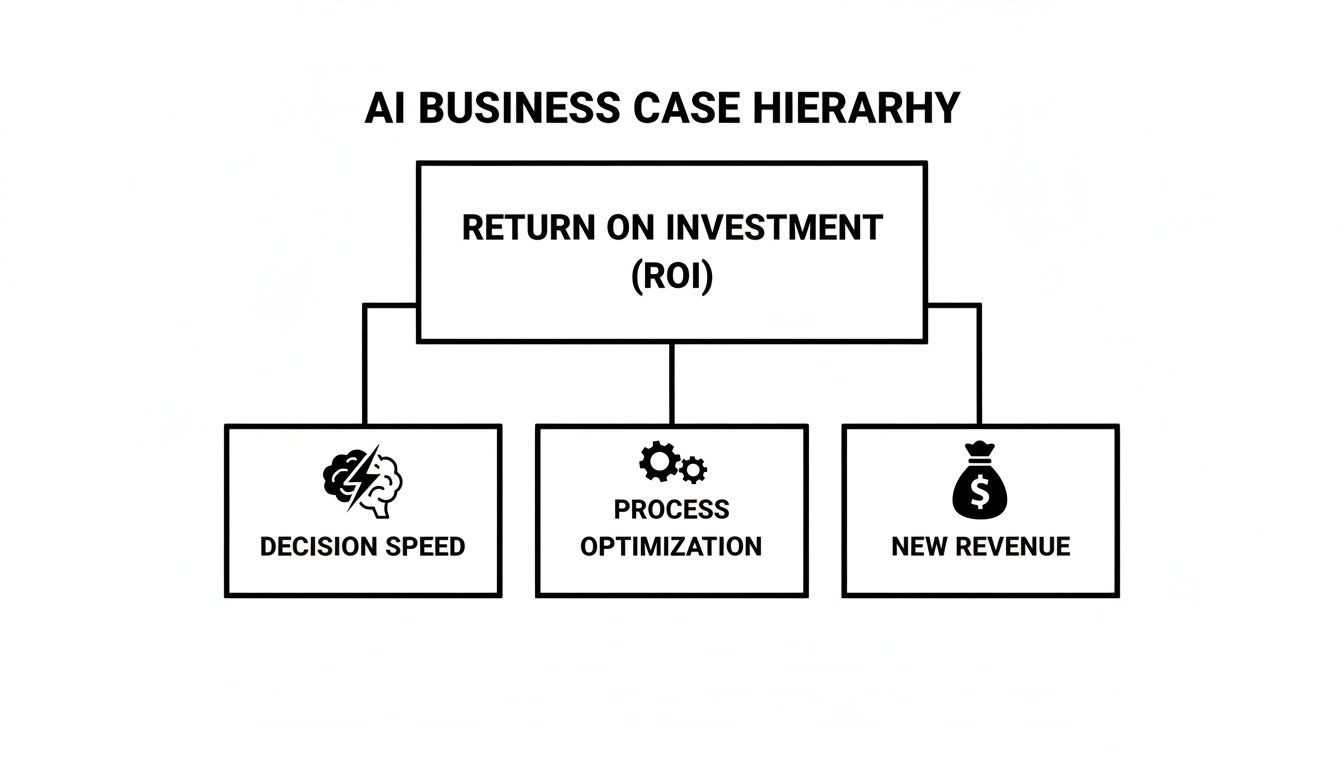 As the diagram illustrates, a strong AI initiative must be directly tied to measurable business results such as accelerated decision-making, optimised processes, and new revenue channels.
Pillar 2: Engineering Excellence
With the strategy defined, the focus shifts to execution. The engineering pillar encompasses the entire technical lifecycle, from initial prototype to a robust, enterprise-grade system integrated seamlessly with your existing technology infrastructure. Achieving this requires deep expertise in AI Engineering.
This discipline extends far beyond coding. It involves building AI solutions that are scalable, secure, and maintainable. Key tasks include selecting appropriate models, designing resilient data pipelines, and ensuring system reliability. For many German enterprises, this also involves a strategic evaluation of self-hosted solutions to maintain full data sovereignty.
Ready to Build Your AI Project?
Let's discuss how we can help you ship your AI project in weeks instead of months.
"A common failure point in AI projects is the inability to move from a successful prototype to a production-grade system. Engineering excellence ensures that what works in the lab also works reliably and securely at enterprise scale."
The main objective is to build and deploy AI systems that are not only effective but also sufficiently robust for mission-critical operations. Success is measured by system performance, scalability, and a smooth transition from pilot phase to ongoing operations.
Pillar 3: Security and Compliance
In Germany and across Europe, security and compliance are not ancillary concerns—they are foundational requirements. This pillar is dedicated to establishing robust data governance and ensuring adherence to critical regulations such as GDPR and industry-specific standards like TISAX in the automotive sector.
Privacy must be embedded by design from the outset. This requires conducting thorough data protection impact assessments, establishing clear data ownership protocols, and implementing stringent access controls. For AI systems, it also demands model transparency and explainability sufficient to meet both regulatory and ethical standards.
A clear governance structure is essential for managing a growing portfolio of AI models. A target operating model can provide the necessary framework for this level of control and oversight.
Pillar 4: Organisational Enablement
Ultimately, the value of any technology is realised through the people who use it. This final pillar addresses the human dimension of the transformation. It is fundamentally a change management challenge, focused on upskilling teams and cultivating a culture that embraces data-driven decision-making.
This requires more than a series of training workshops. It involves creating hands-on projects, establishing communities of practice for knowledge sharing, and consistently communicating the strategic "why" behind the AI vision. The goal is to demystify AI, build trust, and empower employees to view it as a co-pilot that enhances their own capabilities.
The objective is to foster a sustainable AI culture that encourages experimentation and innovation. Success is evidenced by rising adoption rates, user proficiency with new tools, and a demonstrable shift toward an AI-augmented organisational mindset.
The following table summarises how these four pillars create a structured path to AI implementation.
The 4-Pillar AI Implementation Framework
| Pillar | Key Activities | Primary Objective | Key Success Metric |
|---|---|---|---|
| Strategy | Use Case Identification, Business Case Development, Roadmap Creation | Align AI initiatives directly with high-value business goals and secure executive buy-in. | Quality and feasibility of the business case; clarity of the implementation roadmap. |
| Engineering | Model Selection, Data Pipeline Architecture, System Integration, Scalable Deployment | Build and deploy robust, reliable, and scalable AI systems that work in the real world. | System performance and stability; successful transition from pilot to production. |
| Security/Compliance | Data Governance, GDPR/TISAX Adherence, Privacy by Design, Model Explainability | Ensure all AI activities are secure, ethical, and fully compliant with all relevant regulations. | 100% compliance with legal and industry standards; auditable model transparency. |
| Enablement | Upskilling and Training, Change Management, Fostering an AI-Ready Culture | Build organisational capability and drive widespread user adoption of new AI tools. | User adoption rates; employee proficiency with new tools; demonstrated culture shift. |
By systematically addressing each of these pillars, you create a comprehensive and de-risked pathway to making AI a core component of your management operating system.
Leading the Organisational Shift to an AI-Powered Culture
Successful implementation of AI in management is not a technology project; it is a change leadership initiative. The most advanced algorithms will deliver zero value if the organisation's culture, roles, and processes remain static. Executive leaders must guide this human and structural evolution with the same rigour they apply to the technical implementation.
This is about architecting a new mode of collaboration. Managers evolve from supervisors to AI-augmented leaders, using intelligent systems to sharpen strategic thinking and enhance decision quality. Concurrently, employees are equipped with AI co-pilots that automate routine analytical tasks. This frees human capital to focus on high-value activities: creative problem-solving, complex negotiations, and building client relationships.
Redefining Roles and Responsibilities
The integration of AI necessitates a deliberate re-evaluation of job roles. The objective is not to replace personnel but to elevate their contributions by automating tasks, not jobs. A transparent communication strategy is critical to building trust and mitigating resistance, framing AI as a tool for empowerment.
Key actions include:
- Conduct a skills gap analysis: Identify the competencies, such as data literacy and critical thinking, that will become paramount in an AI-augmented environment.
- Invest in targeted upskilling programs: Move beyond generic training to provide hands-on experience with the specific AI tools relevant to individual roles.
- Redesign workflows: Intentionally structure processes to facilitate seamless human-AI collaboration, ensuring the technology supports, rather than dictates, human activity.
This form of strategic workforce planning is urgent. German managers are in the midst of a significant generative AI adoption wave. Recent research indicates the number of German companies using or planning to use GenAI is projected to reach 56% by 2026. Early adopters are deepening their integration, with AI forecast to handle 12.6% of all working hours by that year. A full analysis of these GenAI adoption trends in German firms provides further context.
Establishing Robust AI Governance
As AI becomes embedded in daily operations, a formal governance structure becomes non-negotiable. This framework provides the necessary rules and oversight to ensure AI is developed and deployed responsibly, ethically, and in alignment with business objectives. It establishes the guardrails required to manage risk without stifling innovation.
A strong governance model is the bedrock of a sustainable AI strategy. It establishes clear ownership, accountability, and ethical standards, ensuring that AI-driven decisions are transparent, fair, and auditable.
An effective AI governance committee should be a cross-functional body, comprising representatives from IT, legal, data protection, and key business units. This group is responsible for setting policy, approving high-impact projects, and ensuring compliance with regulations like GDPR. For leaders navigating this complexity, the principles of effective change management consulting offer a valuable strategic roadmap.
Adapting KPIs for an AI-Driven World
Traditional Key Performance Indicators (KPIs) are often inadequate for capturing the full value created by AI. A new set of metrics is required to reflect the impact of intelligent systems. The focus must expand beyond cost savings to include improvements in decision velocity, innovation rate, and employee engagement.
Consider adapting performance metrics to include:
Want to Accelerate Your Innovation?
Our team of experts can help you turn ideas into production-ready solutions.
- Decision Accuracy and Speed: Quantify the improvement in forecast accuracy or the reduction in time required for strategic planning cycles with AI support.
- Process Automation Rate: Measure the percentage of a given workflow that has been automated and the resulting impact on team capacity.
- Innovation Velocity: Track the number of new products, services, or process improvements generated from AI-driven insights.
By leading this cultural shift with clear communication, robust governance, and relevant success metrics, you create an environment where AI is not merely adopted but thrives for long-term strategic advantage.
Your First Steps as an AI-Enabled Leader
Initiating your journey into AI in management is not about a massive technological overhaul. It is a fundamental shift in leadership philosophy. The objective is not to replace human intuition but to augment it with data-driven intelligence. For German executives, this requires decisive, informed action.
This is not a blind leap. Our four-pillar framework—Strategy, Engineering, Security & Compliance, and Enablement—provides a structured, de-risked starting point. By systematically addressing each domain, you can translate abstract concepts into tangible business results with speed and confidence.
Adopting a Co-Preneurial Mindset
Succeeding in this new landscape often requires a different operational mindset. We advocate a "co-preneurial" approach: partnering with specialists to share risk and accelerate time-to-market. This model allows you to bypass the lengthy process of building a large internal team from scratch and instead focus on delivering value rapidly through targeted proofs-of-concept.
The core responsibility of modern leadership is to de-risk innovation. Strategic partnerships enable you to validate business hypotheses with speed, transforming strategic concepts into market-ready solutions without the encumbrance of long internal development cycles.
Looking for AI Expertise?
Get in touch to explore how AI can transform your business.
This collaborative model is crucial for navigating complexity while maintaining momentum.
Securing Germany's Competitive Edge
Integrating AI into core management practices is a strategic imperative for the future of German industry. It is the key to unlocking new levels of efficiency, driving genuine innovation, and securing a sustainable competitive advantage in the global market.
Your first step is not to become a technology expert. It is to identify a single, high-value business problem where AI can deliver a measurable impact. Start there. Build a robust business case, secure a rapid, tangible result, and lead your organisation confidently into its next chapter. The time for informed, decisive action is now.
Got Questions About AI in Management? We’ve Got Answers.
When considering the implementation of AI in management, leaders often have practical, pointed questions. Moving from potential to reality requires addressing these concerns directly. Here are common queries from executives in German enterprises, with direct answers designed to facilitate action.
How can we start with AI if we lack a large data science team?
This is a common challenge, but the solution is more straightforward than it appears. You do not begin by hiring a large team of data scientists; this approach misaligns investment with initial needs.
Ready to Build Your AI Project?
Let's discuss how we can help you ship your AI project in weeks instead of months.
The optimal first step is to select one specific, high-value business problem and engage a specialist partner. Frame this as a focused sprint designed to achieve a quick, tangible result with a clear return on investment, such as improving a production forecast or optimising a supply chain link.
This initial success creates a powerful internal case study. It justifies a gradual, strategic expansion of in-house capabilities through targeted hires and, crucially, by upskilling existing personnel. The focus must remain on delivering business value first, rather than on building a comprehensive technology stack prematurely.
What is the single greatest risk in AI adoption, and how can it be mitigated?
The primary risk is not technological failure but strategic misalignment. Many AI projects fail because they originate from a fascination with the technology ("We need an AI strategy") rather than from a clear business problem. This leads to costly experiments with no discernible impact on financial performance.
The solution is strategic discipline. A business-first approach is non-negotiable.
- Start with a defined business challenge. Identify a concrete problem that impacts your bottom line or competitive position.
- Quantify the opportunity. Develop a rigorous business case and define the specific metrics that will measure success.
- Utilise a structured framework. Ensure your planning addresses strategy, engineering, security, compliance, and organisational enablement from the outset.
- Validate before scaling. Implement a proof-of-concept to test assumptions quickly and de-risk the initiative before committing significant capital.
How do we ensure our AI systems comply with GDPR?
Compliance cannot be an afterthought; it must be integrated into the project lifecycle from day one. Involve your legal and data protection officers during the initial strategy phase, not just prior to deployment.
Want to Accelerate Your Innovation?
Our team of experts can help you turn ideas into production-ready solutions.
Establish robust data governance protocols: understand data provenance, ensure data quality, and implement strict access controls. For applications involving sensitive data, a strategic evaluation of self-hosted or private cloud solutions is essential to maintain data sovereignty.
Partnering with experts who possess deep knowledge of German and EU regulations, including industry standards like TISAX, is critical. This ensures that principles like 'Privacy by Design' and 'Explainable AI' (XAI) are embedded from the ground up. The ability to make model decisions transparent and auditable is not optional; it is a core requirement under GDPR's principles of fairness and accountability.
Addressing these challenges proactively is how you build an AI foundation that is not only powerful but also resilient and compliant.
At Reruption, we are not merely consultants; we are your co-preneurs in the AI era. We help you navigate complexity, manage these challenges, and translate strategic ideas into real-world innovation. We partner with you to de-risk implementation and accelerate your path to tangible business value. Learn how we can help you build your AI-powered future.