Change management consultants serve as strategic architects for an organisation's most pivotal transformations. They are engaged when enterprises navigate significant shifts—such as integrating artificial intelligence, overhauling operational structures, or executing a fundamental cultural realignment. Their primary mandate is to manage the human element of change, ensuring that new strategic initiatives are successfully embedded without disrupting operational continuity.
The Imperative of Strategic Evolution

In today's dynamic market, particularly for German enterprises, the most significant risk is not a bold initiative that falls short of its target, but the creeping paralysis of strategic inertia. Continuous, purposeful evolution is no longer a discretionary discipline; it is a fundamental prerequisite for sustained competitiveness. Organisational stasis is, in effect, regression.
Potent macroeconomic and technological forces compel leadership to rethink foundational business models. The proliferation of Artificial Intelligence, the reconfiguration of global supply chains, and a volatile regulatory landscape are not discrete challenges. They are interconnected currents reshaping the corporate environment, and they demand a strategic, orchestrated response.
From Disruption Management to Organisational Capability
Viewing organisational change as a series of discrete, disruptive projects is a critical strategic error. The superior approach is to cultivate change as a core leadership competency—a permanent, institutional capability that enhances organisational resilience and agility.
Ready to Build Your AI Project?
Let's discuss how we can help you ship your AI project in weeks instead of months.
This paradigm shift is essential because the human variable is the most critical factor in any transformation. A strategically brilliant plan is rendered ineffective if the personnel responsible for its execution are misaligned, resistant, or insufficiently equipped for the new paradigm. Empirical data corroborates this: an estimated 70% of change initiatives fail to achieve their stated objectives, overwhelmingly due to a failure to manage human and cultural dynamics.
Successfully navigating this requires more than standard project management. It demands specialised expertise in organisational diagnostics, stakeholder engagement, and applied behavioural science.
An organisation's capacity for adaptation is directly proportional to its ability to manage the human experience of change. When this dimension is overlooked, even the most promising strategies fail to deliver their intended value.
A Strategic Mandate for Partnership
This reality reframes the calculus for engaging external expertise. Retaining experienced change management consultants is not a remedial measure or an admission of internal deficiency. It is a calculated, strategic investment to de-risk an organisation's most critical initiatives.
Their function is to construct a robust bridge between executive vision and operational reality. They ensure every organisational stratum is prepared, aligned, and motivated to execute the change. In an environment where the cost of inertia is catastrophic, securing this expertise is non-negotiable for ensuring future growth and market leadership.
Architects of Transformation: The Consultant's Mandate

It is a common misconception to equate a change management consultant with a senior project manager. While both roles are mission-critical, they operate on distinct strategic planes. A project manager is accountable for the technical delivery of a project—the what and the when. The change consultant, conversely, architects its human adoption—the why and the how.
They function as the essential conduit between an executive's strategic intent and the operational reality for the workforce. Their entire focus is to ensure that a new strategy, system, or process is not merely installed, but is actively understood, embraced, and ultimately owned by the individuals required to use it. This becomes paramount during high-stakes transformations, especially those involving disruptive technologies like Artificial Intelligence.
This is not a niche discipline; it is a significant economic force. The German management consulting market, in which change management consultants are a core component, is projected to reach a market volume of €47.7 billion in 2025. This reflects the reality on the ground: German enterprises are deeply engaged in complex digitalisation and Industry 4.0 initiatives and require expert guidance to navigate the corresponding human transformation.
Beyond the Gantt Chart: Core Functions
The substantive work of a change consultant begins long before a project plan is finalised. The initial action is a rigorous diagnostic of the organisation's readiness for the impending change. This involves identifying cultural fault lines, latent political dynamics, and pockets of resistance that could sabotage the initiative before it gains momentum.
Want to Accelerate Your Innovation?
Our team of experts can help you turn ideas into production-ready solutions.
Informed by this diagnostic, they architect a change strategy that is inextricably linked to the project's business objectives. Their role transcends "soft skills"; it is about delivering tangible outcomes through several key activities:
- Stakeholder Alignment: Systematically mapping all parties with an interest in the outcome—from the C-suite to the shop floor—and designing tailored engagement plans to secure buy-in and cultivate active championship.
- Communication Architecture: Designing and executing a communication strategy that is clear, consistent, and continuous. This involves addressing difficult questions, relentlessly articulating the strategic "why," and building authentic organisational momentum.
- Behavioural Frameworks: Implementing the necessary structures, training protocols, and incentive systems to embed new behaviours and skills into the organisation's operational DNA.
- Risk Mitigation: Proactively identifying human-centric risks—such as skill gaps, anxieties regarding job security, or perceived loss of status—and neutralising them before they can derail the project.
Empowering Leadership and the Workforce
An exceptional change consultant does not merely manage the change for the client. They build the internal capacity for the client's own leadership to spearhead it. A significant component of their role involves implementing practical leadership development programs that equip managers with the requisite tools to guide their teams through periods of turbulence. This focus on capability-building distinguishes a true transformation partner from a transactional service provider.
The success of any major initiative is ultimately determined by human dynamics. Consultants master this variable, transforming potential resistance into engaged adoption and ensuring the projected value of the change is fully realised.
They function as strategic enablers, de-risking complex projects by concentrating on the single most critical success factor: the people. By mastering the intricate human dimension of transformation, they ensure a high-level strategic vision translates into an operational reality that delivers lasting, measurable results. This requires a profound understanding of both corporate strategy and organisational psychology. To explore these intersections further, you can gain valuable insights from our guide on business management and consulting.
Ultimately, their mandate is to ensure the change is sustained, creating a more resilient organisation prepared for future challenges.
Anatomy of Transformation Failure
The narrative is common: a company initiates a large-scale transformation with ambitious objectives, only for the results to fall significantly short of the initial vision. This is not an anomaly but a persistent and costly pattern.
The deficiency rarely lies with the core strategic concept—be it AI integration or supply chain re-engineering. The critical issue is a systemic blind spot: a failure to adequately account for the human element required to execute the change.
Many leadership teams approach transformation as a purely technical problem. They formulate a detailed project plan, allocate a budget, and expect universal alignment based on the logical merits of the business case. This reflects a fundamental misunderstanding of organisational dynamics. A company is not a machine amenable to simple reprogramming; it is a complex social system founded on habits, relationships, and deeply ingrained operational norms.
This disconnect is particularly evident in the German corporate landscape. A recent study, the Porsche Consulting Change Management Compass 2023, revealed that a remarkable 69% of transformation projects at Germany's largest corporations falter due to inadequate change management. Consider the implications: while 66% of CEOs are planning major overhauls, the majority are projected to miss their targets. You can examine the complete findings in the Porsche Consulting Change Management Compass 2023.
Diagnosing the Root Causes of Failure
To understand why these initiatives underperform, one must look beyond superficial explanations. The root causes are typically enmeshed in the organisation's culture and structure. Identifying these is the foundational step toward developing an effective strategy—and it is here that an experienced change management consultant becomes indispensable.
Looking for AI Expertise?
Get in touch to explore how AI can transform your business.
Four principal factors consistently emerge in large-scale change failures:
- Misaligned Executive Incentives: When executive performance is still measured primarily by short-term, business-as-usual metrics, there is no genuine incentive to champion disruptive change. Public endorsements may be made, but private actions often prioritise departmental stability, creating a significant delta between stated goals and actual behaviour.
- Deficient Communication Strategy: Too often, "communication" is reduced to a series of top-down announcements—a kickoff meeting, periodic email updates, and a go-live notification. This unidirectional approach fails to articulate the strategic why behind the change, creating an information vacuum that is quickly filled by speculation and anxiety.
- Passive Resistance: Overt opposition is rare. More corrosive is passive resistance—manifested as missed deadlines, perpetual requests for additional data, or a reversion to legacy processes. This is not a symptom of laziness, but a clear signal that employees lack conviction in the change because they have been excluded from the process.
- Absence of Meaningful Metrics: Many projects lack clear, concise key performance indicators (KPIs) that link team activities to business outcomes. Without defined metrics for adoption rates or behavioural shifts, it is impossible to track progress, demonstrate value, or establish accountability.
To further clarify these dynamics, we can analyse the common failure points reported by executives.
Common Failure Points in Enterprise Transformation
| Cause of Failure | Impact on Project | Effective Mitigation Strategy |
|---|---|---|
| Misaligned Leadership Incentives | Creates conflicting priorities and undermines the project's authority. | Tie executive bonuses and performance reviews directly to transformation-specific outcomes and adoption metrics. |
| Insufficient Communication | Breeds mistrust, fuels rumours, and leaves employees feeling disconnected and anxious. | Develop a two-way communication plan that focuses on the "why" and creates forums for feedback and dialogue. |
| Passive Employee Resistance | Drags out timelines, erodes momentum, and ultimately sabotages adoption of new processes or tools. | Involve employees in the design and rollout process, creating a sense of ownership and co-creation. |
| Absence of Clear KPIs | Makes it impossible to demonstrate ROI, course-correct effectively, or celebrate tangible wins. | Define a small set of leading and lagging indicators that measure both activity and business impact. |
Ultimately, these factors all point to a single conclusion: transformations succeed or fail based on how well they address the human dimension.
The ultimate measure of success is not whether a new system was launched, but whether it is utilised to create demonstrable business value. Ignoring human dynamics is the most common—and most expensive—mistake a leadership team can make.
The Decisive Human Factor
All of these failure points converge on a singular truth: successfully managing the human side of change is the critical differentiator between a strategic investment and a significant financial loss. A technically flawless solution that fails to achieve user adoption is a complete failure. Conversely, a well-communicated initiative with strong employee buy-in can succeed even with imperfect initial technology.
Ready to Build Your AI Project?
Let's discuss how we can help you ship your AI project in weeks instead of months.
This is precisely where the specialised expertise of change management consultants provides a decisive advantage. They introduce the frameworks and discipline required to address these human factors systematically. By diagnosing organisational readiness and architecting robust strategies for communication, alignment, and measurement, they fundamentally improve the probability of success. It is a structured methodology for navigating the complex reality of major organisational shifts, often employing established models like the McKinsey 7-S model.
Selecting a Transformation Partner
The selection of a consulting partner is one of the most consequential decisions an executive will make. This choice can determine the success or failure of a major initiative, demanding an evaluation that extends far beyond a cursory review of credentials. This is not a procurement of a report, but the selection of a partner to deliver on strategic imperatives.
Evaluating Traditional Consulting Firms
Large, established consultancies have built their reputations on deep industry knowledge, proven methodologies, and extensive libraries of case studies. When evaluating these firms, the focus should be on several key criteria:
- Sector-Specific Expertise that demonstrates a nuanced understanding of your industry and its unique challenges.
- Methodological Rigor that indicates a consistent, data-driven approach to problem-solving and execution.
- Verifiable Success Stories with quantifiable metrics and measurable results that can be independently validated.
This structured assessment framework allows for a clear-eyed view of both the strengths and the inherent limitations of a purely advisory relationship.
Consider a case where a major automotive OEM engaged a global consultancy for a digital transformation. The firm delivered a comprehensive, multi-month playbook. However, during implementation, employee adoption faltered completely. The plan lacked tailored engagement strategies for the frontline teams—the very individuals tasked with execution. The result was a delayed ROI and a significant erosion of stakeholder trust.
Want to Accelerate Your Innovation?
Our team of experts can help you turn ideas into production-ready solutions.
A crucial due diligence step is to request references from projects of similar scope and complexity, and to inquire about employee engagement metrics post-implementation.
True partnership transforms advisory input into shared ownership and collective success.
Assessing Methodological Fit
Numerous frameworks will be referenced—Prosci ADKAR, Kotter’s 8-Step Process—but the mere use of a well-known model does not guarantee success. Application varies significantly.
The critical test is how a firm adapts these methodologies to your specific corporate culture and existing operational processes. The ideal partner tailors their approach to your organisation, rather than imposing a generic, one-size-fits-all model.
An Alternative Paradigm: The Co-Preneur Model
We advocate for a superior model. The Co-Preneur model fundamentally redefines the traditional consultant-client relationship, structuring it as an entrepreneurial joint venture.
Looking for AI Expertise?
Get in touch to explore how AI can transform your business.
It is predicated on the full integration of our team with yours, sharing both the risks and the rewards of the initiative. This eliminates arm's-length advisement in favour of deep, embedded partnership.
The key tenets of the Co-Preneur approach are:
- Shared Risk and P&L Accountability: Our commitment to the outcome is financial, not merely reputational.
- Rapid Prototype Development: We build and test concepts in days, not months, accelerating the path to a validated proof of concept.
- Peer-Level Collaboration: Our experts are embedded directly within your operational rhythm.
- Performance-Based Incentives: Our remuneration is directly tied to your business outcomes. We succeed only when you do.
Co-Preneurs in Action
A German manufacturing client piloted this approach for an AI initiative. Within five days, we delivered a functional AI prototype.
This rapid development cycle provided their leadership with the empirical data needed to validate a major cost-saving hypothesis before committing significant capital. This demonstrates the strategic value of velocity.
Visualising Decision Drivers
The infographic below illustrates a common decision tree for transformation initiatives, tracing the pathway from initial goal-setting to the root cause analysis when targets are missed.
Ready to Build Your AI Project?
Let's discuss how we can help you ship your AI project in weeks instead of months.
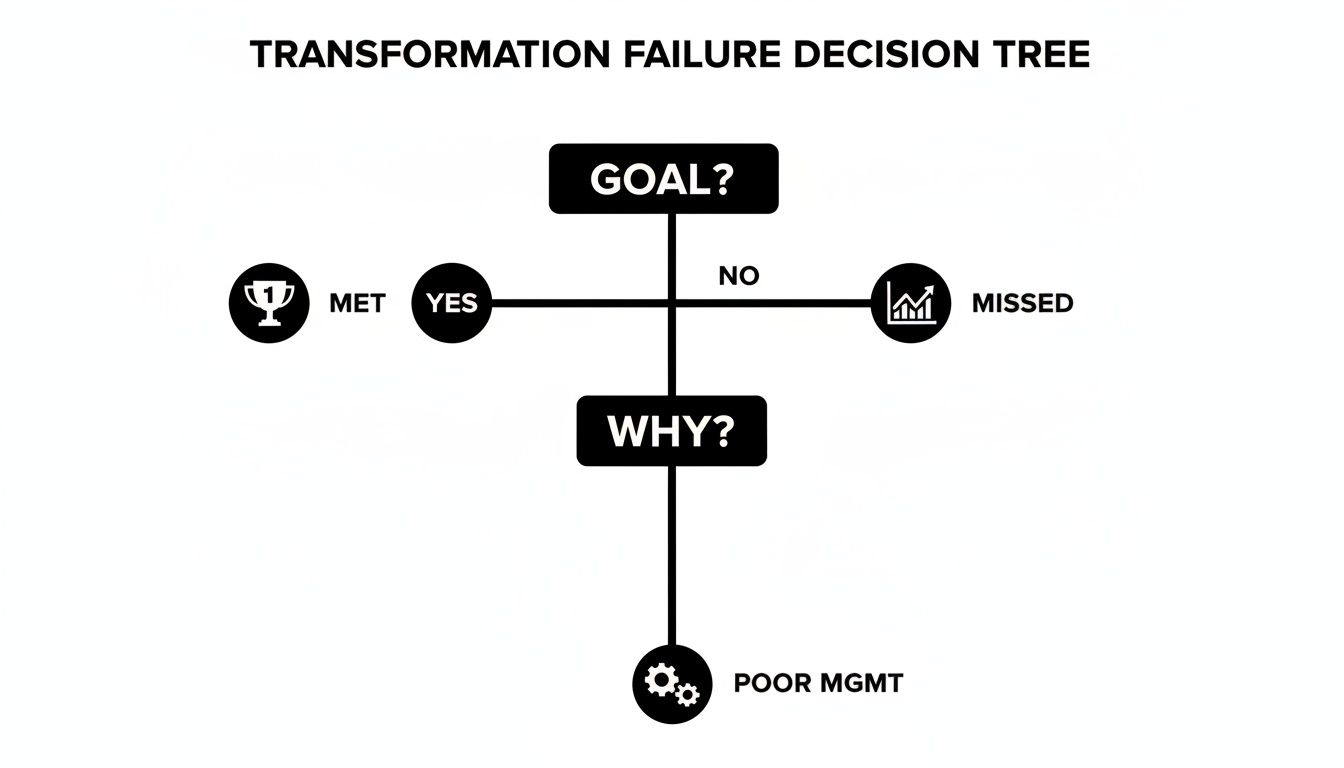
As depicted, missed objectives are frequently attributable to inadequate management oversight or executional deficiencies, rather than flawed strategy. It is in this execution gap that a hands-on, accountable partner provides maximum value.
Comparing Partnership Models: Co-Preneur vs. Traditional Consulting
To further delineate the distinction, the following table provides a direct comparison between a standard consulting engagement and the Reruption 'Co-Preneur' model. It highlights how the core philosophy impacts everything from fee structures to risk management.
| Attribute | Traditional Consultants | Reruption 'Co-Preneurs' |
|---|---|---|
| Fee Structure | Fixed fees or time and materials | Outcome-based fees tied to P&L results |
| Risk Alignment | Client bears most of the project risk | Shared risk model ensures joint accountability |
| Delivery Velocity | Documentation and phased delivery over months | Prototypes in days to validate hypotheses |
| Engagement Footprint | External advisors with periodic touchpoints | Integrated team members embedded during the entire journey |
Each model presents distinct trade-offs regarding control, speed, and risk. The objective is to align your organisation’s strategic priorities and culture with the appropriate partnership model. For many, the concept of a partner who co-owns success is transformative.
A partner who co-owns success transforms risk into opportunity.
Want to Accelerate Your Innovation?
Our team of experts can help you turn ideas into production-ready solutions.
When considering external support, it is also beneficial to understand the nuances between different service models, such as Staff Augmentation vs Consulting.
Defining Engagement Models
Consulting partnerships can be structured in various ways, including fixed-scope projects, time and materials, retainers, or outcome-based models.
Time and materials offers flexibility but places the majority of financial risk on the client. Fixed-scope provides cost predictability but can be rigid, locking parties into assumptions that may become obsolete during the project lifecycle.
Outcome-based models, the foundation of our Co-Preneur approach, align all incentives toward the creation of tangible value.
- Fixed-scope projects can lack the agility to pivot in response to market shifts.
- Retainer agreements ensure access to expertise but may lack a direct incentive to drive specific outcomes.
- Outcome-based engagements reward demonstrable business impact and foster stronger, long-term collaborative relationships.
Critical Questions for Any Potential Partner
Before entering into any agreement, a rigorous inquiry is necessary. The following questions are essential:
Looking for AI Expertise?
Get in touch to explore how AI can transform your business.
- What is the measurable ROI you can guarantee, and how will it be tracked collaboratively?
- How, specifically, do you structure risk distribution and shared accountability in the event of underperformance?
- Can you provide industry-specific case studies that are directly analogous to my business challenges?
- What is your timeline for delivering a working prototype or a minimum viable product?
- What does your day-to-day process for integration with our internal teams entail?
These questions penetrate marketing rhetoric and help identify a firm that is genuinely prepared to co-create value.
For a more comprehensive guide to vetting partners, our resource on vendor due diligence is invaluable.
A Final Selection Checklist
To consolidate the evaluation process, create a decision matrix. Compare shortlisted candidates based on expertise, methodological fit, risk alignment, prototyping velocity, and cultural compatibility.
Score each candidate on a scale of 1 to 5 for each criterion. This provides a clear, objective assessment to identify the top contenders for a proof-of-concept phase. This is not a bureaucratic exercise, but a disciplined process to select the partner with the highest probability of enabling you to achieve your strategic goals.
Choosing a partner is not a checkbox exercise; it is a strategic decision that defines your organisation’s capacity to change.
Ready to Build Your AI Project?
Let's discuss how we can help you ship your AI project in weeks instead of months.
Reruption’s Co-Preneur model offers a clear methodology to embed innovation internally and build a sustainable competitive advantage. It is a commitment to immediate action and shared success.
A Blueprint for Enterprise AI Adoption

Integrating Artificial Intelligence is not a mere technology upgrade; it is a fundamental re-engineering of an organisation's operational DNA. For a German industrial enterprise, such a transformation demands a disciplined, highly structured approach. Success is not defined by algorithm deployment but by the successful redesign of workflows, redefinition of roles, and instillation of a new data-driven mindset across the organisation.
To illustrate, consider a large automotive supplier aiming to implement a predictive maintenance system. The technical objective is straightforward: forecast equipment failures to reduce downtime. The primary challenge, however, is human. Experienced technicians may perceive the AI as a threat to their institutional knowledge, while middle management may lack the skills to interpret and act upon the new data streams.
This is where a hands-on, accountable partner provides critical value. The process does not begin with a technical specification. It begins in the boardroom, aligning leadership on the strategic objectives and defining concrete, measurable outcomes.
From Hypothesis to Prototype
An effective change management consultant will advocate for the rapid validation of use cases. The objective is to move beyond months of theoretical analysis and quickly develop a minimum viable product (MVP) to test the core hypothesis. For the automotive supplier, this would entail building a small-scale predictive model for a single critical asset, executed in weeks, not quarters.
This rapid prototyping approach yields two significant benefits. First, it provides immediate, empirical data on the AI's potential ROI, substantially de-risking the larger investment. Second, it serves as a powerful engagement tool. Technicians and line managers transition from passive observers to active co-creators of the solution.
The fastest path to de-risking an AI initiative is to move from theoretical business cases to tangible, working prototypes. This velocity separates viable concepts from unworkable ones before significant capital is committed.
Early involvement is crucial for building trust and demystifying the technology. When the team begins to view the AI as a tool that augments their expertise rather than replaces it, initial resistance diminishes.
Securing the Operational Core
Once the prototype validates the business case, the focus shifts immediately to security and compliance—a non-negotiable aspect within the German industrial sector. Any AI system interacting with sensitive operational data must be architected with robust security from its inception.
Want to Accelerate Your Innovation?
Our team of experts can help you turn ideas into production-ready solutions.
An accountable partner will ensure the solution adheres to stringent standards such as TISAX and ISO 27001. This extends beyond technical safeguards to include the creation of clear data governance policies that define access, interpretation, and action protocols for AI-generated insights. Integrating these security measures early prevents costly, project-derailing complications later. You can explore this critical area in greater depth in our guide on risk management and compliance.
Enabling the Workforce for Adoption
With a validated and secure solution, the final and most critical phase is workforce enablement. This is far more comprehensive than a one-time training session. It requires a structured program designed to build sustainable skills.
A robust enablement plan includes:
- Role-Specific Training: Technicians learn to interpret predictive alerts and integrate them into daily maintenance schedules.
- Leadership Coaching: Plant managers are coached on leveraging new data streams for improved production planning and resource allocation.
- Cross-Functional Workshops: Engineering, IT, and operations teams collaborate to refine the system and identify new use cases.
By embedding practical, hands-on training directly into daily workflows, the new processes become institutionalised. The AI system ceases to be a "project" and becomes integral to standard operating procedures. This is the hallmark of successful change—when new behaviours become the default.
This blueprint—from rapid validation and robust security to comprehensive workforce enablement—is the methodology for transforming potential resistance into engaged adoption. It ensures that a strategic investment in AI delivers not just technology, but a tangible, sustainable impact on the P&L. It is a methodical journey that a skilled change management consultant undertakes with your team, sharing accountability for the results at every stage.
Critical Questions for Your Transformation Initiative
When contemplating a major corporate transformation, it is imperative to address critical questions before committing significant resources. For any German executive or manager, achieving clarity on these points is non-negotiable. It is the only way to select the right consulting partner and mitigate the risk of project failure.
The following are key questions that consistently arise during the planning of a major change.
What is the optimal time to engage change management consultants?
The answer is unequivocal: at the very inception of the strategic conversation. Change management consultants should be engaged during the initial discovery and planning phases.
Early involvement allows them to conduct a thorough readiness assessment, identify potential cultural and operational impediments, and integrate the human dimension directly into the project's foundational strategy. This treats the people aspect as a core strategic pillar, not as a subsequent HR issue to be managed.
Delaying their engagement until resistance emerges is a reactive posture. This "firefighting" approach is significantly less effective and invariably more costly than proactive, integrated planning from the outset.
How is the ROI of change management measured?
The return on investment must be measured through tangible metrics tied directly to the project's business case. This requires a focus on quantitative key performance indicators (KPIs).
For an AI system implementation, for example, the KPIs should be unambiguous:
- Adoption Rates: What percentage of the target user base is actively utilising the new tools on a daily basis?
- Process Efficiency: What are the measured improvements in cycle times or reductions in error rates?
- Data Integrity: Has the quality and reliability of data improved as a result of the new system?
- Financial Targets: Have the projected cost savings or revenue enhancements been achieved?
A genuinely accountable partner will assist in defining these metrics at the project's start and will have a vested interest in achieving them. The ROI of change management is not an academic concept; it is a figure that manifests on the P&L statement.
In addition to quantitative data, qualitative feedback from employee surveys and stakeholder interviews is essential to gauge whether the change is being culturally embedded. A comprehensive view of ROI considers both financial performance and human factors. For further guidance on selecting a partner who understands this, please refer to our guide on choosing the right consultant.
What is our internal team's role during a consulting engagement?
The relationship must be a true partnership. Your internal team possesses invaluable institutional knowledge that cannot be externally sourced. They are the ultimate champions and owners of the change.
Looking for AI Expertise?
Get in touch to explore how AI can transform your business.
A clear division of labour is essential for effective collaboration:
- Your Leadership acts as the executive sponsor, providing top-level authorisation, governance, and strategic direction.
- Your Project Managers ensure alignment between the initiative and the day-to-day operational realities of the business.
- Your Subject Matter Experts provide critical validation, confirming that proposed solutions are functionally viable in the real-world operational environment.
The ultimate objective of a premier consultant is to build your internal capabilities, effectively making their own role redundant over time. They should be actively transferring knowledge and upskilling your team to manage future change initiatives autonomously.
How does an accountable partnership model de-risk a major AI project?
An accountable model, such as our co-preneur approach, mitigates the risk inherent in large-scale AI projects by focusing on tangible outcomes rather than theoretical deliverables. It directly addresses the primary cause of project failure: the gap between strategy and execution.
Instead of investing significant time and capital in extensive strategy documentation, the emphasis is on rapid prototyping. This allows for the testing of business hypotheses with a minimal initial investment, enabling you to quickly validate what works and discard what does not. This velocity is the most effective form of risk insurance.
Furthermore, by linking a consultant's compensation directly to your P&L results, your objectives become their objectives. They are incentivised not merely to provide advice, but to deliver a measurable impact on the bottom line. This entrepreneurial alignment transforms the dynamic from a client-vendor transaction to a genuine partnership, where both parties share the risk and, more importantly, the reward.
Ready to Build Your AI Project?
Let's discuss how we can help you ship your AI project in weeks instead of months.
At Reruption GmbH, we operate as Co-Preneurs for the AI era, sharing P&L accountability to turn your strategic ideas into market innovations. We build tangible prototypes in days, not months, ensuring your transformation delivers real business value.
Discover our approach at https://www.reruption.com.