
An innovation model business framework is the strategic blueprint that enables an enterprise to convert novel concepts into scalable, commercial value. It is a systematic construct for capital allocation, risk mitigation, and performance measurement, moving beyond the constraints of traditional, linear R&D pipelines to secure a genuine competitive advantage.
For large enterprises navigating market volatility, a robust innovation model is not merely beneficial; it is a strategic imperative for sustained market leadership.
Confronting Germany's Corporate Innovation Paradox
For decades, German enterprises have been synonymous with engineering excellence and rigorous R&D. This deep-seated commitment to quality and incremental improvement constructed an economic powerhouse.
However, the competitive landscape has fundamentally changed. High R&D expenditure, in isolation, no longer guarantees market dominance.
A significant paradox has emerged. Despite substantial investment in innovation, German firms face increasing pressure from agile, digital-native competitors. The rigid, process-intensive methodologies that perfected the internal combustion engine are ill-suited for developing AI-driven services or data-centric business models. This creates a critical disconnect between capital outlay and market impact.
The Disconnect Between Investment and Impact
Quantitative analysis confirms this trend. Germany remains a leading EU investor in corporate innovation, with spending at 143.4 percent of the EU average. Yet, this domestic leadership conceals a decline on the global stage. The nation has slipped from ninth to eleventh place in the World Intellectual Property Organization's Global Innovation Index. A comprehensive analysis of Germany's innovation performance in the EU provides further detail.
This divergence between high investment and diminishing global competitiveness highlights the core issue: it is not a funding problem but a framework deficiency. Channelling capital into outdated innovation structures yields suboptimal returns in a fast-paced global economy.
Shifting from Process to System
The solution is not a revised process but a new strategic perspective. An innovation model business framework is not merely a different sequence of operational steps. It is a dynamic system architected to manage uncertainty and accelerate organisational learning.
This system addresses critical questions that traditional R&D departments were not designed to answer:
- How do we identify and act upon high-potential opportunities with velocity? The focus shifts from exhaustive analysis to rapid market sensing and swift validation.
- How do we de-risk new ventures before committing significant capital? The methodology prioritizes small, rapid, data-driven experiments to test critical assumptions first.
- How do we construct a scalable pathway for successful initiatives? It provides a clear trajectory from a validated pilot to a fully integrated business unit or corporate spin-off.
For C-level executives, this represents a profound strategic pivot—from viewing innovation as a cost centre to managing it as a strategic portfolio of growth initiatives. Adopting this mindset is the foundational step toward recapturing competitive advantage, particularly in the context of how AI will really transform the German Mittelstand. It directly links macroeconomic trends to the necessity of a more agile, results-oriented innovation structure.
Selecting Your Strategic Innovation Model Archetype
Selecting the appropriate structure for corporate innovation is a decisive leadership mandate. The objective is not to adopt the latest trend but to choose a strategic vehicle engineered for specific business outcomes. Consider the innovation model as the operating system for growth; its architecture must align precisely with corporate objectives, risk tolerance, and organisational culture.
No single model is universally superior. Effective leadership requires a nuanced understanding of four primary archetypes, each with distinct purposes, strengths, and operational demands. Mastering these models is the first step toward building an innovation capability that delivers quantifiable results.
The flowchart below illustrates the strategic crossroads confronting many German enterprises: adhere to traditional R&D and risk market erosion, or adopt new models to reclaim competitive leadership.
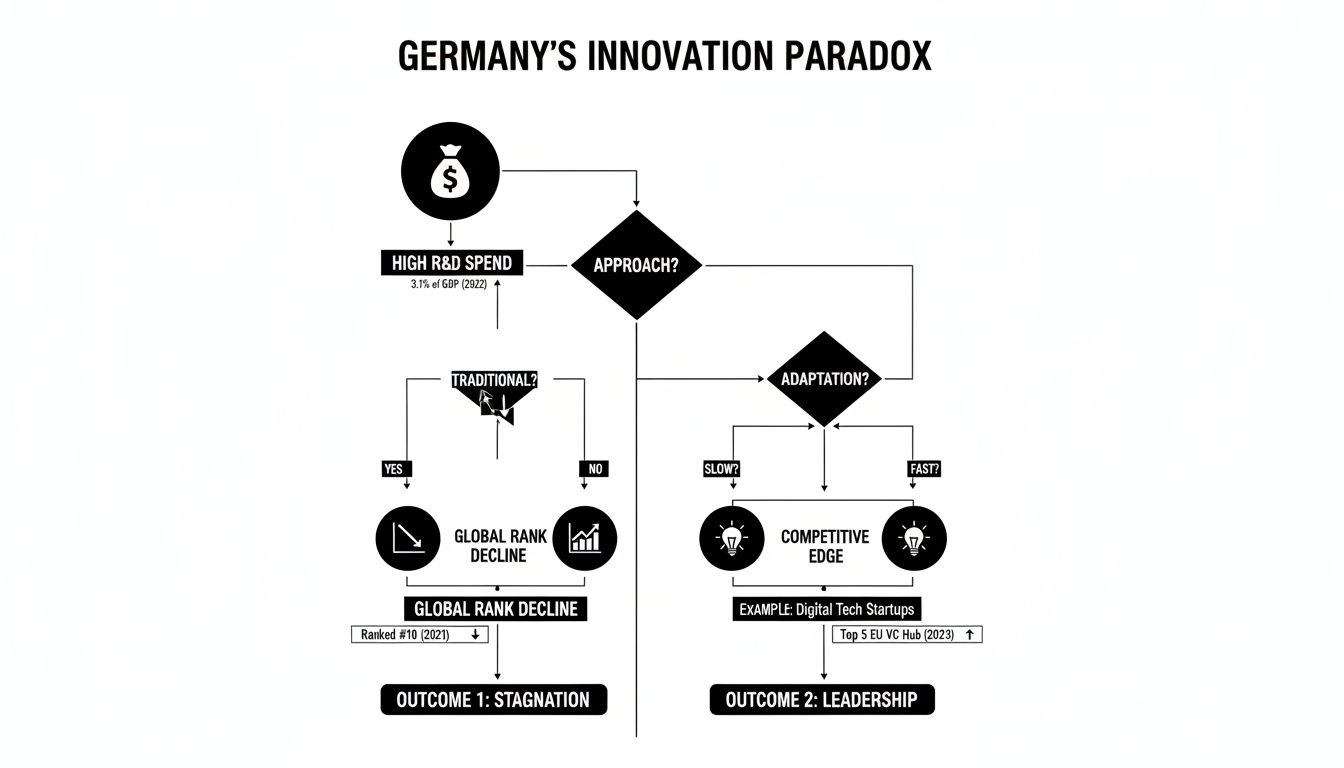
This visual underscores a critical insight: financial investment alone is insufficient. The structure of that investment is what distinguishes market leaders from those facing stagnation.
The Four Primary Innovation Archetypes
To make an informed strategic decision, it is essential to understand the function and optimal application of each model. These archetypes represent distinct tools for specific strategic objectives, from exploring nascent markets to enhancing core competencies.
1. The Incubator
An internal incubator functions as a protected environment within the corporation, designed to nurture early-stage concepts that maintain a strategic connection to the core business. It provides seed funding, executive mentorship, and access to corporate assets, shielding promising projects from the bureaucratic and fiscal pressures of the parent organisation.
- Core Objective: To develop and validate new products or services that represent adjacent growth opportunities for the core business.
- Best For: Enterprises seeking to explore new applications for existing technologies, drive adjacent growth, or embed entrepreneurial thinking within the organisation.
- Key Challenge: Mitigating the "corporate immune system" that can stifle nascent ideas. A clear pathway for integrating successful projects back into a core business unit is also critical.
2. The Accelerator
In contrast to an incubator that nurtures internal concepts, an accelerator engages primarily with external startups. It offers a structured, time-bound program providing mentorship and resources, typically in exchange for an equity position. The primary goal is to accelerate the scaling of existing startups, not to generate ideas de novo.
- Core Objective: To gain direct access to external innovation, identify potential acquisition targets, and absorb the agile methodologies of the startup ecosystem.
- Best For: Organisations aiming to tap into the broader technology landscape, rapidly identify market trends, or build a strategic venture portfolio.
- Key Challenge: Maintaining strategic alignment between the parent company and the startups. Managing the significant cultural disparity between a large corporation and an early-stage venture is paramount.
For many corporations, the strategic value of an accelerator extends beyond the startups themselves. It provides a potent injection of an entrepreneurial, high-velocity culture into the parent organisation—a masterclass in a new operational paradigm.
3. The Venture Builder
Also known as a venture studio, this model operates as a dedicated entity for building new companies from inception. It leverages a centralized pool of resources—including legal, marketing, and technology teams—to rapidly ideate, validate, and launch distinct businesses. These ventures are structured for aggressive scaling and are often established as separate legal entities from the outset.
Ready to Build Your AI Project?
Let's discuss how we can help you ship your AI project in weeks instead of months.
- Core Objective: To create entirely new, independent revenue streams by building and scaling businesses in new markets or with disruptive business models.
- Best For: Ambitious corporations with the capital and risk appetite to make substantial investments beyond their core operations and build a portfolio of high-growth ventures.
- Key Challenge: This model demands significant, long-term capital commitment, a high tolerance for failure, and specialized talent with proven experience in building companies from the ground up.
4. The Open Ecosystem
This model extends beyond the corporate perimeter to construct a network of external partners, including universities, suppliers, customers, and even competitors. Innovation becomes a collaborative endeavor, co-created through shared platforms, joint ventures, and strategic alliances.
- Core Objective: To access a broad and diverse pool of ideas, technologies, and talent to address complex challenges that exceed the capacity of a single entity.
- Best For: Industries facing systemic disruption, such as mobility or energy, where collaborative efforts are necessary to establish new standards and solutions. You can explore various models of business innovation in our detailed guide.
- Key Challenge: The primary complexities involve managing intellectual property rights, aligning strategic objectives among diverse partners, and maintaining momentum within a complex governance structure.
To facilitate a strategic assessment, the following table provides a comparative analysis of the four archetypes.
Innovation Model Archetype Comparison
| Model Archetype | Core Objective | Best For | Key Challenge |
|---|---|---|---|
| Incubator | Develop adjacent products/services internally. | Companies aiming for adjacent growth or fostering internal entrepreneurs. | Overcoming internal resistance and ensuring project integration. |
| Accelerator | Access external innovation and startup talent. | Organisations seeking market insights or potential acquisition targets. | Aligning corporate strategy with startup culture and goals. |
| Venture Builder | Build and scale new, independent businesses. | Businesses with high-risk tolerance looking to build a diverse portfolio. | Requires significant long-term capital and specialised talent. |
| Open Ecosystem | Co-create solutions with external partners. | Industries facing systemic disruption that require collaboration. | Managing IP, aligning diverse partners, and maintaining momentum. |
The selection of an appropriate model is a strategic dialogue, not a procedural exercise. This framework provides a robust foundation for that executive-level discussion.
As you finalize your chosen model, it is also advantageous to explore how AI tools to generate product strategy documents can accelerate foundational planning. The synthesis of a sound strategic model with advanced tools is what transforms strategy into a high-performance innovation engine.
Architecting Your AI-Powered Implementation Roadmap
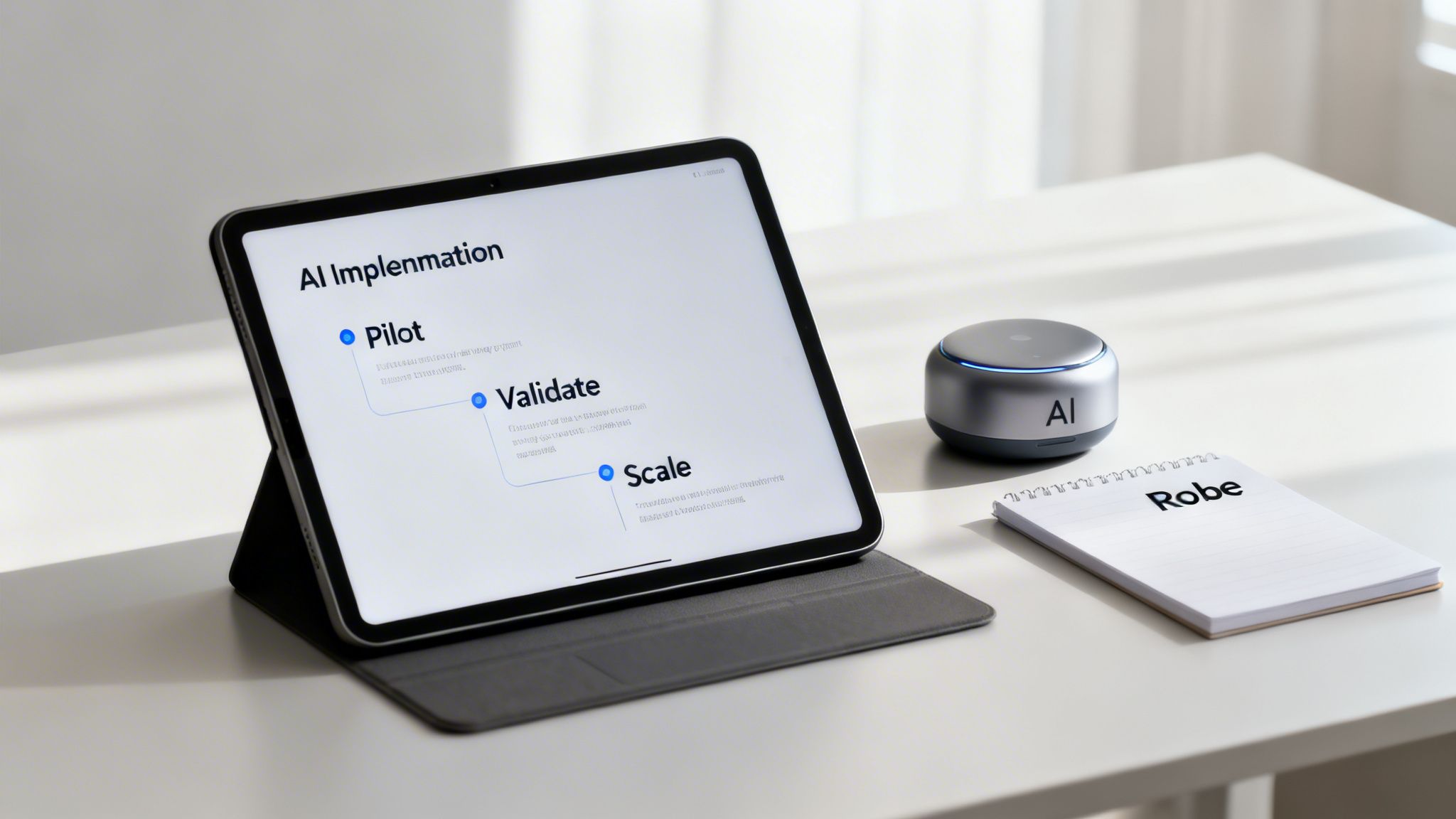
The selection of an innovation model is a pivotal executive decision. However, a model is merely a blueprint. The critical challenge—where most initiatives falter—lies in translating that strategic choice into a concrete implementation plan that delivers measurable results.
The typical failure point is not a lack of vision but the gap between strategic intent and operational reality—the failure to construct a clear, actionable roadmap.
For German leadership, the imperative to bridge this gap is intensifying. German companies recently invested a historic €213.3 billion in innovation. Significantly, the service sector's spending increased by 8.3%, signalling a strategic shift toward new value streams beyond traditional industrial production. A full analysis of Germany's record innovation spending on zew.de is available.
An investment of this scale demands a commensurate execution framework. This section outlines how to construct such a framework, leveraging Artificial Intelligence not as a buzzword but as a core operational accelerator. We will move from high-level strategy to the granular details of governance, team structure, and metrics required to operationalize your chosen innovation model business.
Establishing Governance and Defining Clear Roles
Prior to initiating any pilot, a robust governance structure is essential. This is not about creating bureaucracy but about establishing clarity and accountability. Without it, promising initiatives are stifled by internal politics, ambiguous ownership, and organisational risk aversion.
Want to Accelerate Your Innovation?
Our team of experts can help you turn ideas into production-ready solutions.
First, appoint an Innovation Board or steering committee composed of senior leaders with P&L responsibility. Their mandate is not to micromanage but to champion the innovation portfolio, authorize resources, and remove organisational impediments. They act as the primary defenders of new ventures against the corporate immune system.
Next, define key operational roles. A high-performance innovation unit requires a specific set of competencies:
- Venture Lead: This individual functions as the internal CEO of the project, with full accountability for validating the business case and achieving all milestones.
- Cross-Functional Team: A small, dedicated team comprising specialists from product, engineering, marketing, and finance. It is critical that they are 100% allocated to the project to avoid divided focus.
- Executive Sponsor: A member of the Innovation Board who serves as the venture's primary advocate, providing executive air cover and facilitating access to corporate resources.
This structure establishes a clear line of sight from execution teams to senior leadership, ensuring alignment and accelerating decision-making.
Fostering a 'Co-Preneur' Culture
Traditional corporate culture is often inimical to innovation. It penalizes velocity, risk-taking, and learning from failure. To counteract this, it is necessary to cultivate a 'Co-Preneur' culture within innovation teams. This model empowers them with the autonomy and drive of a startup founder.
A Co-Preneurial team is not given a task list; they are assigned a mission and granted the autonomy to determine the execution path. This instills true ownership over the outcome, linking their efforts directly to business impact.
Looking for AI Expertise?
Get in touch to explore how AI can transform your business.
This represents a fundamental mindset shift, moving the team from a cost-center orientation to a value-creation engine. They are not merely managing a project; they are building a business. A well-designed Target Operating Model provides the structural framework to embed this culture within the broader organization.
From Pilot to Scale: A Phased Approach
An effective roadmap is not a monolithic plan but a phased journey designed to systematically reduce uncertainty at each stage. By integrating AI-powered tools, each phase can be executed with greater speed and data-driven confidence.
Phase 1: Validate (Weeks, Not Months) The singular objective of this phase is to test the highest-risk assumptions as rapidly and cost-effectively as possible. Here, AI serves as a powerful accelerator.
- AI-Powered Market Research: Utilize large language models (LLMs) to analyze market trends, competitive positioning, and customer sentiment from vast datasets, delivering insights in hours instead of weeks.
- Rapid Prototyping: Employ generative AI tools to create functional mock-ups and user interfaces for early user testing, before committing to code development.
- Hypothesis Testing: Run simulations of go-to-market strategies to pressure-test pricing models and customer acquisition channels prior to any financial outlay.
The key deliverable for this phase is not a finished product but validated learning. The team must definitively answer: "Is this a significant problem, and is our proposed solution desirable, viable, and feasible?"
Phase 2: Build & Iterate (Months) Upon validation of core assumptions, the focus shifts to developing a Minimum Viable Product (MVP). The objective is to launch a product with the essential features required to solve a core problem for an initial user base.
Ready to Build Your AI Project?
Let's discuss how we can help you ship your AI project in weeks instead of months.
- Agile Development Sprints: Operate in short, intensive cycles, continuously deploying and refining the product based on empirical user data.
- Measure What Matters: Define precise Key Performance Indicators (KPIs) that track user engagement and value creation, not merely feature completion. Metrics such as Daily Active Users (DAU), retention rates, and Net Promoter Score (NPS) become the guiding metrics.
Phase 3: Scale & Integrate (Ongoing) Once the MVP achieves product-market fit—defined as a repeatable and scalable model for acquiring and retaining customers—the focus shifts to growth. This stage involves scaling the technology, expanding the team, and determining the venture's long-term organizational structure.
Several strategic options exist for the venture's future:
- Re-integration: The successful venture is absorbed into an existing business unit.
- New Business Unit: The venture graduates to become an independent division within the parent company.
- Spin-Off: The venture is established as a separate corporate entity, free to pursue aggressive growth strategies and potentially external funding.
This structured, phase-gated methodology ensures that investment is incrementally increased based on demonstrated progress, transforming an innovation model from a theoretical concept into a powerful, results-driven engine for the enterprise.
Putting Theory into Practice: Innovation Models in Key German Industries
Theoretical models are only valuable insofar as they address real-world challenges. For corporate leaders in Germany, the ultimate test of any innovation model business framework is its ability to generate measurable value within the nation's key economic sectors. This is not about abstract theory but about practical application that directly impacts the bottom line.
The following examples demonstrate how specific innovation archetypes, augmented by AI, can address concrete challenges in Germany's most vital industries. We move from high-level strategy to tangible outcomes, illustrating how the right model can unlock new revenue streams and secure a sustainable competitive advantage.
Want to Accelerate Your Innovation?
Our team of experts can help you turn ideas into production-ready solutions.

Automotive Sector: The Venture Builder
An established automotive OEM is at a strategic inflection point. Its business model, centered on vehicle sales, is being disrupted by the market's shift toward integrated mobility services. The traditional R&D department lacks the speed and external focus to compete with agile technology startups.
The strategic response is to deploy a Venture Builder model. This structure operates as an independent startup factory, endowed with the autonomy and velocity required to build a portfolio of new mobility ventures.
- Implementation: The Venture Builder establishes a separate legal entity focused on a mobility-as-a-service (MaaS) platform. This new company is staffed with a hybrid team of corporate veterans with deep industry knowledge and external entrepreneurs who bring a founder's mindset.
- AI Integration: AI is integrated from inception to accelerate validation. It powers dynamic route optimization, predictive demand modeling for fleets, and uses natural language processing (NLP) to analyze customer feedback, enabling rapid service enhancements.
- Measurable Outcome: Within 18 months, the venture successfully launches a subscription-based e-mobility service in three major German cities. This establishes a new, recurring revenue stream—independent of vehicle sales—and repositions the parent company as a credible contender in the future of mobility.
Advanced Manufacturing: The Internal Incubator
A leading German manufacturer of industrial machinery faces erosion of its high-margin after-sales service business from third-party providers. A strategic shift is required from a reactive, break-fix model to a proactive, value-added service offering.
In this context, an internal Incubator is the optimal solution. It provides a protected environment to develop and test a new service-based business model without disrupting core manufacturing operations.
Looking for AI Expertise?
Get in touch to explore how AI can transform your business.
The primary function of an Incubator is to de-risk a new business concept. It is a safe harbor where an entrepreneurial team can experiment, insulated from the main organization's rigid processes and quarterly performance pressures.
The Incubator team is given a clear mandate: to create a predictive maintenance platform.
- Implementation: A cross-functional team is selected for the Incubator, provided with a ring-fenced budget and direct access to a select group of key clients for co-development of a "machine-as-a-service" pilot.
- AI Integration: The team develops an AI system that ingests sensor data from machinery in the field. Machine learning algorithms analyze this data to predict component failure with over 95% accuracy, enabling pre-emptive maintenance scheduling. This represents a significant value proposition for any operator in the industrial automation sector.
- Measurable Outcome: The pilot proves successful, demonstrating a 30% reduction in client downtime and a 20% increase in service revenue for the pilot cohort. This provides a robust business case for scaling the platform into a new, high-margin division.
E-Commerce: The Open Ecosystem
A large e-commerce retailer is struggling to meet escalating consumer demands for hyper-personalization. Its internal development teams cannot build and integrate sophisticated AI-driven features, such as advanced recommendation engines or virtual try-on tools, at the required pace.
The most effective strategy is to adopt an Open Ecosystem model. Rather than attempting to build all capabilities in-house, the company focuses on creating a platform that facilitates the rapid and secure integration of best-in-class third-party AI solutions.
- Implementation: The retailer establishes a partner program with well-defined APIs and a streamlined vetting process, attracting AI startups specializing in e-commerce technology.
- AI Integration: A new partner’s AI-powered recommendation engine is integrated. This system analyzes user behavior in real-time, delivering product suggestions that are significantly more relevant than the retailer’s legacy, rules-based system.
- Measurable Outcome: The impact is immediate. Within one quarter of implementation, the new system drives a 15% increase in average order value and a 10% uplift in customer conversion rates, delivering a direct and substantial return on investment.
Navigating Execution Barriers To Accelerate Success
A well-defined innovation model provides a strong strategic foundation. However, even the most robust blueprint can fail when confronted with organisational realities. The path from concept to market-ready solution is fraught with obstacles that can halt even the most promising initiatives.
Ready to Build Your AI Project?
Let's discuss how we can help you ship your AI project in weeks instead of months.
For executive leadership, the critical task is not merely selecting the right model but proactively clearing the path for its success. This requires addressing the deep-seated cultural norms and rigid procedures that stifle progress.
Confronting Common Innovation Blockers
In most established corporations, innovation initiatives encounter recurring impediments. These are not indicators of a flawed strategy but the natural immune response of a system optimized for stability and efficiency, not disruptive change.
Three classic obstacles consistently emerge:
- Internal Resistance: This often originates from middle management, where new ventures may be perceived as threats to existing budgets, headcounts, and spheres of influence. Without strong executive sponsorship, promising projects are often deprived of the necessary resources to survive.
- Pervasive Risk Aversion: An organizational culture that penalizes failure will never produce genuine innovation. When teams are disincentivized from experimenting due to fear of negative consequences, they will default to safe, incremental improvements, thereby forfeiting significant growth opportunities. Our guide on risk management and compliance frameworks offers effective mitigation strategies.
- The Failure to Terminate Unviable Projects: The inability to discontinue a failing project is as detrimental as the unwillingness to initiate a promising one. Emotional attachment or the absence of clear termination criteria leads to "zombie projects" that continue to consume valuable resources long after they should have been decommissioned.
Overcoming these barriers requires more than an executive mandate. It necessitates a new operating model—one that incorporates external accountability and a fundamentally different operational cadence.
The Co-Preneur Model: A Catalyst for Velocity
This is precisely where engaging an external partner as a Co-Preneur provides a decisive advantage. This model transcends traditional consulting engagements. It involves embedding a dedicated team of entrepreneurs and AI engineers who share P&L accountability for the venture's success, ensuring they have a vested interest in the outcome.
Want to Accelerate Your Innovation?
Our team of experts can help you turn ideas into production-ready solutions.
This partnership is specifically designed to overcome common execution barriers. It injects a true entrepreneurial discipline focused on speed, empirical testing, and rapid learning—a capability often underdeveloped within large corporations. The Co-Preneur also provides a neutral, external perspective, facilitating difficult decisions—such as terminating an underperforming project—based on data rather than internal politics.
Germany's strategic initiative to modernize its digital infrastructure provides a highly favorable context for this approach. The federal government has committed an additional €34.2 billion over four years to accelerate its digital expansion. This substantial investment directly addresses the nation's primary challenge: a slow adoption of digital transformation despite world-class research capabilities. For corporate leaders, this national priority creates a powerful tailwind for launching ambitious, AI-driven innovation projects. Further insights on Germany's accelerated digital expansion on business-sweden.com are available.
De-Risking and Accelerating the Path to Market
The primary function of a Co-Preneur partnership is to dramatically compress the timeline from idea to validated learning. By providing specialized AI engineering talent from day one, this model bypasses the often protracted process of internal recruitment and training.
This collaborative structure establishes a high-velocity workflow that delivers tangible results:
- Bridge Capability Gaps: Gain immediate access to the senior AI and product talent required to build and test sophisticated solutions now.
- Inject P&L Accountability: The partner’s success is directly tied to the venture's financial performance, creating a relentless focus on delivering business value, not just achieving project milestones.
- Compress Validation Timelines: Utilize AI-powered tools to de-risk assumptions and build functional prototypes in days, not months.
- Ensure an Efficient Path: The Co-Preneur brings a proven, structured methodology for translating strategic vision into a market-ready, AI-powered product, skillfully navigating the corporate landscape.
Ultimately, this approach provides a de-risked and accelerated pathway to measurable results. It enables an established corporation to innovate with the speed and agility of a startup, while leveraging its intrinsic advantages of scale and market access.
FAQs For The Leadership Team
Even with a robust strategy, transforming a company's approach to innovation inevitably raises critical, practical questions at the executive level. The following addresses common concerns voiced by leadership teams considering a new innovation model business structure.
How Do We Actually Measure The ROI On This?
Measuring the ROI of innovation requires a balanced portfolio of metrics. Leading indicators, such as the speed of hypothesis validation or the number of successfully de-risked prototypes, measure learning velocity and efficiency. These metrics provide an early assessment of the innovation process's health.
Lagging indicators, which tie directly to business performance, provide the ultimate measure of success. These include new revenue generated, cost savings achieved through process optimization, or increased market share. A Co-Preneur partner establishes a framework to track both sets of metrics from inception, ensuring that every innovation activity is directly linked to P&L accountability. The objective is to combine process efficiency with tangible financial outcomes.
Our Culture Is Inherently Risk-Averse. How Can We Successfully Implement An Agile Model?
Attempting a large-scale, instantaneous cultural transformation is inadvisable and likely to fail. The prudent approach is to begin with a focused pilot. Isolate a single project and shield it from the operational pressures of the core business. Assign a dedicated, cross-functional team with a singular mandate: to de-risk the new concept through rapid, small-scale experiments.
An external partner can serve as a catalyst, introducing the agile methodologies and entrepreneurial mindset necessary for this "innovation island" to succeed. Once a tangible success, supported by empirical data, is achieved, it becomes a powerful internal case study for securing broader organizational buy-in. This approach does not ask for a leap of faith; it demonstrates a proven, methodical path to results within a risk-averse environment.
What Is The First Actionable Step To Modernize Our Innovation Approach?
The essential first step is to convene the senior leadership team for a strategic alignment workshop. The objective is to establish a single, shared definition of "innovation" for your specific business context and to agree upon the primary strategic problem it is intended to solve. Is the goal to counter a competitor, protect margins, or respond to a market shift? Without this top-level clarity, all subsequent efforts will lack focus.
Immediately following this alignment, conduct a rapid audit to identify two or three high-potential use cases where AI can deliver clear and significant value. This grounds the initiative in concrete business objectives from the outset, building momentum by focusing the organization on a tangible, high-impact target.
For business leaders seeking clarity on the regulatory landscape impacting innovative products, an essential resource can be the Cyber Resilience Act FAQ. Understanding these requirements early is crucial for any new tech-driven venture.
This disciplined, sequential approach ensures that your investment in innovation is built on a solid foundation of strategic clarity and focused execution. It is the methodology for maximizing the probability that your new innovation model will deliver a substantial, long-term impact.
At Reruption GmbH, we act as your Co-Preneurs for the AI era, embedding with your teams to accelerate the path from idea to market-ready innovation with full P&L accountability. Discover how we can help you build and scale your next venture.
Looking for AI Expertise?
Get in touch to explore how AI can transform your business.